

Some reasoning problems produce an answer almost immediately. The answer feels obvious, simple, and complete, so there seems to be little reason to look again. Yet in certain problems, that first response is exactly where the difficulty begins. The mind has found a compelling answer, but not necessarily the best-supported one.
Cognitive reflection concerns what happens when an initial response is checked rather than accepted automatically. The key process is not “thinking slowly” for its own sake. It is noticing that an answer may deserve reconsideration, examining the relevant relationship or rule, and then either revising the answer or confirming that the first response was justified. Cognitive reflection becomes relevant to the broader reasoning process when an initially compelling conclusion gives the reasoner a reason to check again.
Quick Answer
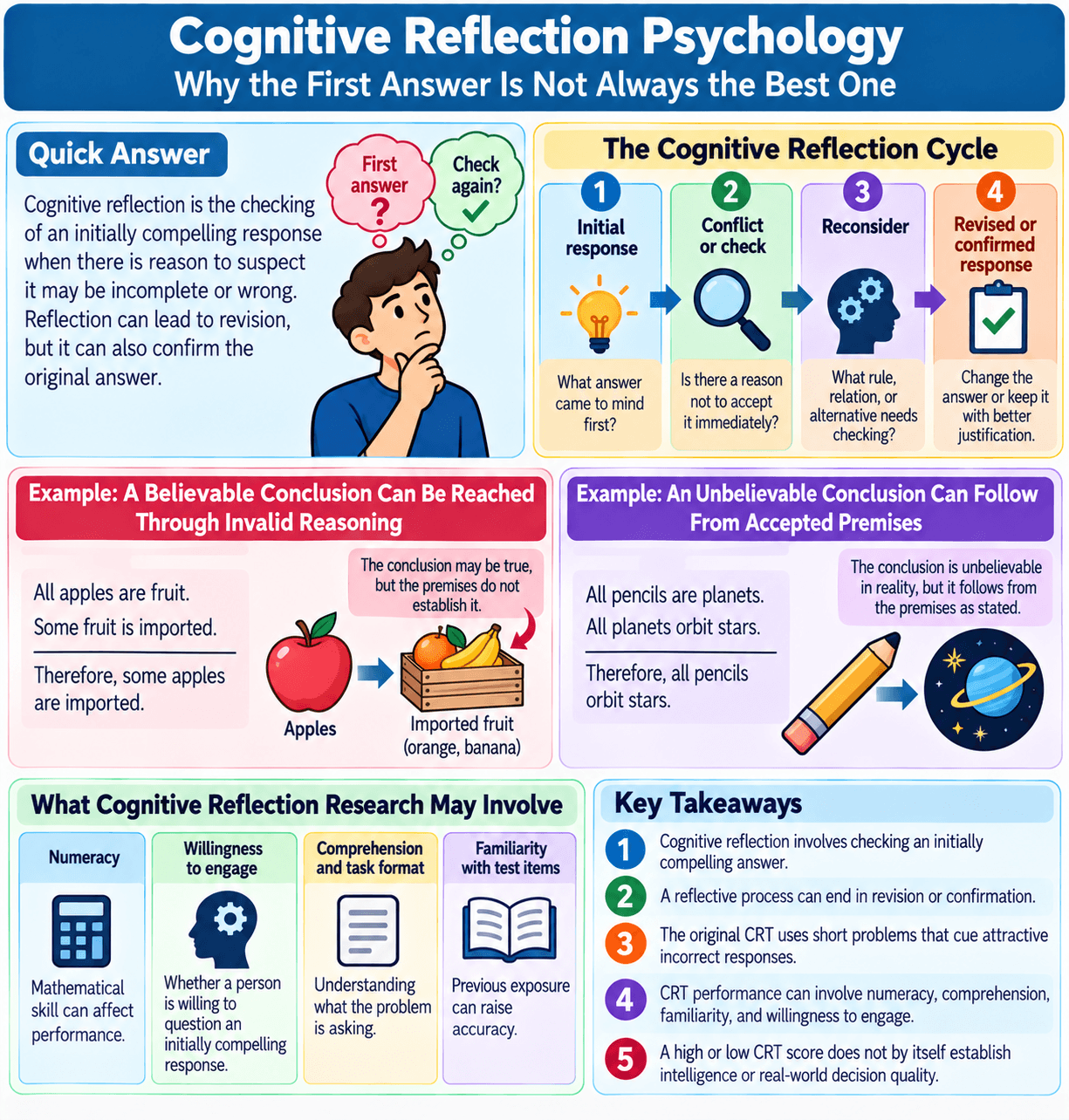
Cognitive reflection is the checking of an initially compelling response when there is reason to suspect it may be incomplete or wrong. Research often studies this process with short problems designed to evoke a tempting first answer. Reflection can lead to revision, but it can also confirm the original answer. Performance on such tasks does not by itself measure intelligence, rationality, or real-world judgment.
What Cognitive Reflection Means
An immediately compelling response
A cognitive-reflection problem is usually designed so that one answer comes to mind with little effort. That answer is not random. It often arises from a familiar operation, a simple pattern, or a plausible interpretation of the problem.
The important feature is that the first response feels good enough to stop. The task becomes interesting when that response conflicts with a relationship that becomes visible only after further checking.
Detecting a reason to check
Reflection begins when something interrupts automatic acceptance. The trigger may be an inconsistency, an unusual wording pattern, a remembered rule, a sense that the answer came too easily, or a deliberate habit of verification.
Noticing a reason to check is different from already knowing the correct answer. A person may recognize that the first response is suspicious but still fail to work out a better one.
Revising or confirming the answer
Reflection is often described as overriding an intuitive response, but that description can be too narrow. Sometimes careful checking shows that the first response was correct.
The more useful definition is therefore “reconsider when warranted,” not “always replace the first answer.” A reflective process can end in revision or confirmation.
The Cognitive Reflection Cycle
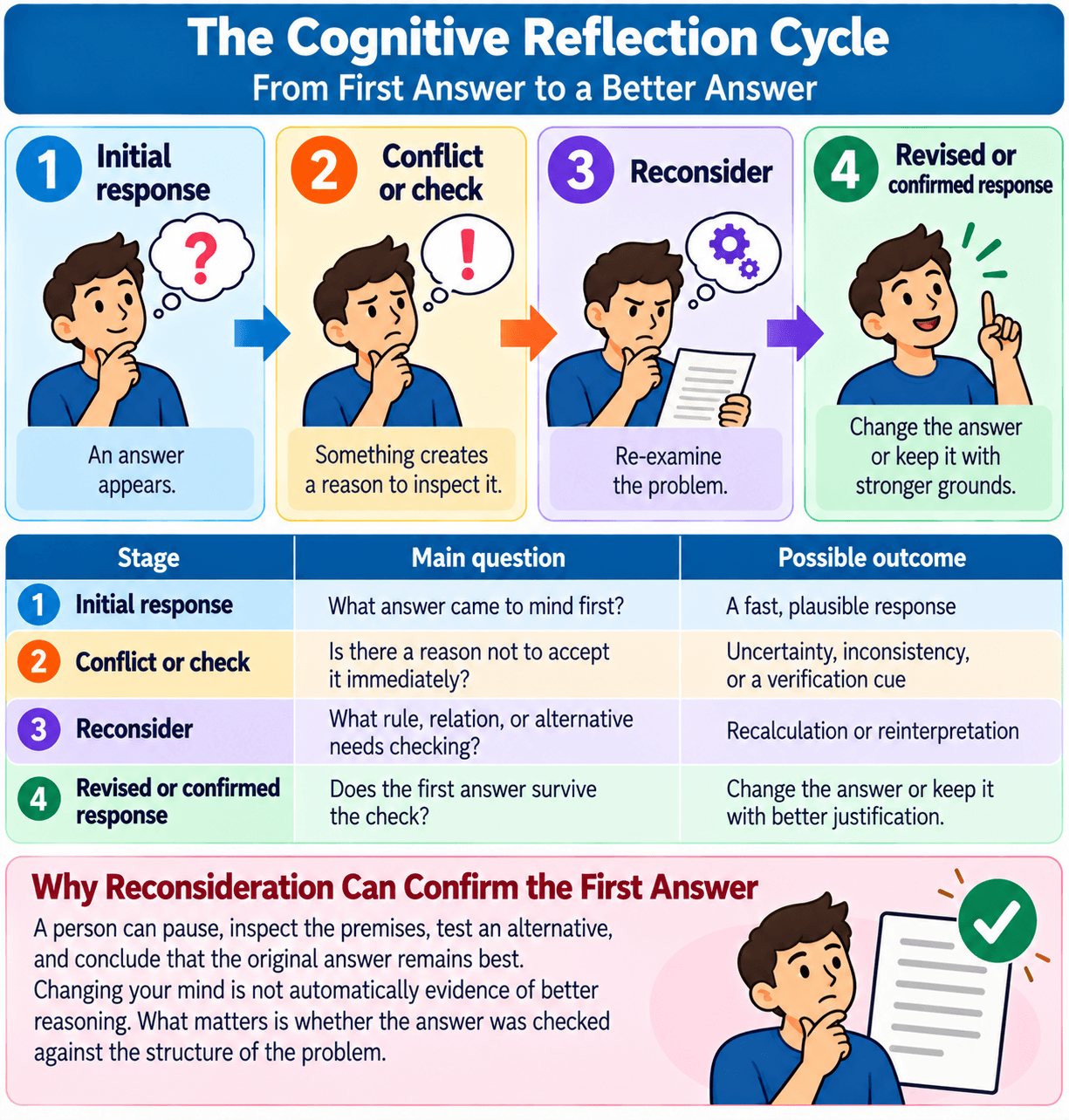
INITIAL RESPONSE → CONFLICT OR CHECK → RECONSIDER → REVISED OR CONFIRMED RESPONSE
A practical model of cognitive reflection has four stages. First, an answer appears. Second, something creates a reason to inspect it. Third, the reasoner re-examines the problem. Fourth, the answer is either changed or retained on stronger grounds.
| Stage | Main question | Possible outcome |
|---|---|---|
| Initial response | What answer came to mind first? | A fast, plausible response |
| Conflict or check | Is there a reason not to accept it immediately? | Uncertainty, inconsistency, or a verification cue |
| Reconsider | What rule, relation, or alternative needs checking? | Recalculation or reinterpretation |
| Revised or confirmed response | Does the first answer survive the check? | Change the answer or keep it with better justification |
Why reconsideration can confirm the first answer rather than always overturn it
If reflection were defined only by answer change, careful checking of a correct first response would disappear from the concept. But a person can pause, inspect the premises, test an alternative, and conclude that the original answer remains best.
This distinction matters because changing your mind is not automatically evidence of better reasoning. What matters is whether the answer was checked against the structure of the problem.
The Cognitive Reflection Test as Research Context
Frederick’s original CRT
Shane Frederick introduced the original three-item Cognitive Reflection Test in 2005 as a brief measure of a person’s ability or disposition to resist reporting the first response that comes to mind and reflect further. The original Cognitive Reflection and Decision Making study used deceptively simple numerical problems that tend to cue an attractive but incorrect response.
The test became influential because it was short, memorable, and associated with a range of reasoning and decision outcomes. Its popularity also made the meaning of CRT performance an important research question in its own right.
Why classic items became influential
The original items have a useful psychological design. They do not merely ask for difficult calculations. Instead, they make an incorrect answer easy to generate, creating a situation where the reasoner may need to question an answer that feels immediately right.
That design made the CRT a convenient way to study the tension between an intuitive response and further checking. It also encouraged a broader interpretation of the test that later researchers have examined critically.
What short puzzle-style tasks are designed to capture
At their best, reflection tasks create a controlled opportunity to observe whether a person accepts a tempting response or engages with the problem further. However, a final answer alone cannot reveal every step that produced it.
A correct answer may come from careful reflection, strong mathematical knowledge, prior exposure, recognition of the problem, or a fast but accurate solution. An incorrect answer may reflect failed calculation, misunderstanding, lack of knowledge, or acceptance of the intuitive lure. Outcome and process should therefore not be treated as identical.
What Cognitive Reflection Research May Involve
Numeracy
The original CRT uses numerical problems, so mathematical skill can affect performance. A person must often understand the structure of a quantitative relationship and execute the relevant calculation accurately.
A 2022 meta-analysis of cognitive reflection and cognitive abilities found substantial relationships between CRT performance, cognitive abilities, and numeracy-related skills. This is an important reason not to interpret the original CRT as a pure measure of one isolated tendency to reflect.
Reasoning disposition and willingness to engage
The idea behind cognitive reflection also includes whether a person is willing to question an initially compelling response. Two people with similar knowledge may differ in whether they inspect an answer that feels obvious.
Yet willingness to engage cannot be read directly from accuracy alone. A person may engage deeply but make a computational error, while another may recognize the correct pattern quickly.
Comprehension and task format
Performance depends on understanding what the problem is asking. Wording, presentation, response format, and how clearly the relevant relation is represented can affect whether the intuitive lure is noticed and whether an alternative solution is accessible.
This matters because a failure to solve the problem can occur before the supposed intuition-versus-reflection conflict is even reached.
Familiarity with test items
The classic CRT became extremely well known. Previous exposure can raise accuracy because a participant may remember the problem or know that an obvious answer is probably a trap.
Research on repeated exposure to the Cognitive Reflection Test found that previous experience was associated with higher performance, while the test’s correlations with several other variables remained relatively robust in those studies. The finding is useful because familiarity matters without automatically making every exposed score meaningless.
Alternative Ways to Measure Reflection
Why researchers developed new items
Once the original three problems became familiar, researchers needed tasks that could preserve the basic idea without relying on memorized answers. New measures also allowed researchers to address difficulty, reliability, and dependence on mathematics.
One expanded version was developed to provide a wider range of item difficulty, reducing problems that arise when a short test is too difficult for some groups and too easy for others.
Verbal reflection tasks
A particularly useful development is the verbal CRT. Researchers created nonmathematical problems that still contain an appealing incorrect response and a defensible correct answer.
The verbal Cognitive Reflection Test was designed partly to reduce the confounding role of mathematical ability. Its existence also makes a broader point: cognitive reflection research is about checking compelling responses, not about arithmetic alone.
Why different formats complicate simple score comparisons
A numerical CRT, an extended CRT, and a verbal CRT can share a general purpose while placing different demands on numeracy, verbal comprehension, familiarity, and item knowledge.
For that reason, “CRT score” should not always be treated as though every version measures exactly the same combination of processes in exactly the same way.
What a Correct Answer Can Hide
Correct after deliberate checking
One person may generate the tempting response, notice a conflict, work through the relationship, and then produce the correct answer. This is the process most people imagine when they hear “cognitive reflection.”
Correct without an obvious reflective episode
Another person may understand the relevant relation immediately because of practice, expertise, or familiarity with that class of problems. The correct answer appears quickly and does not require a visible struggle with a lure.
Correct because the item was already known
A participant who remembers a famous CRT item can report the answer from memory. Accuracy is high, but that particular response tells us less about whether the person detected and corrected an intuitive error during the present attempt.
Why accuracy alone is an imperfect process label
These routes can end at the same correct response even though the underlying processes differ. The reverse is also true: two incorrect answers can reflect different failures. One person may never question the lure, while another reflects but uses the wrong operation.
This is why modern interpretation benefits from process evidence, multiple items, and careful wording rather than treating each answer as a direct readout of a person’s thinking style.
What CRT Scores Do Not Prove
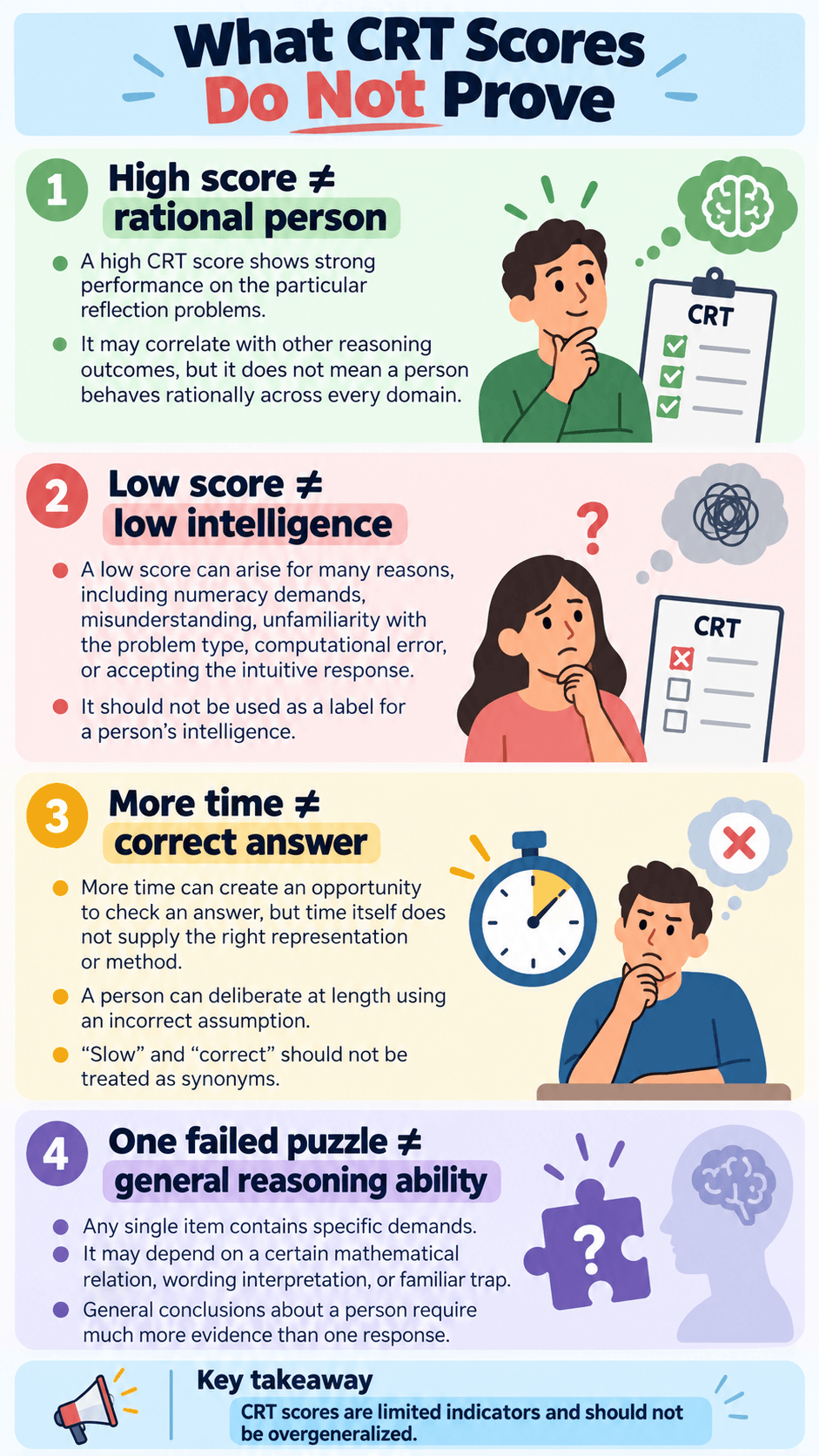
High score does not equal a rational person
A high CRT score shows strong performance on the particular reflection problems administered. It may correlate with other reasoning outcomes, but it does not establish that a person behaves rationally across every domain.
Real-world reasoning involves knowledge, incentives, social context, emotion, goals, time pressure, and domain-specific expertise that a few short puzzles cannot reproduce.
Low score does not equal low intelligence
A low score can arise for many reasons, including numeracy demands, misunderstanding, unfamiliarity with the problem type, computational error, or accepting the intuitive response. It should not be used as a label for a person’s intelligence.
The fact that CRT performance correlates with cognitive abilities does not make one brief CRT administration interchangeable with a comprehensive intelligence assessment.
Taking longer does not guarantee correctness
More time can create an opportunity to check an answer, but time itself does not supply the right representation or method. A person can deliberate at length using an incorrect assumption.
Likewise, someone with strong knowledge may reach a correct answer quickly. Speed and reflection are related in some contexts, but “slow” and “correct” should not be treated as synonyms.
One failed puzzle does not reveal general reasoning ability
Any single item contains specific demands. It may depend on a certain mathematical relation, wording interpretation, or familiar trap. General conclusions about a person require much more evidence than one response.
This is especially important outside research settings, where casual online versions of famous items are sometimes presented as personality or intelligence verdicts.
Cognitive Reflection vs Intuitive and Analytical Decision Making
Reasoning answer versus choice process
Cognitive reflection research often asks whether an initially compelling answer to a reasoning problem is checked. Decision-making research asks how people choose among alternatives, including when they rely more on intuitive or analytical processing.
The two areas interact because reflective tendencies can influence choices. But answering a puzzle and selecting between real options are not the same cognitive task. This checking process should also be kept separate from the broader distinction between reasoning and decision making: reconsidering a conclusion is not the same task as choosing among options.
Why this article should not recreate intuition-versus-analysis decision advice
Advice such as “use intuition for familiar choices and analysis for complex choices” belongs to decision strategy. Cognitive reflection has a narrower concern: whether an initially compelling answer deserves another look.
This narrower focus also avoids treating intuition as inherently bad. An intuitive response can be accurate, well learned, and efficient. Reflection matters when there is a reason to verify it.
Cognitive Reflection vs Metacognition
Specific checking of an initially compelling answer
Cognitive reflection focuses on a particular reasoning situation: a response comes to mind, and the reasoner may or may not reconsider it before answering.
Broader monitoring of confidence, understanding, error, and strategy
Metacognition is much broader. It includes monitoring what you know, judging confidence, noticing confusion, selecting strategies, allocating effort, and regulating learning or problem solving.
Cognitive reflection can involve metacognitive monitoring, such as noticing that an answer feels suspicious. But it should not be used as a replacement term for all self-monitoring of thought.
Conflict Detection and Reconsideration
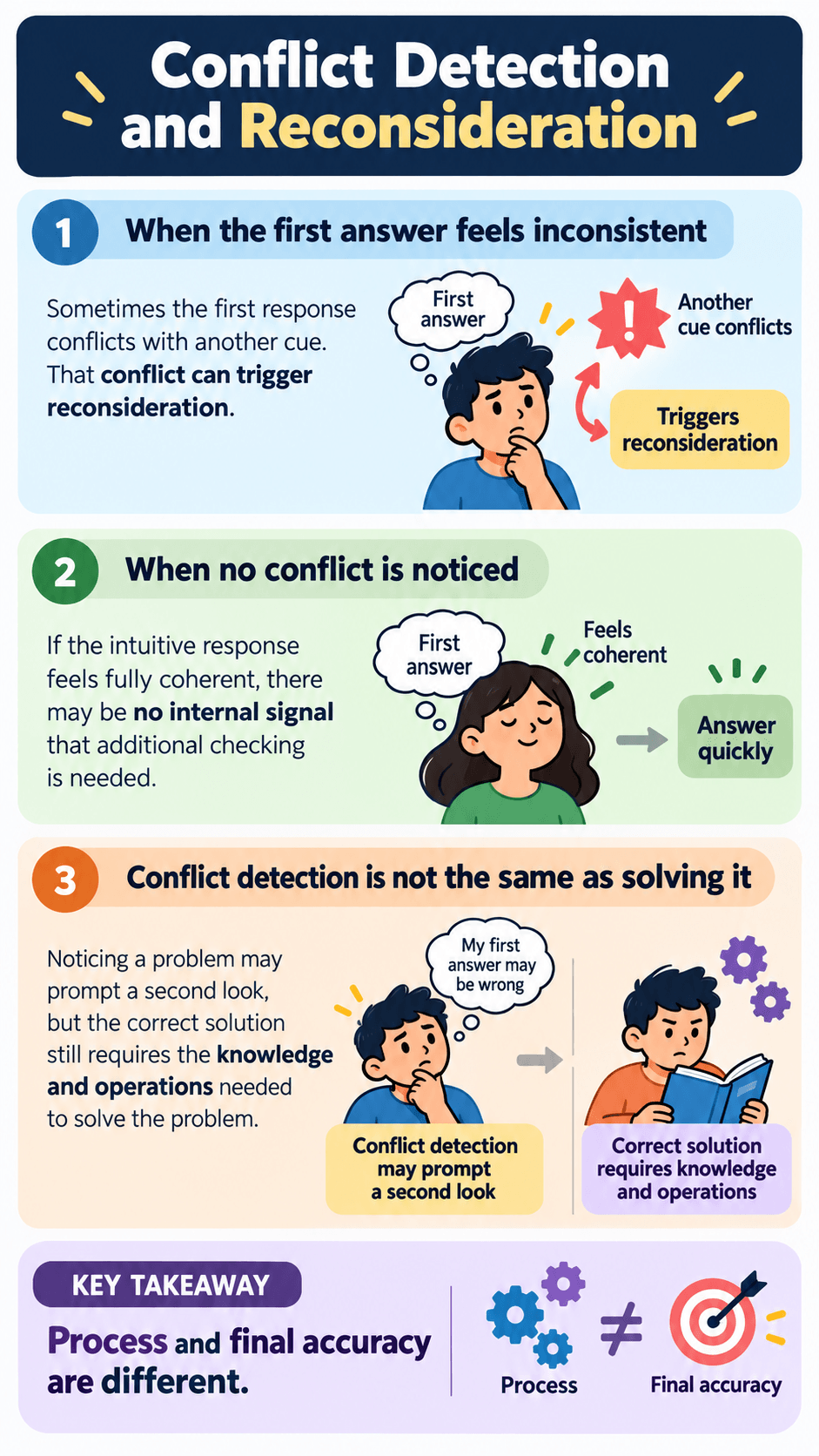
When something about the first answer feels inconsistent
Sometimes the first response conflicts with another cue. A quantity seems too large, a relationship does not fit, or a rule suggests a different result. That conflict can trigger reconsideration. One source of conflict can be belief bias, where the believability of a conclusion influences the judgment of whether it logically follows.
The important point is that conflict is information. It tells the reasoner that the first representation may not be sufficient.
When no conflict is noticed
If the intuitive response feels fully coherent, there may be no internal signal that additional checking is needed. A person can therefore answer quickly without feeling careless.
This helps explain why some reflection problems are effective: the incorrect response does not feel like a weak guess. It feels like a solution.
Why noticing conflict and solving the problem correctly are different achievements
Conflict detection may prompt a second look, but the reasoner still needs the knowledge and operations required to solve the problem. Recognizing “my first answer may be wrong” does not tell you what the right answer is.
A 2019 evaluation of the Cognitive Reflection Test as a measure of intuition, reflection, numeracy, and insight challenged the assumption that correct and incorrect CRT responses map perfectly onto reflective and intuitive processing. This reinforces the need to distinguish process from final accuracy.
Why Reflection Is Not Simply Slow Thinking
Slow errors are still possible
Someone can spend several minutes pursuing the wrong method. Effort does not guarantee that the problem has been represented correctly.
Reflection is better identified by what is checked than by the clock alone. Did the person reconsider the relevant relation, test the intuitive answer, and examine an alternative?
Fast correct responses are also possible
Expertise, familiarity, or recognition can make a correct response rapid. If someone has already learned the underlying relation, the once-difficult check may become automatic.
This is why response speed should be interpreted in relation to knowledge and task history.
Task knowledge and practice can change response speed
A person who encounters many reflection problems learns that apparently simple questions may contain a lure. That knowledge can change both the speed and strategy of later responses.
Practice can therefore make a reflective checking routine faster. Fast performance after learning should not automatically be classified as unreflective.
When Is a First Answer Worth Checking?
When the answer depends on a hidden relationship
A quick response deserves scrutiny when the problem involves a ratio, conditional rule, category relation, or other structure that can be easily replaced by a simpler but incorrect operation. The check should target that relationship rather than merely repeat the first calculation.
When the wording permits more than one interpretation
Ambiguous wording can generate a confident answer to the wrong interpretation. Restating the problem in your own words can reveal whether the first response depends on an assumption that was never stated.
When an answer arrives with no visible support
An immediate answer is not suspicious simply because it is fast. But if you cannot state what rule or relation supports it, a short verification may be useful.
The goal is selective checking, not chronic doubt. Reflection is most useful when there is a meaningful reason to inspect the answer.
A Practical Reflection Prompt Without Turning This Into Self-Help
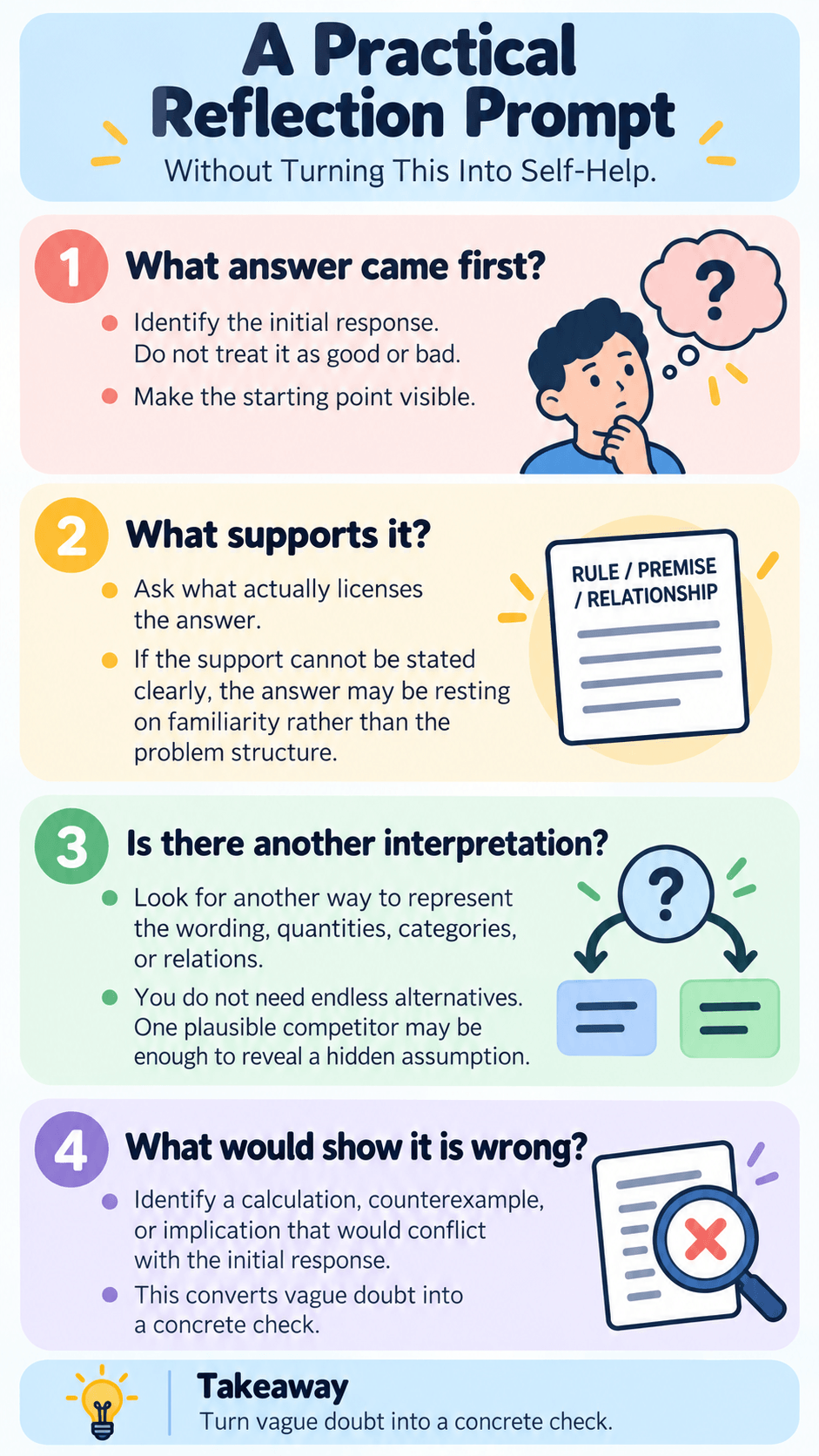
What answer came first?
Identify the initial response without treating it as either good or bad. The purpose is to make the starting point visible.
What rule, premise, or relationship supports it?
Ask what actually licenses the answer. If the support cannot be stated clearly, the answer may be resting on familiarity rather than the problem structure.
Is there a competing interpretation worth checking?
Look for another way to represent the wording, quantities, categories, or relations. You do not need endless alternatives. One plausible competitor may be enough to reveal a hidden assumption.
What would show the first answer is wrong?
Identify a calculation, counterexample, or implication that would conflict with the initial response. This converts vague doubt into a concrete check.
Limits of Generalizing From Laboratory Tasks
Ecological limits of short puzzles
A three-item or ten-item test strips away much of real life. Real decisions can unfold over days, involve feedback, require specialized knowledge, and include social or emotional consequences.
Laboratory tasks are valuable because they isolate processes. The same isolation limits how directly their scores should be generalized to complex everyday behavior.
Differences among alternative CRT formats
Researchers now use numerical, extended, and verbal forms. These formats can differ in difficulty, familiarity, numeracy demands, and reliability.
Process research on newer verbal items has also shown that correct responses usually, but not always, involve reflection, while lure responses usually, but not always, lack it. This kind of evidence matters because it tests whether the assumed mental process actually accompanies the observed answer.
Why broad claims about intelligence or rationality need caution
CRT performance is related to other cognitive measures, and researchers actively debate what combination of ability, numeracy, disposition, and task-specific processes it reflects. Those relationships make the test scientifically interesting, but they also argue against simplistic labels.
The safest interpretation is specific: a CRT score summarizes performance on a particular set of reflection problems under particular conditions. Broader conclusions need broader evidence.
FAQ About Cognitive Reflection
Is cognitive reflection the same as analytical thinking?
No. Analytical thinking is a broader description of deliberate, rule-based, or effortful processing. Cognitive reflection refers more specifically to checking an initially compelling response and potentially revising it. Reflection can involve analytical thought, but the concepts are not interchangeable.
Is the CRT an intelligence test?
No. CRT performance is correlated with cognitive abilities and numeracy, but the test was developed around susceptibility to compelling first responses and further reflection. It is not a comprehensive intelligence assessment, and a brief score should not be used as an IQ label.
Does a higher CRT score prove better real-world decisions?
No. Higher CRT scores are associated with various reasoning and judgment outcomes in research, but a score does not guarantee good decisions across settings. Real-world performance depends on domain knowledge, goals, incentives, experience, context, and many other factors.
Can reflection still lead to a wrong answer?
Yes. Reflection creates an opportunity to reconsider, not a guarantee of correctness. A person can check the wrong feature, use an incorrect rule, misunderstand the problem, or make a calculation error after noticing that the first response deserves scrutiny.
Key Takeaways
- Cognitive reflection concerns checking an initially compelling answer when there is reason to reconsider it.
- Reflection can revise the first response or confirm it; changing an answer is not required.
- The original CRT uses short problems that cue attractive incorrect responses, but accuracy alone does not reveal every underlying thought process.
- CRT performance can involve numeracy, cognitive abilities, comprehension, task format, familiarity, and willingness to engage.
- A high or low CRT score does not by itself establish intelligence, overall rationality, or real-world decision quality.
- Cognitive reflection is narrower than analytical decision making and broader metacognitive monitoring should not be reduced to CRT performance.
The most useful way to understand cognitive reflection is not as a battle in which slow thought must defeat fast thought. It is a checking process. An answer arrives, something provides a reason to inspect it, and the reasoner tests whether the response survives. Sometimes it does. Sometimes it does not. The value lies in making the answer answerable to the structure of the problem rather than to the feeling that it came to mind first.

Michael Reed is the Founder and Lead Writer at Psychology Exposed. He writes about human behavior, relationships, emotional patterns, self-awareness, and practical psychology topics using research-informed, easy-to-understand content.
Read More About Michael Reed: https://psychologyexposed.com/michael-reed/
1 thought on “Cognitive Reflection Psychology: Why the First Answer Is Not Always the Best One”