
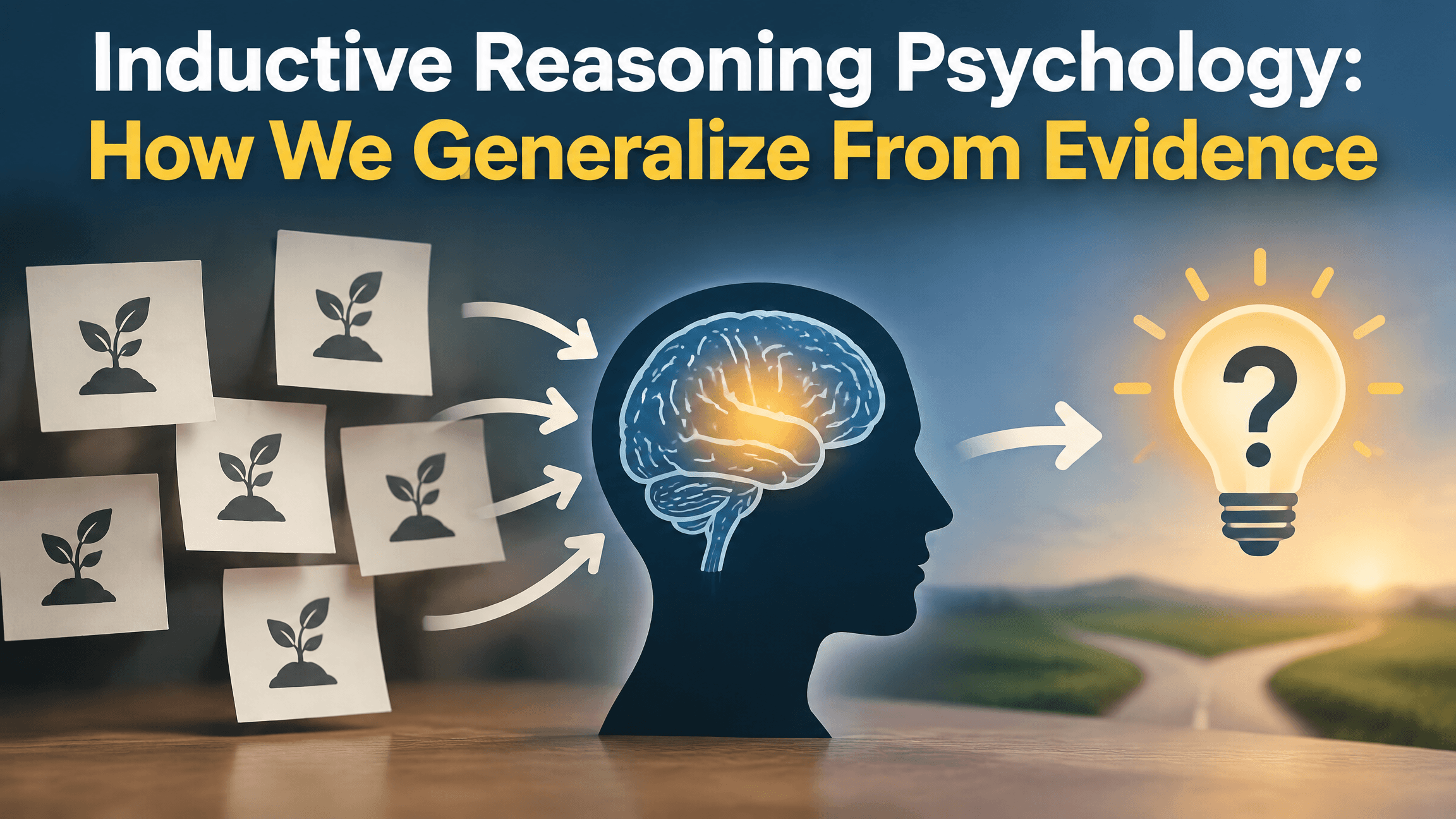
You notice several examples, detect a pattern, and start to expect that the pattern will continue. That move from observed cases to a broader conclusion is a basic form of inductive reasoning. It helps people predict what may happen next, generalize from experience, and decide how much confidence a limited sample deserves.
Induction is useful precisely because everyday life rarely gives complete information. We often have to reason from a handful of observations rather than from rules that guarantee a conclusion. The challenge is not to eliminate uncertainty. It is to judge how strongly the available evidence supports the generalization, what important cases may be missing, and how willing we should be to revise the conclusion when new evidence appears. Induction fits within the broader study of reasoning because it asks what a limited set of observations supports beyond the cases already seen.
Quick Answer

Inductive reasoning is the process of moving from particular observations, cases, or examples toward a broader conclusion that is supported but not guaranteed. Stronger induction usually depends on the quality, diversity, relevance, and representativeness of the evidence. A useful inductive conclusion remains open to updating because new cases can strengthen, weaken, narrow, or overturn the pattern.
What Inductive Reasoning Does
From observations to broader conclusions
The APA Dictionary of Psychology defines induction as deriving a general conclusion, principle, or explanation from particular instances or observations. In ordinary reasoning, this can be as simple as seeing that a bus has arrived late several mornings in a row and expecting another delay tomorrow.
The conclusion goes beyond what has been directly observed. You know what happened on several previous mornings. You do not yet know what will happen tomorrow. Induction connects the observed cases to an unobserved case or to a wider category.
Why the conclusion can be strong without being guaranteed
An inductive conclusion does not need certainty to be reasonable. Suppose a gardener has grown the same herb in six shaded locations and each plant has done well. It is reasonable to infer that the herb generally tolerates shade, but a seventh plant could fail because of soil, temperature, disease, or another factor.
This is not a flaw that turns induction into guessing. It reflects the fact that limited evidence rarely fixes one future outcome with necessity. The relevant question is how much support the evidence provides, not whether uncertainty has been eliminated.
The Inductive Reasoning Cycle

CASES → PATTERN → GENERALIZATION → NEW EVIDENCE → UPDATE
A practical way to follow inductive reasoning is to separate five stages. First, you observe cases. Second, you notice some regularity among them. Third, you form a broader generalization or prediction. Fourth, new observations appear. Fifth, you update the generalization if the new evidence matters.
| Stage | Main question | Example |
|---|---|---|
| Cases | What have I actually observed? | Four deliveries arrived before noon. |
| Pattern | What regularity appears across the cases? | This service often arrives in the morning. |
| Generalization | What broader conclusion does the pattern support? | Future deliveries may usually arrive before noon. |
| New evidence | What happens in additional cases? | Two later deliveries arrive in the afternoon. |
| Update | How should the conclusion change? | The timing may be less consistent than first assumed. |
Why updating matters when exceptions appear
A useful inductive conclusion is revisable. If the first four observations support one pattern and the next ten show something different, holding tightly to the original conclusion would ignore better evidence.
Updating does not always mean abandoning the generalization. Sometimes the right move is to narrow it. Perhaps morning delivery is common only on weekdays, or only from one local depot. An exception can reveal a condition that the original pattern overlooked.
What Makes an Inductive Inference Stronger or Weaker?

Number of observations at a conceptual level
More observations can strengthen a generalization because they reduce the chance that the conclusion rests on a single unusual case. Seeing one bicycle from a brand develop the same fault tells you less than seeing the same fault across many bicycles from different production batches.
But quantity alone is not enough. Twenty nearly identical observations collected under the same conditions may reveal less than a smaller set that covers a wider range of relevant situations. Evidence strength depends on what the cases represent, not simply how many there are.
Diversity of observations
Diverse evidence can support broader generalization because it samples more of the space the conclusion is supposed to cover. If you want to know whether a property is common to mammals, evidence from several very similar mammals may be less informative than evidence from mammals that differ substantially from one another.
Research on sample diversity in inductive reasoning has shown that adults often prefer diverse samples when evaluating broader category claims. The basic intuition is coverage: evidence drawn from different parts of a category can support a wider generalization than repeated examples from one narrow corner.
Typicality and category coverage
A typical example may seem informative because it resembles many other members of its category. Learning that a common garden bird has a particular biological property may feel more useful for predicting the property across birds than learning the same thing about an unusual species.
Typicality is not a single simple cue, however. Research on typicality effects in category-based induction suggests that what often matters is how well an example represents the central tendency of the category, not merely whether people label it as a “typical” member.
Variability and exceptions
Evidence that contains substantial variability should lead to a more cautious generalization. If five cafés in a chain serve breakfast at different times, the evidence may support “breakfast is available at these locations” more strongly than “breakfast always starts at 7:00.”
Exceptions are informative because they help define the boundary of a claim. A generalization that survives varied cases may deserve more confidence. A generalization that works only under one narrow condition may need to be rewritten more precisely.
Evidence strength depends on the claim being made
The same observations can support a narrow conclusion strongly and a broad conclusion weakly. Suppose three models from one laptop series run a particular program without difficulty. That may support a claim about those three models, and perhaps cautiously about that series. It provides much less support for the claim that every laptop from the manufacturer will perform the same way.
This claim-to-evidence match is easy to miss because broad statements often sound cleaner and more useful. Yet inductive strength depends partly on how far the conclusion reaches beyond the observed cases. A modest conclusion can be well grounded even when a sweeping version is not.
Representative and Unrepresentative Evidence
Why one vivid example may be weak evidence
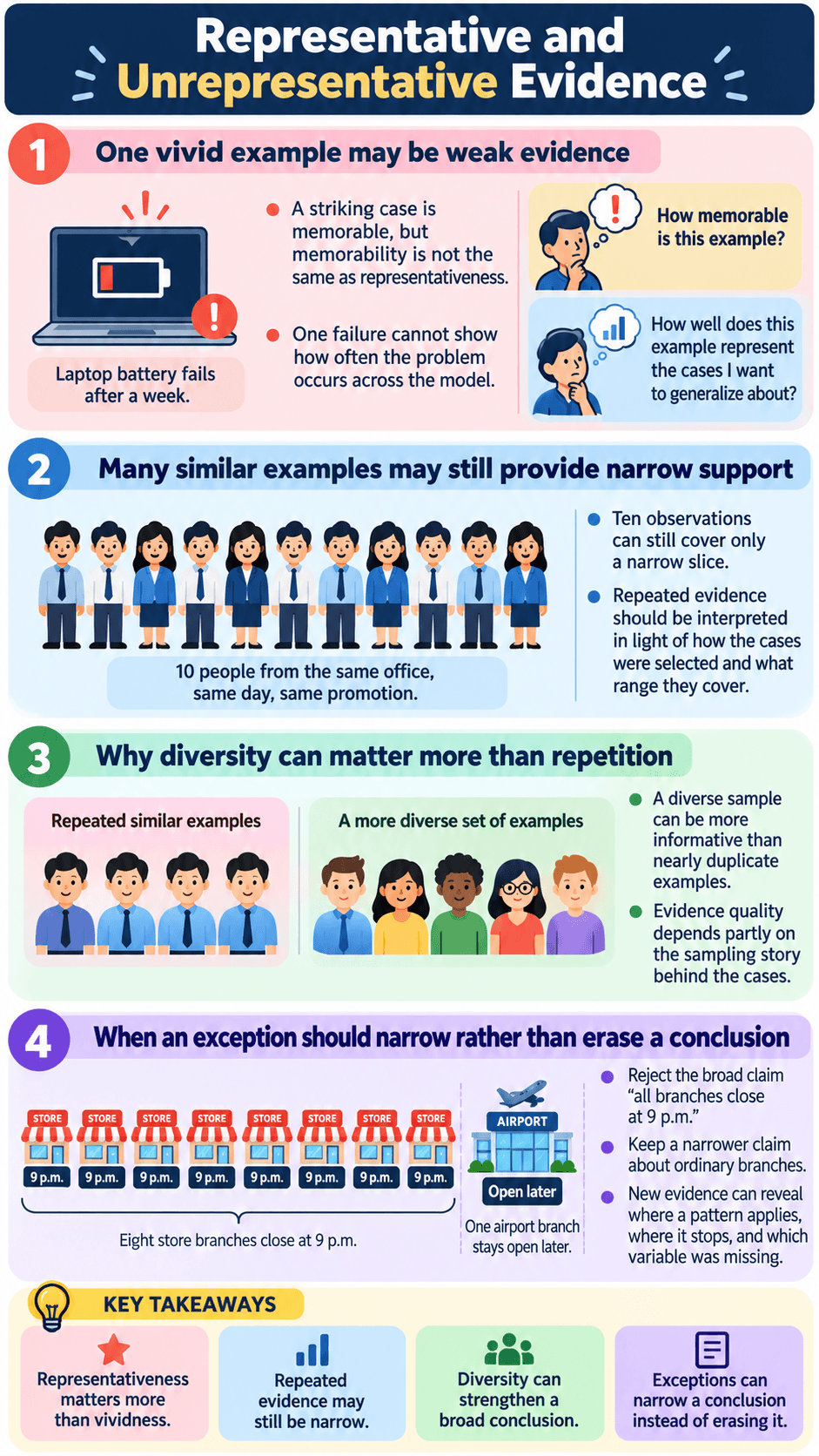
A striking case is easy to remember, but memorability is not the same as representativeness. If one laptop battery fails dramatically after a week, the event may feel highly informative because it is vivid. Yet one failure cannot tell you how often the same problem occurs across the model.
Inductive reasoning improves when the question shifts from “How memorable is this example?” to “How well does this example represent the cases I want to generalize about?”
Why many similar examples may still provide narrow support
Ten observations can look impressive while still covering a narrow slice of the relevant category. Imagine trying to infer how customers use a service by interviewing ten people from the same office, on the same day, who all joined through the same promotion. The sample may reveal something real about that subgroup without representing the entire customer base.
The psychological lesson is not that every informal observation requires statistical sampling. It is that repeated evidence should be interpreted in light of how the cases were selected and what range they actually cover.
Why diversity can matter more than repetition
If a conclusion is broad, evidence drawn from meaningfully different cases can test the generalization across more conditions. This is one reason a diverse sample may sometimes be more informative than repeated examples that are nearly duplicates.
Research on the diversity effect in inductive reasoning also shows an important nuance: people do not evaluate diversity in a vacuum. Assumptions about how the sample was selected can change whether diversity strengthens the inference. Evidence quality therefore depends partly on the sampling story behind the cases.
When an exception should narrow rather than erase a conclusion
Imagine that eight branches of a store close at 9 p.m., while one airport branch stays open later. The exception does not necessarily make the first eight observations useless. Instead, it suggests that location type may be an important condition. The broader claim “all branches close at 9” should be rejected, while a narrower claim about ordinary branches may remain reasonable.
Inductive revision is often about improving the boundary of a conclusion. New evidence can reveal where a pattern applies, where it stops, and which variable was missing from the first version of the generalization.
Category-Based Induction
How similarity influences generalization
Category-based induction occurs when information about one category member or class is projected to another. If one species is known to have a newly discovered property, people may judge another species more likely to share it when the two seem similar.
Similarity matters because it offers a reason to expect shared properties, but similarity alone is not proof. Two objects can resemble each other in obvious ways while differing on the property that matters.
Typical examples versus unusual examples
Some examples seem more representative of a category than others. A robin may feel more representative of “bird” than a penguin because it shares more features with many familiar birds. That can make people more willing to generalize from the robin to birds as a whole.
Research on category-based induction and conclusion typicality found that typicality can influence the perceived strength of an inductive argument. This helps explain why category judgments depend not only on the premises but also on how representative the target of the generalization seems.
Extending a property from known cases to new category members
Suppose you learn that two familiar species of songbird carry a particular harmless enzyme. You may infer that another songbird is more likely to carry it than a reptile. The inference uses category structure and similarity to extend a property beyond the observed cases.
The broader the conclusion, the more demanding the evidence becomes. Extending a property from one robin to another robin is a narrower inference than extending it from one robin to every bird. Inductive strength depends partly on the distance between what was observed and what is being claimed.
Prediction From Past Cases
When past patterns support expectations
Prediction is a natural use of induction. If a machine has overheated every time it runs for more than six hours, you may predict that another six-hour run carries a high chance of overheating. The prediction is grounded in a repeated relationship between past conditions and outcomes.
The usefulness of that prediction depends on whether the relevant conditions remain similar. If the machine has been repaired or the cooling system has changed, old observations may become less informative.
Why past regularity is evidence rather than certainty
A stable past pattern supports an expectation, but it does not logically force the future to match. Even a long run of similar outcomes leaves open the possibility of change.
This is why inductive confidence should be graduated. “This usually happens under these conditions” is different from “this must happen.” The first statement can be strongly supported while remaining revisable.
How new evidence should change the conclusion
Updating is easier when the original conclusion was stated with the right level of precision. If you conclude “this process usually takes about three days,” then several five-day cases should lower confidence or change the estimated range. If you instead declared “this process always takes three days,” the first exception immediately breaks the claim.
Good induction therefore includes a willingness to state conclusions at the strength the evidence actually supports.
Inductive Reasoning vs Deductive Reasoning
Degree of support versus necessity
Deductive reasoning asks whether a conclusion must follow from the premises. Inductive reasoning asks how strongly the observations support a broader conclusion. These standards should not be mixed.
| Feature | Inductive reasoning | Deductive reasoning |
|---|---|---|
| Main question | How strongly does the evidence support this conclusion? | Must the conclusion follow from the premises? |
| Typical evidence | Observations, cases, examples, patterns | Rules, premises, necessary relations |
| Conclusion | Supported to some degree | Necessary if the inference is valid |
| Effect of an exception | May weaken or narrow the generalization | A counterexample defeats validity |
Why deduction and induction answer different reasoning problems
It would be a mistake to call induction weak deduction. If you are predicting next month’s demand from past orders, no deductive rule may be available. Induction is the appropriate tool because the evidence supports a forecast without guaranteeing it.
Likewise, when a conclusion really is forced by the premises, treating it as merely probable misses the structure of the problem. The form of reasoning should match the kind of support available.
Induction vs Learning Psychology
Learning as change in knowledge or skill
Learning is broader than induction. A person can learn a motor skill through practice, memorize a fact, develop a habit, or acquire vocabulary without making an explicit generalization from cases.
Induction as a specific inference from observations toward a broader conclusion
Inductive reasoning can contribute to learning because it helps people extract patterns and extend knowledge beyond observed examples. But the two concepts should not be collapsed. Learning describes change in knowledge or performance. Induction describes one way the mind draws a broader conclusion from limited evidence.
Induction vs Hypothesis Testing
Generalizing from cases
Induction often begins with observed cases and asks what broader pattern they support. Several plants thrive under a certain light condition, so you infer that the species may tolerate that condition well.
Testing whether a specific explanation survives evidence
Hypothesis testing begins with a candidate explanation or proposition and asks what evidence would support, weaken, or distinguish it from alternatives. You might hypothesize that the light condition caused better growth, then compare plants under different conditions to see whether the prediction holds.
The processes can interact. Induction can suggest a hypothesis, and testing can provide new cases that reshape an inductive generalization. They are still different reasoning tasks: one extends from evidence toward a broader pattern, while the other evaluates a candidate explanation against informative evidence. If the central task changes from generalizing across cases to choosing which explanation best fits an observation, abductive reasoning becomes the more precise frame.
A Practical Evidence Check for Inductive Conclusions
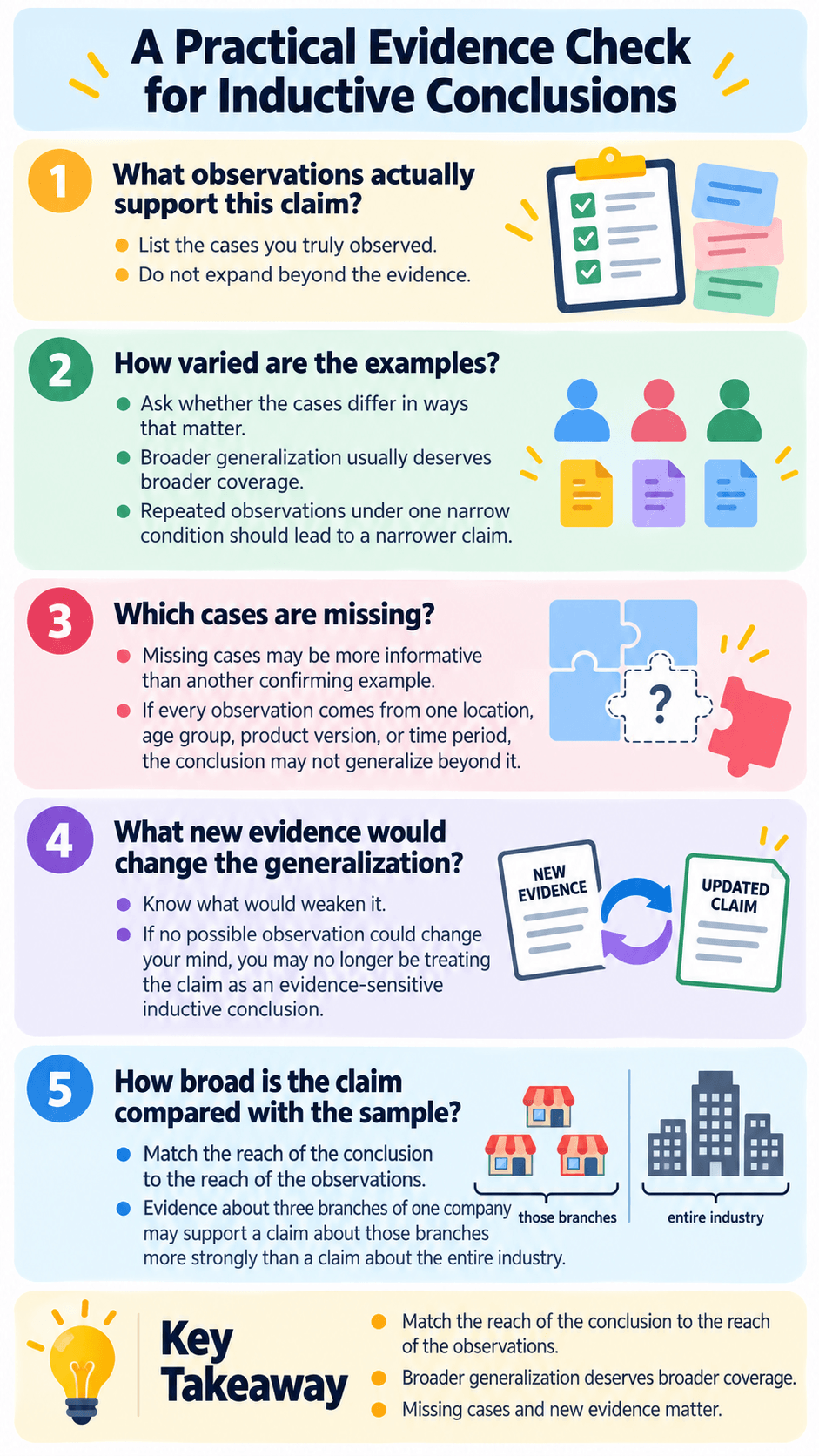
What observations actually support this claim?
List the cases you truly observed rather than the cases you assume are similar. This prevents the conclusion from quietly expanding beyond the evidence.
How varied are the examples?
Ask whether the cases differ in ways that matter for the conclusion. A broader generalization usually deserves broader coverage. Repeated observations under one narrow condition should lead to a narrower claim.
Which cases are missing?
Missing cases may be more informative than another confirming example. If every observation comes from one location, age group, product version, or time period, the conclusion may not generalize beyond it.
What new evidence would change the generalization?
A conclusion is easier to evaluate when you know what would weaken it. If no possible observation could change your mind, you may no longer be treating the claim as an evidence-sensitive inductive conclusion.
How broad is the claim compared with the sample?
Match the reach of the conclusion to the reach of the observations. Evidence about three branches of one company may support a claim about those branches more strongly than a claim about the entire industry.
Common Errors Without Turning Induction Into a Bias List
Treating one striking case as broad proof
A single case can reveal that something is possible, but it rarely establishes how common the pattern is. Vividness should not substitute for coverage.
Assuming more examples always mean stronger evidence
More examples help when they add relevant information. Twenty repeated cases from the same narrow source may contribute less than a smaller set that includes meaningfully different conditions.
Confusing plausibility with certainty
An inductive conclusion can be highly plausible without being guaranteed. Keeping those ideas separate allows confidence to increase with evidence without turning a strong probability into a false claim of necessity.
Ignoring how the sample was selected
Sampling procedure can change what the evidence means. Research on sample selection and inductive generalization found that adults’ generalizations varied depending on how the observed examples were described as having been selected. A sample is not informative only because it contains several cases. How those cases entered the sample can matter.
FAQ About Inductive Reasoning
Is inductive reasoning just guessing?
No. Guessing may have little or no evidential basis. Inductive reasoning uses observations or examples to support a broader conclusion. The support can be weak or strong, and the conclusion remains uncertain, but uncertainty alone does not make the inference arbitrary.
Can an inductive conclusion be reasonable and still turn out wrong?
Yes. A conclusion can be well supported by the evidence available at the time and still be overturned by new cases. Inductive reasoning manages uncertainty rather than eliminating it, so revision is part of the process rather than proof that the earlier inference was irrational.
Why does sample diversity matter?
Diverse cases can cover more of the category or situation the conclusion is meant to describe. That wider coverage may support broader generalization. However, diversity should be interpreted together with typicality, relevance, and assumptions about how the sample was selected.
Is inductive reasoning the same as statistical inference?
No. Statistical inference is a formal family of methods for drawing conclusions from data under specified models and assumptions. Inductive reasoning is a broader psychological process that includes everyday generalization from examples, categories, and past cases. Statistical methods can support induction, but everyday induction does not require formal calculation.
Does one exception prove an inductive conclusion was useless?
Not necessarily. An exception may show that the claim was too broad, identify a missing condition, or reduce confidence without destroying the entire pattern. The right response depends on what the original conclusion claimed and how informative the new case is.
Key Takeaways
- Inductive reasoning extends beyond observed cases to form broader generalizations or predictions.
- Its conclusions can be well supported without being guaranteed, so uncertainty is part of the reasoning form rather than a defect.
- Evidence quality depends on more than quantity; diversity, typicality, coverage, relevance, variability, and sampling procedure can all matter.
- New evidence should be able to strengthen, weaken, narrow, or revise an inductive conclusion.
- Induction differs from deduction because it provides degrees of support rather than logical necessity.
- Induction also differs from general learning and from hypothesis testing, even though all three processes can interact.
A useful next step is to take one generalization you currently believe and inspect the evidence underneath it. Write down the cases you actually observed, how varied they are, which cases are missing, and what new observation would make you revise the conclusion. The goal is not to become uncertain about everything. It is to make the breadth and confidence of the conclusion match the evidence that supports it.

Michael Reed is the Founder and Lead Writer at Psychology Exposed. He writes about human behavior, relationships, emotional patterns, self-awareness, and practical psychology topics using research-informed, easy-to-understand content.
Read More About Michael Reed: https://psychologyexposed.com/michael-reed/