
A conclusion can sound obviously true and still fail to follow from the premises. Another conclusion can sound absurd while being logically valid. When people judge an argument partly by whether its conclusion fits what they already believe, rather than only by whether the conclusion follows, psychologists call this belief bias.
Belief bias is most often studied with syllogisms because they allow researchers to separate two questions that everyday thinking usually blends together: “Is this conclusion believable?” and “Is this conclusion logically supported by these premises?” The effect is important not because belief always defeats logic, but because believability can change how arguments are interpreted, examined, and accepted.
Quick Answer
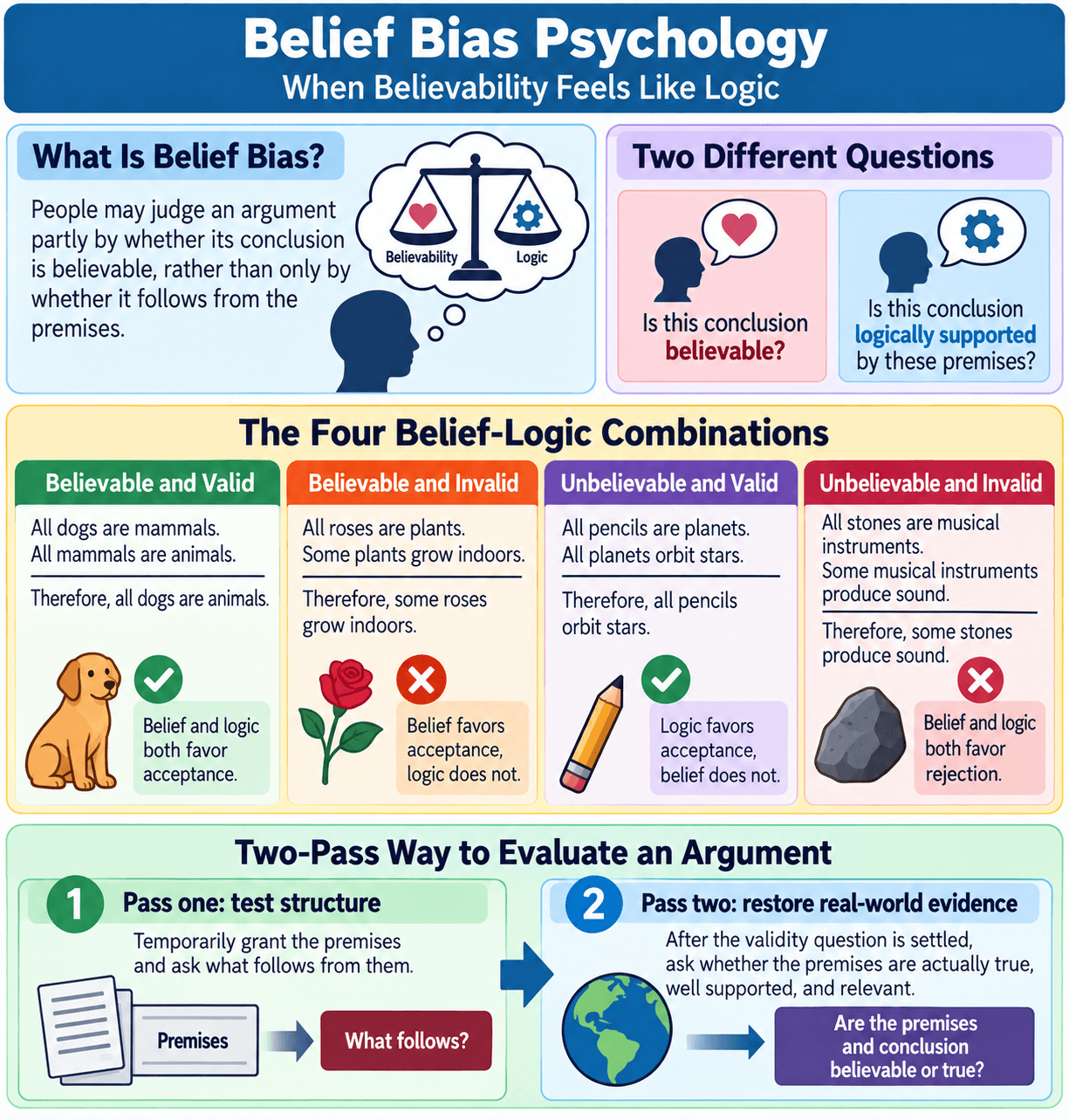
Belief bias is the tendency for the believability of a conclusion to influence judgments about whether an argument is logically valid. A believable conclusion may feel easier to accept even when it does not follow, while an unbelievable conclusion may be rejected even when it does. Research shows that the interaction is complex: people can sometimes detect conflict between belief and logic without fully resolving it.
What Belief Bias Means
Believability and validity answer different questions
Believability asks whether a conclusion fits your existing knowledge or expectations. Validity asks whether the conclusion must follow from the stated premises. These judgments can agree, but they do not have to.
Suppose the premises are: “All tropical birds are metal. All metal things sink. Therefore, all tropical birds sink.” The premises are unrealistic, but if they are accepted for the purpose of the task, the conclusion follows from them. Rejecting the conclusion because birds are not metal would answer a truth question rather than a validity question.
Why syllogisms are useful for studying the effect
Syllogisms allow researchers to vary logical validity and conclusion believability separately. A conclusion can therefore be believable-valid, believable-invalid, unbelievable-valid, or unbelievable-invalid. Comparing responses across these combinations reveals whether belief changes logical judgment.
A large meta-analysis of belief bias in syllogistic reasoning revisited decades of research using more refined measurement models. Its findings support a more careful interpretation than the simple claim that belief uniformly reduces people’s ability to distinguish valid from invalid arguments.
The Four Belief-Logic Combinations

Believable and valid
This is the easiest combination psychologically because belief and logic point in the same direction. If all dogs are mammals, all mammals are animals, and the conclusion says all dogs are animals, both world knowledge and premise structure support acceptance.
Believable and invalid
This combination creates one classic form of belief bias. Imagine: all roses are plants. Some plants grow indoors. Therefore, some roses grow indoors. The conclusion is believable, but the premises do not require it. The indoor plants could all be non-roses.
Because the conclusion already seems plausible, the reasoner may be less motivated to search for an alternative arrangement that makes it false.
Unbelievable and valid
This combination creates conflict in the opposite direction. Suppose: all pencils are planets. All planets orbit stars. Therefore, all pencils orbit stars. The conclusion is unbelievable in reality, but it follows from the premises as stated.
The challenge is to temporarily separate the formal task from ordinary knowledge. The reasoner must ask what follows if the premises are granted, not whether the premises describe the real world.
Unbelievable and invalid
Here belief and logic again point in the same direction. The conclusion sounds wrong and also fails to follow. Rejection therefore requires less separation between prior knowledge and premise structure.
| Conclusion | Valid argument | Invalid argument |
|---|---|---|
| Believable | Belief and logic both favor acceptance | Belief favors acceptance, logic does not |
| Unbelievable | Logic favors acceptance, belief does not | Belief and logic both favor rejection |
Why Agreement Cases Can Hide the Effect
When belief and logic give the same answer
If a conclusion is both believable and valid, accepting it tells us little about which signal drove the judgment. The person may have evaluated the premises carefully, relied mainly on prior knowledge, or used both. The final answer looks the same either way.
The same problem appears with unbelievable-invalid arguments. Rejecting the conclusion is compatible with accurate logical reasoning, simple disbelief, or both. Agreement cases are therefore useful baselines, but they do not expose the conflict directly.
Conflict cases are more diagnostic
Believable-invalid and unbelievable-valid problems pull belief and logic in opposite directions. These cases reveal whether a person’s validity judgment shifts when the conclusion feels right or wrong independently of the argument structure.
This does not mean conflict cases perfectly reveal one mental mechanism. They are simply more informative because the two cues no longer recommend the same response.
Difficulty is not evidence of failure
Taking longer or feeling less certain on a conflict problem can indicate that the reasoner is noticing competing signals. A difficult item may therefore reveal more engagement with the conflict than an easy agreement item.
That is another reason to avoid reading a single response as a global measure of reasoning ability. The psychological process includes interpretation, conflict, confidence, and search, not only the final choice.
The Core Conflict: “Sounds True” vs “Follows From”
A believable conclusion can be reached through invalid reasoning
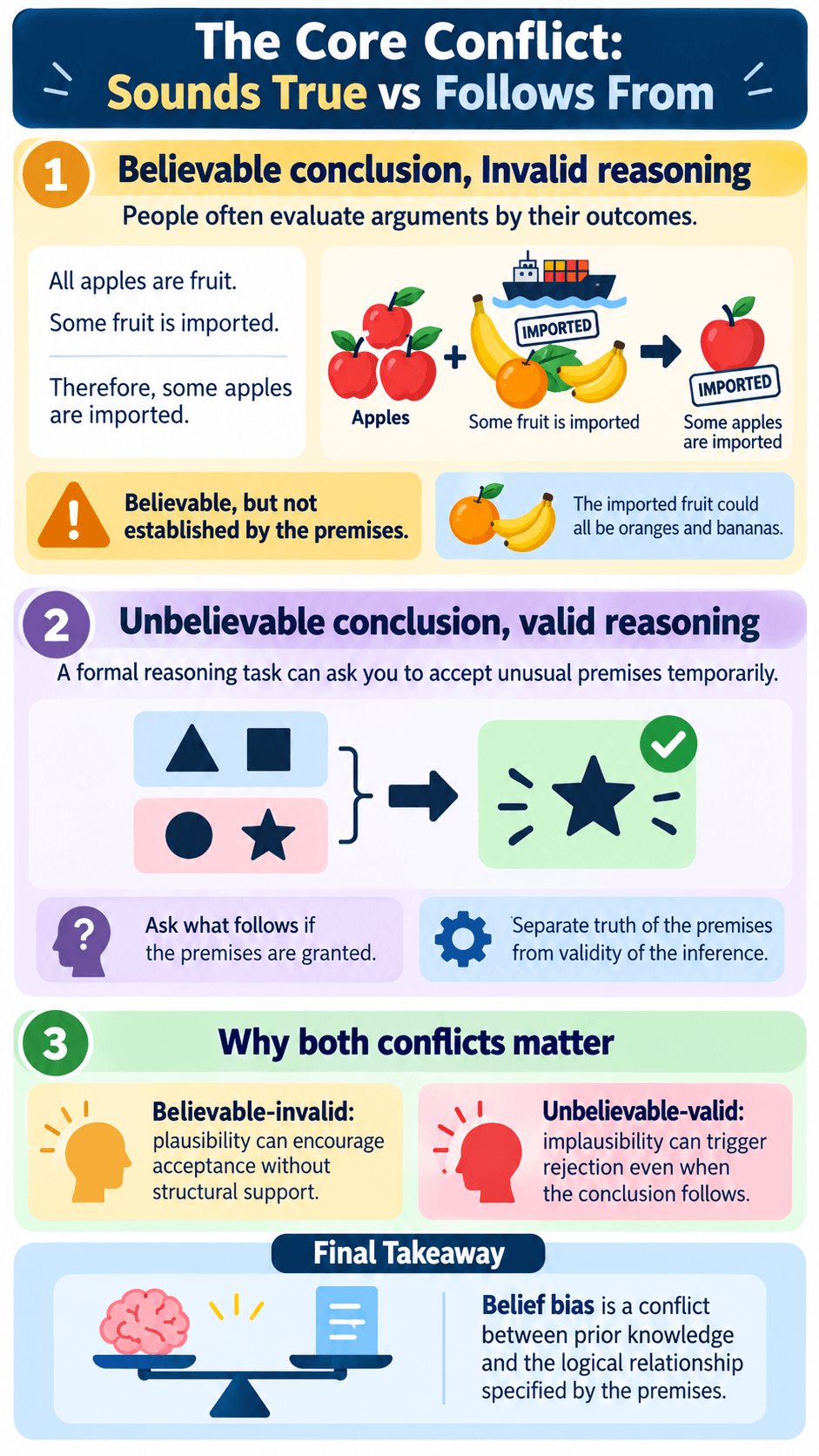
People often evaluate arguments by their outcomes. If the conclusion is already known to be true, the path to it can receive less scrutiny. Yet a correct conclusion does not repair an invalid inference.
Consider: all apples are fruit. Some fruit is imported. Therefore, some apples are imported. The conclusion may be factually true in many places, but those premises do not establish it. The imported fruit could consist entirely of oranges and bananas.
An unbelievable conclusion can follow from accepted premises
A formal reasoning task sometimes asks you to accept unusual premises temporarily. This can feel unnatural because everyday reasoning normally benefits from checking claims against reality.
The skill being tested is narrower: can you keep the truth of the premises separate from the validity of the inference? The bizarre content is deliberately useful because it exposes whether world knowledge is replacing the premise structure.
Why both kinds of conflict matter
Believable-invalid arguments reveal whether plausibility can encourage acceptance without adequate structural support. Unbelievable-valid arguments reveal whether implausibility can trigger rejection even when the conclusion follows.
Together they show that belief bias is not just “believing what you want.” It is a conflict between two legitimate sources of information: prior knowledge about the world and the logical relationship specified by the premises.
Where Belief Can Influence the Reasoning Process
Interpreting the premises
Beliefs can affect how a premise is understood before a conclusion is even evaluated. Familiar category relationships may encourage people to add assumptions, reverse a relation, or interpret an ambiguous statement in a way that fits prior knowledge.
Classic work on believability and syllogistic reasoning identified several possible points at which beliefs could influence performance, including interpretation, examination of alternative representations, and evaluation of candidate conclusions.
Searching for alternative representations
A first mental representation may support a believable conclusion. If that conclusion already feels right, there may be less pressure to search for another arrangement of the premises that would show the conclusion is not necessary.
This matters because many invalid syllogisms can look convincing in one arrangement. The error becomes visible only when another arrangement is considered.
Evaluating the conclusion
Believability can also affect the final acceptance stage. A conclusion that matches prior knowledge may receive a lower threshold for acceptance, while an unbelievable conclusion may invite more skepticism.
These possible influences need not be mutually exclusive. Different tasks, people, or argument structures may produce different combinations of interpretation, search, and response effects.
Why “Belief Overrides Logic” Is Too Simple
The effect is not all-or-nothing
People do not simply switch logic off whenever a conclusion is believable. They often remain sensitive to validity even when belief exerts pressure in the opposite direction.
The 2018 hierarchical Bayesian meta-analysis found that the relationship between believability and people’s ability to discriminate valid from invalid arguments is more nuanced than some earlier summaries suggested. It also emphasized the importance of measurement choices and individual differences.
Response tendency and reasoning ability are not the same thing
A person can have a stronger tendency to accept believable conclusions without completely losing sensitivity to validity. This distinction matters because raw acceptance rates can blend together different psychological processes.
Earlier model-based work on belief bias in syllogistic reasoning also showed why simple response patterns do not cleanly identify one underlying mechanism. Different accounts can sometimes produce similar surface behavior.
Different theories explain different parts of the effect
Researchers have proposed explanations involving mental models, selective scrutiny, response criteria, heuristic processing, and other mechanisms. No single everyday slogan captures all findings.
For a practical reader, the important conclusion is that belief bias should be understood as an interaction between prior beliefs and reasoning processes, not as proof that people are incapable of logic.
Conflict Detection: Can People Sense That Something Is Wrong?
Feeling conflict without producing the correct answer
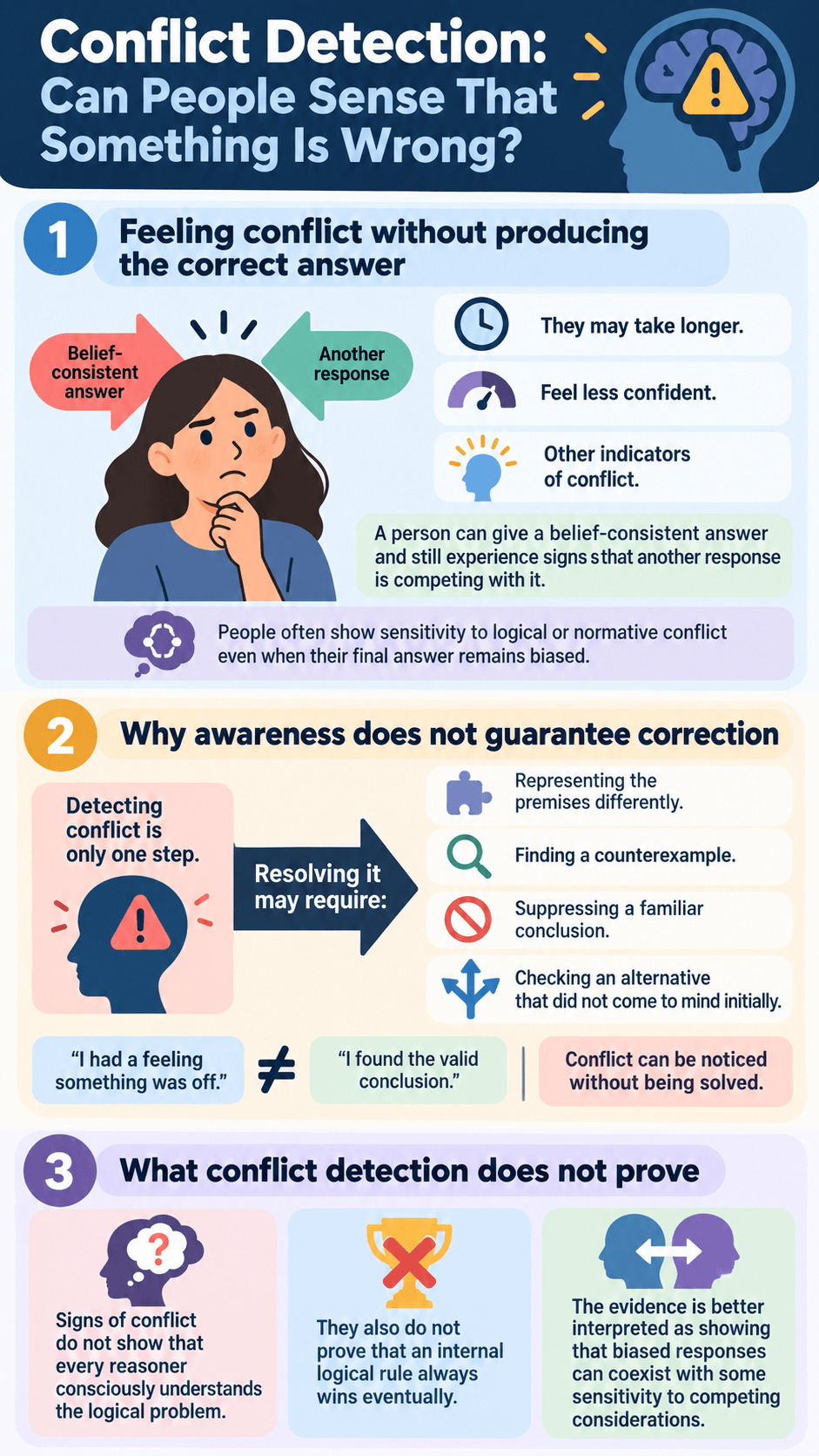
A person can give a belief-consistent answer and still experience signs that another response is competing with it. They may take longer, feel less confident, or show other indicators of conflict. Noticing that belief and logical structure are pulling in different directions can create a reason for cognitive reflection, although detecting the conflict does not guarantee that it will be resolved correctly.
Research reviewed in work on bias and conflict detection argues that people often show sensitivity to logical or normative conflict even when their final answer remains biased.
Why awareness does not guarantee correction
Detecting conflict is only one step. Resolving it may require representing the premises differently, finding a counterexample, suppressing a familiar conclusion, or checking an alternative that did not come to mind initially.
This explains why “I had a feeling something was off” and “I found the valid conclusion” are different achievements. Conflict can be noticed without being solved.
What conflict detection does not prove
Signs of conflict do not show that every reasoner consciously understands the logical problem. They also do not prove that an internal logical rule always wins eventually. The evidence is better interpreted as showing that biased responses can coexist with some sensitivity to competing considerations.
What Process-Tracing Studies Add
Looking beyond the final yes-or-no response
If researchers measure only whether someone accepts a conclusion, they see the outcome but not the path. Process measures such as response time, confidence, eye movements, or verbal reports can reveal which parts of an argument receive attention.
An eye-movement study of belief and logic in syllogistic reasoning found patterns consistent with selective-processing accounts, suggesting that believability can influence how premises are inspected rather than acting only at the final response stage.
Why this changes the interpretation of an error
Two people can give the same incorrect answer for different reasons. One may misread a premise. Another may correctly represent the premises but stop searching once a believable conclusion appears. A third may detect conflict but still favor prior knowledge.
This is why one wrong response should not be treated as a transparent window into a single mental process.
Belief Bias vs Confirmation Bias
Belief bias concerns validity judgments
Belief bias is specifically about how the believability of a conclusion influences judgments of an argument’s logical validity. It is commonly studied using structured reasoning problems where belief and logic can be placed in conflict.
Confirmation bias concerns seeking or interpreting evidence
Confirmation bias is broader and usually refers to tendencies to seek, notice, interpret, or remember information in ways that support an existing hypothesis or belief. It concerns evidence handling rather than specifically judging whether a conclusion follows from premises.
Why the concepts can overlap without being identical
A person may favor a believable conclusion and then search selectively for support, so both processes can occur in one situation. But belief bias can be demonstrated even in a short syllogism where there is no opportunity to search for new evidence. The mechanisms and experimental tasks are therefore distinct.
Belief Bias vs Motivated Reasoning
Believability is not the same as personal motivation
A conclusion can be believable because it matches ordinary knowledge, not because the person wants it to be true. Belief bias does not require emotional investment, identity protection, or personal stakes.
Motivated reasoning adds goals and desired outcomes
Motivated reasoning concerns the influence of goals, preferences, or desired conclusions on how information is evaluated. That is a broader and more personally directed process.
Keeping the distinction prevents a neutral laboratory effect from being misread as evidence that someone is deliberately defending a preferred worldview.
Belief Bias vs General Belief and Attitude Psychology
Belief psychology asks how beliefs form, persist, and change
Belief and attitude research covers processes such as learning, persuasion, social influence, identity, confidence, and belief revision. Those are broad questions about what people accept as true or favorable.
Belief bias asks a narrower reasoning question
Here the issue is whether the believability of a conclusion changes the judgment of an argument’s validity. The relevant outcome is not whether the person’s worldview changes. It is whether prior belief interferes with or shapes evaluation of the premise-to-conclusion relationship.
A Two-Pass Way to Evaluate an Argument
Pass one: test structure under the stated premises
Temporarily grant the premises and ask what follows from them. This is the stage where counterexamples, category relations, or other validity checks belong. Real-world plausibility is set aside only long enough to evaluate the inference.
Pass two: restore real-world evidence
After the validity question is settled, ask whether the premises are actually true, well supported, current, and relevant. A valid inference built on false premises is not a sound real-world argument.
Why separating the passes can reduce confusion
Everyday reasoning normally mixes factual knowledge and logical structure, which is useful. The two-pass method is a temporary discipline for situations where you need to know which part of an argument is doing the work.
It helps avoid two opposite errors: accepting an invalid argument because its conclusion happens to be true, and rejecting a valid inference merely because its premises are unrealistic.
A Practical Belief-Bias Check
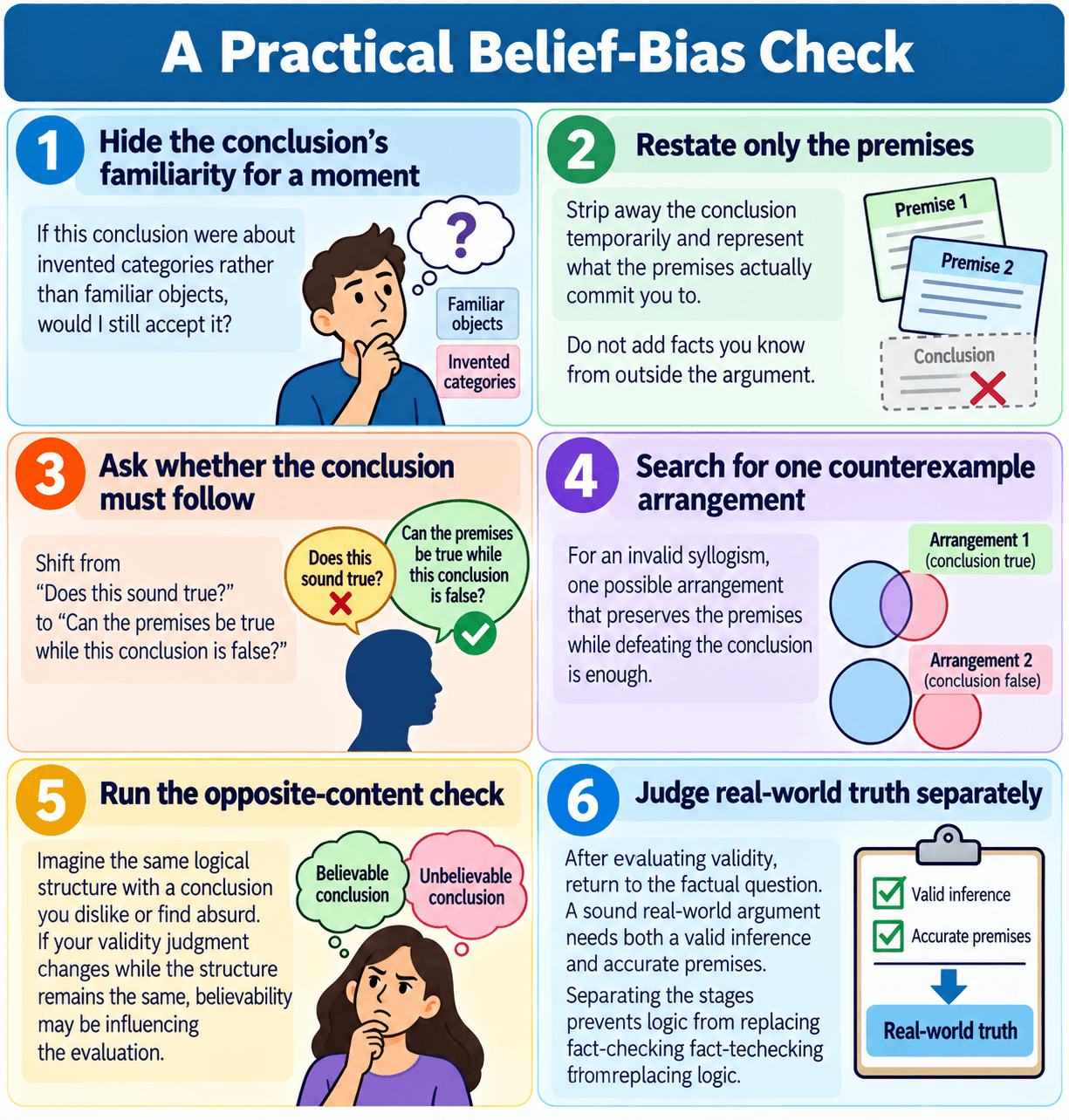
1. Hide the conclusion’s familiarity for a moment
Ask yourself: if this conclusion were about invented categories rather than familiar objects, would I still accept it? This helps expose whether world knowledge is carrying the argument.
2. Restate only the premises
Strip away the conclusion temporarily and represent what the premises actually commit you to. Do not add facts you know from outside the argument.
3. Ask whether the conclusion must follow
Shift from “Does this sound true?” to “Can the premises be true while this conclusion is false?” That question targets validity directly.
4. Search for one counterexample arrangement
For an invalid syllogism, one possible arrangement that preserves the premises while defeating the conclusion is enough. Counterexample search is especially useful when the conclusion feels obviously believable.
5. Run the opposite-content check
Imagine the same logical structure with a conclusion you dislike or find absurd. If your validity judgment changes while the structure remains the same, believability may be influencing the evaluation.
6. Judge real-world truth separately
After evaluating validity, return to the factual question. A sound real-world argument needs both a valid inference and accurate premises. Separating the stages prevents logic from replacing fact-checking or fact-checking from replacing logic.
Three Short Conflict Examples
Example 1: believable but invalid
All surgeons are professionals. Some professionals work at night. Therefore, some surgeons work at night.
The conclusion is believable, but it is not forced by the premises. The professionals who work at night could all belong to other occupations.
Example 2: unbelievable but valid
All stones are musical instruments. All musical instruments produce sound. Therefore, all stones produce sound.
The premises are false in ordinary life, but if both premises are accepted temporarily, the conclusion follows. Calling it invalid because stones are not musical instruments confuses truth with validity.
Example 3: believable and valid
All oak trees are plants. All plants are living organisms. Therefore, all oak trees are living organisms.
This case feels easy because belief and structure agree. It is therefore less useful for detecting whether a person is keeping believability and validity separate.
When Believability Is Actually Useful
Everyday reasoning should not ignore world knowledge
Outside formal tasks, prior knowledge is valuable. If an argument depends on a premise that is obviously false, noticing that fact is part of good reasoning. The point is not to suppress belief in every situation.
The key is knowing which question you are answering
When the task asks about validity, isolate the premise-to-conclusion relationship. When the task asks whether an argument should be trusted in the real world, evaluate both structure and factual accuracy.
This distinction prevents an artificial lesson from being drawn from laboratory tasks. Real-world reasoning usually benefits from integrating logic with evidence, knowledge, and source quality.
What Belief Bias Does Not Prove
It does not prove someone is unintelligent
Belief-bias effects are influenced by task structure, representation, familiarity, conflict, response criteria, and individual differences. One response does not support a broad conclusion about intelligence or cognitive ability.
It does not prove someone is dishonest or defensive
The effect can occur without personal stakes. A person may simply find a believable conclusion easier to accept. Inferring bad faith would add a motive that the reasoning result itself does not establish.
It does not mean prior knowledge is usually harmful
Knowledge is essential for understanding the world. The problem appears when a task requires judging one thing, logical support, and the mind substitutes another, factual plausibility. The solution is better separation of questions, not distrust of knowledge.
It does not justify labeling someone globally irrational
Belief bias is measured in specific tasks under specific instructions. The same person may reason accurately in one structure and struggle in another. Performance can also change when the wording, content, or opportunity to reconsider changes.
A narrow laboratory effect should therefore stay narrow in interpretation. It tells us about how belief and logical structure can interact, not whether a person’s everyday thinking deserves a global label.
FAQ About Belief Bias
What is belief bias in simple terms?
Belief bias is when whether a conclusion seems believable affects your judgment of whether it follows logically from the premises. It can make believable invalid conclusions easier to accept and unbelievable valid conclusions easier to reject.
Is belief bias the same as confirmation bias?
No. Belief bias concerns logical validity judgments when conclusion believability conflicts with argument structure. Confirmation bias concerns how people search for, interpret, or remember evidence in ways that support existing beliefs or hypotheses.
Can people notice the conflict and still give the biased answer?
Yes. Research on conflict detection suggests that people can show signs of recognizing competition between an intuitive or belief-based response and a logical consideration even when they do not produce the logically correct answer.
Does belief bias mean logic and belief should always be separated?
No. In formal validity tasks they should be separated temporarily. In real-world evaluation, both matter: the inference should be structurally adequate and the premises should be supported by evidence.
Does making a belief-bias error mean someone is irrational?
No. A single reasoning error does not justify a broad label. Performance depends on many features of the problem and the person-task interaction. Belief bias is best understood as a measurable reasoning tendency, not a diagnosis of someone’s overall rationality.
Key Takeaways
- Belief bias occurs when conclusion believability influences judgments of logical validity.
- Believable-invalid and unbelievable-valid arguments are especially useful for revealing conflict between prior knowledge and premise structure.
- Belief can influence premise interpretation, search for alternative representations, and final conclusion acceptance.
- Research does not support reducing belief bias to the simple idea that belief always overrides logic; measurement, strategy, and individual differences matter.
- People can sometimes detect conflict between belief and logic even when they do not fully resolve it.
- Belief bias is distinct from confirmation bias, motivated reasoning, and the broader psychology of belief formation and attitude change.
The most useful practical habit is to ask two questions in sequence instead of one: “Does this conclusion follow from these premises?” and then “Are these premises and this conclusion actually believable or true?” Keeping those questions separate for a moment makes it easier to see when a familiar conclusion is doing more persuasive work than the logical structure deserves.

Michael Reed is the Founder and Lead Writer at Psychology Exposed. He writes about human behavior, relationships, emotional patterns, self-awareness, and practical psychology topics using research-informed, easy-to-understand content.
Read More About Michael Reed: https://psychologyexposed.com/michael-reed/
1 thought on “Belief Bias Psychology: When Believability Feels Like Logic”