
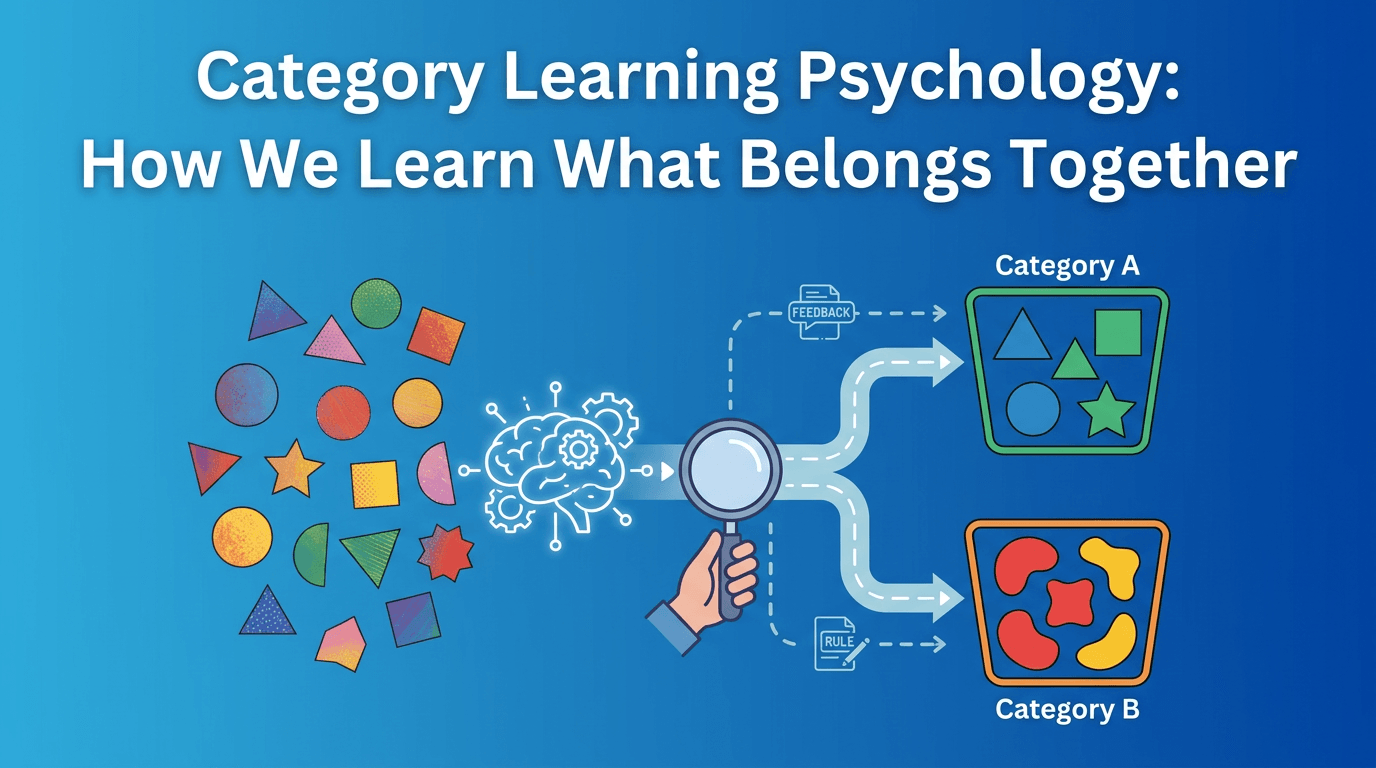
Imagine being shown a series of unfamiliar objects and being asked to sort each one into Category A or Category B. At first, your choices may feel like guesses. After seeing more examples, receiving feedback, and noticing which dimensions matter, your decisions can become faster and more accurate. Eventually, you may classify a new example correctly even though you have never seen that exact item before.
That is the central problem in category learning psychology: how experience teaches us which examples belong where. The process is narrower than learning in general. It is also different from simply building a rich concept. Category learning focuses on acquiring a classification structure that can be applied to new instances. Depending on the task, that learning may involve explicit rules, similarity, repeated exposure, feedback, attention to relevant dimensions, or information that is difficult to put into words.
Quick Answer: What Category Learning Is
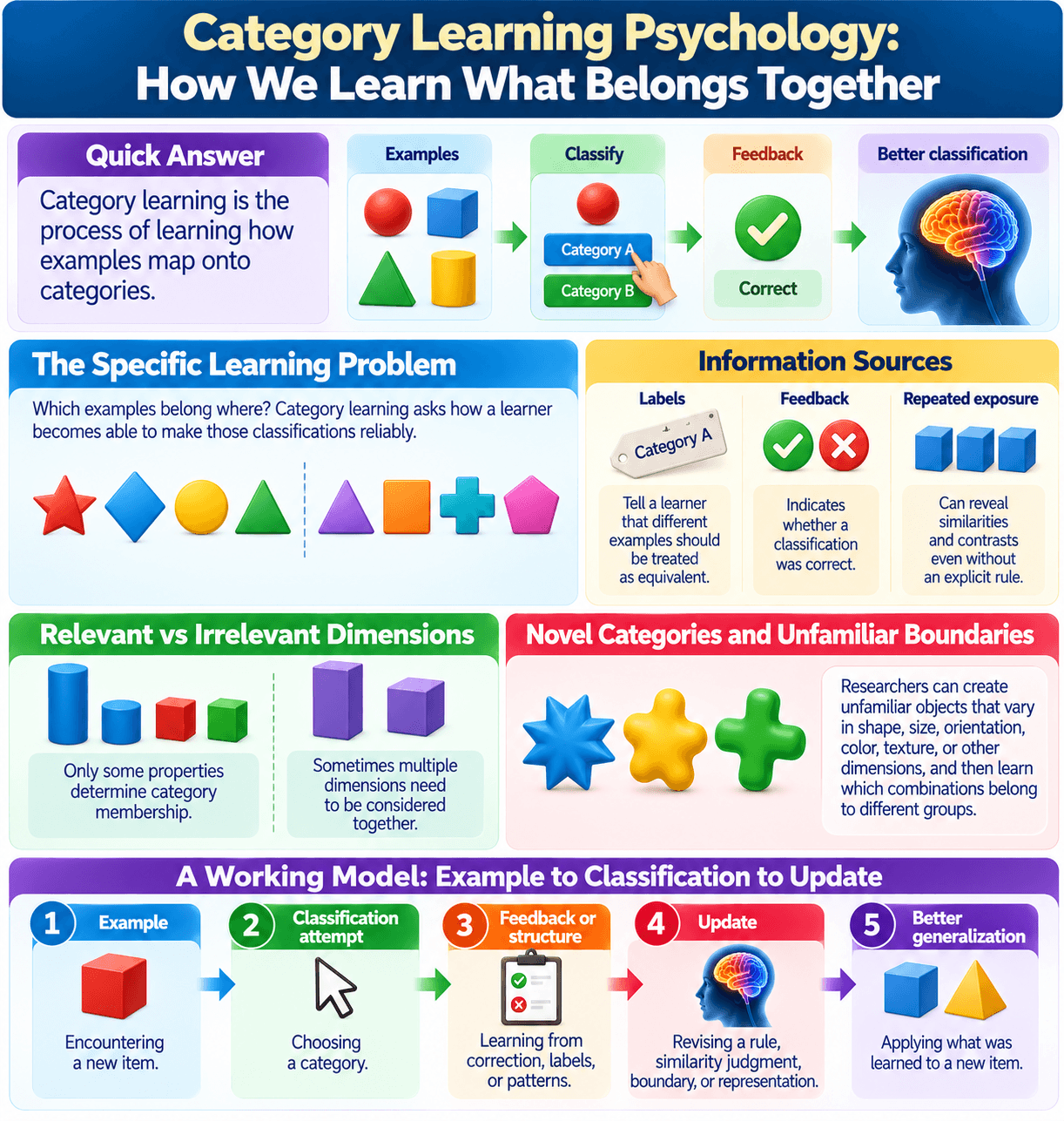
Category learning is the process of learning how examples map onto categories. A learner encounters instances, attempts to classify them, receives information from feedback or structure in the examples, updates what matters, and becomes better able to classify new cases. Different category tasks can favor different strategies, so psychology does not treat one learning mechanism as universally correct for every category.
The Specific Learning Problem: Which Examples Belong Where?
Categorization itself is the act of grouping or assigning instances to classes. The APA Dictionary of Psychology defines categorization as grouping objects, events, people, or experiences into classes based on shared characteristics and distinctions between classes. Category learning asks an additional question: how does a learner become able to make those classifications reliably?
The answer matters because category judgments are rarely limited to examples already encountered. A learner needs to recognize structure that can transfer to new items. If training produces perfect memory for ten examples but no ability to classify an eleventh, the learner has not acquired a very useful category system.
Novel categories and unfamiliar boundaries
Category learning is easiest to see when the categories are initially unfamiliar. Researchers can create artificial objects that vary in shape, size, orientation, color, texture, or other dimensions. Participants then learn which combinations belong to different groups.
Because the researcher controls the structure, it becomes possible to ask what the learner notices, whether an explicit rule is discovered, how errors change after feedback, and how well learning generalizes beyond the training set.
Labels, feedback, and repeated exposure
A category label can tell a learner that different examples should be treated as equivalent for the task. Feedback can indicate whether a classification was correct. Repeated exposure can reveal similarities and contrasts even when no one states an explicit rule.
These information sources do not always have the same effect. A clear label may help organize examples, while feedback can redirect attention after an error. Exposure may help when the structure of the examples itself is informative. Which source matters most depends on the task.
Relevant versus irrelevant dimensions
A stimulus can contain many properties, but only some determine category membership. Suppose unfamiliar shapes differ in height, width, color, and border thickness, but only height separates the categories. Successful learning requires discovering that height matters more than the other dimensions.
In another task, no single dimension may be sufficient. Height and width might need to be considered together. This difference is important because it changes what an effective learning strategy looks like.
A Working Model: Example to Classification to Update

A useful model for category learning is:
EXAMPLE → CLASSIFICATION ATTEMPT → FEEDBACK OR STRUCTURE → REPRESENTATION UPDATE → BETTER GENERALIZATION
This sequence is a practical map rather than one literal theory of learning. Some learning occurs with explicit corrective feedback, some through exposure, and some through a mixture of both.
| Stage | What the learner is doing | What may change |
|---|---|---|
| Example | Encountering a new item | Available features and relationships |
| Classification attempt | Choosing a category | Current decision strategy becomes visible |
| Feedback or structure | Learning from correction, labels, or patterns across examples | Attention to useful information |
| Update | Revising a rule, similarity judgment, boundary, or representation | How future examples are evaluated |
| Generalization | Applying what was learned to a new item | Breadth and reliability of category knowledge |
Learning From Examples
Comparing similarities and differences
Examples teach more than isolated facts. A learner can compare them and discover which properties stay consistent, which vary freely, and which distinctions separate one category from another.
For example, imagine learning two categories of imaginary plants. Leaf color appears in both categories, but leaf arrangement differs reliably. Over repeated examples, arrangement should become more useful than color. The learner is not simply counting features. The learner is discovering which variation predicts category membership.
Discovering which dimensions matter
Attention is therefore central to many category-learning tasks. If a learner focuses on an obvious but irrelevant feature, performance may stay poor. Feedback can help redirect attention toward a subtler but more predictive dimension.
This does not mean that category learning is merely an attention task. The learner also has to connect useful information with category responses and retain enough structure to generalize to future examples.
Why examples can teach without an explicit verbal rule
People sometimes become accurate at a classification even when they cannot clearly state how they are doing it. A category boundary may depend on a combination of dimensions that is difficult to summarize verbally. Repeated examples can still support improving performance.
A major review, Human Category Learning 2.0, describes several widely studied task structures, including rule-based, information-integration, prototype-distortion, and unstructured tasks. The review also makes clear that proposals linking these tasks to separate learning systems remain theoretically debated rather than fully settled.
Feedback and Error Correction
What corrective feedback can change
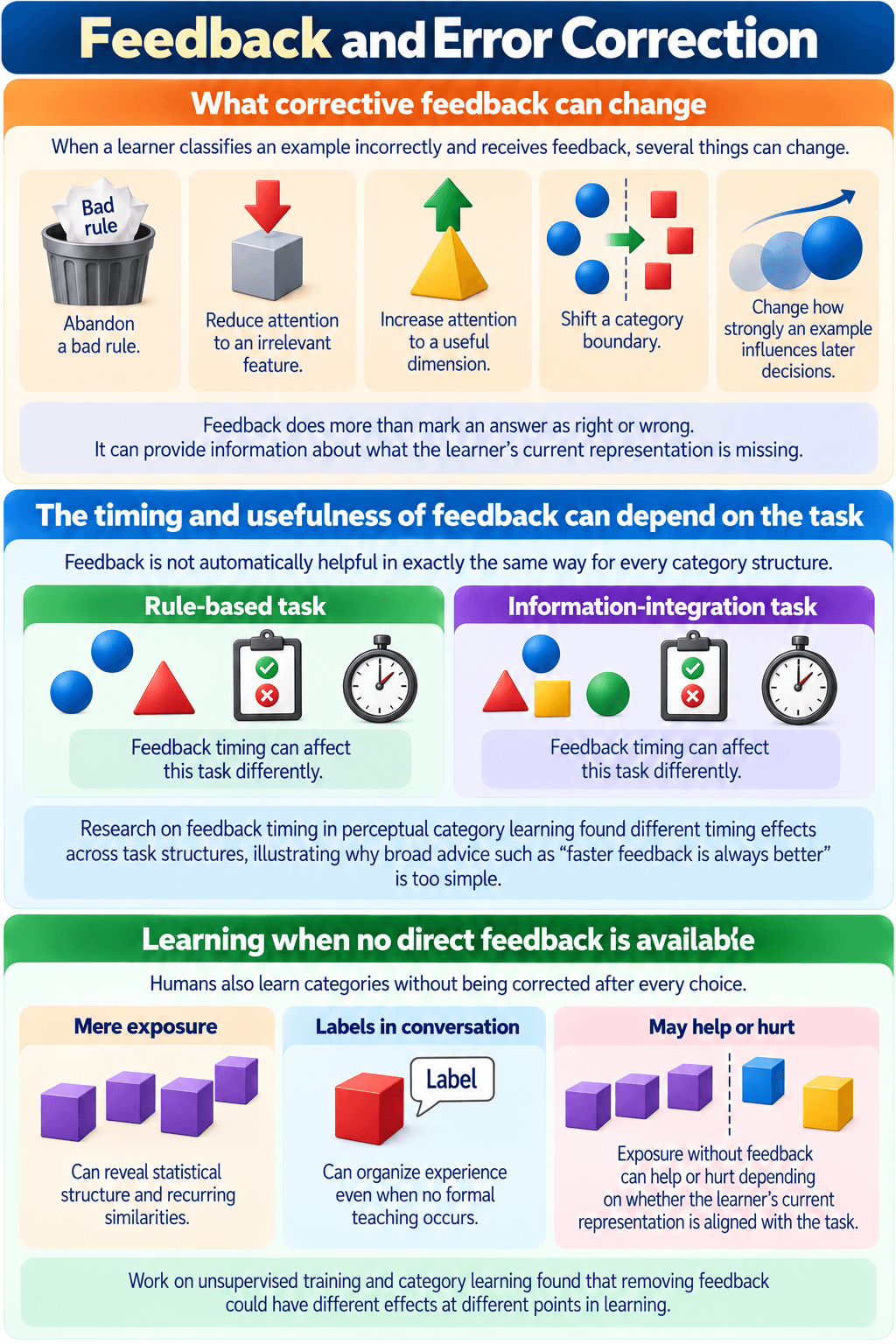
When a learner classifies an example incorrectly and receives feedback, several things can change. The learner may abandon a bad rule, reduce attention to an irrelevant feature, increase attention to a useful dimension, shift a category boundary, or change how strongly an example influences later decisions.
Feedback therefore does more than mark an answer as right or wrong. It can provide information about what the learner’s current representation is missing.
The timing and usefulness of feedback can depend on the task
Feedback is not automatically helpful in exactly the same way for every category structure. Experiments comparing rule-based and information-integration tasks have found that details such as feedback timing can affect the two tasks differently. Research on feedback timing in perceptual category learning found different timing effects across task structures, illustrating why broad advice such as “faster feedback is always better” is too simple.
The practical lesson is not that one precise delay should be used outside the laboratory. It is that the usefulness of feedback depends partly on what the learner is trying to learn and how the category information is structured.
Learning when no direct feedback is available
Humans also learn categories without being corrected after every choice. Mere exposure can reveal statistical structure, recurring similarities, and clusters of examples. Labels encountered in conversation can organize experience even when no formal teaching occurs.
Research comparing supervised and unsupervised conditions shows that exposure without feedback can help or hurt depending on whether the learner’s current representation is aligned with the task. Work on unsupervised training and category learning found that removing feedback could have different effects at different points in learning. This is another reason not to reduce category learning to simple reward and correction.
Generalizing Beyond Trained Examples

The strongest evidence of useful category learning is often what happens with new examples. A learner who understands enough of the category structure should be able to classify instances that were never part of training.
Near versus novel examples
Some test items closely resemble the training examples. Others lie farther away from familiar cases. Success with near items may require only modest extension of what was learned, while distant items place greater demands on the representation.
This distinction helps explain why high training accuracy is not the same as broad generalization. A learner may master a narrow region of the category space while remaining uncertain about unusual members.
Training sets shape what generalizes
The examples selected for training matter. If all examples are nearly identical, the learner may acquire a narrow view of the category. Greater diversity can reveal which dimensions are allowed to vary, although variation can also make the learning task harder.
One recent study found that the coherence of a training set affected later generalization in prototype-based categories. Research on coherent category training reported better generalization following more coherent training sets in its experimental tasks, while simply increasing the number of examples had more limited effects. Findings like this show that “more examples” is not the only property that matters.
Category boundaries and uncertainty
Items near a learned boundary are often harder to classify than clear examples. That uncertainty is informative. It may reveal that the learner has not yet found the relevant structure, or it may reflect a genuinely ambiguous category boundary.
Repeated errors near one region can lead the learner to refine the boundary, seek another dimension, or rely on a different representation.
When generalization exposes a weak representation
Suppose a learner succeeds during training because every Category A item is blue and every Category B item is green. If color was an accidental correlation and the test items no longer preserve it, performance can collapse. Generalization reveals that the learner acquired the wrong cue.
This is why researchers often care about transfer to novel examples rather than training accuracy alone. A useful category representation should capture structure that continues to matter when superficial details change.
Different Task Structures in Category-Learning Research

Category-learning experiments often deliberately create different structures to test competing explanations. These structures are best understood as properties of tasks, not permanent learning styles or fixed kinds of people.
Rule-verbalizable tasks
In a rule-based task, a relatively simple verbal rule can produce high accuracy. For example, “items taller than this value belong to Category A” may separate the groups. The learner can search for a relevant dimension, test a candidate rule, and revise it after errors.
Rule-based categorization is therefore closely connected with explicit hypothesis testing in some experiments. Still, the goal is classification. General hypothesis testing is a broader reasoning process.
Information-integration tasks
In an information-integration task, accurate classification depends on combining information from multiple stimulus dimensions before the decision. The optimal boundary is often difficult to state as a simple verbal rule.
Experimental work describes a long history of dissociations between rule-based and information-integration performance. At the same time, researchers continue to debate whether these differences require distinct learning systems. Research testing task-difficulty explanations illustrates that the debate is empirical and ongoing rather than a closed question.
Similarity-based and prototype-distortion paradigms
Another research design starts with a central prototype and creates training examples by distorting it. Learners may never see the prototype itself yet later respond to it as highly representative. Such tasks let researchers examine abstraction, similarity, and generalization.
These paradigms are useful for studying prototype-like learning, but they should not be taken as proof that every natural category is stored as a prototype. The experiment defines a particular statistical structure. Human concepts outside the laboratory can contain rules, exceptions, functions, relations, and extensive prior knowledge.
Why these are research paradigms, not permanent human learning types
It would be misleading to label one person a “rule learner” and another an “information-integration learner” as if these were fixed identities. The same person can face many kinds of category structures and may use different strategies across tasks.
Performance also depends on attention, prior knowledge, feedback, practice, stimulus structure, and instructions. A task classification tells us about the problem being studied, not a permanent psychological type.
Does Category Learning Use One System or Several?
Why researchers debate single-system and multiple-system accounts
Some theories propose that different category structures rely heavily on distinct learning systems. The influential COVIS framework, for example, distinguishes an explicit system associated with rule-based learning from a more procedural system associated with information-integration learning.
Other researchers argue that apparent dissociations may sometimes be explained within more unified accounts, by differences in representation, attention, task difficulty, or learning dynamics. Evidence continues to be evaluated through behavioral experiments, computational models, neuropsychological findings, and neuroscience.
What COVIS can illustrate without treating it as settled fact
COVIS is useful because it generates specific predictions about when verbalizable and less-verbalizable category structures should behave differently. That makes it scientifically testable. It should not be presented as a proven map showing that every human category is assigned to one of two permanent brain systems.
The responsible summary is simpler: different category tasks show meaningful differences, and multiple theoretical accounts compete to explain why.
Why the Order of Examples Can Matter
Learning unfolds over time, so the sequence of examples can shape what becomes noticeable. Seeing several highly similar examples together can make within-category commonalities obvious. Alternating contrasting categories can make differences easier to notice. Neither arrangement is universally best.
Early examples can influence what the learner looks for
If the first few examples suggest an easy but misleading rule, the learner may continue testing that rule even after exceptions appear. A different sequence may reveal the relevant distinction earlier.
A review of sequencing effects in inductive category learning notes that study order can change what is learned and how efficiently learning proceeds. Research on sequencing effects in category learning emphasizes that the best sequence depends on the learning problem rather than following one universal schedule.
Contrast and similarity serve different purposes
Similar examples can highlight shared structure. Contrasting examples can reveal discriminating features. A useful training sequence may need both. If a learner only sees members within one category, common structure may become clear while the boundary against neighboring categories remains vague.
If every trial alternates radically different examples, distinctions may become obvious but subtler within-category structure may be harder to notice. The right balance depends on the target category and what the learner already knows.
Category Learning vs General Learning
Psychological learning is a broad idea covering relatively lasting changes in knowledge, skill, expectation, or behavior through experience. Category learning is one specialized form of that larger process.
| General learning | Category learning |
|---|---|
| Can involve facts, skills, habits, associations, strategies, or behaviors | Focuses on learning how instances map to categories |
| May not involve classification at all | Classification is the central task |
| Includes many mechanisms and research traditions | Studies examples, dimensions, boundaries, feedback, similarity, rules, and generalization |
| Can ask whether experience changed behavior or knowledge | Asks whether experience improved category judgments, especially for new items |
This distinction prevents category learning from becoming a second overview of reinforcement, observational learning, practice, memory, transfer, and all the other processes covered by broader learning psychology.
Category Learning vs Concept Formation
Learning category assignments versus building conceptual representation
Concept formation asks how a usable representation develops from experience, prior knowledge, relations, functions, language, and other information. Category learning focuses more narrowly on learning which examples belong to which categories.
They overlap because better category learning can change a concept, and richer conceptual knowledge can improve classification. But the primary questions remain different.
Imagine learning about musical instruments. Developing an understanding of instruments as objects that produce organized sound in particular ways is concept formation. Practicing whether unfamiliar instruments belong to strings, percussion, woodwinds, or brass is category learning.
Category Learning vs Prototype, Exemplar, and Rule-Based Accounts
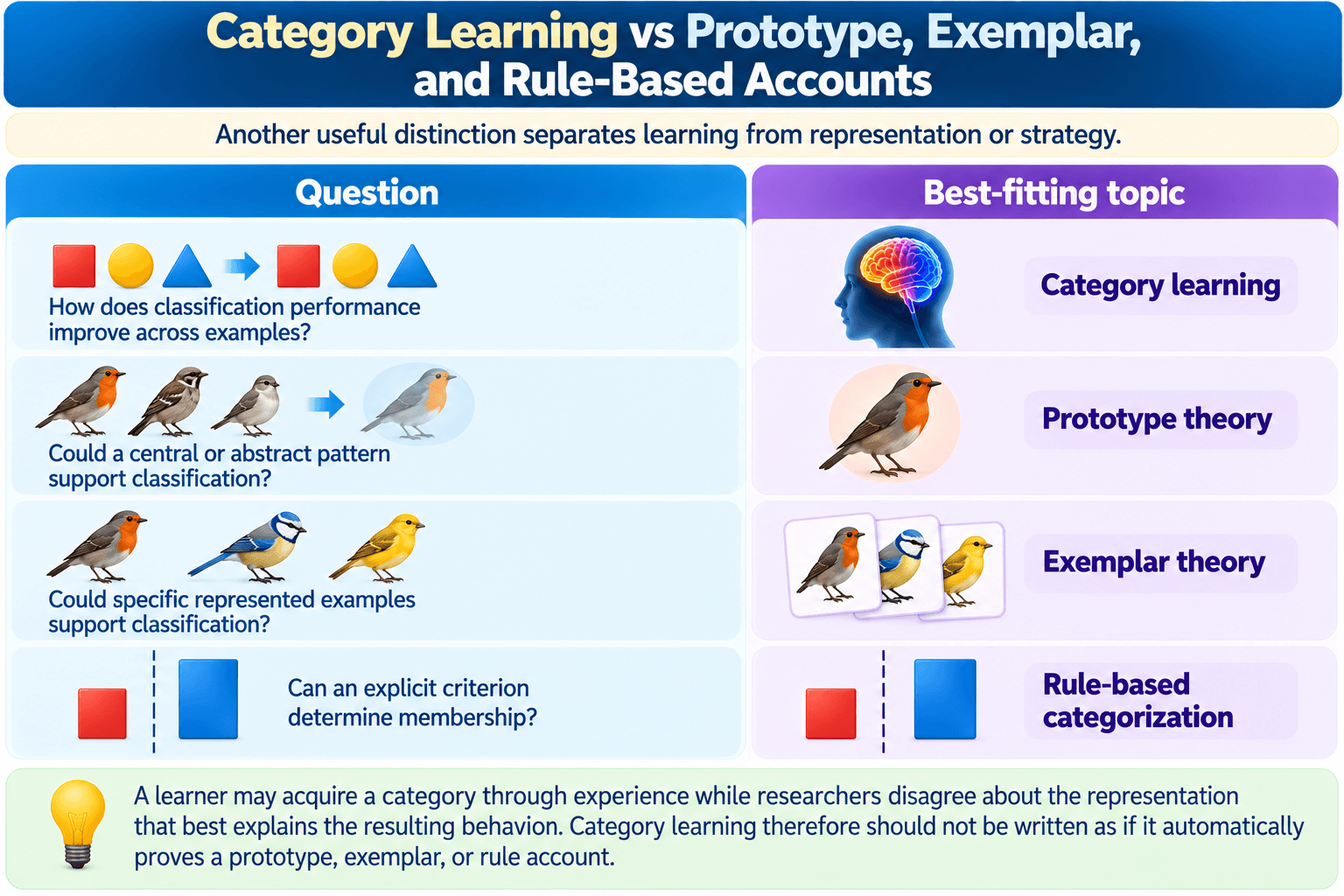
Another useful distinction separates learning from representation or strategy.
| Question | Best-fitting topic |
|---|---|
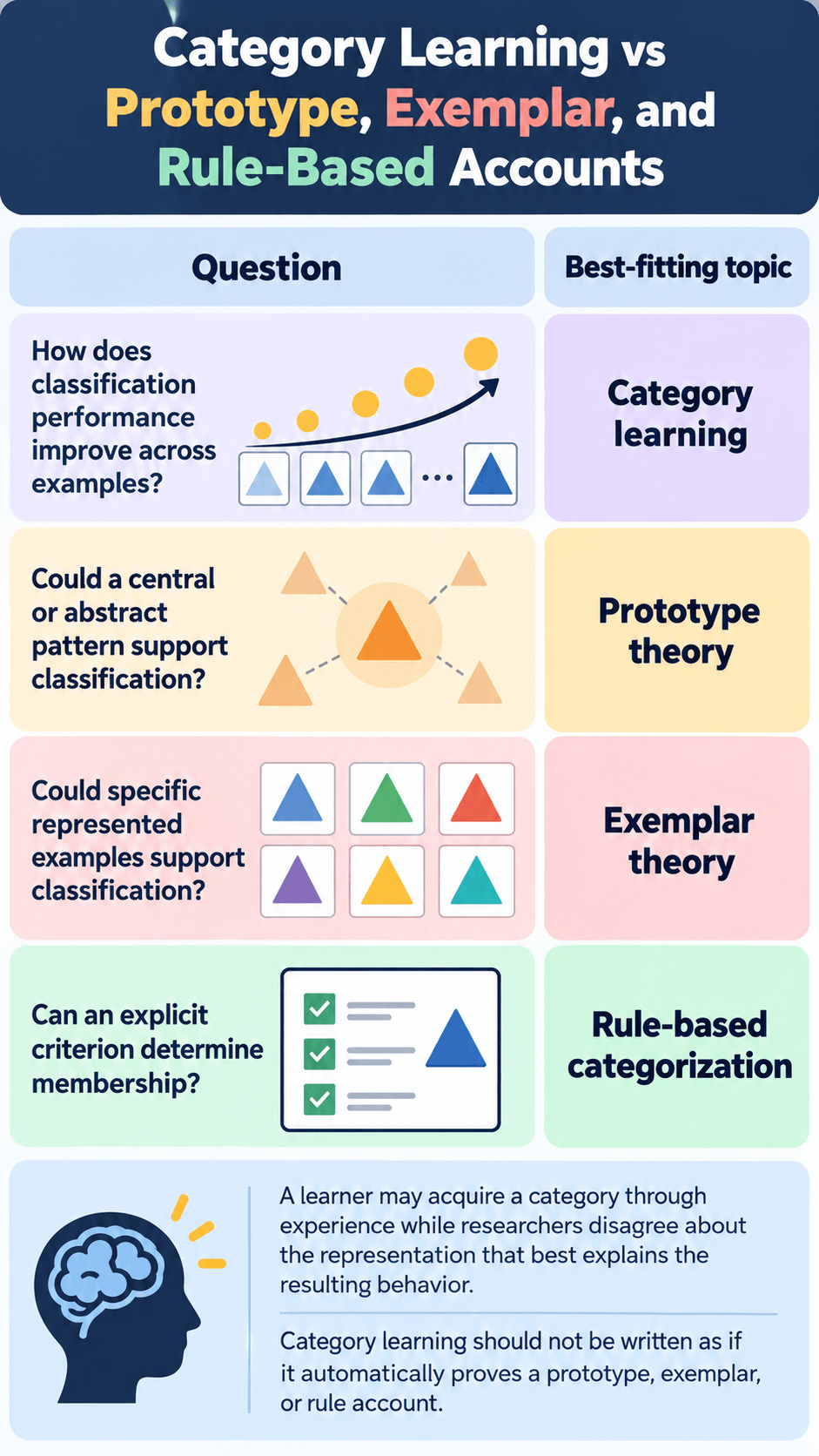
| How does classification performance improve across examples? | Category learning |
| Could a central or abstract pattern support classification? | Prototype theory |
| Could specific represented examples support classification? | Exemplar theory |
| Can an explicit criterion determine membership? | Rule-based categorization |
A learner may acquire a category through experience while researchers disagree about the representation that best explains the resulting behavior. Category learning therefore should not be written as if it automatically proves a prototype, exemplar, or rule account.
When Category Learning Goes Wrong in a Task
Errors can reveal why a learning problem is difficult. The goal is not to diagnose the learner. It is to inspect the relationship between the examples, the relevant information, and the current strategy.
Too many irrelevant dimensions
A task becomes harder when many noticeable properties vary but only a few predict membership. Learners may spend time testing dimensions that look important but are actually noise.
Sparse or misleading examples
A small sample can create false impressions about what defines a category. If every early example shares an accidental feature, the learner may treat that feature as important until a counterexample appears.
Changing boundaries or inconsistent feedback
Learning becomes difficult when the correct classification shifts or feedback is unreliable. In such cases, errors may reflect instability in the environment rather than a failure of attention or memory.
A mismatch between task structure and strategy
An explicit one-dimensional rule is ineffective if the category boundary depends on integrating several dimensions. Conversely, relying on vague similarity can be inefficient when a simple rule cleanly separates the categories.
Improvement can therefore involve changing the strategy rather than trying harder with the same one.
A Practical Way to Analyze a Category-Learning Problem
If you are learning a real classification system, such as identifying plant types, file categories, product defects, game positions, or equipment classes, the following questions can clarify the task:
- What examples have I actually seen, and are they representative of the full range?
- Which dimensions predict the category, and which are merely noticeable?
- Is there a rule I can state clearly, or does the distinction depend on several cues together?
- What kinds of mistakes repeat most often?
- Does feedback tell me which feature I misunderstood, or only that the final answer was wrong?
- Can I classify new examples that look different from the training set?
- Would contrasting two easily confused examples reveal a more useful distinction?
This is not a test of intelligence or a fixed “learning style.” It is a way to diagnose the structure of the learning task itself.
FAQ About Category Learning Psychology
Can people learn a category without being able to state the rule?
Yes. Some category structures can be learned even when the learner cannot easily verbalize the information that produces accurate classifications. This is especially relevant in information-integration and similarity-based tasks. However, being unable to verbalize a rule does not by itself prove that one particular implicit learning system caused the performance.
Is category learning just reinforcement learning?
No. Corrective feedback can be important, but category learning also occurs through examples, labels, similarity, contrast, exposure, prior knowledge, and explicit rules. Different experiments emphasize different mechanisms. Reinforcement-based processes are part of some theories, not a complete definition of category learning.
Does seeing more examples always produce broader generalization?
Not necessarily. The structure and diversity of the examples matter, not only their number. Additional examples that are redundant may add little, while carefully chosen variation can reveal which properties are stable and which can change. Research also shows that coherence and sequence can influence what generalizes.
Are rule-based and information-integration tasks separate kinds of people?
No. They are research task structures, not personality categories or permanent learner types. The same person may use an explicit rule in one classification problem and rely on multidimensional similarity or experience in another.
Key Takeaways
- Category learning focuses on acquiring a classification system that can be applied to new examples.
- Examples, labels, feedback, attention, similarity, rules, and task structure can all influence what gets learned.
- Generalization to unseen items is more informative than training accuracy alone because it shows whether useful structure was acquired.
- Rule-based, information-integration, prototype-distortion, and similar tasks are experimental paradigms, not fixed human learning styles.
- Category learning is narrower than Learning Psychology and differs from Concept Formation, which focuses on how a representation develops.
- Competing single-system and multiple-system theories remain part of an active scientific debate, so no one account should be presented as final.
Final Thought: Look Beyond Correct Answers
When category learning is working well, the important change is not merely a higher score on familiar examples. The learner has discovered enough structure to handle something new. A useful next step is therefore to test the boundary of what has been learned: vary the examples, remove an accidental cue, introduce an unusual member, or compare two cases that are easy to confuse. Those tests reveal whether the learner has memorized the training set or acquired a classification system that can genuinely generalize.
Educational note: Difficulty with a category-learning task does not, by itself, indicate low intelligence, ADHD, autism, a learning disorder, dementia, or neurological disease. Performance can reflect the examples, instructions, feedback, relevant dimensions, prior experience, and structure of the task. Clinical or developmental conclusions require much broader evidence and appropriate assessment.

Michael Reed is the Founder and Lead Writer at Psychology Exposed. He writes about human behavior, relationships, emotional patterns, self-awareness, and practical psychology topics using research-informed, easy-to-understand content.
Read More About Michael Reed: https://psychologyexposed.com/michael-reed/