
If a package is marked fragile, it must be handled carefully. If the alarm is armed, opening the door will trigger a warning. If the soil is dry, the plant needs water. Everyday thinking is full of statements that connect one condition with another. Yet people do not always interpret these rules in the same way, and small changes in wording, context, or background knowledge can change which conclusions seem justified.
Conditional reasoning is the study of how people understand and reason from statements of the form “if P, then Q.” The logic can look simple on paper, but the psychology is richer. People must identify what the condition actually says, distinguish what is sufficient from what is necessary, avoid reversing the relationship, and decide whether real-world context changes how the rule should be understood.
Quick Answer

Conditional reasoning is reasoning with if-then relationships. In the standard form “if P, then Q,” P is the antecedent and Q is the consequent. Some inferences, such as modus ponens and modus tollens, are valid under the standard interpretation. Others, such as affirming the consequent or denying the antecedent, can feel natural but do not necessarily follow because alternative possibilities remain.
What Conditional Reasoning Means
The basic form: if P, then Q
A conditional statement links two propositions. The first part, P, is the condition. The second part, Q, is what is said to follow when that condition holds. Conditional reasoning is one focused part of the broader study of reasoning, centered on what can and cannot follow from an if-then relationship.
For example: “If a file is encrypted, then it requires authorization to open.” Here, “the file is encrypted” is P, and “the file requires authorization” is Q. The rule tells you what follows when P is true. It does not automatically tell you that Q can happen only when P is true.
Antecedent and consequent
Psychologists and logicians call P the antecedent and Q the consequent. These labels matter because many reasoning mistakes involve reversing the direction of the relationship.
If “being encrypted” is sufficient for “requiring authorization,” it does not follow that every file requiring authorization must be encrypted. Other security rules might also require authorization. Keeping antecedent and consequent separate makes the direction of the rule easier to track.
Why everyday “if” can carry more meaning than a bare logical rule
In ordinary language, an if-then sentence may communicate more than a formal relation. It may describe a cause, a permission, a threat, a promise, a policy, or a practical rule. A review of the psychological problems raised by the word “if” explains why conditionals have generated competing theories for so long.
Context can influence which possibilities people consider. “If the badge is valid, the door opens” may be heard as a technical rule. “If you finish the report, you may leave early” sounds more like a permission. The same grammatical form can therefore be interpreted through different practical expectations.
The Four Basic Conditional Inferences
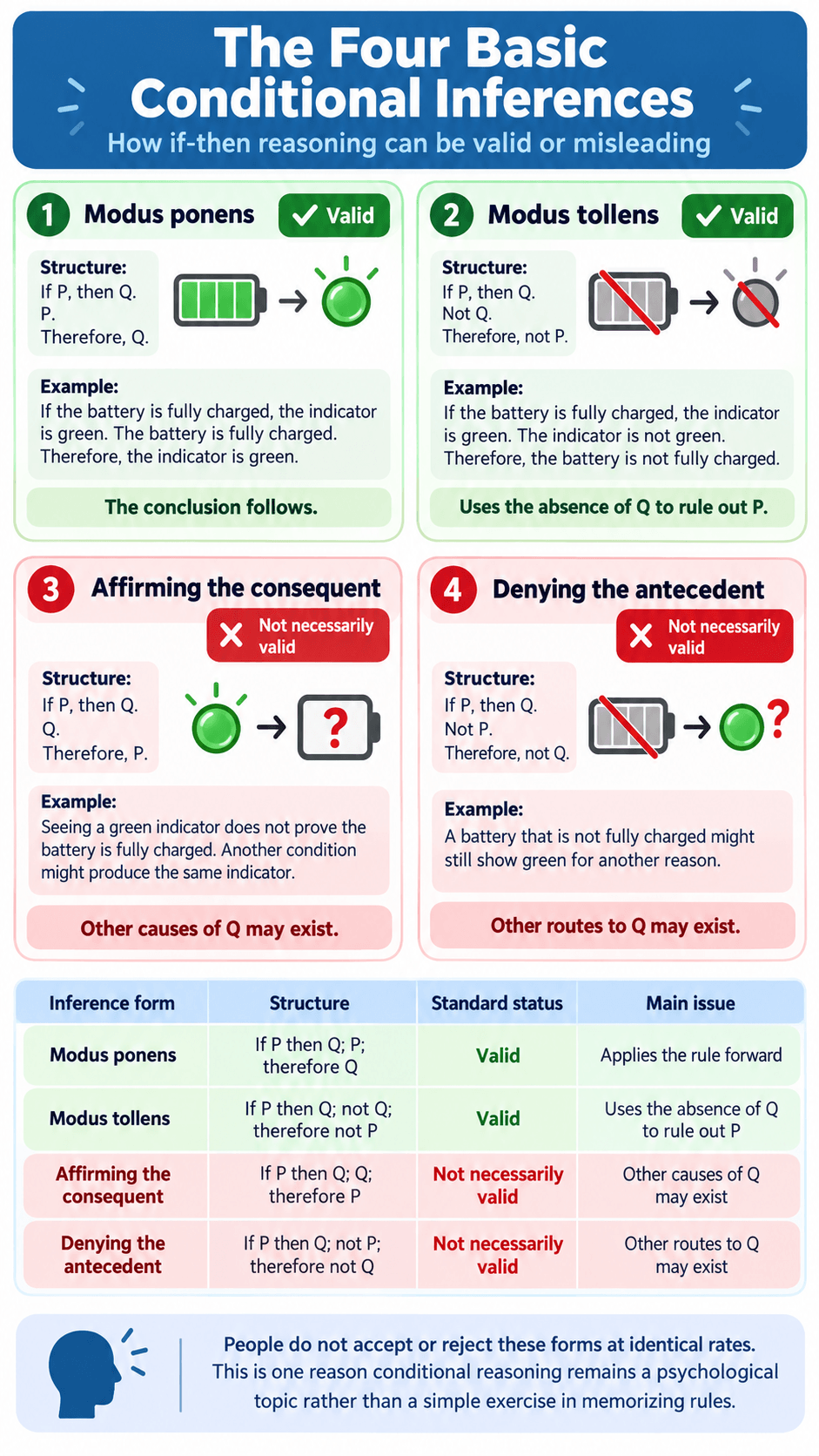
Modus ponens
Modus ponens has this form:
- If P, then Q.
- P.
- Therefore, Q.
Example: If the battery is fully charged, the indicator is green. The battery is fully charged. Therefore, the indicator is green. Under the stated rule, the conclusion follows.
Modus tollens
Modus tollens has this form:
- If P, then Q.
- Not Q.
- Therefore, not P.
Example: If the battery is fully charged, the indicator is green. The indicator is not green. Therefore, the battery is not fully charged. If the original rule is accepted as stated, this inference is valid.
Affirming the consequent
Affirming the consequent has this form:
- If P, then Q.
- Q.
- Therefore, P.
This does not necessarily follow. If a fully charged battery produces a green indicator, seeing a green indicator does not prove the battery is fully charged unless the rule also says that only a fully charged battery can produce green. Another condition might produce the same indicator.
Denying the antecedent
Denying the antecedent has this form:
- If P, then Q.
- Not P.
- Therefore, not Q.
This also does not necessarily follow. If a fully charged battery produces a green indicator, a battery that is not fully charged might still show green for another reason. The original rule tells us what follows from P, not what must happen whenever P is absent.
| Inference form | Structure | Standard status | Main issue |
|---|---|---|---|
| Modus ponens | If P then Q; P; therefore Q | Valid | Applies the rule forward |
| Modus tollens | If P then Q; not Q; therefore not P | Valid | Uses the absence of Q to rule out P |
| Affirming the consequent | If P then Q; Q; therefore P | Not necessarily valid | Other causes of Q may exist |
| Denying the antecedent | If P then Q; not P; therefore not Q | Not necessarily valid | Other routes to Q may exist |
Research on the four basic conditional inference forms has shown that people do not accept or reject these forms at identical rates. This is one reason conditional reasoning remains a psychological topic rather than a simple exercise in memorizing rules.
Necessary and Sufficient Conditions

What a sufficient condition means
If P guarantees Q under the rule, P is sufficient for Q. When P occurs, that is enough to conclude Q.
Suppose: “If a ticket is marked VIP, then it includes lounge access.” Being marked VIP is sufficient for lounge access under the stated rule. You do not need another condition once VIP status is established.
What a necessary condition means
A necessary condition is something that must be present for another condition to hold. If authorization is necessary for entry, then entry cannot occur without authorization.
Necessary and sufficient are easy to confuse because everyday language often leaves one direction unstated. “If you have a staff badge, you may enter” makes a staff badge sufficient under that rule. It does not necessarily make a staff badge necessary because visitors may have another approved route.
Why reversing the rule causes trouble
People often hear “if P, then Q” as though it meant “P if and only if Q.” That stronger interpretation makes P both sufficient and necessary for Q. Sometimes real-world context supports that stronger reading, but it should not be assumed automatically.
A useful check is to ask: “Could Q happen without P?” If the answer is yes, then P may be sufficient without being necessary.
Why Affirming the Consequent Feels So Natural
Q may make P more plausible without proving P
Seeing the predicted result can make the condition that predicted it seem more likely. If rain often makes the pavement wet, wet pavement can reasonably increase the plausibility that it rained. But that is different from a deductive conclusion because a sprinkler or cleaning crew could also explain the wet pavement.
This distinction shows how conditional reasoning can blend with other forms of inference. “Q makes P more plausible” may be sensible abductive or probabilistic reasoning even when “Q therefore P” is not deductively valid.
Alternative routes to the same outcome
The main question is whether Q has more than one possible route. If several conditions can produce the same outcome, observing the outcome cannot uniquely identify which condition occurred.
For example, if a password error triggers a red warning, seeing a red warning does not prove there was a password error. A network problem, expired account, or security lockout might produce the same warning.
Why the real-world interpretation can differ from a formal task
In ordinary life, people are rarely asked to ignore background knowledge. If experience tells you that one cause is overwhelmingly common, inferring it from the outcome may be practical. In a formal conditional task, however, the question is narrower: does the stated rule alone force that conclusion?
Psychology is interested in both levels. A response can be formally invalid under the bare rule while still revealing sensible use of background knowledge in a real-world context.
Why Denying the Antecedent Also Feels Reasonable
The mistaken assumption that P is the only route to Q
When people deny P and then deny Q, they are often treating P as the only cause or route to Q. This is understandable when the conditional sounds exclusive even though exclusivity was never stated.
If “pressing the green button starts the machine,” not pressing the green button does not prove the machine cannot start. It may also start by timer, remote command, or another control.
When context can make the inference more reasonable
Sometimes background knowledge genuinely suggests that P is the only available route. If a tightly controlled system has exactly one activation method, denying that method may justify denying the outcome.
The key is that the stronger conclusion comes from additional knowledge, not from the bare “if P, then Q” form alone.
How People Mentally Represent If-Then Rules
Possibilities that are made explicit
One influential view is that people reason by representing possibilities compatible with a conditional. Johnson-Laird and Byrne’s theory of conditionals, meaning, pragmatics, and inference argues that knowledge and context can modulate how a conditional is represented.
Under this view, people may initially focus on the case in which P and Q are both true. Other possibilities can remain less explicit unless the task encourages a fuller representation.
Why some inference forms require more checking
Modus ponens is often easy because the stated condition and the observed antecedent fit directly. Modus tollens may require considering more of the conditional relationship, especially whether a case with P and not Q is allowed.
Affirming the consequent and denying the antecedent become tempting when alternative possibilities are not represented clearly. If a person considers only the most obvious P-and-Q case, the rule can feel more like a two-way relationship than it actually is.
Competing theories matter because no single simple story explains everything
Conditional reasoning has been explained through mental models, suppositional approaches, probabilistic accounts, and other theories. A comparison of formal models of four conditional reasoning theories found that different theoretical approaches capture different patterns in the data.
For a general reader, the important point is not to choose a theoretical winner. It is to understand that human reasoning with “if” statements depends on interpretation, represented possibilities, context, and the type of inference being evaluated.
Context Changes How Conditional Rules Are Understood
Abstract rules can feel different from practical rules
A rule using arbitrary letters and numbers may feel more difficult than a rule about familiar permissions or actions. The difference is not necessarily that the underlying logic has changed. The familiar context may make the purpose of the rule, the relevant counterexample, or the intended interpretation easier to see.
Permissions, obligations, and social rules
Consider: “If a person is drinking alcohol, they must be over the legal age.” The practical goal of checking this rule is clear. You need to look for a person who might violate the requirement, not merely for examples that match the rule.
Conditional statements involving permissions and obligations often guide attention toward potential violations because the reason for the rule is easier to understand.
Causal conditionals
A causal statement such as “If the sensor overheats, the system shuts down” invites knowledge about mechanisms and alternative causes. The same outcome could potentially arise for other reasons, so people may interpret the conditional as one causal route rather than an exclusive definition.
This is one reason real-world causal conditionals often produce different responses from arbitrary formal conditionals.
The Wason Selection Task as a Window Into Conditional Reasoning

The basic idea
In a typical selection task, people see a conditional rule and several cards. Each card has information on two sides, but only one side is visible. The task is to choose which cards must be turned over to determine whether the rule has been violated.
The challenge is to look for evidence that could make the antecedent true while the consequent is false. Those are the cases that would contradict the rule.
Why people often select matching information
People are often drawn toward cards that visibly match the words named in the rule. If a rule mentions A and 4, A and 4 may feel immediately relevant. But testing a conditional requires asking which hidden information could falsify the rule, not which visible information resembles it.
Why task interpretation matters
Performance in the selection task has been interpreted in many ways. Research on misinterpretation of conditional statements in the Wason task found that some apparent reasoning errors reflected how participants understood the rule rather than only how they evaluated it.
More recent work continues to use the task to study semantic, pragmatic, and contextual influences on conditional reasoning. The important lesson is not that one card puzzle proves people are illogical. It is that reasoning depends partly on what people think the conditional means and what they believe the task is asking them to test.
A Four-Form Conditional Check
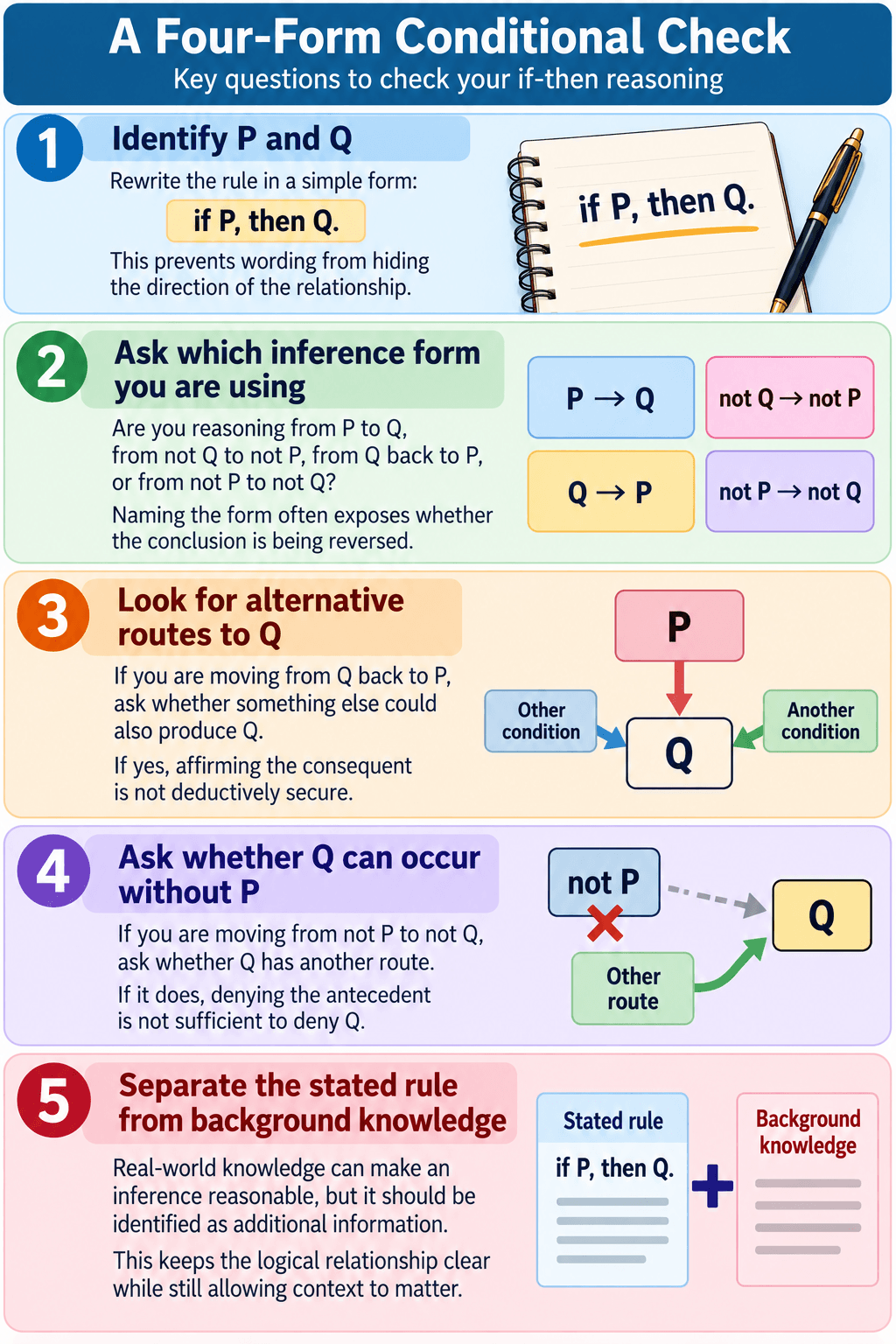
1. Identify P and Q
Rewrite the rule in a simple form: if P, then Q. This prevents wording from hiding the direction of the relationship.
2. Ask which inference form you are using
Are you reasoning from P to Q, from not Q to not P, from Q back to P, or from not P to not Q? Naming the form often exposes whether the conclusion is being reversed.
3. Look for alternative routes to Q
If you are moving from Q back to P, ask whether something else could also produce Q. If yes, affirming the consequent is not deductively secure.
4. Ask whether Q can occur without P
If you are moving from not P to not Q, ask whether Q has another route. If it does, denying the antecedent is not sufficient to deny Q.
5. Separate the stated rule from background knowledge
Real-world knowledge can make an inference reasonable, but it should be identified as additional information. This keeps the logical relationship clear while still allowing context to matter.
Conditional Reasoning vs General Deductive Reasoning
Deduction is broader
Deductive reasoning includes any inference in which a conclusion is intended to follow necessarily from premises. Conditional reasoning is one family inside that broader category.
Categorical syllogisms, spatial relations, and other necessary inferences can be deductive without using if-then statements.
Conditional reasoning has its own interpretation problems
The word “if” carries semantic and pragmatic complexity that deserves focused treatment. People may hear causation, permission, temporal sequence, probability, or exclusivity depending on the context. Those issues are not central to every form of deduction.
Why the four inference forms deserve their own treatment
Modus ponens, modus tollens, affirming the consequent, and denying the antecedent provide a compact way to study directionality, alternatives, and conditional interpretation. They show why understanding an if-then rule involves more than knowing that deduction exists.
Conditional Reasoning vs Syllogistic Reasoning
If-then relations versus category relations
Conditional reasoning centers on P-to-Q relations. Syllogistic reasoning centers on categorical relationships such as all, some, and none.
“If a card is red, then it is marked” is a conditional rule. “All red cards are marked” can express a similar relation, but syllogistic tasks typically ask how several category statements combine with one another.
Why the error patterns differ
Conditional errors often involve reversing direction or treating one route as the only route. Syllogistic errors more often involve integrating category relations, quantifiers, and the believability of conclusions.
The topics overlap under deduction, but the structures and psychological challenges are different enough to examine separately.
Conditional Reasoning and Cognitive Reflection
When the first interpretation is tempting
An if-then problem can produce an immediate response because one conclusion feels natural. Seeing Q may quickly suggest P, especially when P is a familiar cause of Q.
The first response is not automatically wrong. The question is whether another plausible route or interpretation should be checked before accepting it.
Reflection can help by reopening alternatives
A reflective check may ask: “Is P really the only way to get Q?” or “Did the rule state both directions, or only one?” These questions reopen possibilities that the first interpretation may have ignored.
This is a narrow connection with cognitive reflection. Conditional reasoning concerns the structure of the if-then rule. Cognitive reflection concerns whether an initial answer is reconsidered. The two processes can interact without being the same topic.
Common Misunderstandings About If-Then Rules
“If P then Q” means “P if and only if Q”
Not necessarily. “If P, then Q” guarantees Q when P occurs under the rule. It does not automatically say that P is required for Q.
If Q is true, P must have happened
Only if you know that P is the sole route to Q. The conditional by itself does not establish that exclusivity.
If P is false, Q must be false
Again, Q may have another route. Denying P does not necessarily eliminate Q.
Real-world exceptions always make the reasoning invalid
That depends on the task. In a formal exercise, the rule may be treated as given. In everyday reasoning, known exceptions can change how literally the conditional should be applied. The first question is whether you are testing the structure of a stated rule or evaluating whether the rule accurately describes reality.
FAQ About Conditional Reasoning
What is the difference between antecedent and consequent?
In “if P, then Q,” P is the antecedent and Q is the consequent. The antecedent states the condition, while the consequent states what follows when that condition holds. Keeping the two roles distinct helps prevent reversing the relationship.
Why is affirming the consequent not always valid?
Because Q may have more than one possible cause or route. If P guarantees Q, observing Q does not prove P unless the rule also establishes that P is necessary for Q.
Why is modus tollens valid?
If the rule guarantees that P cannot occur without Q, then observing not Q rules out P. A case with P and not Q would violate the rule, so not Q allows the conclusion not P under the standard interpretation.
Does context change the logic of an if-then statement?
Context can change how the statement is interpreted and which background assumptions are included. A formal rule may have one stipulated meaning, while a real-world conditional may carry causal, pragmatic, or social information. Psychology studies how those interpretations affect reasoning performance.
Does difficulty with conditional reasoning mean someone is irrational?
No. Performance depends on wording, interpretation, task demands, background knowledge, familiarity, and which possibilities are represented. One mistake on an if-then problem does not justify a broad judgment about intelligence or rationality.
Key Takeaways
- Conditional reasoning examines how people reason from if-then relationships such as “if P, then Q.”
- Modus ponens and modus tollens are valid under the standard interpretation, while affirming the consequent and denying the antecedent are not necessarily valid.
- Sufficient and necessary conditions are different, and confusing them often reverses the meaning of a rule.
- Context, background knowledge, pragmatics, and represented possibilities can change how people interpret a conditional.
- The Wason Selection Task shows how conditional reasoning depends on both inference and task interpretation, not simply on memorizing formal rules.
- Conditional reasoning is a focused part of deduction, distinct from syllogistic reasoning and from cognitive reflection even when those processes interact.
A useful next step is to take one if-then statement you encounter today and rewrite it as P and Q. Ask whether P is sufficient, whether it is also necessary, and whether Q could occur through another route. That short check is often enough to reveal when an if-then rule supports a conclusion and when the mind has quietly made the rule stronger than it actually is.

Michael Reed is the Founder and Lead Writer at Psychology Exposed. He writes about human behavior, relationships, emotional patterns, self-awareness, and practical psychology topics using research-informed, easy-to-understand content.
Read More About Michael Reed: https://psychologyexposed.com/michael-reed/
1 thought on “Conditional Reasoning Psychology: How We Think With If-Then Rules”