
You can recognize a chair you have never seen before, treat a robin and a penguin as birds despite obvious differences, and understand that a coffee cup belongs with other cups even when its shape, color, and material are unusual. These ordinary judgments depend on a powerful cognitive ability: organizing experience into concepts and categories.
That ability does more than help with naming. It lets you predict what unfamiliar things may do, choose how to respond to them, connect new information with prior knowledge, and revise what you know when an example does not fit. Psychology does not explain all of this with one single theory. Different kinds of categories may depend on different mixtures of similarity, remembered examples, explicit rules, relationships, context, goals, and prior knowledge.
Quick Answer: How Concepts and Categories Organize Experience

Concepts are mental representations or organized knowledge that help us think about objects, events, properties, actions, and relationships. Categories are groupings of things treated as belonging together for some purpose. Categorization is the process of deciding that a new instance belongs, does not belong, or fits only weakly. Together, these processes support recognition, classification, prediction, and generalization.
The Core Distinction: Concept, Category, and Categorization
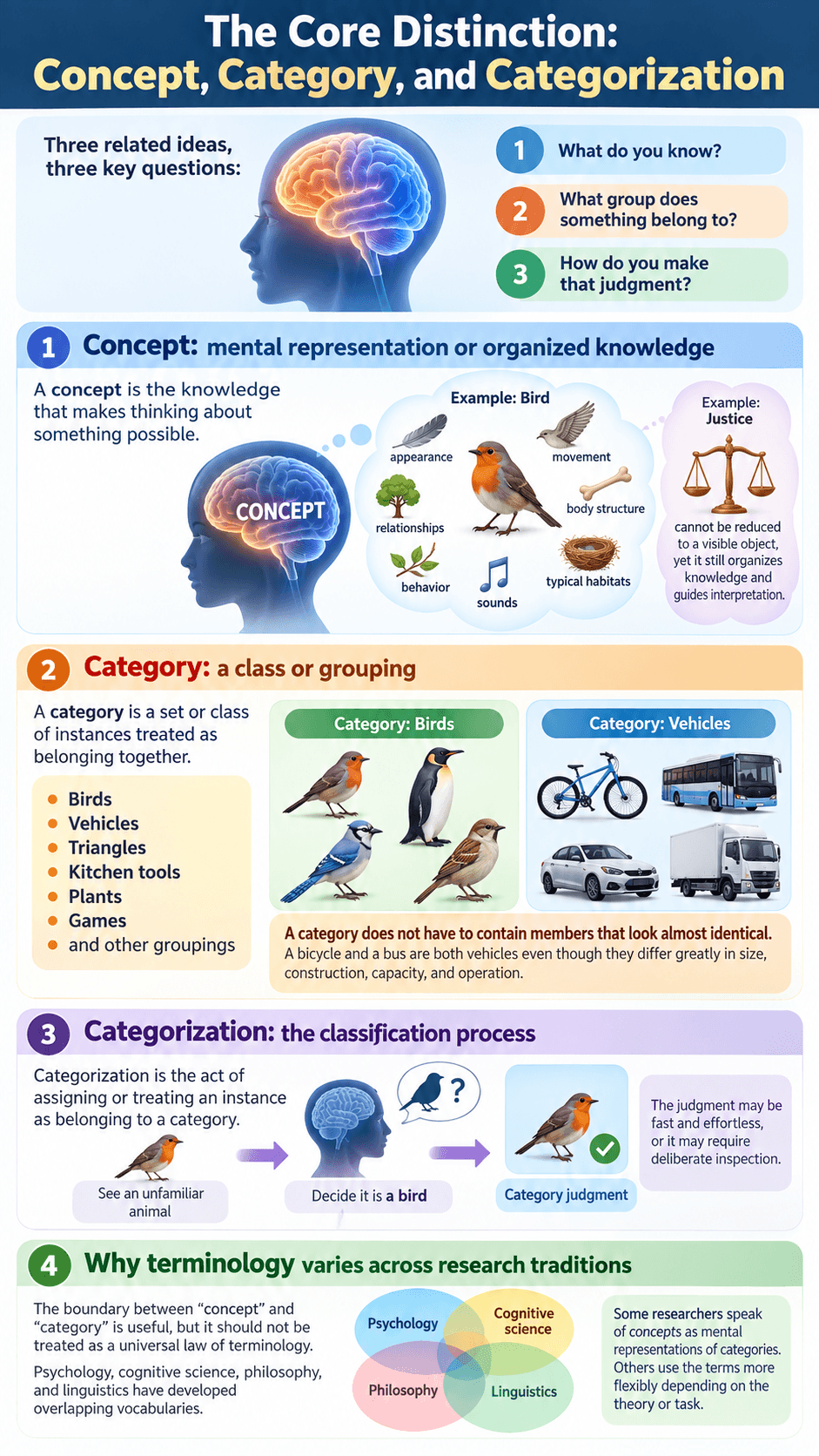
These words are closely related, and researchers do not always use them in exactly the same way. For a practical reading of the topic, it helps to separate three questions: What do you know? What group does something belong to? How do you make that judgment?
Concept as mental representation or organized knowledge
A concept is the knowledge that makes thinking about something possible. Your concept of a bird may include appearance, movement, body structure, typical habitats, behavior, sounds, and relationships with other things. Your concept of justice is different because it cannot be reduced to a visible object, yet it still organizes knowledge and guides interpretation.
Conceptual knowledge is not necessarily one fixed list of features. A review of concepts and categories in cognitive science notes that theories must explain how different kinds of information about an entity are organized and function together, rather than assuming that one simple dimension explains conceptual knowledge. A review in the Annual Review of Psychology describes this as a central problem in understanding conceptual representation.
Category as a class or grouping
A category is a set or class of instances treated as belonging together. Birds form a category. Vehicles form another. So do triangles, kitchen tools, plants, games, and countless other groupings. The grouping may be based on perceptual similarity, function, rules, relationships, shared history, goals, or some combination of these.
A category does not have to contain members that look almost identical. A bicycle and a bus are both vehicles even though they differ greatly in size, construction, capacity, and operation. What matters is that the cognitive system treats them as belonging together for a relevant purpose.
Categorization as the classification process
Categorization is the act of assigning or treating an instance as belonging to a category. The APA Dictionary of Psychology describes categorization as grouping objects, events, people, or experiences into classes based on similarities within a class and distinctions between classes.
If you see an unfamiliar animal and decide it is a bird, the output is a category judgment. If you decide that a new tool is a wrench rather than a pair of pliers, that is another category judgment. The judgment may be fast and effortless, or it may require deliberate inspection.
Why terminology varies across research traditions
The boundary between “concept” and “category” is useful, but it should not be treated as a universal law of terminology. Psychology, cognitive science, philosophy, and linguistics have developed overlapping vocabularies. Some researchers speak of concepts as mental representations of categories. Others use the terms more flexibly depending on the theory or task.
The practical distinction is still helpful: concept refers to the representation or knowledge, category to the group, and categorization to the classification process. It gives us a map without pretending that every research tradition uses the same labels.
Why Categorization Matters for Everyday Cognition
Without some way to treat different experiences as meaningfully related, every object or event would have to be handled as completely new. Categorization reduces that burden. It allows knowledge gained from previous encounters to influence how a new instance is understood.
Recognition and efficient processing
Imagine entering an unfamiliar kitchen. You do not need to inspect every object from scratch. You can recognize cups, drawers, knives, plates, and appliances even if their exact designs are new to you. Category knowledge gives you a useful starting point.
This efficiency is not the same as perfect accuracy. Fast classification can be uncertain or context-sensitive. An unusual object may initially look like one thing and later be reclassified after you notice its function or structure.
Classification and prediction
Once something has been classified, category knowledge supports expectations. If an object is identified as a chair, you expect that it can probably support sitting. If an unfamiliar fruit is identified as citrus, you may expect certain textures, smells, or ways of preparing it.
These predictions are useful precisely because they go beyond what is visible in the moment. The mind uses what is known about the category to anticipate properties of the new instance.
Generalization beyond the examples already seen
Generalization is one of the main benefits of categorization. You can learn from a limited set of examples and apply what you learned to a new member. A child who has seen only a few dogs can later recognize an unfamiliar dog. An adult learning a new game can recognize a familiar type of move even when the board position is new.
Classification and generalization are connected but not identical. “This animal is a bird” is a classification. “It probably lays eggs because it is a bird” is a generalization from category knowledge. Keeping that distinction clear helps separate categorization from broader forms of reasoning.
Core Mental Model: Experience to Representation to Classification to Generalization to Update
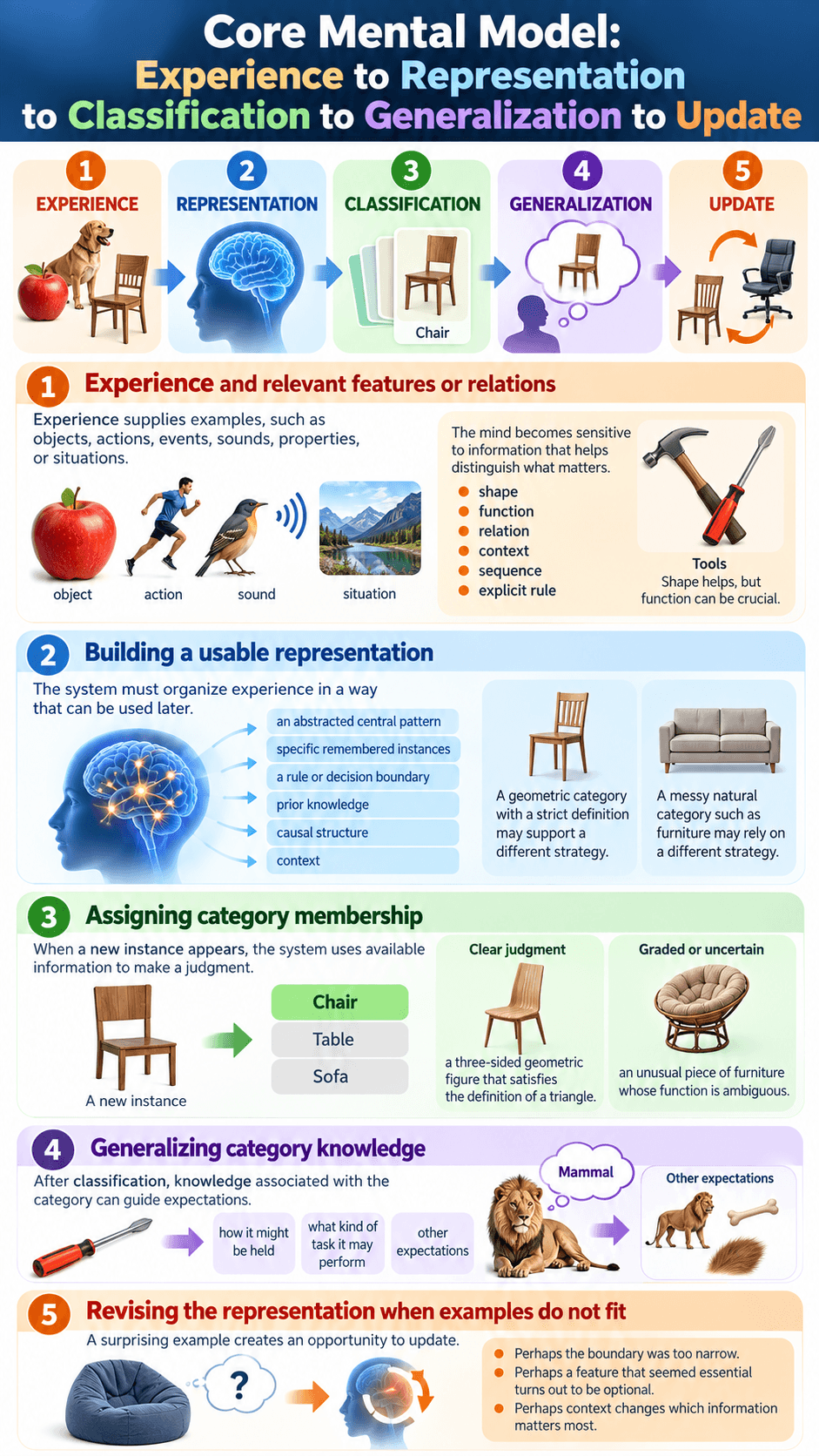
A useful way to understand the overall process is:
EXPERIENCE → REPRESENTATION → CLASSIFICATION → GENERALIZATION → UPDATE
This is a reader-friendly model, not a claim that every act of categorization unfolds through five fixed stages.
Experience and relevant features or relations
Experience supplies examples. Those examples may be objects, actions, events, sounds, properties, or situations. The mind becomes sensitive to information that helps distinguish what matters. Sometimes shape is important. In other cases, function, relation, context, sequence, or an explicit rule matters more.
Consider tools. Shape helps, but function can be crucial. Two objects that look different may still be treated as the same kind of tool because they perform the same task. Conversely, two objects that look similar may belong to different categories because they are designed for different purposes.
Building a usable representation
The system must organize experience in a way that can be used later. One theory may emphasize an abstracted central pattern. Another may emphasize specific remembered instances. A third may emphasize a rule or decision boundary. Other approaches stress prior knowledge, causal structure, or context.
The important point is that representation is not automatically identical across all categories. A geometric category with a strict definition may support a different strategy from a messy natural category such as furniture.
Assigning category membership
When a new instance appears, the system uses available information to make a judgment. That judgment may be clear, as with a three-sided geometric figure that satisfies the definition of a triangle. It may be graded or uncertain, as with an unusual piece of furniture whose function is ambiguous.
Research on categorization has long compared prototype, exemplar, and rule-based approaches rather than treating a single account as universally sufficient. A review of prototype and exemplar processes emphasizes that each can be useful under different task conditions and category structures.
Generalizing category knowledge
After classification, knowledge associated with the category can guide expectations. This is what makes a category useful rather than merely a label. Knowing that an object is a screwdriver suggests how it might be held and what kind of task it may perform. Knowing that an animal is a mammal supports other expectations, although those expectations may still have exceptions.
Generalization should therefore be treated as probabilistic when the category supports tendencies rather than strict rules. Being a category member does not guarantee every associated property.
Revising the representation when examples do not fit
A surprising example creates an opportunity to update. Perhaps the boundary was too narrow. Perhaps a feature that seemed essential turns out to be optional. Perhaps context changes which information matters most.
Good category knowledge is not simply a collection of rigid boxes. It can be stable enough to support prediction while remaining flexible enough to accommodate exceptions, new information, and changing purposes.
A Reader-Friendly Process Map: Notice, Group, Represent, Classify, Generalize, Revise
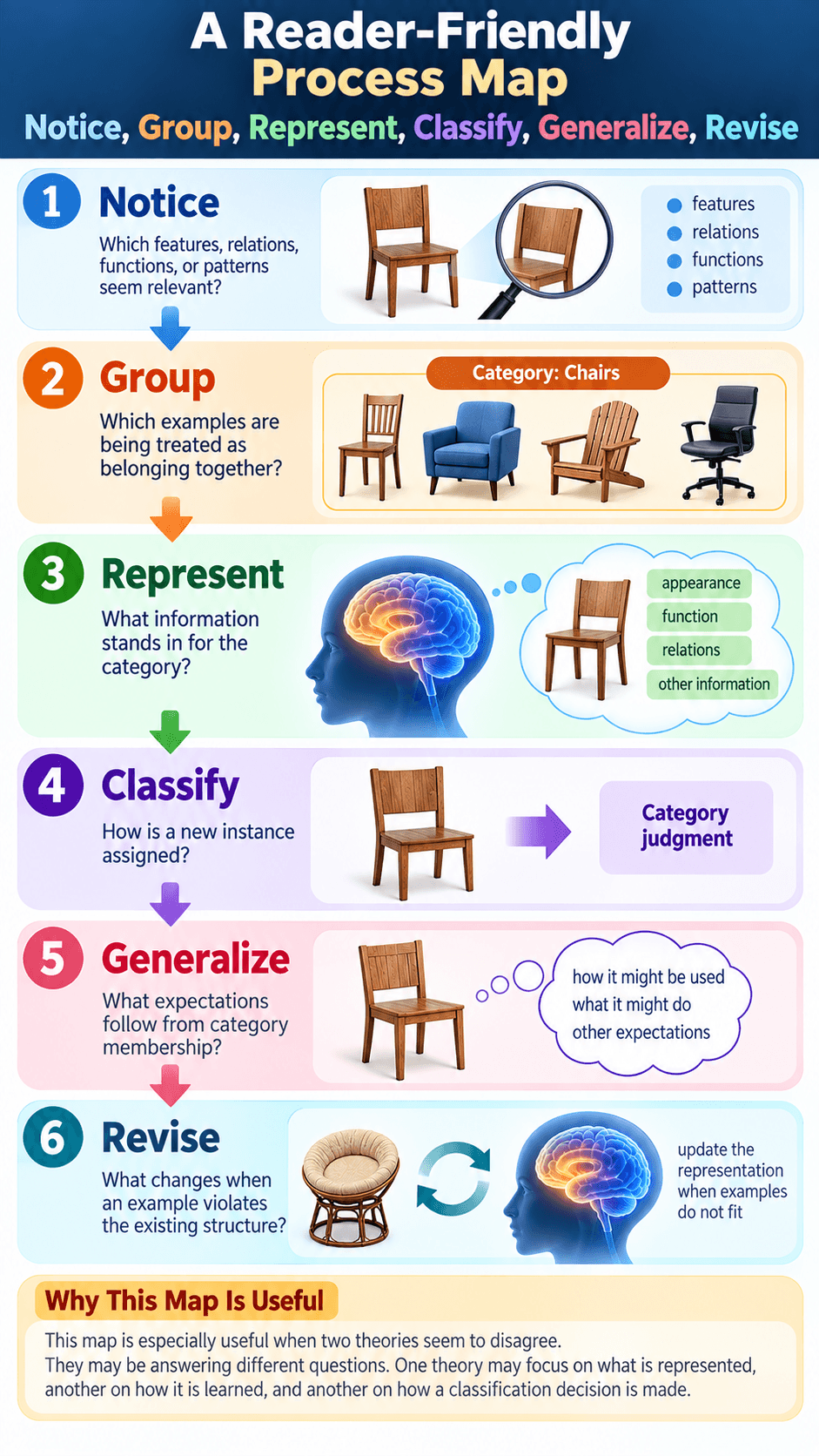
A second model focuses on the questions a person could ask when trying to understand categorization:
- Notice: Which features, relations, functions, or patterns seem relevant?
- Group: Which examples are being treated as belonging together?
- Represent: What information stands in for the category?
- Classify: How is a new instance assigned?
- Generalize: What expectations follow from category membership?
- Revise: What changes when an example violates the existing structure?
This map is especially useful when two theories seem to disagree. They may be answering different questions. One theory may focus on what is represented, another on how it is learned, and another on how a classification decision is made.
Building Concepts and Learning Categories
How new concepts take shape
Concept formation asks how a usable representation develops. Experience matters, but concepts are not built only by counting visible features. Relations, functions, prior knowledge, labels, goals, counterexamples, and context may all influence what becomes important.
The concept of “container,” for example, is not tied to one shape or material. Bottles, boxes, bowls, and bags differ greatly in appearance, yet a functional relation, something holding or enclosing something else, helps organize them.
Why concept and category are not identical questions
Knowing about birds is richer than merely deciding whether an animal belongs to the bird category. Conceptual knowledge can include behavior, anatomy, habitats, relationships, functions, and expectations. A membership judgment uses only part of that knowledge at a given moment.
This is why a person can know much about an item and still hesitate over its category, or classify something correctly while knowing little about it.
How category learning differs from learning in general
Category learning asks how experience teaches a system which examples belong where. Feedback, repeated examples, relevant dimensions, similarity, and rule discovery can all matter. But this is a specialized learning problem, not a replacement for the broader psychology of learning.
A person can improve at classifying unfamiliar shapes without acquiring a broad theory of those shapes. Conversely, someone may learn many facts about an object without practicing category decisions at all.
How Categories May Be Represented
Prototype-based representation
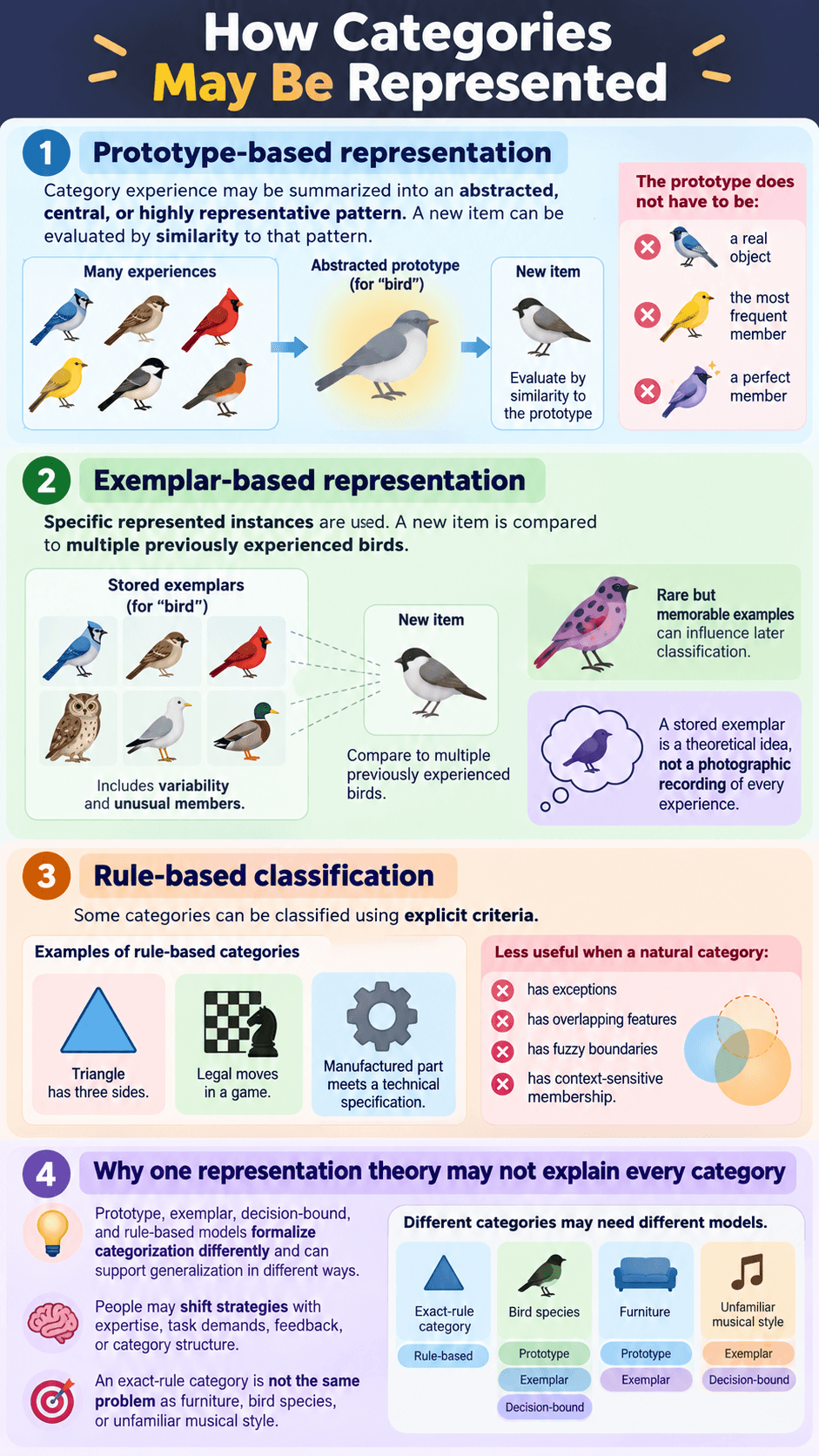
Prototype approaches propose that category experience may be summarized into an abstracted, central, or highly representative pattern. A new item can then be evaluated by how similar it is to that pattern.
The prototype does not have to be a real object, the most frequent member, or a perfect member. It is a theoretical representation of central structure. This is useful for explaining how people may classify new items they have never encountered before.
Exemplar-based representation
Exemplar approaches emphasize specific represented instances. Instead of comparing a new bird with one abstract “average bird,” the system may draw on similarity to multiple previously experienced birds.
This can preserve information about variability and unusual members. It also helps explain why rare but memorable examples can influence later classification. Importantly, “stored exemplar” is a theoretical idea, not a claim that the mind keeps a photographic recording of every experience.
Rule-based classification
Some categories can be classified using explicit criteria. A triangle has three sides. A game may define legal moves with stated conditions. A manufactured part may belong to a category only if it meets a technical specification.
Rule-based classification is powerful when the relevant structure can be verbalized. It becomes less useful when a natural category has exceptions, overlapping features, fuzzy boundaries, or context-sensitive membership.
Why one representation theory may not explain every category
The long history of competing categorization models suggests caution toward simple universal claims. A theoretical analysis comparing several approaches notes that prototype, exemplar, decision-bound, and rule-based models formalize categorization differently and can support generalization in different ways. That comparison of categorization and generalization is one reason it is safer to think in terms of multiple useful models rather than a single mechanism for every domain.
People may also shift strategies with expertise, task demands, feedback, or category structure. A category defined by one exact rule is not the same problem as identifying a type of furniture, judging a species of bird, or classifying an unfamiliar musical style.
How Category Structure Changes Judgment
Why some members feel more typical than others
Within many categories, some members are judged as better examples. A robin may feel more representative of “bird” than a penguin, even though both are genuine birds. This is the typicality effect.
Typicality is not the same as membership. It is also not direct proof that the mind stores a prototype. Exemplar models and other approaches can also produce typicality effects. This distinction matters because an observed pattern and a theory explaining that pattern are not the same thing.
Why an intermediate level often feels useful
Categories can be organized at different levels: animal, dog, golden retriever; vehicle, car, sports car; furniture, chair, office chair. The intermediate level is often called the basic level because it can provide a useful balance between being informative and being economical.
Research on real-world scenes describes superordinate, basic, and subordinate levels and notes that basic-level descriptions often offer a useful trade-off between informativeness and cognitive effort. Research on category systems for real-world scenes also shows why level of abstraction is a separate question from whether a particular member is typical.
The preferred level is not universal. Expertise can make more specific categories efficient. A bird expert may routinely make distinctions that a novice treats as unnecessary.
Category boundaries can be sharp, graded, or context-sensitive
Some categories have clear formal boundaries. A geometric definition can make membership straightforward. Others have graded structure: an item may be a weak or unusual member without being excluded. Still others depend heavily on goals and context.
Imagine organizing food in a kitchen. Tomatoes may be grouped with vegetables for cooking, with fruits in a botanical context, or with salad ingredients for meal preparation. The grouping changes because the purpose changes, not because the object itself has changed.
How Prior Knowledge and Concept Combination Extend the System
Organized prior knowledge shapes what new information means
Concepts rarely operate in isolation. Prior knowledge includes expected relationships, sequences, roles, and contexts. When you enter a restaurant, you do not merely recognize tables, menus, and food as separate objects. You understand a familiar structure involving ordering, serving, paying, and leaving.
These organized knowledge structures help interpretation, but they can also create expectations that need updating. A restaurant with self-service ordering or no physical menu may violate part of the familiar structure without ceasing to be a restaurant.
Existing concepts can combine into new meanings
The conceptual system is also productive. “Pet fish,” “stone lion,” “sports car,” and “emergency meeting” combine familiar concepts into more specific meanings. The result is not always simple addition. New properties or relations can emerge from the combination.
Research on conceptual combination examines how people construct new meanings from existing concepts. An open-access review of conceptual combination discusses how context, conceptual knowledge, and different forms of information can contribute to these interpretations.
This capacity shows why conceptual knowledge is more flexible than a dictionary of fixed definitions. Familiar representations can be reorganized, qualified, and combined to understand something novel.
What Can Change a Category Judgment?
| Influence | What it can change | Simple example |
|---|---|---|
| Similarity | How closely a new item resembles known members or a central pattern | An unfamiliar fruit resembles several known citrus fruits |
| Function | Which properties matter most for classification | An oddly shaped object is still classified as a tool because of what it does |
| Relations | How an item fits with other items or roles | A container is understood partly by the relation between an object and what it holds |
| Prior knowledge | Which cues are treated as meaningful | A mechanic notices vehicle distinctions that a novice misses |
| Context | Which grouping is useful in the moment | A tomato is grouped differently in cooking and botany |
| Goals | The level or boundary of the category | “Chair” may be enough for shopping, while “ergonomic office chair” matters for a work setup |
| Feedback | How boundaries or strategies are revised | Repeated correction changes which visual features matter in a training task |
| Expertise | Which distinctions feel natural and efficient | A bird expert readily uses species-level categories that a novice rarely uses |
The table also shows why a category judgment should not be interpreted as a direct readout of one fixed mental representation. The same person may classify differently when the task, context, or goal changes.
Which Explanation Fits Your Question?
| If you are asking… | The most relevant idea is… |
|---|---|
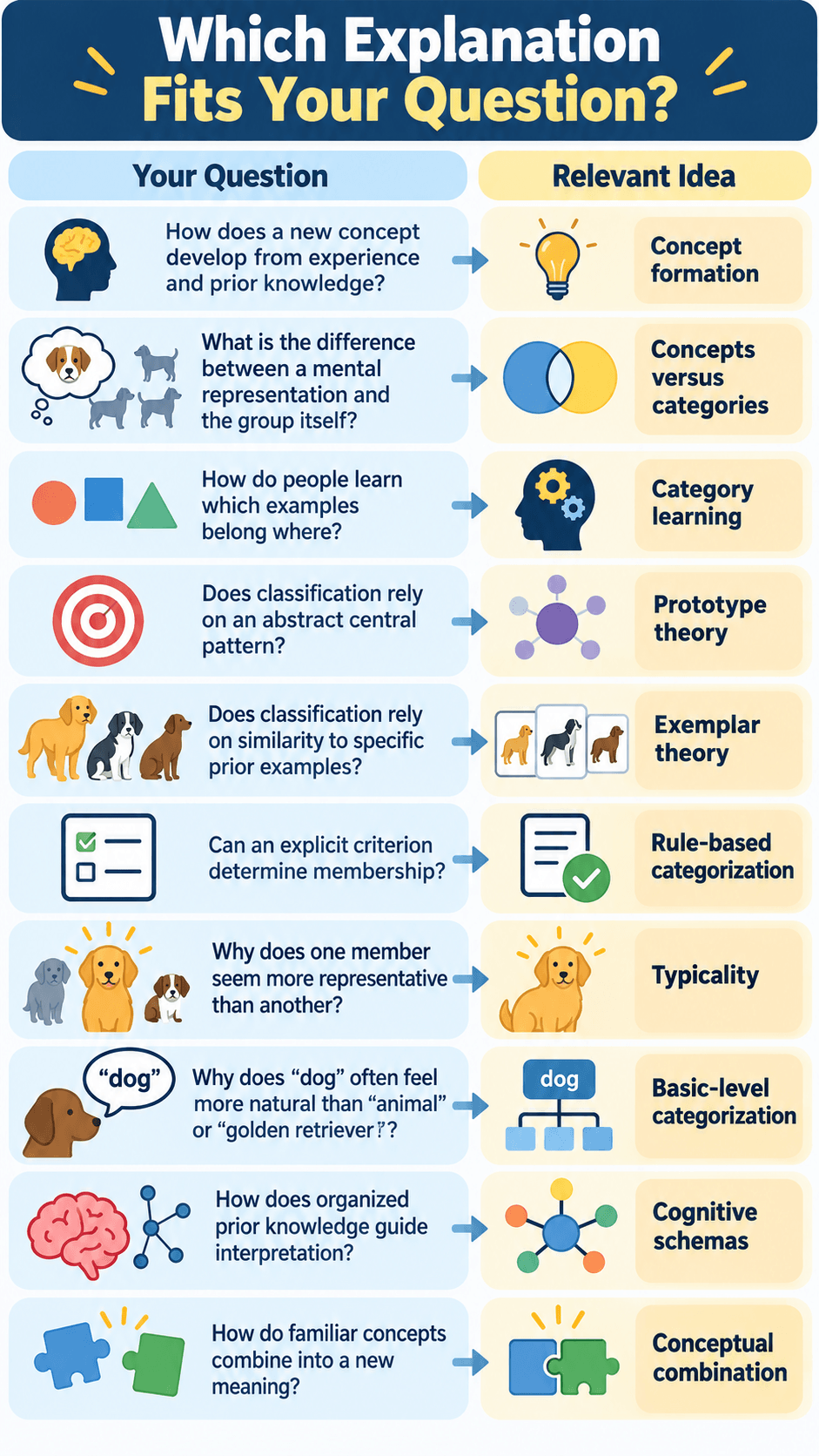
| How does a new concept develop from experience and prior knowledge? | Concept formation |
| What is the difference between a mental representation and the group itself? | Concepts versus categories |
| How do people learn which examples belong where? | Category learning |
| Does classification rely on an abstract central pattern? | Prototype theory |
| Does classification rely on similarity to specific prior examples? | Exemplar theory |
| Can an explicit criterion determine membership? | Rule-based categorization |
| Why does one member seem more representative than another? | Typicality |
| Why does “dog” often feel more natural than “animal” or “golden retriever”? | Basic-level categorization |
| How does organized prior knowledge guide interpretation? | Cognitive schemas |
| How do familiar concepts combine into a new meaning? | Conceptual combination |
Common Misunderstandings About Categorization
Categorization is not the same as stereotyping
Categorization is a basic cognitive function used for objects, events, actions, properties, and many other kinds of information. Stereotyping involves generalized expectations or associations connected to social categories. The existence of ordinary categorization does not by itself explain prejudice, hostility, or discrimination.
That distinction is also ethically important. Saying that categorization is normal should never be used to excuse treating an individual as if group-level assumptions were sufficient evidence about that person.
Categorization is not the same as inductive reasoning
Categorization answers a question such as “What kind of thing is this?” Inductive reasoning asks what broader conclusion is supported by evidence. Category membership can provide information used in an induction, but the classification and the inference are separate cognitive jobs.
For example, deciding that an unfamiliar animal is a bird is categorization. Inferring that it probably shares a property observed in many other birds is induction.
Typicality is not category membership
Atypical does not mean incorrect. A penguin can be a poor example of the mental picture that comes quickly to mind for “bird” while remaining a genuine bird. Confusing typicality with membership makes category boundaries look simpler than they really are.
One theory does not explain every domain
It is tempting to ask whether the mind “really” uses prototypes, exemplars, or rules. A better question is often: under what conditions does each approach explain behavior well? Category structure, goals, feedback, expertise, and context can all influence the strategy that is useful.
This also protects against an overly mechanical view of cognition. Concepts should not be imagined as fixed files stored in one mental cabinet. They are functional organizations of knowledge that support different tasks.
Practical Reflection Questions
You can notice categorization in everyday life without turning the exercise into a personality test. Choose one ordinary category, such as “tool,” “snack,” “game,” or “vehicle,” and ask:
- What makes an instance clearly belong?
- Which members feel especially typical, and which feel unusual?
- Are you relying on appearance, function, a rule, remembered examples, or several cues at once?
- Would your grouping change if your goal changed?
- What example would make you reconsider the boundary?
- Would an expert in this domain divide the category more finely than you do?
The point is not to discover your personal “categorization style.” People can use different information in different domains. The exercise simply makes visible how much ordinary thought depends on grouping, representing, and revising knowledge.
FAQ About Concepts and Categorization Psychology
Are concept and category the same thing in psychology?
Not always. A useful distinction is that a concept is the mental representation or organized knowledge used for thinking, while a category is the class of instances treated as belonging together. However, research traditions sometimes use the terms differently or partly interchangeably, so the distinction should be treated as an editorial aid rather than a universal rule.
Does every category have a prototype?
No conclusion that broad is justified. Prototype theory is influential, but some categories are better described by explicit rules, collections of individual examples, boundaries, prior knowledge, or combinations of mechanisms. Even when people show typicality effects, that observation alone does not prove that a prototype is the stored representation.
Can a person use different categorization strategies in different tasks?
Yes. A person may use an explicit rule for a geometric classification, similarity for a natural category, and specialized knowledge in an expert domain. Strategy can also change with practice, feedback, task demands, and the structure of the category itself.
Why can category boundaries change with context or expertise?
Context changes which distinctions matter, while expertise changes what information a person notices and how finely a domain is organized. A novice may treat many objects as simply “birds,” while an expert distinguishes species quickly. Neither level is automatically superior; each may fit a different purpose.
Key Takeaways
- Concepts organize knowledge, categories group instances, and categorization is the process of assigning instances to those groups.
- Categories make cognition efficient because they support recognition, prediction, and generalization beyond examples already seen.
- Prototype, exemplar, and rule-based approaches offer different explanations of how category judgments may be supported, and no single model should be treated as universal.
- Typicality concerns how representative a member seems, while category level concerns whether a person uses a broad, intermediate, or specific grouping.
- Prior knowledge, context, goals, feedback, and expertise can all change which information matters for classification.
- Categorization is a basic cognitive function, but it should not be equated with stereotyping, prejudice, or inductive reasoning.
Final Thought: Notice What Your Categories Let You Do
The most useful next step is to watch one ordinary category in action. Notice how quickly you recognize a new member, what information you rely on, what you expect after classifying it, and what kind of example would force you to revise your judgment. That sequence reveals the practical value of concepts and categories: they let prior knowledge guide new situations without requiring every experience to start from zero.
Educational note: This article explains cognitive psychology for general readers. It is not a diagnostic tool and should not be used to infer intelligence, learning disorders, neurodevelopmental conditions, or neurological disease from how someone categorizes information.

Michael Reed is the Founder and Lead Writer at Psychology Exposed. He writes about human behavior, relationships, emotional patterns, self-awareness, and practical psychology topics using research-informed, easy-to-understand content.
Read More About Michael Reed: https://psychologyexposed.com/michael-reed/