
Some reasoning problems ask you to combine statements about groups or categories and decide what, if anything, must follow. If every copper token is marked, and every marked token is stored in Box A, then every copper token must be stored in Box A. But if some marked tokens are stored in Box A, the conclusion changes. A small difference in words such as “all,” “some,” or “none” can completely change what the premises allow.
Syllogistic reasoning studies how people integrate these categorical premises, represent the possible relationships among groups, and judge whether a conclusion is logically required. The task is narrower than general deduction and different from if-then reasoning. It also reveals something psychologically important: a conclusion can sound believable without following from the premises, while an unusual conclusion can still be valid.
Quick Answer
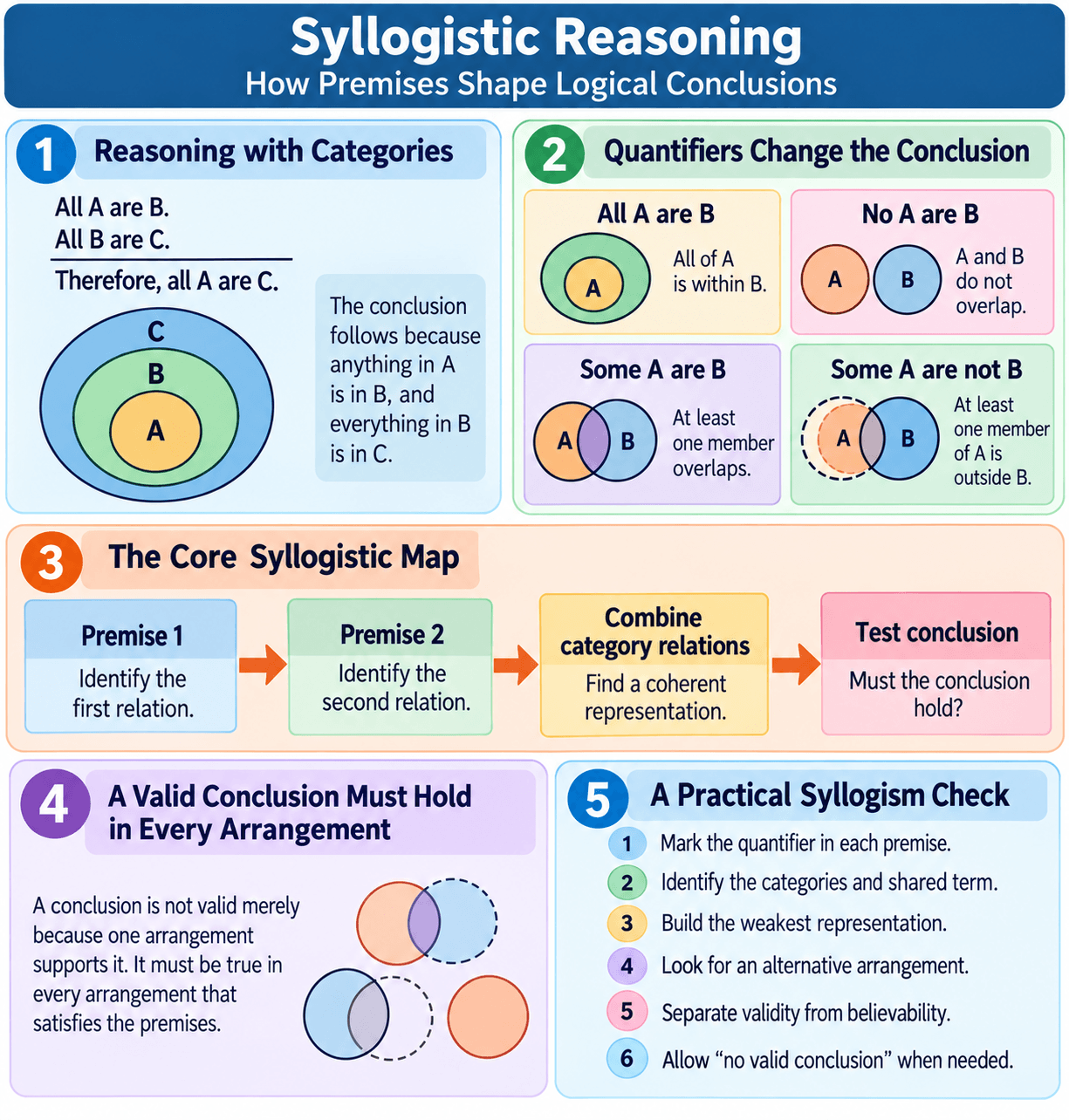
Syllogistic reasoning is deductive reasoning with quantified category statements such as “all,” “some,” and “none.” The reasoner combines two or more premises and asks what conclusions must be true if those premises are accepted. Psychological research examines how people represent category relationships, why some syllogisms are easier than others, and how content or prior belief can influence judgments of logical validity.
What Syllogistic Reasoning Means
Reasoning with categorical premises
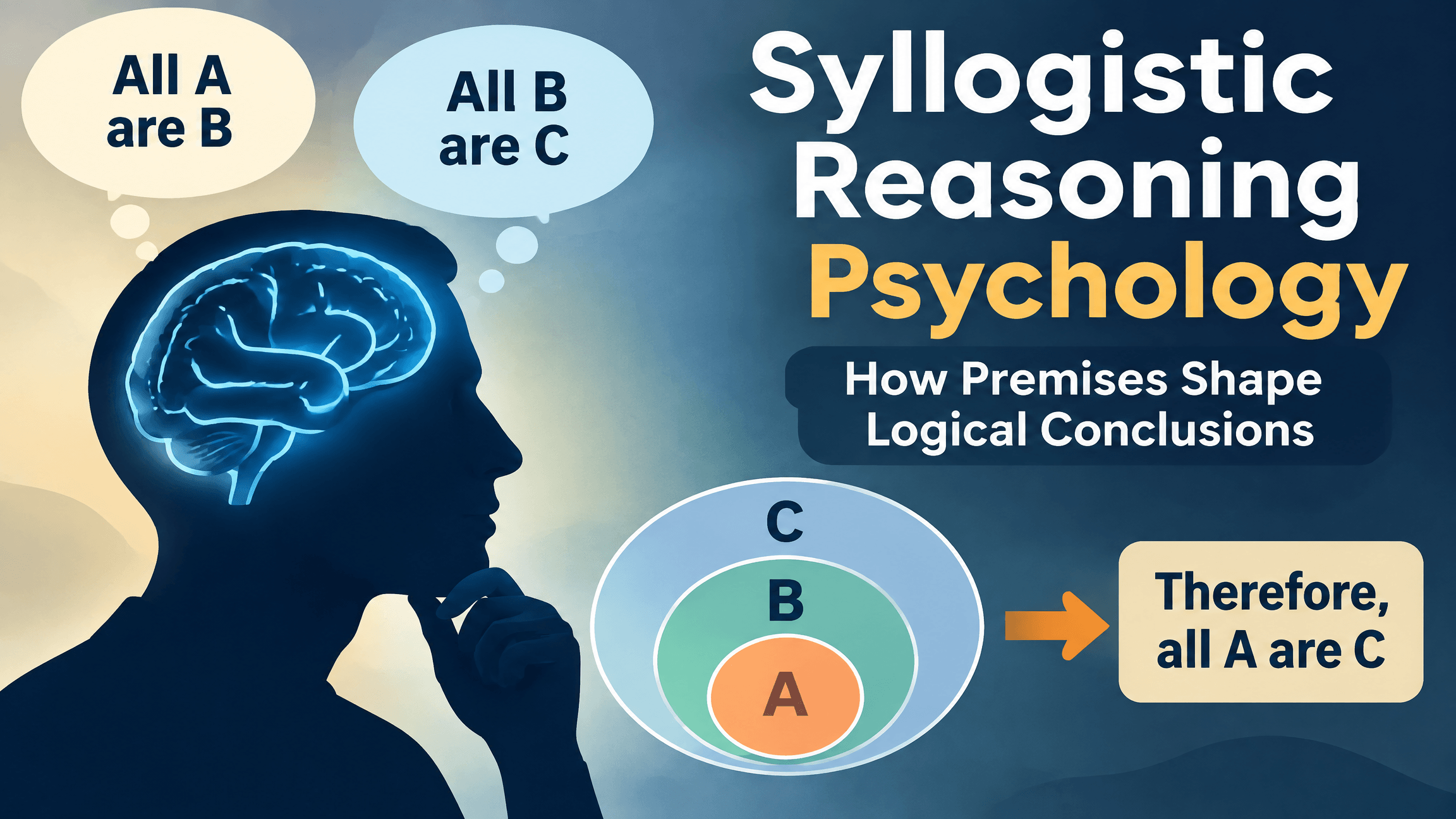
A categorical syllogism describes relationships among classes or groups. A familiar example is:
- All A are B.
- All B are C.
- Therefore, all A are C.
The conclusion follows because anything placed inside category A must also fall within B, and everything in B falls within C. The reasoning depends on how the category relations combine, not on whether A, B, and C refer to familiar objects. Syllogistic reasoning sits within the broader psychology of reasoning and focuses on conclusions supported by quantified category premises.
Why “all,” “some,” and “none” matter
Quantifiers determine how much of one category is related to another. “All A are B” is much stronger than “some A are B.” “No A are B” excludes overlap entirely. “Some A are not B” guarantees at least one member of A outside B.
Changing a single quantifier can change the logical conclusion. Compare “all painters are musicians” with “some painters are musicians.” The first statement places the entire painter category within musicians. The second establishes only partial overlap.
The Core Syllogistic Map
PREMISE 1 → PREMISE 2 → COMBINE CATEGORY RELATIONS → TEST CONCLUSION
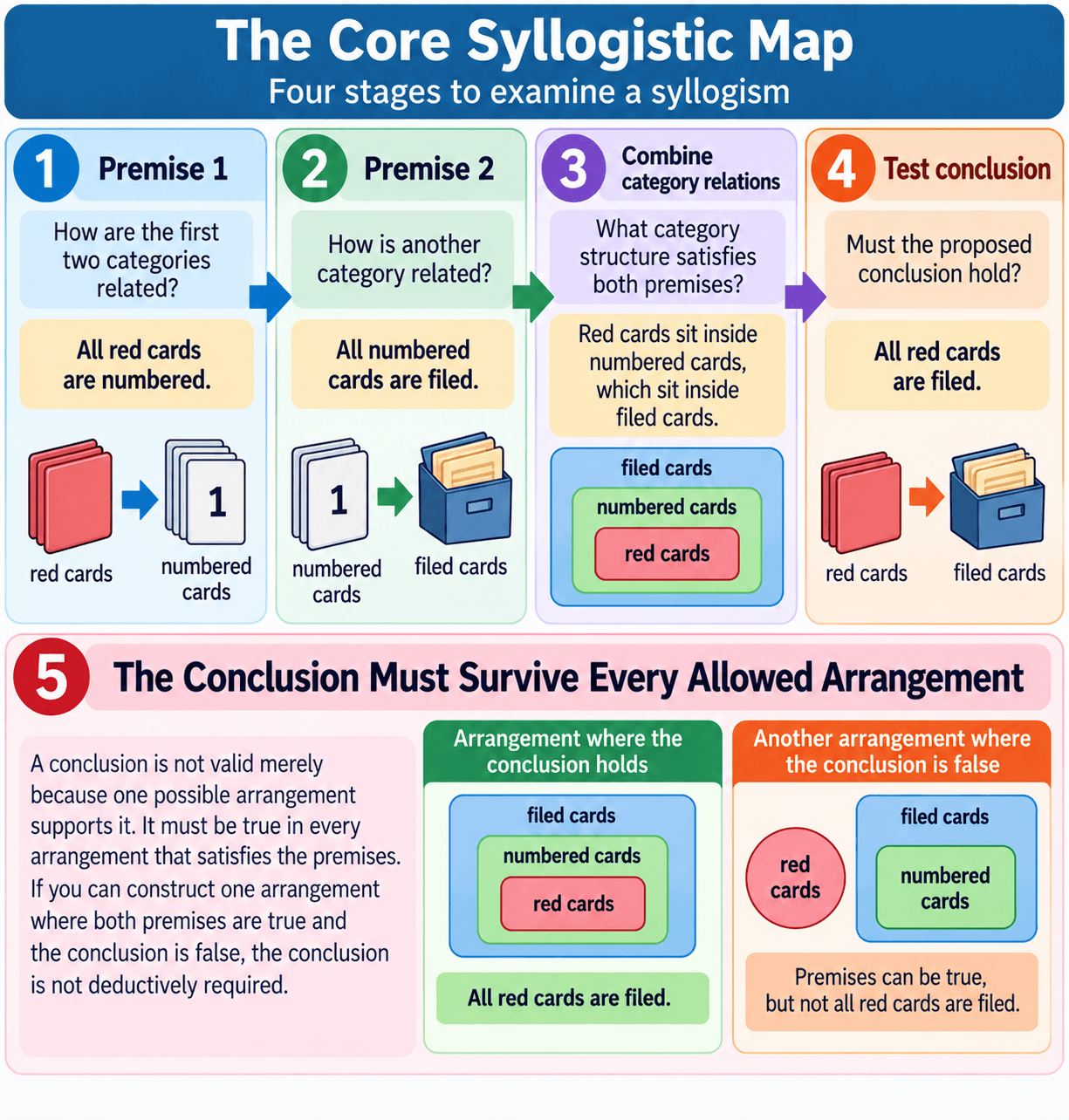
A practical way to examine a syllogism is to separate four stages. First, identify the relationship stated in the first premise. Second, identify the relationship in the second. Third, combine those relationships into one coherent representation. Fourth, test whether the proposed conclusion must hold across every arrangement consistent with the premises.
| Stage | Main question | Example |
|---|---|---|
| Premise 1 | How are the first two categories related? | All red cards are numbered. |
| Premise 2 | How is another category related? | All numbered cards are filed. |
| Combine | What category structure satisfies both premises? | Red cards sit inside numbered cards, which sit inside filed cards. |
| Test conclusion | Must the proposed conclusion hold? | All red cards are filed. |
Why the conclusion must survive every allowed arrangement
A conclusion is not valid merely because one possible arrangement supports it. It must be true in every arrangement that satisfies the premises. If you can construct one arrangement where both premises are true and the conclusion is false, the conclusion is not deductively required.
This counterexample logic connects syllogistic reasoning to broader deduction. The distinctive feature here is that the possibilities are built from category relations rather than if-then rules or other forms of premise structure.
Universal and Particular Statements
Universal affirmative: all A are B
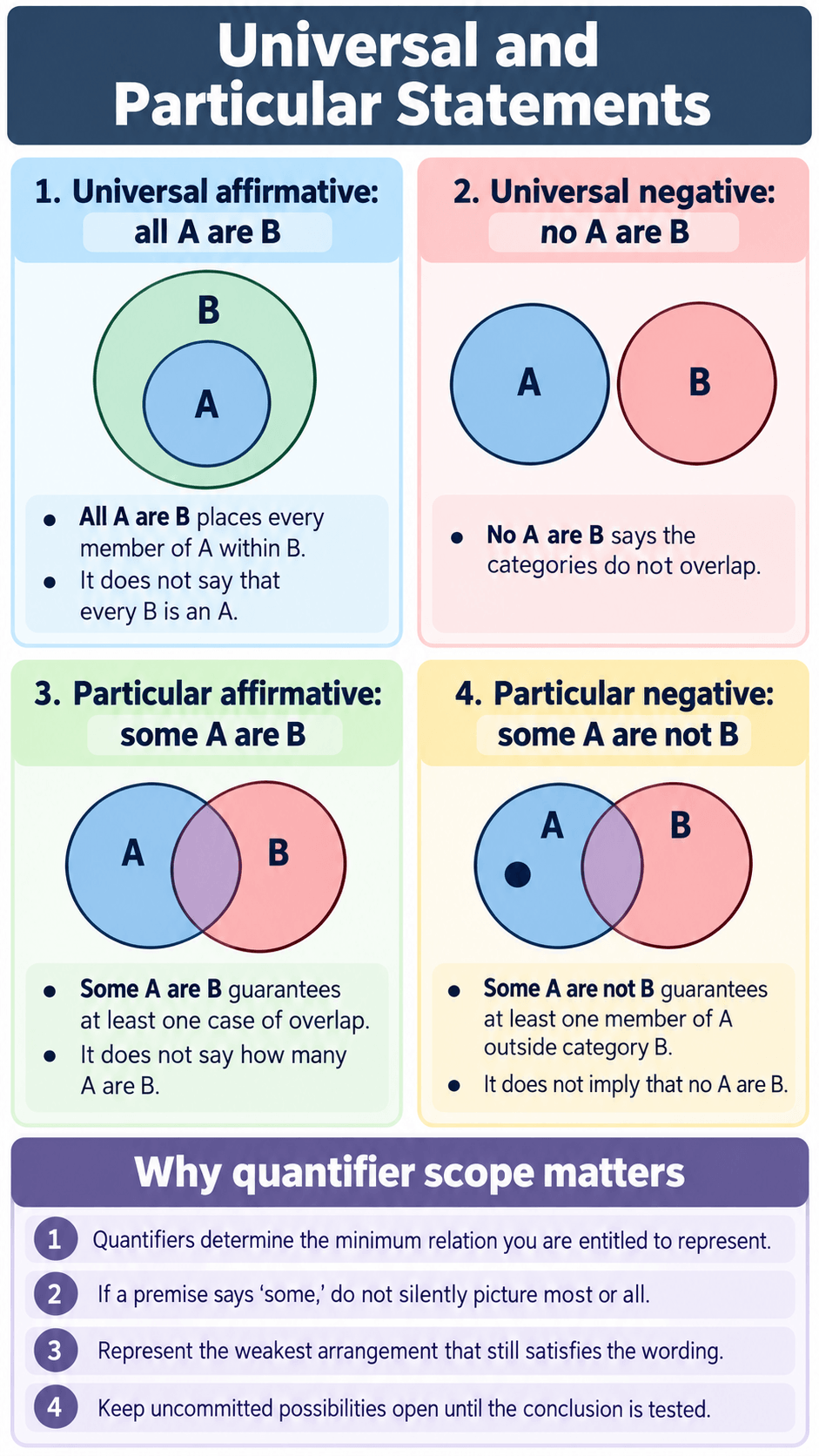
“All A are B” places every member of A within B. It does not say that every B is an A. If all sparrows are birds, many other birds can still exist.
Universal negative: no A are B
“No A are B” says the categories do not overlap. If no blue folders are archived, then an archived folder cannot also be blue under that premise.
Particular affirmative: some A are B
“Some A are B” guarantees at least one case of overlap. It does not say how many A are B or whether most members overlap.
Particular negative: some A are not B
“Some A are not B” guarantees at least one member of A outside category B. It does not imply that no A are B.
Why quantifier scope matters
Quantifiers determine the minimum relation you are entitled to represent. If a premise says “some,” you should not silently picture most or all members of the category in that relationship. Doing so makes the conclusion look stronger than the premises justify.
A useful habit is to represent the weakest arrangement that still satisfies the wording. If the premises allow many different placements of the remaining category members, those uncommitted possibilities should stay open until the conclusion is tested.
How Premises Combine
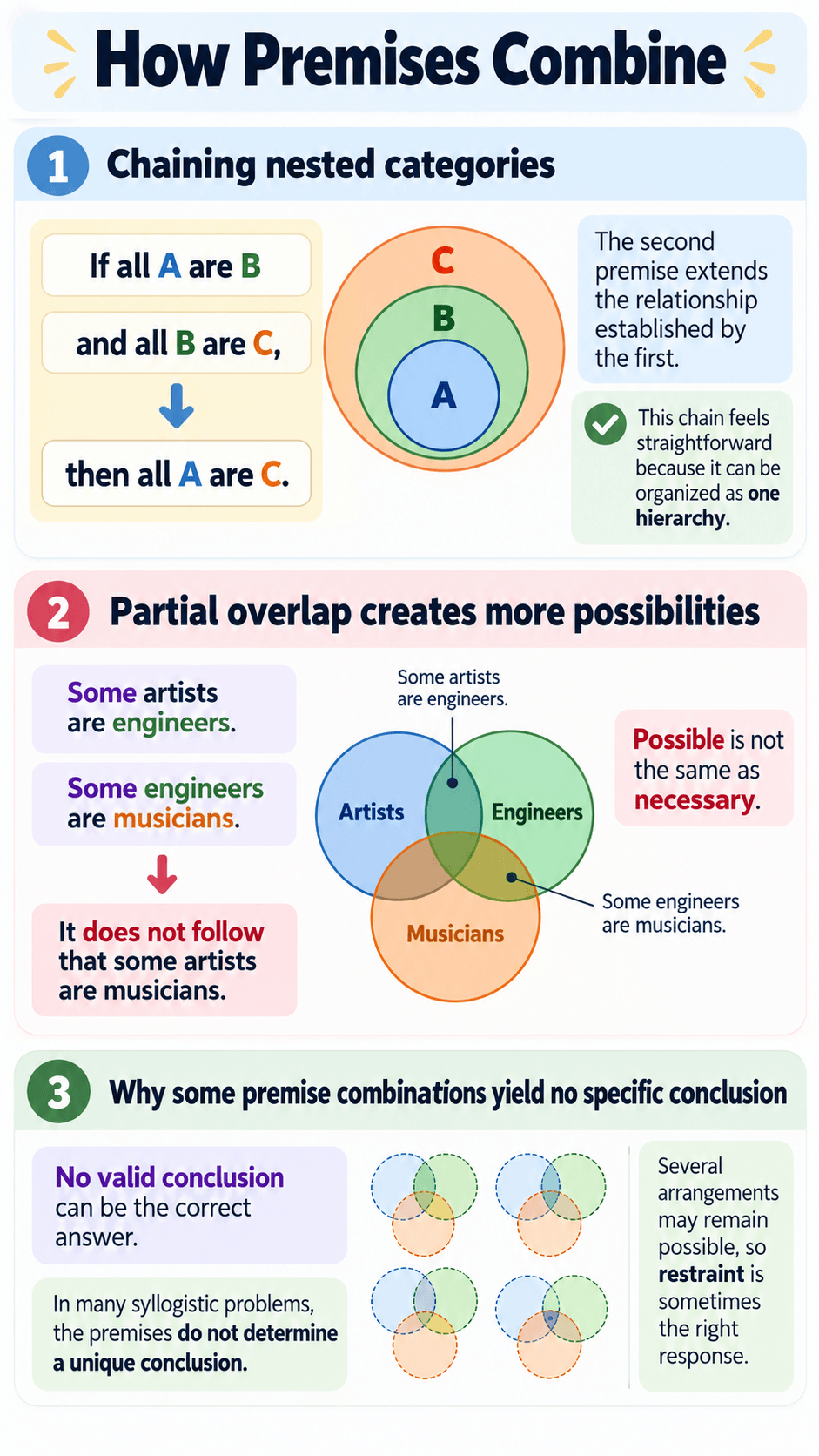
Chaining nested categories
Some syllogisms are easy because the category structure can be nested directly. If all A are B and all B are C, then all A are C. The second premise extends the relationship established by the first.
This kind of chain feels straightforward because the representation can be organized as one hierarchy.
Partial overlap creates more possibilities
Statements involving “some” often leave more arrangements open. Suppose some artists are engineers and some engineers are musicians. It does not follow that some artists are musicians. The artist-engineers could be different people from the engineer-musicians.
The premises are compatible with overlap between artists and musicians, but they do not require it. That distinction between possible and necessary is central.
Why some premise combinations yield no specific conclusion
Not every pair of categorical premises forces a substantive conclusion about the remaining categories. Modern research on “no valid conclusion” responses in syllogistic reasoning highlights how important this outcome is. In many syllogistic problems, the logically appropriate response is that the premises do not determine a unique conclusion.
This matters because people often feel pressure to choose something. Syllogistic reasoning sometimes rewards restraint: if several arrangements remain possible and none forces the proposed relation, “no valid conclusion” may be the correct answer.
Using Simple Diagrams Without Letting the Diagram Decide for You
Why circles and nested sets can help
Simple category diagrams can make quantified relations easier to inspect. “All A are B” can be pictured as A inside B. “No A are B” can be pictured as non-overlapping sets. “Some A are B” can be marked with at least one shared member.
The value of the diagram is not that drawing is inherently more logical. It reduces the memory burden by putting the category relationships in front of you.
Why one diagram may be insufficient
The danger is treating the first diagram you draw as though it were the only arrangement allowed by the premises. Particular statements often leave several possibilities open. A conclusion may look true in the first diagram while failing in another equally legitimate one.
For that reason, a diagram should be followed by the same question used in verbal reasoning: can I redraw the categories in a different way that still satisfies the premises but makes the conclusion false?
Diagrams are a checking aid, not a separate source of truth
A drawing is useful when it preserves the wording accurately. If you accidentally make “some” into “all” or reverse a universal statement, the visual representation simply turns a verbal mistake into a picture. The quantifiers still control what the diagram is allowed to show.
Mental Representation of Category Relations
Representing one possible arrangement
One influential account of reasoning proposes that people construct mental representations of situations compatible with the premises. For “all A are B” and “all B are C,” the reasoner may imagine A inside B and B inside C.
If that first representation supports a conclusion, it can be tempting to stop. But some problems allow alternative arrangements that defeat the conclusion.
Searching for alternative arrangements
Under a mental-model approach, an important step is to consider whether another arrangement satisfies the premises but changes the conclusion. This resembles counterexample search.
Research testing mental-model predictions in syllogistic reasoning has also shown that people do not always construct multiple alternatives in the simple way early versions of the theory predicted. The findings are useful precisely because they show that human syllogistic reasoning is not captured by one uncontested mechanism.
Why theory remains open
Psychologists have proposed rule-based, mental-model, heuristic, probabilistic, and hybrid accounts of syllogistic performance. A modern model of probabilistic representation in syllogistic reasoning, for example, attempts to integrate features of mental-model and heuristic approaches.
For a general reader, the practical lesson is modest: people appear to simplify, represent, and interpret category relations in several ways. Performance is shaped by more than formal validity alone.
Conversion: A Common Interpretation Problem
Why “all A are B” does not mean “all B are A”
If all violinists in an orchestra are musicians, it does not follow that all musicians in the orchestra are violinists. Reversing the relationship creates a stronger claim than the premise provides.
This kind of conversion can feel natural because many everyday categories overlap heavily. But a syllogistic task asks what follows from the stated relation, not what seems likely from background knowledge.
Some statements can be reversed more safely than others
“No A are B” supports “no B are A” because non-overlap is symmetric. “Some A are B” supports “some B are A” because the same overlapping member belongs to both categories.
By contrast, universal affirmative statements cannot generally be reversed. Recognizing which relations are symmetric helps prevent accidental strengthening of a premise.
Atmosphere and Quantifier Cues
How premise wording can suggest a conclusion form
People may sometimes use the surface form of the premises as a cue to what the conclusion should look like. Universal premises can make a universal conclusion feel natural. Negative premises can make a negative conclusion feel expected.
These tendencies have historically been discussed through ideas such as “atmosphere,” although modern research treats syllogistic performance as more complex than one simple heuristic.
Why a plausible conclusion form still needs validation
A conclusion can match the tone or quantifier pattern of the premises and still fail logically. The structure must be checked by seeing whether the category relation is necessary.
Heuristic cues may help generate a candidate conclusion, but they should not replace the validity test.
Content Changes How Syllogisms Are Solved
Abstract versus meaningful categories
A syllogism involving unfamiliar labels such as “all nops are taves” removes most world knowledge. A syllogism about familiar professions, animals, or objects activates existing conceptual relationships.
Meaningful content can make the premises easier to understand, but it can also introduce expectations that influence how the categories are represented.
Content can influence strategy
Research on content and strategy in syllogistic reasoning found that particular content could encourage participants to use different interpretive strategies when solving syllogisms. The broader point is that people do not always process identical logical forms in identical ways.
This does not mean content changes whether an argument is formally valid. It means content can change the psychological route used to evaluate it.
Conceptual knowledge may shape representation
Other work has shown that relations among familiar concepts can alter reasoning performance even when the formal structure is held constant. In one study of conceptual structures and syllogistic reasoning, manipulating semantic relationships changed response patterns in ways consistent with effects on mental representation.
Prior knowledge therefore needs to be separated from logical structure. It may aid understanding, interfere with validity judgment, or change which representation comes to mind first.
Syllogistic Reasoning and Believability
Believable conclusions can feel easier to accept
Suppose a syllogism ends with a conclusion that matches what you already know. Acceptance may feel immediate. When the conclusion is bizarre or clearly false in ordinary life, people may scrutinize it more carefully.
This interaction between believability and validity is a major topic in reasoning research. A meta-analysis of belief bias in syllogistic reasoning shows that the phenomenon has been studied extensively and that measurement and theory are more complicated than a simple claim that belief always overrides logic.
Why this article stops before explaining belief bias in depth
For syllogistic reasoning, the important point is that familiar content can influence judgments of conclusion validity. The deeper question of why believable conclusions are accepted differently, how conflict is detected, and which models best explain that interaction belongs to belief bias specifically.
Keeping that boundary clear prevents the category logic of syllogisms from being confused with a separate psychological effect involving prior belief.
Syllogistic Reasoning vs Conditional Reasoning
Category relations versus if-then rules
Syllogisms work with quantified category statements such as all, some, and none. Conditional reasoning works with directional statements such as “if P, then Q.” Both can support deductive inference, but the structures differ.
| Feature | Syllogistic reasoning | Conditional reasoning |
|---|---|---|
| Typical form | All, some, none | If P, then Q |
| Main relation | Category inclusion, exclusion, or overlap | Condition and consequence |
| Common challenge | Integrating quantified category relations | Direction, alternatives, necessary vs sufficient conditions |
| Typical error | Invalid conversion or unsupported category conclusion | Affirming the consequent or denying the antecedent |
Why the two should not be treated as interchangeable
“All red cards are marked” and “if a card is red, then it is marked” can sometimes express similar information. Yet research tasks built from categorical quantifiers and those built from conditionals produce different interpretive problems and error patterns.
Understanding the distinction helps identify which reasoning structure is actually causing difficulty.
Syllogistic Reasoning vs Deductive Reasoning Generally
Syllogisms are one family of deduction
Deduction is the broader category. It includes any inference where the conclusion is intended to follow necessarily from the premises. Syllogistic reasoning is one historically important subtype centered on quantified categories.
Why studying syllogisms is psychologically useful
Syllogisms offer controlled ways to vary validity, premise form, quantifiers, content, and believability. This makes them useful experimental tools for studying how people represent premises and judge conclusions.
They should not be treated as a complete model of human reasoning. Everyday deduction can involve conditionals, spatial relations, rules, and many other structures.
A Practical Syllogism Check
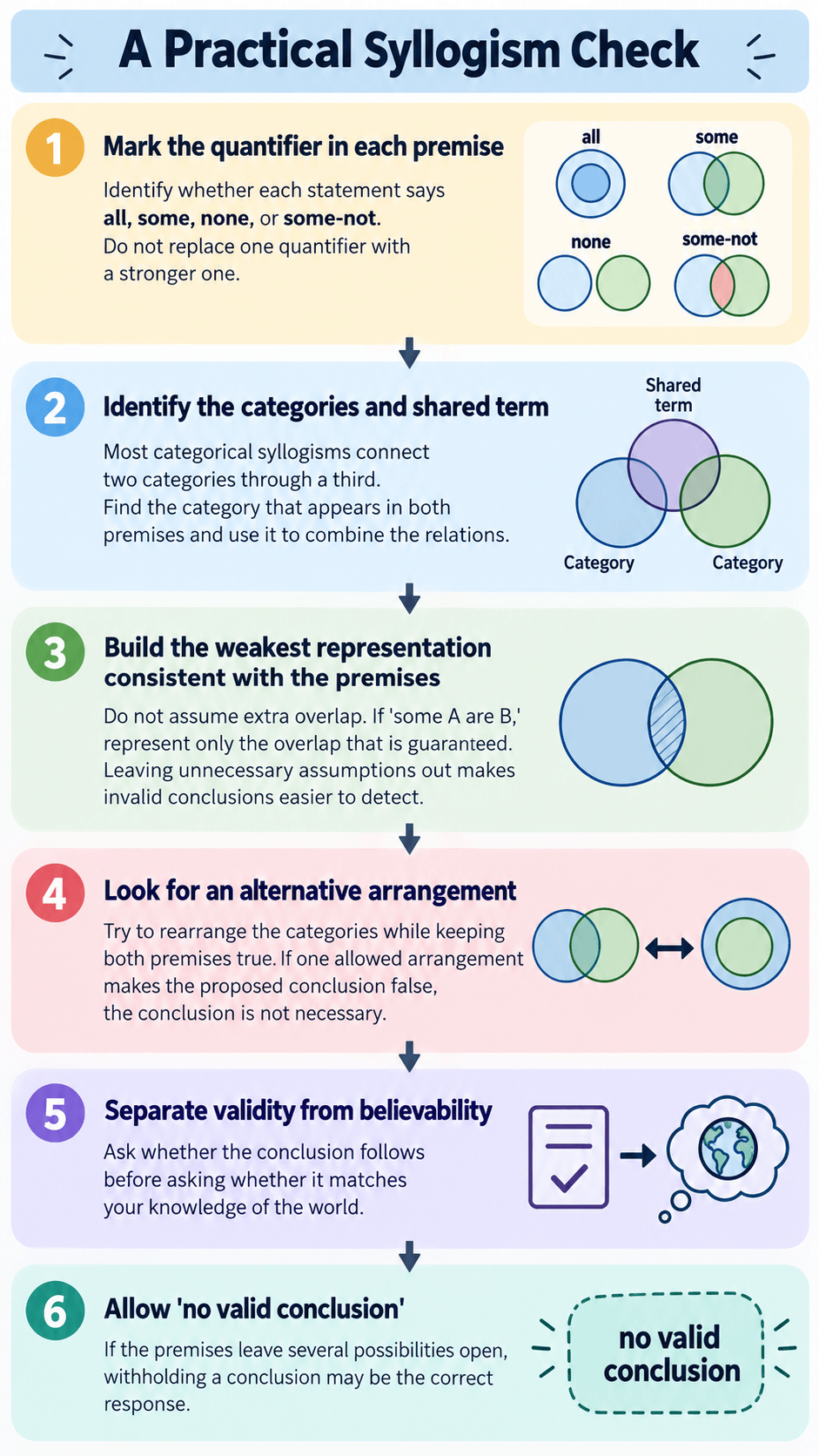
1. Mark the quantifier in each premise
Identify whether each statement says all, some, none, or some-not. Do not replace one quantifier with a stronger one.
2. Identify the categories and shared term
Most categorical syllogisms connect two categories through a third. Find the category that appears in both premises and use it to combine the relations.
3. Build the weakest representation consistent with the premises
Do not assume extra overlap. If “some A are B,” represent only the overlap that is guaranteed. Leaving unnecessary assumptions out makes invalid conclusions easier to detect.
4. Look for an alternative arrangement
Try to rearrange the categories while keeping both premises true. If one allowed arrangement makes the proposed conclusion false, the conclusion is not necessary.
5. Separate validity from believability
Ask whether the conclusion follows before asking whether it matches your knowledge of the world. This prevents a believable conclusion from being accepted merely because it sounds right.
6. Allow “no valid conclusion” when the premises leave several possibilities open
A reasoning task does not always owe you a positive conclusion. If the premises fail to determine the relationship being asked about, withholding a conclusion is the logically appropriate response.
Three Short Examples
Example 1: a valid categorical chain
All cedar boxes are wooden. All wooden boxes are inspected. Therefore, all cedar boxes are inspected. The conclusion must hold because the cedar category is contained within wooden, which is contained within inspected.
Example 2: an invalid overlap inference
Some designers are writers. Some writers are musicians. Therefore, some designers are musicians. The conclusion is possible, but not required. The writer-designers and writer-musicians could be different people.
Example 3: a conclusion that feels true but is not established
All whales are mammals. Some mammals live on land. Therefore, some whales live on land. The conclusion conflicts with familiar knowledge, but even without that knowledge the premises do not establish it. The land-living mammals could belong entirely outside the whale category.
This example is useful because it shows that validity should be decided from the premise structure. Real-world knowledge may make the error obvious, but the logical problem exists independently of that knowledge.
Common Misunderstandings
If the conclusion is possible, it must be valid
No. Deductive validity requires necessity, not possibility. A conclusion that works in one allowed arrangement can still fail in another.
“Some” means “many”
Not in formal reasoning. “Some” guarantees at least one case, but it does not specify a majority or typical pattern.
“All A are B” means “all B are A”
No. Universal inclusion is directional. Reversing it can create an invalid conclusion.
A strange conclusion must be logically wrong
No. Believability and validity are separate. An unusual conclusion can follow from unusual premises, while a believable conclusion can fail to follow.
A wrong syllogism answer proves poor intelligence
No. Performance can vary with representation, wording, working-memory demands, content, familiarity, and strategy. One task or error does not justify a broad conclusion about intelligence or cognitive health.
FAQ About Syllogistic Reasoning
What is a syllogism in psychology?
A syllogism is a reasoning problem in which quantified statements about categories are combined to evaluate a conclusion. Psychology uses syllogisms to study how people represent premises, integrate category relations, and distinguish validity from content or believability.
Why are syllogisms sometimes difficult even when the rules look simple?
Difficulty can increase when premises allow several possible category arrangements, when quantifiers are easy to misinterpret, or when familiar content pulls attention away from the formal relationship. Different theoretical models also suggest that people use different representations and shortcuts across problems.
What does “no valid conclusion” mean?
It means the premises do not force a specific conclusion of the type being considered. Several arrangements may satisfy the premises, and those arrangements may support different outcomes. In that case, declining to draw a stronger conclusion is appropriate.
How is syllogistic reasoning different from belief bias?
Syllogistic reasoning is the broader task of combining quantified category premises and testing conclusions. Belief bias is a specific psychological effect in which the believability of a conclusion interacts with judgments of logical validity. The effect is often studied using syllogisms, but the two concepts are not the same.
Are syllogisms the same as all deductive reasoning?
No. Syllogisms are one family of deductive problems. Deduction also includes conditional, spatial, relational, and other forms of reasoning where conclusions are intended to follow necessarily from premises.
Key Takeaways
- Syllogistic reasoning combines quantified category statements such as all, some, and none to determine what conclusions must follow.
- A valid conclusion must survive every arrangement consistent with the premises, not merely one plausible arrangement.
- Universal, particular, affirmative, and negative statements create different category relationships and cannot be freely converted into one another.
- Some syllogisms correctly yield no valid conclusion because the premises leave multiple relationships possible.
- Content and prior belief can change how people interpret and judge syllogisms without changing the formal validity of the argument.
- Syllogistic reasoning is one subtype of deduction and should be kept separate from conditional reasoning and the more specific phenomenon of belief bias.
A useful next step is to slow down before choosing a conclusion. Mark each quantifier, draw the weakest category relationship that satisfies the premises, and then deliberately look for another arrangement. If one alternative keeps the premises true while making the conclusion false, the conclusion is not necessary. That habit turns a syllogism from a verbal impression into a clearer test of category structure.

Michael Reed is the Founder and Lead Writer at Psychology Exposed. He writes about human behavior, relationships, emotional patterns, self-awareness, and practical psychology topics using research-informed, easy-to-understand content.
Read More About Michael Reed: https://psychologyexposed.com/michael-reed/