
How do you come to understand what counts as a tool, a game, a vehicle, a warning, or even an idea such as fairness? You rarely receive a complete definition first and then apply it forever. More often, you encounter examples, notice patterns, learn what matters, meet exceptions, connect new information with what you already know, and gradually build a representation that becomes useful for thinking.
That broad process is what concept formation psychology tries to explain. It is not simply memorizing labels, and it is not limited to deciding whether an item belongs in a category. A concept has to support recognition, prediction, comparison, communication, and often generalization to situations that were never encountered before. Because concepts range from concrete objects to abstract relationships, psychologists have proposed multiple ways that experience, features, relations, context, prior knowledge, and language may contribute.
Quick Answer: What Concept Formation Means
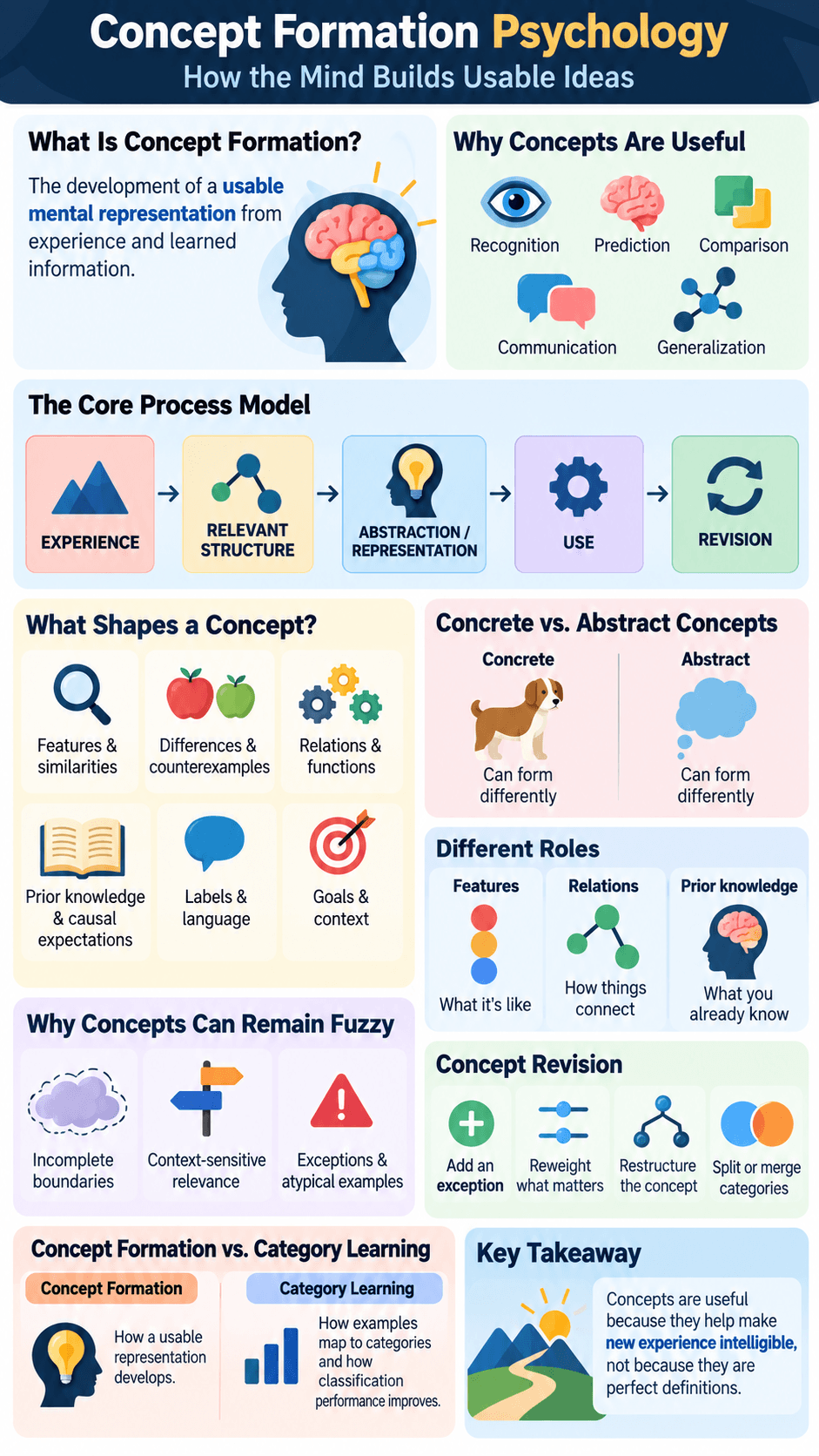
Concept formation is the development of a usable mental representation from experience and learned information. The mind may become sensitive to shared features, important differences, functions, relations, examples, counterexamples, prior knowledge, labels, and goals. The result does not have to be a rigid definition. A useful concept can remain flexible, context-sensitive, and open to revision when new evidence does not fit.
From Experience to a Usable Concept
A concept becomes useful when it lets a person do more than remember individual encounters. If you have seen only a few bicycles, you can still recognize a bicycle with a frame shape or handlebar design you have never seen. If you understand “container,” you can apply the idea to a bottle, box, bowl, pouch, or unfamiliar object that performs the same broad function.
The APA Dictionary of Psychology describes conceptualization as forming concepts from experience or learned material. That definition is deliberately broad. It does not say that one mechanism, such as feature matching, explains every concept.
Encountering examples, events, properties, and relations
Concept formation begins with information. Sometimes that information comes from repeated perceptual experience. A person sees many birds, cups, vehicles, or trees. Sometimes the information comes from instruction, reading, conversation, diagrams, or explicit definitions. Many concepts are built from both direct and indirect experience.
The input can also be relational rather than object-based. “Above,” “inside,” “cause,” and “exchange” depend on relationships between things. A concept of “birthday” includes an event structure, not one shared visible appearance. This is one reason concepts should not be treated as collections of surface features alone.
Noticing potentially relevant structure
Not every property of an example matters equally. A red screwdriver and a blue screwdriver can still belong together because color is usually less important than shape and function. For another category, color may be central. Learning therefore involves becoming sensitive to which dimensions, features, relations, or functions are useful.
This selectivity is crucial. An object contains many possible properties, but a concept must organize the ones that support useful discrimination and generalization. The relevant structure depends partly on the domain and partly on what the person is trying to do.
Abstracting or organizing a representation
Psychologists use “abstraction” in more than one way, but one common meaning is forming a more general representation from particular instances. The APA definition of abstraction explicitly notes the formation of general ideas or concepts from similarities across instances while also acknowledging that the precise cognitive processes remain under investigation.
Abstraction does not require throwing away every detail. A useful representation may preserve central properties, important relations, unusual exceptions, or contextual information. What is retained depends on the kind of concept and the demands placed on it.
Using the concept for recognition, prediction, and classification
A representation becomes cognitively useful when it supports new cases. Recognizing an unfamiliar chair as a chair is one use. Predicting that it will probably support sitting is another. Distinguishing it from a stool or a decorative sculpture may require still more information.
This ability to go beyond the original examples is the payoff of concept formation. The mind is not merely archiving encounters. It is building knowledge that can guide future judgments.
Revising the concept after mismatch
New experience sometimes exposes a weakness in the existing representation. A child may initially think that all birds fly, then encounter penguins or ostriches. An adult may think of all cups as having handles, then encounter handleless cups. The concept can survive because a previously central property becomes less important.
Revision does not always mean replacing the whole concept. Sometimes one feature is reweighted. Sometimes a boundary becomes broader. Sometimes an exception is stored. Sometimes a person discovers that what looked like one category is better divided into several.
A Working Model: Experience to Structure to Representation to Use to Revision
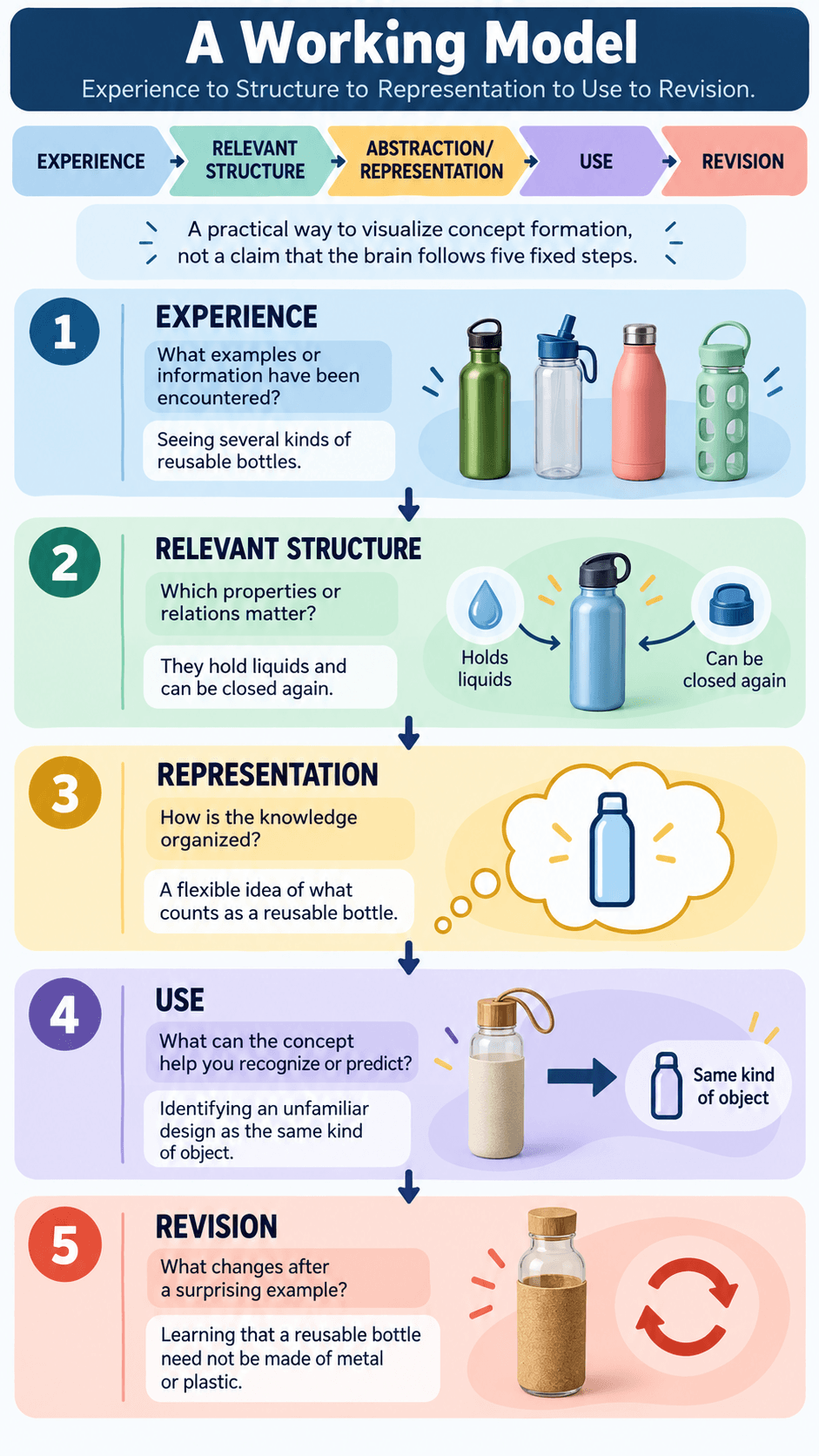
A practical way to visualize concept formation is:
EXPERIENCE → RELEVANT STRUCTURE → ABSTRACTION/REPRESENTATION → USE → REVISION
This model is not a claim that the brain follows five fixed steps. It is a way to separate the major cognitive jobs involved.
| Stage | Main question | Everyday example |
|---|---|---|
| Experience | What examples or information have been encountered? | Seeing several kinds of reusable bottles |
| Relevant structure | Which properties or relations matter? | They hold liquids and can be closed again |
| Representation | How is the knowledge organized? | A flexible idea of what counts as a reusable bottle |
| Use | What can the concept help you recognize or predict? | Identifying an unfamiliar design as the same kind of object |
| Revision | What changes after a surprising example? | Learning that a reusable bottle need not be made of metal or plastic |
What Information Can Shape a Concept?
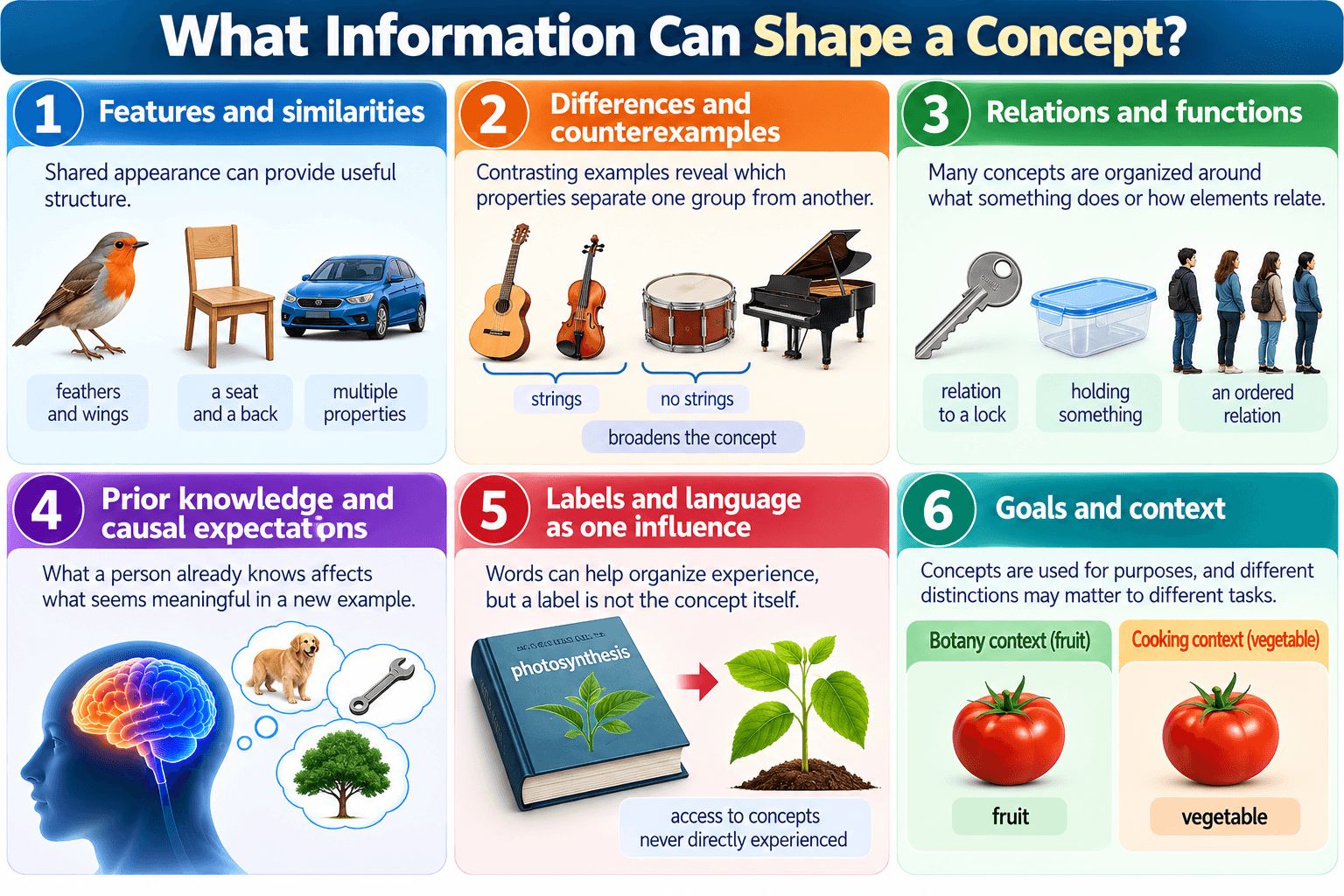
A strong account of concept formation must explain why the same cue can matter greatly in one domain and very little in another. Shared appearance is useful for some categories, but function, relation, causal knowledge, labels, goals, or context may dominate elsewhere.
Features and similarities
Features are an obvious source of structure. Birds often have feathers and wings. Many chairs have a seat and a back. Cars share multiple visible and functional properties. Similarity lets new examples inherit some of the organization learned from previous ones.
But similarity is not self-explanatory. Two items are similar in countless ways if you search hard enough. What matters is which dimensions are psychologically important. A chef, mechanic, botanist, and novice may attend to different properties because their knowledge and goals differ.
Differences and counterexamples
Differences help define what a concept is not. If every positive example looks nearly identical, a learner may focus on accidental properties. Counterexamples reveal which properties actually separate one group from another.
Suppose someone learns “musical instrument” only from guitars and violins. A drum broadens the concept because it lacks strings. A piano changes the picture again. With each contrasting example, the representation can become less tied to superficial resemblance and more sensitive to function or structure.
Relations and functions
Many concepts are organized around what something does or how elements relate. A key is understood partly through its relation to a lock. A container is defined partly by holding something. A queue is not a particular collection of people but an ordered relation among them.
Relational knowledge is especially important when appearances vary widely. Items can look different yet perform the same function, or look similar while serving different functions. Concept formation therefore often requires more than perceptual averaging.
Prior knowledge and causal expectations
What a person already knows affects what seems meaningful in a new example. Knowledge about animals, tools, plants, or machines can direct attention toward properties that a novice might overlook. Prior theories can also shape expectations about which features belong together.
A broad review of concepts and categories emphasizes that conceptual knowledge is not easily reduced to a single representational format. Research reviewing categories, concepts, and conceptual development describes multiple routes through which conceptual knowledge can emerge from experience and learning.
Labels and language as one influence
Words can help organize experience. A label may signal that different-looking examples should be treated as related, or it may direct attention toward a distinction that matters in a community. Language also gives people access to concepts they may never have directly experienced.
Still, a label is not the concept itself. Knowing the word “photosynthesis” is not the same as understanding the process. Likewise, people can possess useful nonverbal distinctions before they know the conventional label. Language is one influence on conceptual organization, not a complete explanation of it.
Goals and context
Concepts are used for purposes. A shopper, mechanic, designer, and insurer may organize vehicles differently because different distinctions matter to each task. A tomato can be relevant as a fruit in botany and grouped with vegetables in everyday cooking.
James Hampton’s discussion of abstraction and context in concept representation highlights a central tension: concepts must be general enough to apply across instances while remaining sensitive to context. Flexible use does not mean the concept has no structure. It means the useful structure can depend partly on the situation.
Features, Relations, and Prior Knowledge Do Different Jobs
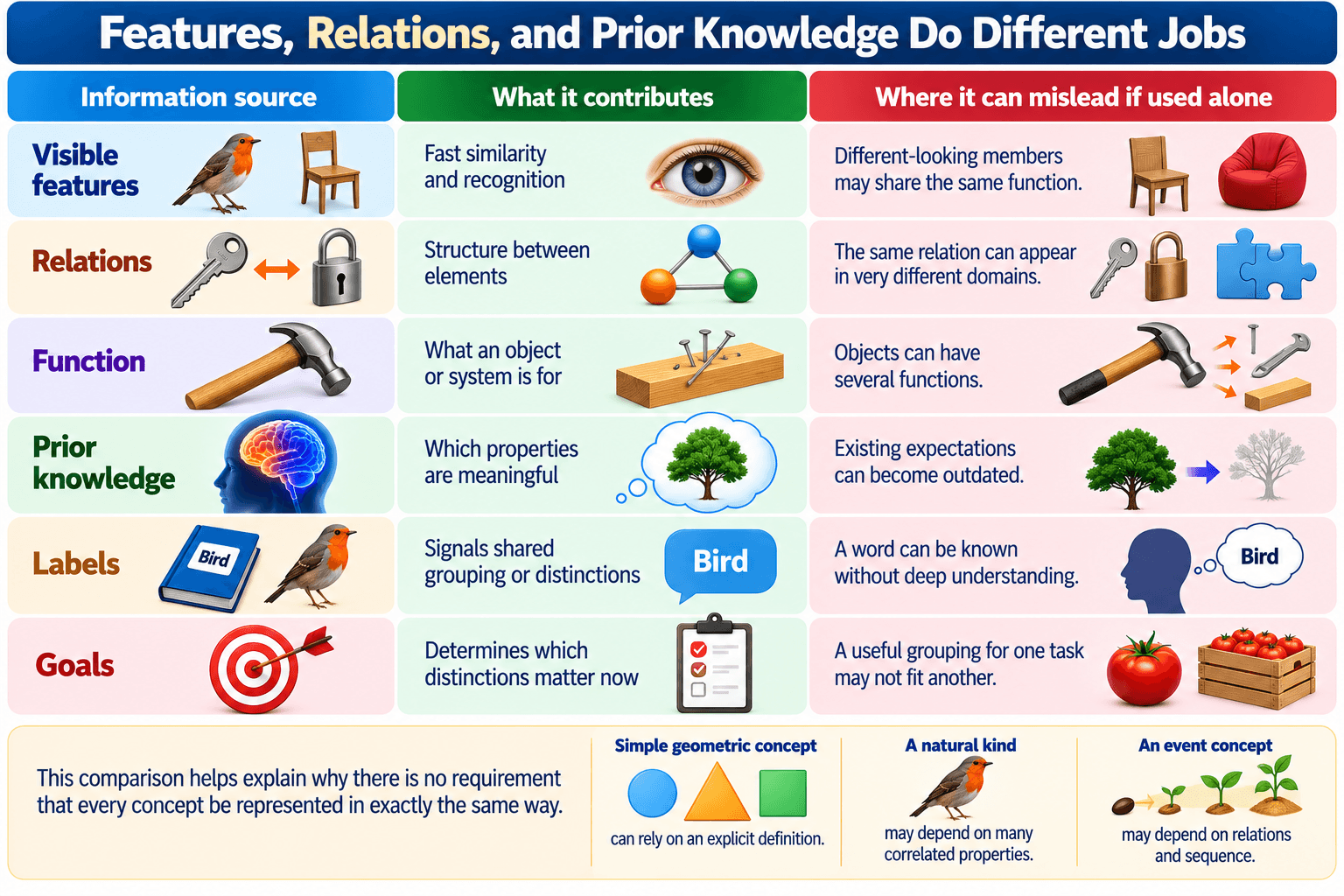
| Information source | What it contributes | Where it can mislead if used alone |
|---|---|---|
| Visible features | Fast similarity and recognition | Different-looking members may share the same function |
| Relations | Structure between elements | The same relation can appear in very different domains |
| Function | What an object or system is for | Objects can have several functions |
| Prior knowledge | Which properties are meaningful | Existing expectations can become outdated |
| Labels | Signals shared grouping or distinctions | A word can be known without deep understanding |
| Goals | Determines which distinctions matter now | A useful grouping for one task may not fit another |
This comparison helps explain why there is no requirement that every concept be represented in exactly the same way. A simple geometric concept can rely heavily on an explicit definition. A natural kind may depend on many correlated properties and background knowledge. An event concept may depend heavily on relations and sequence.
Concrete Concepts and Abstract Concepts
Why visible objects may offer different cues than justice or danger
Concrete objects often provide repeated perceptual structure. You can see and manipulate cups, chairs, tools, and fruit. Abstract concepts such as justice, risk, or obligation do not present one stable visual form. Their meanings may depend more heavily on relations, language, social practices, internal states, and broader situations.
A modern consensus paper on abstract concepts argues against treating abstractness as a single simple dimension. Current research on abstract concepts emphasizes multiple dimensions and the possible roles of sensorimotor experience, language, social interaction, and cultural context.
Why abstract concepts need not have one simple shared feature set
Consider “danger.” A slippery floor, an electrical fault, an unstable ladder, and an approaching storm share little visually. What connects them is a richer structure involving potential harm, uncertainty, and expected consequences.
This makes abstract concept formation especially useful for seeing the limits of a simple feature-list theory. Some concepts require relations, situations, goals, and background knowledge to become coherent.
Natural and Artificial Concept-Learning Examples
Everyday categories with messy boundaries
Natural categories are often rich, variable, and full of exceptions. Furniture includes chairs, desks, beds, shelves, and objects that sit near category boundaries. Games differ in rules, materials, goals, competitiveness, and physical action. These categories challenge the idea that one small set of necessary features always determines membership.
Research on concepts has therefore examined family resemblance, prototypes, exemplars, rules, and knowledge-based approaches. Concept formation can draw on these different kinds of structure without requiring one theory to win in every domain.
Laboratory tasks with controlled features
Researchers also create artificial categories. Participants may learn to classify unfamiliar shapes, patterned objects, or computer-generated creatures. The advantage is control: the researcher can decide which dimensions matter and test how people respond to examples and feedback.
Classic concept-attainment work used controlled examples to study how people search for relevant attributes and test possible rules. Such tasks remain useful because they expose specific learning processes that would be difficult to isolate in everyday categories.
What artificial tasks can and cannot show
A laboratory category can reveal how people respond to a known structure, but it should not automatically be treated as a miniature version of every real concept. Real-world concepts may contain much richer knowledge, long histories of experience, cultural information, functions, and causal relationships.
Controlled tasks are therefore evidence about particular mechanisms under particular conditions. They are not proof that every concept in everyday life is formed through the same procedure.
Why Concepts Can Remain Fuzzy
Incomplete boundaries
Some concepts work well even when people cannot state a perfect boundary. Most people can use “furniture” competently while disagreeing about borderline cases such as a floor lamp, decorative screen, or built-in shelf. The absence of a crisp verbal definition does not mean the concept is useless.
Context-sensitive relevance
A property can become important in one situation and irrelevant in another. When choosing a vehicle for city parking, size may dominate. When choosing one for carrying equipment, cargo space may matter more. The underlying concept remains recognizable while different dimensions gain weight.
Exceptions and atypical examples
Concepts often survive exceptions. Penguins do not force people to abandon the concept of bird. Instead, the representation accommodates a member that lacks one highly familiar property. This flexibility is one reason concepts can support real-world reasoning without requiring every instance to be identical.
Concept Revision: What Happens When Examples Do Not Fit
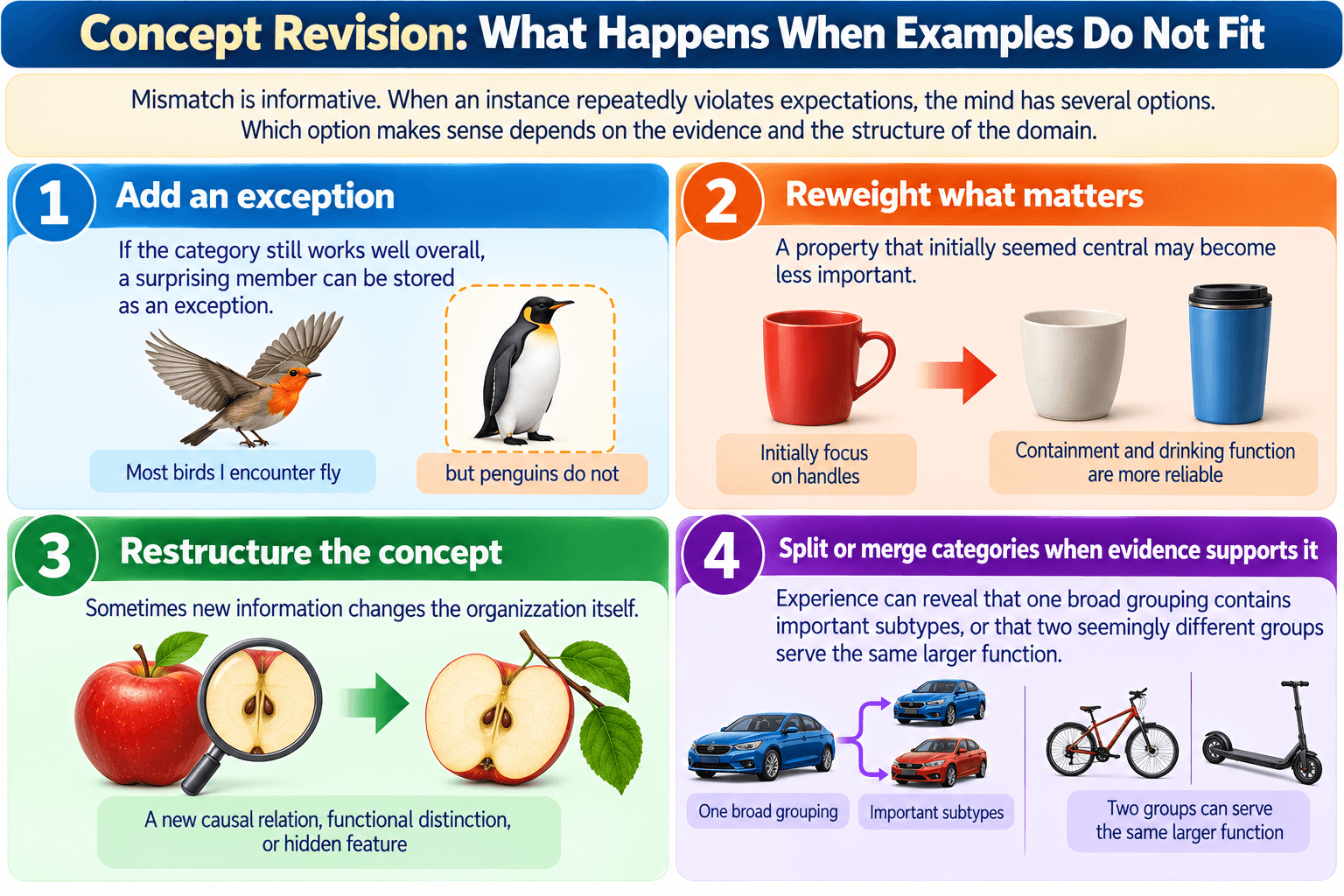
Mismatch is informative. When an instance repeatedly violates expectations, the mind has several options. Which option makes sense depends on the evidence and the structure of the domain.
Add an exception
If the category still works well overall, a surprising member can be stored as an exception. “Most birds I encounter fly, but penguins do not” preserves useful knowledge without rewriting everything.
Reweight what matters
A property that initially seemed central may become less important. Someone learning about cups may first focus on handles, then discover that containment and drinking function are more reliable than handle presence.
Restructure the concept
Sometimes new information changes the organization itself. A learner may discover a causal relation, functional distinction, or hidden feature that makes previous groupings look superficial.
Split or merge categories when evidence supports it
Experience can reveal that one broad grouping contains important subtypes, or that two seemingly different groups serve the same larger function. Experts often develop more differentiated concepts because their tasks reward distinctions that novices have little reason to make.
Concept Formation vs Category Learning
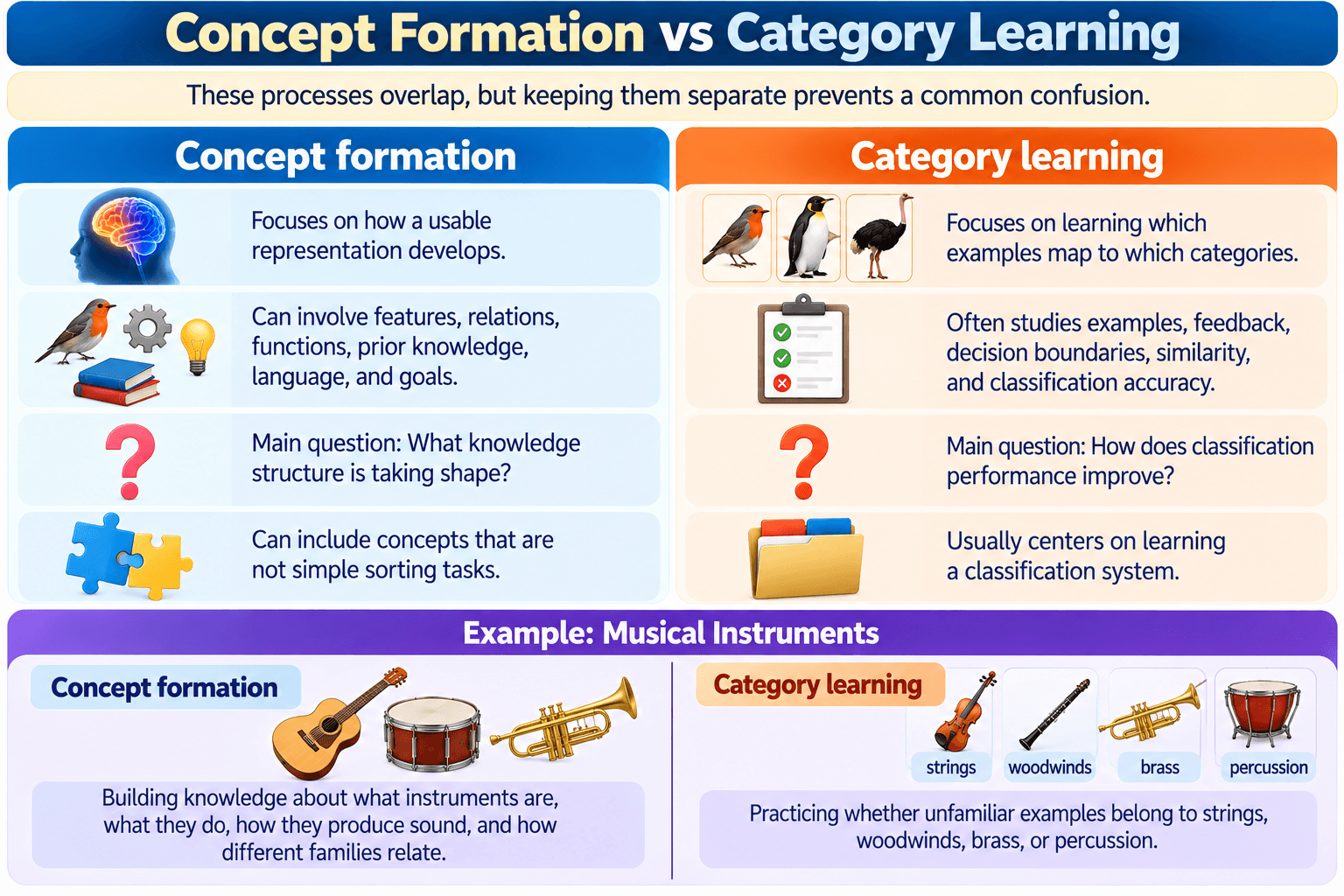
These processes overlap, but keeping them separate prevents a common confusion.
| Concept formation | Category learning |
|---|---|
| Focuses on how a usable representation develops | Focuses on learning which examples map to which categories |
| Can involve features, relations, functions, prior knowledge, language, and goals | Often studies examples, feedback, decision boundaries, similarity, and classification accuracy |
| Main question: What knowledge structure is taking shape? | Main question: How does classification performance improve? |
| Can include concepts that are not simple sorting tasks | Usually centers on learning a classification system |
Suppose someone is learning about musical instruments. Building knowledge about what instruments are, what they do, how they produce sound, and how different families relate is concept formation. Practicing whether unfamiliar examples belong to strings, woodwinds, brass, or percussion is more specifically category learning.
Concept Formation vs Cognitive Development
Age-general mechanism versus change across development
Concept formation occurs throughout life. Adults learn new professional concepts, technologies, hobbies, scientific ideas, foods, tools, and social practices. The mechanisms discussed here are therefore not limited to childhood.
Cognitive development asks a different question: how capacities for thinking, including concept formation, change with age and maturation. Developmental research is valuable, but turning concept formation into a sequence of childhood stages would answer a different question from the one addressed here.
What Concept Formation Is Not
It is not just a fixed list of necessary and sufficient features
Some categories really do have explicit defining criteria. A triangle is a straightforward example. But many natural and abstract concepts do not behave so neatly. Similarity, examples, functions, relations, causal knowledge, and context may all contribute.
It is not the same as semantic processing during language comprehension
Conceptual knowledge is used during language, but forming a concept and activating meaning while reading or listening are different questions. A person may already possess the concept of a bicycle before encountering the word in a sentence. Language processing concerns how meaning becomes available and integrated in real time.
It is not automatically a prototype or exemplar account
Prototype and exemplar theories describe important possibilities for how categories may be represented or used. Concept formation is broader. It asks how useful conceptual organization develops in the first place, including cases where rules, relations, causal knowledge, or contextual structure matter.
Work on situated conceptualization also argues that concepts are often represented within richer situations rather than as isolated context-free entries. Barsalou’s account of situated conceptualization illustrates why context can be part of the representation rather than merely an afterthought.
A Practical Self-Check for Understanding a Concept
If you want to see how well a concept has formed, try using it rather than reciting its label. Choose an ordinary idea such as “tool,” “container,” “game,” or “warning” and ask:
- Can I recognize examples that look different from the ones I first learned?
- Which features matter, and which are accidental?
- Does function matter more than appearance?
- Are important relationships or sequences part of the concept?
- What is a strong counterexample to my current understanding?
- Can I explain why an unusual member still belongs?
- What new example would force me to revise the concept?
A concept is more useful when it supports flexible judgment across new cases. Being able to repeat a definition is sometimes helpful, but it is not the only evidence that a representation has become usable.
FAQ About Concept Formation Psychology
Does every concept form by finding shared features?
No. Shared features can matter, especially for visually similar categories, but concepts can also depend on relations, functions, causal knowledge, prior knowledge, labels, goals, and context. Different concepts may rely on different combinations of information, so feature extraction should not be treated as a universal explanation.
Can language influence concept formation without fully determining it?
Yes. Labels can signal that examples belong together, highlight distinctions, and provide access to ideas that are difficult to learn through direct perception alone. At the same time, people can acquire meaningful distinctions from nonverbal experience, and knowing a word does not guarantee deep conceptual understanding.
How are counterexamples useful in concept formation?
Counterexamples reveal which parts of an existing representation are too narrow, accidental, or misleading. They may lead a person to reduce the importance of one feature, add an exception, notice a more useful relation, or reorganize the concept around a different distinction.
Is concept formation the same in children and adults?
The broad problem of building useful conceptual representations exists across the lifespan, but knowledge, language, attention, experience, and cognitive development differ with age. This article focuses on the age-general cognitive problem rather than claiming that children and adults use identical processes in every domain.
Key Takeaways
- Concept formation is the development of a usable representation, not merely learning a label or making one classification.
- Features matter, but relations, functions, prior knowledge, language, goals, examples, and counterexamples can also shape a concept.
- Concrete and abstract concepts can rely on different mixtures of perceptual, relational, linguistic, and contextual information.
- A concept can remain useful even when its boundaries are fuzzy or it contains atypical members and exceptions.
- Concept formation differs from category learning because it focuses on how the representation develops rather than only how classification accuracy improves.
- Psychology does not have one settled mechanism that explains the formation of every kind of concept.
Final Thought: Test the Representation With a New Example
A useful way to think about concept formation is to ask what happens when the next example is unfamiliar. If your representation helps you recognize what matters, ignore accidental details, make a reasonable prediction, and revise when necessary, it is doing real cognitive work. Concepts are valuable not because they freeze experience into perfect definitions, but because they organize enough structure to make new experience intelligible.
Educational note: Difficulty learning or using a concept in a particular task is not, by itself, evidence of low intelligence, a learning disorder, ADHD, autism, dementia, or another neurological or psychological condition. Clinical and developmental conclusions require appropriate assessment and much broader evidence.

Michael Reed is the Founder and Lead Writer at Psychology Exposed. He writes about human behavior, relationships, emotional patterns, self-awareness, and practical psychology topics using research-informed, easy-to-understand content.
Read More About Michael Reed: https://psychologyexposed.com/michael-reed/