
Using two languages does not usually mean keeping one language completely switched off while the other runs alone. Research suggests that words and meanings from both languages can become active to some degree, even when a bilingual person intends to use only one. The mind therefore has to manage overlap, competition, context, and selection rather than operate two perfectly sealed language systems.
Bilingualism psychology examines how this management works. It asks why cognates can be easier to process, why false friends can create interference, how speakers select the intended language, what happens when they switch languages, and why one language may become more dominant in one period of life than another. It also asks how proficiency, recent use, interactional context, and language similarity change those processes.
The most useful starting point is that bilingualism is not one uniform experience. People differ in when they learned each language, how often they use them, which settings they use them in, how similar the languages are, and which language is more accessible for a particular task. Those differences matter more than treating every bilingual person as belonging to one identical cognitive category. Within language psychology, bilingualism examines how more than one language can remain active, interact, and be selected during comprehension and production.
Quick Answer

Bilingualism psychology studies how the mind understands, selects, and produces more than one language. Evidence suggests that both languages can remain partly active, creating opportunities for facilitation and competition. Proficiency, dominance, context, recent use, and switching habits help determine which language wins access. Code-switching is not simply confusion, and bilingualism does not guarantee a universal cognitive advantage or disadvantage.
Bilingualism Is a Continuum, Not an All-or-Nothing State
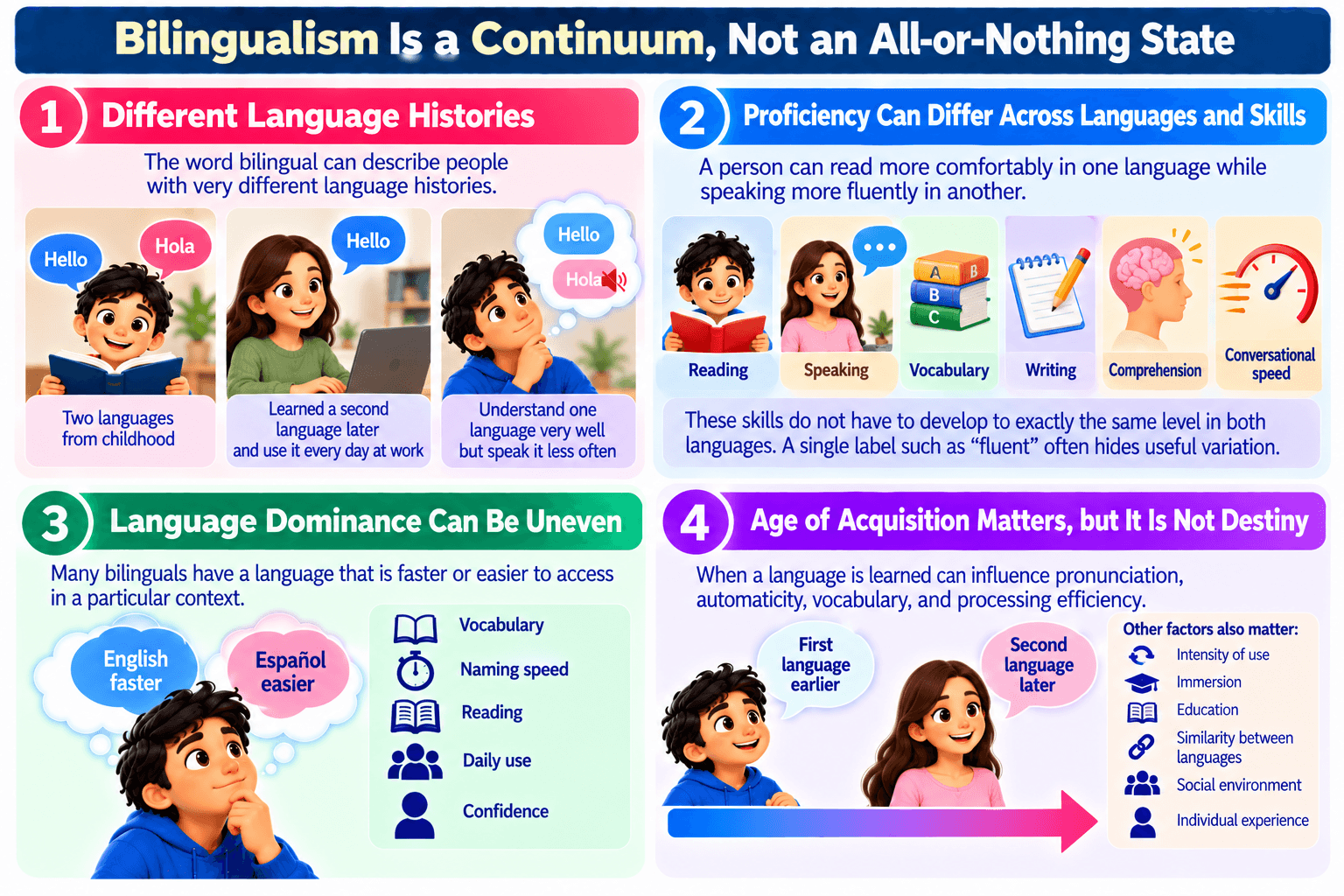
The word bilingual can describe people with very different language histories. One person may have spoken two languages from childhood. Another may have learned a second language later and now use it every day at work. A third may understand one language very well but speak it less often.
Proficiency can differ across languages and skills
A person can read more comfortably in one language while speaking more fluently in another. Vocabulary, pronunciation, comprehension, writing, and conversational speed do not have to develop to exactly the same level in both languages.
This is why a single label such as “fluent” often hides useful variation. Psycholinguistic studies usually need more specific information about proficiency and use.
Language dominance can be uneven
Many bilinguals have a language that is faster or easier to access in a particular context. Dominance can show up in vocabulary, naming speed, reading, daily use, or confidence, and the pattern does not have to be identical across every skill.
Dominance should therefore be treated as a relative property of the person’s current language experience rather than a permanent ranking of one language as “better.”
Age of acquisition matters, but it is not destiny
When a language is learned can influence pronunciation, automaticity, vocabulary, and processing efficiency. Earlier and later learning histories create different opportunities for exposure and practice.
But age of acquisition is only one variable. Intensity of use, immersion, education, similarity between languages, social environment, and individual experience also matter. A later-learned language can become highly proficient and, in some contexts, even more dominant than the first language.
Both Languages Can Be Active at the Same Time

One of the most consistent findings in bilingual psycholinguistics is that the nontarget language is often not completely silent. During reading, listening, and speaking, lexical candidates from both languages can become active enough to influence processing.
A recent study of language-nonselective lexical access summarizes extensive evidence that adult bilinguals activate information from both languages in parallel, while also showing that the strength of cross-language activation can depend on input modality and language-specific cues.
Cross-language activation
Suppose a Spanish-English bilingual is reading an English word whose form resembles a Spanish word. Information associated with the Spanish form may become active even though the task is entirely in English. Similar effects can occur during spoken-word recognition and speech planning.
This does not mean the person consciously thinks of both languages on every word. Much of the interaction is inferred from reaction times, eye movements, errors, or other experimental measures.
Why activation does not equal confusion
Several candidates can become active while the correct language is still selected efficiently. A monolingual listener also activates several possible words as speech unfolds and gradually narrows the competition. Bilingual processing adds cross-language candidates to that general competition problem.
Co-activation is therefore evidence of an interactive system, not proof that a bilingual speaker cannot keep languages apart.
A Simple Bilingual Selection Model
A reader-friendly model is:
CONTEXT → BOTH LANGUAGES PARTLY ACTIVE → CANDIDATE WORDS COMPETE OR COOPERATE → TARGET LANGUAGE SELECTED → RESPONSE
This model is intentionally simplified. Different theories disagree about how much inhibition, activation, language membership, and task-specific control contribute. The model is useful because it captures the central problem: the intended language has to be selected from a system in which the other language may still be accessible.
Context narrows the competition
If you are speaking Vietnamese with family, using English in a work meeting, or reading a French novel, the situation strongly favors one language. The topic, listener, visual setting, accent, and recent language use can all increase the accessibility of the intended language.
Context does not necessarily switch the other language completely off. It changes the balance.
Selection does not require conscious suppression on every word
A bilingual speaker does not usually pause before each word to decide which language it belongs to. Much of language selection is rapid and automatic enough to support fluent conversation.
Control becomes more visible when the languages are both highly relevant, when the task requires frequent switching, or when similar forms activate competing meanings.
Cognates Show How Two Languages Can Cooperate
Cognates are words across languages that share meaning and have similar forms, such as piano in English and Spanish. They are especially useful in research because a cognate can receive support from both languages.
Cognate facilitation
A broad review of bilingual language processing describes a common pattern in which bilinguals recognize cognates faster than comparable noncognates. The effect is difficult to explain if the nontarget language is completely inactive.
When a form and meaning overlap across languages, activation from both language systems can converge on the same lexical candidate. That convergence can make recognition or production easier under some conditions.
Cognate effects are not identical for everyone
The strength of cognate facilitation can depend on proficiency, language dominance, writing system, frequency, task, and how similar the cognate forms actually are. A Spanish-English cognate written in a shared alphabet creates a different processing situation from translation equivalents written in unrelated scripts.
The general principle is cross-language interaction, not one fixed size of cognate benefit.
False Friends and Interlingual Competition
Cross-language overlap can also create interference. A form may look or sound similar across languages while carrying different meanings.
When form overlaps but meaning does not
Researchers often study interlingual homographs, which share a written form across languages but differ in meaning. The bilingual-processing review cited above notes that such items can slow responses compared with control words under some task conditions.
The everyday category often called “false friends” captures a related problem: similarity in form encourages one interpretation, but the intended meaning belongs to the other language.
Why interference does not mean the languages are mixed up
Temporary competition is a normal consequence of overlapping representations. If two candidates fit part of the input, the system needs evidence to favor one. Context, language membership, frequency, and proficiency help settle the competition.
An occasional cross-language intrusion therefore tells us more about parallel activation than about a failure to possess separate linguistic knowledge.
Language Selection and Control
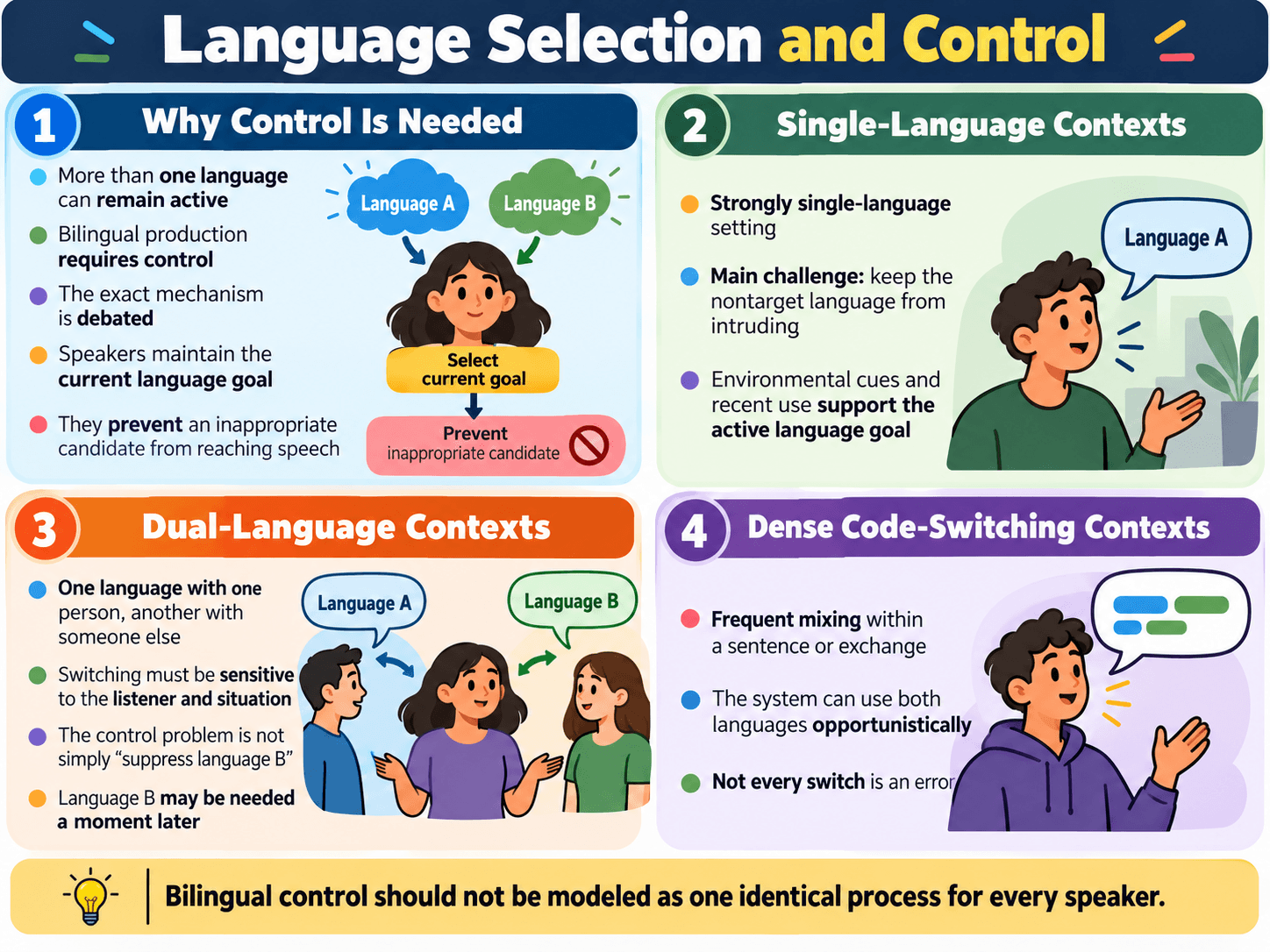
Because more than one language can remain active, bilingual production requires control. The exact mechanism is debated, but theories commonly ask how speakers maintain the current language goal and prevent an inappropriate candidate from reaching speech.
The adaptive control hypothesis proposes that language-control processes adapt to the interactional context. A person who keeps languages separate by setting may face different control demands from someone who switches frequently within the same conversation.
Single-language contexts
In a strongly single-language setting, the main challenge may be keeping the nontarget language from intruding. Environmental cues and recent use support the active language goal.
Dual-language contexts
In some settings, the speaker uses one language with one person and another language with someone else. Switching must be sensitive to the listener and situation. The control problem is not simply “suppress language B,” because language B may be needed a moment later.
Dense code-switching contexts
Other communities and conversations permit frequent mixing within a sentence or exchange. Here the system can use both languages opportunistically rather than treating every switch as an error.
These different environments help explain why bilingual control should not be modeled as one identical process for every speaker.
Code-Switching Is Not the Same as Confusion

Code-switching is the use of more than one language within a conversation, interaction, or utterance. It can respond to the listener, topic, social setting, available vocabulary, quotation, emphasis, or community norms.
Switches can be systematic
Bilingual speakers often switch at linguistically permissible points and in ways that other members of their community readily understand. A switch may occur because one phrase is more accessible, because a concept is normally discussed in one language, or because the speaker is aligning with the listener.
Calling all code-switching “confusion” misses this structured and context-sensitive nature.
Switching can reduce rather than create difficulty
If a word is temporarily easier to retrieve in the other language, switching can keep conversation moving. In some bilingual settings, staying rigidly in one language may actually require more control than using the most accessible available word.
That does not mean every switch is deliberate. It means switching can arise from several mechanisms and should not automatically be treated as a failure.
Why Laboratory Language Switches Can Carry a Cost
In controlled experiments, people are often cued to name objects or respond in one language and then abruptly switch to the other. Responses on switch trials are frequently slower than responses when the same language repeats.
What switch cost means
A switch cost is the reaction-time or accuracy difference between switching languages and staying in the same language. The cost may reflect reconfiguration, changing language goals, overcoming previous inhibition, or other control processes.
A meta-analysis of bilingual language-switch costs found that some proposed asymmetries are less robust than often assumed. This supports caution about turning one laboratory pattern into a universal property of bilingual minds.
Why laboratory switching is not ordinary code-switching
Laboratory switches are often externally imposed and unpredictable. Natural switches can be voluntary, contextually appropriate, or driven by accessibility. The speaker may know in advance that both languages are allowed.
This difference helps explain why bilinguals can switch smoothly in conversation even when an experiment detects a reaction-time cost.
Switch costs do not prove switching is harmful
A brief processing cost says nothing by itself about whether code-switching is bad for communication, intelligence, or language skill. It simply shows that changing the active task or language goal can require processing under a particular experimental design.
Language Dominance Can Change With Experience
A first language is not guaranteed to remain the fastest language for every task forever. Daily exposure and immersion can shift the balance of accessibility.
Recent use matters
If a person spends months working almost entirely in a second language, that language may become faster for workplace vocabulary and routine conversation. Returning to the first language can sometimes produce a brief sense of searching for words that were previously effortless.
This is not necessarily language loss. Accessibility changes with use.
Different domains can favor different languages
A person may discuss family life most naturally in one language and professional concepts in another. A technical vocabulary learned in English may remain easier in English even when the speaker’s broader dominant language is Vietnamese, Spanish, or Arabic.
Dominance is therefore often domain-specific rather than a single score.
Dominance can shift without erasing earlier knowledge
Reduced use of one language can make retrieval slower, while renewed exposure can restore accessibility. Bilingual processing is dynamic because experience continually changes the relative strength of competing representations.
Does Bilingualism Create a Lexical Disadvantage?
Bilingual speakers are sometimes described as having smaller vocabularies or slower lexical retrieval simply because they use two languages. The evidence is more nuanced.
Vocabulary comparisons depend on which language is tested
A bilingual person distributes experience across languages. Testing only one language can miss knowledge available in the other. The relevant comparison also depends on when the languages were learned and which language is currently dominant.
Recent meta-analytic evidence argues against a simple bilingual lexical deficit
A meta-analysis of 130 studies on the bilingual lexical deficit found that simultaneous bilinguals did not show a general expressive-vocabulary deficit, and sequential bilinguals did not show one when tested in their mother tongue. Differences were more evident when sequential bilinguals were tested in their second language, especially with later acquisition.
The more accurate interpretation is therefore not “two languages damage vocabulary.” Language history, proficiency, and test language matter.
Does Bilingualism Produce a General Cognitive Advantage?
Another popular claim goes in the opposite direction: managing two active languages supposedly trains executive control so strongly that bilingual people become broadly better at inhibition, attention, switching, or cognitive flexibility.
Why the idea is plausible
Bilinguals often select between competing linguistic alternatives and adapt to changing language contexts. It is reasonable to ask whether repeated language-control demands transfer to nonlinguistic control tasks.
Why the evidence remains debated
A meta-analysis of 170 studies found that reported executive-function advantages varied by task and age and also raised questions about publication bias. Other meta-analyses have reached more skeptical conclusions. The safest reading of the bilingual-advantage evidence is that any domain-general benefit is not a simple, universal consequence of knowing two languages.
Bilingualism clearly provides linguistic and communicative capacities. Claims about broad improvements in intelligence or executive functioning require separate evidence.
Why bilingualism should not be sold as brain training
Learning and using languages can be valuable for communication, identity, education, work, and access to people and information. Those benefits do not need a universal executive-function bonus to be meaningful.
Likewise, a mixed result on a laboratory control task does not make bilingualism harmful.
Bilingualism vs Cognitive Flexibility
Managing multiple languages can require switching and adaptation, but bilingual language control should not be treated as identical to cognitive flexibility in general.
Language switching is a specific control problem
The speaker needs to select words from the language that fits the current goal, listener, and context. This involves linguistic representations and language-specific cues.
Cognitive flexibility is broader
Cognitive flexibility refers more broadly to adjusting strategies, rules, attention, or responses when circumstances change. Language switching can be one setting in which flexible control is studied, but success in two languages does not automatically prove a general flexibility advantage across unrelated tasks.
This distinction matters especially when interpreting claims that bilingualism makes someone universally “better at switching.”
Bilingualism vs Language Learning
Bilingual processing asks what happens once more than one language has become available to the mind. Language learning asks how new knowledge and skill are acquired.
Processing and managing an existing language system
The present topic concerns cross-language activation, selection, switching, dominance, and lexical interaction during real-time comprehension and production.
Acquiring vocabulary, grammar, and proficiency
Learning questions include practice, feedback, memory, instruction, exposure, and how skill changes over time. The existing How Learning Works in Psychology article is the better framework for the broader mechanics of acquisition.
Keeping the topics separate prevents bilingualism psychology from turning into a language-learning advice guide.
Bilingualism vs Translation
Translation is one activity available to bilingual speakers, but bilingual language processing is much broader.
Translation requires mapping across languages
When translating, a person must identify meaning in one language and produce an appropriate expression in another. The nearest word may not always preserve the same nuance, register, or context.
Everyday bilingual processing does not require constant translation
Highly proficient bilinguals can often understand and speak a language directly without consciously converting every sentence into another language. Translation may become more noticeable for unfamiliar words, low-proficiency situations, or tasks that explicitly require cross-language mapping.
This is another reason not to imagine bilingualism as two dictionaries connected by a permanent translation step.
What Cognates, False Friends, and Switching Reveal Together
These three phenomena offer a compact picture of the bilingual system.
| Phenomenon | What happens | What it suggests |
|---|---|---|
| Cognate facilitation | Similar form and shared meaning can speed processing | Both languages can provide converging activation |
| False-friend interference | Similar form with conflicting meaning can slow selection | Nontarget language information can compete |
| Language switching | The system changes which language is currently favored | Context and control help manage co-active languages |
Together, they make a simple “language A on, language B off” model difficult to sustain. Bilingual processing looks more like a dynamic balance of activation, competition, facilitation, and context-sensitive control.
Common Myths About Bilingual Minds
Several popular claims sound plausible because they take one real finding and extend it too far.
Myth: Bilingual people are always equally fluent in both languages
Bilingual experience is often asymmetric. One language may be stronger for reading, another for family conversation, and another domain may depend on which language was used to learn the relevant concepts.
Myth: Code-switching means the speaker is confused
Switching can reflect accessibility, community norms, listener adaptation, or efficient use of the bilingual repertoire. It can be structured and context-sensitive rather than accidental.
Myth: Two languages automatically delay or damage language
A broad claim of inherent damage is not supported by the processing evidence reviewed here. Performance depends on exposure, proficiency, test language, and individual history. Ordinary cross-language influence should not be interpreted as pathology.
Myth: Bilingual people are universally smarter or more flexible
Bilingualism does not provide a guaranteed intelligence boost or universal executive-control advantage. Some studies report benefits on specific tasks, while other large studies and meta-analyses find small, variable, or null effects.
A Practical Framework for Understanding a Bilingual Profile
Instead of asking whether someone is “truly bilingual,” it is more useful to ask how their two languages are used.
Which language is used where?
Home, work, school, online spaces, friendships, and formal settings can favor different languages. These contexts change which vocabulary and structures are practiced most often.
Which language is easier for which task?
Reading a novel, writing a report, telling a childhood story, doing mental arithmetic, or discussing technical material may each favor a different language.
How often does switching occur?
Some speakers keep languages separated by context. Others switch frequently within conversations. The control demands created by those environments are not identical.
How recent is the current pattern of use?
Immersion, travel, a new job, or a change in household language can shift accessibility. A bilingual profile is therefore a moving pattern rather than a fixed trait.
FAQ
These questions address common misunderstandings about managing two languages.
Are both languages active even when a bilingual person uses only one?
Often, yes. Many studies find cross-language activation during reading, listening, and speaking, even when only one language is required. The strength of that activation depends on factors such as proficiency, dominance, modality, language similarity, and context, so “both languages active” does not mean equally active at every moment.
Why are cognates often easier for bilinguals?
Cognates share meaning and overlap in form across languages. When both languages become partially active, the two systems can provide converging support for the same lexical item. This can speed recognition or production compared with a similar noncognate, although the size of the effect varies with language pair and task.
Does code-switching mean someone has poor control of both languages?
No. Code-switching can be a systematic way of adapting to the listener, topic, community, or accessibility of a word. Laboratory studies do find costs for some externally cued switches, but natural switching and experimental switching are not the same situation.
Does bilingualism always improve executive function?
No. The literature is mixed. Some studies and meta-analyses report advantages on particular tasks or in particular age groups, while others find very small or no reliable effects after accounting for publication bias and other variables. A universal bilingual executive-function advantage is not established.
Can one language become more dominant than a person’s first language?
Yes. Dominance can shift with immersion, daily use, education, occupation, and social environment. A later-learned language can become faster or more accessible in important domains without erasing knowledge of the earlier language.
Key Takeaways
- Bilingualism is a continuum shaped by proficiency, dominance, exposure, context, age of acquisition, and recent language use.
- Both languages can remain partly active, so bilingual processing involves cross-language facilitation, competition, and selection rather than two perfectly isolated systems.
- Cognates can receive support from both languages, while false friends and interlingual homographs can create temporary competition.
- Code-switching can be systematic and context-sensitive; it should not automatically be interpreted as confusion or poor language ability.
- Laboratory switch costs reveal control demands under specific tasks, but they do not show that natural bilingual switching is harmful.
- Claims of universal bilingual cognitive advantages, disadvantages, vocabulary deficits, or intelligence gains are too broad for the evidence.

Michael Reed is the Founder and Lead Writer at Psychology Exposed. He writes about human behavior, relationships, emotional patterns, self-awareness, and practical psychology topics using research-informed, easy-to-understand content.
Read More About Michael Reed: https://psychologyexposed.com/michael-reed/