

A familiar word can seem to announce itself the instant you hear or see it. Someone begins saying “calendar,” your eyes land on the word “coffee,” or a sentence contains an unusual spelling, and recognition feels immediate. Yet the input reaching the mind is not a ready-made label. It is a pattern of sounds or letters that must be matched against linguistic knowledge while other possible words may briefly compete.
Word recognition psychology examines that identification process. It asks how a spoken or written form becomes a familiar lexical item, why common words are often recognized quickly, why similar words can interfere with one another, and how context can make one candidate more likely than another. The focus is narrower than speech perception and earlier than full semantic interpretation.
This distinction matters because “I heard the sounds,” “I recognized the word,” and “I understood what the word means here” are related experiences, but they are not the same psychological question. Separating them gives a clearer view of what the mind is doing when a word becomes familiar. Within the broader field of language psychology, word recognition sits between identifying a linguistic form and accessing the meaning associated with it.
Quick Answer

Word recognition is the process by which a spoken or written word form becomes identified as a familiar lexical item. Recognition is influenced by factors such as frequency, familiarity, similarity to other words, competition among candidates, and context. Researchers often describe this with mental-lexicon models, but the “lexicon” is a useful theoretical construct, not a literal dictionary stored in one place in the brain.
Recognizing a Word Is Not the Same as Understanding Its Full Meaning
You can identify a familiar word before you have settled on its meaning in a particular sentence. That is especially easy to notice with ambiguous words such as “bank,” “match,” or “light.” The form may be familiar immediately, while the sentence determines which meaning becomes relevant.
From plausible word form to familiar lexical item
For spoken language, the input first has to be treated as plausible linguistic material. Once enough sound information is available, the system can begin evaluating which known word forms fit. For written language, visual patterns such as letter identity and order provide the form information that supports recognition.
In both cases, the central question is identification: which familiar word best matches the incoming pattern? Research on competition in spoken and written word recognition describes both modalities in terms of multiple candidate forms becoming active and competing, even though spoken and written input place different constraints on the process.
Why identification and meaning access are separable questions
Suppose you read the sentence, “She sat beside the bank.” The letters are enough to identify the word “bank,” but its intended meaning remains uncertain until more context is available. Word recognition asks how the form becomes identified as that familiar word. Semantic processing asks which knowledge associated with the word becomes active and appropriate in context.
The separation is not absolute. Form, meaning, and context can interact rapidly. The useful point is conceptual: identifying a word and selecting its meaning solve different problems, so an explanation of one should not be treated as a complete explanation of the other.
The Mental Lexicon as a Useful Model
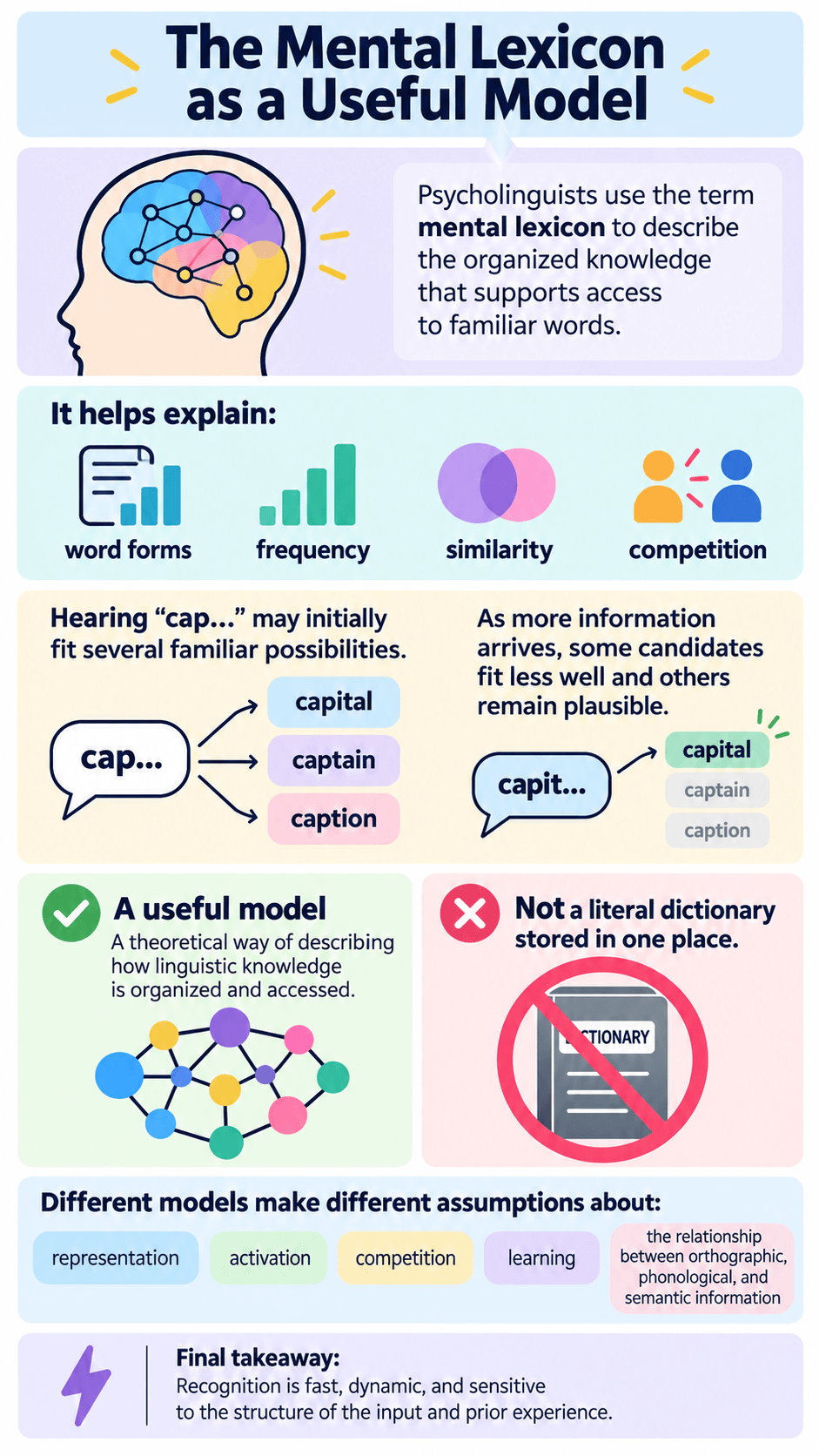
Psycholinguists often use the term “mental lexicon” to describe the organized knowledge that supports access to familiar words. The term is helpful because it gives us a way to talk about word forms, frequency, similarity, and competition without pretending that every word is processed in isolation.
What the metaphor helps explain
Imagine hearing the beginning “cap…” The input might initially fit several familiar possibilities, such as “capital,” “captain,” or “caption.” As more information arrives, some candidates fit less well and others remain plausible. A mental-lexicon framework helps explain why the identity of neighboring words can influence how quickly a target is recognized.
Studies of spoken-word recognition frequently describe this as activation and competition among lexical candidates. For example, research on lexical competition in spoken-word recognition found that recognition was influenced by both competition from perceptually similar words and the frequency of the target word.
Why it is not a literal dictionary stored in one place
The mental lexicon should not be pictured as a book in the head with one entry per word sitting in a single location. It is a theoretical way of describing how linguistic knowledge is organized and accessed. Different models make different assumptions about representation, activation, competition, learning, and the relationship between orthographic, phonological, and semantic information.
This matters because metaphors can become misleading when taken too literally. Saying a word is “in the lexicon” does not imply that the mind performs a conscious lookup or searches a list from top to bottom. Recognition is fast, dynamic, and sensitive to the structure of the input and prior experience.
A Simple Word-Recognition Framework
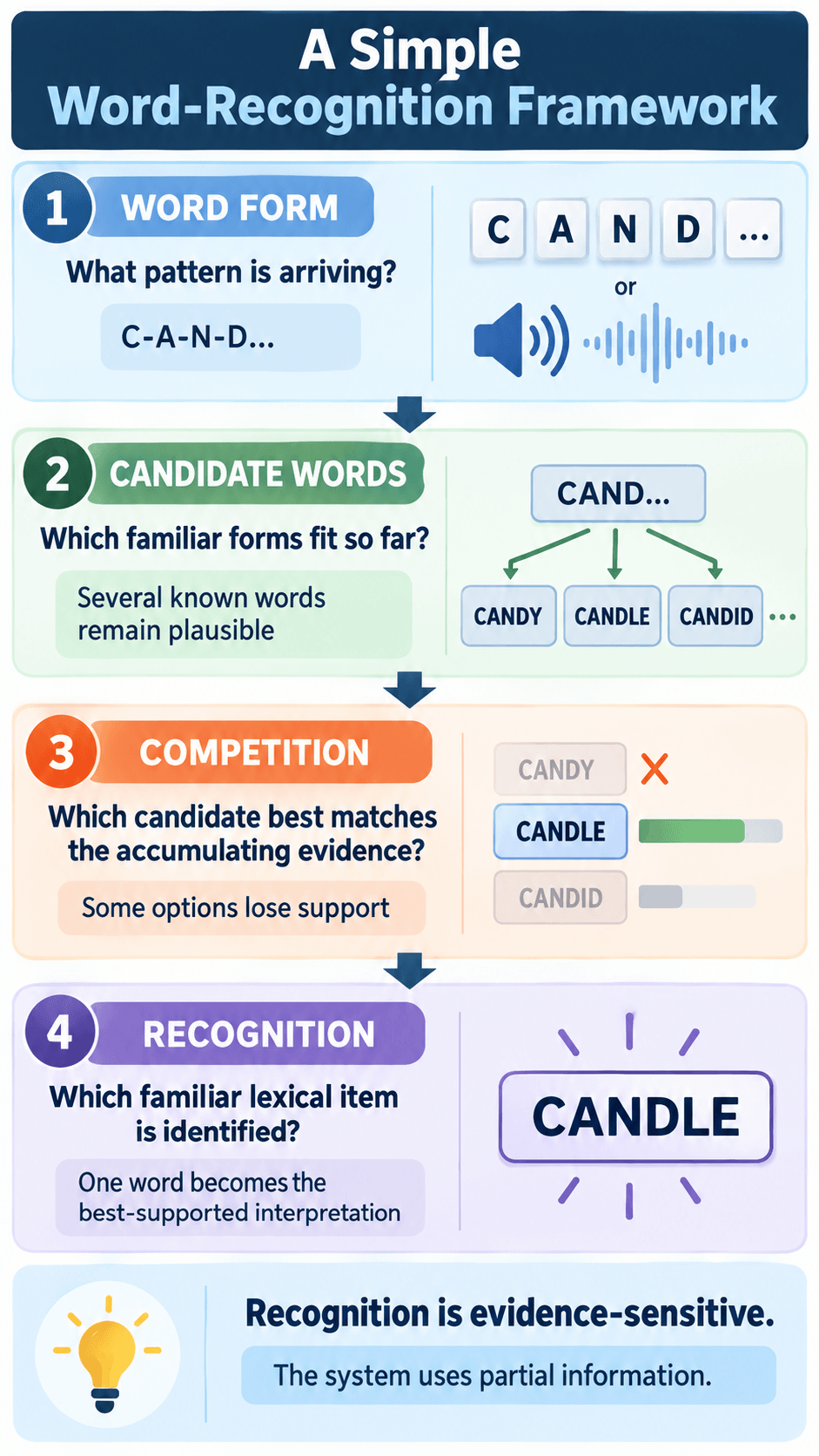
A compact model can make the basic problem visible without claiming that cognition moves through four sealed stages.
WORD FORM → CANDIDATE WORDS → COMPETITION → RECOGNITION
First, the incoming pattern provides information about form. That form activates one or more plausible familiar words. Candidates differ in how strongly they fit the input, how familiar they are, and how strongly competing forms are activated. Recognition emerges as the evidence increasingly favors one interpretation.
| Step | Main question | Simple example |
|---|---|---|
| Word form | What pattern is arriving? | Letters C-A-N-D… or the spoken sounds at the start of a word |
| Candidate words | Which familiar forms fit so far? | Several known words remain plausible |
| Competition | Which candidate best matches the accumulating evidence? | Some options lose support as more letters or sounds arrive |
| Recognition | Which familiar lexical item is identified? | One word becomes the best-supported interpretation |
Why recognition can begin before the full input is complete
Spoken words unfold over time, so waiting until the last sound would be inefficient. Research on the development of lexical competition in spoken and written word recognition notes that listeners begin activating words as acoustic information arrives and update those activations as later information becomes available.
Written recognition can also develop incrementally, though the input is spatial rather than a sound stream unfolding through time. The exact dynamics differ across modalities and tasks. The larger principle is that recognition is evidence-sensitive: the system uses partial information rather than requiring a perfectly complete form before anything happens.
What Makes a Word Easier or Harder to Recognize?
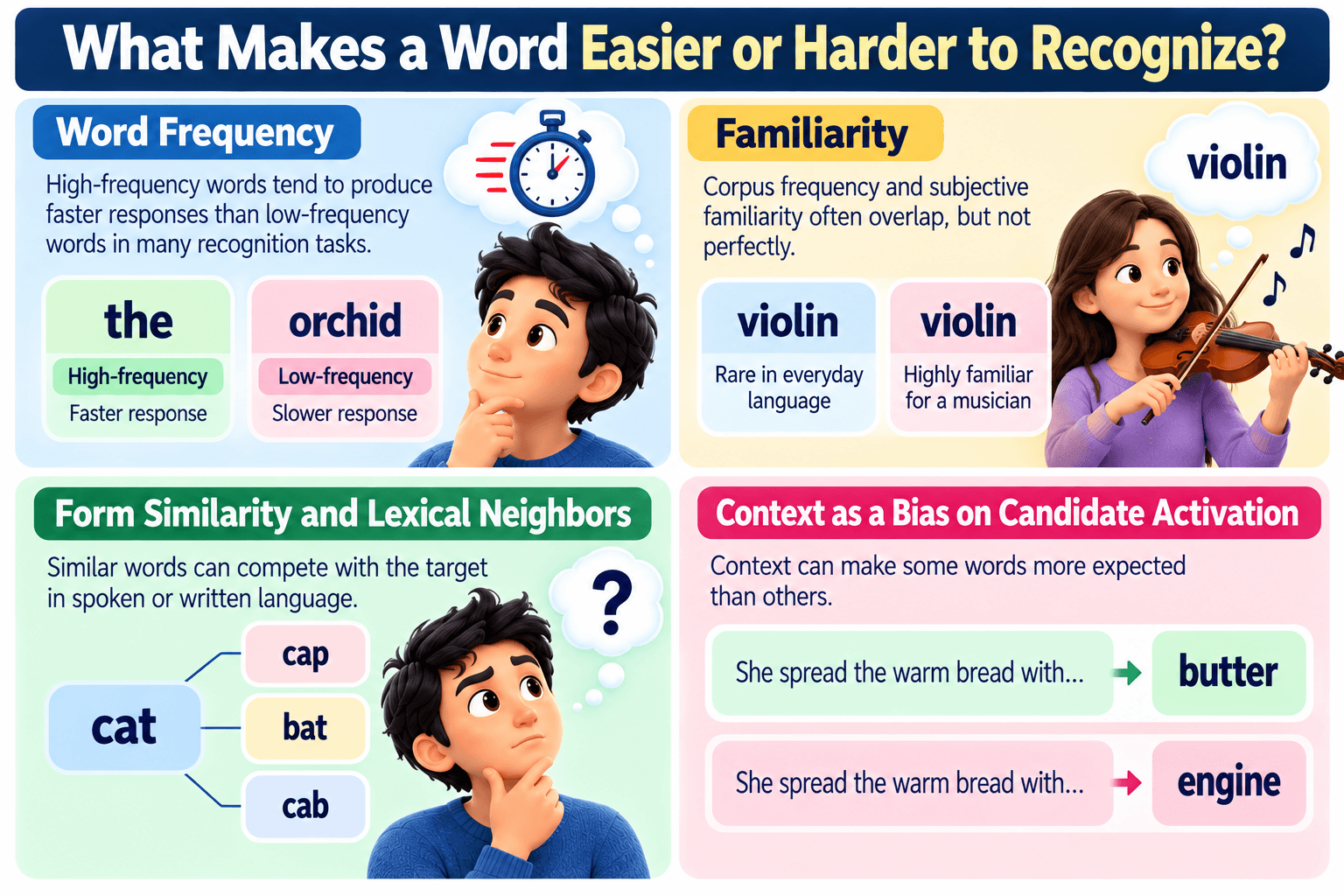
There is no single “difficulty score” attached to a word. Recognition reflects several interacting influences, including how often a word has been encountered, how familiar it is to a particular reader or listener, how many similar forms compete with it, and what the surrounding context makes likely.
Word frequency
High-frequency words tend to produce faster responses than low-frequency words in many recognition tasks. This is one of the most robust findings in visual word-recognition research. A review of models of visual word recognition identifies frequency as a major determinant of lexical-decision and naming speed, while also showing that theories differ in how they explain the effect.
Frequency should not be treated as destiny. A common word can still be difficult in noise, an unusual font, an unfamiliar accent, or an ambiguous context. A rarer word can be recognized quickly by someone who encounters it often in a profession, hobby, community, or personal interest.
Familiarity
Corpus frequency describes how often a word appears across a body of language, while subjective familiarity concerns an individual’s experience with that word. The two often overlap, but not perfectly. A specialized term may be rare in everyday language yet highly familiar to a musician, engineer, gamer, gardener, or physician.
This is one reason recognition should be understood as experience-sensitive. The language environment of a particular person shapes which forms are strongly established and which remain relatively unfamiliar.
Form similarity and lexical neighbors
A lexical neighbor is another familiar word that resembles the target in form. In spoken language, neighbors may be phonologically similar. In print, they may share similar letter patterns. The exact definition of a neighborhood depends on the model and measurement method, but the useful idea is straightforward: recognition happens in a field of alternatives.
Research on orthographic neighborhood density and word frequency shows that similarity among written words can affect response-time distributions, and that these effects can interact with word frequency rather than operating as a single simple rule.
Context as a bias on candidate activation
Context can make some words more expected than others. If you hear “She spread the warm bread with…” the next word is constrained by what has already been said. This does not mean context makes the sensory input irrelevant. It means recognition can be influenced by both incoming form and prior linguistic information.
Context is most useful when treated as one source of evidence. Strong bottom-up information can override an expectation, while a highly constraining sentence can help when the input is incomplete or uncertain.
Spoken and Written Word Recognition
Spoken and written words raise the same broad identification problem, but the form of the evidence is different. Speech unfolds through time and varies with speaker, rate, accent, and coarticulation. Print is laid out visually and depends on orthographic patterns such as letters and their order.
Phonological form in spoken input
In spoken-word recognition, the system must use changing sound information to identify familiar word forms. Early portions of a word can support several candidates at once. Later sounds can strengthen one candidate and weaken others. This is why words that share beginnings can temporarily compete.
Different theories disagree about how candidates are activated and how competition is resolved. Cohort-style models emphasize the importance of unfolding input, while neighborhood and interactive models characterize similarity in other ways. The evidence supports dynamic competition, but no single simplified diagram captures every detail.
Orthographic form in written input
Written-word recognition depends on the visual pattern of the word. Letter identity, letter position, familiar spelling patterns, and similarity to other written words can all matter. A printed word does not have to be consciously sounded out letter by letter before it can become familiar.
Models of visual recognition differ in how they represent letter order, phonology, semantics, and learned statistical patterns. For a general reader, the key point is that a familiar printed string is processed in relation to prior experience with words, not as an isolated picture.
Shared question, different input constraints
| Feature | Spoken word | Written word |
|---|---|---|
| Primary form information | Acoustic and phonological pattern | Visual and orthographic pattern |
| How input arrives | Unfolds through time | Usually available spatially on the page or screen |
| Common source of competition | Phonologically similar words | Orthographically similar words |
| Shared problem | Identify the familiar lexical item that best fits the input | |
Why Candidate Words Compete
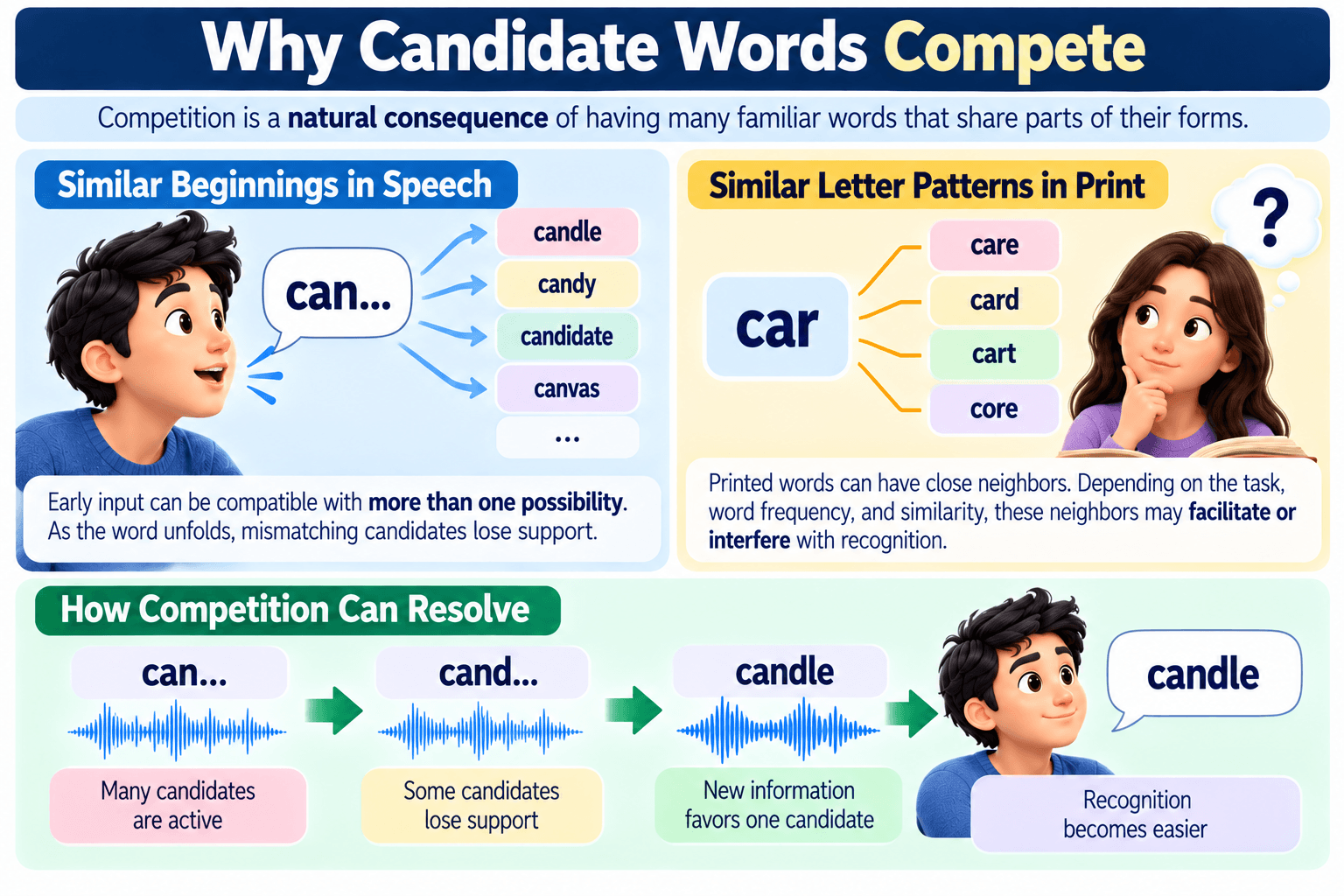
Competition is not a sign that recognition is failing. It is a natural consequence of having many familiar words that share parts of their forms. Early input is often compatible with more than one possibility.
Similar beginnings in speech
Hear “can…” and many words may remain possible for a moment: “candle,” “candy,” “candidate,” “canvas,” and others depending on the exact sounds and the listener’s vocabulary. As the word unfolds, mismatching candidates lose support.
Classic cohort accounts were built around this left-to-right narrowing process. Later work allows a more flexible picture in which rhyme competitors, embedded words, and partially matching forms may also become relevant. The principle survives even when the theory changes: multiple possibilities can be active before identification settles.
Similar letter patterns in print
Printed words can also have close neighbors. “Care,” “card,” “cart,” and “core” share much of their visual structure. Depending on the task, word frequency, neighborhood density, and exact similarity, these neighbors may facilitate or interfere with recognition.
That complexity is why it is better to say similarity affects recognition than to claim “more neighbors always means slower reading.” Effects vary with the type of neighborhood, the language, the experimental task, and other properties of the target.
How competition can resolve as more information arrives
Recognition becomes easier when new information rules out alternatives. In speech, later phonemes reduce the number of plausible candidates. In writing, additional letters or a clearer orthographic pattern can favor one familiar form. Sentence context can further bias the system toward candidates that fit what has already been understood.
The result can feel instantaneous because the narrowing process is fast. The subjective experience of “just knowing the word” does not mean only one candidate was ever active.
How Researchers Study Word Recognition
Because lexical identification is fast and partly outside conscious awareness, researchers often study it indirectly. They use carefully designed tasks to compare response speed and accuracy across many trials and participants.
Lexical decision tasks
In a lexical decision task, a participant sees or hears a string and decides whether it is a real word in the language being tested. A sequence such as “table” might require a “word” response, while a pronounceable nonword requires a “nonword” response.
These tasks are widely used because they make variables such as frequency, similarity, repetition, and context measurable. They are not pure windows into one hidden mental stage, however. The response also includes decision-making and motor components, so results are interpreted across controlled conditions rather than as a direct readout of a personal lexicon.
Real words versus nonwords
Nonwords help researchers ask what happens when a string looks or sounds language-like but lacks an established lexical entry. A nonword can be designed to resemble real words closely or only weakly, allowing researchers to examine how familiar form patterns affect decisions.
The contrast is valuable because recognition is not simply visual familiarity with any pronounceable pattern. A string may follow spelling conventions and still fail to match a known word.
Response time as a group-level measure rather than a personal diagnostic score
Reaction time is useful when researchers compare many controlled trials, often across groups or experimental conditions. A difference of a few dozen milliseconds can reveal how a variable influences processing when the study is designed carefully.
That does not make a single lexical-decision score a diagnosis of memory, reading ability, intelligence, or neurological health. Everyday word recognition is affected by attention, fatigue, familiarity, sensory conditions, language background, task instructions, and many other factors. Laboratory measures answer research questions, not personal clinical questions by themselves.
Word Frequency Without Oversimplifying the Mind
Frequency is important because repeated exposure changes the history of a word in the language-processing system. Still, it is easy to turn a reliable experimental effect into an overly simple story.
Why common exposure often changes accessibility
Words encountered often have more opportunities to become well established. In many experiments, high-frequency words are identified or responded to faster than lower-frequency words. This pattern appears in both reading and other lexical-access tasks.
One review discussing frequency effects in lexical access notes robust processing advantages for frequently used words while also emphasizing that the location and explanation of the frequency effect remain theoretically debated.
Why frequency is not the only influence
Frequency interacts with familiarity, context, age of acquisition, morphology, neighborhood structure, modality, and task demands. A word can be globally uncommon but personally familiar. A common word can be slowed by poor signal quality or strong competitors. A predictable context can make a lower-frequency word easier to anticipate.
So “high frequency equals easy” is too crude. Frequency changes the probabilities within a larger system of evidence.
Word Recognition vs Speech Perception vs Semantic Processing
These three topics often blur together because they occur close together in normal comprehension. A clean comparison prevents one explanation from swallowing the others.
Sound recognized as speech
Speech perception asks how an acoustic signal becomes recognizable linguistic input. The challenge includes variability in speakers, accents, timing, coarticulation, noise, and segmentation. The system must first treat changing sound as speech-like information.
Familiar lexical item identified
Word recognition asks which known word the form corresponds to. Once a plausible linguistic form is available, multiple familiar candidates may fit, and recognition depends on how the evidence favors one candidate over alternatives.
Meaning activated and selected
Semantic processing asks what the identified word means in the present context. The word “light” can refer to illumination, low weight, or other meanings. Recognizing the form as the familiar word “light” does not by itself determine which meaning is active.
| Question | Main process | Example |
|---|---|---|
| What linguistic sounds are present? | Speech perception | Turning a variable sound stream into speech information |
| Which familiar word is this? | Word recognition | Identifying the form as “bank” |
| What does this word mean here? | Semantic processing | Selecting riverbank rather than financial institution |
Everyday Examples of Lexical Competition
Lexical competition is easiest to understand when the examples involve forms rather than abstract definitions. The following situations are ordinary consequences of overlapping word knowledge, not signs of a problem.
A word that starts like another word
Someone says, “Please bring the cap…” For a brief moment, “cap,” “cable,” “cabinet,” “capital,” or another form might be considered depending on the actual sound sequence. When the next sounds arrive, most options rapidly become implausible.
You normally do not notice the losing candidates. Recognition feels smooth because competition is resolved quickly.
A familiar spelling pattern with several possible completions
While reading, a partial pattern such as “car…” could fit “card,” “care,” “cargo,” “carpet,” or many other words. Skilled recognition uses the available letters and learned spelling patterns to narrow the possibilities. The exact competitors depend on the letters that are visible and the reader’s lexical knowledge.
This helps explain why word recognition is not simply “seeing the whole word as a picture.” The system is sensitive to internal structure and similarity.
Context narrowing the candidate set
Compare “He mailed the…” with “He hammered the…” Before the final word arrives, the sentences make different candidates more likely. Context does not guarantee the next word, but it changes the distribution of expectations.
This is why a noisy or briefly obscured word may sometimes be easier to recognize in a strongly constraining sentence than by itself. The system can combine form evidence with what the sentence makes plausible.
What to Do Next When Your Question Is About Meaning Rather Than Identity
Word recognition ends at a useful boundary: identifying a familiar lexical item. Many questions people have about language begin only after that point.
When the next question is what the word means
If you are wondering how the same word can activate different concepts, how categories and associations are organized, or how context selects one meaning over another, the relevant process is semantic processing. Recognition supplies the familiar form; semantic processing deals more directly with the knowledge that form activates.
This distinction is especially useful with ambiguous words. “Bank” can be recognized correctly even while its intended meaning remains unresolved.
When an earlier word changes what becomes easier to process
A different question arises when seeing or hearing one word changes the accessibility of a related word that follows. For example, processing “doctor” may affect how quickly “nurse” is processed in a laboratory task. That specific prior-context effect belongs to semantic priming rather than general word recognition.
Keeping the distinction prevents a broad recognition article from absorbing every phenomenon involving words. Recognition concerns identifying the familiar item; priming concerns how earlier activation changes later processing under particular conditions.
FAQ
These questions clarify several terms that often cause confusion when people first encounter word-recognition research.
What is lexical access in simple terms?
Lexical access refers to gaining access to stored linguistic information associated with a familiar word. Depending on the theory and task, researchers may use the term for access to a word form, its lexical representation, or related information. In everyday language, it is reasonable to think of it as the mind reaching the familiar word representation that best fits the input.
Why are common words often recognized faster?
Frequent exposure tends to make common words highly accessible within the language-processing system, so many experiments find faster responses to high-frequency words than to low-frequency words. Frequency is not the only influence, though. Personal familiarity, context, competitors, modality, and task demands also matter.
What are lexical neighbors?
Lexical neighbors are familiar words that resemble a target word in form. Phonological neighbors sound similar, while orthographic neighbors share similar spelling patterns. Researchers use different formal definitions, so “neighbor” is best understood as a model-dependent way of describing competing or related word forms.
Why do researchers use nonwords?
Nonwords give researchers a comparison case that has language-like form but is not an established real word. By varying how closely a nonword resembles familiar words, researchers can study spelling or sound patterns, lexical competition, and the decision process involved in judging whether an item belongs to the known vocabulary.
Is the mental lexicon a real dictionary in the brain?
No. The mental lexicon is a theoretical construct used to describe organized word knowledge and the processes that make familiar words accessible. It should not be imagined as a literal dictionary stored in one location or searched consciously one entry at a time.
Key Takeaways
- Word recognition concerns identifying a familiar lexical item from spoken or written form, not fully interpreting its meaning.
- A useful model is WORD FORM → CANDIDATE WORDS → COMPETITION → RECOGNITION, but real processing is more interactive than a rigid sequence.
- Frequency, familiarity, form similarity, lexical neighbors, and context can all influence how recognition unfolds.
- Spoken and written word recognition solve a similar identification problem while working with different kinds of input.
- Lexical decision tasks reveal processing effects across controlled trials, but they are not stand-alone diagnostic tests of an individual person.
- The mental lexicon is a research model for organized word knowledge, not a literal dictionary stored in one part of the brain.

Michael Reed is the Founder and Lead Writer at Psychology Exposed. He writes about human behavior, relationships, emotional patterns, self-awareness, and practical psychology topics using research-informed, easy-to-understand content.
Read More About Michael Reed: https://psychologyexposed.com/michael-reed/