
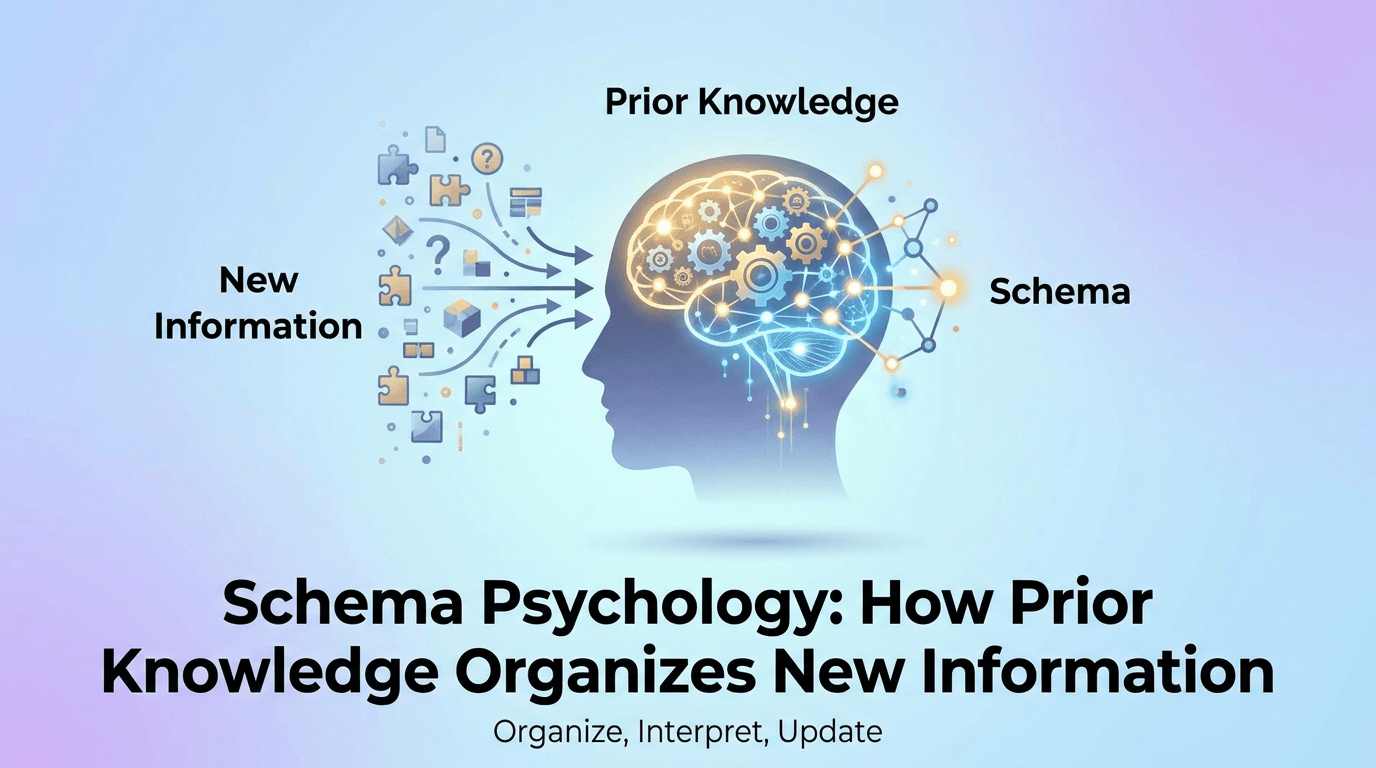
When you walk into a restaurant, you usually do not need instructions for every step. You expect to find a place to sit, some way to order, food or drinks, a method of payment, and a recognizable sequence linking those parts together. If the restaurant works differently, you notice the mismatch because you already carry organized knowledge about what restaurants are usually like.
In cognitive psychology, that organized prior knowledge is often described with the concept of a schema. A schema helps structure expectations about objects, situations, roles, relationships, and events. It can make new information easier to interpret because the mind does not have to begin from zero each time. At the same time, schemas are adaptable. When repeated experience no longer fits the old structure, the representation can be revised.
Quick Answer: What a Cognitive Schema Is
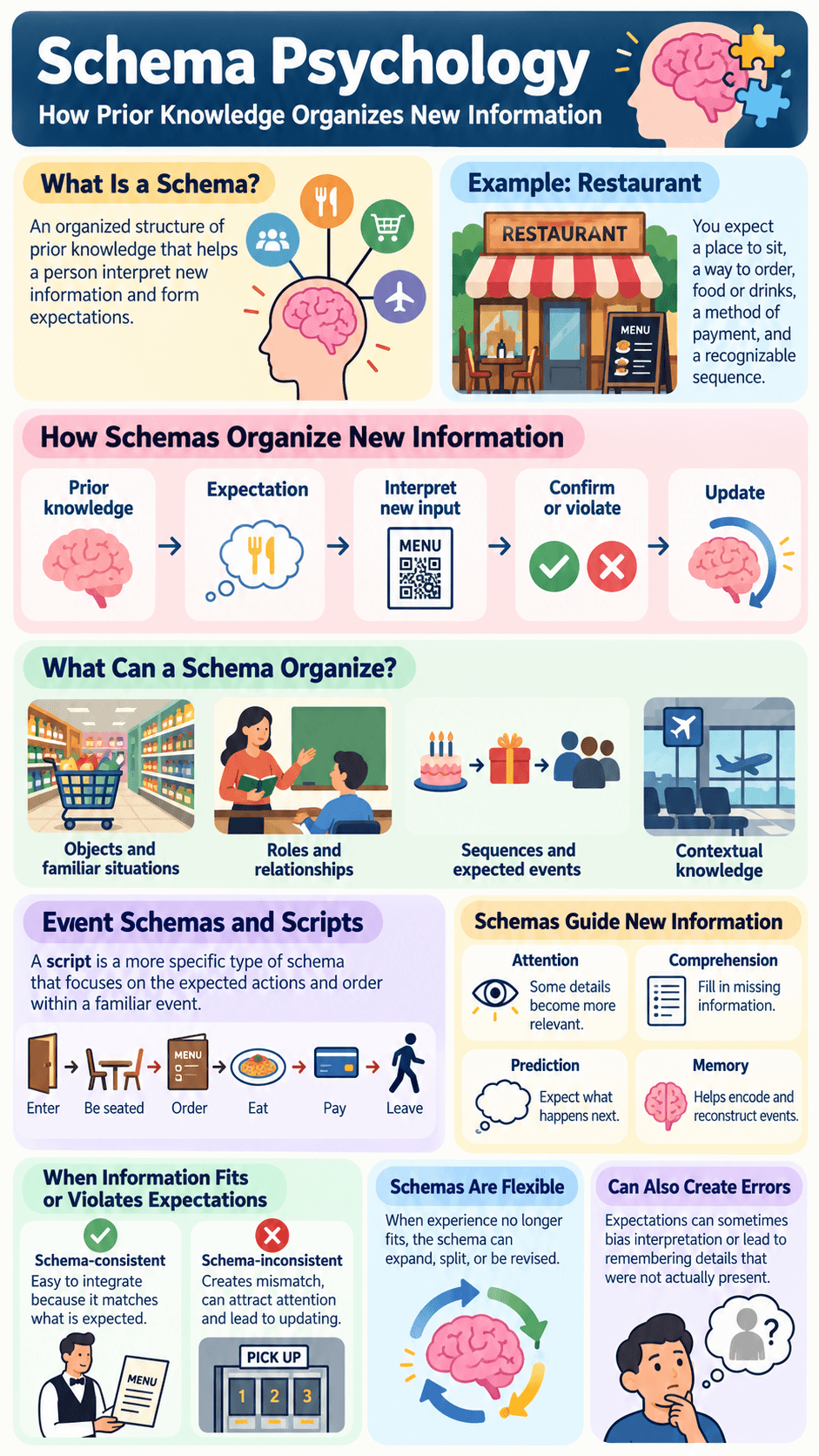
A cognitive schema is an organized structure of prior knowledge that helps a person interpret new information, form expectations, and understand how familiar elements fit together. Schemas can organize objects, situations, roles, and event sequences. They are not automatically distorted or unhealthy, and cognitive schema psychology is not the same as Schema Therapy or a diagnosis of “maladaptive schemas.”
Core Model: Prior Knowledge to Expectation to Update
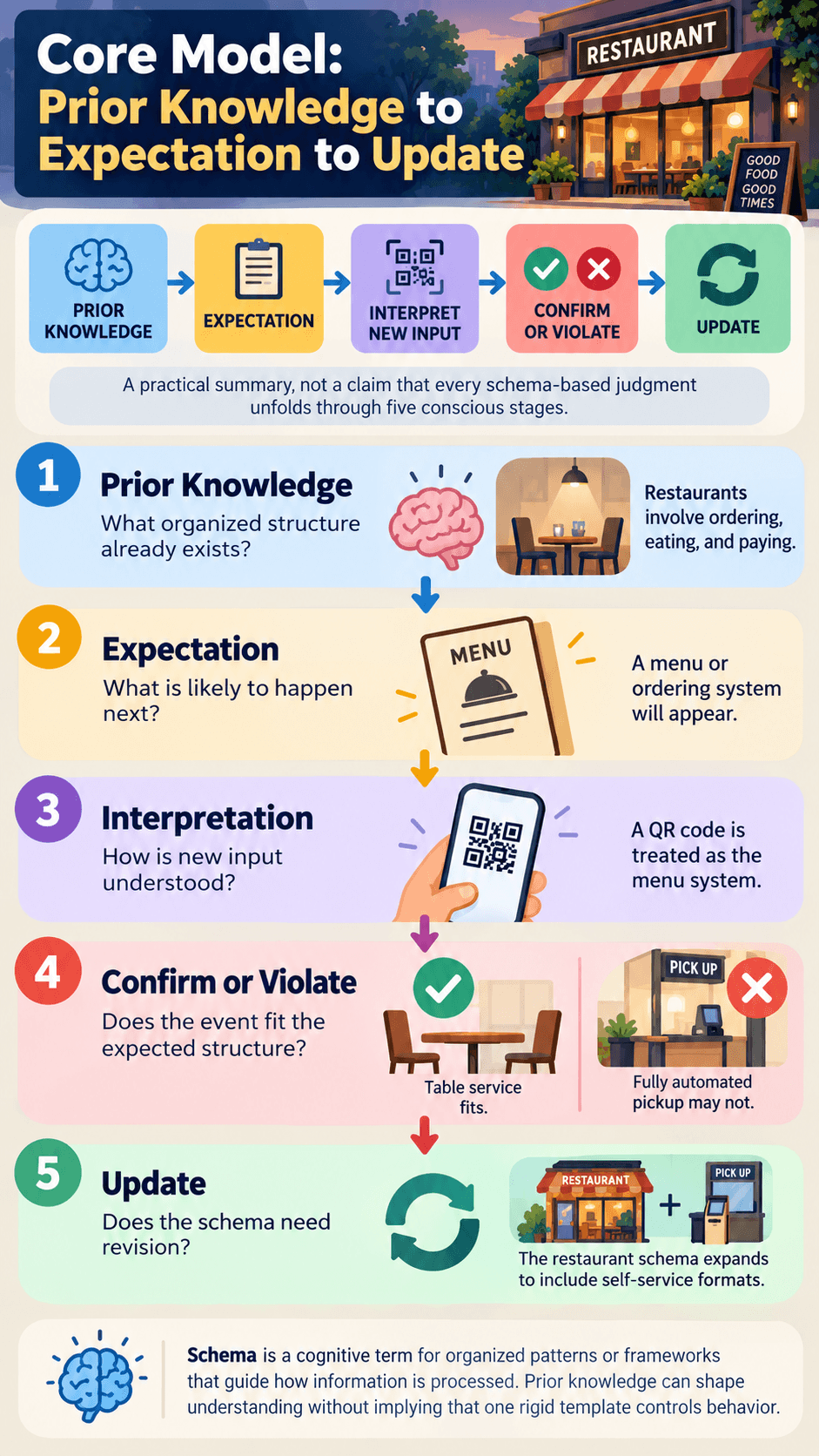
A useful way to visualize schema-guided processing is:
PRIOR KNOWLEDGE → EXPECTATION → INTERPRET NEW INPUT → CONFIRM OR VIOLATE → UPDATE
This model is a practical summary, not a claim that every schema-based judgment unfolds through five conscious stages.
| Stage | Main question | Restaurant example |
|---|---|---|
| Prior knowledge | What organized structure already exists? | Restaurants involve ordering, eating, and paying |
| Expectation | What is likely to happen next? | A menu or ordering system will appear |
| Interpretation | How is new input understood? | A QR code is treated as the menu system |
| Confirm or violate | Does the event fit the expected structure? | Table service fits; fully automated pickup may not |
| Update | Does the schema need revision? | The restaurant schema expands to include self-service formats |
The APA Dictionary of Psychology uses schema as a cognitive term for organized patterns or frameworks that guide how information is processed. The idea is broad enough to explain why prior knowledge can shape understanding without implying that one rigid template controls behavior.
What Information Can a Schema Organize?
Objects and familiar situations
A schema can organize knowledge about recurring objects and settings. A supermarket schema may include aisles, shelves, baskets, checkout areas, price labels, and the broad purpose of selecting and paying for goods.
The representation does not need to specify the exact layout of one store. It captures enough common structure to make an unfamiliar supermarket understandable. Details unique to one location can be handled separately.
Roles and relationships among elements
Schemas can also represent how elements relate. In a classroom, teacher, student, lesson, assignment, and classroom materials are not simply separate concepts. Their roles and relationships help define the situation.
The same object can take on a different meaning depending on the schema. A blank form at an airport may be interpreted as travel documentation, while a similar-looking form in a clinic may be understood as registration paperwork.
Sequences and expected events
Many familiar situations have a rough temporal structure. A birthday party may involve arriving, greeting people, eating, giving gifts, and leaving. A job interview may involve introductions, questions, discussion of experience, and a closing exchange.
The sequence does not have to be exact. The schema provides an expected structure, not a script that reality must follow perfectly.
Contextual knowledge
Context can determine which schema becomes active. A counter, numbered ticket, and waiting area mean something different in a bakery, government office, airport, or hospital.
Prior knowledge helps select the interpretation that best fits the current setting. This is one reason schemas can speed comprehension: they narrow the range of plausible meanings without requiring deliberate analysis of every detail.
Event Schemas and Scripts
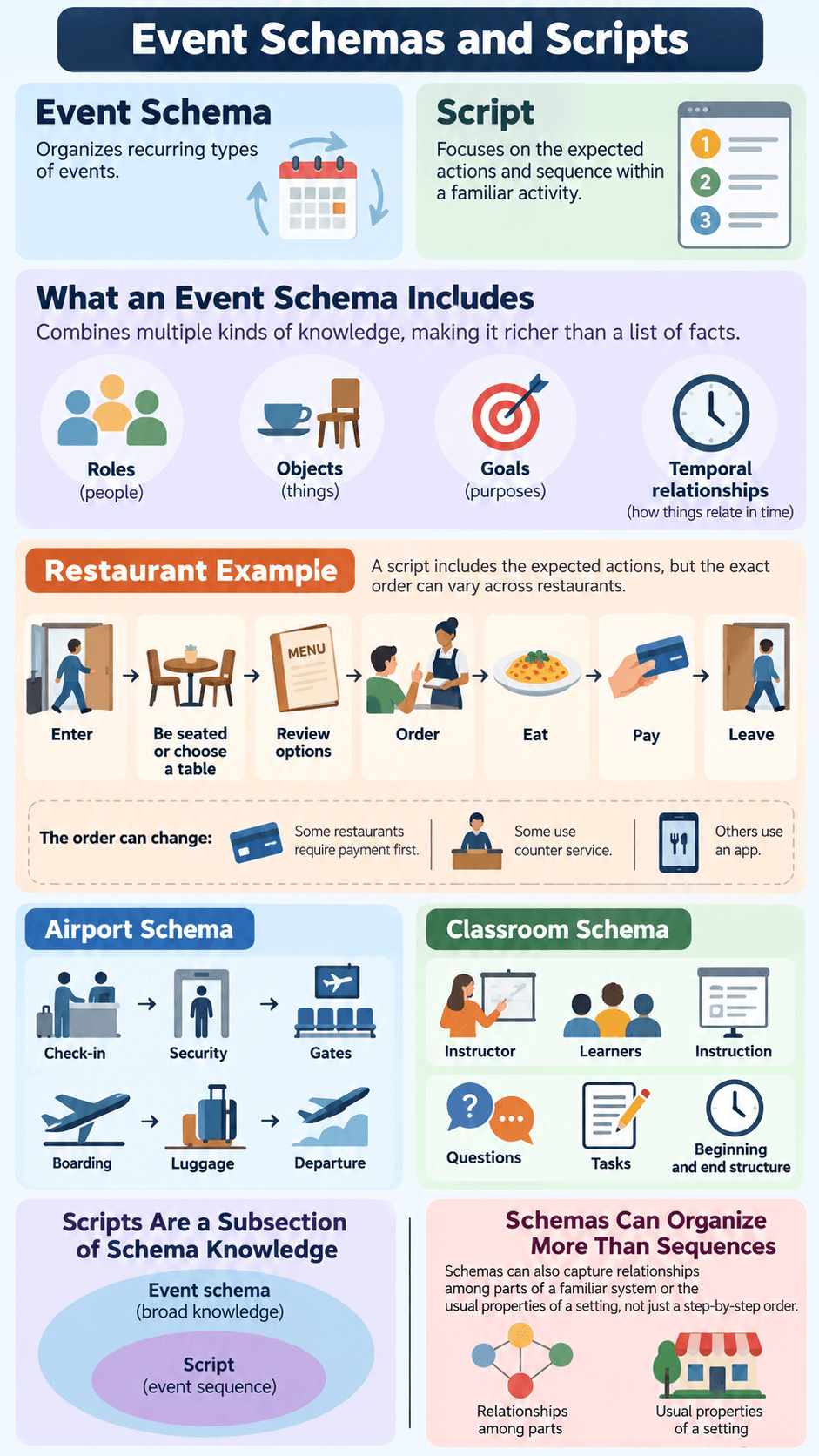
Event schemas organize recurring types of events. A closely related concept is the script, which focuses more specifically on the expected actions and sequence within a familiar activity.
The APA Dictionary entry on script describes a script as a cognitive schematic structure containing the basic actions and temporal or causal relationships that make up a complex activity.
Restaurant example
A restaurant script might include entering, being seated or choosing a table, reviewing options, ordering, eating, paying, and leaving. The exact order can change. Some restaurants require payment first, some use counter service, and others use an app.
The script remains useful because it captures the recurring organization rather than one exact episode. When a step is omitted, people can often infer what probably happened.
Airport or classroom example
An airport schema can include check-in, security, gates, boarding, luggage, and departure. A classroom schema can include an instructor, learners, instruction, questions, tasks, and some structure for beginning and ending the session.
These examples show that event schemas combine roles, objects, goals, and temporal relationships. They are richer than a list of unrelated facts.
Why scripts are a subsection of broader schema knowledge
Scripts are especially useful for routine event sequences, but schemas are broader. A schema can organize knowledge that is not primarily sequential, such as the relationships among parts of a familiar system or the usual properties of a setting.
A review of event perception and event schemas distinguishes knowledge about event types from representations of one particular event and relates event schemas to more specific notions such as scripts. This helps keep “schema” from becoming a synonym for any remembered sequence.
How Schemas Guide New Information
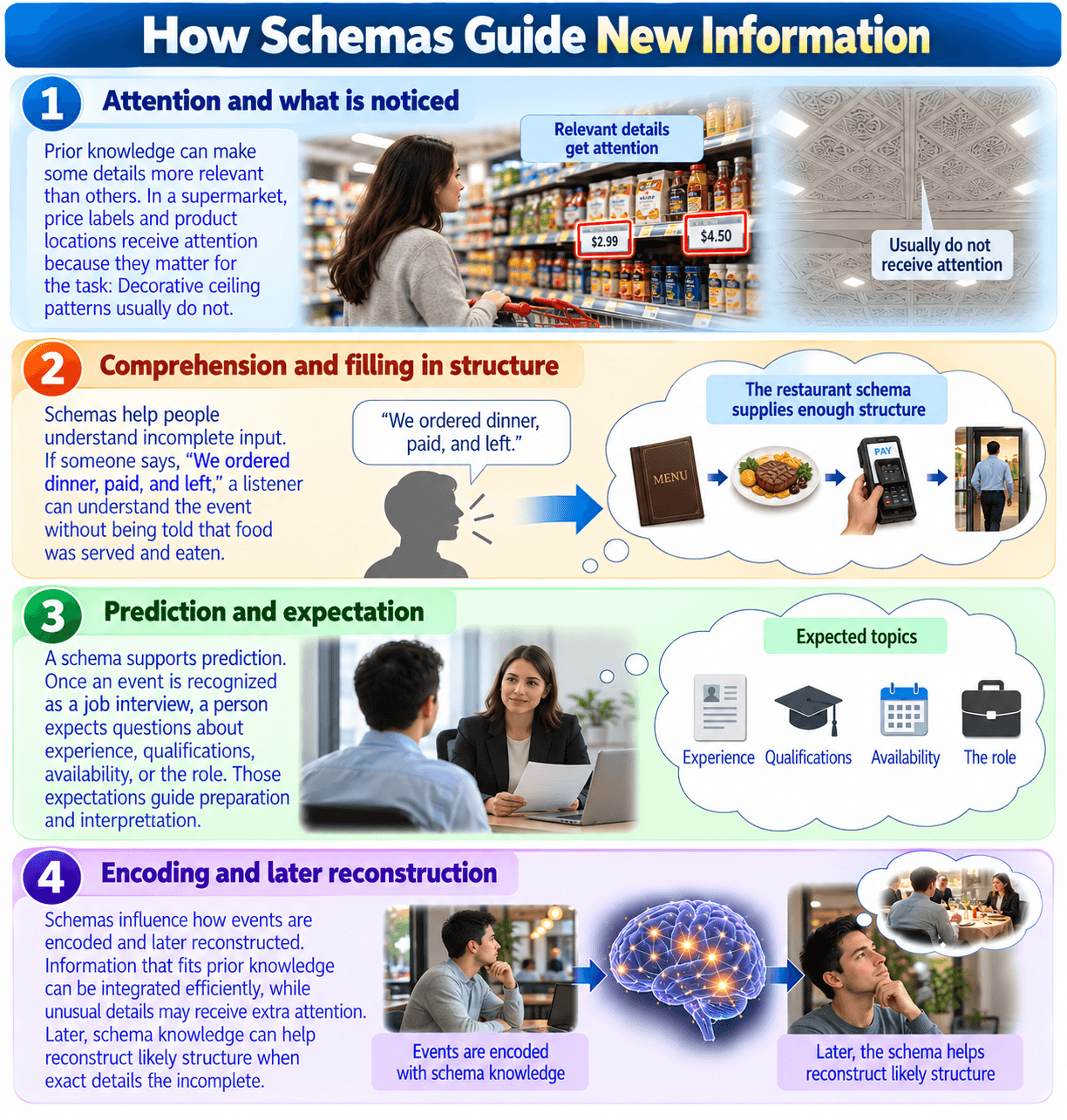
Attention and what is noticed
Prior knowledge can make some details more relevant than others. In a supermarket, price labels and product locations receive attention because they matter for the task. Decorative ceiling patterns usually do not.
This does not mean a schema completely determines attention. Unexpected information can capture attention precisely because it violates what was expected.
Comprehension and filling in structure
Schemas help people understand incomplete input. If someone says, “We ordered dinner, paid, and left,” a listener can understand the event without being told that food was served and eaten. The restaurant schema supplies enough structure to make the sequence coherent.
This ability is useful because real communication rarely states every link explicitly. Prior knowledge allows comprehension to go beyond the literal details that are present.
Prediction and expectation
A schema also supports prediction. Once an event is recognized as a job interview, a person expects questions about experience, qualifications, availability, or the role. Those expectations guide preparation and interpretation.
A modern review of previous knowledge and memory schemas describes schemas as associative knowledge structures that alter how new information is processed. The important point for everyday cognition is that prior structure changes what the person is ready to expect and integrate.
Encoding and later reconstruction as a bridge to memory
Schemas also influence how events are encoded and later reconstructed. Information that fits prior knowledge can be integrated efficiently, while unusual details may receive extra attention. During later remembering, schema knowledge can help reconstruct likely structure when exact details are incomplete.
This is a bridge to memory psychology rather than the main subject here. Schema effects do not mean that memory is simply invented or generally unreliable. They mean that remembering occurs in the context of existing knowledge rather than as a perfectly isolated recording process.
Schema-Consistent and Schema-Inconsistent Information
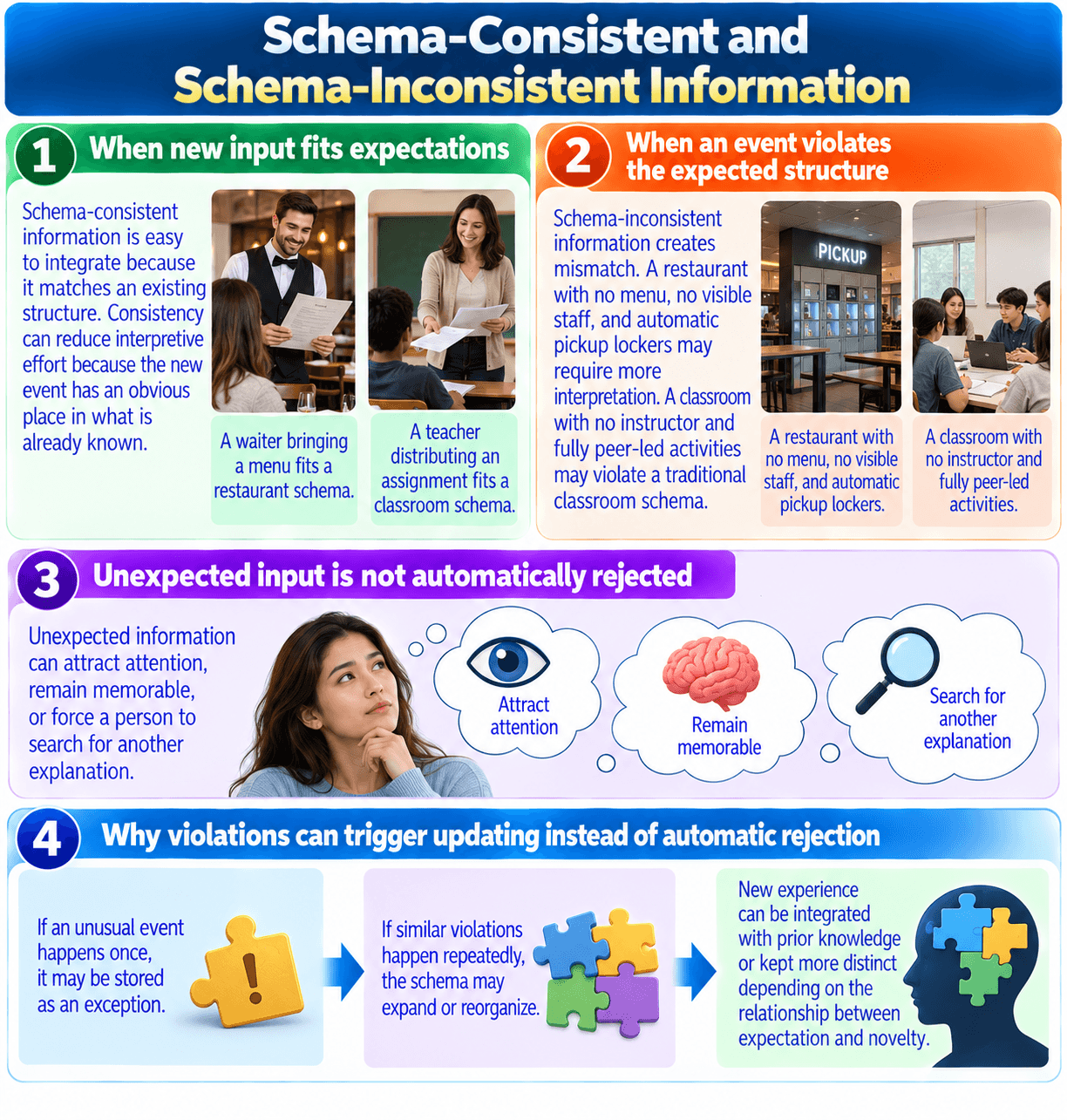
When new input fits expectations
Schema-consistent information is easy to integrate because it matches an existing structure. A waiter bringing a menu fits a restaurant schema. A teacher distributing an assignment fits a classroom schema.
Consistency can reduce interpretive effort because the new event has an obvious place in what is already known.
When an event violates the expected structure
Schema-inconsistent information creates mismatch. A restaurant with no menu, no visible staff, and automatic pickup lockers may initially require more interpretation. A classroom with no instructor and fully peer-led activities may violate a traditional classroom schema.
Unexpected input is not automatically rejected. It can attract attention, remain memorable, or force a person to search for another explanation.
Why violations can trigger updating instead of automatic rejection
If an unusual event happens once, it may be stored as an exception. If similar violations happen repeatedly, the schema may expand or reorganize.
Recent work reviewing expected and unexpected events in memory emphasizes that new experience can be integrated with prior knowledge or kept more distinct depending on the relationship between expectation and novelty. This supports a flexible view of schemas rather than a model in which prior knowledge simply filters out contradiction.
How Schemas Become More Useful With Experience
Expertise and richer structured knowledge
Experts often possess more detailed schemas than novices. A beginner may understand a restaurant only as a place to order and eat. A restaurant manager may represent staffing, seating flow, kitchen timing, inventory, reservations, and customer turnover as an interconnected structure.
Richer schemas can make new information easier to place because there are more meaningful relationships available. The same new fact can therefore be more informative to an expert than to a novice.
Context-sensitive expectations
Experience also teaches that one schema can have variants. A classroom can be a lecture hall, laboratory, seminar, or online session. A supermarket can be staffed, self-checkout based, or delivery-only.
Useful schema knowledge therefore includes flexibility about which elements are essential and which are context-dependent. A strong schema does not require every familiar situation to look the same. It preserves relationships that remain useful while allowing details to vary.
Context can also determine which part of prior knowledge becomes active. A job interview held in a corporate office may activate expectations about formal introductions and structured questions. A portfolio interview at a design studio may activate expectations about showing work, discussing process, and receiving open-ended prompts. Both are interviews, but different variants make different details informative.
This flexibility helps explain why ordinary schemas should not be pictured as rigid checklists. They can contain defaults, alternatives, and conditions. What matters is whether the organized knowledge helps interpret the current situation while remaining responsive to evidence that the situation is different.
Updating after repeated mismatch
A schema that repeatedly predicts poorly becomes less useful. If a workplace adopts a new meeting process for months, employees gradually stop treating the new structure as surprising. Their expectations change.
A modern review of schema and prior knowledge describes schemas as adaptable structures built from multiple experiences rather than as fixed snapshots. Ghosh and Gilboa’s review of memory-schema definitions highlights adaptability as one important feature that distinguishes schemas from more rigid representations.
How Schemas Help Experts See Structure Novices Miss
Experts organize details into meaningful patterns
A novice in a restaurant kitchen may see appliances, containers, ingredients, and people moving quickly. An experienced chef sees stations, workflow, dependencies, timing constraints, and likely bottlenecks. The difference is not simply that the expert knows more facts. The facts are organized into structures that make relationships meaningful.
Richer prior knowledge can speed interpretation
When new information fits an established schema, an expert can often place it rapidly. A mechanic hearing a particular engine symptom can connect it with a network of possible systems and causes that a novice does not yet possess.
This does not guarantee that experts are always correct. Strong schemas can create expectations too. The advantage is that expert knowledge usually contains more differentiated structure and more ways to revise an interpretation when evidence fails to fit.
Expertise can also create more specialized schemas
A broad “meeting” schema may be enough for everyday work. Someone who regularly runs design reviews, sales calls, incident-response meetings, and hiring panels may develop distinct schemas for each. Experience can therefore refine one broad structure into several more specialized ones.
This illustrates why schema development is not simply adding details to one fixed template. Organized prior knowledge can become more differentiated as the person learns which relationships reliably matter.
When Schemas Create Errors
Expectation-driven interpretation
The same efficiency that helps comprehension can sometimes bias interpretation. If you strongly expect an event to follow a familiar pattern, an ambiguous detail may be interpreted in the direction of that pattern.
For example, someone entering a traditional restaurant may initially assume that a person standing near the entrance is a host because that role fits the setting, even if the person is another customer.
Remembering likely elements that were not actually present
Because schemas contain expected structure, people can sometimes later report likely details that were not explicitly present. A person remembering an office scene may recall ordinary office objects that fit the situation even when some were absent.
This should not be turned into the claim that memory is usually false. Schema-based memory effects vary with task, expectations, attention, and the kind of information being tested. The responsible conclusion is that prior knowledge can influence reconstruction, not that it replaces evidence.
Why schemas are not inherently inaccurate or biased
Schemas exist because recurring structure is useful. Expecting a checkout process in a supermarket or boarding process at an airport is usually adaptive. The problem arises when the existing representation is applied rigidly despite evidence that the situation differs.
A schema can therefore be accurate, incomplete, outdated, overgeneralized, or highly expert. “Schema” names the organized structure, not its moral or clinical quality.
Schema vs Concept
Class, property, or relation representation versus richer structured prior knowledge
A concept helps represent a class, property, relation, event, or idea. A schema usually refers to a richer organized structure connecting multiple elements and expectations.
Your concept of “restaurant” lets you identify restaurants as a type of place. A restaurant schema adds roles, objects, likely sequences, goals, and relationships among those parts. The distinction is useful even though researchers may use the terms with some overlap.
Schema vs Belief
Knowledge structure versus proposition accepted as true
A belief is typically something a person accepts as true, such as “this store closes at nine.” A schema is a broader organization of related knowledge and expectations, such as how supermarkets usually work.
A schema can contain or support beliefs, but it is not reducible to one proposition. This distinction matters because ordinary schema theory should not turn every expectation into a belief claim.
Schema vs Stereotype
Broad organized knowledge versus generalized social-category expectation
Schema is a general cognitive term that can apply to restaurants, classrooms, airports, tools, events, and many other domains. A stereotype is a generalized belief or association about members of a social group.
Social stereotypes can be described as schema-like in some theoretical traditions, but cognitive schema psychology should not be collapsed into stereotype psychology. The social consequences, ethical issues, and intergroup processes require their own analysis.
Schema vs Problem Representation and Mental Model
Stored prior structure versus the current model of one problem
A schema is prior knowledge that can be activated across similar situations. A problem representation is the way a person currently models one specific problem, including its givens, constraints, relationships, and goal.
When solving a scheduling problem, prior schemas about calendars, tasks, and dependencies may help. The representation of this particular schedule is still a current problem model rather than the schema itself.
Why “mental model” is a broader term
“Mental model” is used broadly in psychology and related fields for internal representations that help people understand systems, situations, or relationships. Some mental models may draw on schemas, but the terms should not be treated as perfect synonyms.
In this context, schema is most useful when the emphasis is on organized prior knowledge acquired across experience. Mental model is broader and can include a temporary representation constructed for a specific situation.
What Cognitive Schema Psychology Is Not
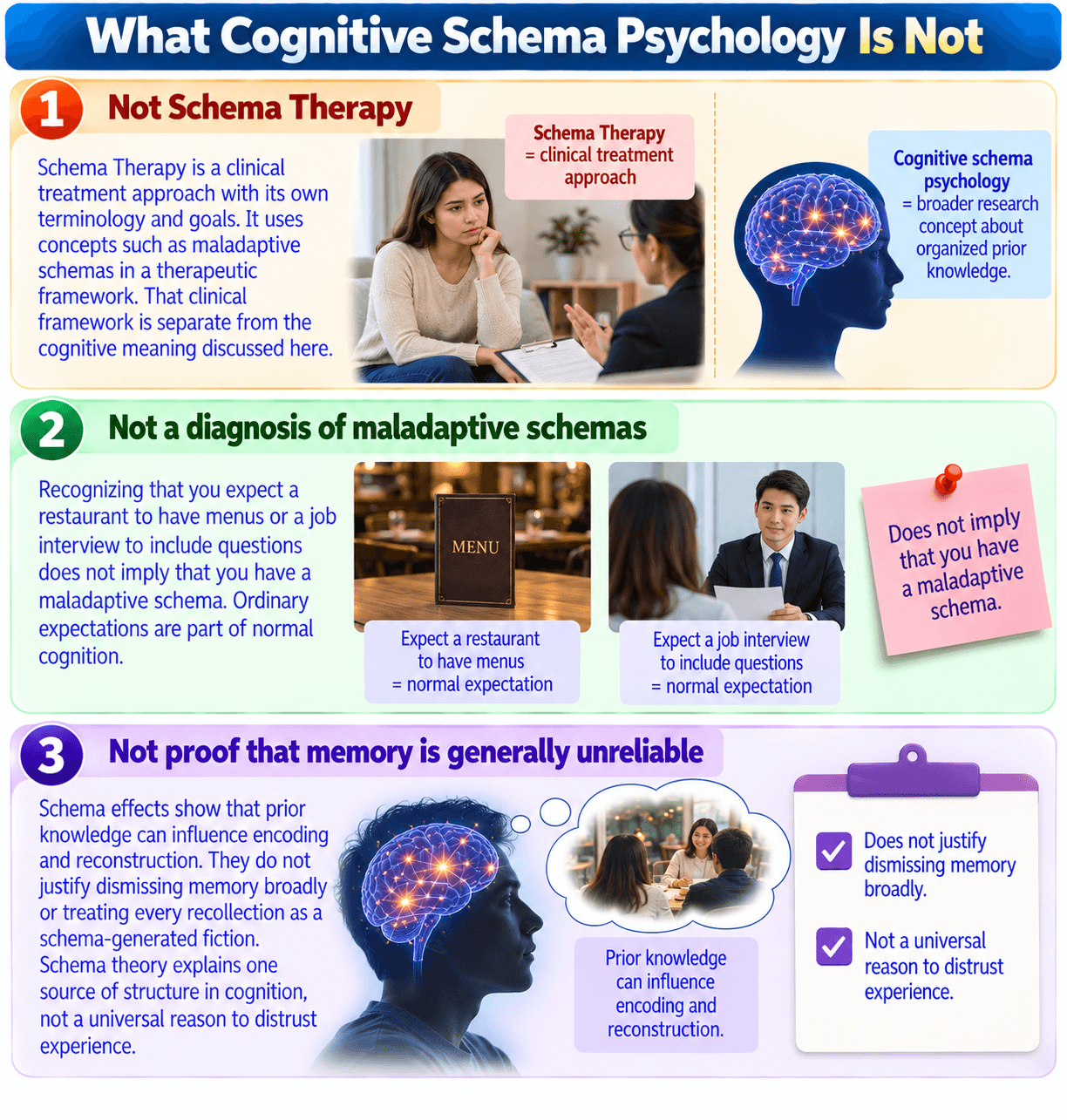
Not Schema Therapy
Schema Therapy is a clinical treatment approach with its own terminology and goals. It uses concepts such as maladaptive schemas in a therapeutic framework. That clinical framework is separate from the cognitive meaning discussed here.
The APA Dictionary description of Schema Therapy identifies it as a therapeutic approach designed to change problematic belief patterns derived from earlier experiences. Cognitive schema psychology is a much broader research concept about organized prior knowledge.
Not a diagnosis of maladaptive schemas
Recognizing that you expect a restaurant to have menus or a job interview to include questions does not imply that you have a maladaptive schema. Ordinary expectations are part of normal cognition.
Terms from therapy, such as abandonment, defectiveness, emotional deprivation, or mistrust schemas, should not be self-assigned simply because the word “schema” appears in cognitive psychology.
Not proof that memory is generally unreliable
Schema effects demonstrate that prior knowledge can influence encoding and reconstruction. They do not justify dismissing memory broadly or treating every recollection as a schema-generated fiction.
Evidence, context, repeated observations, and direct records remain important. Schema theory explains one source of structure in cognition, not a universal reason to distrust experience.
A Practical Way to Notice a Schema in Everyday Life
Choose a familiar situation such as a supermarket, airport, classroom, birthday party, or job interview. Then ask:
- What do I expect to see before I enter?
- Which roles do I assume will be present?
- What sequence do I expect to unfold?
- Which details do I barely notice because they fit expectations?
- What would immediately feel surprising?
- Would one unusual event count as an exception or make me revise the schema?
- How would an expert in this setting represent it differently?
The point is not to diagnose hidden patterns. It is to see how organized prior knowledge reduces uncertainty and makes familiar environments easier to interpret.
FAQ About Schema Psychology
Is every belief a schema?
No. A belief is usually a proposition accepted as true, while a schema is a broader organized structure connecting multiple elements, expectations, roles, or relationships. A schema can support beliefs, but one belief does not automatically constitute a schema.
Are schemas always biased or inaccurate?
No. Schemas are useful because environments often contain recurring structure. They help people understand routine situations quickly. Errors become more likely when an outdated or overly rigid schema is applied despite contradictory evidence.
How is an event script related to a schema?
A script is a more specific kind of schema-like structure focused on the expected actions and order within a familiar event. A restaurant script might organize ordering, eating, paying, and leaving. Schema is the broader term and can organize information that is not primarily sequential.
Is cognitive schema psychology the same as Schema Therapy?
No. Cognitive schema psychology studies organized prior knowledge as a general feature of cognition. Schema Therapy is a clinical treatment framework that uses its own concepts about maladaptive patterns and therapeutic change. The shared word does not make the two topics interchangeable.
Key Takeaways
- A schema is organized prior knowledge that helps structure expectations and interpretation.
- Schemas can organize objects, settings, roles, relationships, and recurring event sequences.
- Event scripts are a more specific form of structured knowledge about the likely actions and order within familiar activities.
- Schema-consistent information is often easy to integrate, while violations can attract attention and trigger updating.
- Schemas can support efficient comprehension but can also shape interpretation or reconstruction when information is incomplete.
- Cognitive schemas are not the same as beliefs, stereotypes, problem representations, generic mental models, or the clinical schemas used in Schema Therapy.
Final Thought: Prior Knowledge Is Most Useful When It Can Change
A schema earns its value by helping new situations make sense quickly. It connects current input with what has been learned before, supplies expectations, and reduces the amount of interpretation required from scratch. But useful prior knowledge cannot remain rigid. When experience repeatedly violates the old structure, the schema must expand, split, or reorganize. The strength of schema-based cognition is therefore not simply expectation. It is organized expectation that remains open to evidence.
Educational note: Here, “schema” is used in the general cognitive-psychology sense. It is not intended to identify maladaptive schemas, diagnose mental-health conditions, or replace assessment or treatment by a qualified professional.

Michael Reed is the Founder and Lead Writer at Psychology Exposed. He writes about human behavior, relationships, emotional patterns, self-awareness, and practical psychology topics using research-informed, easy-to-understand content.
Read More About Michael Reed: https://psychologyexposed.com/michael-reed/