
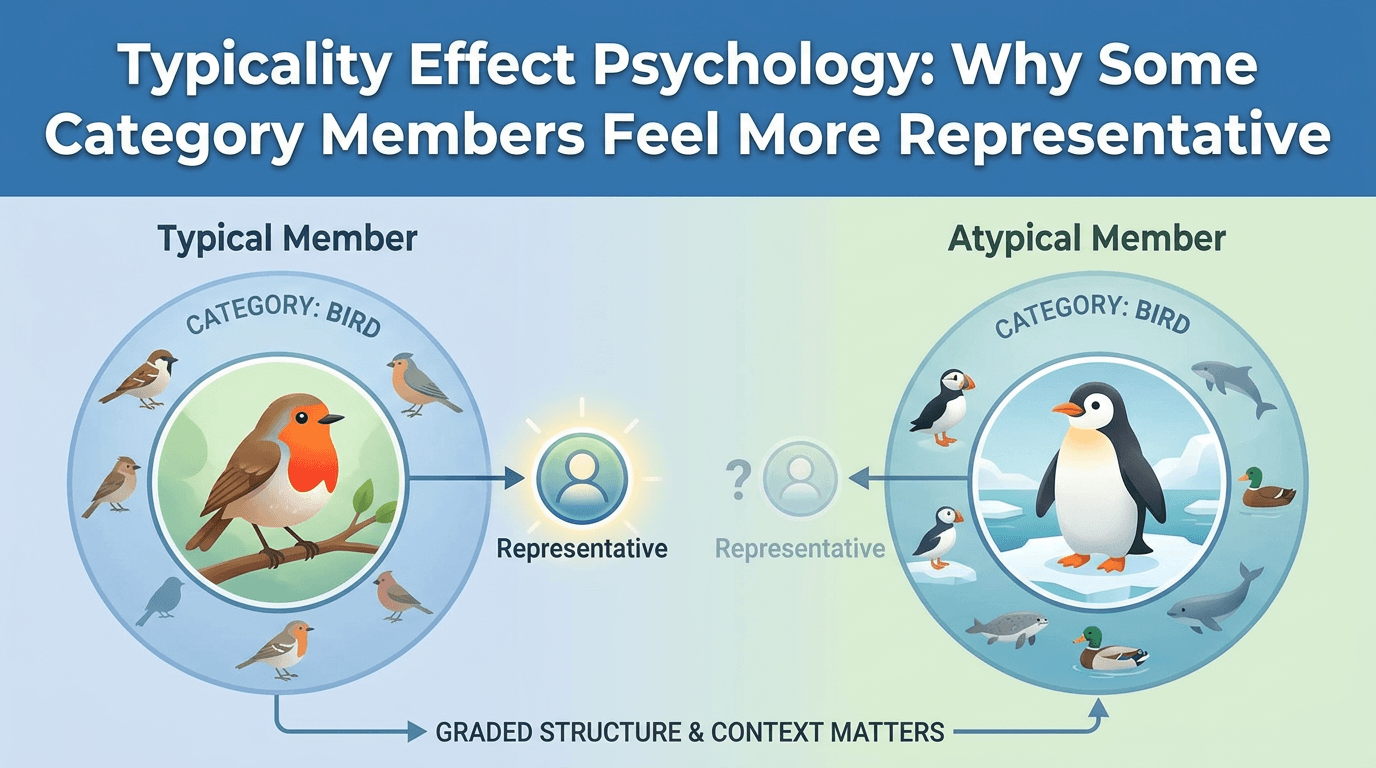
A robin and a penguin are both birds, but many people experience them differently as category examples. A robin often feels immediately “bird-like,” while a penguin feels unusual even though its membership is not in doubt. The difference is not about whether one belongs and the other does not. It is about typicality: how representative a category member seems.
The typicality effect is one of the clearest signs that many categories have internal structure. Members are not always treated as equally good examples. Typical members may be named sooner, verified faster, learned more easily, or judged as better representatives than atypical members. Yet typicality should not be confused with frequency, category membership, prototype storage, or basic-level categorization. It is an observed pattern of graded representativeness, and several theories can explain why it occurs.
Quick Answer: What Is the Typicality Effect?
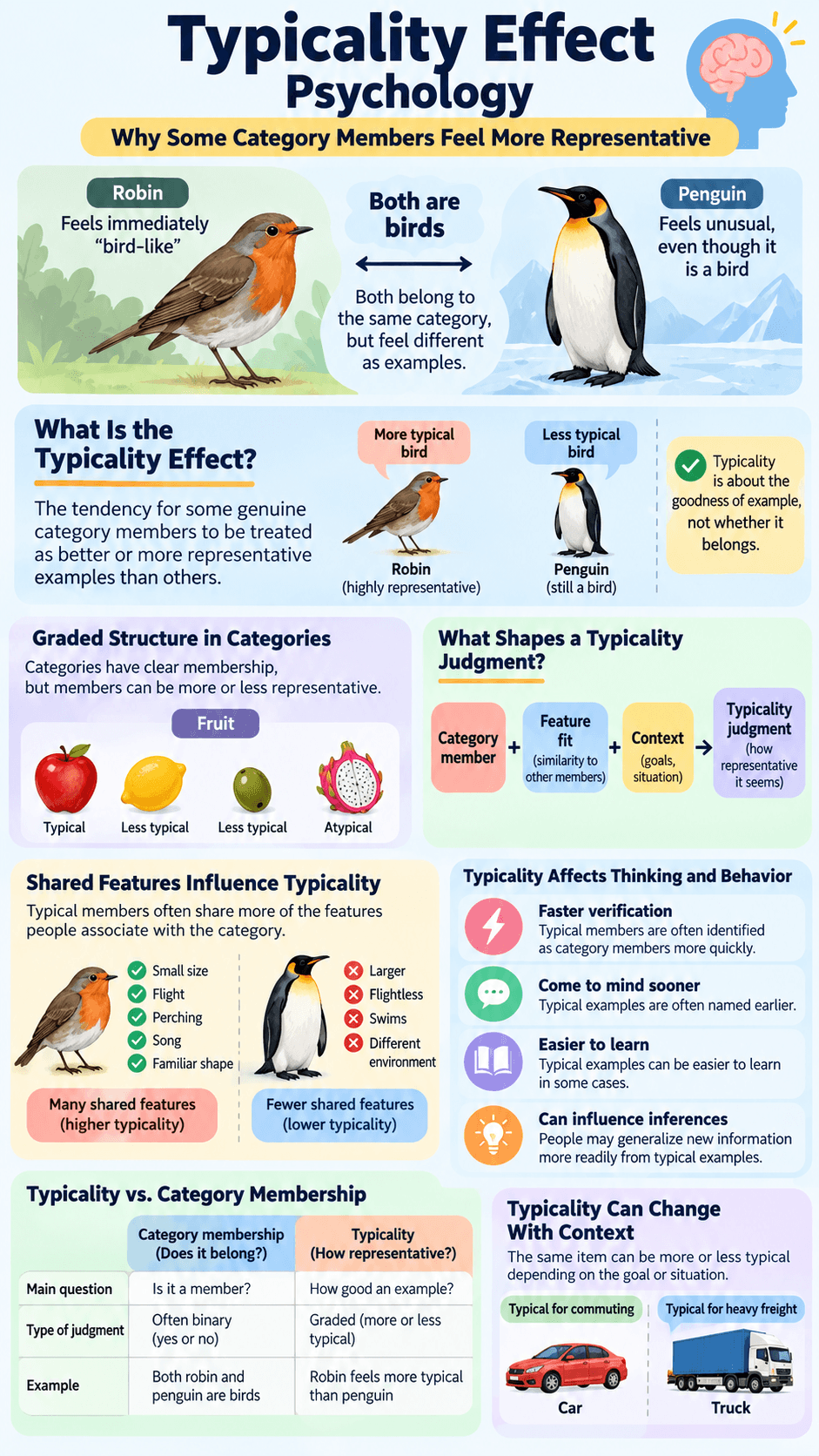
The typicality effect is the tendency for some genuine category members to be treated as better or more representative examples than others. A robin may be judged a more typical bird than a penguin, even though both are birds. Typicality can influence speed of category verification, judgments, learning, and other category-related tasks, but it does not determine whether an item truly belongs.
Typicality Is About Goodness of Example, Not Membership
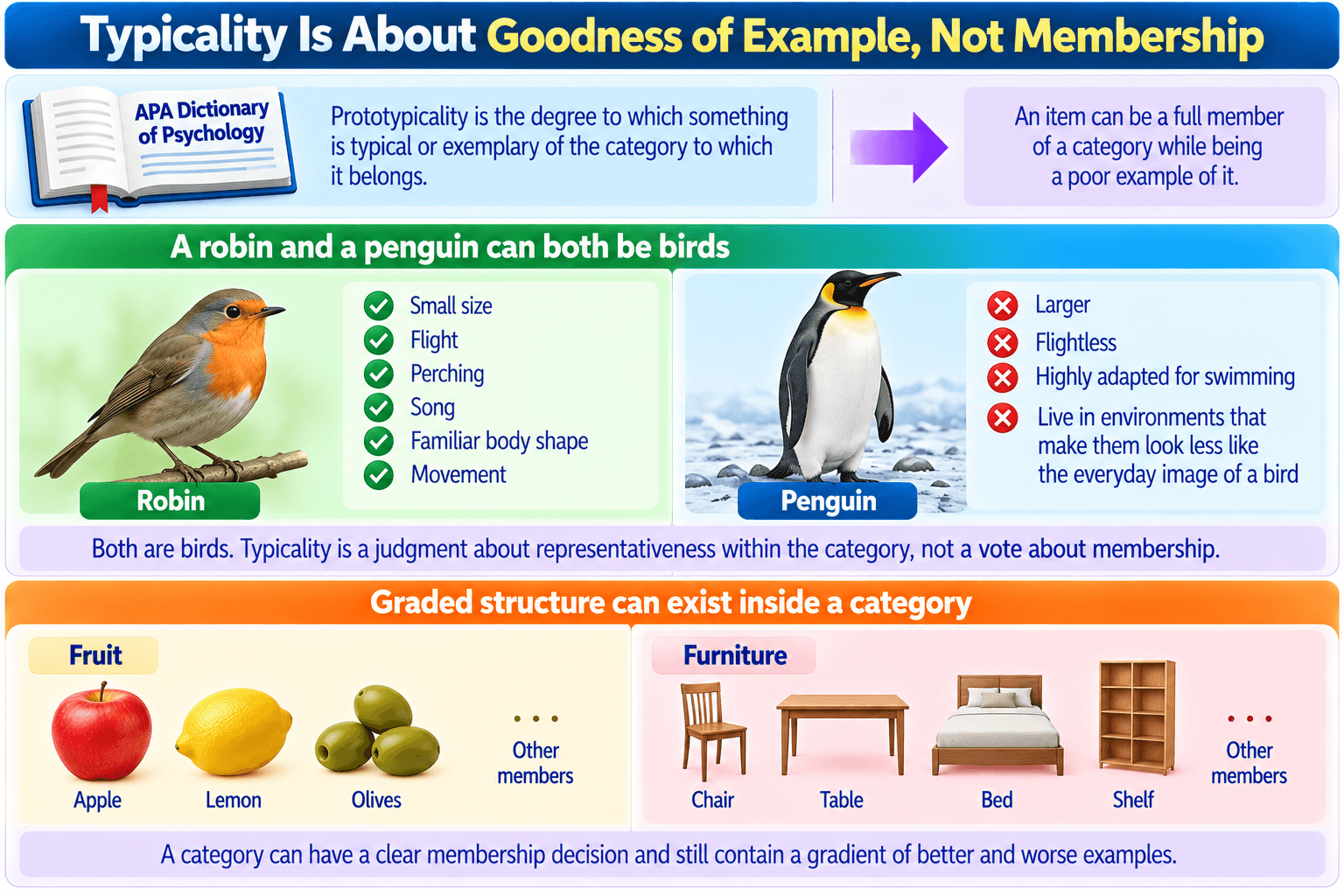
The APA Dictionary of Psychology defines prototypicality as the degree to which something is typical or exemplary of the category to which it belongs. That wording captures the most important distinction in this topic: an item can be a full member of a category while being a poor example of it.
A robin and a penguin can both be birds
Robins share many properties that people commonly associate with birds: small size, flight, perching, song, familiar body shape, and movement. Penguins differ on several of those properties. They are larger, flightless, highly adapted for swimming, and live in environments that make them look less like the everyday image many people have of a bird.
None of this removes penguins from the bird category. Typicality is therefore not a hidden vote about whether membership is “real.” It is a judgment about representativeness within the category.
Graded structure can exist inside a category
A category can have a clear membership decision and still contain a gradient of better and worse examples. This is called graded structure. Fruit can include apples, lemons, olives, and other members that do not all feel equally representative. Furniture can include chairs, tables, beds, shelves, and borderline-looking pieces that vary in how readily they come to mind.
Graded structure matters because it shows that categories are often richer than a flat list of members. The mind can know that two items belong to the same group while still treating one as more central.
Core Model: What Shapes a Typicality Judgment?
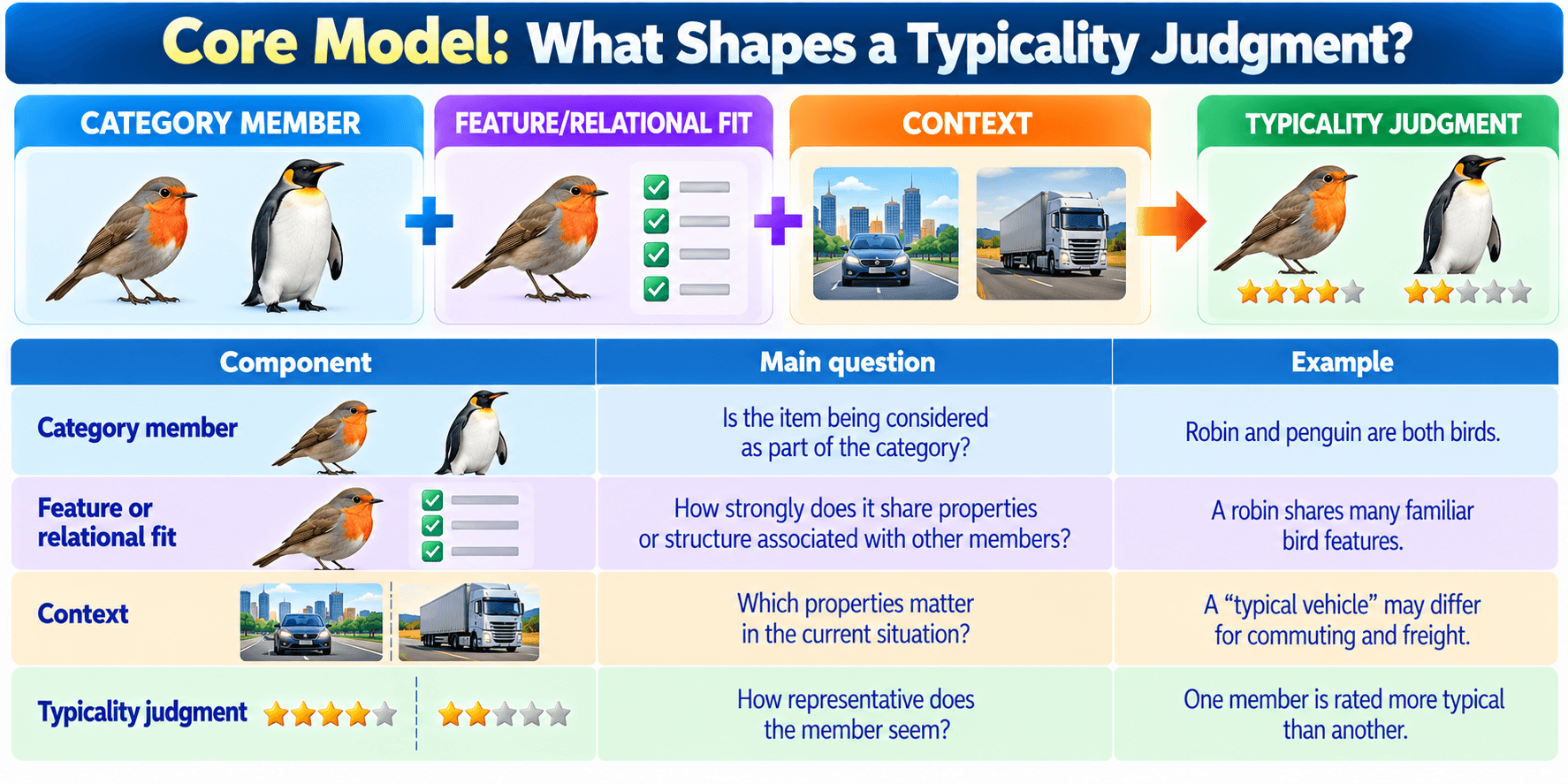
A useful model for the phenomenon is:
CATEGORY MEMBER + FEATURE/RELATIONAL FIT + CONTEXT → TYPICALITY JUDGMENT
This model does not claim that all three ingredients contribute equally in every category. It is a way to avoid treating typicality as one fixed property stored inside the item itself.
| Component | Main question | Example |
|---|---|---|
| Category member | Is the item being considered as part of the category? | Robin and penguin are both birds |
| Feature or relational fit | How strongly does it share properties or structure associated with other members? | A robin shares many familiar bird features |
| Context | Which properties matter in the current situation? | A “typical vehicle” may differ for commuting and freight |
| Typicality judgment | How representative does the member seem? | One member is rated more typical than another |
Family Resemblance: Why Shared Structure Matters
Typical members often share more with other category members
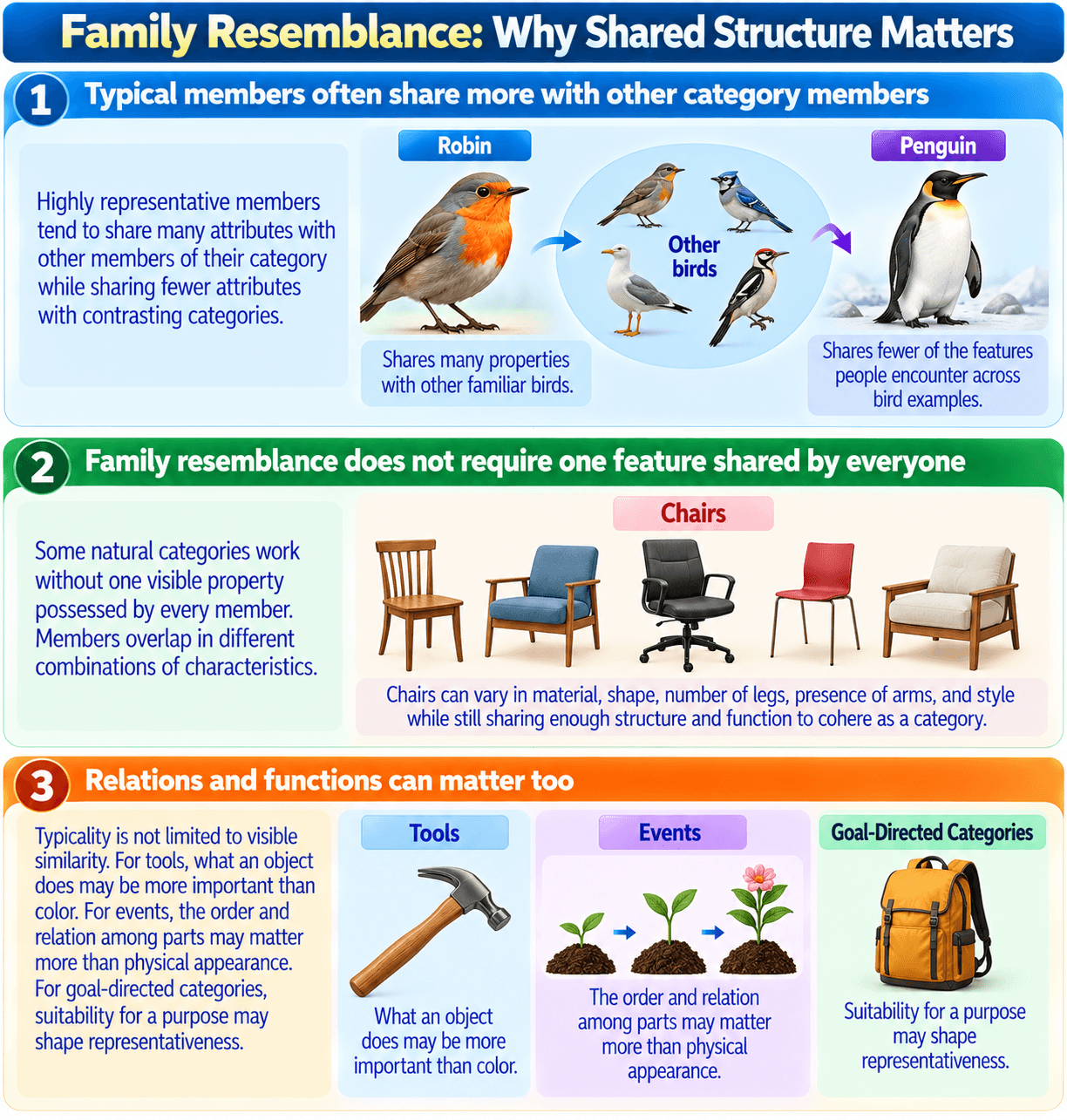
Eleanor Rosch and Carolyn Mervis proposed that highly representative members tend to share many attributes with other members of their category while sharing fewer attributes with contrasting categories. Their classic family-resemblance research found strong relationships between attribute overlap and rated prototypicality across several natural categories.
This helps explain why a robin can feel highly representative. Many of its properties overlap with other familiar birds. A penguin still belongs, but it shares fewer of the features people encounter across the broader set of bird examples.
Family resemblance does not require one feature shared by everyone
Some natural categories work without one visible property possessed by every member. Instead, members overlap in different combinations of characteristics. Chairs can vary in material, shape, number of legs, presence of arms, and style while still sharing enough structure and function to cohere as a category.
Typical members sit near the dense part of this overlap. Atypical members may possess fewer common features, unusual combinations, or properties that also appear in neighboring categories.
Relations and functions can matter too
Typicality is not limited to visible similarity. For tools, what an object does may be more important than color. For events, the order and relation among parts may matter more than physical appearance. For goal-directed categories, suitability for a purpose may shape representativeness.
This broader view prevents family resemblance from becoming a checklist of surface features only. The psychologically important structure depends on the kind of category.
How Psychologists Measure Typicality
Typicality ratings
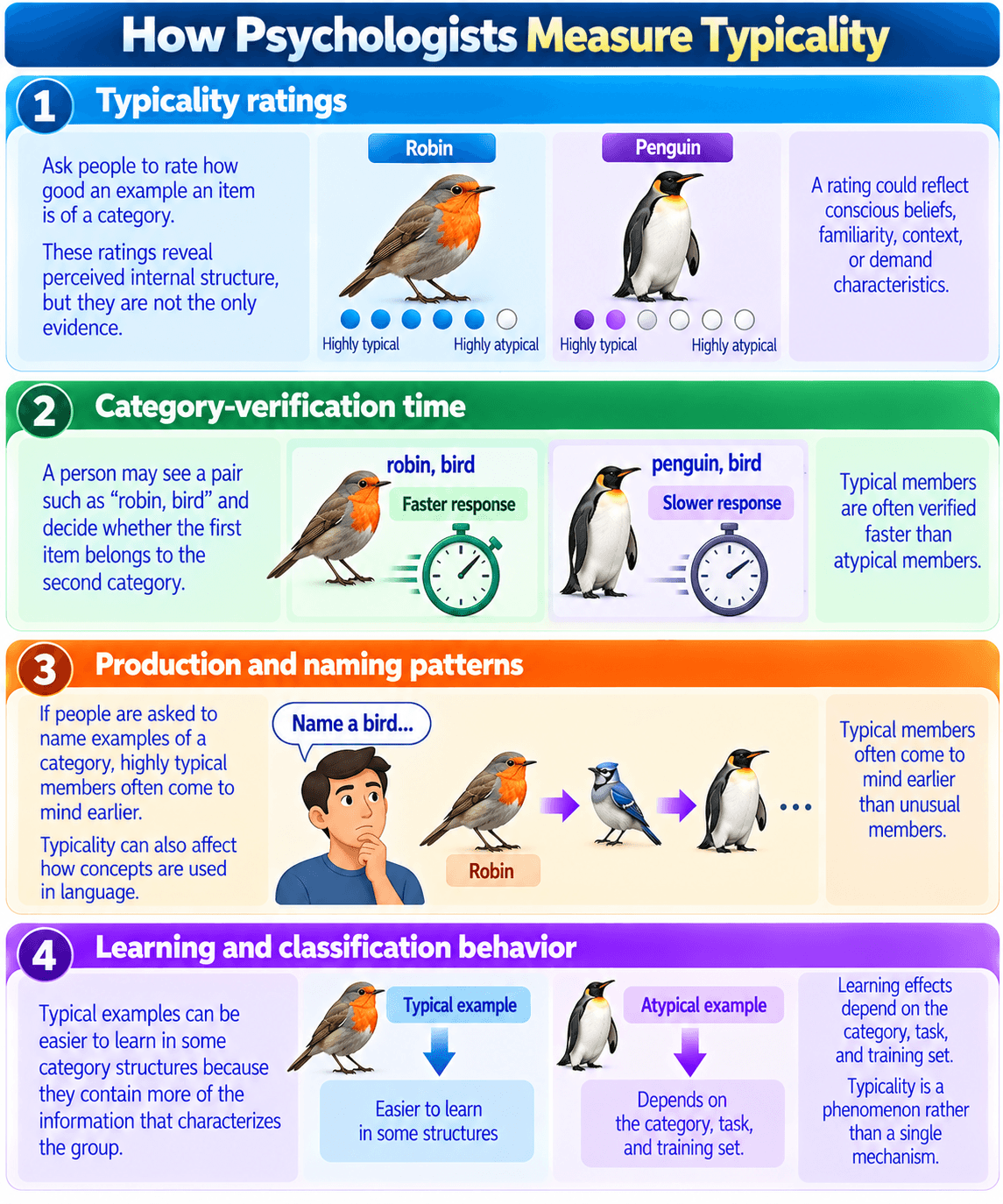
One straightforward method is to ask people to rate how good an example an item is of a category. Participants might rate robin and penguin on a scale from highly typical to highly atypical as birds.
These ratings reveal perceived internal structure, but they are not the only evidence. A rating could reflect conscious beliefs, familiarity, context, or demand characteristics. Researchers therefore also use behavioral tasks.
Category-verification time
In a category-verification task, a person may see a pair such as “robin, bird” and decide whether the first item belongs to the second category. Typical members are often verified faster than atypical members.
Research on the typicality effect in category judgments summarizes this pattern and reports that typical items produced faster responses than atypical items in the studied inclusion task. It also found that the size and timing of the effect depended on whether participants were making inclusion or exclusion judgments.
Production and naming patterns
If people are asked to name examples of a category, highly typical members often come to mind earlier. When someone hears “name a bird,” robin-like examples may be produced before unusual birds.
Typicality can also affect how concepts are used in language. Research on prototypicality in sentence production found that typicality influenced ordering under specific conceptual conditions, supporting the idea that typicality is not merely a property of a word’s spelling or frequency.
Learning and classification behavior
Typical examples can also be easier to learn in some category structures because they contain more of the information that characterizes the group. However, learning effects depend on the category, task, and training set.
This is another reason to call typicality a phenomenon rather than a single mechanism. Similar behavioral advantages can emerge from different underlying representations.
Typicality Can Affect Speed Without Changing the Correct Answer
One of the most useful ways to understand the typicality effect is to separate response ease from membership correctness.
| Question | Robin | Penguin |
|---|---|---|
| Is it a bird? | Yes | Yes |
| Does it resemble many familiar birds? | Strongly | Less strongly |
| How representative does it feel? | Often high | Often lower |
| How quickly might membership be verified? | Often faster | Often slower |
The category decision can therefore remain exactly the same while processing differs. Atypicality is not equivalent to uncertainty about truth. It can simply mean that the item’s relationship to the category is less central or less immediately activated.
Typicality vs Frequency
Frequent does not automatically mean typical
People encounter some category members often, and familiarity can certainly influence judgment. But typicality is not identical to encounter frequency. An item can be common in a person’s environment without sharing the structural properties that make it a central example of the category.
Likewise, a category member can feel highly representative even when a person has not encountered it more often than every alternative. Family resemblance, ideals, prior knowledge, and context can contribute independently of raw frequency.
Familiarity and representativeness can overlap
The distinction does not mean frequency is irrelevant. Repeated exposure can affect what feels normal, which examples come to mind, and which properties are learned as common. Familiarity may therefore correlate with typicality in some settings.
The key point is conceptual: “I have seen this often” and “this is a good example of the category” are different judgments, even when they happen to produce similar rankings.
Typicality Is Not the Same as Prototype Theory
Typicality is an observed phenomenon
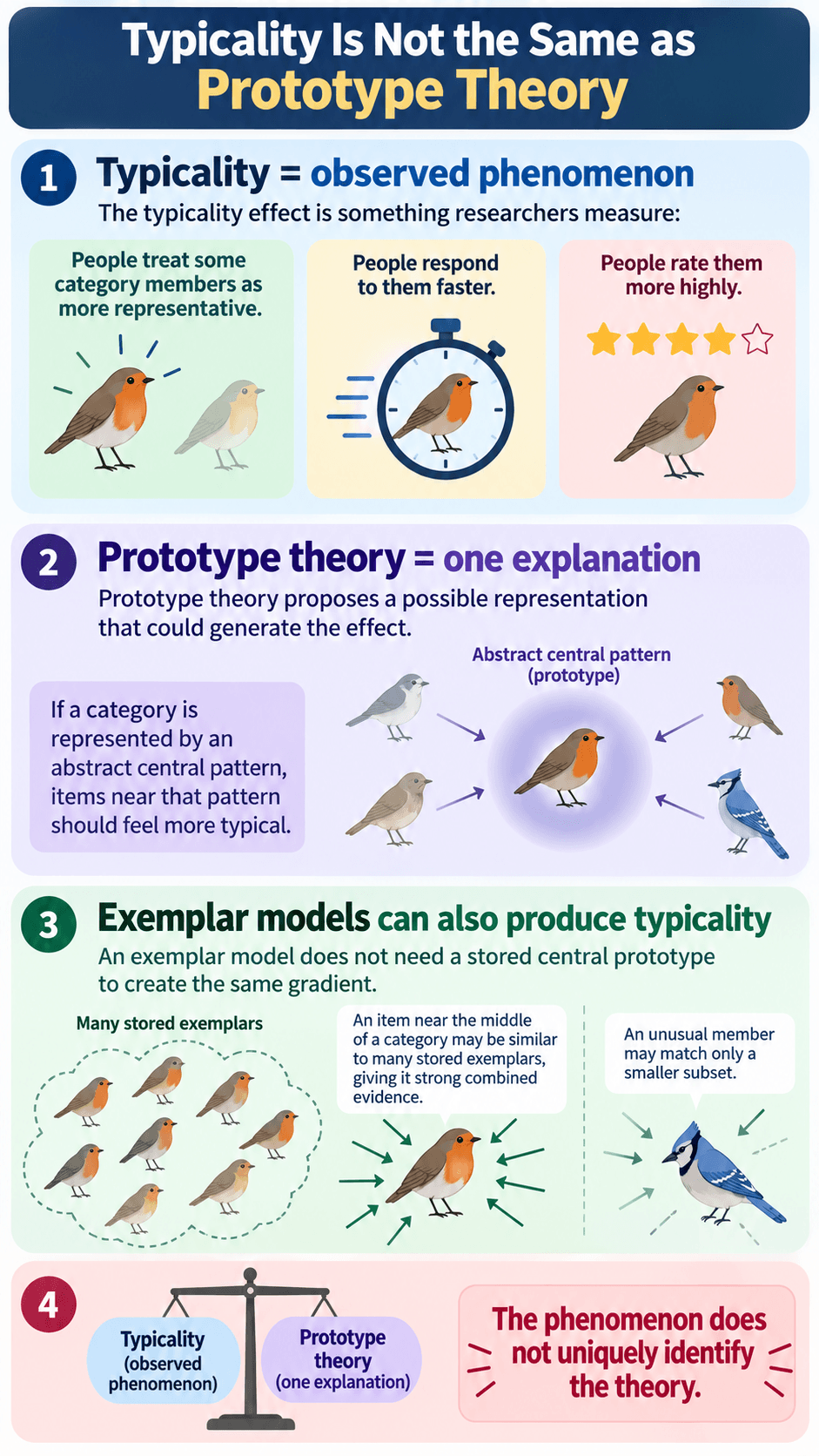
The typicality effect is something researchers measure: people treat some category members as more representative, respond to them faster, or rate them more highly.
Prototype theory is one explanation
Prototype theory proposes a possible representation that could generate the effect. If a category is represented by an abstract central pattern, items near that pattern should feel more typical.
Exemplar models can also produce typicality
An exemplar model does not need a stored central prototype to create the same gradient. An item near the middle of a category may be similar to many stored exemplars, giving it strong combined evidence. An unusual member may match only a smaller subset.
A review of categorization models notes that family-resemblance categories show graded structure while prototype and exemplar approaches offer different representational explanations. Research comparing prototypes, exemplars, and category structure is a useful reminder that the phenomenon does not uniquely identify the theory.
Typicality Can Come From Different Kinds of Category Structure
Not every category produces representativeness in the same way. For some familiar taxonomic categories, shared properties among members can strongly shape typicality. For more goal-directed categories, usefulness for the goal may matter more than resemblance to an average member.
Taxonomic categories often emphasize shared structure
Categories such as birds, fruit, vehicles, and furniture usually contain members that overlap in appearance, function, behavior, or other properties. In these cases, a highly typical member often shares many of the features that recur across the category.
This is why family resemblance is such a useful explanation for many natural categories. A central fruit may share shape, taste, growth pattern, and everyday use with many other fruits, while an unusual member may overlap on fewer familiar dimensions.
Goal-derived categories can emphasize usefulness instead
Consider “things to take on a camping trip.” A tent, flashlight, water container, and sleeping bag do not form a tight visual family. What unites them is that they help satisfy the goal. A highly typical member may therefore be one that is especially useful or expected in that situation rather than one that resembles the other members physically.
This distinction matters because it shows why no single similarity measure can explain all typicality judgments. What makes a member representative depends partly on what kind of category is being represented.
Ad hoc categories reveal how flexible typicality can be
People can also construct temporary categories for a current task, such as “things to move out of the rain” or “items useful during a power outage.” These groupings may not exist as stable long-term categories before the situation arises.
Typicality can still emerge because some items fit the temporary goal better than others. The effect therefore does not require every category to have one permanent center stored in advance. A category can acquire graded structure from the demands of the current situation.
Typicality Can Change With Context
A category member is not equally typical for every purpose
Imagine the category “vehicle.” A compact car may be a highly representative everyday vehicle for city commuting. In the context of moving heavy equipment, a truck becomes much more central. The item has not changed, but the goal changes which properties matter.
Research on typicality has shown that conceptual context can alter explicit ratings and other typicality effects. The sentence-production work cited earlier also reviews evidence that the same category member can vary in typicality depending on how the concept is framed.
Goal-derived categories make context especially visible
Some categories exist mainly because of a goal, such as “things to take camping” or “good birthday gifts.” These groups do not necessarily have the same stable family-resemblance structure as taxonomic categories such as fruit or bird.
An item can be typical because it is especially good for the goal. A tent may be central to camping even though it does not physically resemble a flashlight, sleeping bag, or portable stove.
Expertise can shift what feels representative
A novice and an expert may organize the same domain differently. A casual bird observer may judge a robin as highly representative because it fits broad familiar features. An ornithologist may have more differentiated knowledge that changes which distinctions are salient within particular bird groups.
Typicality judgments therefore reflect conceptual organization, not an immutable ranking built into the objects themselves.
Typicality vs Category Membership
| Category membership | Typicality |
|---|---|
| Asks whether an item belongs | Asks how representative the member seems |
| Can be binary in many tasks | Is often graded |
| May be determined by a formal rule | Can depend on similarity, knowledge, goals, and context |
| Triangle membership depends on geometric criteria | One triangle shape may look more visually “typical” than another |
This distinction becomes especially clear in rule-defined categories. Every valid triangle has the same membership status, even if an equilateral triangle looks more like the mental image a person immediately associates with “triangle” than a very narrow scalene one.
Why Typical Examples Can Influence Inference Without Defining Membership
Typical examples can affect more than speed of recognition. They may also shape expectations about unknown properties. If people learn that one member of a category has a new feature, they may be more willing to generalize from a highly representative member than from an unusual member under some conditions.
Representative examples can feel more informative
A typical member overlaps with many other members, so information attached to it may seem more likely to extend across the category. This does not mean the inference is logically guaranteed. It means graded category structure can influence how psychologically persuasive the generalization feels.
Inference and typicality are still separate questions
Typicality asks how representative the member seems. Inductive reasoning asks how strongly evidence supports a broader conclusion. A typical member can serve as a strong premise in some induction tasks, but that does not make typicality itself a reasoning process.
Background knowledge can override surface typicality
If a person knows that the property being inferred depends on a mechanism found only in unusual members, an atypical example may become more informative. This is another reason typicality should not be treated as a universal shortcut that controls every judgment about a category.
Typicality vs Basic-Level Categories
Typicality ranks members within a category
Typicality compares members such as robin and penguin within “bird,” or sedan and unusual specialty vehicle within “vehicle.” The question is which member is more representative.
Basic level concerns the level of abstraction
Basic-level categorization asks whether a label such as “dog” is more natural or informative than a broader label such as “animal” or a narrower one such as “golden retriever.” The issue is where a category sits in a hierarchy.
An item can be highly typical at one level and still be described using several category levels. Typicality and basic-level preference can interact in cognition, but they are not the same phenomenon.
Typicality vs Stereotypes
Ordinary category representativeness is a general cognitive phenomenon
Typicality research applies to fruit, birds, furniture, tools, shapes, events, and many other categories. The existence of graded representativeness does not by itself explain prejudice, social evaluation, or discriminatory behavior.
Social stereotypes involve generalized expectations about people
A stereotype is a generalized belief or association about members of a social group. Applying group-level assumptions to an individual raises questions that go well beyond whether category members have graded cognitive structure.
It is therefore a mistake to take evidence about robins, furniture, or laboratory shapes and use it as a justification for social stereotyping. Generic categorization and stereotype formation belong to different explanatory levels.
What Typicality Does Not Prove
It does not prove that a prototype is stored
If typical members are processed faster, that tells us that the category has graded structure for that task. It does not reveal whether the representation is a prototype, a collection of exemplars, a knowledge structure, or some combination.
It does not prove that atypical members are uncertain members
A penguin does not become “less of a bird” because it is rated as less typical. Representativeness and membership must remain separate.
It does not prove that the ranking is fixed across contexts
Goals, instructions, expertise, contrast categories, and task format can change which properties are emphasized. The 2016 study cited earlier found that even inclusion versus exclusion methods changed how strongly typicality appeared in response times and electrophysiological measures.
It does not imply that the most familiar example is always best
Familiarity can influence processing, but it is not the definition of typicality. A typicality judgment can reflect structural fit, family resemblance, category goals, and conceptual context.
A Practical Way to Notice Typicality
Choose an ordinary category such as fruit, tool, furniture, vehicle, or bird. Then compare several genuine members.
- Which example comes to mind first?
- Which member feels like the clearest representative?
- Which properties does that member share with many others?
- Can you name an atypical member that still clearly belongs?
- Is the most familiar member also the most typical, or are those judgments different?
- Would the ranking change if the goal or context changed?
- Would an expert in the domain rank the same examples in the same order?
The exercise is not designed to uncover a hidden personal cognitive type. It simply makes graded category structure visible and shows why “belongs” and “best example” are different questions.
FAQ About the Typicality Effect
Can an atypical member still be a completely valid category member?
Yes. That is one of the defining points of the typicality effect. A penguin can be an atypical bird while remaining fully a bird. Typicality concerns representativeness, not the truth of category membership.
Does high typicality mean an item is encountered more often?
Not necessarily. Frequency and familiarity can contribute to judgments, but typicality also reflects shared structure, goals, context, prior knowledge, and similarity to other category members. The two variables can correlate without being identical.
Is the typicality effect evidence for prototype theory?
It is compatible with prototype theory, but it does not uniquely prove it. Exemplar models can also produce higher representativeness for items that are similar to many stored instances. Model comparisons are needed to distinguish explanations.
Can typicality change with context or expertise?
Yes. What makes an item representative can depend on the purpose of the category, the comparison set, the current task, and the person’s knowledge. Typicality is therefore better understood as a judgment emerging from a category representation in context than as a permanent property of the object.
Key Takeaways
- The typicality effect means that genuine category members can differ in how representative they seem.
- Typicality is graded, while category membership can remain unchanged.
- Family resemblance is one important source of typicality because central members often share more structure with other category members.
- Frequency and familiarity may influence typicality but are not the same thing as representativeness.
- Prototype theory is one explanation of the effect, but exemplar and other models can also produce typicality gradients.
- Context, goals, task format, and expertise can shift which members feel most typical.
Final Thought: Ask “How Representative?” Separately From “Does It Belong?”
The typicality effect becomes much clearer when those two questions are kept separate. Category membership tells you whether an item belongs. Typicality tells you how strongly it matches the structure, expectations, or goals associated with the category in the current context. Once that distinction is visible, unusual members stop looking like problems for categorization. They become evidence that categories can be both stable enough for membership judgments and flexible enough to contain graded internal structure.
Educational note: Typicality judgments are cognitive measures, not diagnostic tools. They should not be used to infer intelligence, memory ability, personality, neurodevelopmental conditions, or neurological disease. Social-group stereotypes also should not be justified by evidence from ordinary object-category typicality research.

Michael Reed is the Founder and Lead Writer at Psychology Exposed. He writes about human behavior, relationships, emotional patterns, self-awareness, and practical psychology topics using research-informed, easy-to-understand content.
Read More About Michael Reed: https://psychologyexposed.com/michael-reed/