
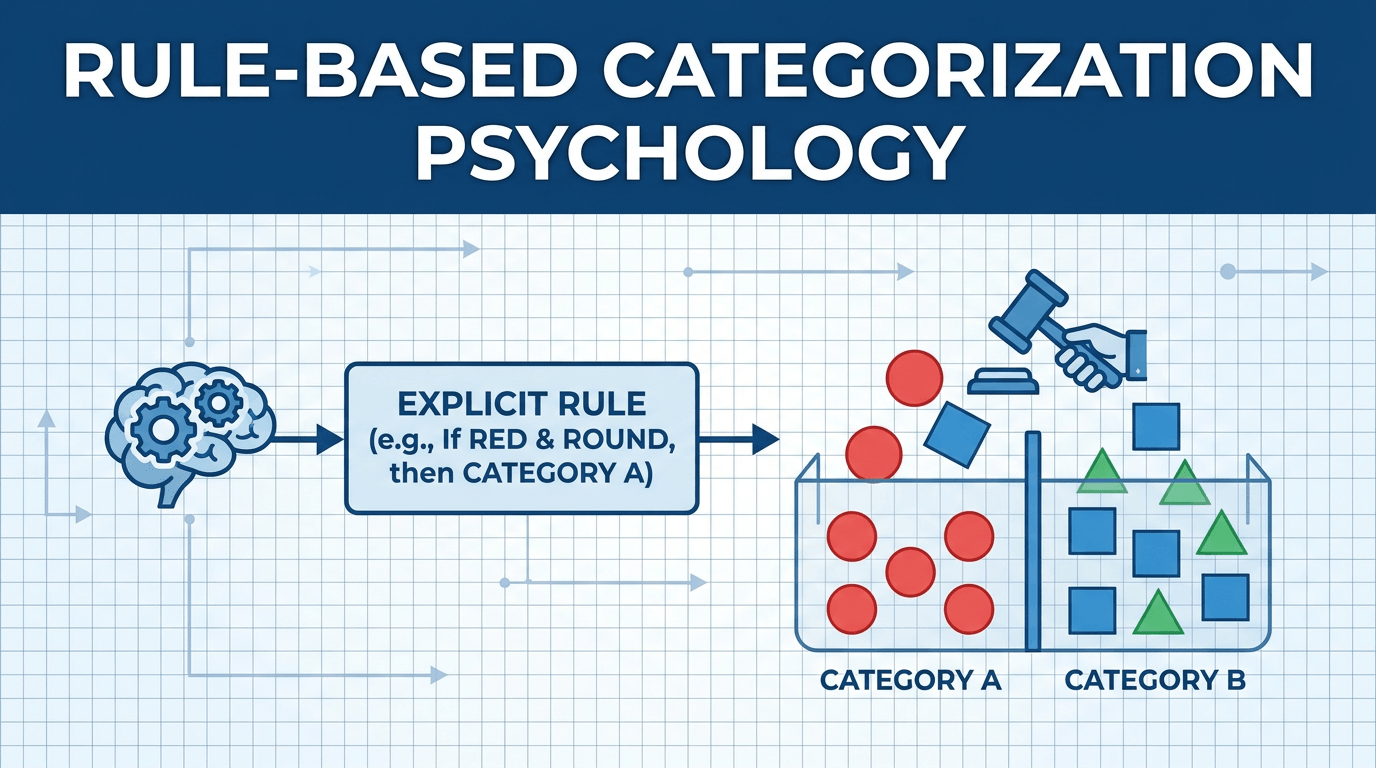
Some categories can be learned by discovering a rule. If a shape has three sides, it belongs in the triangle category. If a laboratory stimulus is longer than a certain value, it may belong in Category A. If a game piece meets a stated condition, it can make a legal move. In cases like these, classification can depend on a criterion that a person can often describe in words.
Rule-based categorization psychology studies this kind of classification. The core question is not simply whether people use logic. It is whether category membership can be decided by applying an explicit or verbalizable rule to relevant information. That makes rule-based categorization different from prototype matching, exemplar similarity, conditional reasoning, and hypothesis testing, even though those processes can interact during learning.
Quick Answer: What Rule-Based Categorization Means
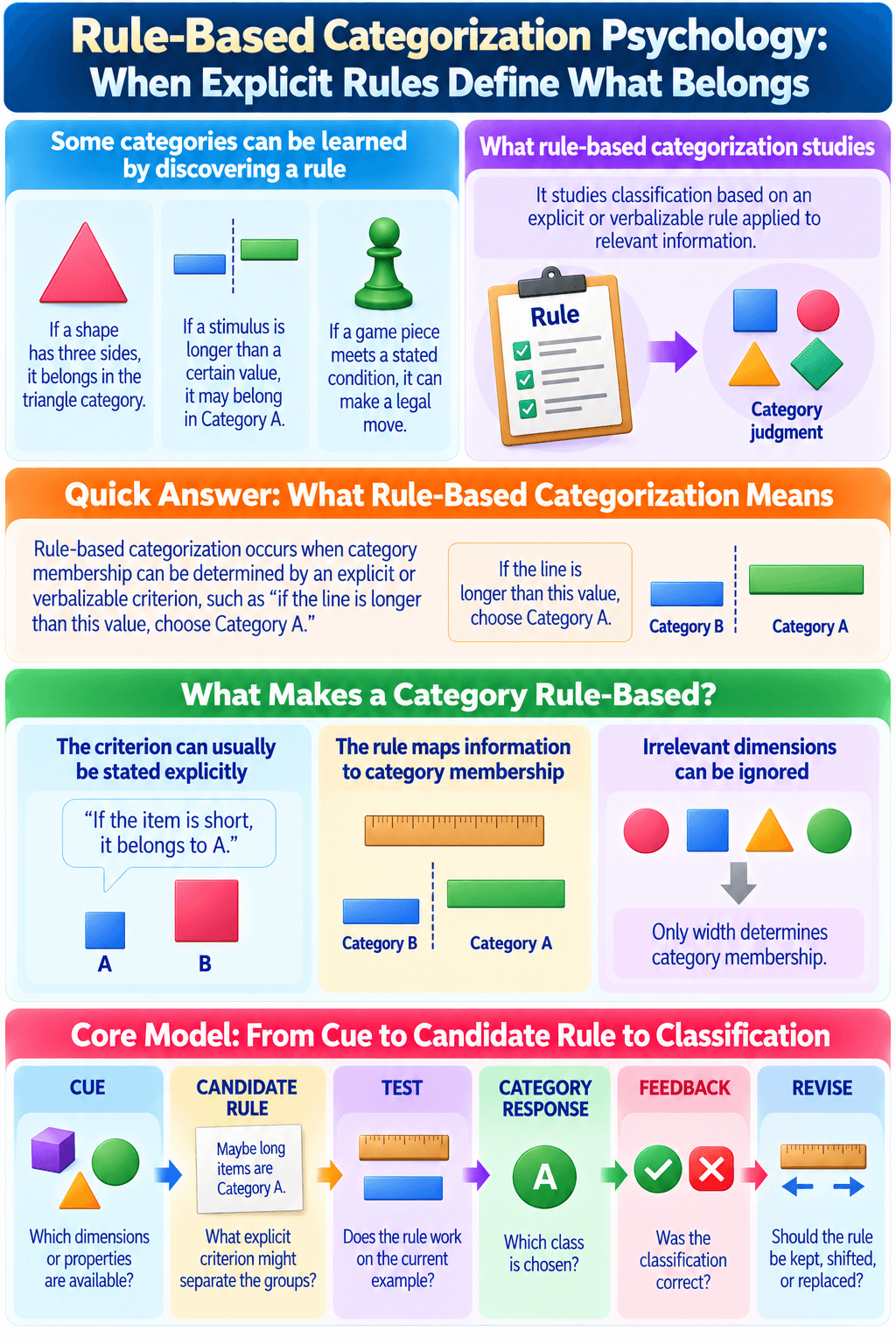
Rule-based categorization occurs when category membership can be determined by an explicit or verbalizable criterion, such as “if the line is longer than this value, choose Category A.” A learner may search for the relevant dimension, test candidate rules, use feedback, and revise the rule after errors. The output remains a category judgment: which class does this item belong to?
What Makes a Category Rule-Based?
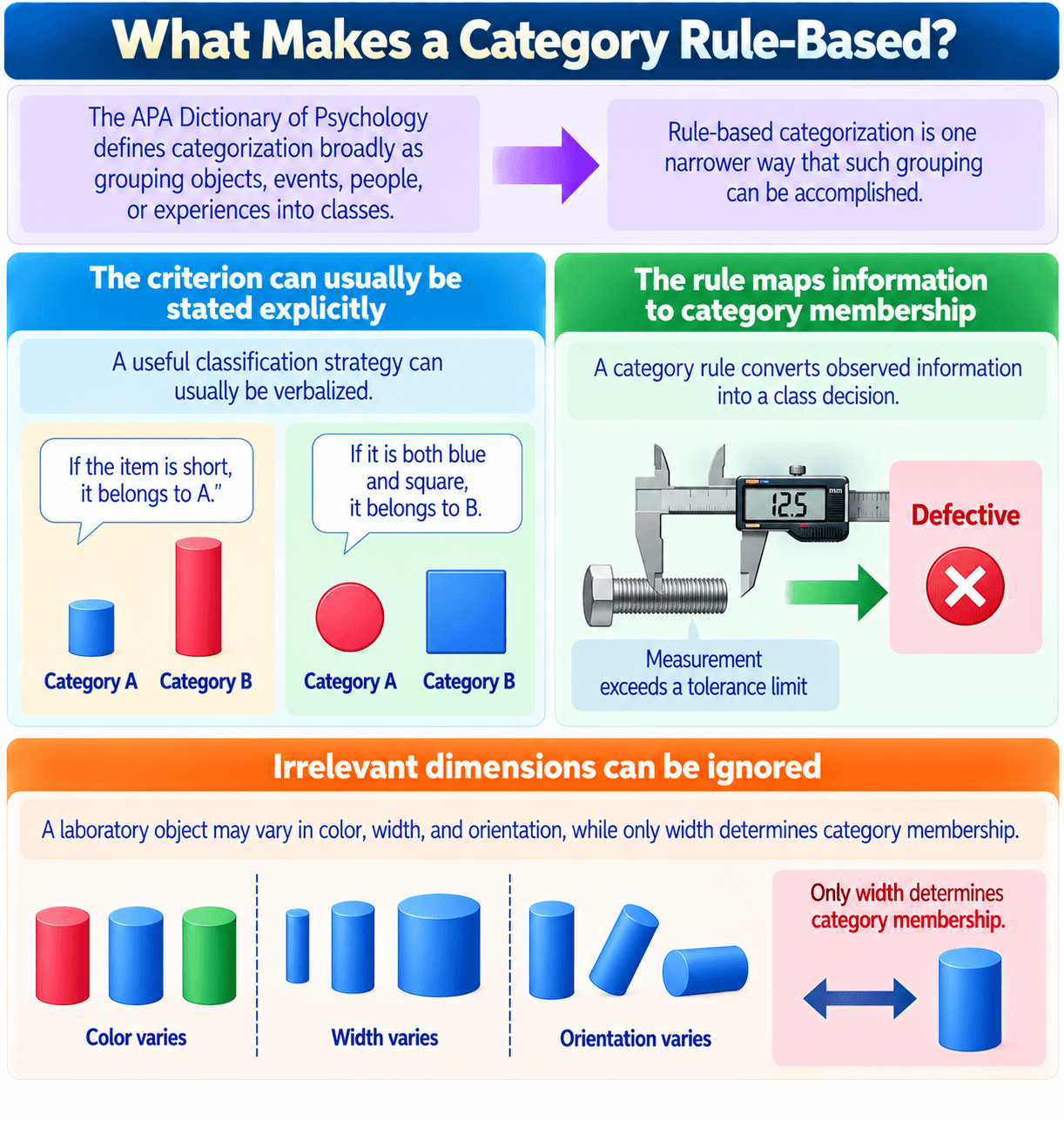
The APA Dictionary of Psychology defines categorization broadly as grouping objects, events, people, or experiences into classes. Rule-based categorization is one narrower way that such grouping can be accomplished.
The criterion can usually be stated explicitly
The defining feature of a rule-based task is that a useful classification strategy can usually be verbalized. A learner might say, “If the item is short, it belongs to A,” or “If it is both blue and square, it belongs to B.”
Research comparing rule-based and information-integration tasks commonly defines rule-based categories by the availability of a simple, explicit decision boundary. Recent work comparing rule-based and information-integration learning describes rule-based categories as structures for which selective attention to dimensions can support explicit rules that separate the categories.
The rule maps information to category membership
A category rule is useful because it converts observed information into a class decision. The learner identifies a relevant property, applies a condition, and chooses the corresponding category.
For example, a quality-control system might define a part as defective if a measurement exceeds a tolerance limit. The visual appearance of the part may vary in many ways, but the rule tells the classifier which dimension matters and where the category boundary lies.
Irrelevant dimensions can be ignored
Rule-based learning often depends on discovering that some noticeable features do not matter. A laboratory object may vary in color, width, and orientation, while only width determines category membership. Once the useful dimension is identified, the others can receive less attention.
This selective focus is one reason explicit rules can make categorization efficient. The learner does not need to preserve every property of every example if one criterion reliably separates the categories.
Core Model: From Cue to Candidate Rule to Classification
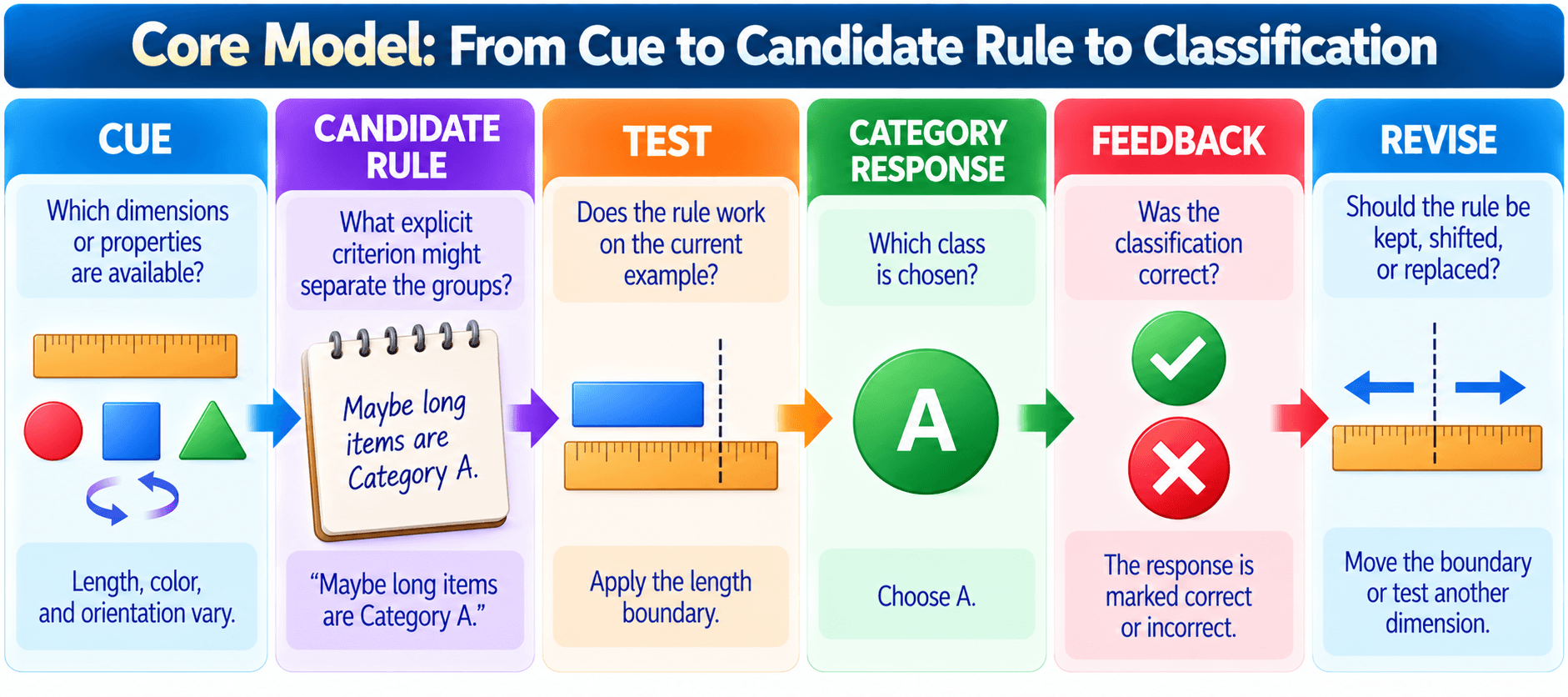
A practical model for rule-based categorization is:
CUE → CANDIDATE RULE → TEST → CATEGORY RESPONSE → FEEDBACK → REVISE
This is a reader-friendly model of the learning process, not a claim that every rule-based decision unfolds consciously through six fixed stages.
| Stage | Main question | Simple illustration |
|---|---|---|
| Cue | Which dimensions or properties are available? | Length, color, and orientation vary |
| Candidate rule | What explicit criterion might separate the groups? | “Maybe long items are Category A” |
| Test | Does the rule work on the current example? | Apply the length boundary |
| Category response | Which class is chosen? | Choose A |
| Feedback | Was the classification correct? | The response is marked correct or incorrect |
| Revise | Should the rule be kept, shifted, or replaced? | Move the boundary or test another dimension |
How Rule Discovery Works
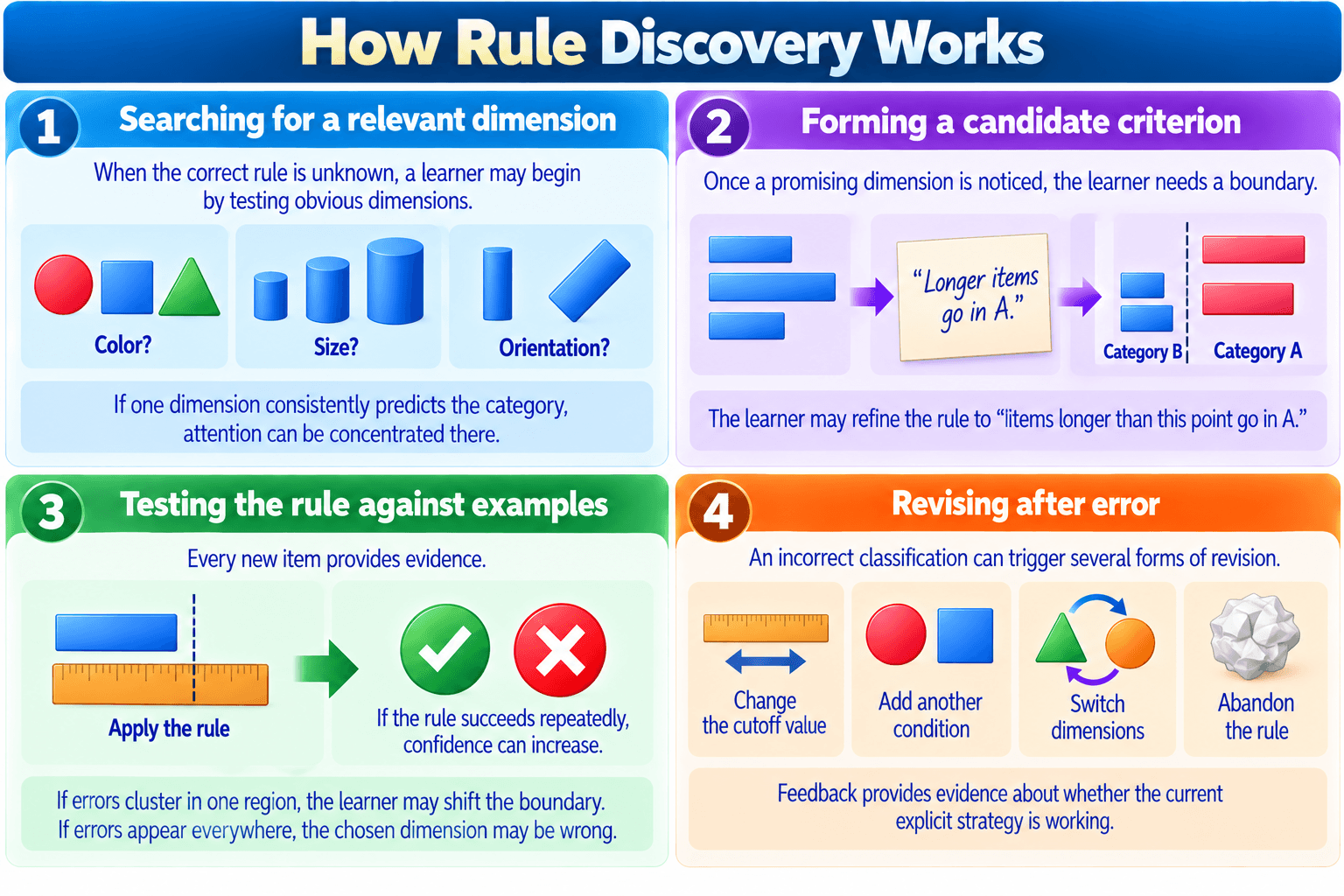
Searching for a relevant dimension
When the correct rule is unknown, a learner may begin by testing obvious dimensions. Is color the key? Is size? Is orientation? If one dimension consistently predicts the category, attention can become concentrated there.
Experimental research shows that priming attention toward a relevant dimension can improve later performance in rule-based category learning. Research on relevant and irrelevant dimension priming found that directing attention toward useful stimulus information benefited rule-based learning in the studied task.
Forming a candidate criterion
Once a promising dimension is noticed, the learner needs a boundary. “Longer items go in A” is still incomplete if both categories contain long and short examples. The learner may refine the rule to “items longer than this point go in A.”
This makes rule-based learning partly a search problem. The learner is not only noticing features but testing candidate decision criteria that can be accepted or rejected by experience.
Testing the rule against examples
Every new item provides evidence. If the rule succeeds repeatedly, confidence in it can increase. If errors cluster in one region, the learner may shift the boundary. If errors appear everywhere, the chosen dimension may be wrong.
A good rule is therefore not merely easy to say. It has to predict category membership across the relevant examples.
Revising after error
An incorrect classification can trigger several forms of revision. The learner may change the cutoff value, add another condition, switch dimensions, or abandon the rule entirely.
This error-driven revision is one reason rule-based tasks are often paired with trial-by-trial feedback in experiments. Feedback provides evidence about whether the current explicit strategy is working.
Simple Rules, Conjunctive Rules, and More Complex Criteria
Single-dimension rules
The simplest rule depends on one dimension. “If the bar is wider than X, choose Category A” is a one-dimensional classification criterion.
These tasks are useful in research because the optimal strategy is transparent and easy to verbalize once discovered. They also make it easier to observe whether the learner is attending to the relevant dimension.
Conjunctive rules
Some categories require two conditions at once. An item might belong to Category A only if it is both large and dark. Neither feature alone is sufficient.
Conjunctive rules remain explicit, but they increase working demands because the learner must track more than one property and combine them correctly.
Disjunctive or alternative rules
A rule can also allow more than one route to membership. A technical system might classify an item as high risk if condition X is present or if both conditions Y and Z are present.
The important point is that the classifier can still state the criterion. Complexity alone does not make a task non-rule-based, although highly complicated rules can become impractical to discover or use.
Why verbalizability matters more than simplicity alone
A category can depend on multiple dimensions yet still support an explicit verbal rule. Conversely, a category boundary can be mathematically simple while being difficult for a participant to describe or discover consciously.
In rule-based category-learning research, the useful distinction is therefore not merely “easy versus hard.” It concerns whether the optimal decision strategy is available to explicit reasoning and verbal description.
Rule-Based vs Information-Integration Categories
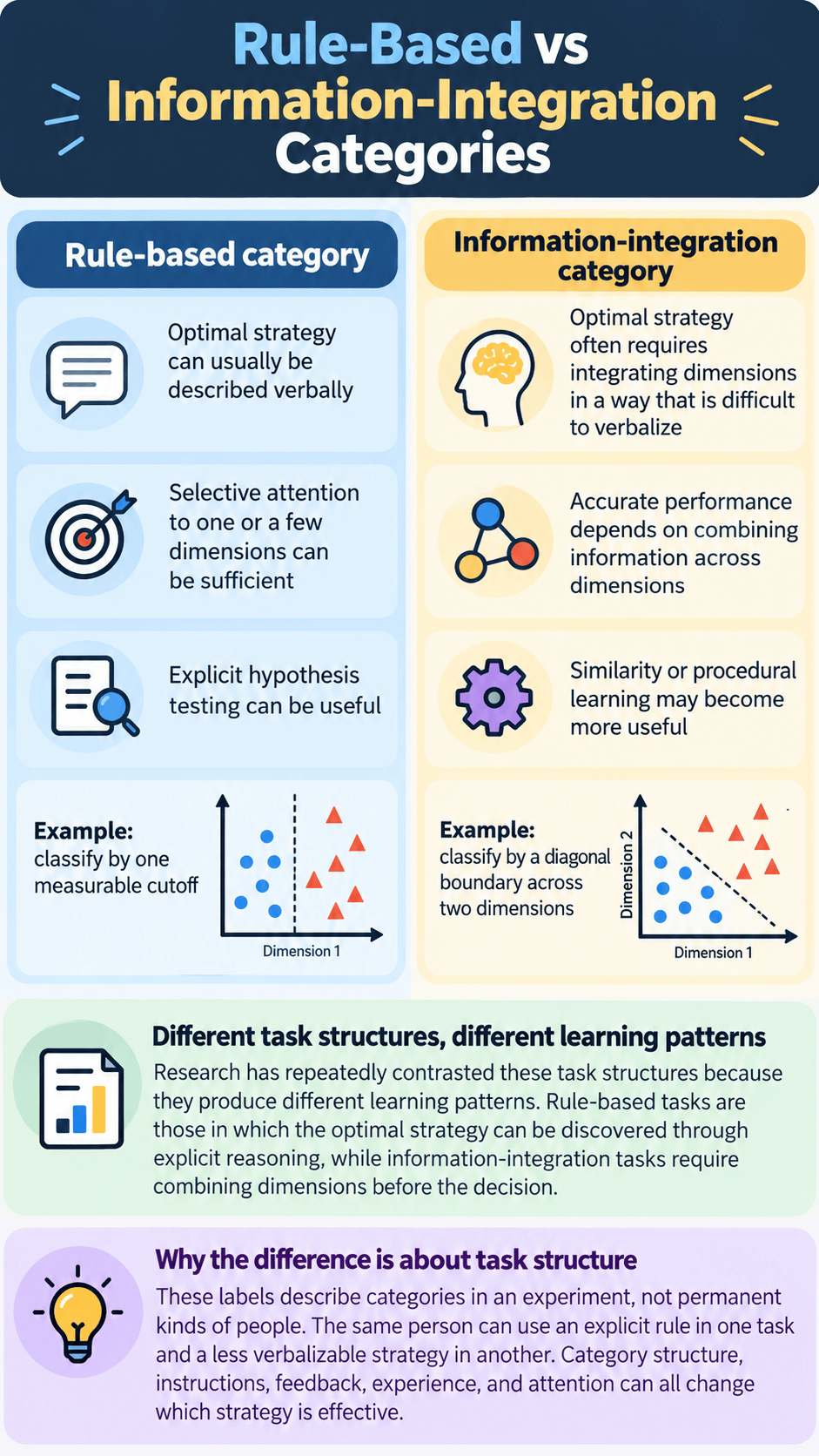
| Rule-based category | Information-integration category |
|---|---|
| Optimal strategy can usually be described verbally | Optimal strategy often requires integrating dimensions in a way that is difficult to verbalize |
| Selective attention to one or a few dimensions can be sufficient | Accurate performance depends on combining information across dimensions |
| Explicit hypothesis testing can be useful | Similarity or procedural learning may become more useful |
| Example: classify by one measurable cutoff | Example: classify by a diagonal boundary across two dimensions |
Research has repeatedly contrasted these task structures because they produce different learning patterns. Work comparing rule-based and information-integration category tasks describes rule-based tasks as those in which the optimal strategy can be discovered through explicit reasoning, while information-integration tasks require combining dimensions before the decision.
Why the difference is about task structure
These labels describe categories in an experiment, not permanent kinds of people. The same person can use an explicit rule in one task and a less verbalizable strategy in another.
That distinction protects against a common mistake: turning laboratory task types into fixed “learning styles.” Category structure, instructions, feedback, experience, and attention can all change which strategy is effective.
When Explicit Rules Work Well
Clear boundaries
Rules are highly effective when a category has a stable criterion. Mathematical categories, technical standards, and some laboratory classifications are obvious examples.
If the boundary is consistent, a learner can classify new items without remembering every previous instance. The rule acts as a compact decision procedure.
Diagnostic dimensions
A rule works best when the relevant dimension clearly distinguishes categories. If line width predicts membership perfectly while color varies randomly, width can become the decision variable and color can be ignored.
Rules become less useful when many dimensions provide weak, overlapping evidence rather than one or two strong diagnostic cues.
Stable feedback
Consistent feedback makes rule testing more informative. If correct answers are reliable, an error tells the learner that the rule or boundary needs revision.
Inconsistent feedback creates ambiguity. The learner cannot tell whether the rule is wrong, the example is an exception, or the feedback itself is noisy.
Rule-Plus-Exception Categories
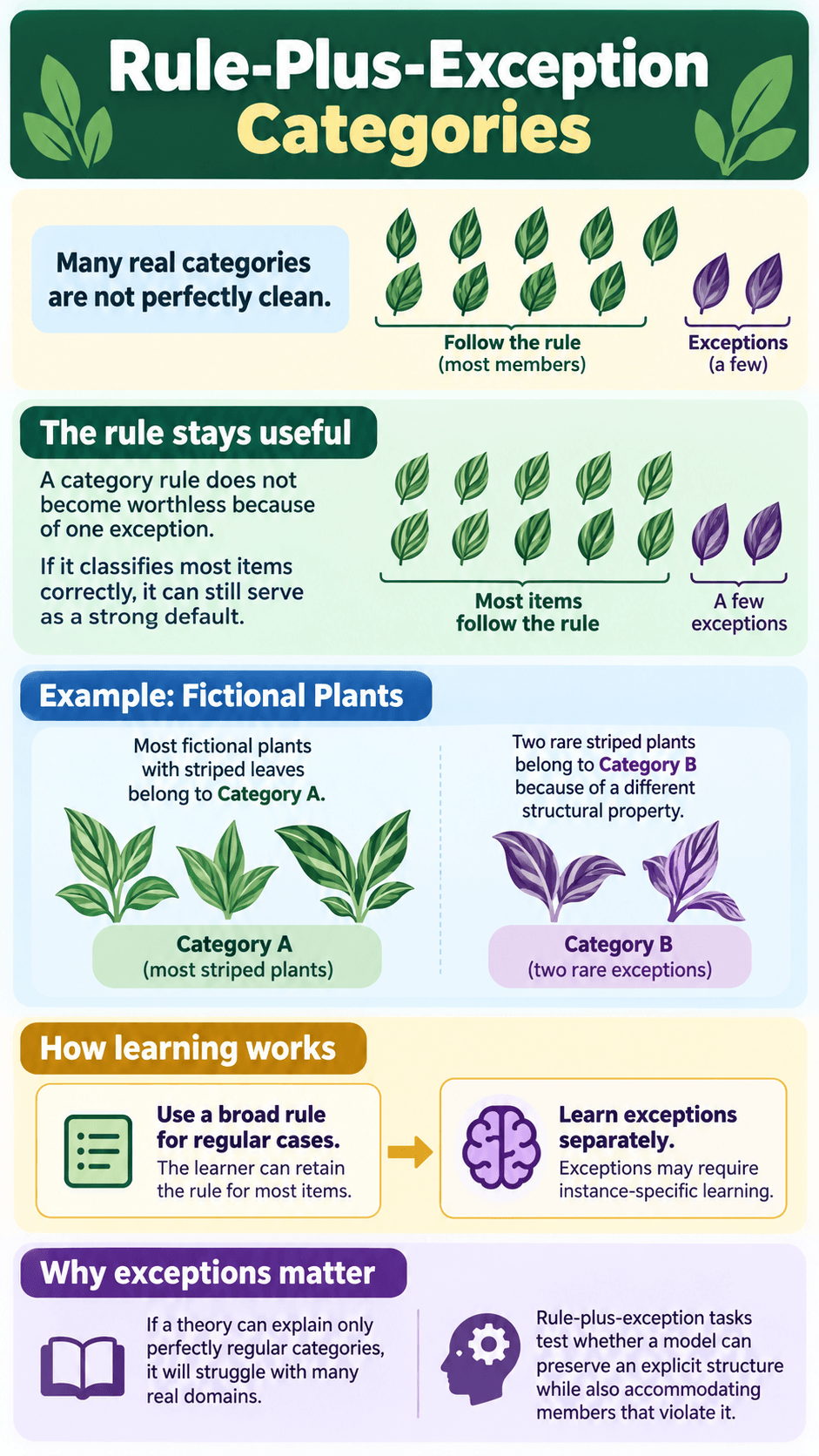
Many real categories are not perfectly clean. Most members may follow a useful rule while a small number violate it. These are often called rule-plus-exception structures.
The rule can remain useful even when exceptions exist
A category rule does not become worthless because of one exception. If it classifies most items correctly, it can still serve as a strong default. The learner then needs an additional way to handle the unusual cases.
For example, suppose most fictional plants with striped leaves belong to Category A, but two rare striped plants belong to B because of a different structural property. A learner can retain the broad rule while separately learning the exceptions.
Exceptions may require instance-specific learning
Rule-plus-exception structures show why rule and exemplar processes need not be mutually exclusive. A person may use an explicit rule for regular cases and rely on specific memories for exceptions.
Research on learning exceptions to category rules found that the timing of exception introduction influenced later exception performance in a rule-plus-exception task. Findings like this illustrate that learning the default structure and learning the exceptions can place different demands on the learner.
Why exceptions matter for theory
If a theory can explain only perfectly regular categories, it will struggle with many real domains. Rule-plus-exception tasks are useful because they test whether a model can preserve an explicit structure while also accommodating members that violate it.
Rule-Based Categorization vs Prototype Matching
Criterion versus central similarity
A rule asks whether an item satisfies a condition. A prototype account asks how similar the item is to a central category representation. These can produce the same answer in easy cases but rely on different information.
A perfect equilateral triangle and a very thin scalene triangle both satisfy the rule for triangle membership. One may look more visually “typical,” but typical appearance is not what makes either item a triangle.
Sharp boundaries versus graded resemblance
Rules often create relatively sharp decision boundaries: the criterion is met or it is not. Prototype similarity is naturally graded: one item can be closer to the center than another.
This difference becomes important when category membership and representativeness diverge. An atypical member may satisfy the rule completely while remaining far from the prototype.
Rule-Based Categorization vs Exemplar Matching
Applying a criterion versus comparing with stored cases
Exemplar theory proposes that a new item can be classified through similarity to specific represented instances. Rule-based categorization instead uses an explicit criterion.
Imagine identifying a legal move in a board game. You can apply the written rule directly without searching memory for several similar past moves. In another domain with many irregular cases, comparison with past examples may be more useful than a single explicit criterion.
Why both processes may be available
People do not have to rely on one representation format for every category. A learner may use a rule when it works, remember exceptions as individual cases, and shift toward similarity when the rule becomes unreliable.
Direct model comparisons support this broader view. Research competitively testing rule and exemplar models found that which model better described behavior depended on properties of the stimulus conditions.
Rule-Based Categorization vs Conditional Reasoning
Same “if-then” language, different cognitive output
Both processes may use statements that sound like “if X, then Y,” but they answer different questions. In rule-based categorization, the rule maps observed properties to a category response. The output is membership: A or B, valid or invalid, defective or acceptable.
Conditional reasoning asks what conclusion follows from a conditional statement and additional information. The output is an inference, not merely a category label.
A classification example
Suppose a factory rule says, “If a part is longer than 10 centimeters, classify it as Type A.” A 12-centimeter part is placed in Type A. That is rule-based categorization.
A reasoning example
Now consider, “If the alarm is armed, the indicator light is on. The indicator light is not on. What follows?” Evaluating the logical relationship among these statements is conditional reasoning. The task is about inference rather than assigning an object to a learned category.
Rule-Based Categorization vs Hypothesis Testing
Hypothesis testing can help discover the rule
When a learner does not know the correct dimension, candidate rules function like hypotheses. “Maybe color matters” can be tested. After an error, the learner may reject that idea and try size instead.
This makes hypothesis testing an important mechanism in many rule-learning tasks. It explains how a person searches the space of possible rules.
But the final output is still category membership
Hypothesis testing is broader than categorization. Scientists test hypotheses about causes, relationships, mechanisms, and predictions that may have nothing to do with category membership.
In a rule-based categorization task, hypothesis testing is useful because it helps discover the classification criterion. Once the rule is known, the task remains deciding where each item belongs.
Rule-Based Categorization vs General Category Learning
Category learning asks how experience improves classification across examples. Rule-based categorization describes one kind of structure and one family of strategies within that broader problem.
| Category learning | Rule-based categorization |
|---|---|
| Broadly asks how classification is acquired | Focuses on categories with explicit or verbalizable criteria |
| Can involve rules, prototypes, exemplars, feedback, or multidimensional integration | Emphasizes rule search, relevant dimensions, explicit boundaries, and revision |
| May include tasks with no simple verbal rule | Requires a useful criterion that can generally be stated |
| Primary outcome is improved classification across learning | Primary strategy is applying the discovered rule to membership decisions |
Why Explicit Rules Can Become Automatic With Practice
A rule may begin as a deliberate verbal strategy and later become faster to apply. Early in learning, a person might silently repeat the criterion and inspect the relevant dimension. After many correct trials, the same judgment can feel immediate.
Faster performance does not mean the rule disappeared
Speed alone does not tell us which representation is being used. A practiced explicit criterion can be applied rapidly, just as a familiar arithmetic rule can become quick without ceasing to be rule-governed.
Researchers need more than response time to identify strategy
To infer a rule-based strategy, researchers often examine response patterns, model fits, verbal reports, transfer items, and the locations of errors relative to candidate decision boundaries. One behavioral measure by itself rarely identifies the underlying process with certainty.
Practice can also reveal that the original rule was provisional
A learner may begin with an adequate one-dimensional rule, then encounter examples showing that a second dimension matters. Practice therefore does not only automate. It can also expose limitations and trigger a more accurate criterion.
What Makes Rule Learning Fail?
Focusing on the wrong dimension
A learner may lock onto a noticeable feature that is irrelevant. If color varies dramatically, it may attract attention even when orientation is the true category cue.
Repeated feedback can correct this, but an early misleading pattern may keep the learner testing an ineffective rule longer than expected.
Choosing a boundary that is too broad or too narrow
The correct dimension can be identified while the cutoff remains wrong. A learner may know that size matters but set the dividing point too high, producing systematic errors near the true boundary.
Adding too many conditions
A learner can overcomplicate a category by adding conditions to explain every individual example. The resulting rule may fit the training set perfectly but generalize poorly.
This resembles overfitting in statistical modeling: a rule becomes tailored to accidental details instead of capturing the stable classification structure.
Forcing a rule onto a category that is not rule-friendly
Some categories do not have a simple verbalizable boundary. Persisting with explicit rules in those tasks can produce slow learning or unstable strategies.
The responsible response is not to conclude that the learner lacks reasoning ability. The task may simply favor a different representation or decision process.
How Multiple-System Claims Should Be Interpreted
COVIS as an influential theory
One influential framework, COVIS, proposes that rule-based categories rely heavily on an explicit hypothesis-testing system, while information-integration learning relies more on a procedural system. This framework has generated many testable predictions and a large empirical literature.
However, the broader theoretical question remains debated. Researchers continue to test whether observed differences require distinct learning systems or can be explained through other properties of representation, difficulty, attention, and learning dynamics.
Why task differences should not become brain-type labels
Even when experiments find distinct patterns across rule-based and information-integration tasks, that does not justify labeling people as permanently “rule-based thinkers” or “procedural thinkers.”
Recent research has found both stable and flexible behaviors when the same individuals learn different category structures. That supports a more cautious picture in which people adjust strategies to fit the problem rather than expressing one fixed categorization type.
A Practical Way to Analyze a Rule-Based Category
If you suspect a classification problem has a rule-like structure, ask:
- Can the category boundary be stated clearly in words?
- Which dimensions are actually relevant?
- Is one dimension enough, or must several conditions be combined?
- Does the rule classify new examples, not just the training set?
- Where do errors cluster relative to the decision boundary?
- Are there true exceptions, or is the current rule simply wrong?
- Would a prototype or exemplar account better explain the difficult cases?
The goal is not to discover a personal “rule-thinking style.” It is to determine whether the structure of the category supports an explicit criterion and whether that criterion generalizes reliably.
FAQ About Rule-Based Categorization
Does rule-based categorization require conscious reasoning?
Rule-based category-learning tasks are typically designed so that the useful rule can be explicitly discovered and verbalized. A person may eventually apply a well-practiced rule quickly, but the defining feature of the task is that an explicit criterion is available, not that every classification must feel slow or consciously effortful.
Can a category have a rule and still contain exceptions?
Yes. Rule-plus-exception categories contain a useful default rule alongside members that violate it. The learner may use the rule for regular cases and preserve specific information about exceptions. This is one reason rule and exemplar processes need not be mutually exclusive.
Is rule-based categorization the same as logical reasoning?
No. Explicit reasoning can help discover and test a classification rule, but the final goal is category membership. Logical reasoning is broader and can evaluate conclusions, relationships, and arguments that have nothing to do with categorization.
Are rule-based and information-integration categories different learning styles?
No. They are task structures used in categorization research. The same person may use an explicit rule in one task and a less verbalizable multidimensional strategy in another. Treating them as fixed learner identities goes beyond what the experimental labels mean.
Key Takeaways
- Rule-based categorization uses an explicit or verbalizable criterion to decide category membership.
- Learners can search relevant dimensions, test candidate rules, use feedback, and revise boundaries after errors.
- Rules may be single-dimensional, conjunctive, or more complex as long as the criterion remains explicit enough to state and apply.
- Rule-plus-exception structures show that a useful rule can coexist with instance-specific knowledge about unusual members.
- Rule-based categorization differs from conditional reasoning, hypothesis testing, prototype matching, exemplar matching, and category learning as a whole.
- Rule-based and information-integration tasks are research structures, not fixed psychological types of people.
Final Thought: A Good Rule Must Survive a New Example
The most useful test of a category rule is not whether it explains the examples already seen. It is whether the rule classifies a new case for the right reason. A concise rule that ignores irrelevant dimensions, handles the genuine boundary, and generalizes beyond training can make categorization efficient. When exceptions accumulate or the boundary becomes difficult to verbalize, that is evidence that another representation may need to complement or replace the rule.
Educational note: Performance on a rule-based categorization task should not be used to infer intelligence, executive-function ability, ADHD, autism, neurological disease, or a fixed cognitive style. Task structure, feedback, attention, prior experience, and strategy all influence performance.

Michael Reed is the Founder and Lead Writer at Psychology Exposed. He writes about human behavior, relationships, emotional patterns, self-awareness, and practical psychology topics using research-informed, easy-to-understand content.
Read More About Michael Reed: https://psychologyexposed.com/michael-reed/