
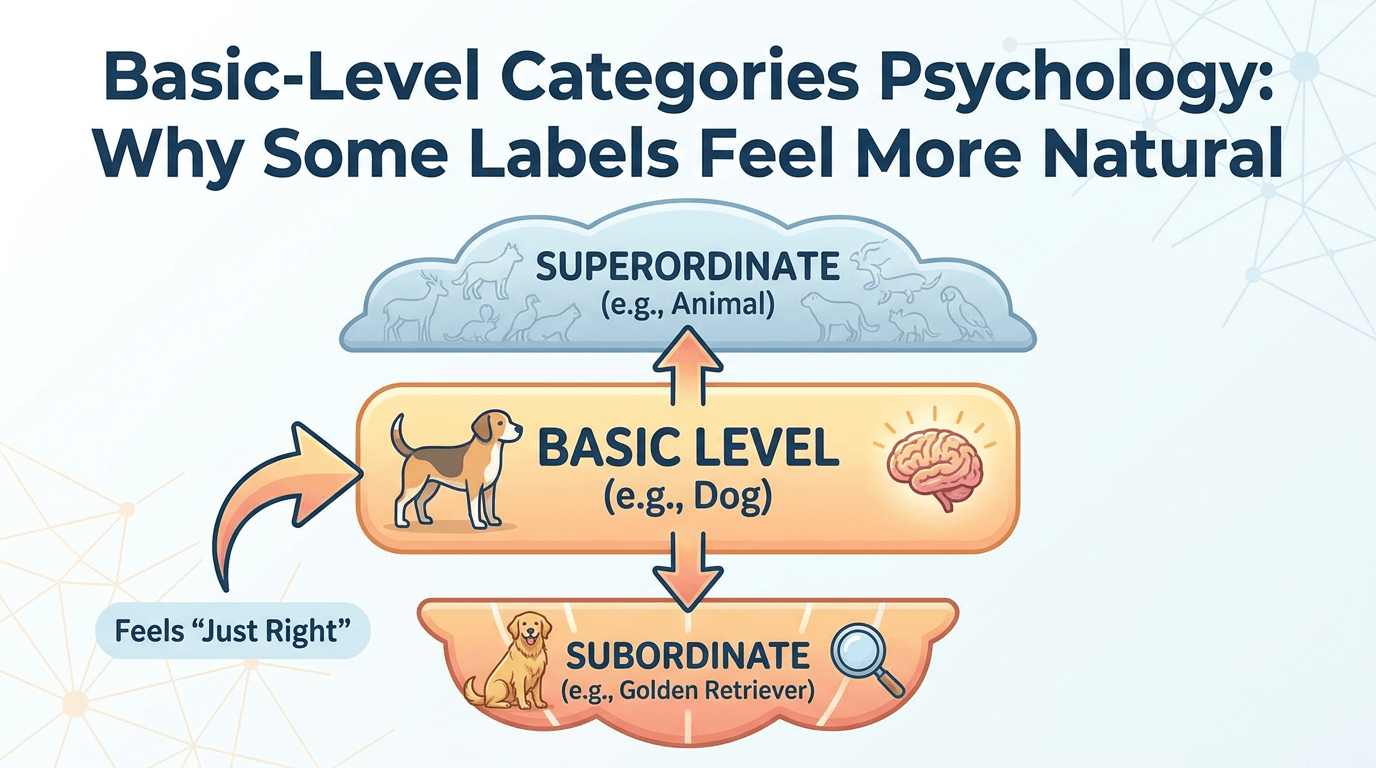
If someone points to a golden retriever and asks, “What is that?”, many people will answer “dog” rather than “animal” or “golden retriever.” All three labels can be correct, but they operate at different levels of abstraction. Cognitive psychology uses the idea of basic-level categories to explain why an intermediate label often feels especially natural, informative, and easy to use.
The basic level is not simply the shortest word, the most familiar label, or the most typical category member. It is a level in a category hierarchy. Classic research proposed that this intermediate level often provides a useful balance: it preserves many properties shared by members while still distinguishing the category clearly from neighboring categories. That balance can make labels such as “dog,” “chair,” or “car” efficient for everyday thinking. However, expertise, goals, context, and culture can shift which level is most useful.
Quick Answer: What Is a Basic-Level Category?
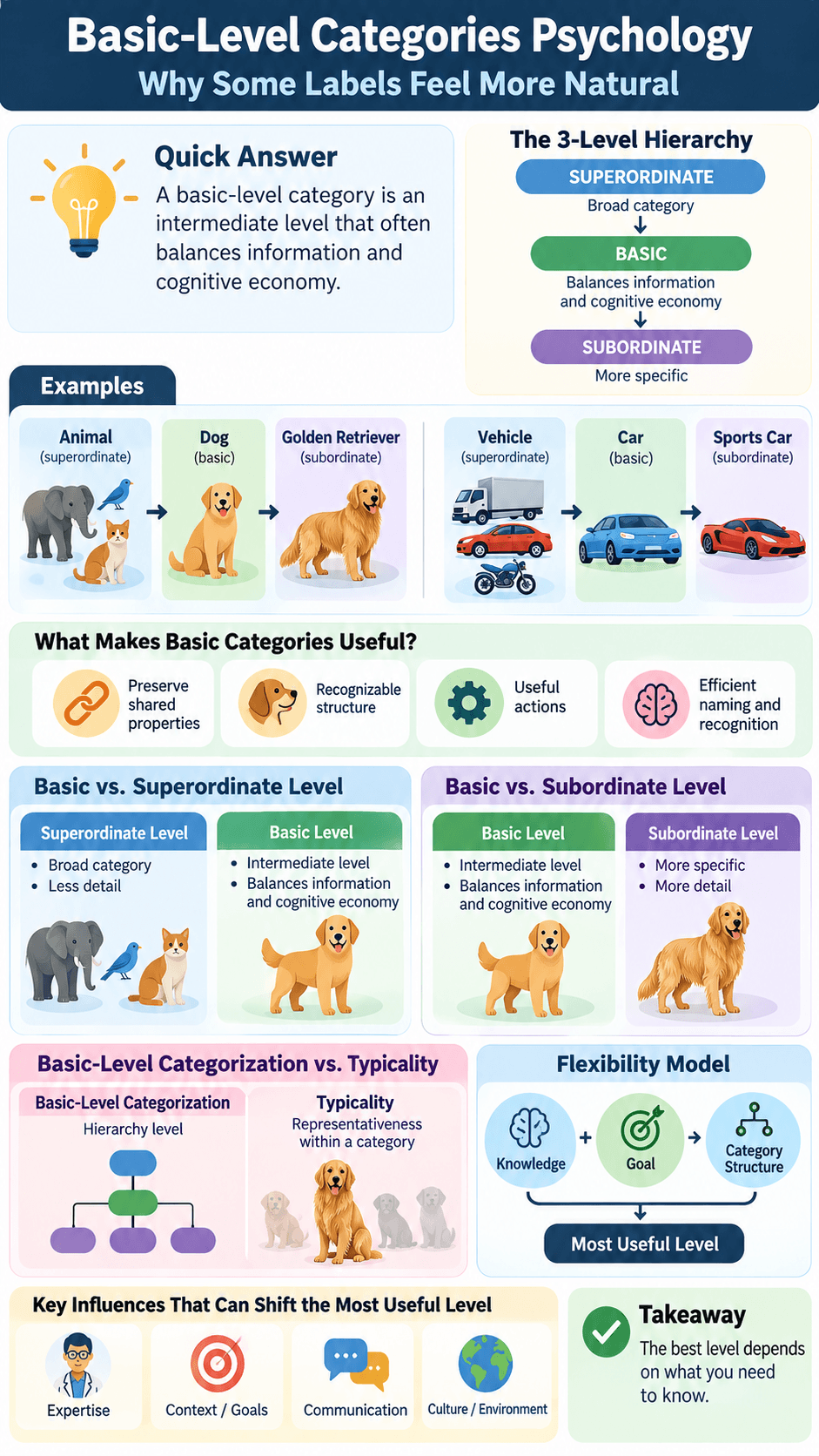
A basic-level category is an intermediate level of classification that often gives people a useful balance between information and cognitive economy. In a hierarchy such as animal → dog → golden retriever, “dog” is commonly treated as the basic level. It is more informative than the broad label “animal” while requiring less detail than the narrower label “golden retriever.”
The Three-Level Hierarchy
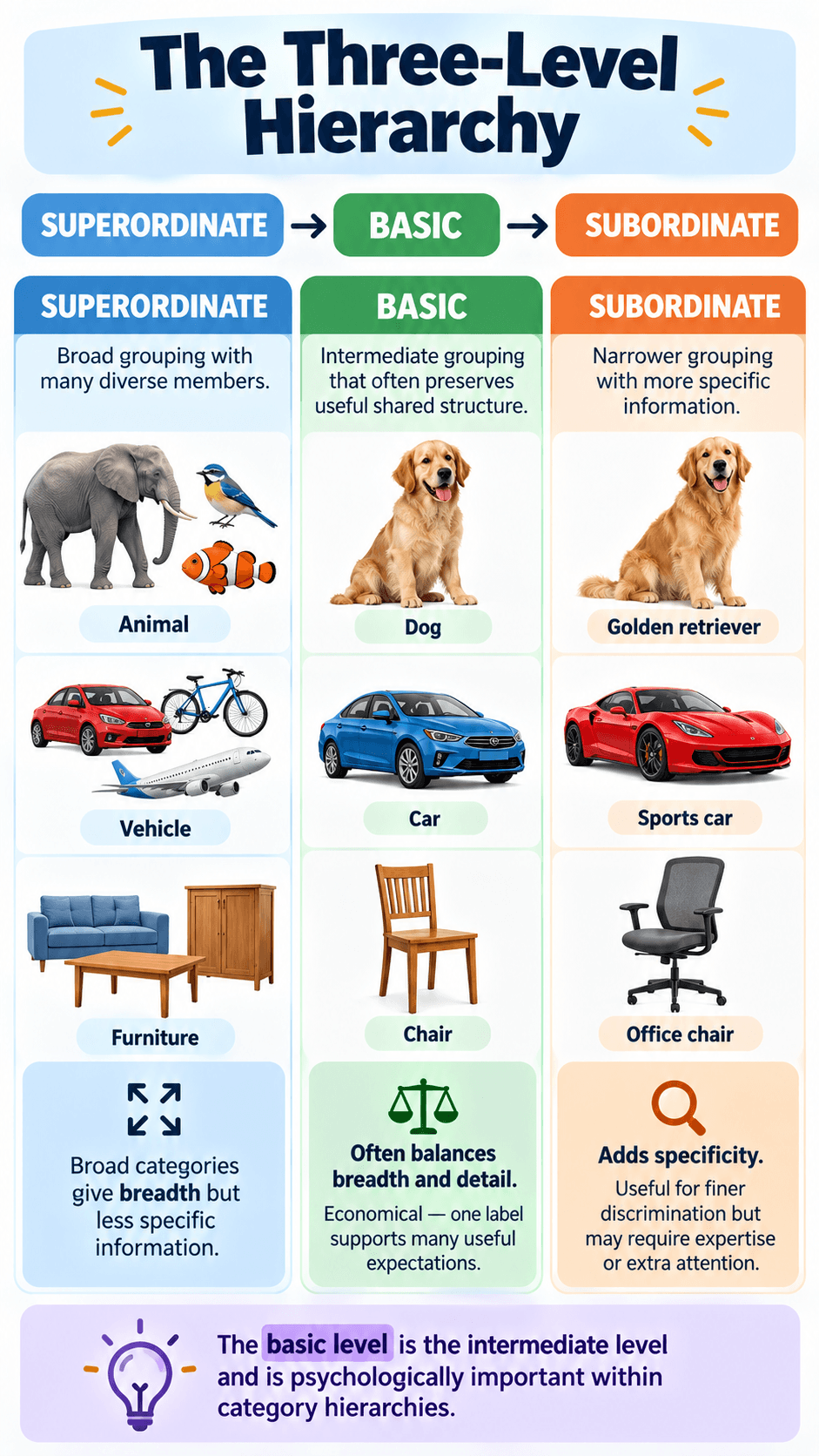
The simplest way to understand basic-level categorization is to compare three levels of abstraction:
SUPERORDINATE → BASIC → SUBORDINATE
| Level | Example | Main feature |
|---|---|---|
| Superordinate | Animal | Broad grouping with many diverse members |
| Basic | Dog | Intermediate grouping that often preserves useful shared structure |
| Subordinate | Golden retriever | Narrower grouping with more specific information |
The APA Dictionary of Psychology entry for basic-level category identifies this intermediate level as psychologically important within category hierarchies. The classic research tradition developed the idea by examining how quickly people recognize objects, how they name them, and how much information is preserved at each level.
Superordinate categories are broad
A superordinate category such as “animal,” “vehicle,” or “furniture” groups together many items that can differ greatly in appearance, movement, function, and internal structure.
The benefit is breadth. The cost is that the label provides relatively little specific information. Knowing that something is a vehicle tells you less about its likely shape, parts, and use than knowing that it is a car.
Basic categories often balance breadth and detail
A basic category such as “dog,” “car,” or “chair” is narrower than the superordinate level, so its members tend to share more visible, functional, and behavioral properties.
At the same time, it remains broad enough to cover many individual examples. “Dog” includes many breeds, sizes, and appearances. That combination makes the level economical: one label supports many useful expectations without requiring a highly specific identification.
Subordinate categories add specificity
A subordinate category such as “golden retriever,” “sports car,” or “office chair” provides more detailed information. It may matter when the task requires finer discrimination.
Specificity has a cost, however. To use the subordinate label accurately, the person must notice distinctions that are unnecessary at the broader basic level. Those distinctions may require expertise or additional attention.
The Classic Basic-Level Idea
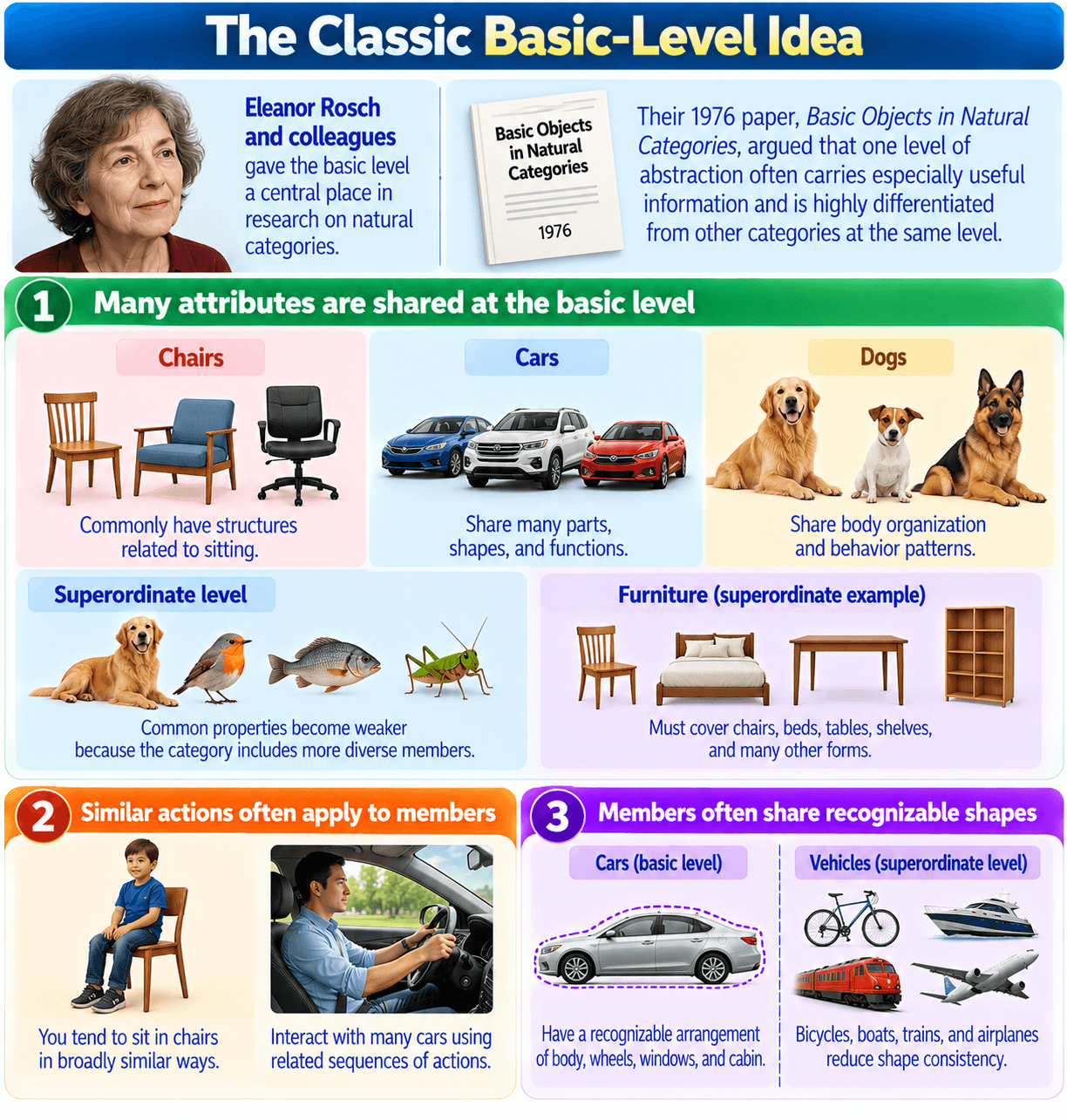
Eleanor Rosch and colleagues gave the basic level a central place in research on natural categories. Their 1976 paper, Basic Objects in Natural Categories, argued that one level of abstraction often carries especially useful information and is highly differentiated from other categories at the same level.
Many attributes are shared at the basic level
Members of a basic category often share a substantial number of properties. Chairs commonly have structures related to sitting. Cars share many parts, shapes, and functions. Dogs share body organization and behavior patterns that distinguish them from many other animals.
At a superordinate level, those common properties become weaker because the category includes more diverse members. “Furniture” must cover chairs, beds, tables, shelves, and many other forms. “Animal” must cover dogs, birds, fish, insects, and more.
Similar actions often apply to members
Classic basic-level research also examined the actions people use with objects. Members of the same basic category often support similar motor patterns. You tend to sit in chairs in broadly similar ways and interact with many cars using related sequences of actions.
This does not mean every category has a simple motor program. The point is that basic-level grouping can preserve practical commonalities that become less consistent at broader levels.
Members often share recognizable overall shapes
For many concrete objects, members of a basic category have enough structural similarity that the category can be recognized from overall form. Cars vary, but most cars have a recognizable arrangement of body, wheels, windows, and cabin. At the superordinate “vehicle” level, bicycles, boats, trains, and airplanes reduce that shape consistency.
Shape is especially relevant for concrete objects, not a universal explanation for all categories. Abstract, relational, and goal-derived categories may rely on different kinds of structure.
Why the Basic Level Can Feel Efficient
It provides useful information without excessive detail
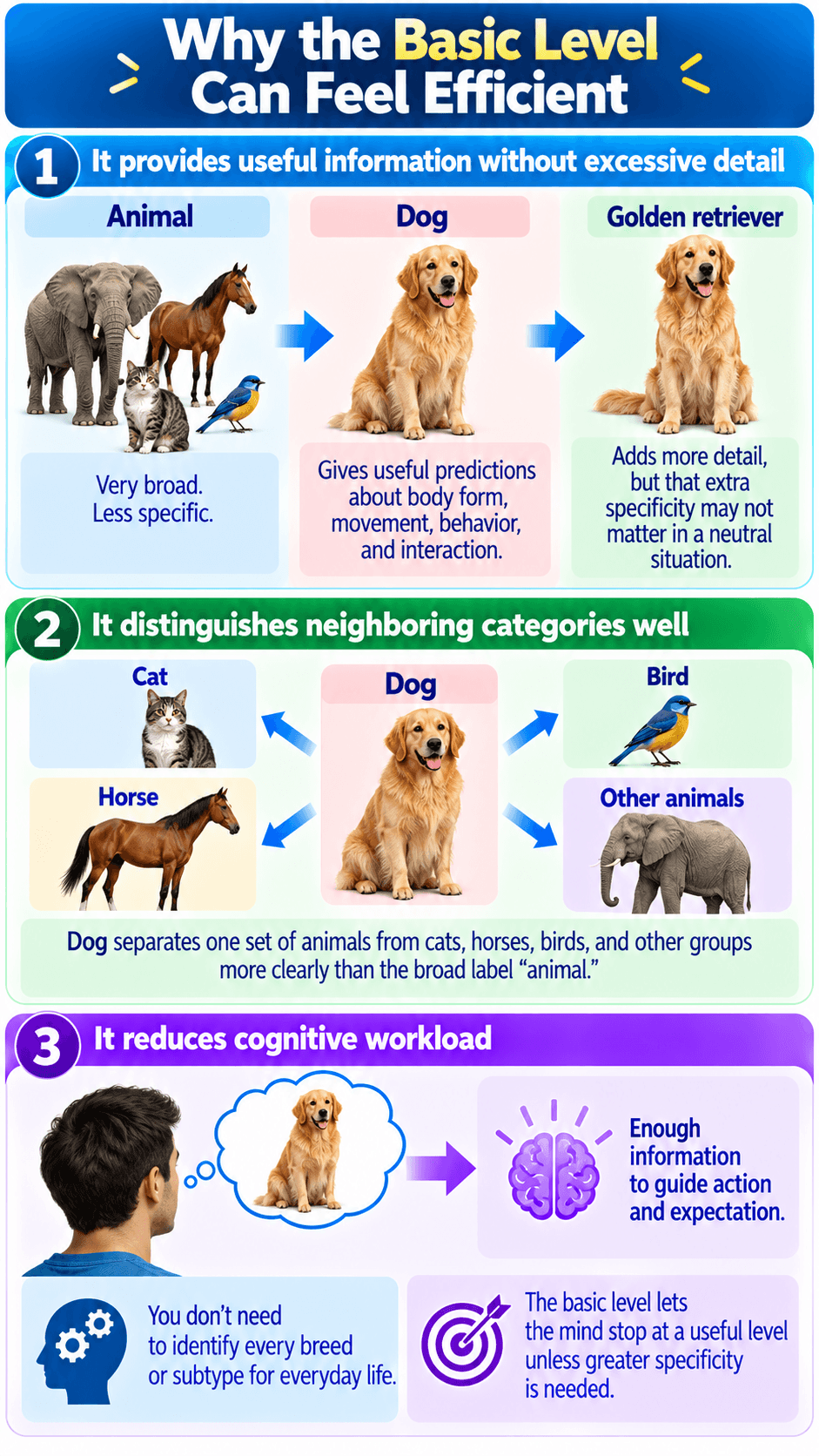
Calling something a “dog” tells you far more than calling it an “animal.” You can make reasonable predictions about body form, movement, behavior, and interaction. Calling it a “golden retriever” adds information, but that extra specificity may not matter in a neutral situation.
The basic level therefore often offers a favorable trade-off. It gives enough information to guide action and expectation without demanding distinctions that are unnecessary for the current purpose.
It distinguishes neighboring categories well
A useful category does not only make its own members similar. It also helps separate them from nearby categories. “Dog” distinguishes one set of animals from cats, horses, birds, and other groups more clearly than the broad label “animal.”
This balance between within-category similarity and between-category difference is one reason classic work described basic categories as especially informative.
It can reduce cognitive workload
A person does not need to identify every breed, model, or subtype in order to navigate everyday life. Basic categories let the mind stop at a useful level unless greater specificity is needed.
This is cognitive economy in a practical sense: represent enough structure to support behavior while avoiding detail that has no current value.
Basic-Level Advantage in Object Recognition
Classic category-verification findings
Researchers have often tested categorization speed by presenting a category label and then asking participants whether a pictured object belongs. In the classic tradition, intermediate labels such as “bird” were often verified faster than broader labels such as “animal” or narrower labels such as a specific bird species.
A review of the timing of visual object categorization summarizes Rosch and colleagues’ basic-level findings and the later debate about exactly when basic, superordinate, and subordinate information becomes available during perception.
Fast does not mean universally first
It would be too strong to say that the brain always completes basic-level categorization before every other level. Later visual-cognition research has shown that task demands, stimulus conditions, expertise, and the specific kind of category can alter processing speed.
The safer conclusion is that basic-level categories often enjoy an efficiency advantage under common conditions, not that one fixed temporal rule governs every act of recognition.
Why the Basic Level Often Supports Useful Mental Images
Broad categories contain too much visual variation
Try to form one detailed mental image of “furniture.” A chair, bed, desk, shelf, and sofa differ too much for one clear shape to capture the whole superordinate category. At the basic level, “chair” usually supports a more coherent image because members share more structural organization.
Subordinate categories refine an image that already exists
Moving from “chair” to “office chair” adds details such as wheels, adjustable height, or armrests. Those details improve specificity, but the broader basic representation already captures much of what is needed to recognize the object as a chair.
Mental imagery is useful evidence, not a universal definition
The ability to form a recognizable image helped classic researchers identify the basic level for concrete objects. It should not become a requirement for every category. Abstract concepts and relational categories may have psychologically useful levels without producing one stable picture.
Basic Level Is Not the Same as Typicality
| Basic-level categorization | Typicality |
|---|---|
| Compares levels in a category hierarchy | Compares how representative members are within a category |
| Example: animal → dog → golden retriever | Example: robin may feel more representative of bird than penguin |
| Main question: Which level of abstraction is most useful? | Main question: Which member feels like a better example? |
| Concerns category labels and hierarchy | Concerns graded internal structure |
A dog can be the basic-level category for a golden retriever, while one dog may still be more typical of “dog” than another. The two phenomena can interact, but they answer different cognitive questions.
Basic Level Is Not Just the Shortest or Most Common Word
Word length is not the mechanism
“Dog” happens to be shorter than “golden retriever,” but this does not explain basic-level categorization. A basic label can be longer than a superordinate label in another language or domain. The theory concerns conceptual organization, not character count.
Frequency can influence accessibility without defining the level
Frequently used labels are often easier to retrieve, so language frequency can interact with categorization. However, a frequent word is not automatically a basic-level category. A word can be common because of culture, communication, or local relevance rather than because it occupies an intermediate conceptual level.
Naming and conceptual level are related but distinct
People often prefer basic-level names in neutral naming tasks, which helped make the phenomenon visible in the first place. But basic-level structure is broader than word retrieval. It also concerns shared attributes, perceptual structure, action, and category differentiation.
This boundary is important because the topic should not be reduced to lexical access or word recognition. Language reflects category structure, but it is not the whole explanation.
Expertise Can Shift the Useful Level
Experts make finer distinctions efficiently
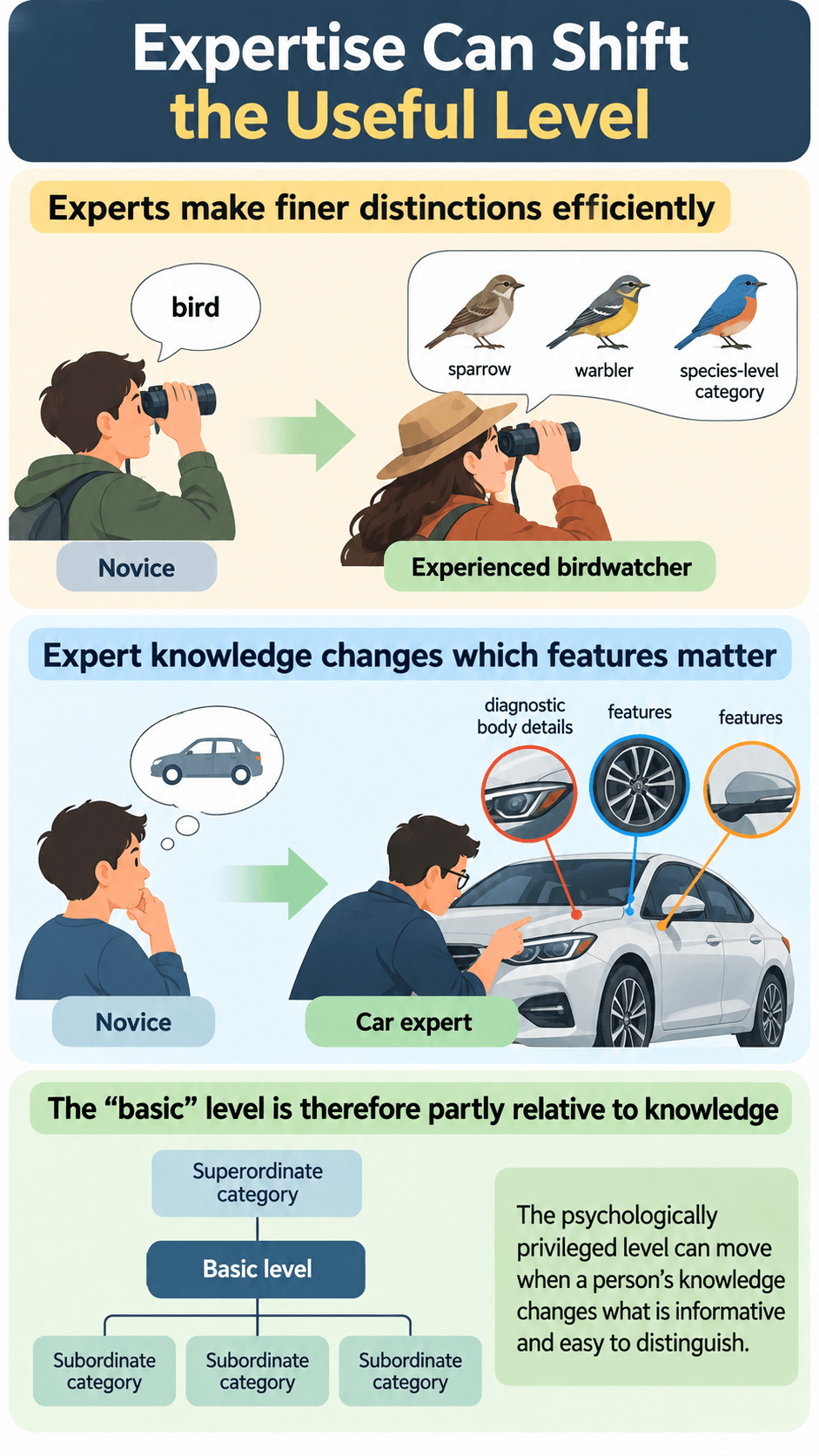
A novice looking at a bird may comfortably stop at “bird.” An experienced birdwatcher may identify “sparrow,” “warbler,” or a species-level category just as naturally. Years of practice make distinctions that were once demanding become informative and efficient.
Tanaka and Taylor tested this question directly in research on object categories and expertise. In expert domains, subordinate categories became more differentiated, were named more frequently, and could be categorized as quickly as the usual basic-level labels.
Expert knowledge changes which features matter
Expertise is not only faster naming. It changes what a person notices. A car expert may recognize diagnostic body details that a novice treats as minor variation. A botanist may use leaf arrangement, reproductive structure, and growth form to make distinctions that are invisible to an untrained observer.
Research on car experts found a processing advantage at basic-level object recognition that was not explained only by raw image features. Work on visual expertise and basic-level categorization supports the role of top-down knowledge and attention in expert performance.
The “basic” level is therefore partly relative to knowledge
This does not mean category hierarchies become arbitrary. The objects still possess structure, and different levels still include one another. But the psychologically privileged level can move when a person’s knowledge changes what is informative and easy to distinguish.
A later set of experiments by Johnson and Mervis also found that increasing expertise affected the level at which categories functioned as basic. Their research on expertise and basic-level categorization supports treating the basic level as sensitive to knowledge rather than as permanently fixed for every observer.
Context and Goals Can Change the Best Label
Neutral naming is only one situation
If someone casually asks what an object is, “car” may be sufficient. If a mechanic asks what needs repair, “car” is too broad. If a traffic report describes a collision, “vehicle” may be all that matters.
The most useful level depends partly on why the category is being used. A label that is efficient in one task can be too broad or too specific in another.
Communication rewards the level that answers the current question
Imagine asking someone to move a chair. “Move the furniture” is too broad because it could refer to several objects. “Move the black ergonomic mesh office chair” may provide unnecessary detail if there is only one chair in the room. “Move the chair” fits the communicative goal.
This is one reason basic-level labels often feel natural: they frequently provide enough information for successful communication without over-specifying.
Tasks can temporarily favor superordinate or subordinate categories
When packing a moving truck, “furniture” may become the relevant grouping because beds, chairs, and tables share a logistics problem. When shopping for a replacement component, a specific subordinate model may be essential.
Basic-level advantage is therefore a common pattern, not an instruction to always use the middle label.
Culture Can Influence Category Organization
Knowledge and environmental relevance are not identical everywhere
People living in different environments may develop detailed knowledge about different plants, animals, foods, tools, or technologies. A category that is highly differentiated in one community may remain broad in another.
Rosch and colleagues explicitly noted that category organization depends partly on the structure of the environment and on people’s knowledge of that structure. The general principles of categorization can remain useful while the specific categories privileged in daily life vary across cultures, subcultures, occupations, and individuals.
A universal-looking hierarchy should not be assumed from English labels alone
Classic basic-level studies often used familiar English object categories. Those findings were foundational, but they should not be treated as proof that every language and culture divides every domain at exactly the same level.
Category labels emerge from interaction among perceptual structure, practical importance, expertise, and language. Cross-cultural variation is therefore compatible with the broader idea that people seek informative, economical groupings.
Why Basic-Level Categories Can Shift With Experience
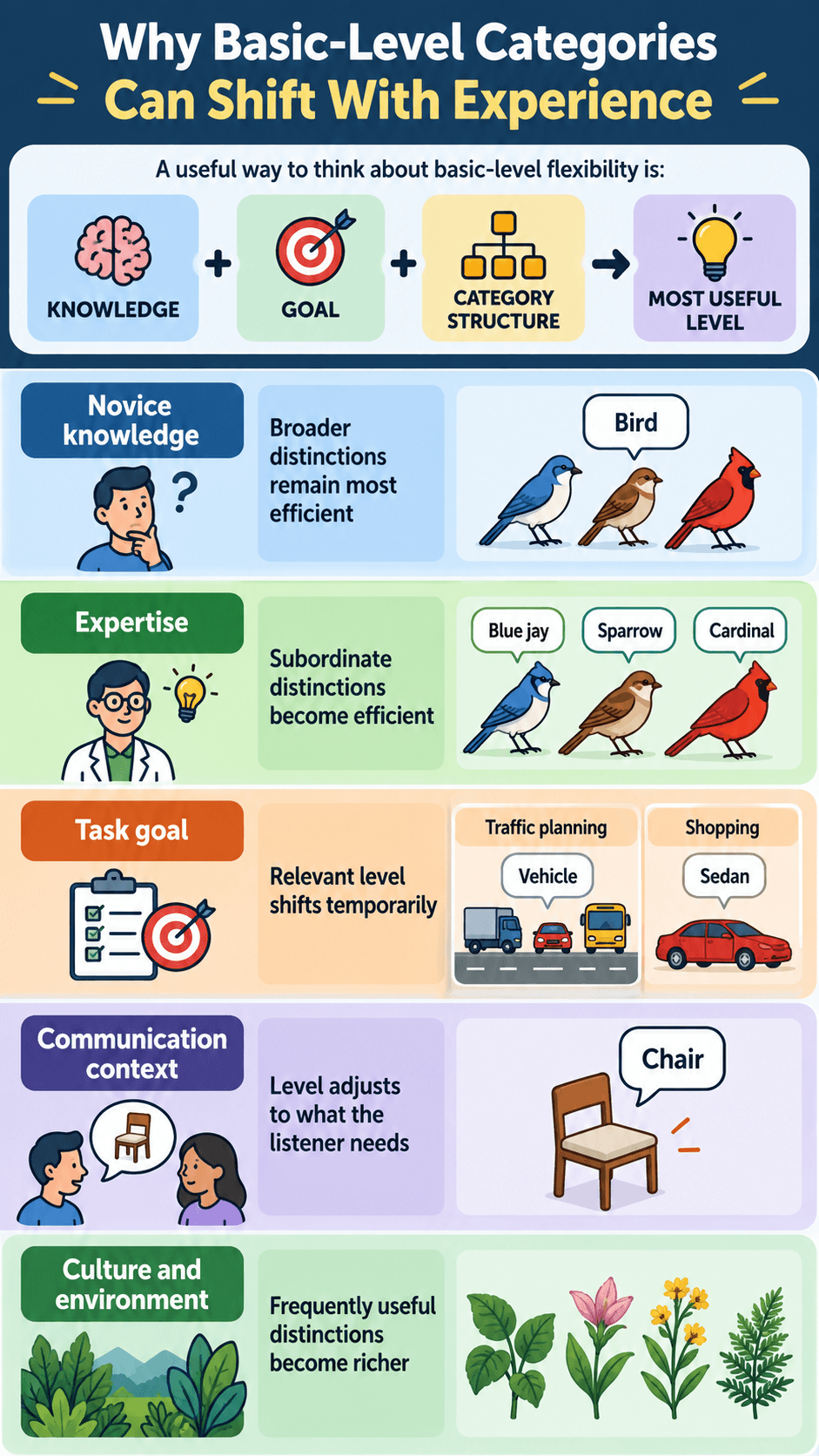
A useful way to think about basic-level flexibility is:
KNOWLEDGE + GOAL + CATEGORY STRUCTURE → MOST USEFUL LEVEL
This does not replace the hierarchy. It explains why the level that feels natural can differ across people or situations.
| Factor | Possible effect | Example |
|---|---|---|
| Novice knowledge | Broader distinctions remain most efficient | “Bird” is enough |
| Expertise | Subordinate distinctions become efficient | Species label becomes natural |
| Task goal | Relevant level shifts temporarily | “Vehicle” for traffic planning, “sedan” for shopping |
| Communication context | Level adjusts to what the listener needs | “Chair” rather than a full product description |
| Culture and environment | Frequently useful distinctions become richer | Detailed local plant or animal categories |
Basic Level vs Superordinate Level
Superordinate labels trade detail for breadth
“Animal” covers far more cases than “dog,” but that breadth weakens predictions about shape, movement, and interaction. “Furniture” includes many objects that support different actions.
Superordinate categories are useful when broad grouping is the goal. They are not cognitively inferior. They simply solve a different problem.
Basic labels often support richer default predictions
Knowing that something is a dog provides a more specific package of expectations than knowing only that it is an animal. That increased predictive value is part of what makes the basic level efficient.
Basic Level vs Subordinate Level
Subordinate labels add detail that may or may not be useful
“Golden retriever” tells you more than “dog,” but the additional information matters only if breed-level distinctions are relevant. If someone merely needs to know whether an animal is likely to be a dog, the subordinate label adds unnecessary specificity.
Experts may make subordinate labels feel basic
With expertise, the extra detail can stop feeling costly. A knowledgeable observer can access a narrower label rapidly and use it routinely. This is one of the strongest reasons not to treat basic-level status as permanently tied to one word.
Basic Level vs Typicality: One More Example
Consider the hierarchy vehicle → car → sports car. “Car” may function as the basic-level category. Inside the category “car,” a standard sedan might feel more typical than a highly unusual microcar or race car.
The level question asks, “Should I call this a vehicle, car, or sports car?” The typicality question asks, “Among cars, how representative is this one?” Mixing those questions produces confusion because hierarchy and graded membership are separate dimensions of categorization.
When the Basic-Level Idea Is Less Useful
Categories without a clear hierarchy
Not every concept fits neatly into three nested levels. Abstract categories, ad hoc categories, and relational concepts may not have an obvious superordinate-basic-subordinate organization.
Domains dominated by strict rules
A formal classification system may require exact technical labels regardless of what feels natural. Scientific, legal, medical, or engineering taxonomies can prioritize precision over everyday cognitive economy.
Situations where one level is selected by instruction
If a task explicitly asks for a species name, a model number, or a broad class, the required level is determined by the task rather than spontaneous preference.
Basic-level theory is most useful for explaining natural, efficient categorization under ordinary conditions, not for claiming that the intermediate label must win in every context.
A Practical Way to Notice Category Levels
Choose an ordinary object and generate three labels at different levels. For a bicycle, you might use “vehicle,” “bicycle,” and “road bike.” Then ask:
- Which label would I use first in a neutral conversation?
- Which level gives me the most useful information without unnecessary detail?
- At what level do members start to share a recognizable structure?
- When would the broader label become more useful?
- When would the narrower label become necessary?
- Would an expert in this domain choose a more specific label than I do?
- Would someone from another environment or culture organize the domain differently?
The exercise is not a test of cognitive ability. It simply reveals that category hierarchies support several correct descriptions, and the most useful one depends on the interaction between knowledge, structure, and purpose.
FAQ About Basic-Level Categories
Is the basic level always the middle level of a hierarchy?
It is usually described as an intermediate level between broader and narrower categories, but “middle” should not be interpreted as a purely formal position. The psychological point is that this level often provides a favorable balance of shared information and distinctiveness. Expertise and context can shift which level functions that way.
Why does “dog” often feel more natural than “animal” or “golden retriever”?
“Dog” is broad enough to cover many examples while still preserving many shared properties and useful expectations. “Animal” is more inclusive but less informative. “Golden retriever” is more precise but requires a finer distinction that is not always relevant.
Can expertise move the basic level downward?
Yes. Research comparing experts and novices shows that subordinate categories can become faster, more differentiated, and more frequently named in expert domains. The hierarchy remains, but the most efficient level can become more specific.
Is a basic-level category the same as a typical category member?
No. Basic level concerns where a category sits in a hierarchy, while typicality concerns how representative a member is within a category. “Bird” can be a basic-level category, and “robin” can be a highly typical member of that category.
Key Takeaways
- Basic-level categories sit between broad superordinate categories and narrow subordinate categories.
- The basic level often balances informativeness with cognitive economy, which can make labels such as “dog,” “chair,” or “car” feel natural.
- Classic research linked the basic level with shared attributes, recognizable structure, similar actions, naming preferences, and efficient categorization.
- Basic-level categorization is not the same as typicality, word frequency, or simple word recognition.
- Expertise can make subordinate distinctions as efficient and natural as ordinary basic-level labels.
- Goals, communication context, culture, and environmental knowledge can shift which level is most useful.
Final Thought: The Best Level Depends on What You Need to Know
The basic-level idea is powerful because it explains why one label often feels “just right” without implying that broader or narrower labels are wrong. A useful category level gives enough information to guide recognition, prediction, and action while avoiding detail that the situation does not require. When knowledge or goals change, the useful level can change too. The hierarchy remains, but cognition does not have to stop at the same point every time.
Educational note: Preference for broader or narrower category labels is not a measure of intelligence, language ability, neurodevelopmental status, or neurological health. Expertise, context, familiarity, culture, and task demands can all influence which level is easiest or most useful.

Michael Reed is the Founder and Lead Writer at Psychology Exposed. He writes about human behavior, relationships, emotional patterns, self-awareness, and practical psychology topics using research-informed, easy-to-understand content.
Read More About Michael Reed: https://psychologyexposed.com/michael-reed/