
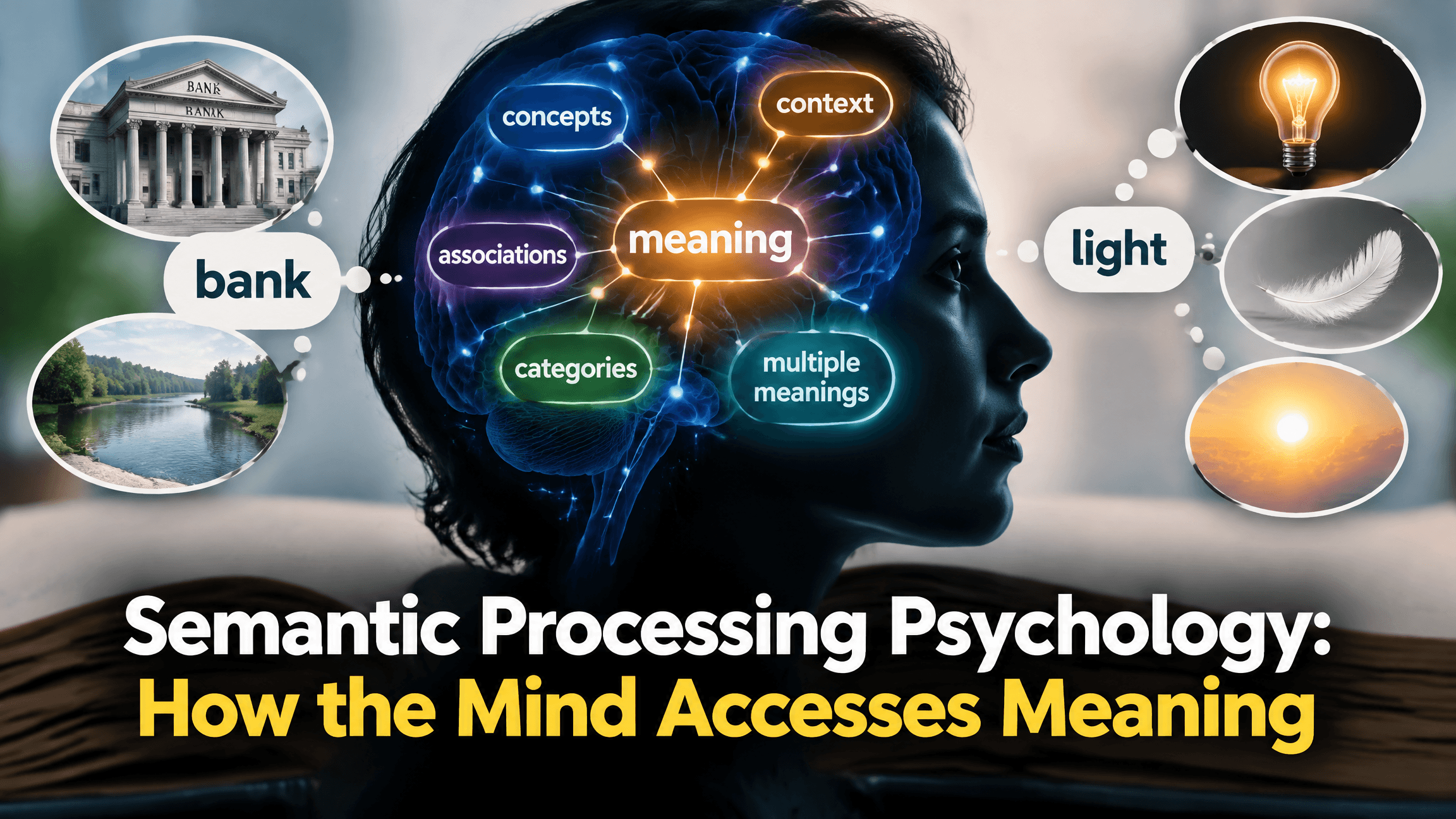
You can recognize a word perfectly and still not know what it means in the moment. The word bank, for example, might refer to a financial institution or the side of a river. Light can describe illumination, low weight, or something that is not intense. The sound or spelling may be familiar immediately, while the intended meaning depends on what surrounds it.
Semantic processing is the part of language comprehension concerned with making meaning available and selecting the interpretation that fits. It helps explain why related ideas come to mind together, why some category members feel more typical than others, and why context can rapidly change what a familiar word seems to mean. Researchers study these questions using many methods and competing models, so there is no need to imagine a single mental dictionary with one fixed route from word to definition.
The useful distinction is simple: recognizing a familiar word form answers something like “what word is this?”, while semantic processing asks “what meaning is relevant here?” That distinction becomes especially important when words are ambiguous, concepts overlap, or a later phrase forces you to revise what you first understood.
Quick Answer

Semantic processing is the set of mental processes involved in accessing and using meaning. A recognized word can activate concepts, features, associations, and sometimes several possible meanings. Context then helps make some interpretations more relevant than others. This is not the same as semantic memory, belief, sentence parsing, or semantic priming, although all of those topics can interact with meaning.
From Recognized Word to Activated Meaning
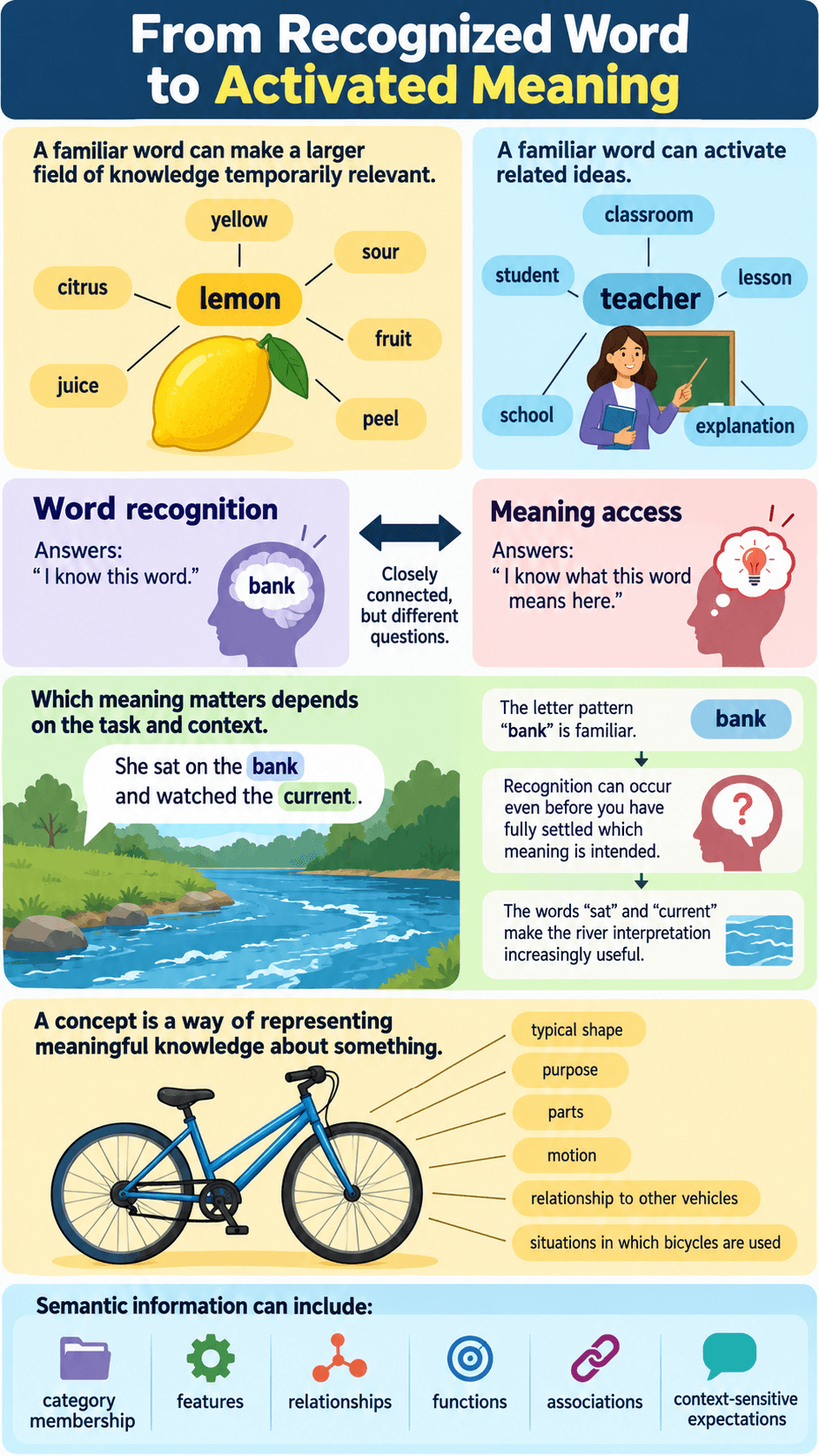
A familiar word does more than produce a sense of recognition. It can make a larger field of knowledge temporarily relevant. Reading lemon may make ideas such as yellow, sour, fruit, peel, juice, or citrus easier to access. Reading teacher may activate classroom, student, lesson, school, or explanation. Which information matters depends on the task and context.
The APA Dictionary of Psychology is useful for checking established psychological terminology, but real-time semantic processing is not well captured by imagining that the mind simply looks up a static definition. Meaning is influenced by relationships among concepts, the current sentence, prior experience, and what has already been activated.
Why identifying a word is not the same as settling its meaning
Word recognition and meaning access are closely connected, but they answer different questions. Suppose you read the sentence, “She sat on the bank and watched the current.” The letter pattern bank is familiar. Recognition can occur even before you have fully settled which meaning is intended. The words sat and current make the river interpretation increasingly useful.
This separation matters because a single familiar form can support multiple senses or meanings. A review of research on semantic ambiguity describes decades of work on how meaning frequency, similarity, and context affect the processing of ambiguous words. The key point for everyday understanding is that “I know this word” and “I know what this word means here” are not always the same mental achievement.
Concepts and semantic information in everyday terms
A concept is a way of representing meaningful knowledge about something. The exact nature of concepts is debated, but a practical explanation does not require choosing one theory. If you know what a bicycle is, your knowledge may include its typical shape, purpose, parts, motion, relationship to other vehicles, and the situations in which bicycles are used.
Semantic information can therefore include category membership, features, relationships, functions, associations, and context-sensitive expectations. Not all of this information has to become conscious at once. Much of semantic processing is inferred from how people respond to words and concepts under controlled conditions.
A Simple Meaning-Access Model
A useful mental model is:
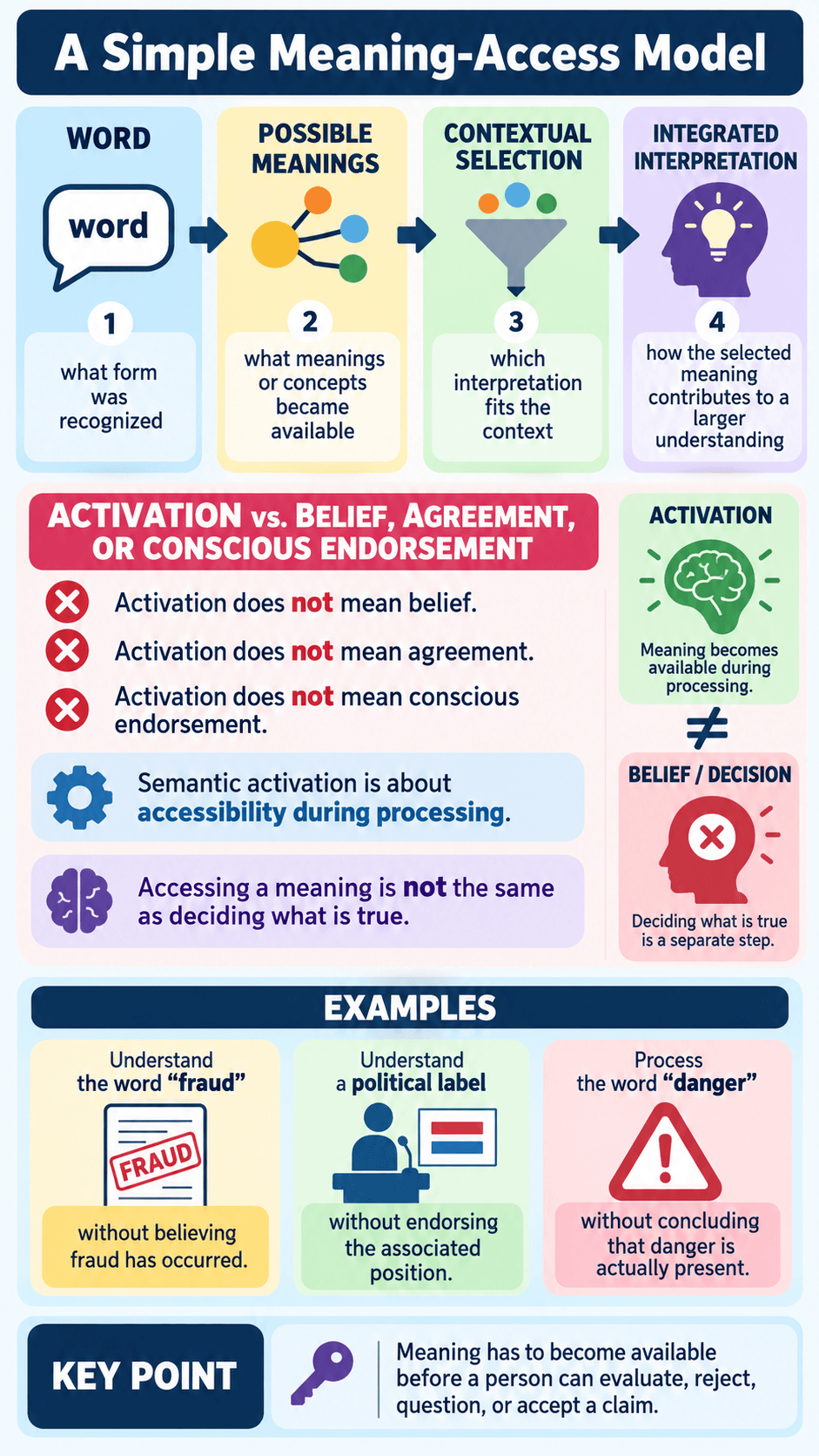
WORD → POSSIBLE MEANINGS → CONTEXTUAL SELECTION → INTEGRATED INTERPRETATION
This model is deliberately simplified. It is useful because it separates four questions: what form was recognized, what meanings or concepts became available, which interpretation fits the context, and how the selected meaning contributes to a larger understanding.
Why activation does not mean belief, agreement, or conscious endorsement
If a word activates a concept, that does not mean you believe the concept is true, approve of it, or even notice it consciously. Semantic activation is about accessibility during processing. A person can understand the word fraud without believing fraud has occurred. They can understand a political label without endorsing the associated position. They can process the word danger without concluding that danger is actually present.
This distinction protects semantic processing from being confused with belief psychology. Meaning has to become available before a person can evaluate, reject, question, or accept a claim. Accessing a meaning is not the same as deciding what is true.
What Kind of Relationships Link Meanings?
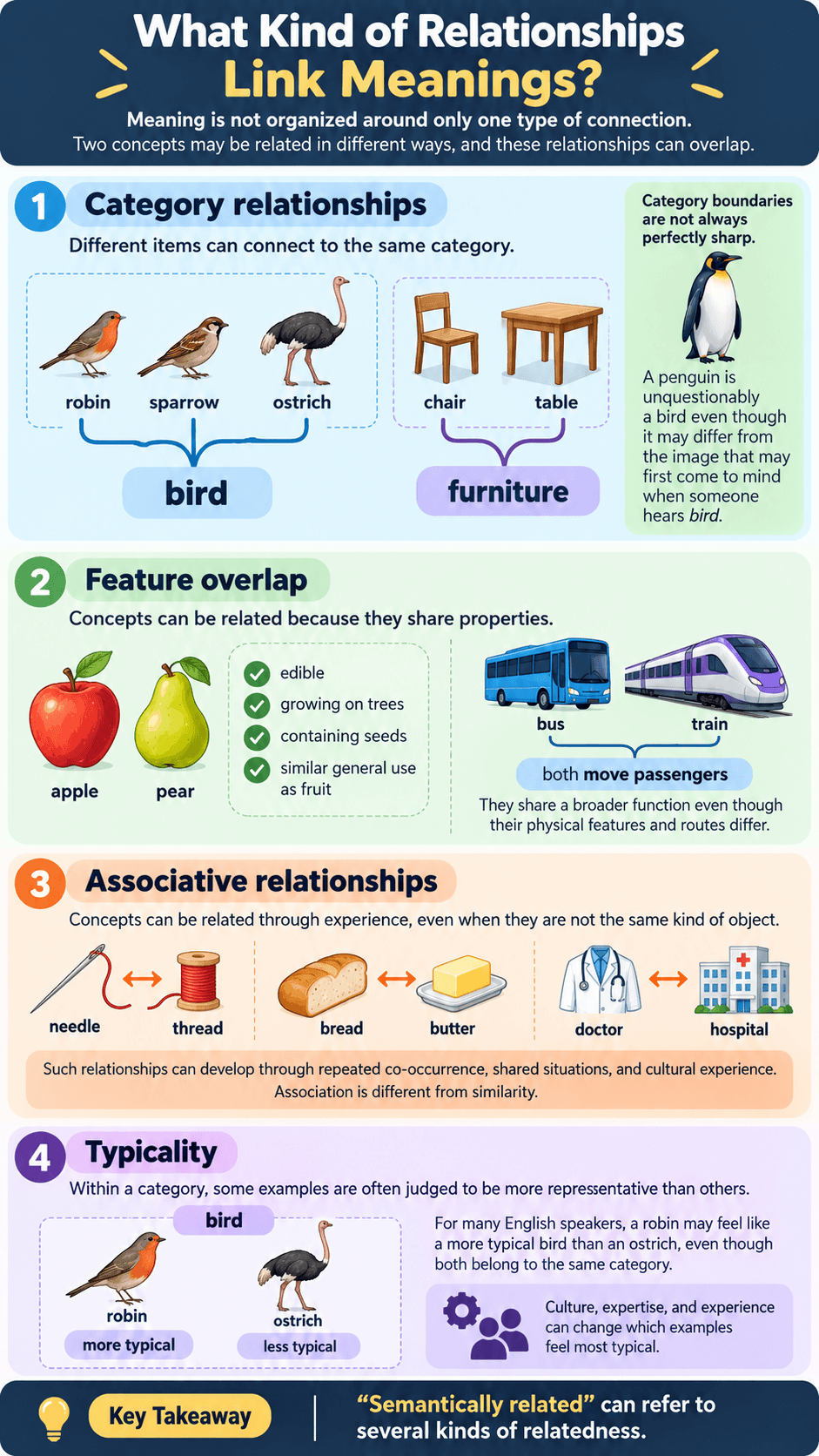
Meaning is not organized around only one type of connection. Two concepts may be related because they belong to the same category, share features, occur together often, serve similar functions, or are strongly associated through experience. These relationships can overlap.
Category relationships
Robin, sparrow, and ostrich can all connect to the category bird. Chair and table can connect to furniture. Categories help people generalize, compare, predict, and organize knowledge, but category boundaries are not always perfectly sharp.
Some categories are defined by clear rules, while many everyday categories are more graded. That is why a penguin is unquestionably a bird even though it differs from the image that may first come to mind when someone hears bird.
Feature overlap
Concepts can also be related because they share properties. An apple and a pear may overlap in features such as being edible, growing on trees, containing seeds, and having a similar general use as fruit. A bus and a train share the broader function of moving passengers, even though their physical features and routes differ.
Feature overlap is one reason semantic similarity can feel immediate. You do not need to deliberately recite every shared property for two concepts to seem related.
Associative relationships
Association is different from similarity. Needle and thread are strongly related even though they are not the same kind of object. Bread may call up butter. Doctor may call up hospital. Such relationships can develop through repeated co-occurrence, shared situations, and cultural experience.
This distinction matters because “semantically related” can refer to several kinds of relatedness. Researchers are careful about the task and relationship being measured rather than assuming that every connection reflects the same mental structure.
Typicality where it helps explain category structure
Within a category, some examples are often judged to be more representative than others. Research on semantic typicality shows that typicality is a robust feature of conceptual processing. For many English speakers, a robin may feel like a more typical bird than an ostrich, even though both belong to the same category.
Typicality does not make one member “more real” than another. It reflects how easily certain examples match a category representation in a given context. Culture, expertise, and experience can change which examples feel most typical.
When One Word Has More Than One Meaning
Ambiguity is not an unusual defect in language. Many common words have more than one meaning or sense. The mind has to remain flexible enough to use the same word form differently across situations.
Lexical ambiguity
Lexical ambiguity occurs when a word form is compatible with more than one interpretation. Sometimes the meanings are clearly distinct, as with bank. Sometimes they are related senses, as when mouth refers to a part of a face or the opening of a river.
Research suggests that meaning frequency and context both matter. An interpretation that is common in a person’s language experience may become available quickly, while a strongly constraining sentence can support a less frequent interpretation. The process is dynamic rather than a rigid rule that “the most common meaning always wins.”
Neutral examples such as bank, light, cold, pitch, and match
| Word | Possible meaning 1 | Possible meaning 2 | Helpful context |
|---|---|---|---|
| bank | financial institution | side of a river | loan, account, river, water |
| light | illumination | low in weight | lamp, room, suitcase, carry |
| cold | low temperature | respiratory illness | weather, coat, cough, symptoms |
| pitch | sound frequency | throw or sales presentation | music, baseball, proposal |
| match | contest | small fire-lighting stick | team, score, candle, flame |
The important feature is not the list itself. It is the way surrounding information changes which interpretation becomes useful.
How context changes which meaning becomes most useful
Compare “The bank approved the loan” with “The canoe drifted toward the bank.” The word is identical, but the surrounding concepts favor very different interpretations. Context can begin influencing meaning before an ambiguous word appears, and later words can also force an update.
Work on lexical ambiguity in sentence comprehension illustrates that ambiguous words can require additional processing and that the interpretation depends on factors such as meaning bias and context. This does not imply that every possible meaning is consciously compared. Much of the competition and selection may occur without deliberate awareness.
Semantic Networks as a Reader-Friendly Model
One common way to explain meaning is to imagine a network in which concepts are connected by different kinds of relationships. If one concept becomes active, nearby or strongly related concepts may also become easier to access. This gives readers a visual way to understand why cat may make dog, pet, fur, or meow more accessible.
What network language can illustrate
A network metaphor is useful for showing that meaning is relational. Concepts do not have to be represented as isolated dictionary entries. Modern work comparing approaches to lexical semantics notes that network-based views represent words or concepts as nodes connected by paths or relations, alongside other approaches to representing semantic information.
The metaphor also explains why distance and connection strength can matter in some models. A strongly associated concept may become accessible more readily than a weakly related one. Still, the metaphor should not be mistaken for a literal wiring diagram of where every word “lives.”
Spreading activation as a historical and useful account, with caution
Spreading activation proposes that activating one concept increases activation in related concepts. The idea has influenced theories of semantic processing for decades and remains useful for explaining some patterns of association and priming.
But it is one theoretical family, not a complete final description of semantic cognition. Different models explain meaning using distributed features, statistical patterns, embodied information, predictive processes, or combinations of representational approaches. The safest use of “spreading activation” is as a model that captures certain relationships and processing effects, not as a literal substance moving through a fixed mental web.
Why the mind should not be described as storing words like files
Computer metaphors can be convenient, but they easily become misleading. Saying that the mind “opens the file for apple” suggests a neat, single-location record containing everything you know about apples. Human semantic knowledge is more flexible and context sensitive than that metaphor implies.
A recent multidisciplinary discussion of what researchers mean by semantic knowledge and related terms highlights how even specialists use words such as concept, semantic, and meaning in different ways. That is a good reason to treat simple models as tools for thinking rather than literal descriptions.
How Context Shapes Meaning Before and After a Word Arrives
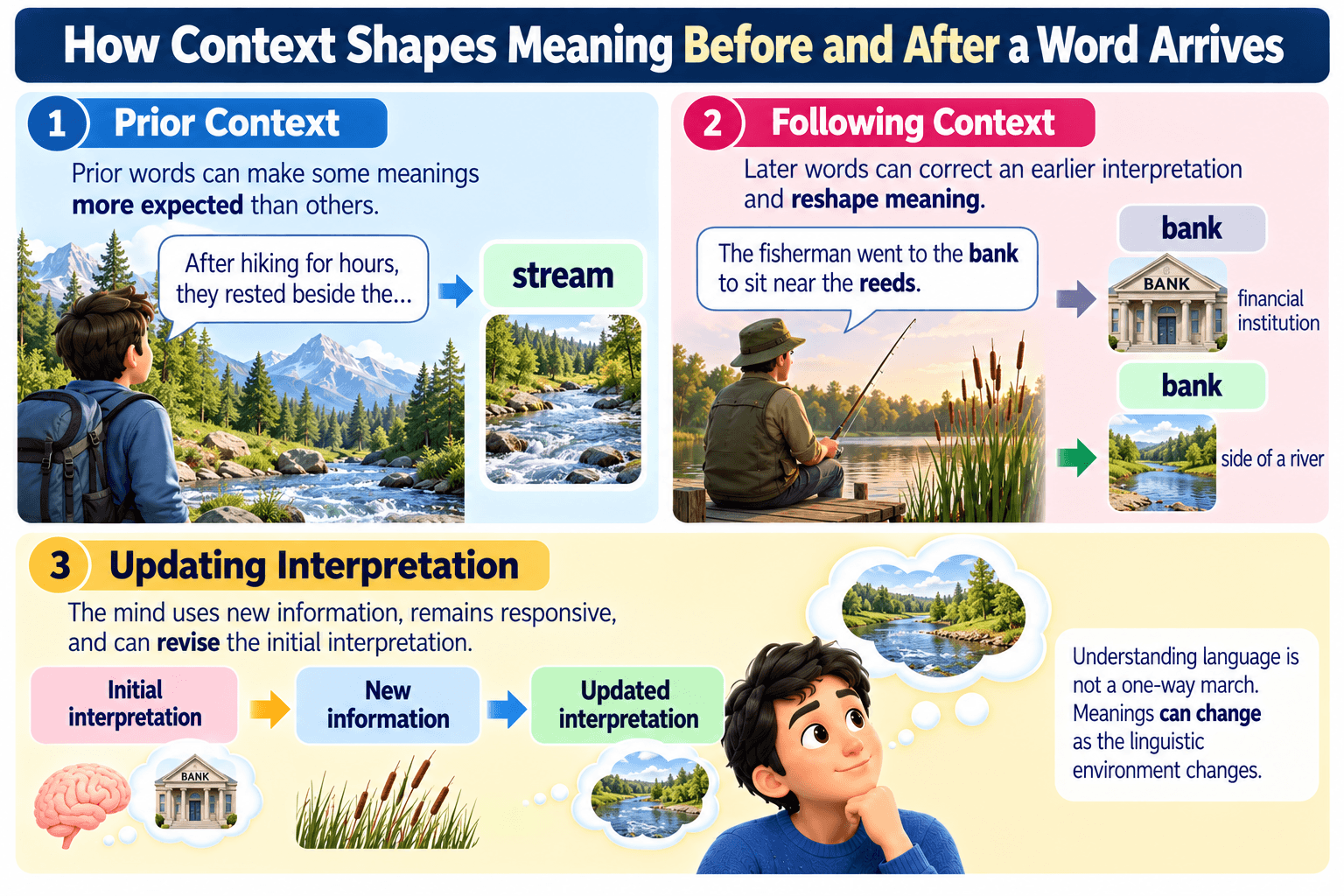
Context is not merely an after-the-fact editor. It can prepare the system for some interpretations and make others less likely. It can also correct an interpretation after new information arrives.
Prior context
In “After hiking for hours, they rested beside the…,” a word such as stream is already more expected than it would be in a financial conversation. Prior words create a field of likely concepts and relationships. This does not guarantee the next word, but it changes the background against which that word is interpreted.
Meaning frequency still matters. A familiar dominant meaning may have an advantage, especially when context is weak. Strong prior context can reduce that advantage or make a less frequent sense easier to use.
Following context
Sometimes an early interpretation looks reasonable until the rest of the phrase arrives. Consider: “The fisherman went to the bank to sit near the reeds.” If you initially pictured a financial institution because of recent context, reeds provides evidence that the river meaning fits better.
Following context can therefore reshape meaning. Understanding language is not simply a one-way march in which each word is permanently interpreted before the next word appears.
Why interpretation can update
Updating is a strength of comprehension. The mind needs to remain responsive to new evidence because natural language is full of ambiguity. An efficient system should use what is likely without becoming unable to revise.
That is why semantic processing is better pictured as graded and context-sensitive than as a single lookup. Meanings compete, cooperate, and change in relevance as the linguistic environment changes.
Semantic Processing vs Word Recognition
These processes interact so quickly that they can feel like one event. Separating them conceptually helps clarify what a particular experiment or everyday experience is actually about.
What word is this?
Word recognition concerns identifying a familiar lexical item from its spoken or written form. Letter patterns, sound patterns, frequency, familiarity, and competition among similar forms are central questions.
If you see table and rapidly identify it as a familiar English word, that is primarily a recognition problem.
What meaning is active here?
Semantic processing begins from the question of what meaningful information becomes available. If table activates furniture, flat surface, legs, dining, spreadsheet arrangement, or a verb meaning to postpone discussion, the problem has moved beyond identifying the word form.
The two processes are not necessarily rigid serial stages. The distinction is about the question being asked, not a claim that the mind always finishes recognition completely before meaning begins.
Semantic Processing vs Sentence Processing vs Pragmatics
Meaning can be studied at several levels. The boundaries are useful even though the processes continuously interact during real comprehension.
Word and concept meaning
Semantic processing focuses on what words and concepts mean and how those meanings become available. Ambiguity, semantic features, category relationships, and context-sensitive meaning activation belong here.
Multi-word structural integration
Sentence processing asks how multiple words are combined over time using order, grammar, plausibility, and other cues. The main problem is no longer just what bank means, but how the meanings and structural relationships across an unfolding sentence fit together.
Intended meaning in wider context
Pragmatics goes further into speaker meaning, shared knowledge, reference, implication, and context beyond the literal sentence. “It is cold in here” can describe temperature, but in a particular setting it might function as an indirect request to close a window.
Semantic processing contributes the meanings needed for that inference, but it is not the whole pragmatic process.
Semantic Processing vs Semantic Memory
The word semantic appears in both topics, which makes them easy to merge. They overlap, but the questions are different.
Using meaning during language processing
Semantic processing concerns meaning in use. What becomes activated when a word is encountered? Which interpretation is supported? How do conceptual relationships change what becomes accessible?
The emphasis is on active comprehension and use of meaning.
Stored general knowledge as a memory-system question
Semantic memory concerns general knowledge that is not tied to one specific autobiographical episode, such as knowing that Paris is in France or that a triangle has three sides. That is a memory-system question.
Language processing depends on stored knowledge, but an explanation of how semantic memory is organized, retained, or impaired belongs to memory psychology rather than being repeated here.
Semantic Processing vs Semantic Priming
The words sound similar, but one is broad and the other describes a specific kind of effect studied experimentally.
General meaning access
Semantic processing includes the broader set of operations that make meanings and conceptual relationships available during language use. It occurs whenever a person understands meaningful words and concepts.
A specific prior-context effect on later processing
Semantic priming examines how processing one item changes later processing of a semantically related item. For example, seeing doctor can, under certain experimental conditions, change how quickly people respond to nurse compared with an unrelated word.
That effect is evidence about semantic relationships and processing, but semantic processing is much broader than priming. Priming results also should not be stretched into claims that a small word cue can reliably control complex real-world behavior.
Everyday Meaning Selection Examples
Several simple examples show why semantic processing is useful outside a laboratory. The examples are not diagnostic tests. They illustrate how flexible meaning can be.
Ambiguous single words
You receive the message, “Bring a light bag.” Here light most naturally means low in weight. In “Turn on the light,” the same word points toward illumination. In “We had a light lunch,” it describes amount or heaviness. The surrounding phrase quickly changes the useful sense.
Category expectations
If someone says, “A bird landed on the fence,” many people may spontaneously imagine a small flying bird rather than an ostrich or penguin. That expectation reflects typicality, not the formal boundaries of the category. A later phrase, “It was a large flightless bird from the zoo,” would force the representation to change.
Context that overturns an early interpretation
Imagine reading, “He carried the bat into the cave.” You may initially interpret bat as sports equipment because of a previous sentence about baseball. The next sentence, “It flapped out of his hands,” overturns that interpretation. Understanding improves by revising what the word was taken to mean.
This kind of update shows why an early interpretation can be reasonable without being final.
What to Explore Next
The next useful question depends on where the difficulty or curiosity lies. Meaning at the word level is only one part of language comprehension.
Move to Sentence Processing when structure across words is the main issue
If you want to know why word order matters, how the mind handles grammatical ambiguity, why a garden-path sentence causes confusion, or why rereading can repair a difficult sentence, sentence processing is the more precise topic.
That shift keeps the focus on how several words are integrated rather than repeating a word-meaning explanation.
Move to Semantic Priming when prior concepts change later processing speed
If the main question is why one word makes a related word faster or easier to process in a laboratory task, semantic priming is the better fit. There the focus is not simply “what does this word mean?” but “how did prior semantic context change the response to a later target?”
FAQ
These questions address common points of confusion about meaning access without turning semantic processing into a theory of belief, memory storage, or communication intent.
What is semantic processing in simple terms?
Semantic processing is how the mind accesses and uses meaning. When you encounter a familiar word, related conceptual information becomes available, and context helps determine which interpretation fits. It includes relationships among concepts, ambiguity resolution, and context-sensitive meaning, but it does not by itself explain every part of sentence comprehension or speaker intention.
Can several meanings of a word be active at once?
Research on lexical ambiguity suggests that more than one meaning can sometimes become available, especially when the word is ambiguous and context has not yet strongly selected one interpretation. How long alternatives remain active depends on factors such as meaning frequency, context strength, and the task used to measure processing. It is better to think in terms of graded availability than a conscious list of definitions.
Is semantic processing the same as semantic memory?
No. Semantic memory concerns stored general knowledge as a memory system. Semantic processing concerns accessing and using meaning during cognition and language comprehension. The two depend on each other, but one topic asks about the knowledge store and the other asks about meaning in active use.
Does activating a meaning mean I believe it?
No. Making a meaning accessible is not the same as accepting a claim. You can understand the meaning of an idea you reject, recognize a stereotype without endorsing it, or process a possibility without deciding it is true. Belief formation involves additional evaluation beyond semantic access.
What is a semantic network supposed to represent?
A semantic network is a model that represents concepts as connected through relationships such as similarity, category membership, or association. It can help explain why related concepts become accessible together. It should not be interpreted as a literal map showing one physical node for every word in the brain.
Key Takeaways
- Recognizing a familiar word and determining its meaning in context are related but distinct problems.
- A word can activate several concepts or interpretations, with context changing which one becomes most relevant.
- Meanings can be connected through categories, shared features, associations, and graded typicality.
- Semantic-network and spreading-activation accounts are useful models, not literal diagrams of how every concept is stored.
- Semantic processing is broader than semantic priming and different from semantic memory, sentence processing, pragmatics, and belief.
- Good comprehension remains flexible enough to revise an early interpretation when later context changes the meaning that fits.

Michael Reed is the Founder and Lead Writer at Psychology Exposed. He writes about human behavior, relationships, emotional patterns, self-awareness, and practical psychology topics using research-informed, easy-to-understand content.
Read More About Michael Reed: https://psychologyexposed.com/michael-reed/