
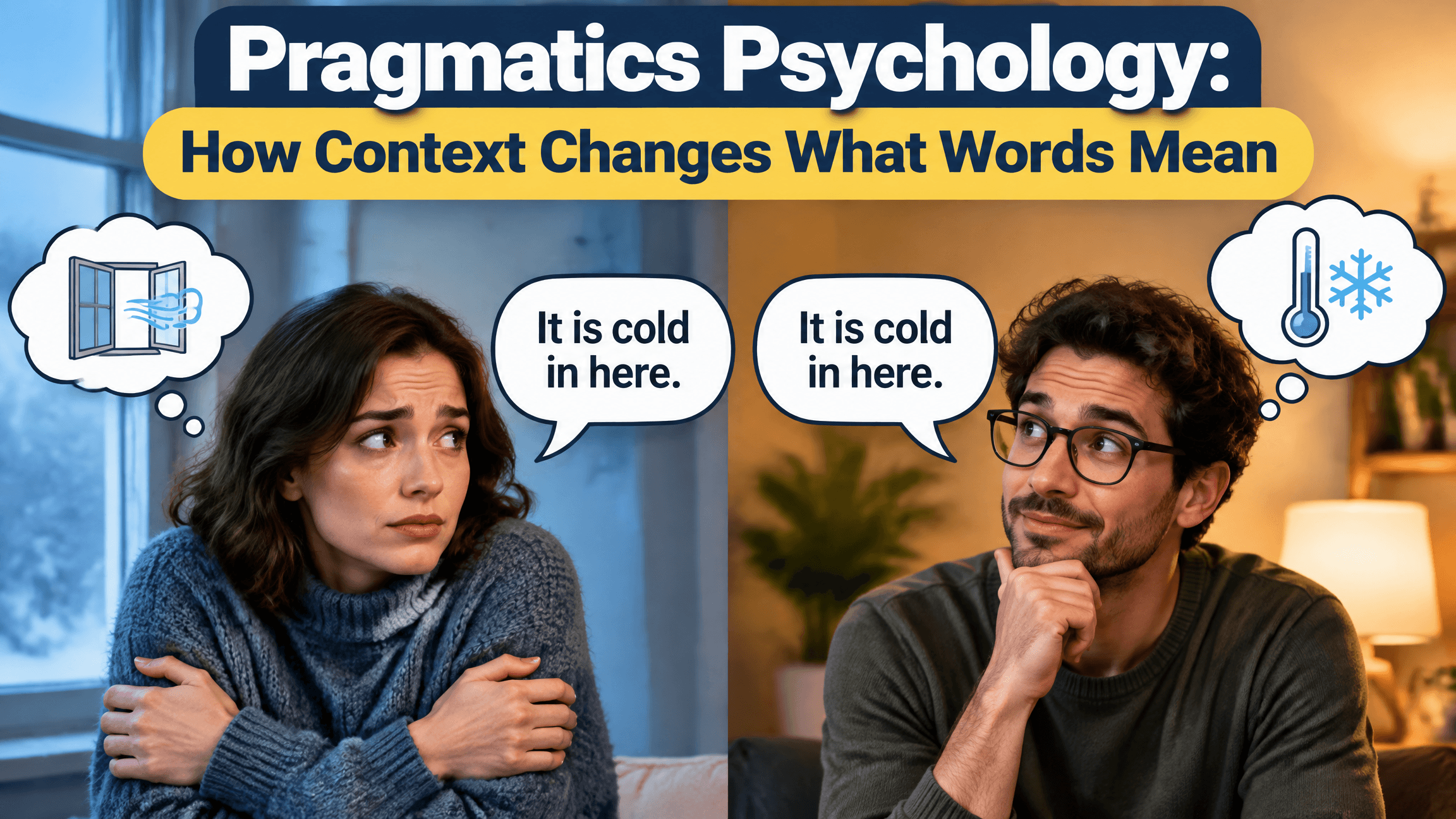
People rarely say everything they mean in completely explicit language. A sentence can be grammatically clear and still leave important work for the listener. “It is cold in here” may simply describe the temperature. In another situation, the same sentence may function as a request to close a window. The words have not changed, but the intended meaning has.
Pragmatics psychology examines how listeners move beyond literal wording by using context, shared knowledge, reference, conversational expectations, and inference. It helps explain how we understand indirect requests, implied meanings, presuppositions, irony, and expressions such as here, there, this, or that, whose interpretation depends on the situation.
The important boundary is that pragmatic inference is not mind reading. Listeners do not gain direct access to another person’s thoughts. They use available evidence to form a context-sensitive interpretation. That interpretation may be reasonable and still be wrong, especially when people do not share the same background knowledge, cultural expectations, or assumptions about the situation. Within language psychology, pragmatics focuses on how understood language is interpreted against context, shared knowledge, and likely speaker intention.
Quick Answer
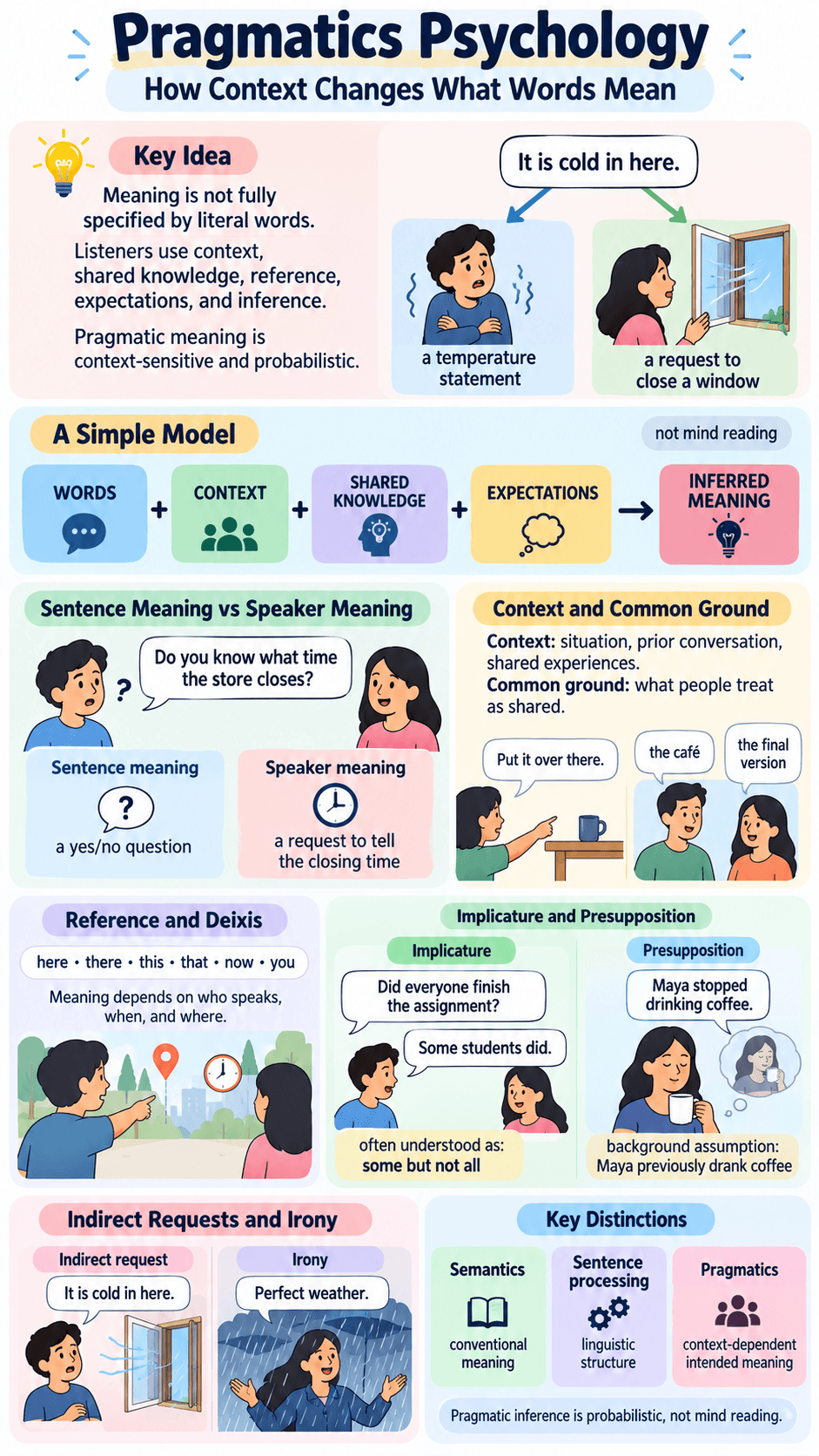
Pragmatics psychology studies how people infer meaning that is not fully specified by literal words and grammar. Listeners combine the sentence with context, shared knowledge, reference, conversational expectations, and clues about a speaker’s likely intention. Pragmatic meaning is therefore context-sensitive and probabilistic. It can explain indirect requests and implications without assuming that listeners can literally know another person’s mind.
Literal Meaning Is Only Part of What a Listener Uses
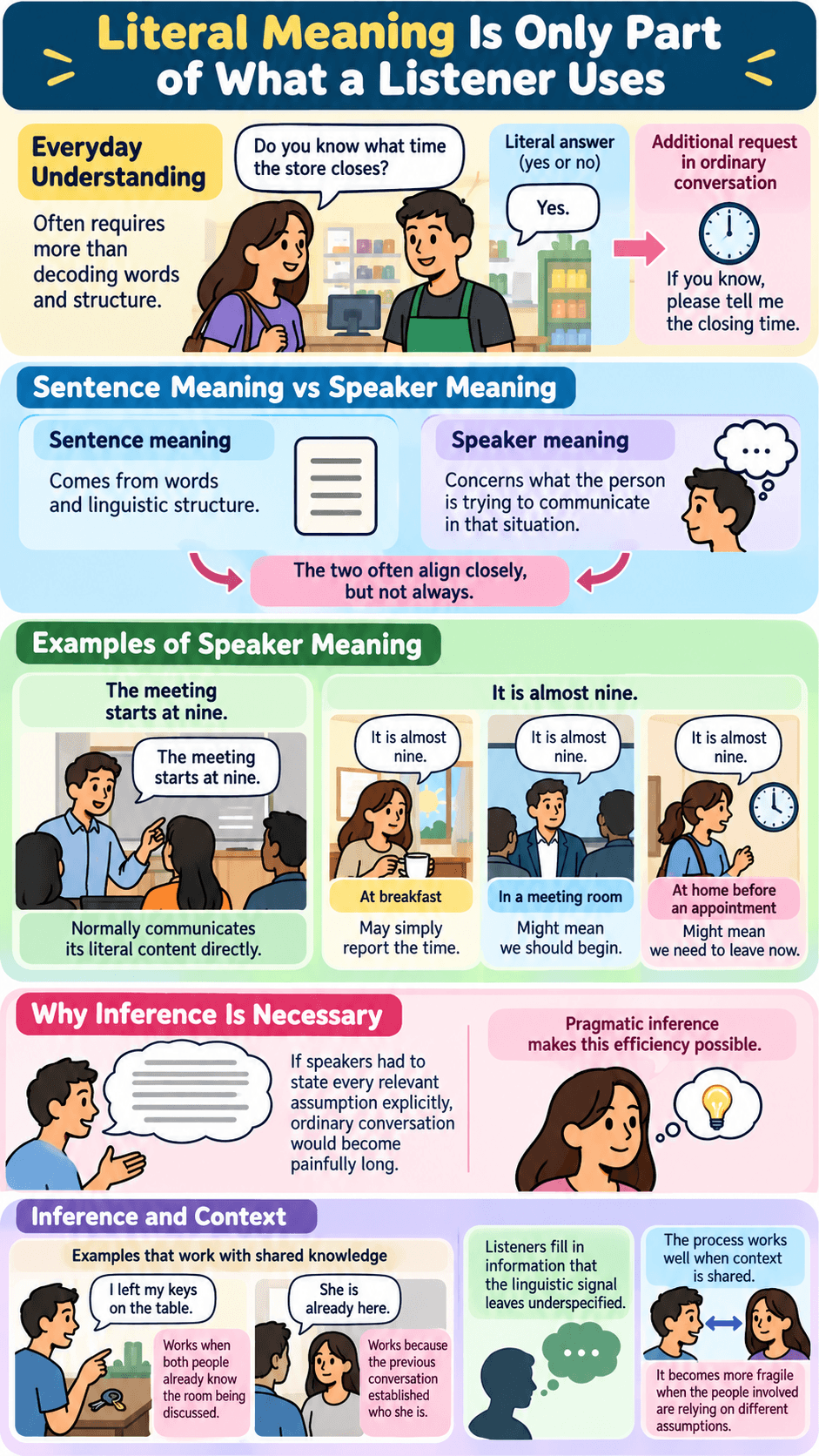
A sentence provides linguistic information, but everyday understanding often requires more than decoding words and structure. Imagine someone asking, “Do you know what time the store closes?” A literal yes-or-no answer could be “Yes.” In ordinary conversation, however, the question usually carries an additional request: if you know, please tell me the closing time.
This distinction between what a sentence conventionally means and what a speaker is using it to communicate is central to pragmatics. Research on sentence meaning and speaker meaning illustrates how an utterance can explicitly ask one thing while pragmatically requesting something more.
Sentence meaning versus speaker meaning
Sentence meaning comes from the words and linguistic structure. Speaker meaning concerns what the person is trying to communicate by choosing that sentence in that situation. The two often align closely, but not always.
“The meeting starts at nine” normally communicates its literal content directly. “It is almost nine” could do much more depending on the setting. At breakfast it may simply report the time. In a meeting room it might mean “we should begin.” At home before an appointment it might mean “we need to leave now.” The pragmatic interpretation depends on what the people involved are doing and what they already know.
Why inference is necessary in ordinary language
If speakers had to state every relevant assumption explicitly, ordinary conversation would become painfully long. A friend can say, “I left my keys on the table,” without specifying which table if both people already know the room being discussed. A coworker can say, “She is already here,” because the previous conversation established who she is.
Pragmatic inference makes this efficiency possible. Listeners fill in information that the linguistic signal leaves underspecified. The process works well when context is shared. It becomes more fragile when the people involved are relying on different assumptions.
A Simple Pragmatic-Inference Model
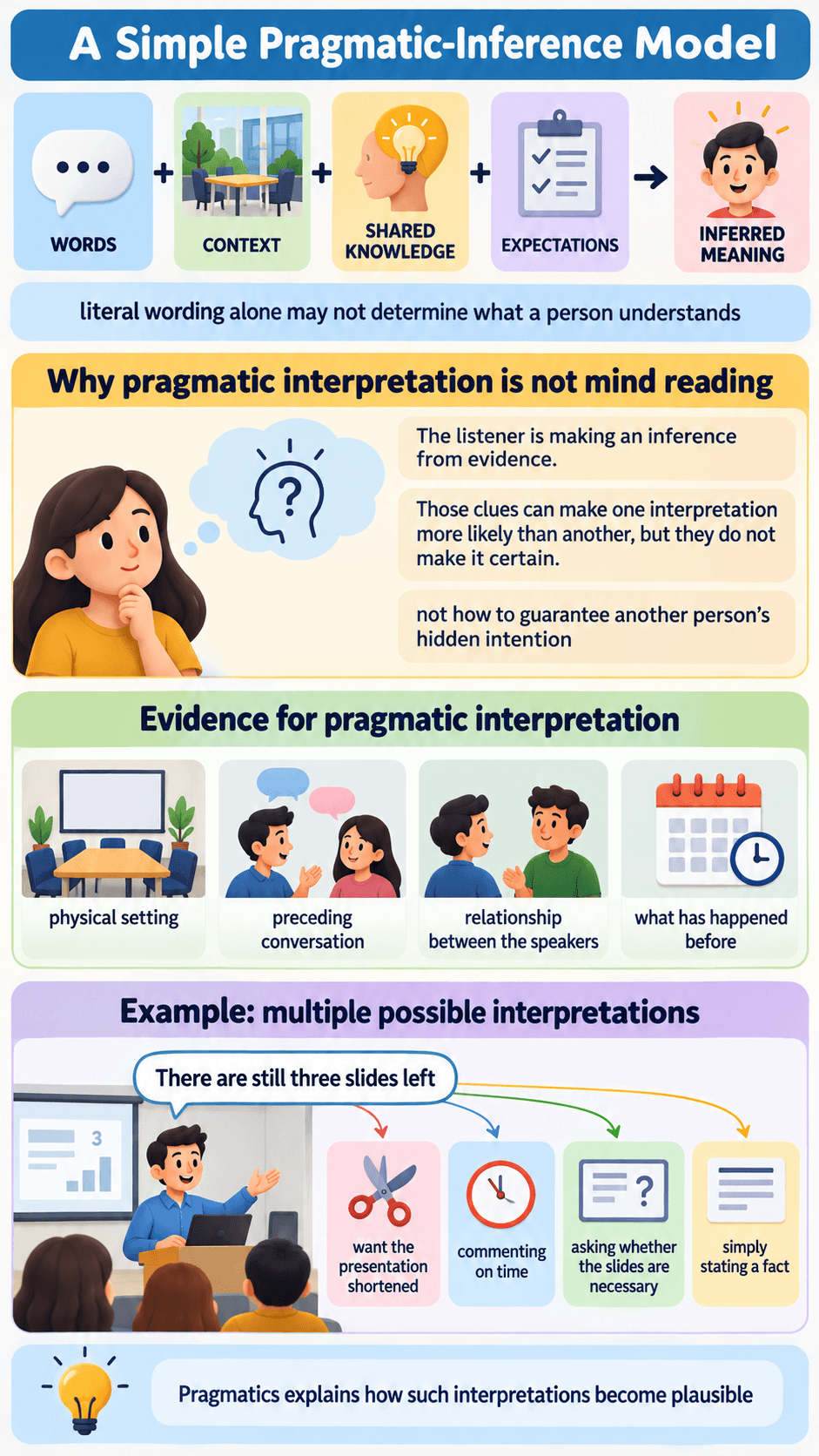
A reader-friendly way to represent the process is:
WORDS + CONTEXT + SHARED KNOWLEDGE + EXPECTATIONS → INFERRED MEANING
This model is intentionally simple. It does not imply that these sources of information are always processed in a fixed order. Instead, it highlights why literal wording alone may not determine what a person understands.
Why pragmatic interpretation is not mind reading
The listener is making an inference from evidence. They may know the physical setting, the preceding conversation, the relationship between the speakers, and what has happened before. Those clues can make one interpretation more likely than another, but they do not make it certain.
If a colleague says, “There are still three slides left,” you might infer that they want the presentation shortened. That interpretation could be correct. They might instead be commenting on time, asking whether the slides are necessary, or simply stating a fact. Pragmatics explains how such interpretations become plausible, not how to guarantee another person’s hidden intention.
Context and Common Ground
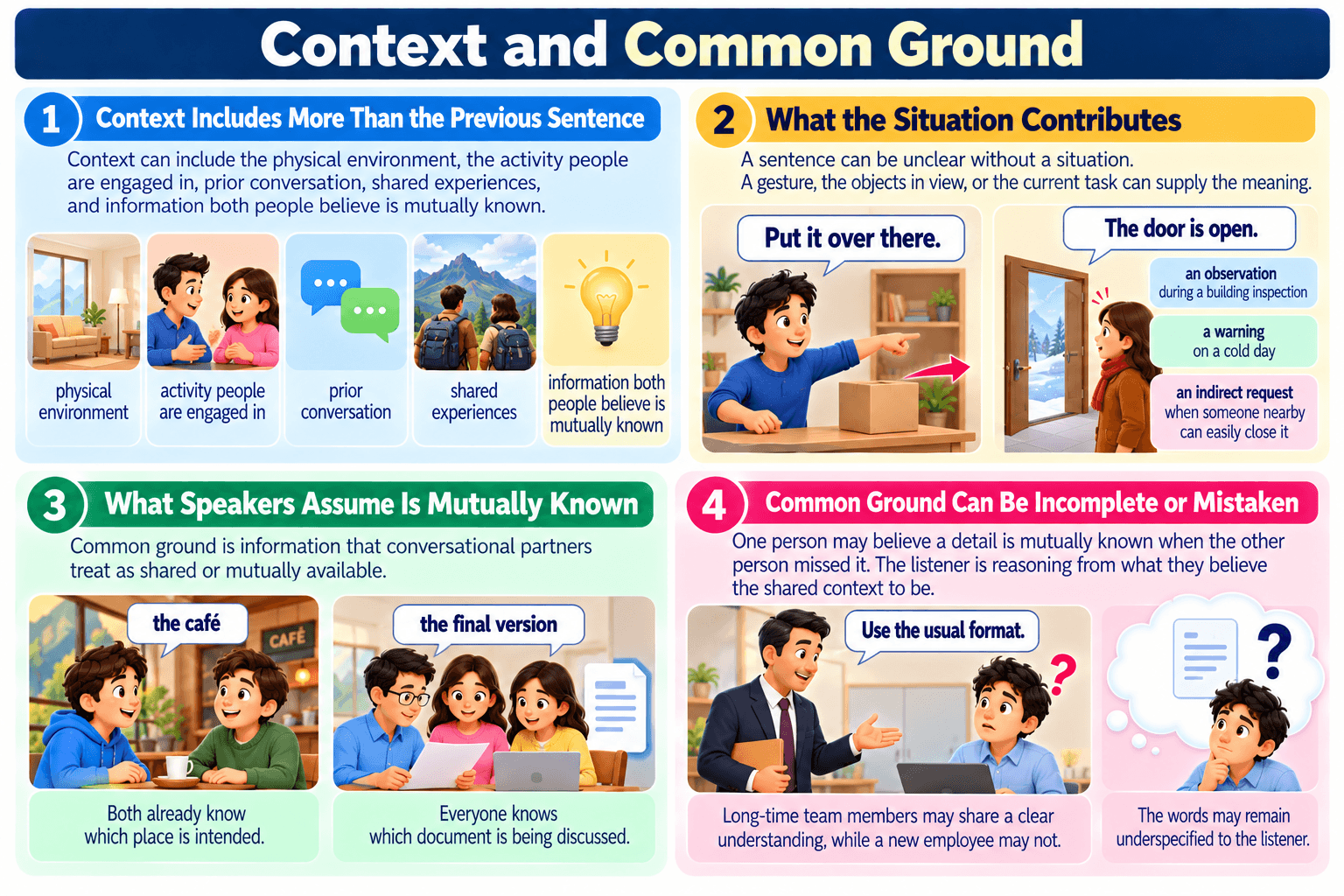
Context includes more than the sentence immediately before the current one. It can include the physical environment, the activity people are engaged in, prior conversation, shared experiences, and information both people believe is mutually known.
What the situation contributes
Imagine hearing “Put it over there.” The sentence contains almost no useful information without a situation. The listener needs to know what it refers to and where there points. A gesture, the objects in view, or the current task can supply that information.
Situational context also changes likely intentions. “The door is open” may be an observation during a building inspection, a warning on a cold day, or an indirect request when someone nearby can easily close it.
What speakers assume is mutually known
Common ground refers broadly to information that conversational partners treat as shared or mutually available. A systematic review of common ground in dialogue research shows that researchers study it through several kinds of linguistic behavior, including how people introduce, reuse, and refine references.
Common ground lets speakers be economical. Two friends can say “the café” if both already know which place is intended. A project team can say “the final version” if everyone knows which document is under discussion. The words are interpretable because the shared background narrows the possibilities.
Why common ground can be incomplete or mistaken
Shared knowledge is never perfect. One person may believe that a detail is mutually known when the other person missed it. Two people may remember the same event differently. One may assume that an inside joke is familiar when it is not.
This explains why pragmatic interpretation can fail without either person being irrational. The listener is often reasoning from what they believe the shared context to be. If that model is inaccurate, an otherwise sensible inference may point in the wrong direction.
For example, imagine a manager saying, “Use the usual format,” to a new employee. Long-time team members may share a clear understanding of what that means, while the new employee has no access to the same history. The phrase is not linguistically complex, but its success depends on background knowledge that is unevenly distributed. What looks like a simple instruction to one person may remain underspecified to another.
This is also why clarification can sometimes be necessary even when every word is familiar. The problem may not be vocabulary or grammar. It may be that the speaker assumed more common ground than the listener actually had.
Reference and Deixis in Everyday Language
Some expressions cannot be interpreted fully without knowing who is speaking, when they are speaking, or what part of the environment they are referring to. Linguists often call expressions such as here, there, this, that, now, and you deictic expressions.
How here, there, this, that, now, and you depend on context
The word here changes reference depending on where the speaker is. Now changes with the time of speaking. You changes with the addressee. “Put this there” may be perfectly understandable while two people are assembling furniture, even though the sentence is nearly meaningless outside that shared scene.
These expressions show that context is not an optional extra added after language has been understood. In some cases, context is required simply to determine what the words refer to.
How listeners resolve who or what a speaker is referring to
Reference resolution often uses prior mention, visual context, familiarity, and knowledge about the speaker. Research on speaker-specific information in reference interpretation describes how shared history and speaker identity can help listeners narrow down intended referents.
If one friend says, “Mark finally called,” the name may identify one person immediately because both friends share the same conversational history. With a stranger, the same name would not be enough. The linguistic form is identical, but shared knowledge changes how easily the reference can be resolved.
Implicature: Meaning Suggested Rather Than Literally Stated
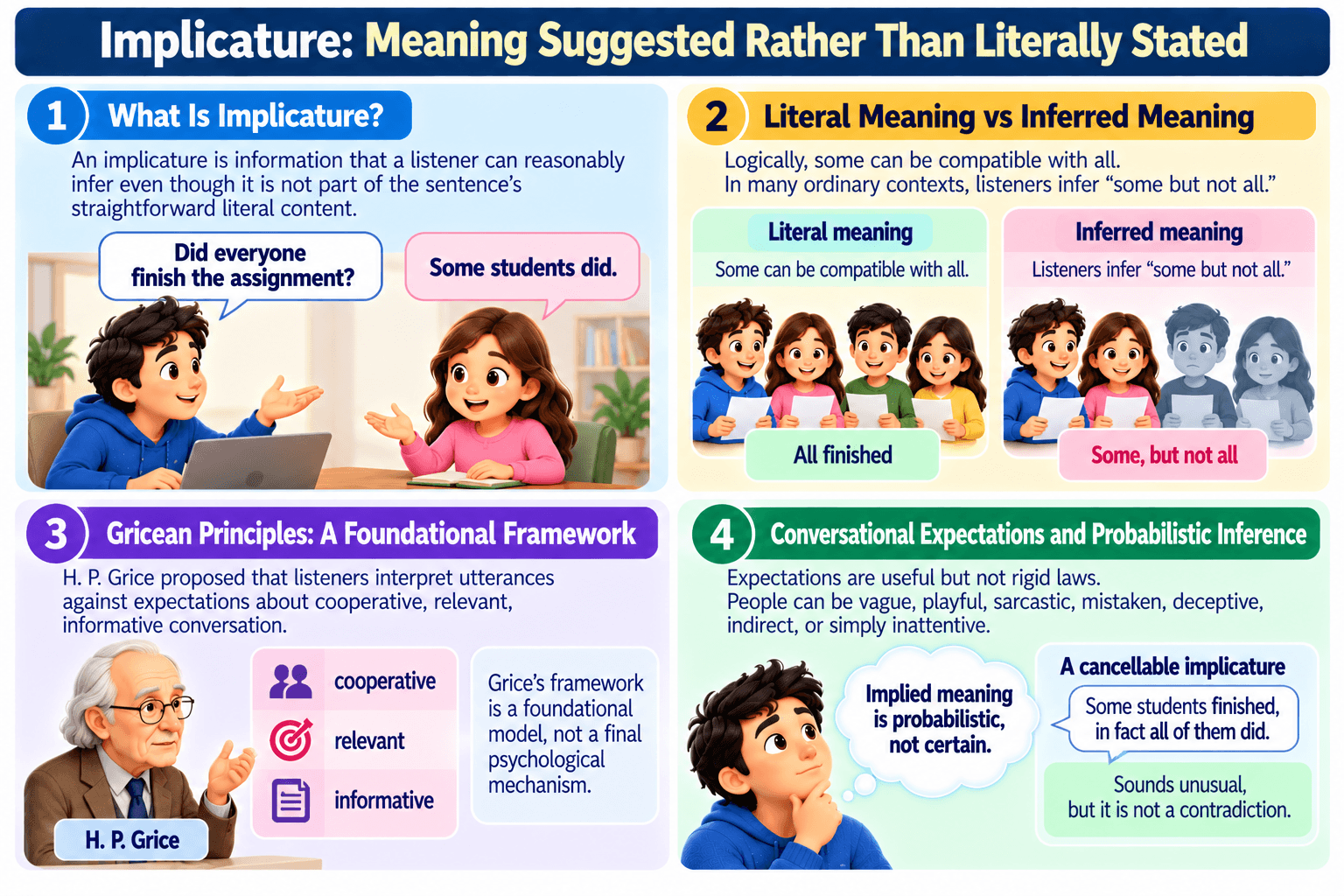
One of the best-known topics in pragmatics is implicature. An implicature is information that a listener can reasonably infer even though it is not part of the sentence’s straightforward literal content.
The logic of inference in ordinary conversation
Suppose someone asks, “Did everyone finish the assignment?” and the reply is, “Some students did.” Logically, some can be compatible with all. In many ordinary contexts, however, listeners infer “some but not all.” Why? Because if the speaker knew that everyone finished and wanted to be maximally informative, saying all would usually have been the more useful choice.
Experimental work on scalar implicature processing shows why researchers distinguish the literal logical content of expressions such as some from pragmatic interpretations that depend on conversational inference.
Gricean principles as historical and theoretical context
Philosopher H. P. Grice provided one of the most influential frameworks for explaining how people communicate more than their sentences literally encode. The basic idea is that listeners interpret utterances against expectations about cooperative, relevant, informative conversation.
Modern pragmatics contains multiple theories and substantial debate about exactly how these inferences are generated. Grice’s framework is therefore best treated as a foundational model, not a final psychological mechanism that explains every case.
Why conversational expectations are useful but not rigid laws
People can be vague, playful, sarcastic, mistaken, deceptive, indirect, or simply inattentive. Cultural norms also differ. The expectation that conversation will be informative or relevant is useful because it guides interpretation, but it is not a guarantee that every speaker follows the same rules in the same way.
This is why pragmatic inference remains probabilistic. An implication can be strong enough to guide understanding without being logically forced by the words themselves.
A useful test is whether the inferred meaning can be cancelled without creating a contradiction. “Some students finished, in fact all of them did” sounds somewhat unusual because the first clause encouraged a narrower inference, but it is not logically self-contradictory. That cancellability helps illustrate the difference between what the words strictly encode and what ordinary conversational expectations lead listeners to infer.
Presupposition: Background Information Treated as Given
Some expressions introduce information as if it is already established rather than presenting it as the main new claim. This backgrounded information is often described as a presupposition.
What is presupposed
Consider: “Maya stopped drinking coffee.” The main assertion is about stopping. The sentence also tends to carry the background assumption that Maya previously drank coffee. Similarly, “Jordan realized the door was unlocked” generally treats the unlocked door as information that holds while making the realization the main event.
Research on the processing of presupposition triggers shows that scholars disagree about how much presuppositional information is encoded linguistically versus integrated pragmatically with context. That debate is a reminder not to present one mechanism as settled fact.
Why listeners may accommodate background assumptions
Sometimes a sentence presupposes information the listener did not previously know. Rather than stopping the conversation, the listener may temporarily add the assumption to their working model of the situation.
If someone says, “I need to pick up my sister from the airport,” a new acquaintance may simply accept that the speaker has a sister, even if that fact was never mentioned before. Pragmatic comprehension often involves this kind of smooth adjustment, provided the assumption is not implausible or contradicted by other information.
Indirect Requests and Everyday Speaker Meaning
Requests are not always phrased as commands. People often use questions or statements whose literal form differs from their social function.
“It is cold in here” as statement versus possible request
Imagine two people sitting beside an open window. One says, “It is cold in here.” Literally, this describes the room. Pragmatically, the listener may infer “Could you close the window?” because the situation provides an obvious action that would address the problem.
The same sentence in a weather station, a refrigerator showroom, or a conversation about insulation might remain only a description. Context determines whether a request interpretation is plausible.
Why the same words can carry different intentions in different contexts
Indirectness allows speakers to communicate while leaving some information unstated. Research on indirect speech has examined why people may prefer indirect forms in situations where social relationships, politeness, or competing interests matter.
For psychology readers, the important point is narrower: linguistic form does not uniquely determine communicative function. A question can operate as a request. A statement can operate as a warning. An observation can operate as an invitation to act. The listener infers that function from the wider situation.
Irony and Other Nonliteral Meaning
Nonliteral language makes the difference between words and intended meaning especially visible. With irony, the literal wording may point in one direction while the situation strongly supports another.
When literal wording conflicts with contextual interpretation
Suppose a picnic begins just as heavy rain starts and someone says, “Perfect weather.” Taken literally, the sentence is positive. In context, the mismatch between the obvious situation and the positive wording can support an ironic interpretation.
Research on irony comprehension highlights the role of context in constraining nonliteral interpretation. There is no need to assume that irony is always processed through exactly the same sequence for every person or situation.
Why prosody can contribute without turning this into Tone of Voice Psychology
How something is said can provide another clue to intended meaning. Stress, timing, or intonation may support an ironic, questioning, or contrastive interpretation. But pragmatics is not simply the psychology of vocal tone.
The existing Tone of Voice Psychology topic focuses on social and emotional information carried through vocal cues. Pragmatics uses prosody only as one possible contextual signal among many, alongside shared knowledge, situation, wording, and conversational expectations.
Pragmatics vs Semantics vs Sentence Processing
These areas overlap during normal comprehension, but they address different levels of the problem.
Word and concept meaning
Semantics concerns conventional meaning and relationships among words and concepts. The word bank can refer to a financial institution or a river edge. Semantic processing helps make those meanings available and supports selection of the one that fits.
Linguistic sentence integration
Sentence processing asks how multiple words are combined using syntax, word order, plausibility, and local context while the sentence unfolds. It explains why a reader can temporarily choose the wrong structure in a garden-path sentence and then revise it.
Context-dependent intended meaning
Pragmatics asks what additional meaning becomes reasonable once the sentence is interpreted within the wider situation. “Can you reach the salt?” can be a question about physical ability, but at the dinner table it is usually understood as a request to pass the salt.
A compact distinction is: semantics provides conventional meaning, sentence processing builds linguistic structure, and pragmatics uses context to infer what the speaker is doing or communicating with that structure.
Pragmatics vs Why Miscommunication Happens
Pragmatic inference can contribute to misunderstanding, but the psychology of miscommunication is broader than pragmatics.
Cognitive-linguistic inference
Pragmatics focuses on the inferential mechanism. Did the listener identify the intended referent? Did they infer the indirect request? Did shared knowledge support the same implication for both people?
The emphasis is on how context-sensitive language interpretation works.
Interpersonal divergence and repair
Miscommunication asks what happens when intended and received meanings diverge between people and how assumptions, emotion, wording, listening, and follow-through can contribute. That broader interpersonal problem is covered separately in Why Miscommunication Happens.
Keeping the topics separate prevents a cognitive explanation of inference from turning into a general conversation-repair guide.
Culture, Familiarity, and Individual Experience
Pragmatic conventions are not identical everywhere. How direct a request should be, what counts as polite, how much background can remain unstated, and when irony is appropriate can differ across communities, relationships, and languages.
Why indirectness and interpretation can vary
A highly indirect request may seem considerate in one context and frustratingly vague in another. An expression that is obvious among close friends may be opaque to a newcomer. Shared history makes some interpretations easier because it reduces uncertainty about references and intentions.
Language proficiency can also matter. Someone may understand the literal words of a second language before becoming equally familiar with all of its indirect conventions, humor, idioms, or culturally specific expectations.
Why variation should not be treated as diagnostic proof
Difficulty interpreting an indirect statement in one situation does not establish a clinical condition. Context may be weak, the speaker may be unusually vague, the listener may be unfamiliar with the convention, or the people may have different cultural expectations.
Pragmatic interpretation varies across people and situations. Clinical assessment involves much more than noticing that someone missed a joke, took a sentence literally, or failed to infer one indirect request.
What to Do Next When Meaning Breaks Down
When an utterance is confusing, the next useful concept depends on where the uncertainty begins.
Move to Sentence Processing when structure is the main issue
If the problem is that the words can be grouped in more than one way, the sentence contains a garden-path structure, or grammar and plausibility are competing, sentence processing is the better framework. The question there is how the linguistic structure itself was built and revised.
Move to Why Miscommunication Happens when message exchange is the main issue
If the literal sentence and likely implication are understandable but two people repeatedly take away different messages, the broader issue is interpersonal communication. Questions about clarification, assumptions, listening, and repair fit better there than in a narrow account of pragmatic inference.
This distinction also prevents every ambiguous interaction from being explained as a failure of pragmatics. Sometimes people understood the language perfectly and still disagreed about expectations, priorities, or what should happen next.
FAQ
These questions clarify the most common boundaries around pragmatic meaning.
What is the difference between literal meaning and speaker meaning?
Literal meaning comes from the words and sentence structure. Speaker meaning is what the person is using those words to communicate in a particular situation. The two may match closely, or the speaker may imply a request, warning, joke, criticism, or other intention that is not explicitly encoded in the sentence.
Is pragmatics the same as context?
No. Context is one major source of information used in pragmatic interpretation. Pragmatics concerns the inferential process by which listeners combine language with context, common ground, reference, and conversational expectations to reach a plausible interpretation of what is meant.
What is implicature in simple terms?
Implicature is meaning that is suggested rather than literally stated. If someone answers “Some people came” when asked whether everyone attended, a listener may infer “not everyone,” even though the word some does not logically exclude all. The inference depends on expectations about why the speaker chose that wording.
Why can an indirect request be understood without being stated directly?
The listener combines the sentence with the situation and the likely purpose of speaking. “It is dark in here” may become a request to turn on a light when the listener is standing beside the switch. The interpretation is supported by the context, but it is still an inference rather than a literal part of the sentence.
Does difficulty with indirect language prove a clinical condition?
No. A missed implication can result from unfamiliarity, weak context, cultural differences, second-language experience, ambiguity, divided attention, or an unusually indirect speaker. A single communication event cannot establish a diagnosis, and general educational content cannot determine why a particular person interpreted an utterance in a certain way.
Key Takeaways
- Pragmatic meaning depends on more than literal words and grammar; context and shared knowledge help listeners infer what a speaker intends.
- Common ground makes communication efficient, but mistaken assumptions about what is shared can also produce reasonable misunderstandings.
- Reference, deixis, implicature, presupposition, indirect requests, and irony all show ways in which context contributes to meaning.
- Pragmatic inference is probabilistic, not mind reading, and conversational expectations are useful guides rather than rigid laws.
- Pragmatics differs from semantics, sentence processing, tone-of-voice interpretation, and the broader psychology of interpersonal miscommunication.
- Variation in indirect-language interpretation should not be treated as diagnostic evidence by itself.

Michael Reed is the Founder and Lead Writer at Psychology Exposed. He writes about human behavior, relationships, emotional patterns, self-awareness, and practical psychology topics using research-informed, easy-to-understand content.
Read More About Michael Reed: https://psychologyexposed.com/michael-reed/