
You say, “That is fine,” and the other person hears disappointment. A coworker says, “Can we talk?” and the sentence feels urgent even though the words are neutral. Someone tells you they are not upset, but their voice sounds clipped and tense. In spoken communication, people do not respond only to vocabulary. They also respond to how the words arrive.
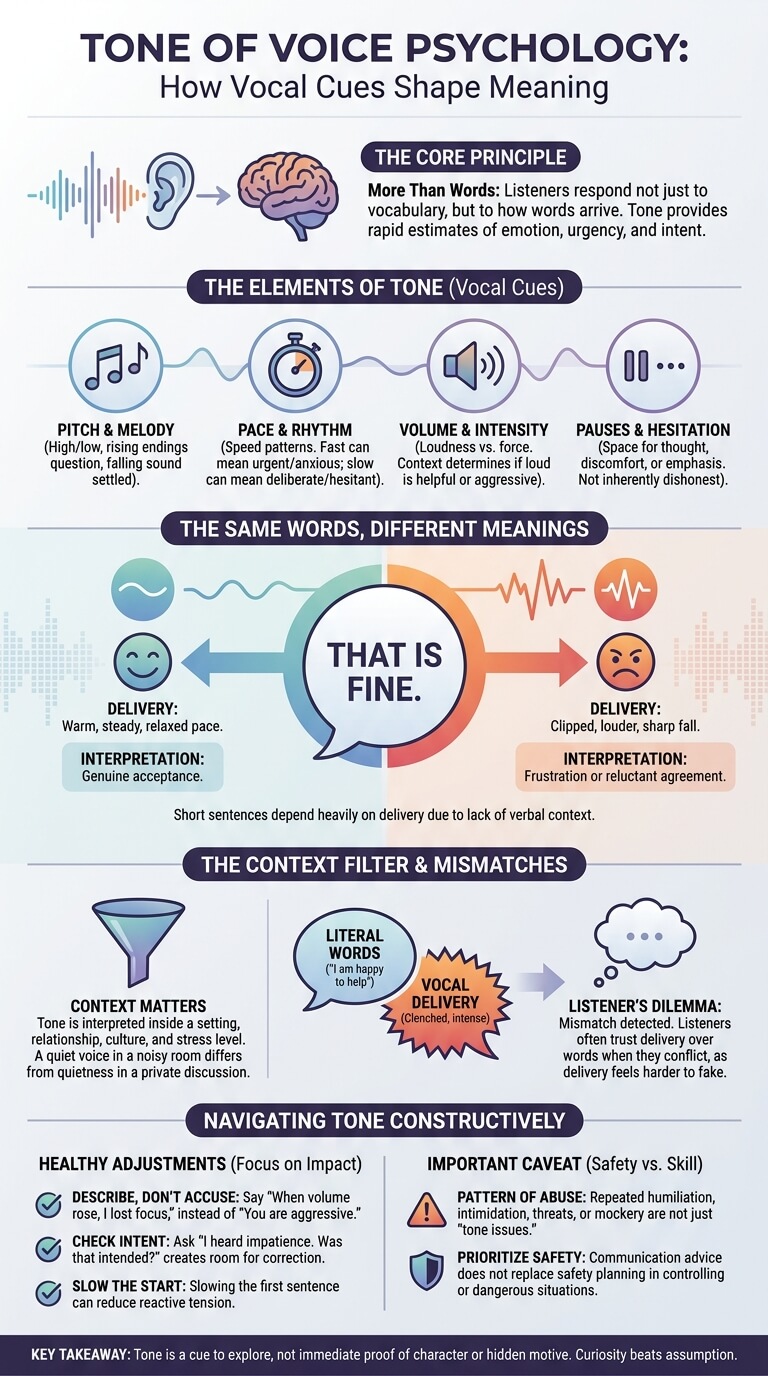
Tone of voice includes changes in pitch, pace, volume, rhythm, pauses, and emphasis. These vocal cues can make a message sound warm, uncertain, irritated, playful, dismissive, serious, or afraid. They help listeners estimate what a speaker may be feeling and how the message relates to them.
That estimate is useful, but it is not proof. A naturally quiet voice may be mistaken for coldness. A fast speaker may sound anxious when they are simply enthusiastic. Stress, culture, language, hearing, fatigue, and individual speaking habits all shape vocal delivery. Understanding tone means noticing its effect while staying curious about its meaning.
Quick Answer
Tone carries emotional and relational information beyond the literal words
Tone of voice psychology examines how vocal delivery changes the way spoken language is interpreted. Pitch, pace, volume, pauses, rhythm, and emphasis provide clues about emotion, urgency, confidence, and social intention. These clues can strongly shape meaning, especially when the words are brief or ambiguous, but no single vocal cue can reliably prove what someone thinks, feels, or intends.
What Tone of Voice Includes

Researchers often use the term prosody for the melodic and rhythmic features of speech. A review of affective and linguistic prosody distinguishes emotional expression from the pitch and stress patterns that organize language. In ordinary conversation, both functions operate together.
Tone is one part of how communication psychology works, alongside words, context, attention, expectations, and feedback.
Pitch and pitch movement
Pitch is how high or low a voice sounds, while pitch movement is the way it rises and falls across a sentence. A rising ending may suggest a question, uncertainty, invitation, or a habitual speech pattern. A low, falling ending may sound settled, serious, tired, or final. Meaning depends on the speaker’s baseline and the situation.
Pace and rhythm
Pace is the speed of speech. Rhythm is the pattern created by speeding up, slowing down, and grouping words. Fast speech may communicate excitement, urgency, nervousness, or impatience. Slow speech may communicate care, authority, exhaustion, hesitation, or deliberate control. Sudden changes from a person’s usual pace often attract more attention than speed alone.
Volume and intensity
Volume refers to loudness, while intensity includes the force behind the voice. A louder message can be easier to hear, but it may also feel forceful or threatening when it exceeds what the setting requires. A very quiet voice can feel gentle, private, withdrawn, or difficult to engage with. The relationship between volume and context matters more than a universal rule.
Pauses and hesitation
Pauses can create space for thought, signal discomfort, add emphasis, or show that a person is choosing words carefully. Hesitation sounds such as “um” and “uh” may reflect planning, uncertainty, distraction, or ordinary speech production. A pause before an answer does not automatically reveal dishonesty. It may simply show that the answer requires care.
Emphasis, stress, and sentence melody
Emphasis highlights one word or phrase, changing the implied message. “I did not say you caused it” differs from “I did not say you caused it.” Sentence melody combines pitch, rhythm, stress, and timing. It can signal whether a statement is sincere, teasing, doubtful, corrective, or emotionally loaded, even before the listener fully processes every word.
Why the Brain Uses Tone to Interpret Meaning
Spoken language unfolds in real time. Listeners cannot pause every sentence to analyze each possible interpretation, so the mind uses vocal information to make rapid estimates about what is happening.
Tone helps estimate emotion, urgency, confidence, and social intention
A voice may help a listener notice that a neutral sentence is actually urgent, that a joke is playful rather than literal, or that reassurance is being offered gently. Research reviewing emotion perception from the voice and other channels shows that vocal information has its own processing features rather than merely copying what facial expressions communicate.
Context changes what the same vocal pattern means
A raised voice at a crowded event may be practical. The same volume in a quiet kitchen may feel aggressive. A quick “okay” during a fast work handoff may mean simple acknowledgment, while the same word after a painful disclosure may feel dismissive. Tone is interpreted inside a setting, relationship, topic, and sequence of events.
Prior experience influences which tones feel safe or threatening
People learn from repeated interactions. If sharp voices previously preceded criticism, a small rise in intensity may trigger caution. If teasing was common and affectionate in a family, playful sarcasm may feel connecting rather than hostile. Past experience helps people detect patterns, but it can also make a familiar tone seem dangerous before the current meaning is clear.
The Same Words, Different Meanings
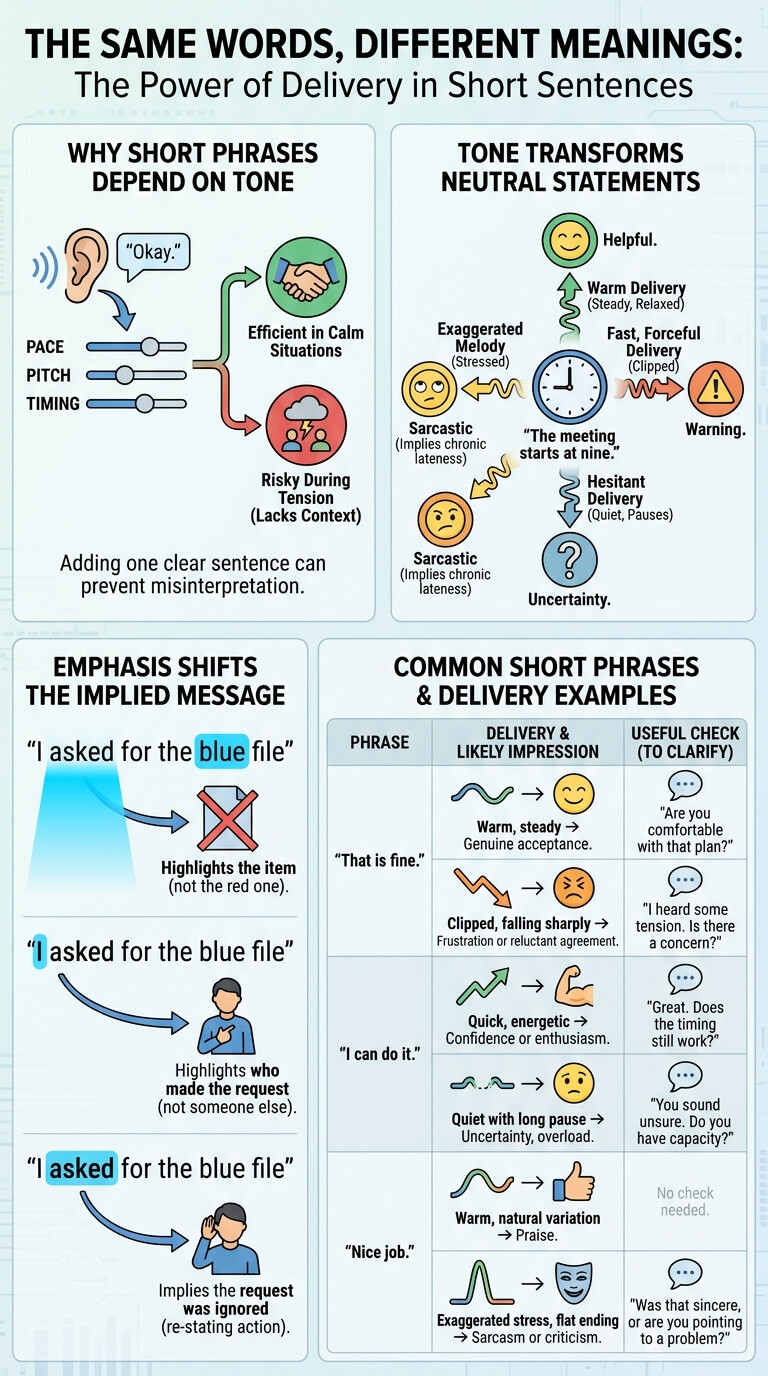
Short sentences are especially dependent on delivery because they contain little verbal context. The table below shows how the same wording can produce different impressions without changing a single word.
| Words | Possible delivery | Likely impression | Useful check |
|---|---|---|---|
| “That is fine.” | Warm, steady, relaxed | Genuine acceptance | “Are you comfortable with that plan?” |
| “That is fine.” | Clipped, louder, falling sharply | Frustration or reluctant agreement | “I heard some tension. Is there a concern we should address?” |
| “I can do it.” | Quick and energetic | Confidence or enthusiasm | “Great. Does the timing still work?” |
| “I can do it.” | Quiet with a long pause | Uncertainty, overload, or reluctance | “You sound unsure. Do you have the capacity?” |
| “Nice job.” | Warm with natural variation | Praise | No check may be needed |
| “Nice job.” | Exaggerated stress and flat ending | Sarcasm or criticism | “Was that sincere, or are you pointing to a problem?” |
Neutral information delivered with warmth, impatience, uncertainty, or sarcasm
Consider the sentence, “The meeting starts at nine.” Warm delivery can sound helpful. A fast, forceful delivery can sound like a warning. A hesitant delivery can suggest uncertainty about the schedule. An exaggerated melody can make the statement sound sarcastic, perhaps implying that someone is often late. The words provide information, while the voice frames the relationship to that information.
How emphasis shifts the implied message
Emphasis changes what appears to be corrected. “I asked for the blue file” highlights the item. “I asked for the blue file” highlights who made the request. “I asked for the blue file” may imply that the request was ignored. Listeners often respond to the highlighted contrast, not only to the sentence as a whole.
Why short phrases are especially dependent on tone
Words such as “sure,” “really,” “whatever,” and “okay” can carry many meanings. Without surrounding detail, the listener relies heavily on pace, pitch, timing, and prior context. This is why brief replies are efficient in calm situations but risky during tension. Adding one clear sentence can prevent the voice from carrying more meaning than intended.
When Words and Tone Do Not Match
A mismatch occurs when the literal message points one way and the vocal delivery points another. “I am happy to help” may be spoken through clenched intensity. “Nothing is wrong” may arrive with a long pause and reduced warmth. The listener now has two streams of information to reconcile.
Because vocal cues are interpreted rather than read directly, they are a common reason miscommunication happens.
Why listeners often trust delivery over literal reassurance
Vocal delivery may feel harder to control than carefully chosen words, so listeners often treat it as more revealing. A large review of the acoustic features of emotional prosody also cautions that the mapping between sound and emotional state is not simple. A mismatch deserves attention, but not certainty.
Genuine mixed emotion versus strategic ambiguity
People can mean their words and still sound conflicted. Someone may agree to help while feeling tired. A parent may be proud and worried at the same time. A manager may support an idea while anticipating risk. Mixed tone is not automatically manipulative. Strategic ambiguity becomes more concerning when a person repeatedly denies an obvious impact while using delivery to intimidate, mock, or avoid accountability.
How to check the mismatch without accusing the speaker of hidden intent
Describe what you noticed and ask for clarification: “You said the plan works, but your voice sounded hesitant. Is there a concern you have not mentioned?” This leaves room for correction. Avoid claims such as, “Your real feelings came out,” because the speaker may have been tired, distracted, or reacting to something unrelated.
Tone Is a Cue, Not Proof

Tone is useful when treated as information to explore. It becomes misleading when treated as a lie detector, personality test, or diagnostic tool.
Individual baseline voices differ
Some people naturally speak loudly, quickly, softly, or with limited pitch variation. Others become animated when interested or quieter when concentrating. The most informative comparison is often with the person’s usual voice in similar settings. Even then, a change indicates that something shifted, not exactly what caused it.
Culture, language, neurodiversity, hearing, fatigue, and stress affect vocal expression
Communication norms differ across communities and languages. Direct volume may signal engagement in one setting and disrespect in another. Hearing differences can also change access to pitch cues. Research on prosodic and word-based emotion cues in people with cochlear implants illustrates why listeners do not all receive the same vocal information.
Neurodivergent people may use or interpret prosody differently, but a voice alone cannot identify neurodivergence. Fatigue, illness, medication effects, pain, stress, and second-language speaking can also reduce variation or alter pace. Curiosity is more accurate than labeling.
One cue cannot establish contempt, deception, attraction, or aggression
A low voice does not prove confidence. A higher pitch does not prove anxiety. A flat voice does not prove boredom. Sarcastic melody does not always mean contempt, and hesitation does not prove deception. Strong conclusions require repeated behavior, context, words, impact, and opportunities for clarification.
Tone of Voice vs Body Language

Vocal cues travel through sound
Tone reaches the listener through pitch, volume, rhythm, pace, pauses, and voice quality. It can be heard on a phone call or voice note when the speaker’s face and posture are invisible. That makes it a distinct part of nonverbal communication.
Tone should not be confused with broader communication styles, which describe recurring patterns of directness, respect, and ownership.
Facial expression, gesture, posture, and distance are visual or spatial cues
Body language includes facial movement, gaze, hand gestures, posture, orientation, and physical distance. These cues can support or contradict vocal delivery, but they are not interchangeable. A calm voice with a tense posture provides a different combination than a calm voice with relaxed movement.
Spoken interaction combines words, voice, body, and context
In person, listeners integrate several channels at once. Trouble begins when one channel is treated as the whole message. A raised eyebrow may be playful when paired with a warm voice and shared joke. The same expression with a cold, prolonged silence may land differently. Interpretation improves when the full situation is considered.
Why Tone Becomes Sharper Under Stress
Stress changes breathing, muscle tension, attention, and impulse control. Those changes may reach the voice before a speaker notices them.
A sharper voice can also trigger defensive communication before the content has been evaluated.
Faster pace and higher intensity during threat or overload
When a person feels rushed, cornered, or overwhelmed, speech may speed up and become louder or more forceful. They may interrupt because they fear losing the chance to explain. This can make the listener feel attacked, which increases their own intensity. The conversation then escalates through delivery even when the original issue was small.
Flatness or reduced variation during fatigue or shutdown
Stress does not always make a voice louder. Exhaustion or overload may produce slower speech, reduced pitch movement, shorter answers, or silence. A listener may hear indifference, while the speaker is conserving effort or trying not to say something impulsive. Asking about capacity can be more useful than demanding a warmer performance.
Why impact still matters even when harshness was unintentional
Intent explains behavior, but it does not erase effect. “I was stressed” may be true and still leave another person feeling spoken down to. A balanced response holds both facts: “I do not think you meant to intimidate me, but the volume made it hard to stay in the conversation. Can we lower it and continue?”
Tone in Text Messages and Voice Notes
Punctuation, brevity, timing, and formatting as imperfect tone substitutes
Text has no audible pitch or volume, so readers infer attitude from punctuation, capitalization, message length, response timing, and history. “Okay.” may look final to one person and completely neutral to another. These signals are culturally and personally variable. When the interpretation matters, ask rather than building a case from punctuation alone.
Voice notes restore vocal information but still lack full context
A voice note adds pace, emphasis, emotion, and pauses, yet the listener cannot see facial expression or immediately ask a question. The speaker may also record while walking, driving, tired, or distracted. Voice notes are richer than text but not complete access to intention.
When to switch channels after repeated misreading
Move from text to voice or an in-person conversation when messages keep becoming shorter, assumptions multiply, or several clarifications fail. Say, “I think we are hearing different tones in these messages. Can we talk for ten minutes?” Choose a channel that provides enough information without forcing immediate engagement when someone needs a reasonable pause.
A Tone Check Without Tone Policing

Tone feedback can clarify impact, but it can also be used to dismiss content. Tone policing happens when attention to delivery becomes a reason to ignore the concern itself, especially when the speaker is upset for a legitimate reason.
Describe the impact rather than declaring the speaker’s character
“When your volume rose, I had trouble focusing on the issue” is more useful than “You are aggressive.” The first statement names observable delivery and effect. The second assigns an identity that invites debate. Specific language makes it easier to adjust the exchange without turning one difficult moment into a character judgment.
Ask what the person intended the delivery to communicate
Try: “I heard that as impatient. Was that what you meant?” The speaker may confirm frustration, explain that they were rushing, or recognize an impact they missed. The question does not require you to ignore how the voice affected you.
Clarify the message before debating the tone
If possible, reflect the content first: “You need the report before noon, and the delay created extra work. I understand that. I also want to discuss how we speak to each other when something goes wrong.” This prevents tone from replacing the original problem while still making delivery part of the conversation.
Keep room for boundaries when delivery is repeatedly demeaning
You do not have to remain in a conversation filled with yelling, ridicule, insults, or threats. A boundary can be direct: “I will discuss the problem, but I will not continue while I am being mocked. We can try again when the conversation is respectful.” A boundary describes what you will do, not how the other person must feel.
How to Adjust Tone Without Becoming Artificial
The aim is not to manufacture a perfect voice. It is to make delivery support the message, especially when stakes are high.
Managing vocal tension is especially relevant in difficult conversations, where emotional load changes both delivery and interpretation.
Slow the first sentence
The opening often sets the pace for everything that follows. Take one breath and deliver the first sentence more slowly than your stressed impulse suggests. “I want to discuss what happened in the meeting” creates more room than launching into several complaints before the listener can orient.
Match volume to the setting
Use enough volume to be heard without overpowering the room. If you notice yourself getting louder, lower your volume before adding more explanation. When someone cannot hear you because of distance or noise, move closer or change locations rather than relying only on force.
Use pauses before high-stakes words
Pause before accusations, boundaries, decisions, or sensitive requests. This reduces blur and gives you a chance to choose precise wording. Compare a rushed “You never include me” with “I want to explain one part that affected me. I was not included in the decision.”
State intention when the topic is sensitive
When your natural delivery is easily misread, name the purpose: “I may sound tense because I am nervous, not because I want to blame you.” This is not a demand that the listener ignore your impact. It provides context that can make the message easier to interpret.
Ask how the message landed
After an important statement, ask, “How did that sound to you?” or “Did my delivery make the request unclear?” Feedback helps you compare intention with reception. Use the answer as information, not as a verdict that your entire way of speaking is wrong.
How Tone Interacts With Misunderstanding and Defensiveness
Tone as one pathway to altered meaning
Miscommunication has many causes, including assumptions, missing context, unclear requests, memory, and emotion. Tone is one pathway among them. A sentence may be factually clear but relationally confusing because the delivery suggests urgency, disappointment, or mockery that the words do not explain.
Tone feedback as a trigger for defensiveness
Being told “watch your tone” can feel like rejection of the entire message. The speaker may defend intention, while the listener defends impact. A more workable sequence is: identify the content, describe the vocal feature, explain the effect, and ask for a specific adjustment. “I hear the deadline concern. The raised volume is making me shut down. Can we continue more quietly?”
Timing and vocal regulation in high-stakes conversations
When people are already activated, even a neutral voice may be heard through a threat-focused filter. A pause can help if it includes a return plan: “I want to continue, but my voice is getting sharp. I need twenty minutes, and I will come back at seven.” The purpose is not avoidance. It is to restore enough control for the words and delivery to match.
When Tone Is Part of an Unsafe Pattern
Repeated humiliation, intimidation, threats, or retaliation
A single tense exchange does not establish abuse. Concern rises when a person repeatedly uses yelling, mockery, threatening quietness, insults, or sudden intensity to frighten, control, isolate, or punish someone. The National Domestic Violence Hotline describes emotional abuse as behavior that may include threats, humiliation, intimidation, and dismissiveness used within a pattern of control.
Why communication advice should not replace safety planning
If mentioning tone may lead to threats, stalking, violence, financial punishment, forced isolation, or retaliation, prioritize safety rather than trying to deliver better feedback. Speak with a trusted person or qualified local service in a way that does not increase risk. Communication skills are not a substitute for specialized support in a controlling or dangerous situation.
Educational note: Vocal behavior alone cannot diagnose a mental health condition, personality, or abusive dynamic. Look at repeated conduct, context, power, fear, and consequences, and seek qualified support when the situation is distressing or unsafe.
FAQ About Tone of Voice Psychology
Can tone change the meaning of a true statement?
Yes. The factual content may remain true while the relational message changes. “The deadline is Friday” can sound helpful, urgent, impatient, or mocking. Tone does not alter the calendar, but it can alter what the listener believes the speaker expects or feels.
Why does a neutral tone sound angry to some people?
Neutral is not universal. A listener compares the voice with personal expectations, cultural norms, prior experiences, and the speaker’s usual delivery. Stress can also increase sensitivity to threat. Check the meaning directly rather than assuming either person is objectively wrong.
Is a monotone voice a sign of disinterest?
Not by itself. Limited pitch variation may be a natural speaking style or may reflect concentration, fatigue, language background, hearing, stress, or neurodivergence. Look for the person’s words, responsiveness, follow-through, and baseline behavior before interpreting interest.
How can someone mention tone without derailing the conversation?
Acknowledge the content first, then describe one observable feature and its effect. For example: “I understand that the delay caused a problem. When the volume rises, I struggle to respond clearly. Can we keep discussing it more quietly?”
Does text have a tone of voice?
Text does not contain audible voice, but readers infer tone from wording, punctuation, formatting, timing, and context. These substitutes are easy to misread, so emotionally important or repeatedly confusing exchanges may benefit from a richer channel.
Key Takeaways
- Tone of voice includes pitch, pace, volume, rhythm, pauses, emphasis, and sentence melody.
- Vocal cues help listeners estimate emotion and intention, but they do not prove hidden motives or personality traits.
- The same words can sound warm, reluctant, sarcastic, urgent, or uncertain depending on delivery and context.
- When words and tone conflict, describe the mismatch and ask a question instead of claiming to know the speaker’s real feelings.
- Tone feedback is most useful when it names observable delivery, acknowledges the content, and requests a specific change.
- Repeated vocal intimidation, humiliation, threats, or retaliation call for safety-focused support rather than better conversational technique alone.
A useful next step is to notice one vocal feature in your next important conversation without assigning it a final meaning. Name what you heard, check your interpretation, and keep the content in view. Tone becomes easier to work with when it is treated as a clue to clarify, not a verdict about the person speaking.

Michael Reed is the Founder and Lead Writer at Psychology Exposed. He writes about human behavior, relationships, emotional patterns, self-awareness, and practical psychology topics using research-informed, easy-to-understand content.
Read More About Michael Reed: https://psychologyexposed.com/michael-reed/