
Someone tells you about a problem, and your mind immediately starts working. You search for a solution, notice a factual error, remember a similar experience, or prepare your side of the story. By the time they finish, you may have a useful response, yet they may still feel that you never fully received what they were trying to say.
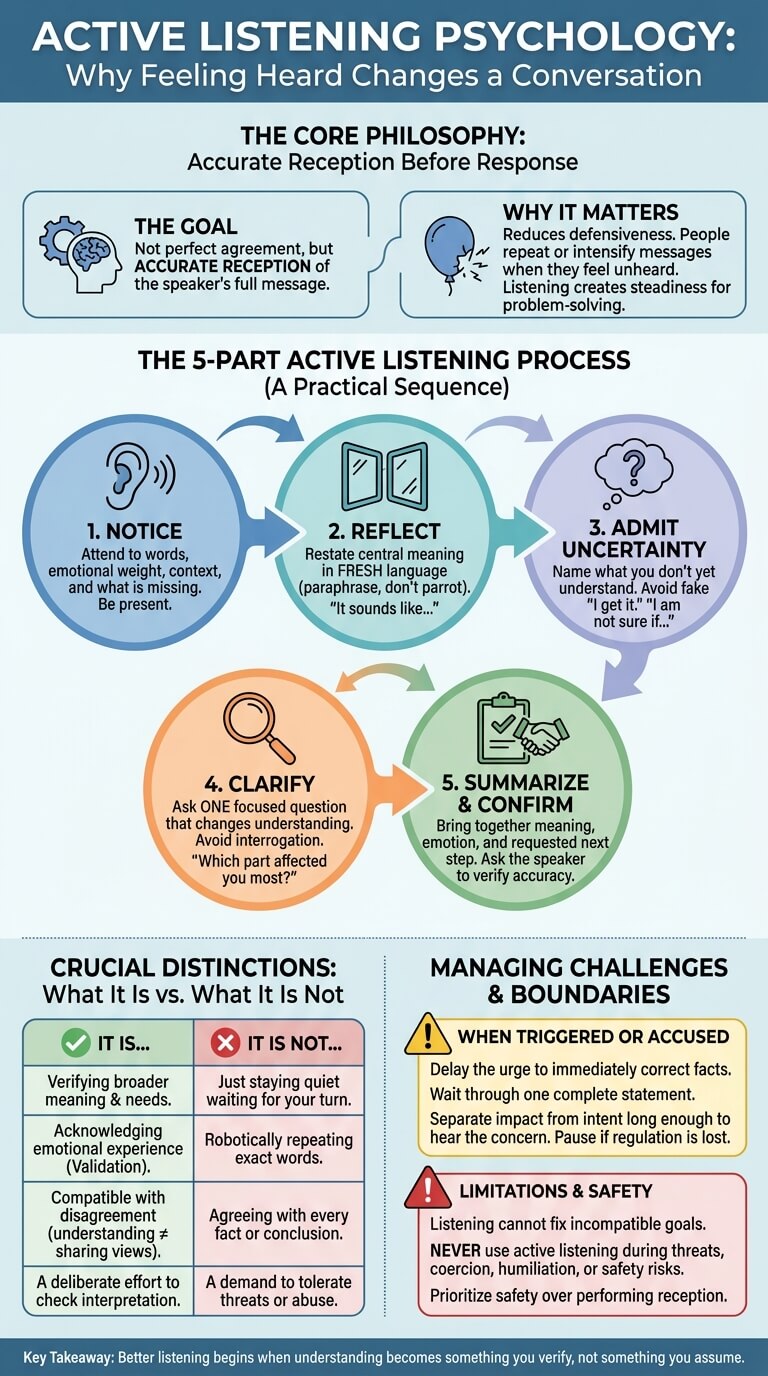
Active listening slows that jump from hearing words to delivering an answer. It is a deliberate effort to notice the message, check your interpretation, reflect the central meaning, and clarify what the speaker needs before you respond from your own perspective. The goal is not perfect agreement. It is accurate reception.
This matters because people often repeat, intensify, or defend a message when they believe its meaning has not landed. A listener who demonstrates understanding can reduce unnecessary confusion and create enough steadiness for disagreement, problem-solving, or repair. Listening cannot resolve every conflict, and it should never be used as a demand that someone remain open during threats, coercion, humiliation, or retaliation.
Quick Answer
Active listening is more than staying quiet while another person speaks.
Active listening is an intentional process of receiving, checking, and reflecting meaning before responding
In active listening psychology, the listener pays attention to words, emotional meaning, context, and the speaker’s practical concern. They paraphrase what they understood, identify uncertainty, ask focused questions, and confirm whether the message was represented accurately. This does not require agreement. It creates a shared starting point before advice, correction, debate, or action.
What Active Listening Really Means
The National Communication Association describes communication as the use of messages to generate meaning across different contexts. Active listening focuses on the receiving side of that process. It asks whether the listener has formed a fair and usable understanding of the message that was sent.
Active listening sits within the broader communication process, where attention, interpretation, emotion, and response work together.
Attention is necessary but not sufficient
Attention makes listening possible, but it does not prove understanding. You can remember every sentence and still assign the wrong meaning. Useful attention tracks the words, emotional weight, practical request, and any context that remains missing, then checks rather than guesses.
The listener checks meaning instead of assuming it
Active listeners treat their first interpretation as a working guess. “It sounds like the deadline matters less than feeling excluded from the decision. Is that right?” gives the speaker a chance to correct the meaning before advice or disagreement begins.
The speaker receives evidence that their message landed
Feeling heard depends partly on observable evidence. A specific reflection shows what the listener believes the message means. Research on how people experience feeling heard highlights perceived openness and responsiveness, not mere exposure to words.
Why Active Listening Reduces Defensiveness
Defensiveness often rises when people believe they are being misrepresented, judged, or pushed toward a conclusion they did not choose. Active listening does not remove every threat, but it reduces avoidable threat created by inaccurate assumptions.
Accurate reflection lowers the need to repeat or intensify
When a message does not seem to land, speakers often add detail, volume, or sharper language. A concise reflection can interrupt that escalation: “The main problem is not that I was late once. It is that I did not update you, so you could not plan.”
Clarification reduces threat created by wrong assumptions
A listener who feels accused may defend intent before understanding the concern. Clarification narrows the issue: “When you say I took over, do you mean I interrupted, changed the plan, or decided without asking?” A broad threat becomes a specific behavior that can be examined.
Emotional recognition increases perceived safety and responsiveness
People often communicate what happened and what it meant emotionally. Research on the effects of empathic paraphrasing during social conflict suggests that reflective responses can influence emotional experience. In daily life, naming the emotional meaning may help a person feel less alone before the problem is solved.
The larger issue is often why people feel unheard, because attention alone does not guarantee understanding, acknowledgment, response, or follow-through.
The Five-Part Active Listening Process
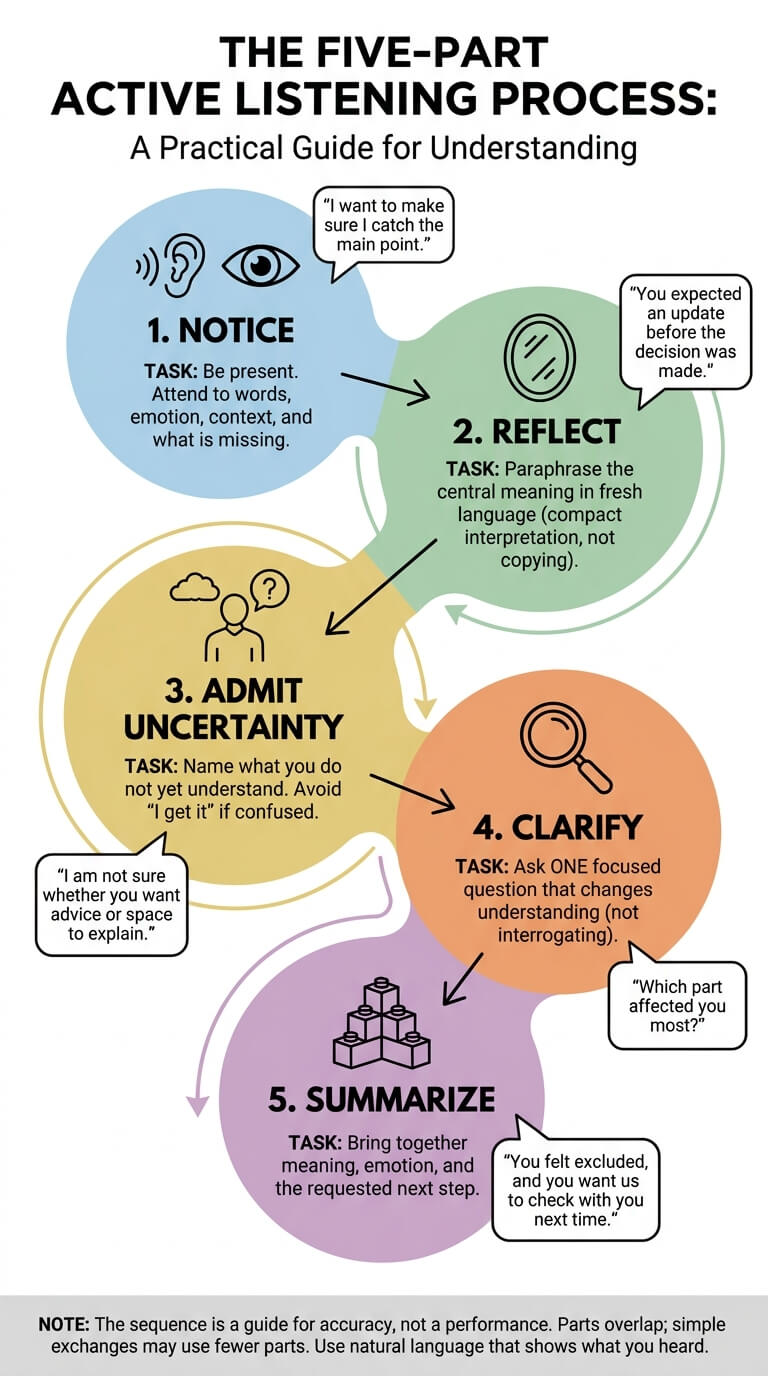
A practical listening sequence is: notice, reflect, admit uncertainty, clarify, and summarize. The parts overlap, but the order helps prevent premature advice or debate.
Not every exchange needs all five parts spoken aloud. A simple message may require only a reflection and confirmation. A confusing or emotionally loaded message may need several rounds. The sequence is a guide for accuracy, not a performance. If a phrase sounds unnatural, use ordinary language that still shows what you heard and where you remain unsure.
| Part | Listener’s task | Useful language |
|---|---|---|
| Notice | Attend to words, emotional weight, context, and what is missing. | “I want to make sure I catch the main point.” |
| Reflect | Restate the central meaning in fresh language. | “You expected an update before the decision was made.” |
| Admit uncertainty | Name what you do not yet understand. | “I am not sure whether you want advice or just space to explain.” |
| Clarify | Ask one focused question that changes understanding. | “Which part affected you most?” |
| Summarize | Bring together meaning, emotion, and the requested next step. | “You felt excluded, and you want us to check with you next time.” |
Be present enough to notice words, emotion, and missing context
Presence means reducing competing tasks enough to process the message. Notice the words, emotional emphasis, practical request, and what remains unexplained. Missing context often points to the most useful clarification.
Paraphrase the central meaning in fresh language
Paraphrasing offers a compact interpretation rather than copying the final sentence. “The schedule is manageable, but last-minute changes make the plan hard to trust” shows the relationship among details. Keep the wording tentative so the speaker can correct it.
Name uncertainty instead of pretending to understand
“I get it” is unhelpful when confusion remains. Be specific: “I understand that you were upset, but I do not yet understand what felt dismissive.” Honest uncertainty prevents false empathy and gives the speaker a clear place to explain.
Ask one clarifying question at a time
Several rapid questions can feel like an interrogation. Choose the one question that would most change your understanding.
- “What were you hoping I would understand?”
- “Do you want listening, advice, or action?”
- “Was the problem what I said, when I said it, or what happened afterward?”
- “What would be useful right now?”
Summarize the meaning, emotion, and requested next step
When an issue has several layers, combine them briefly: “You were already stretched thin, the extra task made your workload feel invisible, and you want priorities discussed before more work is added.” Then ask whether the summary is accurate.
What Active Listening Sounds Like in Real Conversations

Active listening changes with the situation. The following examples show how the same principles can support very different conversations without turning the listener into a fixer, judge, or passive audience.
The order of responses matters. Advice may be welcome after the speaker feels understood, and factual correction may be necessary after the central concern is clear. The same response can feel supportive or dismissive depending on whether it arrives before or after reception. These examples show how to establish shared meaning without delaying your own perspective indefinitely.
Listening to a problem without immediately fixing it
Situation: A friend feels overwhelmed at work. They may feel: tired or afraid they are failing. It may mean: they need company before ideas. Next step: “That sounds like a lot. Do you want help thinking through options, or should I listen first?”
Listening during feedback without building a rebuttal
Situation: A coworker says your updates arrive too late. You may feel: blamed and eager to explain. It may mean: they are naming a coordination problem. Next step: “When my update comes late, you lose time to adjust. Is that the main issue?”
Listening when the speaker is emotional or disorganized
Situation: A family member jumps between events while upset. They may feel: flooded and afraid the larger point will be dismissed. It may mean: organization is low, not that the concern is invalid. Next step: reflect the central thread and invite correction.
Listening when you disagree with the conclusion
Situation: Someone calls your decision unfair, while you believe it was necessary. You may feel: pressure to concede. It may mean: the disagreement is real. Next step: “You believe I prioritized the deadline over the impact on you. I understand that reasoning, although I reached a different decision.”
Active Listening Is Not the Same as Agreement or Validation

| Response | Main purpose | What it does not require |
|---|---|---|
| Active listening | Receive and verify the speaker’s broader meaning. | Accepting every fact, interpretation, or request. |
| Agreement | Share the same conclusion, preference, or judgment. | Understanding every emotional layer. |
| Validation | Acknowledge that an emotion or reaction makes sense in context. | Confirming that every belief or behavior is accurate or acceptable. |
Understanding can coexist with disagreement
You can represent another person’s reasoning accurately and still reach a different conclusion. Listening asks, “Do I understand your position?” Agreement asks, “Do I share it?” State your difference after the speaker confirms that their meaning was represented fairly.
Validation acknowledges emotional experience
Validation recognizes the emotional layer: “I can see why that delay felt dismissive after you had already asked twice.” It does not automatically prove intent, factual accuracy, or the reasonableness of every requested remedy.
Active listening checks the broader message, facts, needs, and meaning
When someone says, “You never support me,” listening can hold the emotional truth without accepting an absolute claim: “You have felt alone in several recent situations. I do not think support has been absent every time, but I want to understand the examples that created that feeling.”
Common Listening Mistakes That Look Helpful

Many weak listening habits come from good intentions. The problem is timing. A response that may be useful later can feel dismissive when it arrives before the message is understood.
Waiting quietly for your turn
Silence is not listening when your attention is on your rebuttal. Test whether you can state the speaker’s meaning in a form they recognize.
Repeating exact words without showing understanding
Mechanical repetition can sound empty. “The priorities keep changing, so you do not know which deadline is real” demonstrates more understanding than copying “I am stressed.”
Asking too many questions and creating an interrogation
Rapid questions may force the speaker to defend details before the main concern is acknowledged. Reflect first, then ask the question that most affects understanding.
Giving reassurance before the concern is clear
“It will be fine” may erase uncertainty that needs attention. First ask what outcome the person fears and whether it points to a real decision.
Turning the story into your own similar experience
A similar story can communicate connection or redirect the conversation. Wait until the speaker finishes, then ask whether your example would be useful.
Listening When You Feel Triggered or Accused
Accurate listening becomes harder when your body is preparing to defend, escape, or counterattack. The goal is not to suppress your reaction. It is to keep the reaction from deciding what the other person meant before you have checked.
These skills become harder, and more important, during difficult conversations shaped by risk, history, or strong emotion.
Notice the urge to correct immediately
Notice fast thoughts such as “That is not what happened” or “I need to explain.” Wait through one complete statement. You are delaying correction, not surrendering it.
Separate impact from intent long enough to hear the concern
Someone can describe a painful impact without knowing your intention. First reflect the impact: “You felt dismissed when I checked my phone.” Then add the missing context without erasing what happened for them.
Ask for a pause when regulation is too low for accurate listening
Pause when you are no longer processing sentences or are likely to become punitive. Be specific: “I need twenty minutes to settle, and I will come back at 7:30.” A return time makes the pause safer than a vague exit.
Return at an agreed time rather than disappearing
When you return, begin with the last point you understood. This shows that the break was for regulation rather than avoidance.
Active Listening in Different Contexts
The core process stays similar across settings, but expectations, power, time, and communication channels change how it should be used.
Context changes what good listening looks like. A close friend may welcome emotional reflection, while a work discussion may need a concise summary and decision. Time limits, authority, privacy, and the communication channel all affect how much clarification is realistic. The standard is not identical behavior everywhere, but enough evidence that the message was understood fairly.
Family and close relationships
Shared history creates useful shorthand and fast assumptions. Ask present-focused questions such as, “Are you asking for help now, or telling me how the earlier situation affected you?”
Friendship and support conversations
Friends differ in whether they want empathy, advice, distraction, or challenge. Ask what would feel useful instead of assuming your preferred support style is universal.
Workplace feedback and collaboration
At work, listening often needs a clear operational summary: “The incomplete handoff delayed your report, and you need the final figures by noon. Is that accurate?” Because power can make correction difficult, invite it directly.
Text, voice notes, and online discussion
Digital channels remove many timing and tone cues. Reflect the issue in writing, one point at a time. When stakes are high, moving to voice or face-to-face conversation may reduce guesswork.
A Listening Self-Check Before You Respond

Use these questions as a brief accuracy test. You do not need perfect answers, but uncertainty should shape your next move.
Can I state the speaker’s meaning without caricaturing it?
A fair summary captures the strongest reasonable version of the concern. If your wording makes the speaker sound obviously irrational, try again.
Do I know whether they want listening, advice, action, or debate?
Many exchanges fail because the participants are in different modes. Ask directly when you do not know what kind of response is wanted.
Have I checked the emotional meaning and practical request?
“I felt left out” needs recognition, while “Please include me before the next decision” is the practical request. Responding to only one layer may leave the other unresolved.
Am I responding to their message or to my prediction?
Past experience can make you answer too early. Notice “They always mean…” and return to the exact message in front of you before reacting to the predicted one.
A First Practice for Better Listening
Practice is easier when the method is small enough to use in ordinary conversation. Begin with a three-move sequence instead of trying to remember every skill at once.
Use one reflection before one question
Reflect the main meaning, then ask a focused question. For example: “You felt unprepared because the plan changed after you had already arranged your day. Which change caused the biggest problem?” Reflection demonstrates reception; the question improves accuracy.
Confirm whether the speaker feels accurately understood
Ask, “Did I get the main point?” or “What am I still missing?” Avoid asking, “Do you understand what I mean now?” before you have checked the other person’s message. The first confirmation belongs to the speaker whose meaning you are trying to receive.
Add your perspective only after the shared meaning is clear
Once the speaker confirms your summary, signal the transition: “I think I understand your concern. I want to share what was happening for me as well.” This keeps listening from becoming permanent one-way communication while protecting the order of the exchange.
What the Conversation May Need After Listening
Accurate reception is often the beginning, not the final result. The next need depends on what the message contains and what has already happened between the people involved.
Emotional acknowledgment when the feeling needs recognition
If the central message is emotional, a correct summary may still sound cold. Add recognition: “You felt embarrassed when that was discussed in front of everyone, and that makes sense given how public it was.” You can acknowledge the experience without agreeing with every interpretation.
A closer look when feeling unheard keeps returning
Repeatedly feeling unheard may involve more than listening technique. The speaker may be understood but receive no response or follow-through. Power may make their preferences easy to ignore. Or both people may understand each other and still want incompatible outcomes. Identify which layer is missing before repeating the same conversation.
Repair when earlier listening failures created tension
If interruption, dismissal, harsh tone, or defensiveness already caused a rupture, listening may need to be paired with responsibility. “I kept correcting details instead of hearing why you were upset. I want to try again, and I will let you finish before I respond.” Repair becomes credible when behavior changes in the next exchange.
Once understanding is clear, repair attempts may still be needed if interruption, dismissal, or withdrawal damaged the exchange.
When Listening Alone Is Not Enough
Good listening improves many conversations, but it is not a universal solution. Some situations require decisions, limits, accountability, professional help, or safety planning.
One sign that the conversation needs something else is repeated accuracy without movement. Both people may be able to summarize each other and still avoid a decision, ignore a boundary, or repeat the same harmful behavior. At that point, more reflection may only postpone the harder task of choosing, acting, documenting, seeking help, or stepping away.
Incompatible goals, repeated disrespect, or refusal to engage
Two people may understand each other clearly and still want different things. A colleague may understand your workload and continue assigning tasks they consider essential. A friend may understand your boundary and reject it. Do not keep listening in the hope that accurate understanding will automatically create cooperation.
Repeated insults, manipulation, or refusal to let you speak are also not solved by performing better reception. A boundary may sound like: “I am willing to discuss the decision, but I will not continue while I am being mocked.”
Fear, coercion, threats, or retaliation that make open conversation unsafe
Active listening should not be used to pressure someone into a vulnerable conversation when they fear punishment, stalking, threats, humiliation, or retaliation. Patterns of power and control require a different response than ordinary misunderstanding. The National Domestic Violence Hotline explains power and control tactics and offers safety-focused information.
Educational note: Communication guidance cannot assess an individual situation or replace qualified professional, workplace, legal, or safety support. Prioritize immediate safety over proving that you can listen calmly.
FAQ About Active Listening Psychology
These questions address the most common points of confusion about using active listening in everyday conversations.
Is active listening just repeating what someone said?
No. Repetition copies words, while active listening checks meaning. A useful reflection reorganizes the central idea in fresh language and leaves room for correction.
Can active listening work when you strongly disagree?
Yes. A fair summary makes disagreement more precise without faking agreement. It can clarify whether negotiation, a boundary, or acceptance of difference is needed.
Why do clarifying questions sometimes feel invalidating?
Questions may feel invalidating when they arrive before acknowledgment or sound like cross-examination. Reflect the main point first, then ask one question that genuinely affects understanding.
How long should someone listen before sharing their view?
There is no fixed time. Share your view after the central meaning has been represented accurately enough to move forward. Listening should not become endless one-way access to attention.
Can active listening become emotionally exhausting?
Yes. Sustained attention and inhibition of immediate reactions require effort. Research on the effects of listening on speakers and listeners supports treating listening as work shared by both participants. Use limits and pauses when needed.
Key Takeaways
- Active listening means receiving, checking, and reflecting meaning before moving to advice, correction, or debate.
- Attention alone is not enough; the speaker needs evidence that the listener understood the central point.
- A useful sequence is to notice, reflect, admit uncertainty, ask one focused question, and summarize the next need.
- Understanding does not require agreement, and validation does not require accepting every fact or behavior.
- When you feel accused, delay immediate correction long enough to understand impact, then add your perspective clearly.
- Listening is not a substitute for boundaries, accountability, professional support, or safety planning when fear and control are present.
A practical next step is simple: in your next meaningful conversation, offer one accurate reflection before asking one question. If the speaker corrects you, treat that correction as useful information rather than failure. Better listening begins when understanding becomes something you verify, not something you assume.

Michael Reed is the Founder and Lead Writer at Psychology Exposed. He writes about human behavior, relationships, emotional patterns, self-awareness, and practical psychology topics using research-informed, easy-to-understand content.
Read More About Michael Reed: https://psychologyexposed.com/michael-reed/