

You can speak clearly, receive a reply, and still leave a conversation with the sense that nothing you said truly registered. The other person may have heard the words but missed the meaning. They may have understood the point but ignored the emotion. They may have acknowledged both and then done nothing about the request.
This is why “I do not feel heard” can describe several different communication failures. Attention, understanding, emotional acknowledgment, response, and follow-through are separate layers. When they are treated as one problem, people often repeat themselves with more detail or intensity while the listener becomes more defensive.
Identifying the missing layer changes what you ask for next. Sometimes you need uninterrupted attention. Sometimes you need the listener to summarize your central point. Sometimes you need empathy, an answer, a decision, or evidence that an agreement will be carried out.
Quick Answer

People feel unheard when their message is not sufficiently attended to, understood, emotionally acknowledged, responded to, or followed through on. Being heard does not require agreement. It requires evidence that the listener received the relevant part of the message and addressed it honestly. The most useful next step is to identify which layer is missing and request that form of reception directly.
What Feeling Heard Actually Includes
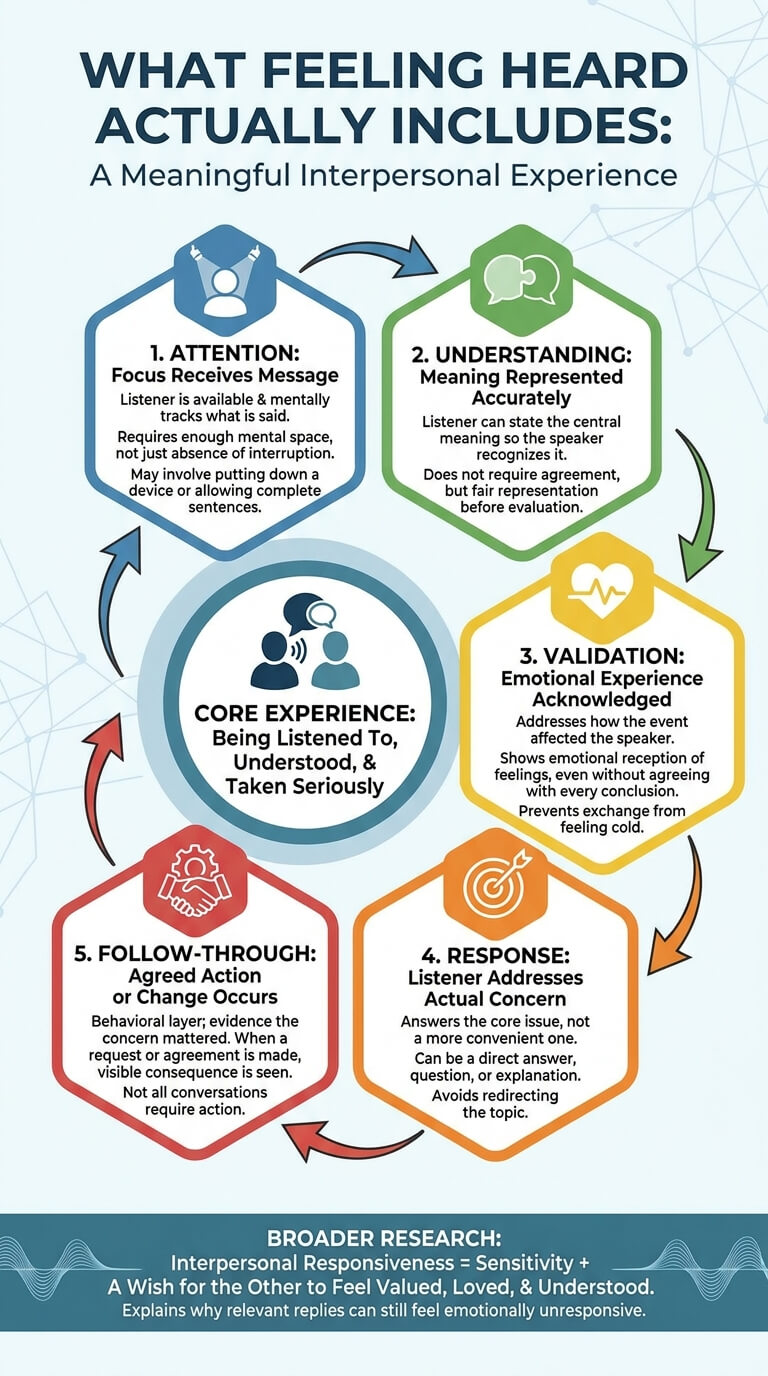
Feeling heard is not a single listening behavior. Research that operationalized the experience of feeling heard describes it as a meaningful interpersonal experience that includes being listened to, understood, and taken seriously. In everyday life, five layers help explain why a conversation may feel complete or incomplete.
The experience of not feeling received is a central question in communication psychology, not only a problem of hearing words.
Attention: the message receives enough focus
Attention means the listener is available enough to receive the message. They may put down a device, stop typing, allow a complete sentence, or be honest that the timing is poor. Perfect eye contact is not required, and some people listen better while walking or doing a simple task. The important issue is whether competing demands prevent the message from forming.
A person can appear quiet while mentally preparing a reply. Useful attention is not only the absence of interruption. It includes enough mental space to track what is being said.
Understanding: the meaning is represented accurately
Understanding asks whether the listener can state the central meaning in a way the speaker recognizes. If you say, “I need more notice before plans involving me are confirmed,” and the listener replies, “You never want to help,” the words were heard but the meaning changed.
Accurate understanding does not require agreement. It requires representing the message fairly before evaluating it.
Validation: the emotional experience is acknowledged
Validation addresses how the event affected the speaker. “I can see why being left out of the decision felt dismissive” shows emotional reception. It does not prove that dismissal was intended or that every conclusion is correct.
Someone may summarize the facts accurately and still leave the emotional layer untouched. That can make the exchange feel cold, procedural, or incomplete.
Response: the listener addresses what was said
A response answers the actual concern rather than a more convenient one. If you ask whether a deadline can change and receive reassurance about the quality of your work, the reply may be kind but unresponsive.
Responses can include an answer, question, decision, explanation, apology, boundary, or honest statement that more time is needed. The key is that the listener engages the issue rather than redirecting it.
Follow-through: agreed action or change occurs
Follow-through is the behavioral layer. A person may say, “I understand,” agree to a next step, and then repeat the same behavior without explanation. The speaker may feel unheard because the acknowledgment produced no observable consequence.
Not every conversation requires action. When a request, agreement, or responsibility is part of the message, however, follow-through becomes evidence that the concern mattered.
Broader research on interpersonal responsiveness describes responsiveness as sensitivity to another person and a wish for them to feel valued, listened to, and understood. This helps explain why a reply can be relevant yet still feel emotionally unresponsive.
Being Heard Is Not the Same as Being Agreed With
Confusing reception with agreement creates unnecessary conflict. A listener can fully understand your position and still reach a different conclusion.
A person can understand and still disagree
Consider two coworkers discussing whether a project should launch Friday. One believes delay will damage trust with customers. The other believes launching with unresolved errors creates greater risk. Each can summarize the other’s reasoning accurately while maintaining a different recommendation.
Agreement without accurate understanding can still feel empty
A quick “Fine, whatever you want” may produce compliance without genuine reception. The listener may not understand the reason, may be avoiding conflict, or may later withdraw the agreement.
Agreement feels less meaningful when you cannot tell whether your experience, logic, or request was actually considered.
The real question is which layer of reception is missing
Before saying “You never listen,” ask what evidence is absent. Did the person miss the core meaning? Did they understand but minimize the emotion? Did they respond without answering? Did they agree and fail to act?
A specific diagnosis of the interaction leads to a more specific request. “Please agree with me” and “Please show me what you understood before giving your view” are very different needs.
Eight Reasons People Feel Unheard

The same painful outcome can arise from different mechanisms. Knowing the mechanism helps you decide whether the next step is better timing, clarification, validation, a direct request, a boundary, or repair.
The listener is distracted or multitasking
Notifications, screens, work demands, children, noise, and fatigue divide attention. The listener may catch keywords while missing the structure of the message. The speaker then has to restart, supply lost context, or wonder which parts were received.
A useful request is practical: “This needs ten focused minutes. Is now workable, or should we choose a time after dinner?”
Interruption prevents the full message from forming
Interruption may come from enthusiasm, anxiety, disagreement, impatience, or a wish to correct facts quickly. Regardless of intent, frequent interruption forces the speaker to defend fragments before the complete point exists.
Advice arrives before the concern is understood
Advice can communicate care, especially when the problem appears solvable. It can also imply that the purpose of speaking is to stop feeling and start fixing. The speaker may still be trying to name what happened, organize emotion, or decide what they want.
The Gottman Institute’s guidance on listening before trying to fix feelings emphasizes empathy, curiosity, summarizing, and validation before moving to solutions. A simple question can prevent mismatch: “Do you want ideas, help taking action, or listening first?”
The listener prepares a defense instead of receiving meaning
Feedback may be heard as a verdict on character. The listener begins explaining intention, finding inaccuracies, or recalling the speaker’s past mistakes. Even a valid explanation can feel dismissive when it arrives before the concern is represented fairly.
The speaker may then intensify to make the impact visible, which gives the listener more evidence that the message is hostile.
Emotion is minimized, mocked, or corrected too early
Responses such as “That is not a big deal,” “You are too sensitive,” or “You should be grateful” treat the emotion as the error. The listener may believe they are adding perspective, but the speaker hears that their experience is unacceptable.
Facts and perspective can still be discussed after acknowledgment. “I did not realize it affected you that strongly. Tell me what felt most upsetting” leaves more room for accuracy.
The conversation goal is mismatched
One person may want emotional support while the other thinks a decision must be made. One may want advice while the other offers reassurance. One may be seeking accountability while the other believes the conversation is a debate about intent.
Both people may contribute effort and still miss each other because they are solving different tasks.
Power differences make one perspective easier to dismiss
Managers, parents, teachers, professionals, and people who control money or access may have greater influence over which account is treated as credible. The lower-power person may speak cautiously, soften the concern, or stop trying after repeated non-response.
A workplace study of experiences of feeling heard at work found that people connected feeling heard with being respected, taken seriously, and treated as having valuable input. In unequal settings, reception is not only a conversational skill. It is also shaped by whether the person has meaningful influence.
Verbal acknowledgment is not followed by action
“I hear you” can become frustrating when the same missed commitment, scheduling problem, interruption, or boundary violation continues. The listener may believe they have acknowledged the concern, while the speaker is waiting for evidence that it changed anything.
This layer is especially important when the message involves a concrete responsibility rather than a request for empathy alone.
What Feeling Unheard Looks Like Across Contexts

Feeling unheard is not limited to romantic conflict. The missing layer changes with the setting, the relationship history, and the kind of response that is possible.
Family: old roles replace current meaning
A parent may hear an adult child’s boundary as teenage rebellion. Siblings may assume the responsible one will cope or the emotional one is exaggerating. The current message is filtered through an old role before it is considered on its own terms.
A useful correction is, “I know this resembles past arguments, but I am asking about this specific plan and how it affects me now.”
Friendship: support becomes comparison or self-focus
You describe a disappointment, and the friend immediately tells a longer story about their own experience. They may be trying to show empathy, yet the focus shifts before your meaning is complete.
A short redirection can help: “I want to hear your experience too. Can I finish what happened to me first?”
Workplace: concerns are acknowledged but not acted on
A manager may listen politely and promise to review workload, safety, credit, or access, yet no decision or timeline follows. The employee may feel unheard because the concern never enters the system that controls outcomes.
Written summaries, clear owners, and dates can convert vague acknowledgment into accountable follow-through.
Online conversation: speed and performance replace understanding
Public platforms reward quick replies, visible certainty, and statements that attract an audience. People may respond to one phrase, infer a position, or perform disagreement for observers rather than clarify the speaker’s meaning.
Close relationships: repeated bids for attention become conflict
A request that first sounded like “Can we talk tonight?” may become “You never care about anything I say” after repeated postponement. The stronger language can hide the original need for attention, acknowledgment, and a reliable return.
Relationship history matters, but the immediate task is still to identify which part of reception keeps failing.
Feeling Unheard vs Misunderstood, Invalidated, or Stonewalled

These experiences overlap, but they are not interchangeable. The distinction tells you where the communication process broke.
| Experience | Main failure | Most relevant next question |
|---|---|---|
| Misunderstood | The meaning received differs from the meaning intended | “Can you tell me what you think I am saying?” |
| Invalidated | The feeling is treated as wrong, excessive, or illegitimate | “Can you acknowledge how this affected me before we discuss the facts?” |
| Stonewalled | Engagement shuts down during conflict without a reliable return process | “Are you asking for a pause, and when will we return?” |
| Unheard | One or more reception layers fail, including response or follow-through | “Which part of my message has not been received or acted on?” |
Misunderstood: the meaning received is different
Misunderstanding is mainly an accuracy problem. The listener may be attentive and caring while constructing a meaning the speaker did not intend. Clarification and reflection are the most direct tools.
Invalidated: the feeling is treated as wrong or illegitimate
Invalidation concerns emotional legitimacy. The listener may understand that you feel anxious and still respond as if the anxiety is ridiculous or unacceptable. Emotional acknowledgment is the missing layer.
Stonewalled: engagement shuts down without a reliable return plan
Stonewalling is more specific than ordinary distraction. The conversation closes during conflict through silence, minimal responses, departure, or refusal to re-engage. A regulated pause can look similar from the outside, but it includes communication and a credible return.
Unheard: one or more reception layers fail
Feeling unheard is the broader outcome. It may include misunderstanding, invalidation, shutdown, lack of response, or missing follow-through. The label describes the experience, not the single cause.
Why Repeating Yourself Can Become More Intense
Repeated non-reception can create a self-reinforcing loop. The speaker becomes more urgent, while the listener becomes less able or willing to receive the message.
Repeated non-reception can intensify defensive communication on both sides.
Failed reception can feel like social threat
When a concern does not register, people may fear that their needs, status, dignity, or belonging do not matter. The issue is no longer only the schedule, joke, deadline, or decision. It becomes whether their perspective has a place in the interaction.
High-quality listening has been linked with social connection. In a series of experiments, feeling listened to reduced state loneliness after people discussed experiences of social rejection. The finding does not mean every unheard conversation causes loneliness, but it illustrates why reception can carry emotional weight beyond the topic itself.
More detail or volume is used to force recognition
The speaker adds examples, repeats the timeline, raises volume, or uses absolute words such as “always” and “never.” These moves may be attempts to make the concern impossible to ignore.
Unfortunately, added intensity can obscure the specific request and increase the listener’s sense of accusation.
The listener becomes more defensive and receives even less
As the message becomes broader or sharper, the listener focuses on exaggeration, tone, or self-protection. They answer the least accurate phrase instead of the original issue.
The exit is not simply “speak more calmly.” Both people need a clearer process: one specific concern, uninterrupted time, a reflection of meaning, and an explicit decision about the response required.
A Five-Layer Heardness Self-Check

Use this check after a conversation feels incomplete. It helps turn a global feeling into a request that another person can understand.
Did the person give enough attention?
Ask whether you had enough time and focus to form the message. Were you repeatedly interrupted? Was the listener distracted? Did they state honestly that the timing was poor?
If attention was missing, request a defined window rather than repeating the whole issue immediately.
Can they state the core meaning accurately?
Ask the person to summarize the central point in one or two sentences. Do not require your exact wording. Listen for whether they grasp the issue, its context, and what you are not saying.
If the summary is inaccurate, correct one point at a time.
Did they recognize the emotional impact?
Consider whether you needed emotional acknowledgment and whether it occurred. A person may understand the logic while overlooking fear, disappointment, embarrassment, or hurt.
Ask directly: “Before we decide what to do, can you tell me what you understand about how this affected me?”
Did they answer the actual request or concern?
Separate a reply from a response. Did they answer the question, make a decision, provide relevant information, or state what they can and cannot do? A long explanation may still avoid the central request.
Did agreed follow-through occur?
Review what was promised, by whom, and by when. If there was no clear action, the conversation may have ended with emotional relief but no shared plan.
If follow-through failed, the next conversation should focus on the commitment and system, not repeat the entire emotional history unless that history is directly relevant.
How to Ask for the Response You Need
Specific requests reduce the chance that the listener chooses the wrong kind of support. They also reveal whether the person is able and willing to respond.
Once the missing layer is clear, assertive communication can turn a vague complaint into a specific request or boundary.
Ask for listening before advice
Try, “I need five minutes to explain this without solutions. After that, I would like your ideas.” The time limit and sequence make the request easier to follow.
Ask the listener to reflect the central meaning
Say, “Before you respond, could you tell me what you think my main point is?” This is especially useful when previous conversations became arguments about something you did not mean.
Ask whether they can take a specific action
Replace “Take this seriously” with an observable request: “Can you confirm the schedule by Thursday?” “Will you include me before the decision is finalized?” or “Can you send the correction to the same group that received the error?”
Separate emotional acknowledgment from agreement
You may say, “I am not asking you to agree with my conclusion. I am asking you to recognize why the situation affected me.” This lowers the fear that empathy requires surrendering a position.
Set a boundary when repeated non-response has consequences
A boundary states what you will do if the issue remains unaddressed. “If the deadline cannot be confirmed, I will not reserve the weekend for the project.” “If the conversation returns to insults, I will end it and communicate in writing.”
Choose a response within your control and avoid using a boundary as disguised punishment.
How Listeners Can Check Whether Someone Feels Heard
Listeners do not need to guess. A few focused checks can reveal whether reception is complete.
Summarize before giving your view
State the core meaning in neutral language: “You are saying that the last-minute change affected your childcare plan and that you need earlier notice.” Then ask whether the summary is accurate.
Ask what part still feels missed
If the person says they still feel unheard, do not repeat “But I listened.” Ask, “Is it the meaning, the emotional impact, the answer, or the follow-through that still feels missing?”
Clarify the desired response
Ask whether they want listening, comfort, advice, information, a decision, action, or space. The desired response may change during the conversation, so check rather than assume.
Confirm follow-through and timing
When action is agreed, summarize who will do what and when. If no action is possible, state that clearly rather than allowing vague agreement to create false expectations.
When the Conversation Becomes a Repeating Loop
Feeling unheard often becomes harder to solve after the conversation turns into a dispute about listening itself.
One person intensifies while the other defends or withdraws
The speaker adds pressure to gain recognition. The listener experiences that pressure as attack and becomes defensive or silent. Each reaction appears to justify the next.
The issue shifts from the original topic to whether listening happened
The conversation begins with a decision, boundary, missed commitment, or emotional event. It ends with “You never listen” and “Nothing I say is ever good enough.” The original action is no longer being addressed.
Repair requires a clearer process, not only another repetition
Pause the history and define the current task. Decide who speaks first, what the listener will reflect, which question needs an answer, and whether a later action must be documented. Repair succeeds when the process changes, not when the same message is delivered with greater force.
Which Skill Fits the Missing Layer?
Different communication skills solve different reception failures. Choosing the right one prevents every painful exchange from becoming a general demand to “communicate better.”
If earlier listening failures damaged trust, repair attempts may be needed before the topic can move forward.
Focused listening for attention and understanding
Use focused listening when the message is interrupted, distorted, or only partly received. The listener gives attention, paraphrases the core meaning, asks clarifying questions, and postpones evaluation until the message is clear.
Validation for emotional acknowledgment
Use validation when the facts are understood but the emotional experience remains unseen. Recognize the feeling and context without automatically agreeing with every interpretation.
Assertiveness for a specific request or boundary
Use assertiveness when you need to make the desired response visible. State the event, impact, need, request, or limit in language that preserves both people’s agency.
Repair when prior failures damaged trust
Use repair when interruption, dismissal, defensiveness, withdrawal, or broken follow-through has become part of the problem. Name the rupture, acknowledge impact, correct what can be corrected, and confirm the next step.
When Feeling Unheard Signals a Broader Problem
Occasional listening failures are common. A broader concern is more likely when non-response is persistent, strategic, humiliating, or connected to control.
Persistent dismissal, contempt, retaliation, or refusal to respond
A person may repeatedly mock concerns, punish disagreement, deny obvious commitments, or refuse any process for response. At that point, the problem is not only that the speaker needs a better request.
Consider whether the environment provides any realistic path for influence, accountability, or protection.
Fear, coercion, humiliation, stalking, threats, or unsafe power dynamics
If speaking honestly may lead to threats, stalking, financial punishment, isolation, humiliation, violence, or retaliation, direct confrontation may increase risk. The National Domestic Violence Hotline’s information on power and control describes patterns in which communication is used to dominate rather than understand.
You do not owe repeated explanations to someone using fear or coercion. Safety planning and confidential support take priority over achieving perfect reception.
When professional, organizational, or safety support may be needed
Workplace concerns may require documentation, management, human resources, a union representative, or legal guidance. Severe distress or repeated communication breakdown may benefit from a qualified mental health professional. Threats, stalking, or violence require safety-focused resources appropriate to your location.
FAQ About Feeling Unheard
These questions address common situations in which the words were technically heard but the interaction still felt incomplete.
Can someone listen and still make you feel unheard?
Yes. They may give attention but misunderstand the meaning, overlook the emotion, avoid the actual request, or fail to follow through. Listening behavior is one layer of reception, not the whole experience.
Why does advice sometimes feel like dismissal?
Advice can arrive before the person has finished explaining, before the emotional impact is acknowledged, or when they wanted companionship rather than solutions. Ask whether advice is wanted and reflect the concern first.
Is feeling unheard always the listener’s fault?
No. The speaker may be unclear, imply a request rather than state it, combine several issues, or expect agreement as proof of listening. Responsibility can be shared. The useful task is to identify what information or response was missing without assigning total blame automatically.
How do you ask to be heard without repeating the whole argument?
Name the missing layer and make one request: “I need you to summarize the main point before responding,” “I need an answer to the scheduling question,” or “I need us to decide who will follow up and by when.”
What if someone acknowledges the concern but never follows through?
Move the discussion from acknowledgment to accountability. Restate the specific agreement, ask what prevented completion, and decide on a realistic next step or boundary. Repeated verbal understanding without action may indicate that the person is unwilling or unable to meet the request.
Key Takeaways
- Feeling heard includes attention, accurate understanding, emotional acknowledgment, relevant response, and follow-through.
- Disagreement does not prove that listening failed, and agreement does not prove that understanding occurred.
- Distracted attention, interruption, premature advice, defensiveness, invalidation, mismatched goals, power differences, and missing action can produce the same painful outcome.
- The Five-Layer Heardness Check helps identify which part of reception is absent before you repeat the whole message.
- Specific requests for listening, reflection, acknowledgment, action, or timing are more useful than a global accusation that someone never listens.
- Persistent contempt, coercion, threats, stalking, humiliation, or retaliation require boundaries and safety-focused support rather than better wording alone.
After the next conversation that leaves you feeling unseen, resist the urge to replay every sentence first. Ask which layer failed. Once you can name whether you needed attention, understanding, validation, response, or follow-through, you can make a clearer request and judge the answer with better information.
Michael Reed, Founder and Lead Writer at Psychology Exposed, writes about human behavior, relationships, emotional patterns, self-awareness, and everyday decisions in accessible, research-aware language. This material provides general education and cannot assess individual mental health, workplace, legal, or safety circumstances.

Michael Reed is the Founder and Lead Writer at Psychology Exposed. He writes about human behavior, relationships, emotional patterns, self-awareness, and practical psychology topics using research-informed, easy-to-understand content.
Read More About Michael Reed: https://psychologyexposed.com/michael-reed/