
Two people can watch the same event, hear the same explanation, and still reach opposite conclusions about what was right. One may focus on harm. The other may focus on loyalty, fairness, intention, responsibility, or the rule that was broken. Both may feel certain that the moral meaning is obvious.
Moral psychology examines how people make these judgments, what emotions follow, and why moral beliefs do not always lead to consistent behavior. It looks at the mental processes behind praise, blame, guilt, outrage, forgiveness, cooperation, double standards, and difficult choices. It does not tell you which moral code you must follow. Instead, it helps explain how human beings interpret conduct and why those interpretations can change with context.
Moral judgment appears when siblings argue about fairness, friends handle secrets, coworkers divide credit, parents set rules, and people explain choices that conflict with their values.
Quick Answer

Moral psychology is the study of how people think, feel, decide, and behave around questions of right and wrong. Moral judgments often draw on perceived harm, fairness, loyalty, duty, intention, emotion, identity, culture, and social pressure. These influences can support cooperation and accountability, but they can also produce blind spots, selective concern, double standards, and intense disagreement.
What Moral Psychology Studies

The field examines several connected processes, from initial judgment to action, emotion, accountability, and the protection of identity.
Moral psychology versus moral philosophy
Moral philosophy asks what people ought to do and how moral claims can be justified. Moral psychology asks how people actually form moral judgments, why particular concerns feel important, and what happens after a judgment is made. The two areas overlap, but they answer different questions.
Philosophy may ask whether lying is ever justified. Psychology asks why one lie is judged protective and another selfish, why intention changes blame, or why someone who values honesty still lies under pressure. The University of Texas at Austin describes morals as standards of conduct that guide judgments of right and wrong.
Judgment, motivation, behavior, and identity
Moral life includes judgment, motivation, action, emotion, and identity. A person may value helping, feel compassion, and still do nothing because of fear, inconvenience, uncertainty, or the belief that someone else will act.
Identity matters because people generally want to see themselves as decent, fair, and responsible. When behavior threatens that self-image, they may admit the mismatch and repair it. They may also minimize the impact, blame the situation, compare themselves with someone worse, or create an exception that protects their view of themselves.
Why moral beliefs do not always predict moral actions
A sincere belief is only one influence on behavior. Choices also reflect habits, rewards, social expectations, power, fatigue, time pressure, fear of exclusion, and the immediate cost of acting consistently. Someone may oppose gossip but join in to maintain belonging. Another person may value fairness but favor a friend when a real benefit is at stake.
This gap does not automatically make the belief fake. People may avoid a cost, misunderstand the situation, or act before reflecting. A repeated gap protected by changing standards is more concerning than one mistake followed by accountability.
Why Moral Psychology Matters in Everyday Life
These judgments shape ordinary trust, cooperation, conflict, forgiveness, and the standards groups use to respond when someone causes harm.
Trust, cooperation, conflict, and repair
Groups function better when members can predict how others will behave. Shared expectations about honesty, reciprocity, care, and responsibility make cooperation less risky. When those expectations are broken, people often experience more than disappointment. They may feel betrayed because the event changes what they believe about the relationship.
Repair involves more than saying, “I did not mean it.” People usually want recognition of impact, a credible explanation, and behavior that makes the future more predictable. Intention matters, but it does not erase outcome.
How moral judgments shape relationships and groups
Moral judgments influence whom people trust, forgive, avoid, defend, punish, or welcome. Within groups, they communicate what behavior is praised and what behavior threatens belonging. This can support safety and cooperation, but it can also create conformity pressure and unequal treatment.
Consider a family rule about helping an aging parent. One sibling may see equal hours as fair. Another may think fairness should account for income, distance, health, and previous caregiving. The disagreement is not only about scheduling. Each person is using a different fairness rule and may interpret resistance as selfishness.
Why neutral psychological language matters
Calling someone immoral can end curiosity before the process is understood. More precise language asks what harm was perceived, which standard was applied, how responsibility was assigned, and whether the same rule was used for everyone. Saying “you used a different standard for your friend” identifies a testable inconsistency without excusing the conduct.
A Core Framework for Understanding Moral Judgment

A moral judgment usually contains several layers at once. The following framework can help separate them without pretending that every decision has one simple answer.
| Layer | Central question | What it can highlight |
|---|---|---|
| Harm | Who may be hurt, protected, or placed at risk? | Suffering, safety, vulnerability, prevention |
| Fairness | Are benefits, burdens, rules, and respect distributed fairly? | Equality, equity, reciprocity, process |
| Loyalty and duty | What do people owe to a person, role, promise, or group? | Commitment, obligation, trust, belonging |
| Emotion | What feeling is directing attention and action? | Guilt, empathy, anger, disgust, pride, shame |
| Identity | What does this judgment imply about who I am or who we are? | Self-image, reputation, justification, defensiveness |
| Context | What intentions, constraints, history, and uncertainty matter? | Meaning, responsibility, proportionality, alternatives |
Perceived harm and protection
People often judge an action by asking who suffered, who was exposed to risk, and whether the harm was intentional or preventable. Yet harm is not always directly visible. One person may focus on immediate pain, while another focuses on a future risk, damage to trust, or the harm of setting a precedent.
A 2025 review in the Annual Review of Psychology describes perceived harm as a major theme in moral judgment while emphasizing that culture and context shape how harm is understood. This helps explain why people may share concern about suffering yet disagree about where the danger lies.
Fairness, reciprocity, equality, and equity
Fairness is not one rule. Equality gives people the same amount. Equity may adjust for effort, contribution, barriers, or circumstance. Need-based fairness gives more help to the person with greater need. Reciprocity asks whether support and sacrifice are returned over time.
Conflict arises when people use different rules without naming them. A parent may divide money equally among adult children. One child may see that as fair, while another believes greater need should matter. The argument becomes easier to understand once the competing standards are visible.
Loyalty, duty, and group norms
Relationships create real responsibilities, so loyalty can be morally meaningful. It becomes difficult when loyalty excuses harm, hides misconduct, or denies outsiders the standards offered to insiders. Group norms also shape which behaviors feel ordinary and whether members feel permitted to question them.
Moral emotions and action tendencies
Emotions do not merely decorate a judgment. They prepare action. Guilt may draw attention toward repair. Shame may produce hiding or self-attack. Empathy may motivate helping. Anger may support confrontation. Disgust may create distance. Pride may strengthen commitment to a valued identity.
These tendencies are not fixed. Research on emotion regulation and moral judgment describes moral evaluation as an interaction between automatic and controlled processes. A feeling can provide information, while reflection can change its intensity, interpretation, or behavioral direction.
Moral identity, self-image, and justification
Moral identity concerns the importance of moral traits and commitments to a person’s sense of self. A strong identity can support consistency because violating a value feels personally significant. It can also create a blind spot when protecting the image of being good becomes more urgent than examining current behavior.
For example, someone who sees themselves as generous may dismiss feedback about controlling help. Instead of asking whether the help respected the other person’s choice, they may rely on past generosity as proof that their motives cannot be questioned.
Culture, context, intention, and uncertainty
Context affects what an action means. Taking property may be theft, borrowing, rescue, or a misunderstanding depending on consent, urgency, ownership, and intention. Culture also influences which duties receive attention and whether the individual or group becomes the main unit of concern.
How Moral Judgments Form
A judgment rarely comes from one mental step. Attention, intuition, interpretation, reasoning, and social feedback can each change the conclusion.
Fast intuitions and slower reasoning
Some judgments appear quickly. A person sees cruelty, betrayal, or unfairness and reacts before forming a detailed explanation. Slower reasoning may then test that response, search for context, compare standards, or justify the first impression.
Fast does not always mean irrational, and slow does not always mean accurate. Deliberation can correct a snap judgment, but it can also defend the conclusion a person already wants.
The role of attention, framing, and available information
Judgment depends on what enters the picture. A story centered on a harmed person may increase concern. A story centered on the accused person’s difficult circumstances may increase understanding. A label such as “betrayal,” “mistake,” or “necessary choice” can direct attention before evidence is examined.
People also infer intention from outcome, assume silence means indifference, or treat one vivid example as representative. Ask which facts are known and which have been supplied by interpretation.
Why intentions and outcomes can pull judgment in different directions
Imagine a friend shares private information while trying to get you help. The intention may have been protective, but the outcome may include embarrassment and lost trust. Focusing only on intention minimizes impact. Focusing only on impact may ignore urgency and available alternatives.
A fuller judgment can hold both: the person may have had a caring motive and still handled the situation poorly. Responsibility then depends on what they knew, what options existed, the seriousness of the outcome, and what they do next.
How social feedback strengthens or changes a judgment
Agreement can increase confidence. Disapproval can prompt reflection, silence, or defensiveness. Public condemnation may also shift attention from the harmed person to reputation and group survival.
Moral reasoning also develops through discussion and exposure to inconsistency. A review on moral reasoning across development and social change describes how people weigh concerns such as equality, merit, and need, and how reasoning about unequal treatment can support revised judgments.
The Main Areas of Moral Psychology

Different questions call for different lenses. The following areas separate emotional, social, identity-based, and decision-focused parts of moral life.
Moral emotions: feelings that signal harm, responsibility, or virtue
Moral emotions include guilt, shame, empathy, compassion, anger, disgust, gratitude, admiration, and forms of pride. Each directs attention differently. The key question is not simply whether the feeling is positive or negative, but what action it encourages and whether that action fits the facts.
Fairness: why unequal treatment feels personally important
Fairness judgments track outcomes, procedures, respect, contribution, need, and reciprocity. Unfairness can create resentment because it suggests that a person’s effort, status, or welfare counts less. People may agree that fairness matters while disagreeing sharply about which fairness rule applies.
Moral outrage: anger at perceived violations
Moral outrage arises when a person interprets conduct as a serious violation that deserves attention or accountability. It can motivate protection and collective action. It can also increase certainty, simplify motives, and turn a proportionate response into humiliation or punishment for its own sake.
Why good people disagree: competing priorities and interpretations
Sincere people may prioritize different concerns. One emphasizes loyalty, another impartiality. One focuses on intention, another outcome. One fears immediate harm, another fears the long-term consequences of a rule. Disagreement does not prove equal accuracy, but it does not automatically prove bad character either.
Moral hypocrisy: double standards and protected self-image
Moral hypocrisy appears when a person presents or applies a standard in a way that protects their own interests, reputation, or group. Not every inconsistency is hypocrisy. The clearer sign is an unequal rule that persists after relevant similarities are pointed out.
Moral licensing: when prior goodness becomes permission
After doing something good, a person may feel they have earned an exception. A generous act can become a reason to act entitled later. An apology can be treated as proof that repeated behavior should no longer be questioned. The present choice is then judged through a moral balance sheet rather than on its own impact.
Empathy and morality: concern that can help but also narrow judgment
Empathy can make another person’s experience vivid and motivate care. It is also selective. People often feel more for those who are familiar, similar, nearby, or represented by a compelling story. A review on empathy, justice, and moral behavior argues for combining empathic concern with reasoning about fairness and wider consequences.
Ingroup versus outgroup morality: loyalty, favoritism, and selective concern
People often give insiders more trust, context, forgiveness, and benefit of the doubt. Outsiders may be judged as a category rather than as individuals. Group loyalty is not automatically wrong, but it becomes dangerous when identity alone decides whose harm matters or whose misconduct is excused.
Ethical decision-making: choices under pressure and uncertainty
Ethical choices become difficult when duties conflict, information is incomplete, and every option carries a cost. Pressure, authority, fear, incentives, and group consensus can narrow the options people notice. A sound process makes stakeholders, harms, rights, uncertainty, and conflicts of interest visible before a decision is finalized.
Guilt versus shame in moral behavior: repair, avoidance, and accountability
Guilt often focuses on a specific action: “I did something harmful.” Shame often spreads the judgment to the whole self: “I am unacceptable.” Guilt may support apology and repair, while intense shame may produce hiding, denial, anger, or withdrawal. Neither response is identical in every person or situation.
Which Area of Moral Psychology Should You Explore Next?
The most useful direction depends on what is driving the situation: emotion, fairness, disagreement, self-image, group identity, or a difficult choice.
When the strongest signal is guilt, shame, empathy, anger, or disgust
Focus on moral emotions. Ask what the feeling highlights, which action it urges, and whether that action supports repair, protection, punishment, distance, or self-defense.
When the conflict is about rules, outcomes, effort, or reciprocity
Examine fairness. Identify whether each person is relying on equality, equity, need, contribution, procedure, or reciprocity. Naming the rule often reveals why the disagreement feels so personal.
When both sides see themselves as principled
Look at moral disagreement. Separate facts from interpretations, then identify the value or feared harm each person is trying to protect. The goal is understanding the real difference before deciding whether agreement is possible.
When behavior and stated standards do not match
Examine self-image, hypocrisy, and licensing. Ask whether the same rule is applied across roles and groups, and whether a past good act is being used to excuse a current choice.
When concern changes according to who is involved
Look at group morality and selective empathy. Notice who receives context, forgiveness, and individual treatment, and who is reduced to a label or denied the benefit of the doubt.
When a real choice has competing harms or duties
Use an ethical decision process. Define the exact choice, identify who carries the cost, check power differences, test the standard through role reversal, and decide how accountability will work if the outcome causes harm.
Common Misunderstandings About Morality
Several popular assumptions make moral behavior look simpler and more consistent than it really is.
Strong moral certainty does not guarantee accurate judgment
Certainty may reflect clear evidence, but it can also reflect emotion, identity, repetition, or social agreement. Confidence should not replace checking facts, intention, context, and whether the same standard is applied consistently.
Emotion is not the opposite of reasoning
Emotion tells people what feels urgent, threatening, admirable, or wrong. Reasoning can test that signal and compare possible responses. Good judgment often requires both, not a victory of logic over feeling.
Empathy is not automatically impartial
Empathy may be strongest for one visible person and weak for many unseen people. It can support compassion while still overlooking scale, probability, rights, or people outside the immediate emotional frame.
Inconsistency is not always hypocrisy
People make mistakes, learn new information, revise beliefs, and face obligations that genuinely differ. Hypocrisy is more likely when a person hides the relevant similarity, changes the rule to protect themselves, or demands a cost they repeatedly refuse to carry.
Explaining a moral process is not excusing harmful behavior
Understanding fear, group pressure, shame, or self-justification can clarify why conduct occurred. It does not remove responsibility. Explanation is most useful when it leads to better prevention, proportionate accountability, and realistic repair.
A Simple Moral Reflection Map
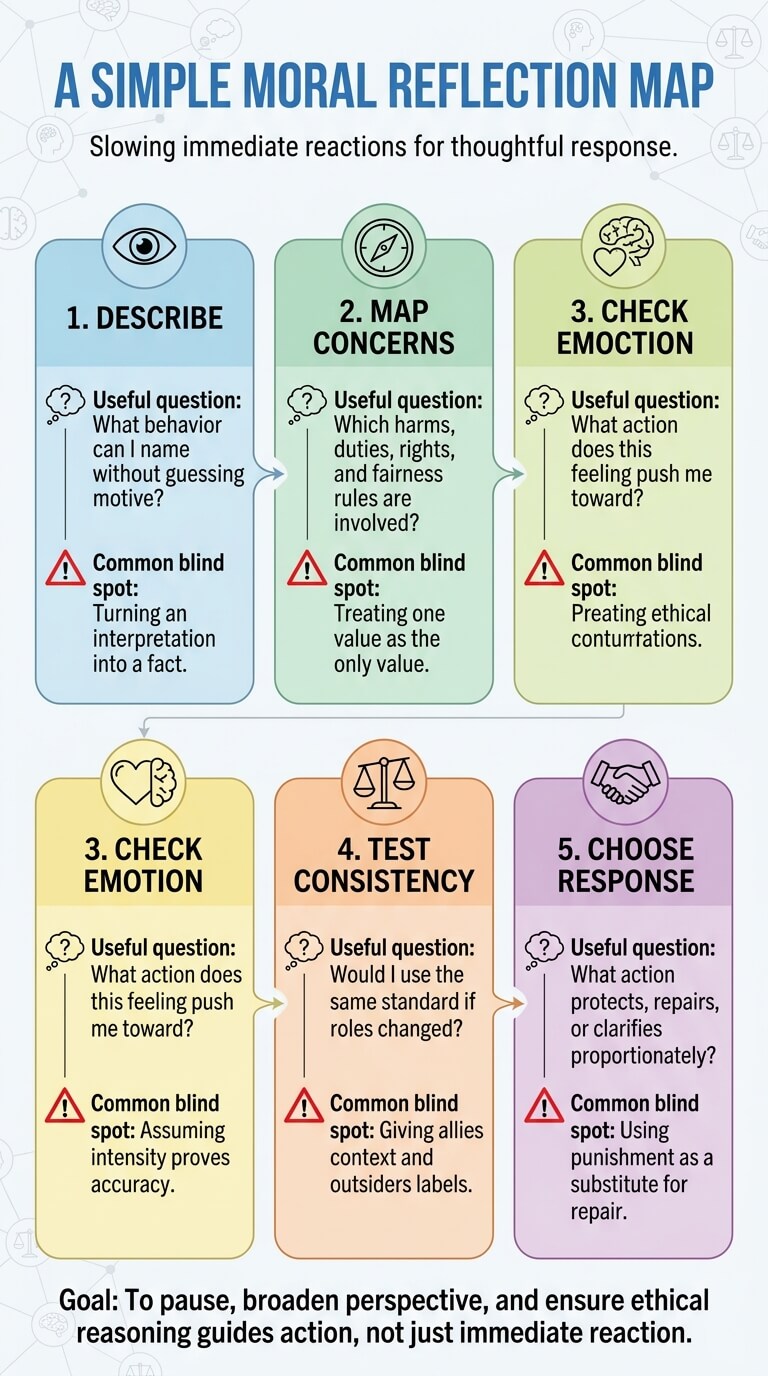
When a moral reaction feels immediate, use the following questions to slow the process without dismissing your concern.
What happened and who may be affected?
Describe the observable action before assigning a permanent character label. Include direct impact, likely future impact, and people who may be missing from the first version of the story.
Which value, rule, duty, or relationship feels threatened?
Name the concern precisely. Is it honesty, care, fairness, loyalty, consent, responsibility, safety, privacy, or trust? Several concerns may be present, and they may pull in different directions.
What emotion is shaping attention?
Notice whether guilt, shame, empathy, fear, anger, disgust, or pride is making one part of the situation unusually vivid. The emotion may carry useful information, but it may also narrow the available response.
Are the same standards being applied across people and groups?
Reverse the roles. Would the judgment change if a friend, opponent, stranger, or authority figure performed the same act under similar conditions? Relevant differences matter, but identity alone should not silently change the rule.
What information or perspective may be missing?
Separate what is known from what is inferred. Check intention, constraints, alternatives, history, and the reliability of the account. Then ask what evidence would genuinely change your conclusion.
| Reflection step | Useful question | Common blind spot |
|---|---|---|
| Describe | What behavior can I name without guessing motive? | Turning an interpretation into a fact |
| Map concerns | Which harms, duties, rights, and fairness rules are involved? | Treating one value as the only value |
| Check emotion | What action does this feeling push me toward? | Assuming intensity proves accuracy |
| Test consistency | Would I use the same standard if roles changed? | Giving allies context and outsiders labels |
| Choose response | What action protects, repairs, or clarifies proportionately? | Using punishment as a substitute for repair |
When Moral Conflict Becomes Emotionally Distressing
Reflection stops being useful when it becomes relentless self-punishment, coercive control, or a situation in which speaking openly may increase danger.
Persistent guilt, shame, rumination, or fear
Moral reflection can become unhelpful when it turns into relentless self-punishment, repeated checking, inability to function, or fear that no repair will ever be enough. Excessive guilt is not reliable evidence that a person caused the harm they fear. Intense shame can also make accountability harder by collapsing a specific action into a global judgment of worth.
When distress is persistent, severe, or linked to depression, panic, trauma, or thoughts of self-harm, support from a qualified mental health professional may be appropriate. Immediate danger or self-harm risk requires urgent local crisis or emergency support.
Coercion, humiliation, threats, or retaliation presented as morality
Sometimes moral language is used to control. A person may claim that obedience proves love, that privacy is disloyal, or that humiliation is deserved. Fear, threats, stalking, isolation, forced confession, and retaliation are not ordinary moral disagreement.
In an unsafe dynamic, direct confrontation or joint communication exercises may increase risk. Prioritize safety, trusted support, and advice from professionals who understand coercion and abuse rather than trying to win the moral argument.
Educational information versus professional support
This material can help organize questions and recognize psychological tendencies. It cannot determine legal responsibility, diagnose a mental health condition, assess immediate danger, or replace professional ethics guidance in medicine, law, finance, education, or other regulated settings.
Frequently Asked Questions About Moral Psychology
These questions address the most common points of confusion about emotion, reasoning, culture, behavior, and ethics.
Is morality mostly emotional or rational?
It is usually both. Some judgments begin as rapid feelings or intuitions, while others involve deliberate comparison of consequences, duties, and evidence. Emotion can identify what feels significant. Reasoning can test the interpretation, consider missing people, and choose a proportionate response.
Are moral beliefs universal across cultures?
Human communities commonly care about concerns such as harm, cooperation, responsibility, and fairness, but cultures may define these concerns differently and give them different weight. Variation does not mean there are no shared tendencies, and shared tendencies do not mean every society reaches the same judgment.
Why do people break rules they sincerely support?
Beliefs compete with immediate rewards, fear, habit, loyalty, social pressure, and self-interest. People may also create exceptions, misunderstand the impact, or assume their intention makes the rule less relevant. The most useful question is often what allowed the value-behavior gap and what would reduce it next time.
Can moral judgments change over time?
Yes. New information, direct experience, relationships, cultural change, reflection, and exposure to inconsistency can alter what people notice and how they weigh competing concerns. Change may be gradual because moral beliefs are often connected to identity and belonging.
Is moral psychology the same as ethics?
No. Ethics often concerns principles, obligations, and what should be done. Moral psychology studies how people actually judge, feel, decide, justify, cooperate, blame, and repair. Psychological explanation can inform ethical reflection, but it does not by itself prove what the correct moral answer is.
Key Takeaways
- Moral psychology studies judgment, emotion, motivation, behavior, and identity around right and wrong.
- Perceived harm, fairness, loyalty, duty, emotion, self-image, culture, and context often interact in one judgment.
- Strong conviction can be sincere without being complete, consistent, or free from bias.
- Intentions matter, but they do not erase outcomes, responsibility, or the need for repair.
- A useful reflection process separates facts from interpretation, checks standards across groups, and looks for a proportionate next step.
- When moral language is tied to fear, coercion, threats, humiliation, or retaliation, safety matters more than improving the discussion.
A practical next step is to choose one recent moral disagreement and write down three things: the harm each person perceived, the fairness rule each person used, and the emotion that shaped attention. That small separation often reveals why the disagreement felt obvious to both sides and what question needs to be answered next.

Michael Reed is the Founder and Lead Writer at Psychology Exposed. He writes about human behavior, relationships, emotional patterns, self-awareness, and practical psychology topics using research-informed, easy-to-understand content.
Read More About Michael Reed: https://psychologyexposed.com/michael-reed/