
Two siblings receive the same amount of help, yet one still feels overlooked. Two friends split a bill equally, but one believes the arrangement ignores a major difference in what each person ordered. A family shares caregiving tasks, and resentment grows because visible chores are counted while planning, worrying, and follow-up remain invisible.
These conflicts are rarely about numbers alone. Fairness judgments combine outcomes, effort, need, history, intention, process, and respect. People may agree that fairness matters while using different rules to define it. One person wants equal treatment. Another wants contributions recognized. A third believes the person with the greatest need should receive more.
Understanding fairness psychology helps explain why perceived unfairness can affect trust so quickly. It also gives you a way to describe the problem without assuming that your first interpretation is the only reasonable one.
Quick Answer
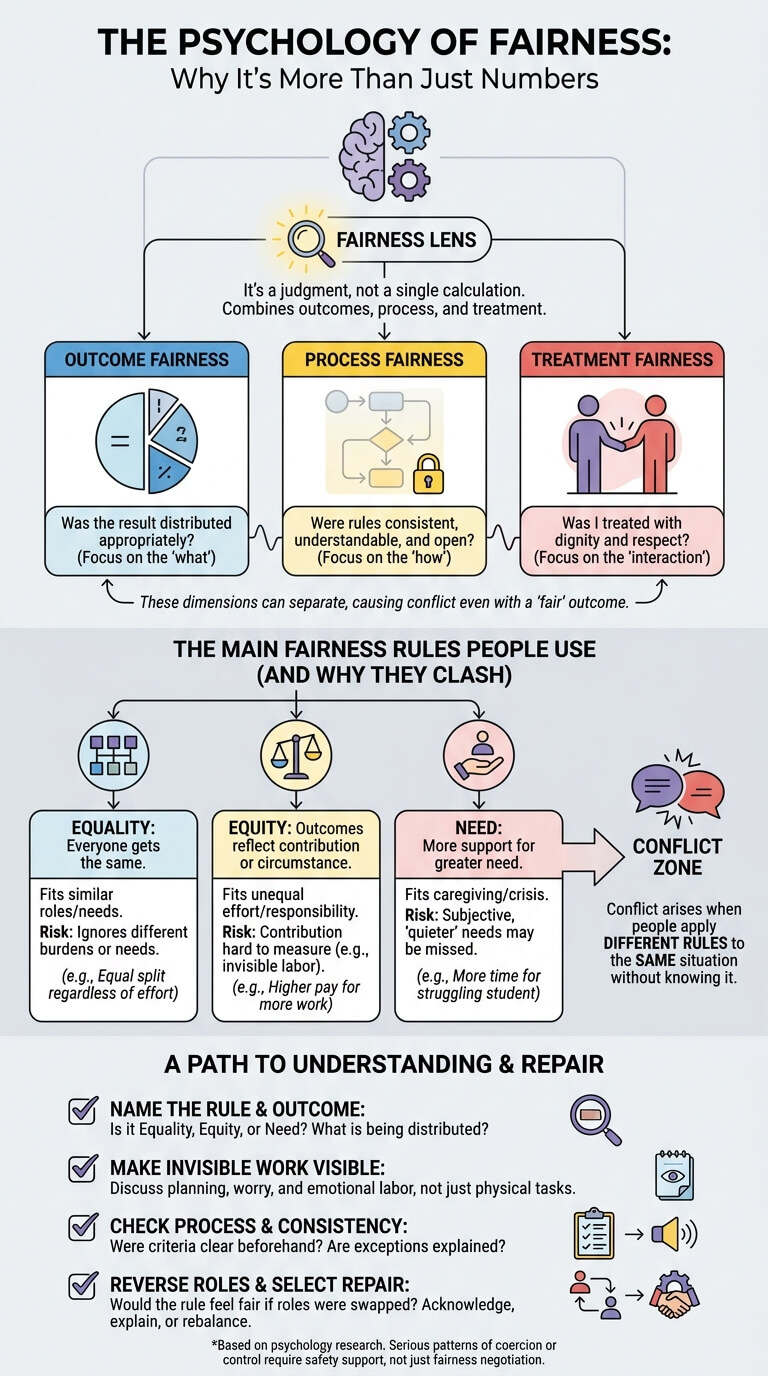
Fairness psychology examines how people judge whether outcomes, rules, effort, needs, exchanges, and treatment are just. Unfairness feels powerful because it may signal loss, exclusion, favoritism, broken reciprocity, or an unreliable process. People often disagree because they are applying different fairness rules, such as equality, equity, need, proportionality, or consistent procedure.
What Fairness Means in Psychology
Fairness is not a single calculation. It is a judgment about whether people received an acceptable outcome, whether the process was trustworthy, and whether everyone was treated with dignity. A decision can appear fair in one dimension and unfair in another. You may accept receiving less if the process was transparent, or resent an equal outcome if your effort was ignored.
Fairness is one part of the broader way moral psychology explains judgments about right, wrong, responsibility, and the rules people expect others to follow.
Fairness judgments are relational. People compare what they gave, what they received, what others received, which rules were announced, and whether exceptions were explained. These comparisons help people estimate whether cooperation is safe and whether future treatment is predictable.
Fairness as a judgment about outcomes, process, and treatment
Outcome fairness asks, “Was the result distributed appropriately?” Process fairness asks, “Were the rules consistent, understandable, and open to relevant input?” Treatment fairness asks, “Was I spoken to honestly and respectfully?”
These dimensions can separate. A parent may make a sensible decision but announce it dismissively. A group may use a respectful process yet reach an outcome that disadvantages one member. A friend may offer an equal split while ignoring information that would make the split more balanced.
Research on procedural justice commonly highlights voice, neutrality, respect, and trustworthiness as important features of a fair process. Although the research setting may differ from everyday life, those principles translate well to families, groups, and relationships.
Why fairness is not always the same as equality
Equality gives everyone the same amount. Fairness may require equality, but not always. If three people have the same role and make the same contribution, equal treatment may seem appropriate. If one person has carried far more responsibility, equal rewards may appear to erase effort. If one person has a serious need, an unequal allocation may feel more humane and more just.
This distinction creates many ordinary disagreements. “Everyone should get the same” sounds fair until people disagree about whether the starting conditions, contributions, or burdens were the same.
How expectations create a comparison point
People rarely judge an outcome in isolation. They compare it with a promise, a prior arrangement, another person’s outcome, their own contribution, or what usually happens. The comparison point can be explicit, such as an agreed schedule, or implicit, such as expecting friends to take turns initiating plans.
When expectations differ, each person may believe the other changed the rules. One partner thinks household effort should balance day by day. The other thinks it should balance across a demanding month. Neither comparison period is automatically correct, but the hidden difference can fuel resentment.
The Main Fairness Rules People Use
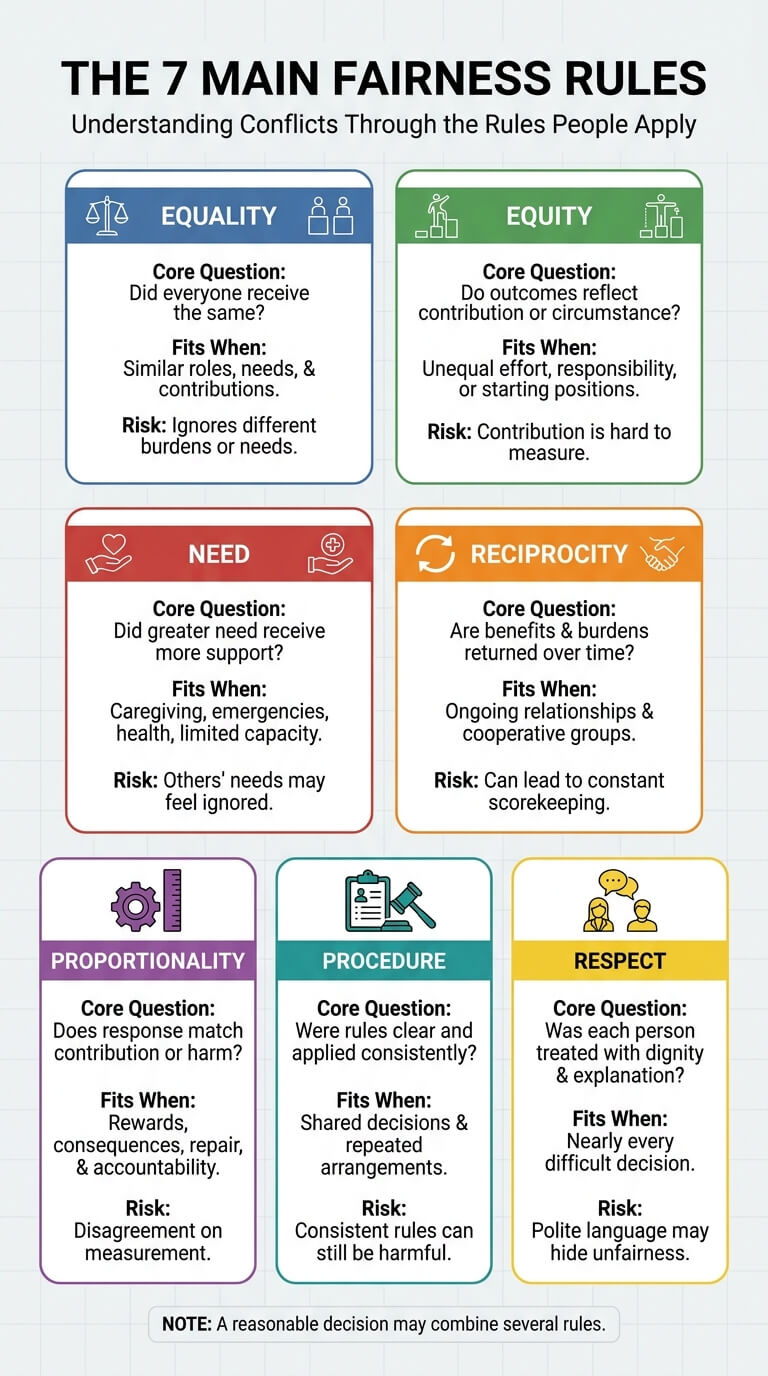
Most fairness conflicts become clearer when you identify the rule each person is applying. The seven rules below overlap, and a reasonable decision may combine several of them.
| Fairness rule | Core question | When it often fits | Common risk |
|---|---|---|---|
| Equality | Did everyone receive the same? | Similar roles, needs, and contributions | Different burdens or needs may be ignored |
| Equity | Did outcomes reflect contribution or circumstance? | Unequal effort, responsibility, or starting position | Contribution can be difficult to measure |
| Need | Did the person with greater need receive more support? | Caregiving, emergencies, health, or limited capacity | Others may feel their needs are never counted |
| Reciprocity | Are benefits and burdens returned over time? | Ongoing friendships, families, and cooperative groups | Care may become constant scorekeeping |
| Proportionality | Does the response match the contribution, benefit, or harm? | Rewards, consequences, repair, and accountability | People may disagree about what should be measured |
| Procedure | Were the rules clear and applied consistently? | Shared decisions and repeated arrangements | A consistent rule can still produce harmful outcomes |
| Respect | Was each person treated as worthy of explanation and dignity? | Nearly every difficult decision | Polite language can hide an unfair outcome |
Equality: everyone receives the same
Equality is easy to see and explain. It reduces suspicion when people are similarly situated. Taking equal turns, dividing identical items evenly, or applying the same deadline to people with the same role may feel straightforward.
Equality becomes less convincing when relevant differences are large. Giving every family member the same amount of caregiving support may sound fair, but it may fail if one person has a temporary disability or another lives far away and cannot provide practical help.
Equity: outcomes reflect effort, contribution, or circumstance
Equity compares inputs and outcomes. People ask whether effort, responsibility, skill, sacrifice, or circumstance was recognized. Equity theory has often described fairness judgments through comparisons between what people contribute and what they receive.
The difficulty is that contributions are not always visible or directly comparable. One person performs more physical tasks. Another carries planning, emotional labor, or financial risk. Arguments intensify when each person measures the contribution they can see most clearly.
Need: more support goes to the person who needs more
The need rule treats unequal support as fair when it reduces a meaningful disadvantage. A child who is struggling may need more teaching time. A friend in crisis may receive more attention for a period. A relative with limited mobility may need others to carry a larger share of physical work.
Experimental research on need-based distributive decisions treats need as a major principle alongside equality and equity. In daily life, the challenge is deciding which needs are relevant, how long the adjustment should last, and how to prevent quieter needs from disappearing.
Reciprocity: benefits and burdens should be returned
Reciprocity does not require identical exchanges. A friend may provide practical help while you provide emotional support. A sibling may manage appointments while another handles transportation. What matters is whether the relationship feels mutually responsive over time.
A review of trust and reciprocity describes how social appraisal and learning contribute to cooperative exchange. People update expectations from repeated interactions. A single imbalance may be understandable, but a repeated pattern can teach someone that their effort will not be returned.
Proportionality: response should match contribution or harm
Proportionality asks whether a reward, burden, consequence, or repair fits what happened. A small mistake may need correction but not public humiliation. A major breach of trust may require more than a quick apology. A person who carried most of a project may reasonably expect more recognition.
This rule is central to accountability. It prevents both minimization and overreaction. The difficult part is agreeing on the seriousness of the impact and the weight of the relevant contribution.
Procedure: the rules and process should be consistent
People often care about how a decision was made even when they dislike the outcome. They want a chance to provide relevant information, understand the standard, and know that the rule was not invented after the result became convenient.
Consistency does not mean rigidity. A process can allow exceptions, but the reasons should be visible and applicable to comparable cases. Secret exceptions create suspicion because they make future treatment unpredictable.
Respect: people should receive dignity and explanation
Respectful treatment includes truthful information, a chance to speak, and language that does not belittle the person affected. Someone may accept “We cannot divide this equally because one person has an urgent need” more easily than “Stop being selfish and accept it.”
Respect does not guarantee agreement. It protects the person’s standing while the disagreement continues. This matters because humiliation often turns a solvable distribution problem into a deeper conflict about belonging and worth.
Why Unfairness Produces Strong Reactions
Loss, status, and exclusion signals
Unfairness may signal more than losing a resource. It can suggest that your contribution is less valued, that your needs count less, or that you are outside the group that receives consideration. This is why a small unequal outcome can trigger a large emotional reaction when it represents a repeated status message.
Broken expectations and violated reciprocity
Cooperation depends partly on expected return. You cook because someone else cleans. You listen because the other person usually listens when you struggle. When one side repeatedly receives without responding, the practical imbalance begins to carry a moral meaning: “My effort is expected, but yours is optional.”
Uncertainty about whether the pattern will continue
A one-time unfair event can feel threatening when no explanation or correction follows. The person is not only reacting to today’s loss. They are asking whether this is the new rule. Clear acknowledgment and a future plan can matter as much as immediate compensation.
Why unfair process can hurt even when the outcome is acceptable
Suppose a group chooses the option you preferred, but does so by ignoring another member, changing the criteria halfway through, or hiding relevant information. You may still feel uneasy because the result cannot be trusted. The same process could disadvantage you next time.
Fair procedures reduce dependence on being the favored person. They communicate that outcomes will not be based only on status, closeness, or convenience.
Equality Versus Equity Versus Need
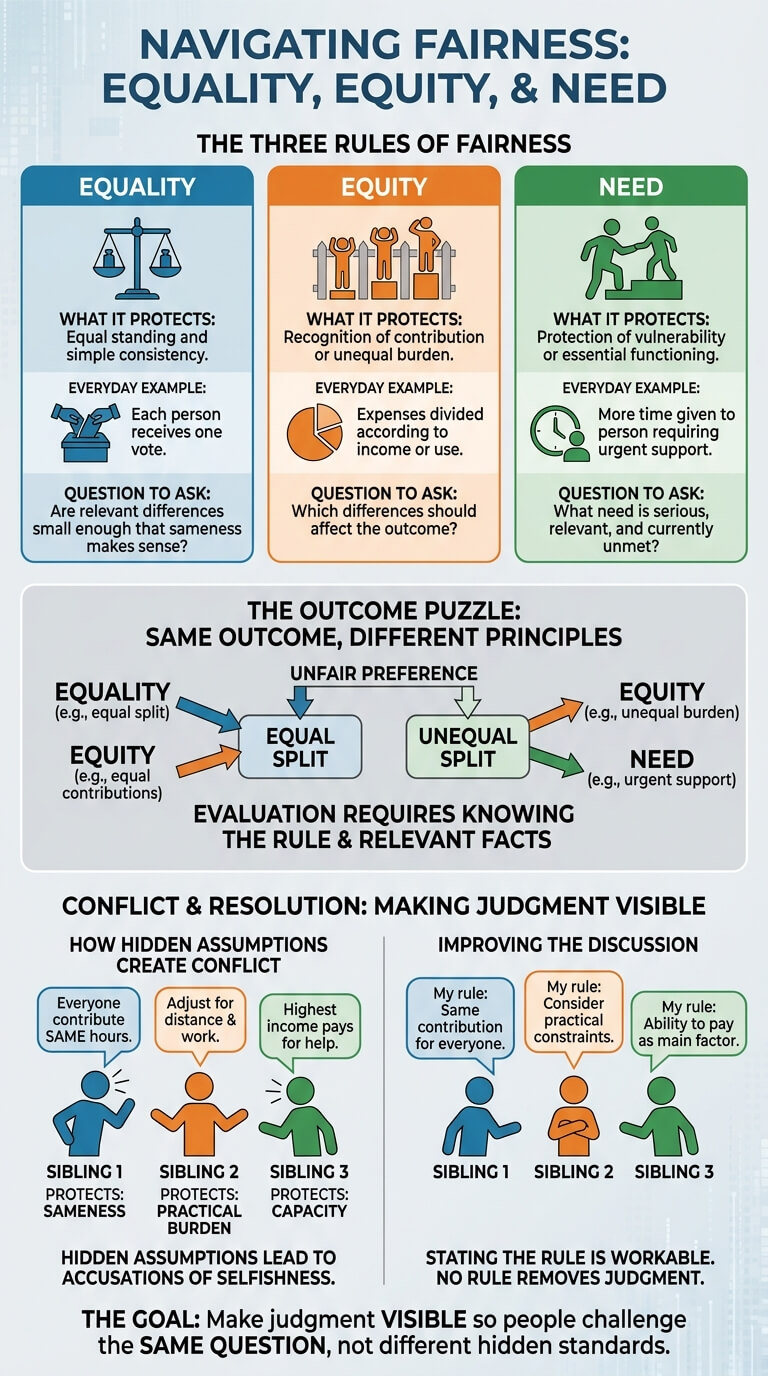
These three rules are often treated as competitors, but each answers a different question.
| Rule | What it protects | Everyday example | Question to ask |
|---|---|---|---|
| Equality | Equal standing and simple consistency | Each person receives one vote | Are relevant differences small enough that sameness makes sense? |
| Equity | Recognition of contribution or unequal burden | Expenses are divided according to income or use | Which differences should affect the outcome? |
| Need | Protection of vulnerability or essential functioning | More time is given to the person requiring urgent support | What need is serious, relevant, and currently unmet? |
The same outcome can follow different fairness principles
An equal split may reflect equality, or it may happen to be equitable because contributions were equal. An unequal split may reflect need, contribution, or an unfair preference. You cannot evaluate the outcome fully without knowing the rule and the relevant facts.
How hidden assumptions create conflict
Imagine three adult siblings deciding how to support an aging parent. One wants each sibling to contribute the same number of hours. One wants contributions adjusted for distance and work schedules. One wants the sibling with the highest income to pay for outside help. Each proposal protects something different: sameness, practical burden, or capacity.
The discussion improves when people state the rule instead of accusing one another of selfishness. “I am using ability to contribute as the main factor” is more workable than “You do not care.”
Examples from shared expenses, caregiving, and group tasks
For shared expenses, equality may fit a similar purchase, while equity may fit very different incomes or consumption. In caregiving, need may justify temporary imbalance, while reciprocity matters across a longer period. In group tasks, contribution may guide credit, but procedure and respect determine whether invisible work was considered.
No rule removes judgment. The goal is to make the judgment visible enough that people can challenge the same question rather than arguing from different hidden standards.
Fairness, Trust, and Cooperation
Consistent treatment makes behavior more predictable
People cooperate more easily when they understand how decisions will be made. Predictability reduces the need to monitor every interaction for favoritism. Even an imperfect arrangement may feel manageable if the rules are clear, revisable, and consistently applied.
Reciprocity supports ongoing cooperation
Reciprocity tells people that giving does not mean disappearing. Contributions are noticed, needs can move in both directions, and support will not always flow toward the same person. Healthy reciprocity is flexible. It allows temporary imbalance without making permanent one-sidedness invisible.
Favoritism and unexplained exceptions weaken trust
Exceptions are not automatically unfair. A person may need more support or have a constraint others do not face. Trust weakens when the exception is hidden, justified differently depending on who benefits, or treated as something no one is allowed to question.
Repair requires more than saying the outcome was technically equal
When someone feels unfairly treated, repeating “But everyone got the same” may miss the complaint. They may be objecting to unequal effort, an ignored need, a broken promise, or disrespect during the decision. Repair starts by identifying which dimension failed.
Why People Disagree About What Is Fair
Different information about effort, need, intention, or history
One person sees the final result. Another remembers the work that led to it. One knows about a private constraint. Another sees an unexplained exception. Before judging motives, ask whether the people are using the same information set.
Self-serving comparison points
People naturally notice their own effort, inconvenience, and intention in detail. They see other people’s visible behavior but not the full internal cost. This does not mean every fairness complaint is biased. It means each person may be comparing the most favorable version of their own contribution with the most visible version of someone else’s.
Group loyalty and selective standards
People may interpret an ally’s mistake as understandable and an outsider’s mistake as evidence of character. They may support an exception for someone close while demanding strict consistency for someone they distrust. A role-reversal question can expose whether the standard changes with group membership.
Culture, roles, and relationship expectations
Families and communities teach different expectations about duty, hierarchy, independence, caregiving, and reciprocity. One person may view helping relatives as a non-negotiable responsibility. Another may view voluntary choice and equal boundaries as more important. The conflict is not only about the current task. It is also about the role each person believes they occupy.
Immediate outcomes versus long-term balance
Fairness can be judged across different time frames. A relationship may be unequal this week but balanced across a year. The reverse is also possible: each isolated event seems explainable, yet the long-term pattern consistently benefits one person. Agree on the relevant period before deciding whether the exchange is balanced.
Fairness Resentment: What It May Be Signaling
Resentment as a record of repeated imbalance
Resentment often accumulates when a person repeatedly gives, adapts, or absorbs consequences without acknowledgment or return. It may function like a mental record of unresolved imbalance. The feeling does not prove the record is complete, but it deserves investigation.
When scorekeeping is informative
Temporary tracking can reveal a pattern that vague impressions hide. Recording who performs recurring tasks, pays shared expenses, initiates contact, or follows through can correct memory and make invisible work discussable.
The purpose should be understanding, not building a prosecution file. A useful record asks, “What is happening over time?” An adversarial record asks, “How can I prove that I am always right?”
When scorekeeping ignores invisible contributions
Lists can still be unfair. They may count dishes washed but not meals planned, money earned but not schedules managed, calls made but not emotional preparation. Ask each person what they contribute that the current measure misses.
The difference between a fairness concern and a demand for control
A fairness concern describes an imbalance and seeks a workable standard. Control demands that another person surrender reasonable choice, access, privacy, or independence. “I need us to divide this responsibility more clearly” differs from “You owe me constant access because I helped you.”
Past generosity does not create unlimited entitlement. Support, gifts, or sacrifice should not be used to justify threats, humiliation, surveillance, financial restriction, or retaliation.
A Fairness Rule Selector for Everyday Decisions
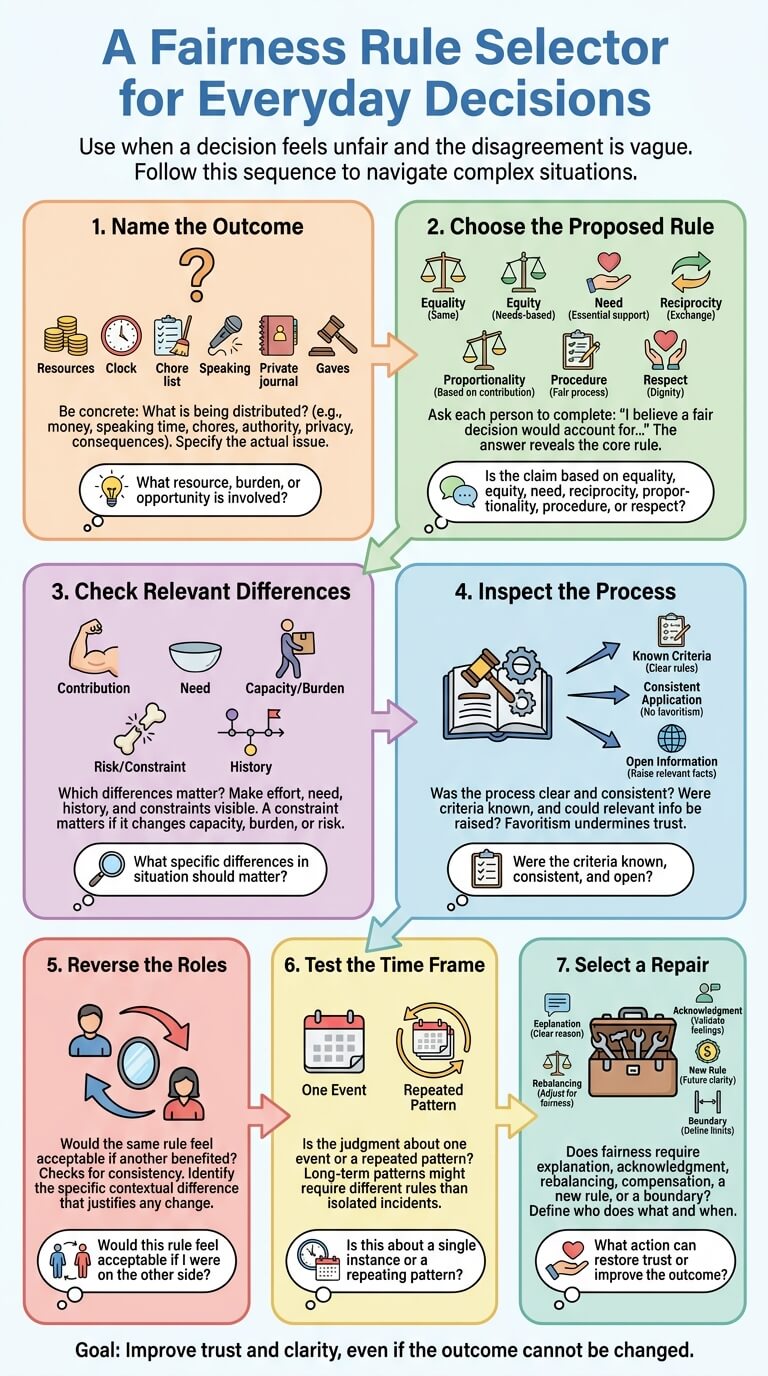
Use this sequence when a decision feels unfair but the disagreement remains vague.
When several fairness rules compete and every option carries a cost, an ethical decision-making process can help compare stakeholders, duties, consequences, and uncertainty more systematically.
- Name the outcome: What resource, burden, opportunity, consequence, attention, or responsibility is being distributed?
- Choose the proposed rule: Is the claim based on equality, equity, need, reciprocity, proportionality, procedure, or respect?
- Check relevant differences: Which differences in contribution, capacity, need, risk, or history should matter?
- Inspect the process: Were the criteria known, consistent, and open to relevant information?
- Reverse the roles: Would the same rule feel acceptable if another person benefited?
- Test the time frame: Is the judgment about one event or a repeated pattern?
- Select a repair: Does fairness require explanation, acknowledgment, rebalancing, compensation, a new rule, or a boundary?
What outcome is being distributed?
Be concrete. “Respect” may be too broad at first. The actual issue might be speaking time, decision authority, privacy, recognition, money, chores, caregiving, or consequences. A specific outcome is easier to evaluate.
Which fairness rule is each person using?
Ask each person to complete the sentence, “I believe a fair decision would account for…” The answer may reveal equal shares, effort, need, prior sacrifice, consistency, or dignity. Two people can then discuss the rule rather than repeating the conclusion.
Was the process clear and consistent?
Check whether the criteria were known before the outcome, whether relevant information could be raised, and whether exceptions were explained. A good outcome reached through favoritism remains difficult to trust.
Were effort, need, history, and constraints visible?
Bring hidden information into view without assuming every difference is relevant. A constraint matters when it changes capacity, burden, or risk. A personal preference may deserve consideration but not automatic priority.
Would the rule feel acceptable if roles were reversed?
Role reversal checks consistency. It does not erase context. If the judgment changes, identify the specific contextual difference that justifies the change. “I would allow this exception for anyone facing the same limitation” is stronger than “It is different because this is my friend.”
What explanation or adjustment could restore trust?
Sometimes the outcome cannot be changed. Trust may still improve through acknowledgment, a clear reason, a future rule, or recognition of the burden. When change is possible, define who will do what, when the arrangement will be reviewed, and how new information will be handled.
Fairness Versus Nearby Moral Issues
Fairness versus sameness
Sameness is one fairness rule, not the entire concept. Equal treatment works when relevant conditions are similar. It may preserve inequality when people begin with very different burdens or needs.
Fairness versus kindness
Kindness may involve generosity beyond what fairness strictly requires. Fairness asks what is due or appropriately balanced. Kindness asks what caring response you are willing to offer. Confusing them can make a voluntary favor feel like a permanent debt.
Fairness versus revenge
Fair consequences aim to acknowledge harm, protect others, restore balance, or prevent repetition. Revenge aims primarily to make the other person suffer. Anger may be understandable, but suffering alone does not repair the original injustice.
Fairness concerns versus moral outrage
A fairness judgment may precede anger, but not every unfair outcome produces outrage. Outrage adds emotional urgency, condemnation, and often a desire for public or collective response. Keeping the initial fairness question clear helps prevent emotional intensity from becoming the only evidence.
How group membership can change the standard
Fairness becomes selective when people excuse allies, scrutinize outsiders, or count only the harms experienced by their own group. Ask whether the same evidence, intention, and consequence would be evaluated similarly if the identities changed.
What to Do When Something Feels Unfair
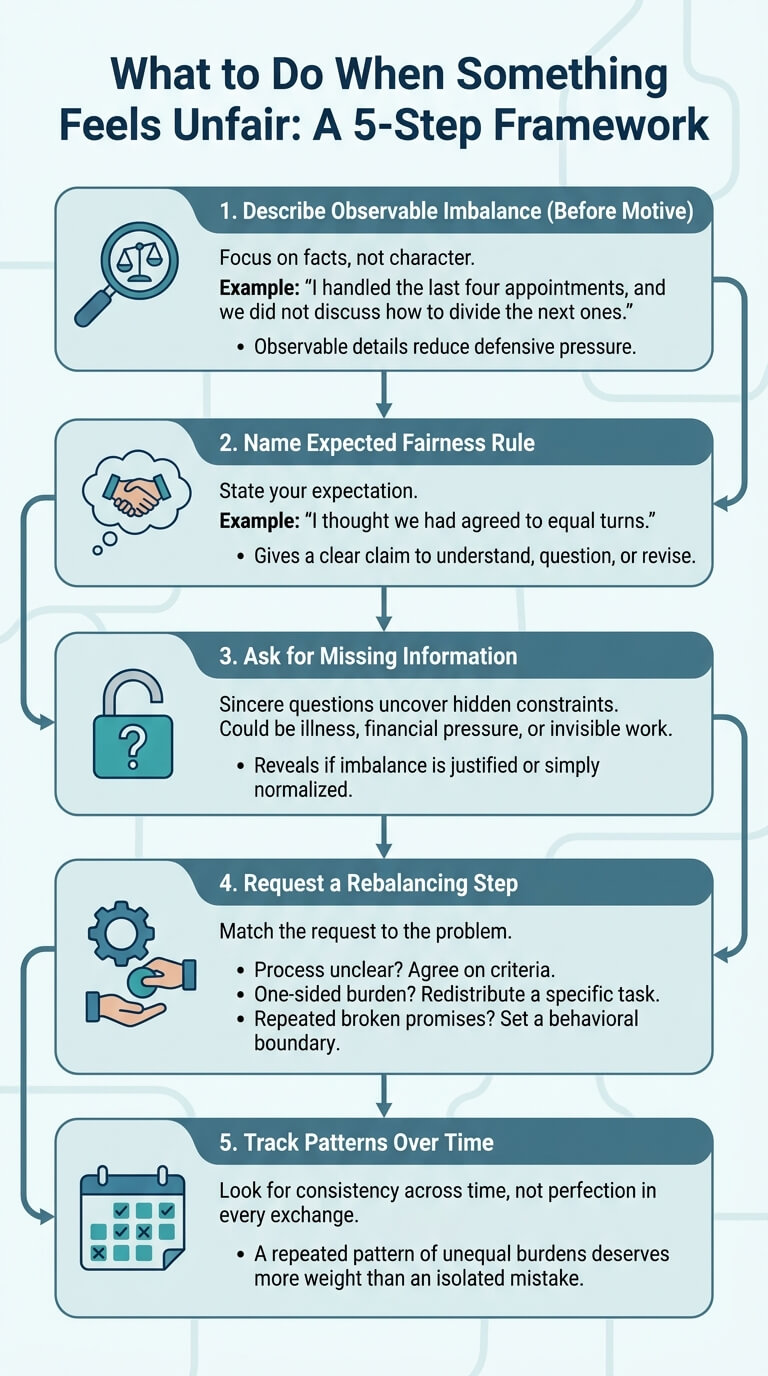
Describe the observable imbalance before assigning motive
Say, “I handled the last four appointments, and we did not discuss how to divide the next ones,” rather than, “You never care about my time.” Observable details reduce the pressure to defend character.
Name the fairness rule you expected
Try, “I expected the workload to reflect how much time each person had available,” or “I thought we had agreed to equal turns.” This gives the other person a claim they can understand, question, or revise.
Ask what information or constraint you may not see
A sincere question can uncover illness, financial pressure, misunderstanding, or invisible work. It can also reveal that there is no missing explanation and that the imbalance has simply been normalized.
Request a process, explanation, boundary, or rebalancing step
Match the request to the problem. If the process was unclear, agree on criteria before the next decision. If the burden is one-sided, redistribute a specific task. If promises are repeatedly broken, set a boundary based on behavior rather than waiting for another explanation.
Track patterns rather than arguing from one isolated moment
One disappointing decision may be a mistake. A repeated pattern of hidden exceptions, unequal burdens, and dismissive responses deserves more weight. Look for consistency across time, not perfection in every exchange.
When an Unfair Dynamic May Need More Support
Ordinary fairness conflicts can often be discussed through clearer expectations and better information. Different steps are needed when the imbalance is enforced through fear, coercion, threats, humiliation, stalking, retaliation, isolation, or control over money and movement.
In those situations, prioritize personal safety and qualified support rather than trying to negotiate a more equal arrangement alone. Do not assume that better wording will change someone who uses consequences to prevent disagreement.
Frequently Asked Questions About Fairness Psychology
Why does unfairness bother some people more than others?
People differ in their expectations, prior experiences, sensitivity to status, dependence on the relationship, and confidence that the process can be corrected. A small unequal event may feel especially significant when it repeats an older pattern of exclusion or when the person has little power to challenge it.
Is equal treatment always fair?
No. Equal treatment may be fair when roles, contributions, needs, and starting conditions are comparable. It may be insufficient when one person faces a greater burden, has contributed substantially more, or needs an accommodation to participate meaningfully.
Why can a fair process still produce an unequal outcome?
A fair process may deliberately consider need, contribution, risk, or capacity. The outcome can therefore be unequal while the criteria remain transparent and consistently applied. The key question is whether the relevant difference justifies the unequal result.
Does resentment always mean a relationship is unfair?
No. Resentment may reflect a real repeated imbalance, but it can also be shaped by unspoken expectations, incomplete information, or attention to one kind of contribution. Treat resentment as a reason to examine the exchange, not as final proof about another person’s motive.
Can people learn to judge fairness more consistently?
Consistency improves when people name the rule they are using, separate observation from interpretation, check relevant differences, reverse roles, and review patterns across time. Complete agreement is not guaranteed because reasonable people may still prioritize equality, equity, need, or loyalty differently.
Key Takeaways
- Fairness includes outcomes, procedures, reciprocity, and respectful treatment, not only equal shares.
- Many conflicts persist because people use different fairness rules without naming them.
- Equality, equity, and need protect different concerns and may produce different outcomes.
- Resentment can reveal a repeated imbalance, but the record should include invisible work and missing information.
- A trustworthy decision uses clear criteria, relevant differences, role reversal, and a specific repair or review step.
- Fear, coercion, threats, humiliation, or retaliation require a safety response rather than ordinary fairness negotiation.
Choose one unresolved fairness conflict and identify the exact rule you expected. Then ask what rule the other person may be using. Naming that difference will not solve every disagreement, but it turns “This is unfair” into a question that can be examined, explained, and acted on.
Author note: Michael Reed is the Founder and Lead Writer at Psychology Exposed. He explains human behavior, emotional patterns, self-awareness, relationships, and everyday decisions in clear, research-aware language. This material is educational and is not a substitute for mental health, legal, financial, medical, or crisis support.

Michael Reed is the Founder and Lead Writer at Psychology Exposed. He writes about human behavior, relationships, emotional patterns, self-awareness, and practical psychology topics using research-informed, easy-to-understand content.
Read More About Michael Reed: https://psychologyexposed.com/michael-reed/