
You discover a mistake that benefits you. A friend asks you to keep information private, but you worry someone could be harmed. A group expects loyalty, while the fair decision may disappoint people you care about. In these situations, the difficulty is not simply choosing what you prefer. The choice affects trust, harm, rights, responsibility, or the way future decisions will be made.
Ethical decisions feel difficult because several reasonable concerns may point in different directions. Honesty can conflict with confidentiality. Loyalty can conflict with impartiality. Preventing one harm may create another. Pressure, fear, incentives, and moral emotion can further narrow what seems possible.
A structured process cannot guarantee a universally correct answer. It can make hidden assumptions, conflicts of interest, missing stakeholders, and avoidable harms easier to see. It also makes the final choice more accountable because the reasoning can be explained, reviewed, and revised.
Quick Answer
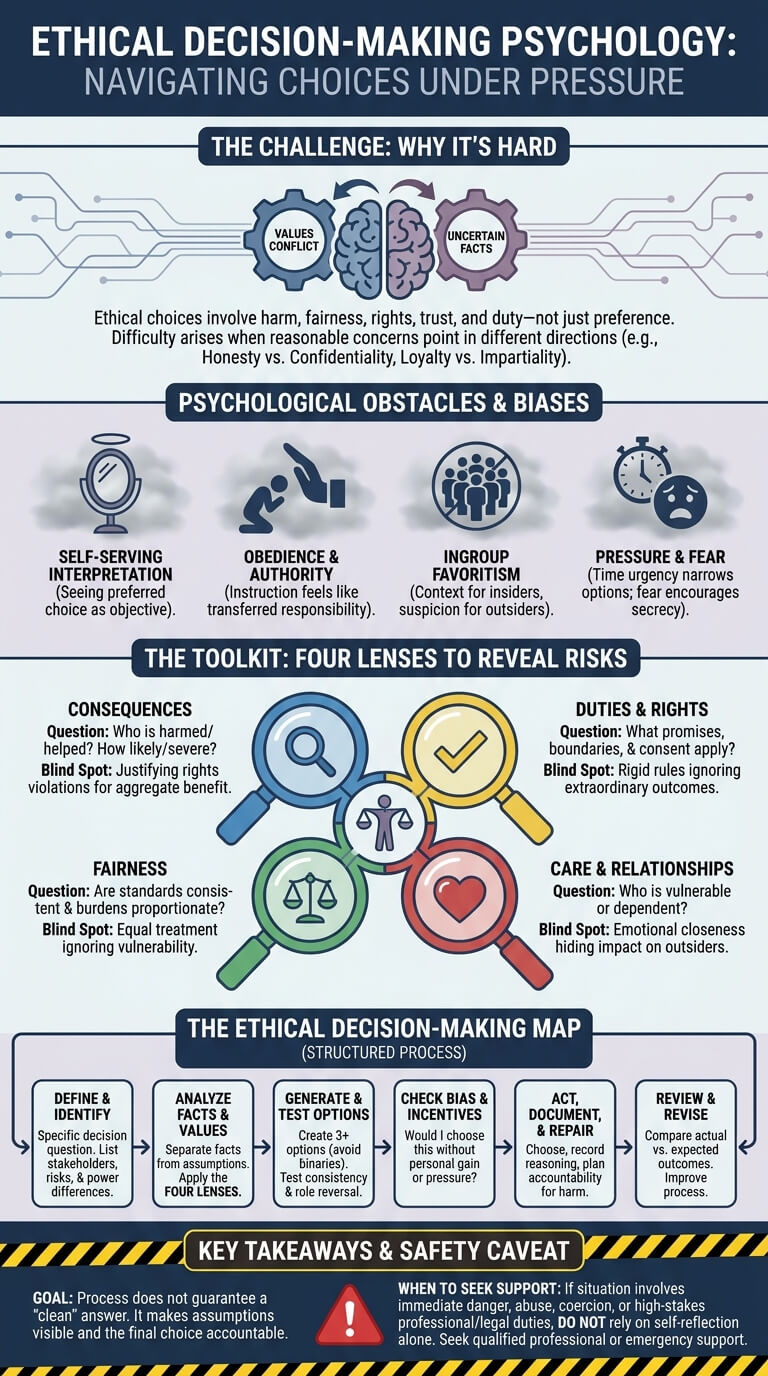
Ethical decision-making is the process of choosing when a situation involves harm, fairness, rights, duties, trust, or responsibility. A useful approach defines the specific choice, identifies stakeholders and power differences, separates facts from assumptions, compares several options through consequence, duty, fairness, and care lenses, checks pressure and self-interest, then plans accountability and review.
What Makes a Decision Ethical or Moral?
The choice affects harm, rights, fairness, trust, duty, or responsibility
A decision becomes ethically significant when it changes more than convenience or personal preference. It may expose someone to harm, interfere with consent, distribute burdens unfairly, break a promise, use power, or affect whether others can trust a relationship or process.
For example, choosing between two meals is usually a preference decision. Choosing whether to hide an ingredient from someone with an allergy is an ethical decision because the choice affects informed consent and safety.
Ethical is not identical to legal, popular, comfortable, or emotionally satisfying
A legal choice can still be unfair or misleading. A popular choice can ignore a vulnerable minority. A comfortable choice can protect the decision-maker from embarrassment while transferring the cost to someone else. A strong feeling can identify a real concern without proving which response is best.
The Markkula Center’s explanation of what ethics is and is not distinguishes ethical standards from feelings, law, religion, and whatever a society happens to accept. These influences may matter, but none is a complete substitute for examining rights, obligations, benefits, fairness, and character.
Why reasonable people may still reach different conclusions
People may agree that a decision is morally important yet weigh the concerns differently. One person prioritizes immediate protection. Another prioritizes truthful process. One sees confidentiality as the central duty. Another believes preventing serious harm overrides it.
Disagreement does not mean that every conclusion is equally defensible. It means the reasoning must identify the facts, principles, tradeoffs, and standards behind the choice rather than relying only on certainty.
Why Ethical Decisions Feel Difficult
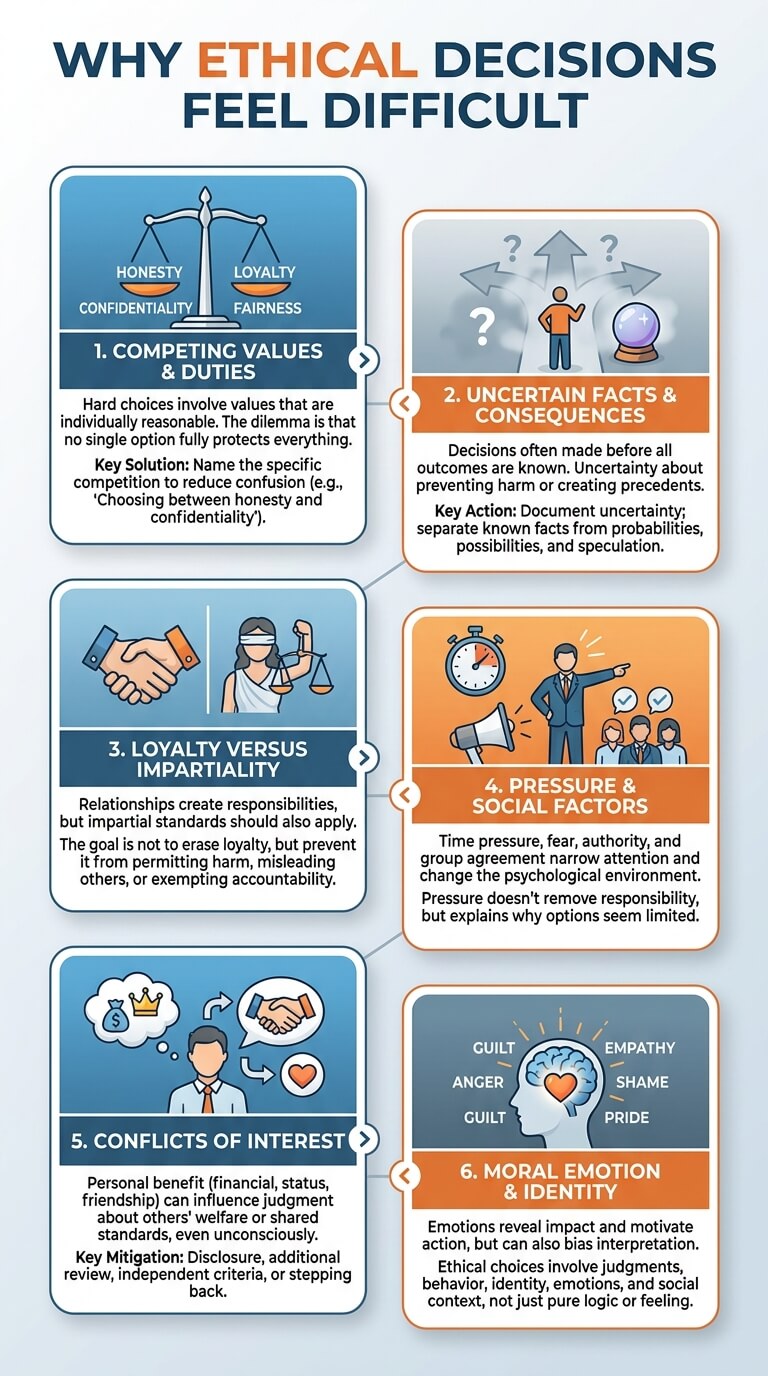
Competing values and duties
Hard choices often involve values that are individually reasonable. You may want to be honest and kind, loyal and fair, protective and respectful of autonomy. The dilemma appears because no available option fully protects everything.
Naming the competition reduces confusion. “I am choosing between honesty and confidentiality” is more useful than “Everything feels wrong.”
Uncertain facts and future consequences
Ethical decisions are often made before all consequences are known. You may not know whether speaking up will prevent harm, whether silence will protect privacy, or whether an exception will create a damaging precedent.
Uncertainty should be documented rather than hidden. Separate what is known, what is probable, what is possible, and what remains speculation.
Loyalty versus impartiality
Relationships create legitimate responsibilities. You may owe more time, support, or confidentiality to someone who depends on you. Impartiality asks whether the same basic standard would apply if the identities changed.
The goal is not to erase loyalty. It is to prevent loyalty from becoming permission to deny harm, mislead others, or exempt insiders from accountability.
Fear, urgency, authority, and social pressure
Time pressure narrows attention. Fear increases the appeal of secrecy or compliance. Authority can make an instruction feel like someone else’s responsibility. Group agreement can feel like evidence even when every member received the same incomplete information.
Pressure changes the psychological environment of the choice. It does not remove personal responsibility, but it may explain why options and objections become harder to notice.
Personal incentives and conflicts of interest
A conflict of interest exists when the decision-maker’s benefit can influence judgment about someone else’s welfare or a shared standard. The influence does not need to be deliberate. Financial gain, status, convenience, reputation, friendship, or fear of loss can make a favorable interpretation feel objective.
Disclosure helps but may not remove the bias. Additional review, independent criteria, or stepping back from the decision may be necessary.
Moral emotion and identity threat
Guilt, anger, empathy, shame, loyalty, and pride direct attention toward different concerns. These emotions can reveal impact and motivate action. They can also make one interpretation feel complete.
A broad review of the psychology of morality emphasizes that moral life involves judgments, behavior, identity, emotions, relationships, and social context. Ethical choices therefore cannot be understood as pure logic or pure feeling.
The Ethical Decision-Making Map
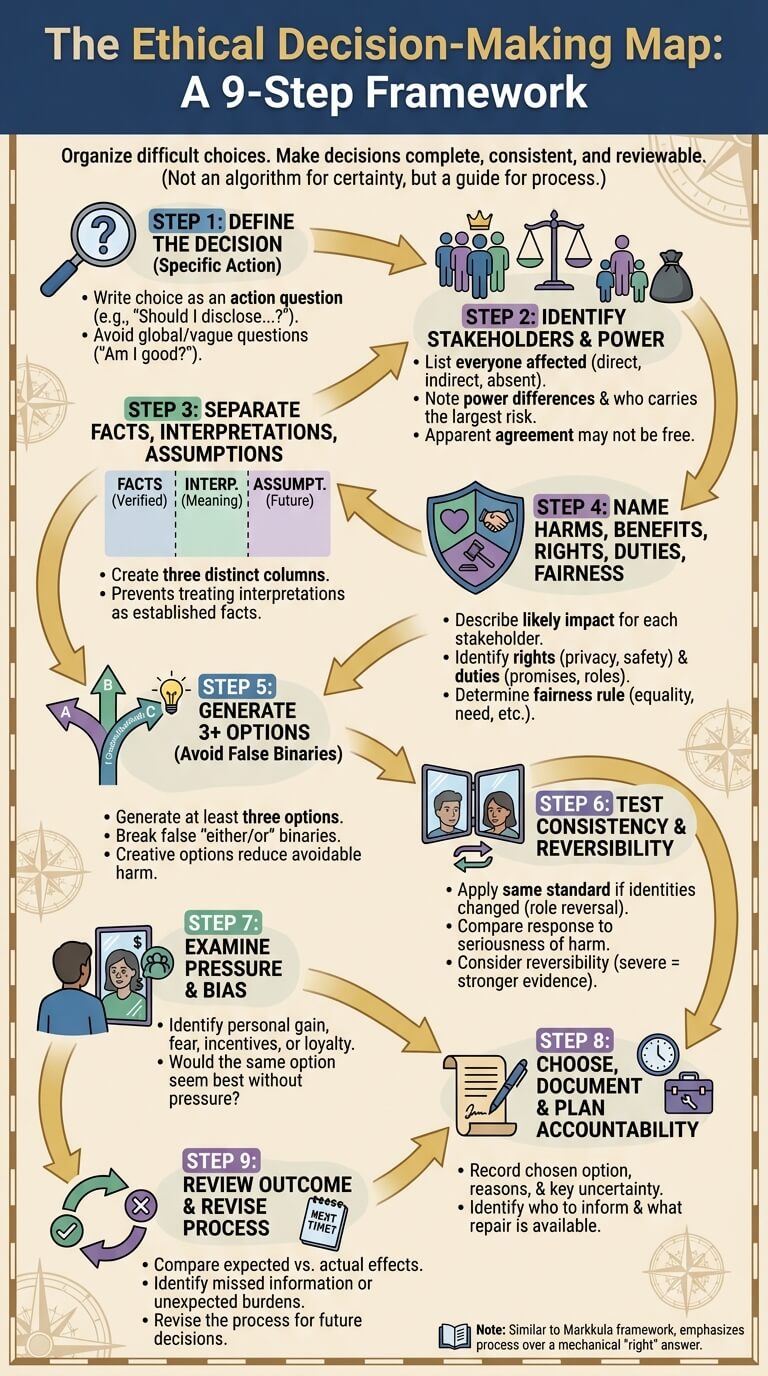
The following nine steps organize a difficult choice. They do not remove uncertainty, and they may not make every option feel clean. Their purpose is to make the decision more complete, consistent, and reviewable.
Step 1: Define the specific decision, not the entire situation
Write the choice as an action question: “Should I disclose this mistake to the person affected?” Avoid global questions such as “Am I a good person?” or “Is this whole relationship ethical?” A specific decision reveals options and consequences.
Step 2: Identify stakeholders, power differences, and who carries risk
List everyone directly and indirectly affected. Include people who are absent, less powerful, unable to object, or likely to carry delayed consequences. Identify who receives the benefit and who carries the largest risk.
Power matters because apparent agreement may not be freely given when someone depends on the decision-maker for money, access, housing, grades, approval, or safety.
Step 3: Separate known facts, interpretations, and assumptions
Create three columns. In the first, record facts that can be verified. In the second, record interpretations about motive or meaning. In the third, record assumptions about what may happen next.
This prevents an interpretation such as “They will never forgive me” from being treated like an established fact.
Step 4: Name the harms, benefits, rights, duties, and fairness rules
Describe the likely harm and benefit for each stakeholder. Identify rights such as privacy, safety, informed consent, or freedom from deception. Name duties created by promises, roles, or accepted responsibility.
Then identify the fairness rule. Does the decision require equality, response to need, recognition of contribution, reciprocity, fair procedure, or proportional consequences?
Step 5: Generate more than two options
Pressure creates false binaries: tell everything or hide everything, obey or betray, help one person or abandon them. Generate at least three options, including modified disclosure, delayed action with a review point, consultation, partial recusal, a boundary, or a protective step that preserves more than one value.
Creative options do not eliminate tradeoffs. They reduce avoidable harm created by assuming only two paths exist.
Step 6: Test consistency, role reversal, proportionality, and reversibility
Ask whether the same standard would apply if identities changed. Compare the response with the seriousness and certainty of the harm. Consider whether the choice can be corrected if new information appears.
A severe and irreversible response requires stronger evidence than a temporary protective pause.
Step 7: Examine pressure, incentives, bias, and group loyalty
Identify what you gain, fear, or protect. Would the same option seem best without the reward, audience, authority figure, or group expectation? Are you applying intention to yourself and impact to others?
This step does not prove that a self-interested option is wrong. It shows where independent review is most useful.
Step 8: Choose, document the reasoning, and plan accountability
Record the chosen option, the reasons, the most important uncertainty, and the harm you are trying to prevent. Identify who should be informed and what repair will be available if the decision causes damage.
A written rationale discourages changing the standard after the result becomes known.
Step 9: Review the outcome and revise the process
After the decision, compare the expected and actual effects. Ask what information was missed, which stakeholder carried an unexpected burden, and whether the process should change next time.
The Markkula ethical decision-making framework similarly emphasizes recognizing an ethical issue, gathering facts and stakeholders, evaluating options through several lenses, acting, and reflecting on the outcome. Its authors also caution that a framework is not an algorithm that mechanically produces the right answer.
Four Lenses That Reveal Different Risks
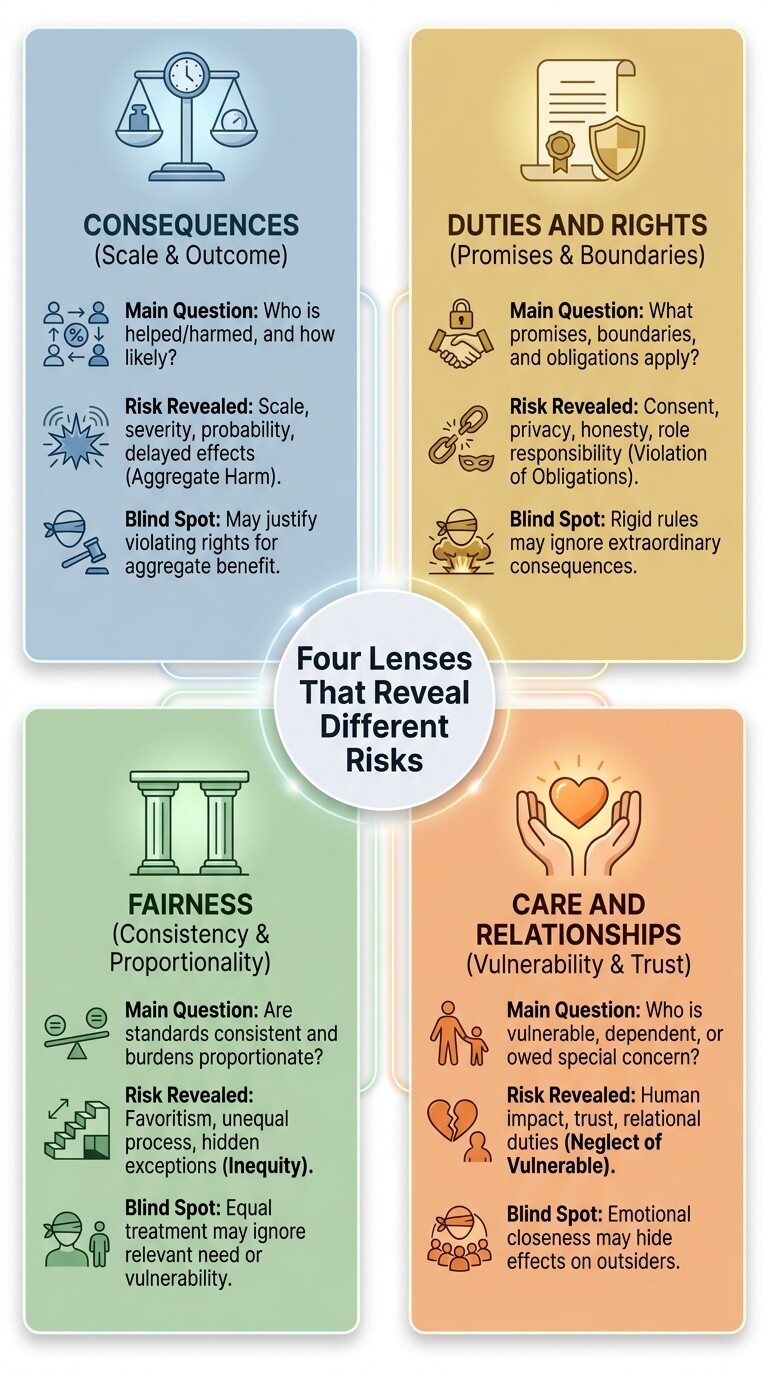
| Lens | Main question | Risk it reveals | Blind spot if used alone |
|---|---|---|---|
| Consequences | Who is helped or harmed, and how likely is each outcome? | Scale, severity, probability, and delayed effects | May justify violating important rights for aggregate benefit |
| Duties and rights | What promises, boundaries, and obligations apply? | Consent, privacy, honesty, and role responsibility | Rigid rules may ignore extraordinary consequences |
| Fairness | Are standards consistent and burdens proportionate? | Favoritism, unequal process, and hidden exceptions | Equal treatment may ignore relevant need or vulnerability |
| Care and relationships | Who is vulnerable, dependent, or owed special concern? | Human impact, trust, and relational duties | Emotional closeness may hide effects on outsiders |
Consequences: who is helped or harmed and how likely is each outcome?
Estimate severity, probability, duration, reversibility, and who bears the effect. Do not count only the most visible outcome. Include indirect and long-term consequences, while marking uncertainty honestly.
Duties and rights: what promises, boundaries, or obligations apply?
Some actions are constrained by consent, confidentiality, truthful representation, accepted roles, or the right not to be used merely as a means. Ask what others reasonably relied on you to do.
Fairness: are standards consistent and burdens proportionate?
Check whether the criteria were known before the outcome and whether similar cases receive similar treatment. Identify whether an exception is based on need, capacity, risk, or another relevant difference rather than identity or convenience.
Care and relationships: who is vulnerable or dependent on the decision?
Relationships add context that general rules may miss. A dependent person, a trusted friend, or someone with less power may require special attention. Care remains accountable when it does not erase outsiders or convert support into control.
Psychological Biases in Ethical Choices
Self-serving interpretation
People often experience their preferred choice as objectively reasonable. They see their own pressure, intention, and sacrifice in detail while seeing another person mainly through visible behavior.
Use written criteria, role reversal, and independent review when the decision benefits you.
Obedience and diffusion of responsibility
Authority can reduce the felt sense of personal choice. In a chain of action, each person may believe someone else is responsible for the final harm. Clarify what part of the action you control and what duty remains yours even when instructions come from above.
Ingroup favoritism
Insiders receive context and patience. Outsiders receive suspicion and global labels. Remove group identities from the description, evaluate the conduct, then add identities back only where they create a relevant responsibility.
Framing and omission
The way a choice is presented changes attention. “Protecting confidentiality” and “withholding risk information” may describe the same act from different angles. Omission can feel less active than deception even when it changes consent in the same way.
Outcome bias and hindsight
A lucky outcome can make a reckless process look wise. A bad outcome can make a careful decision look negligent after the fact. Evaluate what was reasonably knowable at the time, then review whether the process handled uncertainty responsibly.
Moral licensing and sunk moral credit
Past goodness can make a present exception feel earned. “I have always been honest” does not determine whether the current omission is honest. Evaluate the present action without adding unrelated moral credit.
Decisions Under Pressure
Time pressure narrows options
Urgency encourages binary thinking and favors the most emotionally available response. When safety does not require immediate action, create even a short pause to identify a third option, confirm one key fact, or consult someone independent.
Authority changes perceived responsibility
An instruction may feel like a transfer of responsibility. Yet the person carrying out the action may still contribute to harm. Ask who has formal authority, who has relevant expertise, who is accountable, and what escalation path exists.
Fear encourages secrecy or compliance
Fear of punishment, rejection, embarrassment, or loss can make concealment feel necessary. Write down the feared consequence and distinguish discomfort from danger. When retaliation is credible, prioritize safety and protected advice rather than direct confrontation.
Group consensus can feel like evidence
Agreement may reflect shared information, but it may also reflect conformity, authority, or reluctance to object. Research on online moral conformity found that group judgments can shift individual moral evaluations. Consensus should therefore be examined as social information, not treated as automatic proof.
A pause, second opinion, or written rationale can restore perspective
A brief delay can reduce emotional narrowing. An independent person may notice a missing stakeholder or conflict of interest. Writing the rationale makes selective standards easier to see.
Ethical Decision-Making Examples
Telling a difficult truth that may cause harm
Situation: You discover that a friend has been given false information that affects an important personal decision.
What the person may feel: fear of damaging the relationship or causing immediate distress.
What it may mean: honesty, care, timing, and the friend’s right to make an informed choice are competing.
What to do next: confirm the facts, assess urgency, disclose only what is relevant, choose a respectful setting, and avoid using kindness as a reason to preserve deception.
Protecting confidentiality when someone may be at risk
Situation: Someone asks you to keep information private, but the information suggests possible serious harm.
What the person may feel: torn between loyalty and protection.
What it may mean: confidentiality may have limits when danger is credible, but the correct response depends on role, law, professional duties, and actual risk.
What to do next: do not make a high-stakes safeguarding judgment alone. Seek qualified guidance and emergency support when danger is immediate.
Choosing between loyalty and fair treatment
Situation: A friend applies for an opportunity you help allocate.
What the person may feel: pressure to help someone close and fear of appearing disloyal.
What it may mean: the relationship creates bias or a conflict of interest even if you intend to be fair.
What to do next: disclose the relationship, use criteria set in advance, invite independent review, or step back from the decision.
Disclosing a conflict of interest
Situation: You recommend a service while receiving an undisclosed benefit if the recommendation is accepted.
What the person may feel: convinced that the recommendation is still objectively best.
What it may mean: personal benefit can influence judgment and the other person’s consent depends on information being visible.
What to do next: disclose the benefit plainly and consider whether someone without the conflict should make or review the recommendation.
Correcting a mistake that benefits you
Situation: A billing or allocation error gives you more than you were supposed to receive.
What the person may feel: temptation to treat silence as harmless because the mistake was not yours.
What it may mean: keeping the benefit depends on another person remaining unaware of information that could change the outcome.
What to do next: report the error, preserve documentation, and allow the responsible party to correct it through a transparent process.
Ethical Decisions Versus Nearby Topics
| Nearby topic | Main focus | Difference from ethical decision-making |
|---|---|---|
| Everyday decision-making | Preferences, habits, risk, effort, and choice overload | May not involve duties, rights, harm, or accountability |
| Moral disagreement | Why people reach different judgments | Explains disagreement rather than structuring one choice |
| Moral licensing | Past goodness creates permission | One bias that may distort the present decision |
| Moral hypocrisy | Unequal standards protect image or advantage | A pattern of inconsistency, not every hard tradeoff |
| Empathy | Understanding or resonating with another experience | One source of information, not the entire decision process |
Ethical decision-making versus everyday decision-making
Everyday choices may involve comfort, efficiency, uncertainty, or preference. Ethical choices add concerns such as deception, harm, consent, fairness, trust, rights, and responsibility.
Ethical disagreement versus lack of facts
People may appear to disagree morally when they actually rely on different facts. Verify the factual disagreement before debating priorities or principles.
A legitimate exception versus moral licensing
A legitimate exception is based on a relevant difference and can be stated as a repeatable rule. Licensing uses past goodness as permission for the current exception.
A hard tradeoff versus moral hypocrisy
A hard tradeoff openly acknowledges which value will not be fully protected. Hypocrisy applies the standard unevenly while preserving a moral image or advantage.
Empathy versus impartial standards
Empathy reveals lived impact. Impartial standards protect people who are absent, unfamiliar, or less emotionally vivid. Ethical decisions often need both.
A Pressure and Integrity Self-Check
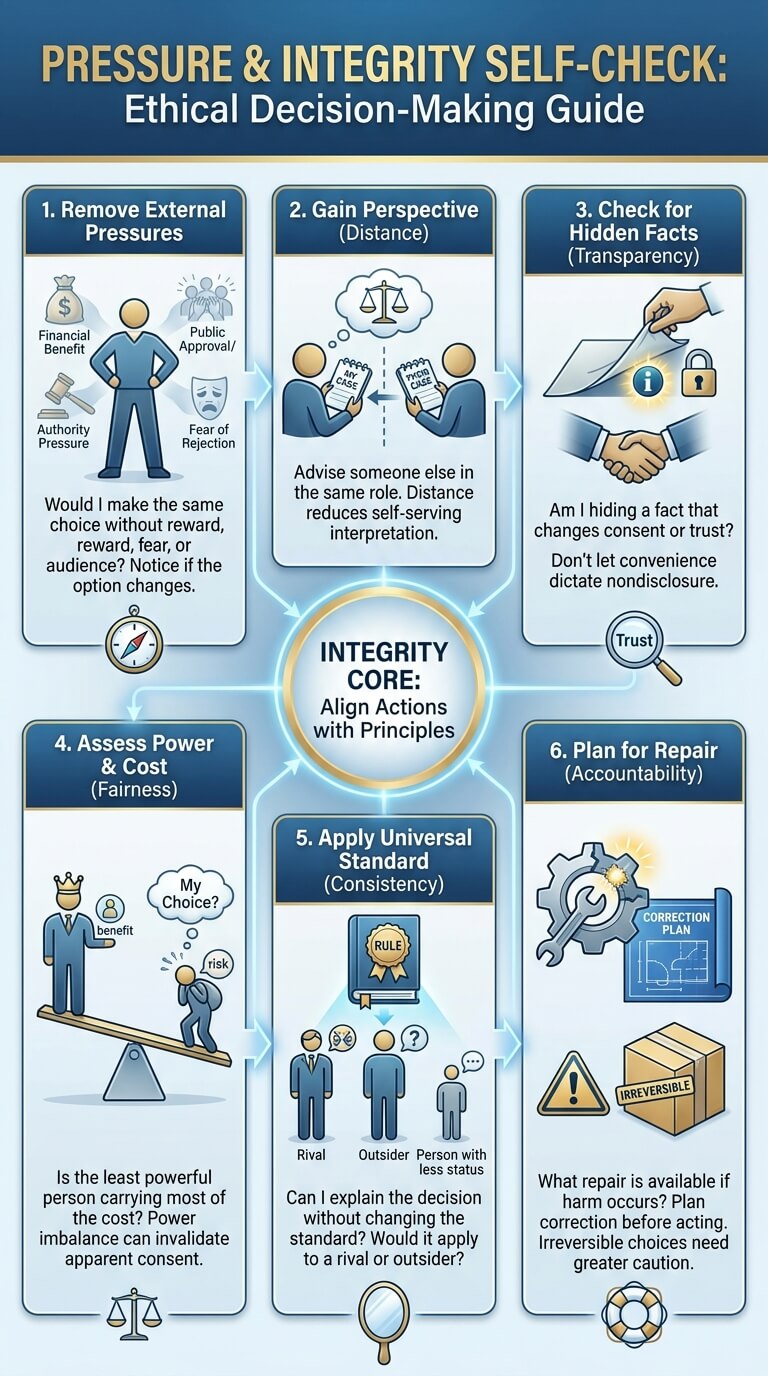
Would I make the same choice without reward, fear, or audience?
Mentally remove the financial benefit, reputational gain, authority pressure, fear of rejection, and public approval. Notice whether the preferred option changes.
What would I advise someone else in the same role?
Distance reduces self-serving interpretation. Give advice before revealing that the case is yours, or write the advice as if it were for a stranger.
Am I hiding a fact that would change consent or trust?
Identify information the affected person would reasonably consider important. Privacy and confidentiality may limit disclosure, but convenience alone is not a sufficient reason to preserve another person’s false assumption.
Is the least powerful person carrying most of the cost?
Examine whether someone with fewer choices bears the risk while others receive the benefit. Power differences may make apparent consent less meaningful.
Can I explain the decision without changing the standard?
State the rule that justifies the choice. Would it apply to a rival, outsider, or person with less status in comparable conditions?
What repair is available if the outcome is harmful?
Plan correction before acting. Irreversible choices and choices with no realistic repair require stronger evidence and greater caution.
What to Do When No Option Feels Clean
Identify the unavoidable tradeoff
Name what cannot be fully protected. Ethical maturity sometimes means accepting that a choice has a moral cost rather than pretending the preferred option is pure.
Reduce preventable harm
Separate unavoidable harm from harm created by poor planning, secrecy, humiliation, or lack of consultation. A difficult choice does not justify careless implementation.
Protect rights and the most vulnerable
Give special attention to people with less power, fewer alternatives, or greater exposure to irreversible harm. Protection should not erase everyone else’s rights, but vulnerability changes what is at stake.
Make the exception explicit and limited
State why the normal rule cannot be followed, who qualifies for the exception, how long it lasts, and when it will be reviewed. Hidden exceptions create favoritism and mistrust.
Document uncertainty and create a review point
Record what is unknown and what evidence would trigger revision. A review point keeps a temporary decision from becoming permanent merely through inertia.
Seek qualified advice when stakes exceed personal competence
High-stakes legal, medical, financial, employment, safeguarding, or professional-code decisions require relevant expertise. A general reflection process cannot determine technical obligations or replace formal advice.
Bridge to Fairness, Empathy, and Moral Self-Image
Choosing the fairness rule
Clarify whether the decision should use equality, equity, need, reciprocity, procedure, or proportionality. Different rules may produce different outcomes, so the chosen rule needs a reason.
Including concern without letting vivid emotion dominate
Keep the visible person’s experience in the decision while adding missing stakeholders, probability, scale, and long-term effects. Stories show human impact. Broader information shows distribution.
Checking hypocrisy and licensing before finalizing the choice
Use role reversal to detect unequal standards. Remove past moral credit to see whether the present choice still fits the rule. Good identity and good history should not replace current accountability.
When Professional or Safety Support Is Needed
Legal, medical, financial, workplace, or safeguarding obligations
Professional roles may include reporting duties, confidentiality limits, conflicts-of-interest rules, or formal procedures that are not obvious from general psychology. Consult the relevant qualified professional, policy, regulator, or ethics resource before acting.
Cultural context can also affect how people understand autonomy, duty, family involvement, authority, and acceptable disclosure. A review of culture and decision making shows that context can influence information use, option generation, and interpretation across decision phases. Cultural understanding should inform careful consultation, not replace rights or safety.
Threats, coercion, abuse, self-harm, violence, or immediate danger
Do not rely on a personal checklist when someone may be in immediate danger or when coercion, threats, stalking, violence, abuse, or self-harm is involved. Prioritize emergency support, safeguarding procedures, crisis resources, and qualified guidance appropriate to the situation.
Emotion is especially important under threat, but regulation can help preserve judgment. A review of emotion regulation in moral judgment describes moral decisions as involving interacting automatic and controlled processes rather than a simple battle between feeling and reason.
Frequently Asked Questions About Ethical Decision-Making
Is the ethical choice always the one with the least harm?
No. Harm is important, but rights, consent, fairness, duties, and trust may limit which harm-reducing options are acceptable. The least total harm is one lens, not the only lens.
What if following a rule creates a worse outcome?
Examine the seriousness and probability of the outcome, the purpose of the rule, whether a principled exception exists, and who has authority to interpret it. High-stakes professional rules require qualified advice rather than personal improvisation.
How should loyalty affect an ethical decision?
Loyalty can create special responsibilities such as care, confidentiality, or support. It should not automatically erase outsiders’ harm, informed consent, or accountability for serious conduct.
Can emotion improve ethical decisions?
Yes. Empathy can reveal impact, guilt can motivate repair, and anger can identify a violated boundary. Emotion improves judgment when it adds information and motivation without becoming the sole proof of facts, intention, or proportional response.
What if I realize afterward that I chose badly?
Acknowledge the mistake, identify who was affected, correct false information, repair what can be repaired, and change the process that produced the decision. Accountability includes learning rather than protecting the original choice at all costs.
Key Takeaways
- Ethical choices involve harm, fairness, rights, duties, trust, consent, or responsibility, not only preference.
- Difficult decisions often contain competing values, incomplete facts, pressure, incentives, and unequal power.
- The Ethical Decision-Making Map moves from a specific decision and stakeholder analysis to options, consistency tests, accountability, and review.
- Consequence, duty, fairness, and care lenses reveal different risks and should be used together.
- Role reversal, written criteria, independent review, and conflict disclosure reduce self-serving judgment.
- No checklist guarantees a morally correct answer, and high-stakes professional or safety situations require qualified support.
Take one difficult choice and write it as a single action question. List the least powerful stakeholder, the fact you are least certain about, and one option you have not yet considered. Then apply the four lenses before deciding what accountability and review will look like.
Author note: Michael Reed is the Founder and Lead Writer at Psychology Exposed. He explains human behavior, emotional patterns, self-awareness, relationships, and everyday decisions in clear, research-aware language. This material is educational and is not a substitute for mental health, medical, legal, financial, employment, safeguarding, or crisis support.

Michael Reed is the Founder and Lead Writer at Psychology Exposed. He writes about human behavior, relationships, emotional patterns, self-awareness, and practical psychology topics using research-informed, easy-to-understand content.
Read More About Michael Reed: https://psychologyexposed.com/michael-reed/