
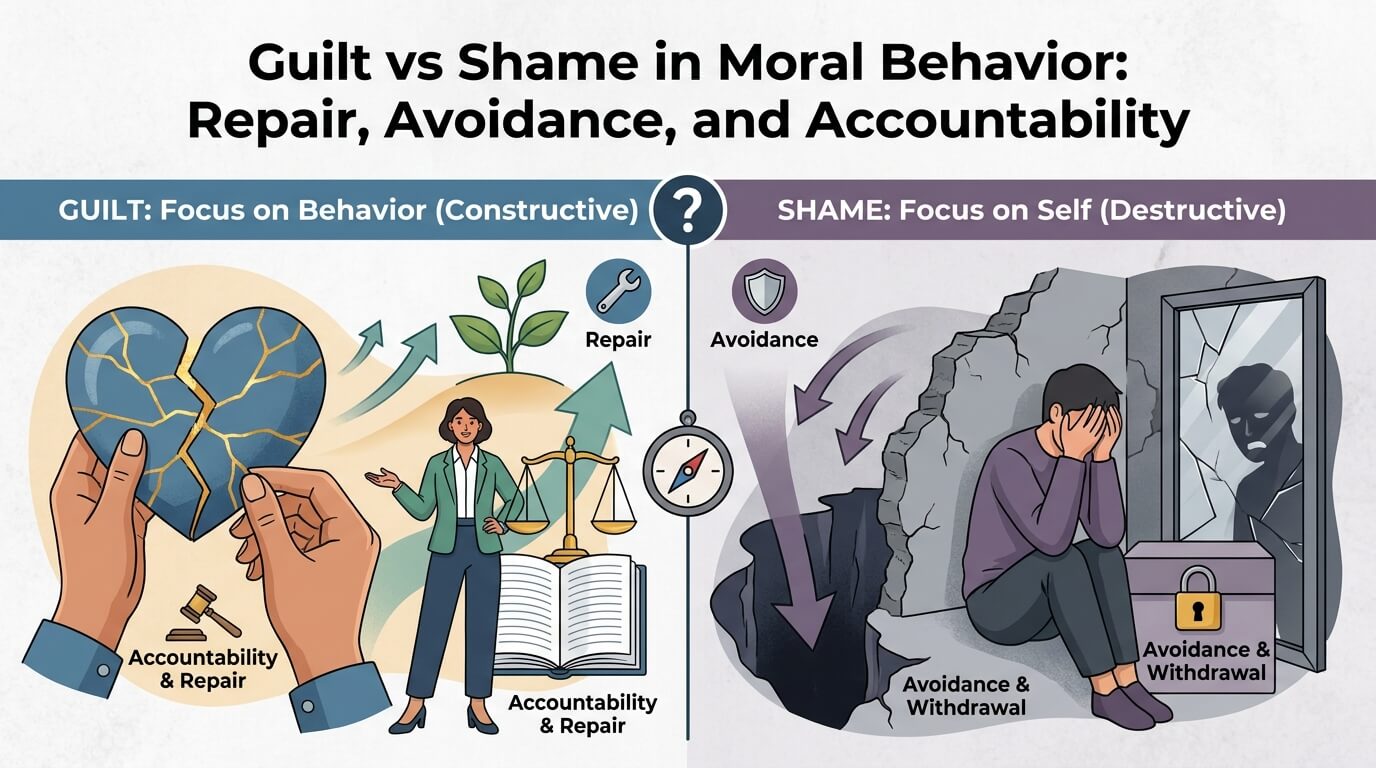
You realize that your words hurt someone. One response sounds like, “I did something wrong, and I need to address it.” Another sounds like, “I am a terrible person, and everyone will see it.” Both reactions can feel painful, but they organize attention in different ways.
Guilt usually focuses more on a behavior, decision, or omission. Shame usually reaches more deeply into identity, social exposure, and the fear that the whole self is defective or unworthy. This difference can shape whether a person approaches the harm, apologizes, makes amends, hides, attacks, denies, or becomes trapped in self-condemnation.
The distinction is useful, but it should not become a rigid rule. Guilt can become excessive, inaccurate, or controlling. Shame can sometimes alert a person to a damaged relationship or a threatened social identity and may, in some circumstances, motivate change. The practical goal is not to eliminate every painful moral emotion. It is to convert valid responsibility into repair without turning one action into a total verdict on the self.
Quick Answer
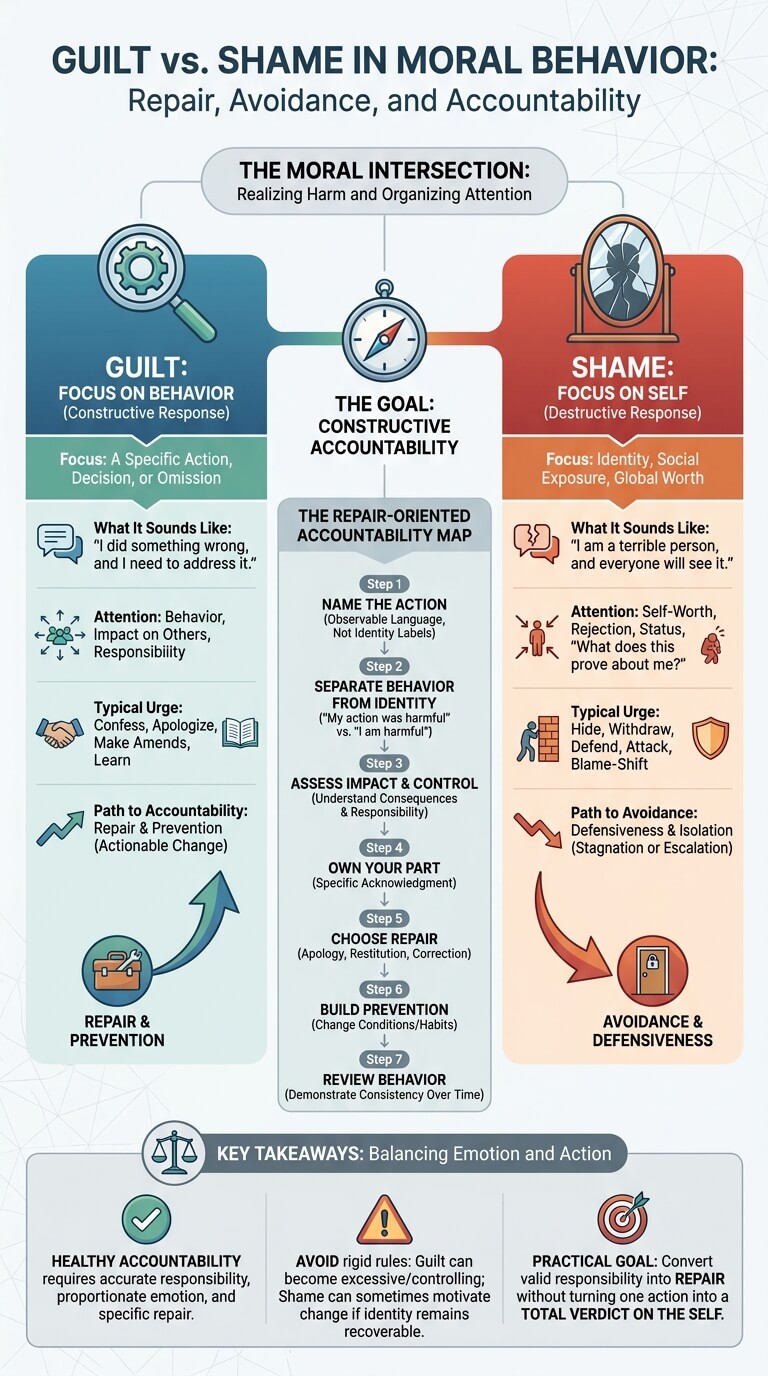
Guilt tends to focus on a specific behavior: “I did something wrong.” Shame tends to focus on the self: “I am wrong.” Guilt is often associated with responsibility, empathy, apology, and repair, while shame more often promotes hiding, withdrawal, defensiveness, or blame-shifting. However, neither emotion is automatically helpful or harmful. Healthy accountability requires accurate responsibility, proportionate emotion, specific repair, and a path back to responsible participation.
What Guilt and Shame Mean in Moral Psychology
Guilt and shame are self-conscious moral emotions. They involve evaluating the self in relation to values, expectations, relationships, or social standards. Unlike fear, which focuses mainly on threat, or anger, which focuses on perceived obstruction or violation, guilt and shame ask what an event means about one’s conduct or standing.
A major review of moral emotions and moral behavior describes a widely used distinction: guilt focuses more narrowly on a negative action, while shame involves a more global negative evaluation of the self. That focus influences attention and action tendencies.
Guilt: “I did something wrong”
Guilt connects discomfort to a behavior, decision, failure, or omission. The person may think, “I lied,” “I broke my promise,” “I ignored information that mattered,” or “I caused harm that I should address.”
Because the problem is located in an action, change remains imaginable. The person can tell the truth, apologize, return a resource, correct a process, accept a consequence, or behave differently next time.
Shame: “There is something wrong with me”
Shame expands the judgment from conduct to identity. The person may think, “I am selfish,” “I am disgusting,” “I am a failure,” or “If people knew, they would reject me.” Attention turns inward toward exposure, worth, and social standing.
When the whole self appears defective, repair may feel insufficient. Correcting one act cannot easily repair a total identity judgment. The person may hide, disappear, attack the accuser, or search for evidence that the failure was not really theirs.
Both emotions can involve social evaluation
Guilt and shame are not separated simply by whether other people know. A person can feel guilt privately and shame in complete secrecy. Both emotions are influenced by imagined judgment, relationships, and internalized standards.
The difference concerns what is being evaluated. Guilt asks what the person did and how it affected others. Shame asks what the event reveals about the person’s value or acceptability.
State emotion versus a repeated emotional tendency
A state is a response to a particular event. A tendency or proneness refers to how readily someone experiences guilt or shame across situations. Research on tendencies can reveal patterns, but it should not be used to label an individual from one reaction.
A person can experience intense shame after one public failure without having a fixed shame-based personality. Another person may feel little emotion yet still recognize responsibility through reflection, principle, or evidence.
The Central Difference: Behavior Focus Versus Self Focus
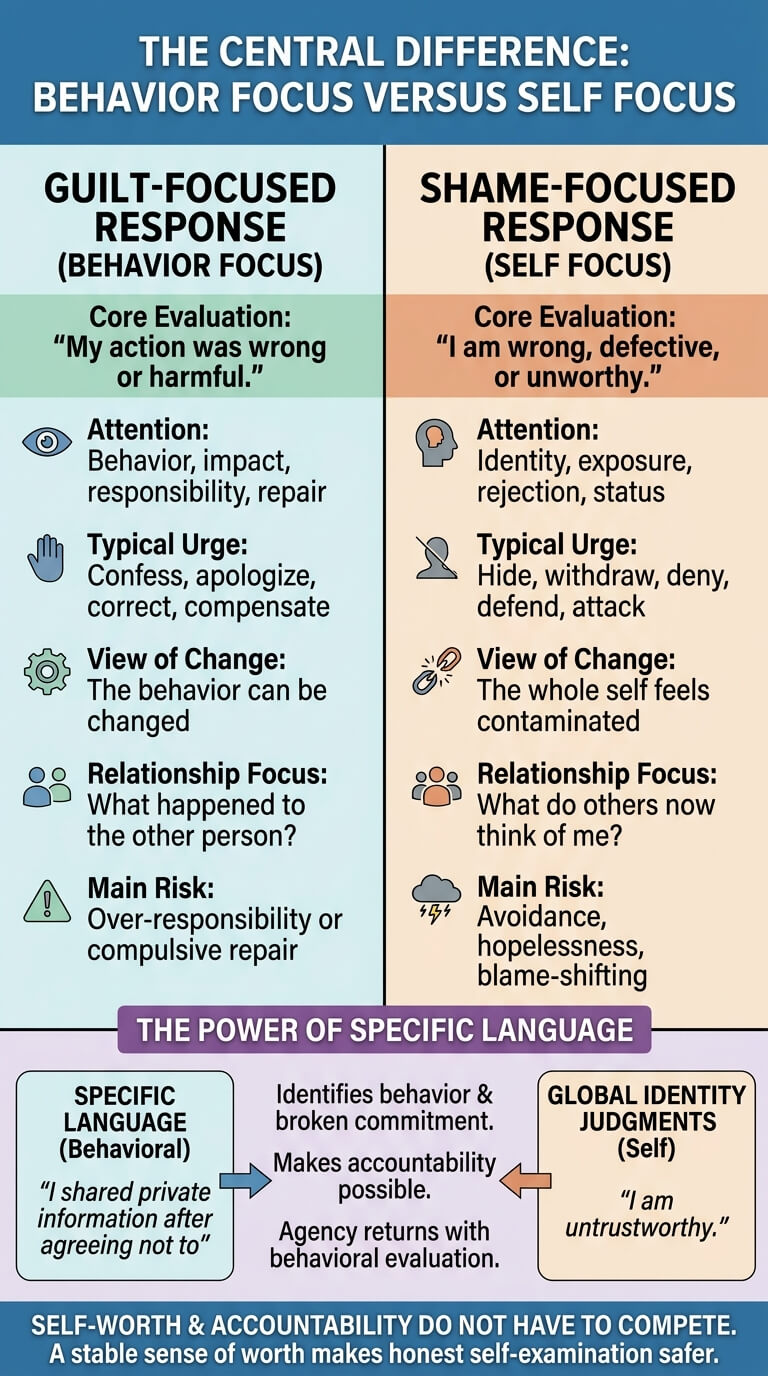
| Dimension | Guilt-focused response | Shame-focused response |
|---|---|---|
| Core evaluation | “My action was wrong or harmful.” | “I am wrong, defective, or unworthy.” |
| Attention | Behavior, impact, responsibility, repair | Identity, exposure, rejection, status |
| Typical urge | Confess, apologize, correct, compensate | Hide, withdraw, deny, defend, attack |
| View of change | The behavior can be changed | The whole self feels contaminated |
| Relationship focus | What happened to the other person? | What do others now think of me? |
| Main risk | Over-responsibility or compulsive repair | Avoidance, hopelessness, blame-shifting |
Specific language keeps responsibility workable
Compare “I shared private information after agreeing not to” with “I am untrustworthy.” The first statement identifies a behavior and a broken commitment. The second turns the event into a stable identity.
Specific language does not soften accountability. It makes accountability possible because the person can identify exactly what must be acknowledged, repaired, and prevented.
Global identity judgments reduce the sense of agency
If the problem is “I am bad,” there is no clear next action. The person may try to escape the feeling rather than address the impact. They may seek reassurance that they are good, demand quick forgiveness, or avoid the affected person.
Agency returns when the evaluation becomes behavioral: “I made this choice, it had this effect, and I am responsible for these next steps.”
Self-worth and accountability do not have to compete
Some people fear that separating behavior from identity is an excuse. It is possible to hold both truths: the action was harmful, and the person remains capable of responsibility and change.
Accountability becomes weaker when the person must first prove they are not completely worthless. A stable sense of human worth can make honest self-examination safer.
How Guilt Can Support Repair
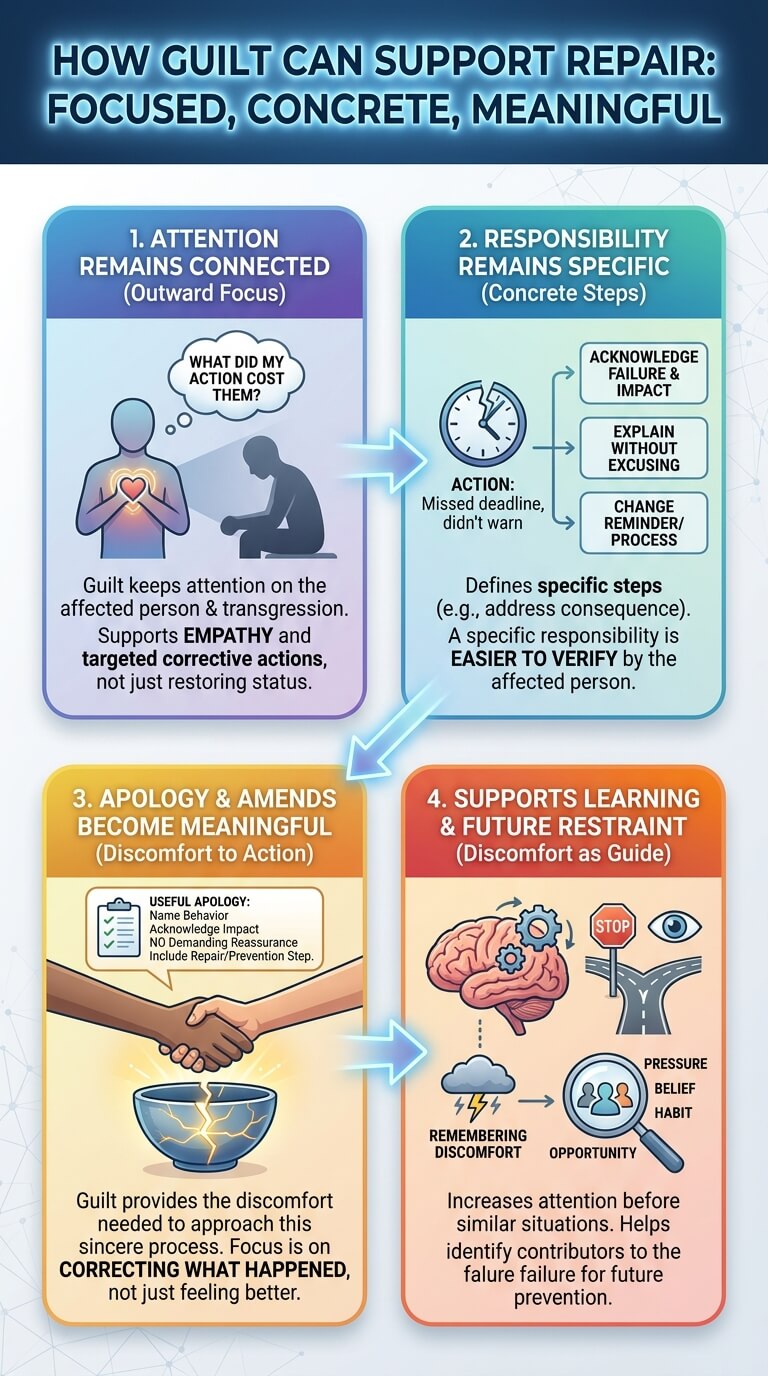
Attention stays connected to the harmed person
Guilt often keeps attention on what happened and who was affected. The person asks, “What did my action cost them?” That outward focus supports empathy and more accurate repair.
Research on guilt and targeted corrective actions suggests that guilty feelings can motivate responses directed toward the specific transgression rather than only broad attempts to restore status. The focus is not simply feeling better. It is correcting what happened.
Responsibility remains specific enough to act on
“I missed an important deadline and did not warn the person depending on me” suggests concrete steps: acknowledge the failure, explain without excusing, address the immediate consequence, and change the reminder or communication process.
A specific responsibility is easier to verify. The affected person can see whether the promised repair actually occurs.
Apology and amends become meaningful
A useful apology names the behavior, acknowledges impact, avoids demanding reassurance, and includes a repair or prevention step. Guilt can provide the discomfort needed to approach this process.
Guilt can support learning and future restraint
Remembering the discomfort associated with a harmful choice may increase attention before a similar situation. The person can identify the pressure, belief, habit, or opportunity that contributed to the failure.
When Guilt Becomes Unhelpful
Responsibility is exaggerated or inaccurate
A person may feel guilty for outcomes they did not control, for setting a reasonable boundary, or for another adult’s reaction to an honest decision. The emotion can be real while the responsibility judgment is inaccurate.
Ask what action was actually yours, what information you had, what control you possessed, and which consequences came from other people’s choices.
Guilt continues after reasonable repair
Some harm cannot be fully undone, and remorse may remain. Yet endless self-punishment does not provide additional repair. After acknowledgment, proportionate consequence, amends, and prevention, the remaining task may be learning to live responsibly with an imperfect past.
Continuing to suffer is not always evidence of deeper morality. The affected person may need reliable behavior more than repeated declarations of pain.
Guilt is used to control behavior
Another person may describe a boundary as betrayal, call independence selfish, or repeatedly list past sacrifices to create obligation. This can produce guilt without establishing a real moral duty.
A valid responsibility can be stated specifically. “You agreed to repay this amount by this date” differs from “After everything I have done, you owe me whatever I ask.”
Guilt turns into rumination instead of action
Rumination repeats the same judgment without creating new information or useful repair. The person replays the event, imagines condemnation, and searches for certainty that they are forgiven.
Move from repetition to a written plan: responsibility, impact, repair, prevention, and review. If no new action remains, additional rumination may be maintaining distress rather than accountability.
Compulsive confession shifts the burden to others
Confession can be honest and necessary. It can also become a way to obtain repeated reassurance. The affected person may be pressured to comfort the person who caused the harm or to provide immediate absolution.
Before disclosing every detail, ask what information the other person needs for consent, safety, trust, or repair and whether the disclosure primarily serves them or relieves your discomfort.
How Shame Can Lead to Avoidance or Defensiveness
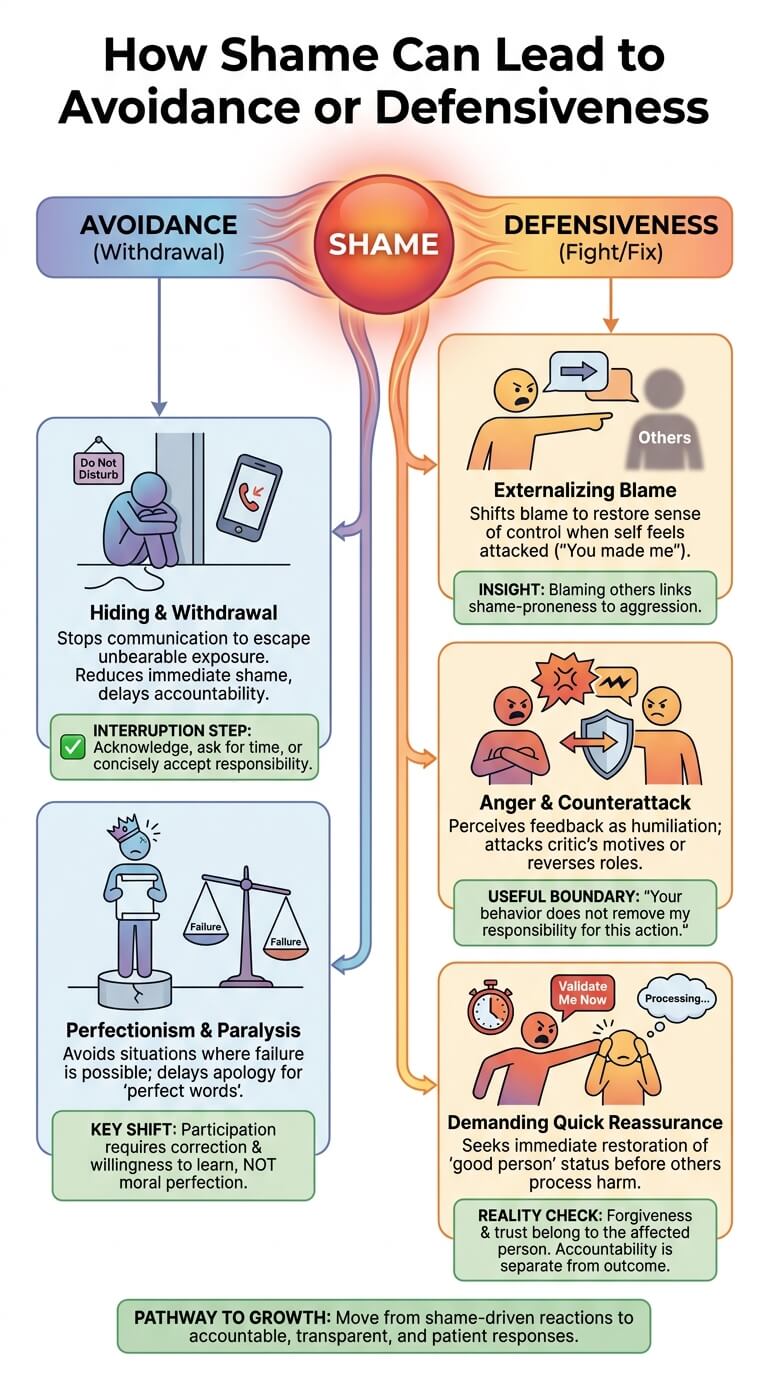
Hiding and withdrawal
If exposure feels unbearable, the person may stop answering messages, avoid the affected person, leave the group, or refuse to discuss the event. Withdrawal reduces immediate shame but delays accountability.
A small approach step can interrupt the pattern: acknowledge receipt, request a specific time to talk, or send a concise statement accepting responsibility without demanding a response.
Externalizing blame
Shame can make the self feel under attack. Blaming someone else may restore a sense of control: “You made me do it,” “You are too sensitive,” or “Everyone behaves this way.”
Research on shame, blame externalization, and aggression found that links between shame-proneness and aggression were substantially connected to the tendency to shift blame outward. This is a group-level finding, not a prediction that every ashamed person becomes aggressive.
Anger and counterattack
Feedback may be experienced as humiliation rather than information about conduct. The person attacks the critic’s motives, brings up unrelated failures, or tries to reverse the roles.
A useful boundary is: “We can discuss my part and your concerns separately, but your behavior does not remove my responsibility for this action.”
Perfectionism and paralysis
When mistakes threaten identity, the person may avoid situations where failure is possible. They delay apologizing until they can find perfect words, refuse to try again, or abandon a valued role.
Responsible participation does not require moral perfection. It requires correction, transparency, and willingness to learn.
Demanding quick reassurance or forgiveness
Shame creates urgency to restore social standing. The person may ask, “Do you still think I am a good person?” before the affected person has had time to process the harm.
Forgiveness, trust, reconciliation, and continued contact belong to the affected person. Accountability does not guarantee any particular relational outcome.
Shame Is Not Always Morally Useless
Shame can signal threatened belonging or reputation
Humans care about social standing and inclusion. Shame can signal that behavior, identity, or public exposure threatens valued relationships. This signal may motivate reflection or change.
The risk is that the person focuses only on restoring reputation rather than addressing the harm. Social concern becomes morally useful when it leads to honest repair rather than image management.
Public and private shame can function differently
Public exposure may intensify defensive attention to status. Private reflection may allow the person to examine conduct with less pressure to perform. The same event can therefore produce different responses depending on audience and safety.
Cultural meanings influence how guilt and shame are experienced
Cultures differ in how strongly they emphasize individual responsibility, family standing, relational harmony, public reputation, and social roles. The words guilt and shame may not map perfectly onto every language or moral system.
Research reconsidering differences between shame and guilt cautions against reducing shame to a uniformly antisocial emotion and guilt to a uniformly prosocial one. Context, appraisal, and regulation matter.
Shame may motivate repair when identity remains recoverable
If the person believes, “This behavior conflicts with the person I want to be, and I can return through responsible action,” shame may be converted into change. If the conclusion is “I am permanently contaminated,” avoidance is more likely.
The key is whether the moral identity is challenged but recoverable, rather than globally destroyed.
Guilt, Shame, and Empathy
Guilt more often keeps attention on the other person
Behavior-focused guilt can highlight the consequences of the action and increase perspective-taking. The question becomes what the affected person experienced and needs.
Shame can turn attention inward
Shame may consume attention with self-evaluation, exposure, and feared rejection. Even intense emotional pain can therefore reduce attention available for the harmed person.
Empathy can improve repair but should not become projection
Imagine the impact, then ask. Do not assume that the person feels what you would feel. A repair plan should respond to their actual needs, rights, and boundaries.
The harmed person should not have to manage the wrongdoer’s emotions
A person accepting responsibility can seek support elsewhere for overwhelming guilt or shame. The affected person may choose to listen, but they should not be made responsible for restoring the other person’s self-worth.
Guilt and Shame Versus Nearby Experiences
| Experience | Main focus | Typical question |
|---|---|---|
| Guilt | A behavior, omission, or responsibility | “What did I do, and how can I address it?” |
| Shame | The whole self and social exposure | “What does this prove about me?” |
| Regret | An outcome or missed alternative | “What do I wish I had chosen?” |
| Embarrassment | An awkward social mistake or unwanted attention | “How do I recover socially?” |
| Remorse | Serious sorrow and responsibility for harm | “How do I face the impact and make amends?” |
| Fear of consequences | Punishment, loss, or exposure | “What will happen to me?” |
| Manipulated guilt | Pressure presented as moral obligation | “Do I truly owe this, or am I being controlled?” |
Guilt versus regret
Regret can concern any disappointing choice, including one with no moral violation. You may regret taking a longer route. Guilt adds responsibility, harm, duty, or a breached standard.
Shame versus embarrassment
Embarrassment usually concerns an awkward mistake or unwanted attention and often passes when the social moment ends. Shame more strongly threatens identity, belonging, or moral worth.
Guilt versus remorse
Remorse usually describes deep sorrow connected to responsibility for serious harm. It may include guilt, empathy, and commitment to repair. The word often implies more sustained moral engagement than a brief guilty feeling.
Guilt versus fear of consequences
Fear asks what punishment, rejection, or loss will happen to the actor. Guilt asks what the actor did and how others were affected. Both can occur together, but compliance motivated only by fear may disappear when detection becomes unlikely.
Authentic guilt versus manipulated guilt
Authentic guilt is linked to a specific responsibility and proportionate repair. Manipulated guilt relies on vague debt, exaggerated obligation, identity attacks, or punishment for reasonable boundaries.
The Repair-Oriented Accountability Map
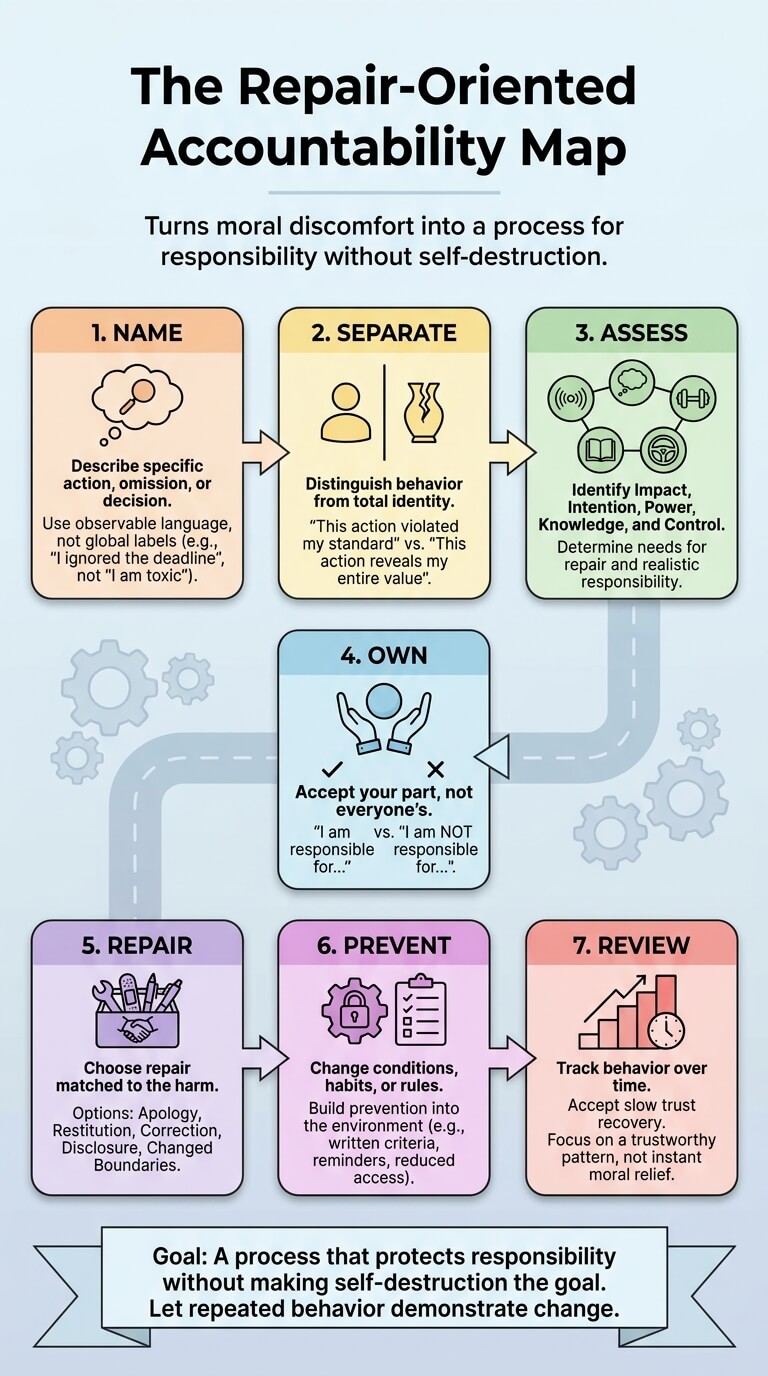
This seven-step map turns moral discomfort into a process that protects responsibility without making self-destruction the goal.
- Name: Describe the specific action, omission, or decision.
- Separate: Distinguish behavior from total identity.
- Assess: Identify impact, intention, power, knowledge, and control.
- Own: Accept the part that is yours without taking responsibility for everything.
- Repair: Choose apology, restitution, correction, disclosure, or changed boundaries.
- Prevent: Change the conditions, habits, or rules that allowed repetition.
- Review: Track behavior over time and accept that trust may recover slowly or not at all.
Step 1: Name the action without global labels
Use observable language: “I repeated private information,” “I ignored the agreed deadline,” or “I benefited from an error and did not report it.” Avoid identity declarations such as “I am toxic” or “I ruin everything.”
Step 2: Separate behavior from total identity
Say, “This action violated my standard” rather than “This action reveals my entire value as a person.” The separation keeps moral judgment serious while preserving the capacity to choose differently.
Step 3: Assess impact, intention, power, knowledge, and control
Impact determines what needs repair. Intention affects blame but does not erase consequences. Power changes responsibility because people with greater control may have stronger duties. Knowledge and realistic alternatives show what the person could reasonably have done.
When responsibility is uncertain or several duties conflict, a broader ethical decision-making process can help separate impact, control, rights, obligations, and proportion.
Step 4: Own the part that is actually yours
Do not minimize your role or absorb everyone else’s. Write one sentence beginning, “I am responsible for…” and another beginning, “I am not responsible for…”
Step 5: Choose repair matched to the harm
An apology may be appropriate but insufficient. Repair may require correcting misinformation, returning money, replacing an item, changing a decision, reporting a conflict, accepting a consequence, or respecting the other person’s choice not to reconcile.
Step 6: Build prevention into the environment
Change the condition that made repetition easy. Use written criteria, disclosure rules, reminders, reduced access, a pause before responding, independent review, or a boundary around high-risk situations.
Step 7: Review behavior rather than demanding instant moral relief
Let repeated behavior demonstrate change. The goal is not immediate certainty that you are forgiven or good. It is a pattern that becomes more trustworthy over time.
How to Apologize Without Making Shame the Center
State what you did
Use specific language and avoid vague phrases such as “mistakes were made.” Naming the action shows that you understand what requires accountability.
Acknowledge impact without arguing intention
You can explain intention later if it adds necessary context. First recognize the effect: “I shared information you trusted me to keep private, and that removed your control over who knew.”
Do not demand reassurance, forgiveness, or access
An apology is not a request for the other person to restore your identity. They may need distance, time, or no further contact. Respecting that choice is part of accountability.
Offer a proportionate repair
Ask what would help, but do not transfer all planning to the harmed person. Offer concrete options based on the impact and accept that some consequences cannot be reversed.
Describe what will change
State the prevention step in observable terms. “I will not share private information without explicit permission, and I will correct the statement with the people who heard it.”
Responding When Someone Else Is Trapped in Shame
Keep the conversation behavioral
Redirect “I am horrible” toward “This behavior caused harm, and these are the next steps.” Do not provide unlimited reassurance that erases the issue, and do not join global condemnation.
Validate emotion without removing responsibility
Try, “I can see that you feel ashamed. We still need to address what happened.” Both emotional recognition and accountability can remain present.
Refuse blame-shifting and intimidation
If the person attacks, threatens, humiliates, or pressures you to withdraw the concern, end the conversation when safe and use appropriate support or formal processes.
Let repair, trust, and contact remain separate
You can accept an apology without restoring trust. You can recognize change without resuming closeness. The person who caused harm does not control the timeline or outcome of reconciliation.
How Parents, Leaders, and Groups Can Correct Without Humiliating
Criticize the action and explain the standard
“You lied about where you were, and that removed information needed for safety” is clearer than “You are a liar.” The first statement identifies the rule and impact.
Use proportionate consequences connected to the behavior
Consequences should protect, repair, teach, or restore fairness. Humiliation, unrelated punishment, and public exposure may increase fear without improving understanding.
Preserve a route back through changed behavior
People need to know how responsible participation can resume. A route back may include restitution, training, supervised responsibility, a review period, or demonstrated consistency.
A recent meta-analytic review of parent-child relationships and shame and guilt distinguishes behavior-focused responses from global negative self-evaluation and examines how relational patterns are associated with children’s self-conscious emotions. Correction is more constructive when it does not make belonging depend on moral perfection.
Avoid public shaming as a shortcut to accountability
Public exposure can increase compliance through fear, but it may also intensify hiding, resentment, status defense, or group hostility. Use only the level of disclosure required for safety, informed decision-making, fair process, or legitimate accountability.
When Guilt or Shame Needs More Support
Persistent, disproportionate, or intrusive guilt
Additional support may be helpful when guilt remains intense despite reasonable repair, attaches to events outside your control, interferes with daily functioning, or drives repeated confession and reassurance-seeking.
Chronic shame and withdrawal
Shame deserves attention when it repeatedly produces isolation, inability to tolerate feedback, severe self-condemnation, or abandonment of important relationships and responsibilities.
Coercive shaming and moral control
Humiliation, threats, stalking, isolation, financial control, retaliation, or demands for obedience may be framed as teaching morality or enforcing loyalty. These behaviors require a safety response, not greater compliance.
Self-harm thoughts or immediate danger
If guilt or shame is accompanied by thoughts of self-harm, inability to stay safe, threats, violence, or immediate danger, seek urgent local crisis or emergency support. Do not remain alone with an immediate safety risk.
How Guilt, Shame, Empathy, and Ethical Choices Connect
Empathy keeps repair connected to the other person
Empathy helps the person understand impact without assuming what the other person feels. It prevents the accountability process from becoming solely about restoring the actor’s comfort.
Ethical reasoning clarifies responsibility and proportion
A structured decision process separates intention, control, duty, power, impact, and uncertainty. This reduces both minimization and excessive self-blame.
Moral licensing can misuse an apology or good deed
A person may treat apology, guilt, or later generosity as moral credit that closes the issue. Evaluate whether the specific harm was repaired and whether behavior changed.
Group loyalty can determine who receives shame or forgiveness
Groups may humiliate outsiders for conduct they correct privately in insiders. Consistent standards require similar evidence, proportionality, and routes to repair across identities.
Frequently Asked Questions About Guilt and Shame
Is guilt always healthier than shame?
No. Behavior-focused guilt is often more compatible with empathy and repair, but guilt can become excessive, inaccurate, manipulative, or repetitive. Shame can sometimes motivate reflection when identity remains recoverable. Context and regulation matter.
Can shame ever motivate positive change?
Yes, especially when it signals a conflict with a valued identity and the person believes responsible return is possible. Shame is less likely to help when it becomes a global verdict of worthlessness or when public humiliation makes status defense the main goal.
How do I know whether my guilt is justified?
Identify the specific action, duty, knowledge, control, impact, and realistic alternatives. If no violated responsibility can be named, the feeling may reflect fear, conditioning, or pressure rather than accurate moral responsibility.
Does apologizing remove guilt?
Not necessarily. An apology may begin repair, but consequences, grief, and learning can remain. Guilt should not be used as a demand for immediate forgiveness. Evaluate whether the apology is followed by proportionate repair and prevention.
What should I do if someone uses guilt to control me?
Ask them to state the specific responsibility, agreement, or harm. Compare the request with your actual role and capacity. Set a boundary when vague debt is used to demand obedience, access, money, silence, or abandonment of reasonable needs.
Key Takeaways
- Guilt usually focuses on a specific action, while shame more often becomes a global judgment of the self.
- Behavior-focused guilt can support empathy, apology, amends, learning, and prevention.
- Shame can encourage hiding, withdrawal, blame-shifting, anger, or demands for quick reassurance.
- Guilt is not automatically accurate or helpful, and shame is not automatically useless in every context.
- The Repair-Oriented Accountability Map separates behavior from identity while preserving responsibility, repair, prevention, and review.
- Correction is more constructive when it names conduct, uses proportionate consequences, and preserves a route back through changed behavior.
- Persistent excessive guilt, chronic shame, coercive shaming, self-harm thoughts, or immediate danger require appropriate support.
Take one event that still produces guilt or shame. Write the behavior in one sentence without using a character label. Then identify the actual responsibility, the repair already completed, and the prevention step still needed. Accountability should make responsible action clearer, not make your humanity disappear.
Author note: Michael Reed is the Founder and Lead Writer at Psychology Exposed. He explains human behavior, emotional patterns, self-awareness, relationships, and everyday decisions in clear, research-aware language. This material is educational and is not a substitute for mental health, medical, legal, safety, or crisis support.

Michael Reed is the Founder and Lead Writer at Psychology Exposed. He writes about human behavior, relationships, emotional patterns, self-awareness, and practical psychology topics using research-informed, easy-to-understand content.
Read More About Michael Reed: https://psychologyexposed.com/michael-reed/