
People rarely enter a social situation as a completely blank page. A student may want to look prepared, a new team member may want to seem helpful, a friend may want to appear considerate, and someone asking for assistance may want others to recognize that they genuinely need help. These goals can influence what people emphasize, how they describe themselves, and which behaviors they make visible.
Psychologists use impression management to describe efforts to influence the impressions other people form. One influential taxonomy associated with Edward Jones and Thane Pittman organizes several recurring approaches into five categories: ingratiation, self-promotion, exemplification, intimidation, and supplication. The categories are useful because each aims at a different social image, but none guarantees that the audience will see the person as intended.
Quick Answer
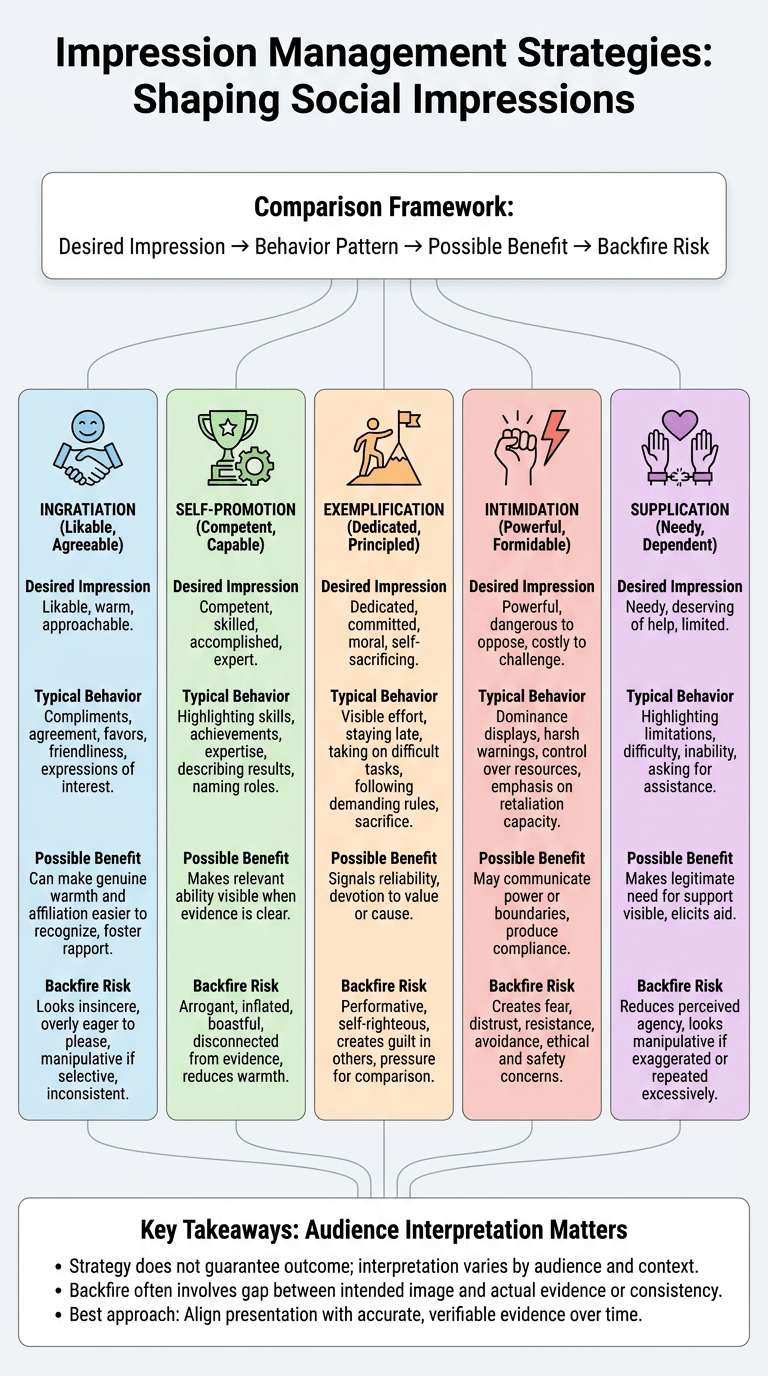
Impression management strategies are recognizable ways people try to shape how they are seen. Ingratiation aims for likability, self-promotion for competence, exemplification for dedication or moral commitment, intimidation for power, and supplication for neediness or dependence. The same behavior can be interpreted differently across audiences, and a strategy may backfire when it feels exaggerated, inconsistent, coercive, or unsupported by evidence.
What Counts as an Impression-Management Strategy
A strategy is best understood as a recurring approach to creating a desired social image. The emphasis is on what the behavior appears designed to communicate. Complimenting someone, describing an achievement, taking on visible extra work, making oneself seem formidable, or highlighting difficulty can each carry an impression-related message depending on the situation.
Strategy as a recurring approach, not a guaranteed outcome
The five-category framework is widely discussed in later research on impression management. A peer-reviewed review in the Annual Review of Organizational Psychology and Organizational Behavior notes that researchers have examined different tactics, their motives, and their effectiveness across social and work settings. A strategy label does not mean the behavior always works or that every instance is deliberate.
Mentioning a difficult project can be simple factual reporting or self-promotion, depending on whether the context makes competence especially relevant. Intent, timing, evidence, and audience expectations all matter.
Why audience interpretation matters as much as intent
Impression management has two sides: what a person is trying to signal and what other people actually infer. Those sides can diverge. A compliment intended as warmth may be read as politeness, sincere appreciation, strategic flattery, or even discomfort, depending on the relationship and context.
Impression strategies are not buttons that reliably produce a social response. People bring prior knowledge, trust, expectations, and their own goals. Ask both, “What image is being attempted?” and, “What evidence will the audience use to interpret it?”
A Comparison Framework: Desired Impression → Behavior Pattern → Possible Benefit → Backfire Risk
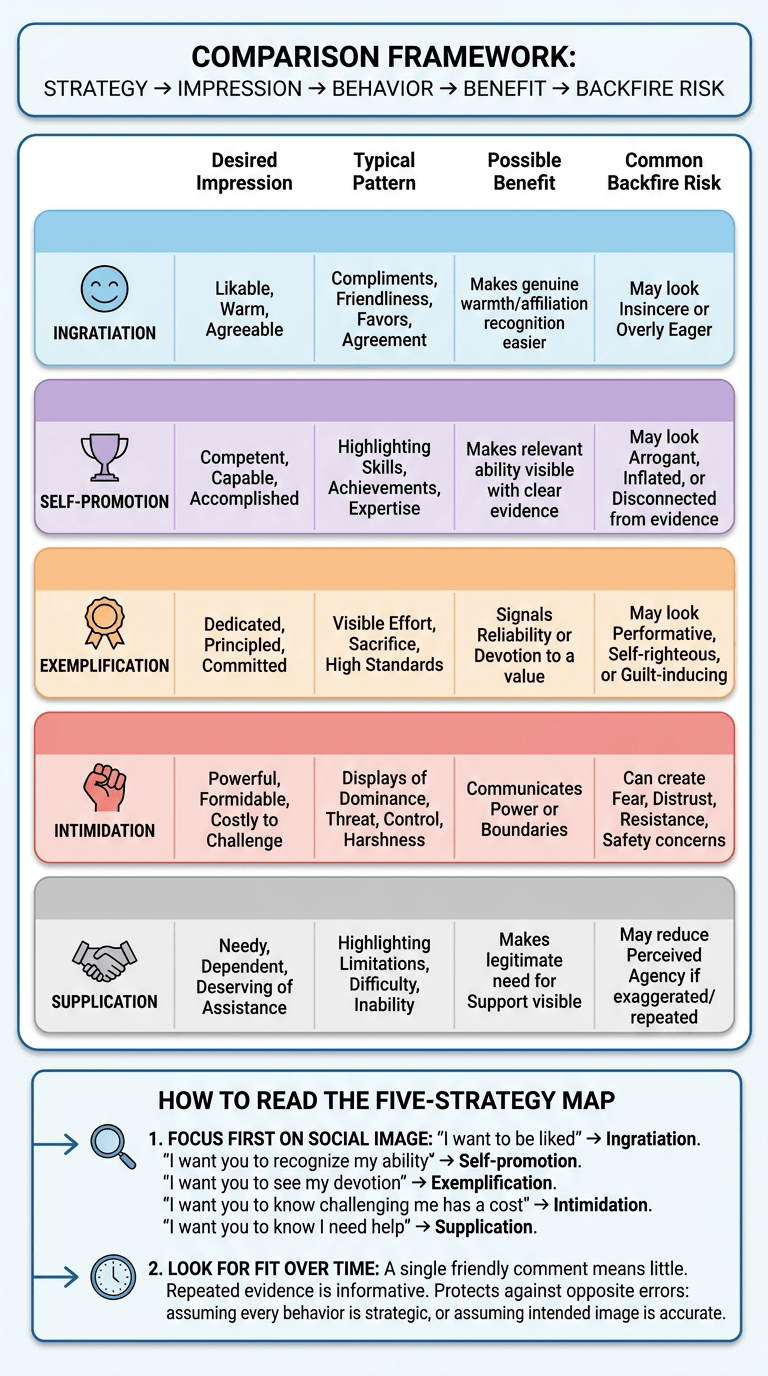
The five strategies become easier to distinguish when they are compared by the image they seek rather than by a single behavior. The table below is descriptive, not a playbook. It shows why similar-looking actions can carry different meanings and why an attempted image can produce the opposite impression.
| Strategy | Desired impression | Typical pattern | Possible benefit | Common backfire risk |
|---|---|---|---|---|
| Ingratiation | Likable, warm, agreeable | Compliments, friendliness, favors, agreement | Can make genuine warmth and affiliation easier to recognize | May look insincere or overly eager to please |
| Self-promotion | Competent, capable, accomplished | Highlighting skills, achievements, expertise | Can make relevant ability visible when evidence is clear | May look arrogant, inflated, or disconnected from evidence |
| Exemplification | Dedicated, principled, committed | Visible effort, sacrifice, high standards, extra commitment | Can signal reliability or devotion to a value | May look performative, self-righteous, or designed to create guilt |
| Intimidation | Powerful, formidable, costly to challenge | Displays of dominance, threat capacity, harshness, or control | May communicate that a person has power or boundaries | Can create fear, distrust, resistance, or safety concerns |
| Supplication | Needy, dependent, deserving of assistance | Highlighting limitations, difficulty, or inability | Can make a legitimate need for support visible | May reduce perceived agency if repeated strategically or exaggerated |
How to read the five-strategy map
Focus first on the social image being pursued. “I want to be liked” points toward ingratiation. “I want you to recognize my ability” points toward self-promotion. “I want you to see how devoted I am” points toward exemplification. “I want you to think challenging me has a cost” points toward intimidation. “I want you to recognize that I need help” points toward supplication.
Next, look for fit between the claimed image and observable behavior over time. A single friendly comment tells you little. Repeated evidence is more informative. This protects against two opposite errors: assuming every pleasant or confident behavior is strategic, and assuming the intended image must be accurate simply because it was presented strongly.
Ingratiation: Trying to Be Seen as Likable or Agreeable
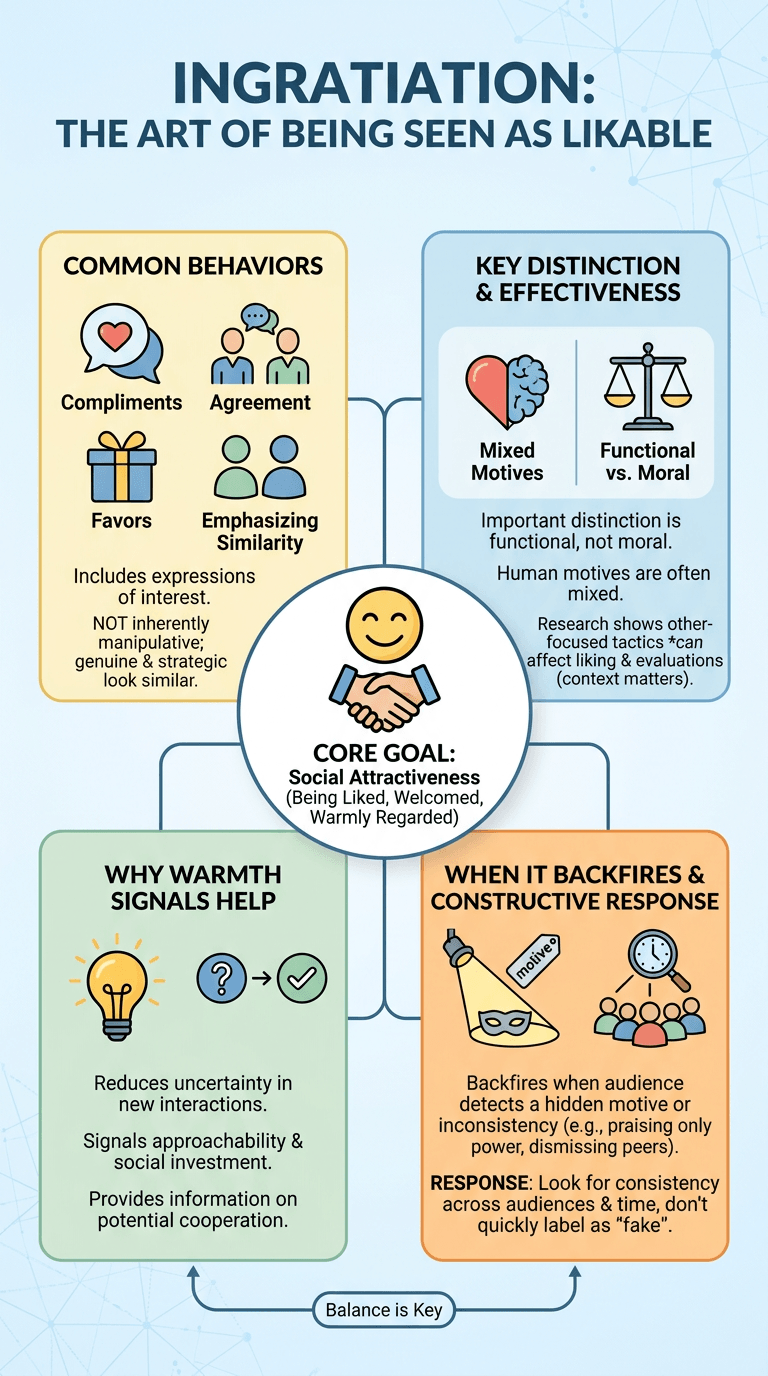
Ingratiation centers on social attractiveness in the broad sense of being liked, welcomed, or regarded warmly. It can include compliments, agreement, favors, expressions of interest, or behavior that emphasizes similarity. None of those behaviors is inherently manipulative. Genuine friendliness and strategic friendliness can look similar from the outside.
Common behavioral patterns
Consider a new member of a volunteer group who learns names quickly, praises another member’s work, and offers help before being asked. The person may simply be considerate. If those behaviors are also shaped by a desire to be seen as agreeable and easy to work with, they can serve an ingratiating function.
The important distinction is functional, not moral. The same person can sincerely like others and still care about being liked in return. Human motives are often mixed.
Why warmth signals may help
Warmth cues can reduce uncertainty in new interactions. Friendly attention, appreciation, and cooperative behavior provide information that someone may be approachable or socially invested. That does not mean agreement and compliments always create liking, but it explains why these behaviors can become part of impression management.
A meta-analysis of interview and performance-rating research found that impression-management tactics can influence evaluators differently depending on the setting and tactic used. The open-access meta-analysis also notes that other-focused tactics such as ingratiation can affect liking and evaluations, while the effectiveness of self-focused tactics varies with context.
When flattery, agreement, or friendliness can look insincere
Ingratiation can backfire when the audience detects a hidden motive or sees a mismatch between the friendliness and the person’s broader behavior. Research on indirect ingratiation has specifically examined how direct tactics can lose effectiveness when the motive becomes obvious. A peer-reviewed study summarized by the University of Haifa describes this recognition problem.
Situation: a colleague praises every idea from a manager but dismisses similar ideas from peers. The audience may feel uncertain about whether the praise is sincere. It may mean the person is prioritizing approval from a high-value audience rather than expressing a stable view. The useful next step is not to label the person as fake. Look for consistency across audiences and over time.
Self-Promotion: Trying to Be Seen as Competent
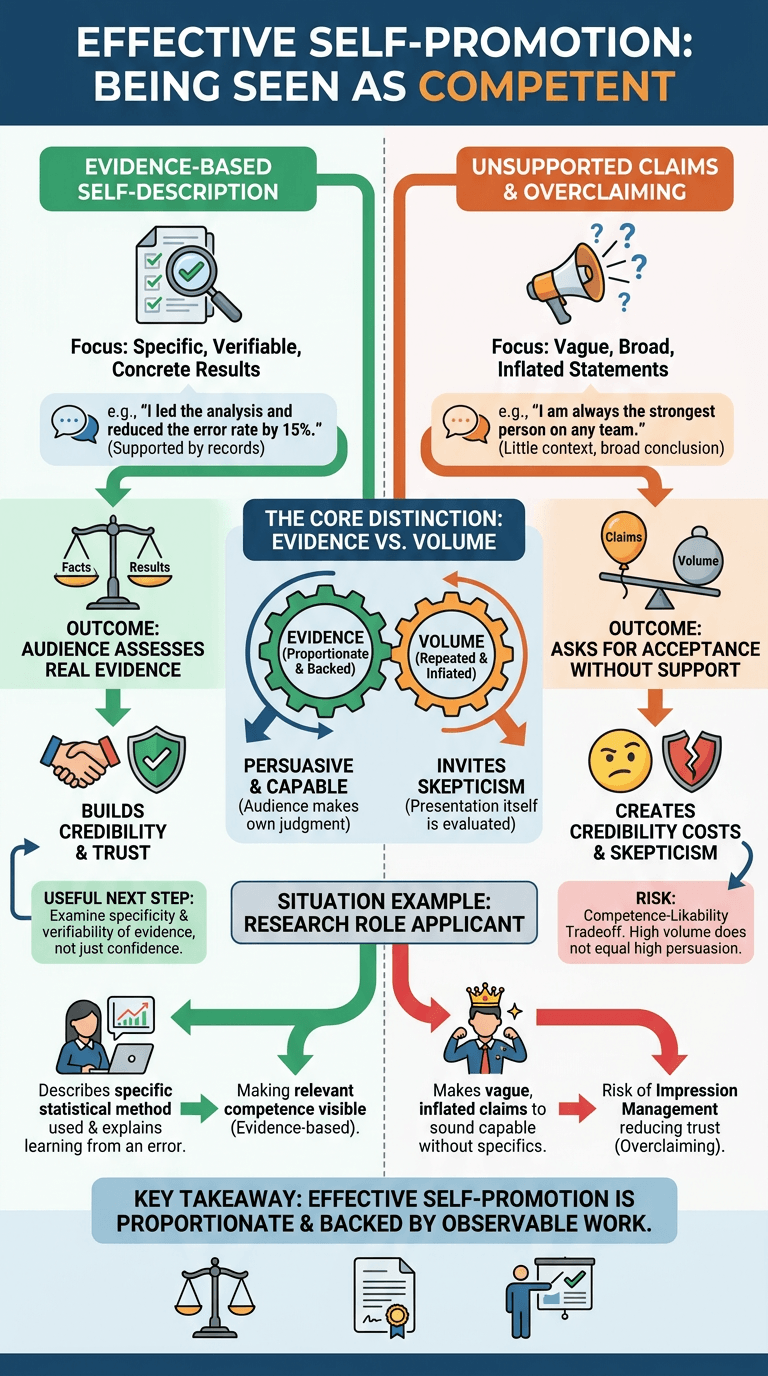
Self-promotion aims to make ability, expertise, achievement, or potential more visible. It may involve describing past results, naming relevant skills, explaining one’s role in a successful outcome, or making expertise easier for an audience to notice. The central question is whether the presentation helps others evaluate real evidence or asks them to accept a favorable claim without enough support.
Evidence-based self-description versus unsupported claims
There is a meaningful difference between saying, “I led the analysis and reduced the error rate,” when records support that statement, and making a vague claim such as, “I am always the strongest person on any team.” The first gives the audience something concrete to assess. The second asks for a broad conclusion with little context.
Situation: a student applying for a research role describes a statistical method they used in a class project and explains what they learned from an error. They may feel pressure to sound capable. The behavior may mean they are trying to make relevant competence visible, not necessarily inflating themselves. A useful next step for the listener is to examine the specificity and verifiability of the evidence rather than judging confidence alone.
Why overclaiming can create credibility costs
Self-promotion is vulnerable to a competence-likability tradeoff. A strong claim can make ability salient, but repeated or inflated claims can invite skepticism. Experimental and field research on self-promotion and intimidation found that impression management sometimes reduced trust, including when highly capable actors promoted themselves. The open-access study on impression management and trust is a useful reminder that being capable does not make every way of displaying capability equally effective.
One practical distinction is evidence versus volume. More self-description is not always more persuasive. When claims are proportionate to the situation and backed by observable work, the audience can make its own judgment. When the claim is much larger than the evidence, the presentation itself becomes part of what people evaluate.
Exemplification: Trying to Be Seen as Dedicated or Principled
Exemplification aims to communicate exceptional commitment, integrity, sacrifice, or devotion to a standard. A person might volunteer for difficult work, arrive early, stay late, publicly follow a demanding rule, or make personal sacrifices visible. Again, visible effort can be genuine. The impression-management question concerns what image the visibility is helping to create.
Visible effort, commitment, and standards
Suppose a community organizer consistently takes the least convenient shift and explains that reliability matters because other volunteers depend on one another. The behavior can signal dedication. If the person would make the same choice without an audience, the action may still have an exemplifying effect once others see it.
Strategy categories describe social function, not secret motive. Visible commitment can shape an impression even when the behavior is sincere.
When moral display or overperformance can create skepticism
Exemplification can create pressure when visible sacrifice becomes a standard that others are expected to match. A teammate who repeatedly says, “I stayed until midnight because I care more than anyone else,” is no longer only showing effort. The comparison invites a moral ranking of other people’s commitment.
Situation: a group member takes on extra tasks and repeatedly highlights how much they gave up to do so. Others may feel grateful at first, then guilty or defensive. It may mean the person wants their sacrifice recognized as evidence of dedication. The next step is to separate the useful behavior from the implied comparison: appreciate real contribution without accepting the claim that visible sacrifice proves greater moral worth.
Intimidation: Trying to Be Seen as Powerful or Costly to Challenge
Intimidation differs sharply from the other categories because the desired image depends on perceived power and possible cost. The person wants the audience to see them as formidable, dangerous to oppose, or capable of imposing consequences. In some settings, ordinary firmness or clear boundaries can be mistaken for intimidation, so the presence of power alone is not enough to classify a behavior.
The intended impression
The intended signal is something like, “I have enough power that challenging me may be costly.” This can appear in dominance displays, harsh warnings, visible control over resources, or behavior that emphasizes the person’s capacity to retaliate. Later research often includes intimidation among the five classic assertive strategies; an open-access discussion of the five-category framework summarizes the taxonomy and distinguishes the social images associated with these approaches.
Why fear-based presentation carries relational and ethical risks
Fear can produce compliance without producing respect, trust, or genuine agreement. An audience may comply in the moment because the perceived cost of resistance is high, then avoid the person, withhold information, seek protection, or push back when conditions change.
Situation: a team lead reacts to questions by reminding people that they control desirable assignments. A team member may feel hesitant to speak openly. The behavior may be an attempt to reinforce power rather than a simple effort to clarify authority. The appropriate next step is not to copy the tactic. Focus on the concrete power dynamic, document important decisions where appropriate, and use safer support channels if questioning the person could trigger retaliation.
Analytical boundary: do not teach threats, coercion, or exploitation
Understanding intimidation as an impression strategy does not make coercive behavior acceptable. If a person uses threats, humiliation, stalking, retaliation, or fear to control someone, the concern is no longer merely how an impression is being managed. Safety and power become more important than social-image analysis.
In an unsafe situation, direct confrontation is not always the right first response. The more useful principle is to assess risk, preserve access to support, and avoid advice that assumes everyone can challenge a powerful person without consequences.
Supplication: Trying to Be Seen as Needing Help
Supplication aims to make limitation, dependence, difficulty, or need visible so that others may provide assistance, protection, lowered demands, or care. This category needs careful handling because asking for help is a normal and often healthy human behavior. Not every expression of difficulty is strategic, exaggerated, or manipulative.
Dependency signals and support seeking
Situation: a new employee says, “I have not used this system before, and I need someone to walk me through the first setup.” They may feel embarrassed about not knowing what to do. The statement may simply communicate a real limitation so the person can get appropriate help. The next step is straightforward: respond to the actual need, then see how the person’s independence changes as they learn.
Supplication becomes a more useful descriptive label when the social image of incapacity itself appears central to the interaction. Even then, observers should be cautious about assuming motive. Hidden disability, missing information, unequal experience, stress, or genuine skill gaps can all make a person need more support than an outsider expects.
Why repeated strategic helplessness can undermine trust or agency perceptions
If someone repeatedly emphasizes inability in situations where they have demonstrated capacity, observers may begin to question whether the presentation matches the evidence. Over time, the strategy can also reduce how much agency others attribute to the person.
The better response is evidence-sensitive rather than punitive. Offer reasonable help, clarify what support is available, and notice whether capability grows with practice. This avoids two errors at once: rewarding exaggerated helplessness indefinitely and shaming someone who genuinely needs assistance.
Mixed Strategies and Audience Fit
People do not always use one strategy at a time. A person can combine self-promotion with ingratiation, such as describing an achievement while also emphasizing teamwork. Someone can combine exemplification with self-promotion by presenting exceptional effort as evidence of both commitment and competence.
Why people may combine strategies
Different social goals often coexist. A person may want to be seen as capable and likable, principled and competent, or powerful and fair. That makes mixed presentation understandable. It also increases the chance of tension between signals.
For example, repeated self-promotion may make competence more visible while reducing warmth. Heavy ingratiation may increase warmth while making the person seem less independent. The tradeoff is not fixed, but it explains why people sometimes adjust one signal after noticing how another is being received.
How audience values and context change interpretation
Audience fit means that the same behavior can carry different meanings depending on what the situation rewards and what the audience already knows. In a scholarship interview, naming a specific achievement may be expected. Repeating the same achievement at a casual dinner can feel out of place. In a crisis, visible confidence may be reassuring. In a collaborative learning group, exaggerated certainty may discourage questions.
Context also changes how much evidence the audience has. New acquaintances may rely more on self-description, while long-term contacts can compare claims with repeated behavior.
Why Impression Strategies Backfire
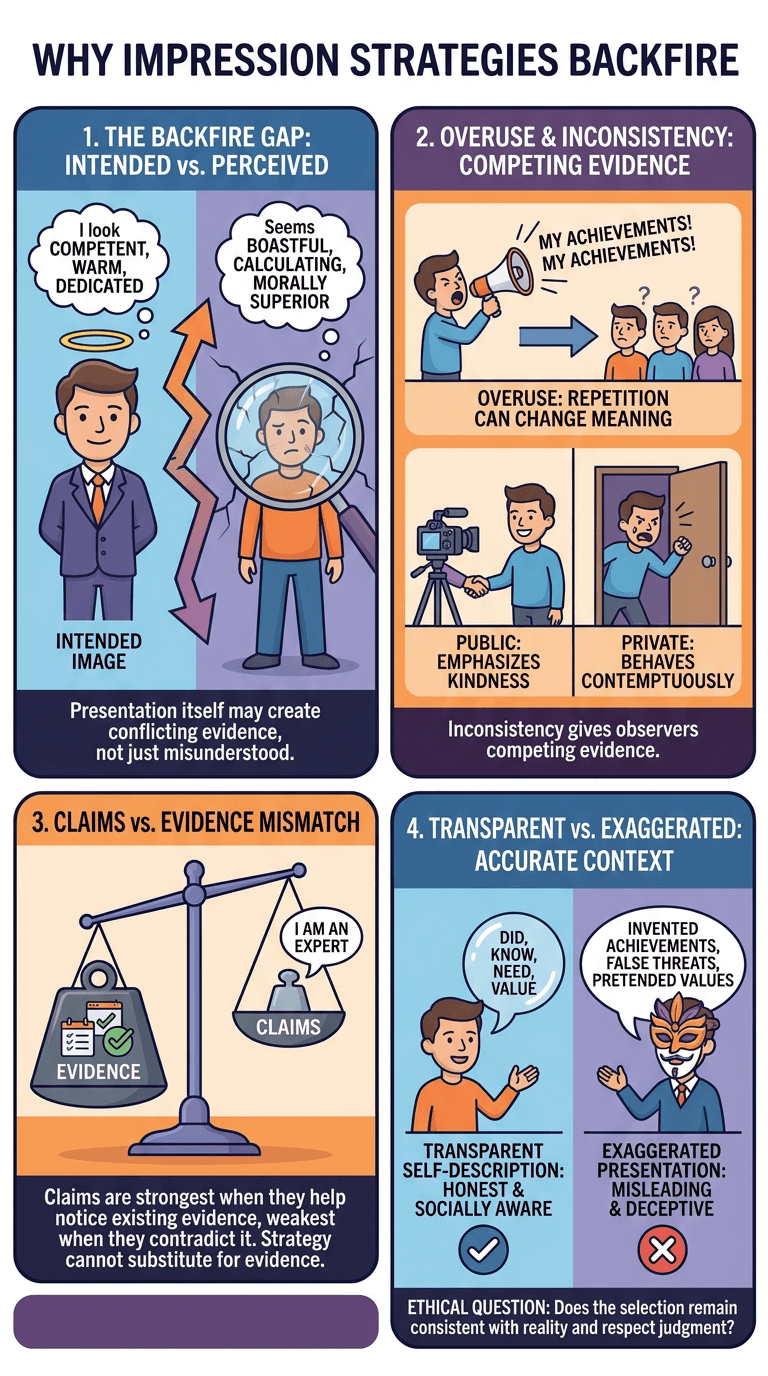
Backfire usually involves a gap between the intended image and the meaning the audience takes from the behavior. A person tries to look competent and seems boastful. They try to look warm and seem calculating. They try to look dedicated and seem morally superior. The failure is not simply that the audience “misunderstood.” The presentation itself may have created conflicting evidence.
Overuse and inconsistency
A small amount of self-description may be informative. Repetition can change its meaning. If someone constantly returns to their achievements, compliments only powerful people, or makes every contribution visibly sacrificial, the audience has more reason to consider strategic motive.
Inconsistency creates a different problem. A person who emphasizes kindness in public but behaves contemptuously in private gives observers competing evidence. A favorable claim is then weighed against behavior, not accepted in isolation.
Mismatch between claims and evidence
Claims are strongest when they help the audience notice evidence that is already available. They are weakest when they ask the audience to ignore contradictory evidence. “I am experienced with this software, and here are two projects I completed with it” is easier to assess than “I am an expert” with nothing further.
This principle applies beyond competence. Dedication, warmth, need, and power are all interpreted through behavior. A strategy may attract attention to an image, but it cannot permanently substitute for evidence.
Transparent self-description versus exaggerated presentation
A useful dividing line is whether the presentation gives the audience accurate context or creates a false inference. Saying what you did, what you know, what you need, or what you value can be both honest and socially aware. Inventing achievements, manufacturing dependency, making false threats, or pretending to hold values you routinely violate is different because the presentation itself becomes misleading.
That distinction keeps impression management separate from the assumption that all self-presentation is deceptive. Social life requires selective communication. The ethical question is whether the selection remains consistent with reality and respects the other person’s ability to judge for themselves.
Impression Management Strategies vs Persuasion, Manipulation, and Status Signaling
These ideas overlap in real life, but they answer different questions. Impression management concerns the image an audience forms of the person. Persuasion is more directly concerned with changing a belief, attitude, or decision. Manipulation involves attempts to influence another person’s perceptions, emotions, or choices in ways that may rely on distortion, pressure, exploitation, or concealed control.
Shaping an impression versus changing a decision
Imagine someone accurately describing their experience at the start of a group project. The immediate aim may be to be seen as competent. If they then argue that the group should adopt a particular plan, the goal shifts toward persuasion. If they deliberately hide critical information so others will agree, the concern may shift further toward manipulation.
The boundaries are not always visible from one behavior, but keeping the goals separate prevents ordinary self-presentation from being mislabeled as manipulation.
When status or power becomes a different primary issue
Intimidation can overlap with status and power because it tries to make power salient. Still, a person’s social standing is not the same thing as the strategy used to display it. Someone can have high status without intimidating anyone, and someone can attempt intimidation without actually having durable status or respect.
If the main question is who receives deference, rank, prestige, or recognized standing, the psychology of status is the better lens. If the main question is what social image a particular behavior is trying to create, the impression-strategy lens remains useful.
What to Do Next: Evaluate a Strategy Without Copying It
The most responsible use of this framework is observational. Instead of asking, “Which tactic should I use?” ask what social image is being attempted, what evidence supports it, and what the behavior costs the relationship or group.
Identify desired impression, evidence, audience context, and likely cost
| Question | What it helps you notice |
|---|---|
| What impression seems important here? | Likability, competence, dedication, power, or need |
| What behavior is carrying that message? | Compliment, claim, sacrifice, dominance display, or expression of limitation |
| What evidence supports the image? | Observable behavior, results, consistency, context, or reliable history |
| How might this audience interpret the same behavior? | Fit, skepticism, warmth, pressure, fear, or uncertainty |
| What is the likely social cost if the presentation is overused? | Distrust, dislike, guilt, avoidance, reduced agency, or resistance |
This set of questions works whether you are reflecting on your own behavior or trying to understand someone else’s. It also keeps interpretation tentative. One behavior is rarely enough to establish motive.
Prefer accurate evidence over manufactured signals
If you need to communicate competence, show relevant work. If you need help, describe the concrete limitation. If you value a principle, let repeated behavior demonstrate it. If you want to build rapport, genuine interest is more informative than exaggerated agreement.
The point is not to eliminate self-presentation. That is unrealistic. The more durable approach is to make the presentation easier to verify, less dependent on pressure, and more consistent with what other people can observe over time.
Why Strategy Choice Depends on Impression Motivation
Before a strategy appears, something usually makes a particular impression matter. The audience may control an opportunity, represent a valued group, know information that could affect the person’s future, or simply matter emotionally. The desired image then narrows what kinds of behavior feel relevant.
How motivation shapes the strategy that becomes attractive
If likability is the priority, ingratiation becomes more relevant. If competence matters, self-promotion becomes more relevant. If moral commitment matters, exemplification becomes more relevant. If the person wants to emphasize power, intimidation becomes more relevant. If assistance is the goal, supplication becomes more relevant.
This does not mean people consciously choose from a five-item menu. Much social behavior is habitual, learned, or only partly deliberate. The categories are most useful after the fact as a way to organize recurring patterns without pretending that every action came from a calculated plan.
FAQ About Impression Management Strategies
The categories are a map of recurring social-image strategies, not personality types. People may use different approaches in different situations, and the same behavior may have more than one function.
Are these five strategies the only possible impression-management behaviors?
No. The five-category taxonomy is influential because it organizes several recognizable approaches around different desired images. Real social behavior is more varied. People can combine strategies, use indirect versions, respond defensively after an image is threatened, or present information in ways that do not fit neatly into one category.
Is self-promotion always dishonest?
No. Self-promotion can simply make relevant achievements or abilities visible. The key questions are whether the claim is accurate, whether the evidence supports it, and whether the level of emphasis fits the situation. Honest self-description and exaggeration should not be treated as the same thing.
Why can ingratiation backfire?
Warmth signals can lose credibility when they seem excessive, selectively directed toward powerful people, or inconsistent with behavior toward others. An audience that suspects the friendliness is mainly instrumental may reinterpret the same compliment or agreement as flattery rather than genuine regard.
Is intimidation an acceptable impression-management strategy?
It is a recognized analytical category, not an endorsement. Attempts to appear formidable can create fear and resistance, and threats, coercion, humiliation, or retaliation raise ethical and safety concerns beyond ordinary social presentation. Understanding the category should help people recognize the dynamic, not reproduce harmful behavior.
Can one behavior fit more than one strategy?
Yes. Volunteering for a difficult task might signal competence, dedication, helpfulness, or several of those at once. The likely function depends on the person’s apparent goal, how the behavior is framed, what the audience values, and what pattern appears across time.
Key Takeaways
- The five classic strategy categories aim at different images: likability, competence, dedication, power, and need.
- A strategy describes an attempted social signal, not a guaranteed audience reaction or a fixed personality trait.
- Ingratiation and self-promotion can be entirely truthful, yet both may backfire when they look exaggerated, selective, or unsupported.
- Exemplification becomes socially costly when visible commitment turns into moral comparison or pressure on others.
- Intimidation deserves extra caution because fear, threats, retaliation, and coercion can create genuine safety problems.
- The most useful test is whether the presented image is supported by consistent evidence and leaves the audience free to make its own judgment.

Michael Reed is the Founder and Lead Writer at Psychology Exposed. He writes about human behavior, relationships, emotional patterns, self-awareness, and practical psychology topics using research-informed, easy-to-understand content.
Read More About Michael Reed: https://psychologyexposed.com/michael-reed/