

You probably do not speak to a close friend in exactly the same way you speak during a job interview, a classroom discussion, or a first meeting with someone important. You may emphasize different skills, choose different stories, change how formal you sound, or decide that some personal information belongs in one setting but not another. Those shifts are often treated as evidence that people are being fake. Psychology offers a more useful view: social situations create audiences, and audiences change what information feels relevant to show.
Self-presentation is the broad process of expressing or displaying parts of yourself while other people may form impressions. It can be deliberate, such as choosing what to include in a professional bio, but it can also be partly habitual, such as becoming more reserved around a strict authority figure. The key question is not simply, “Am I acting differently?” It is whether the presentation fits the situation while staying reasonably consistent with reality and with values that matter to you.
This distinction matters because self-presentation sits between private experience and public interpretation. You control what you say and do more directly than you control what another person concludes. Understanding that gap makes it easier to think clearly about authenticity, impression management, online identity, evaluation concerns, performance under observation, and reputation without collapsing them into one idea.
Quick Answer
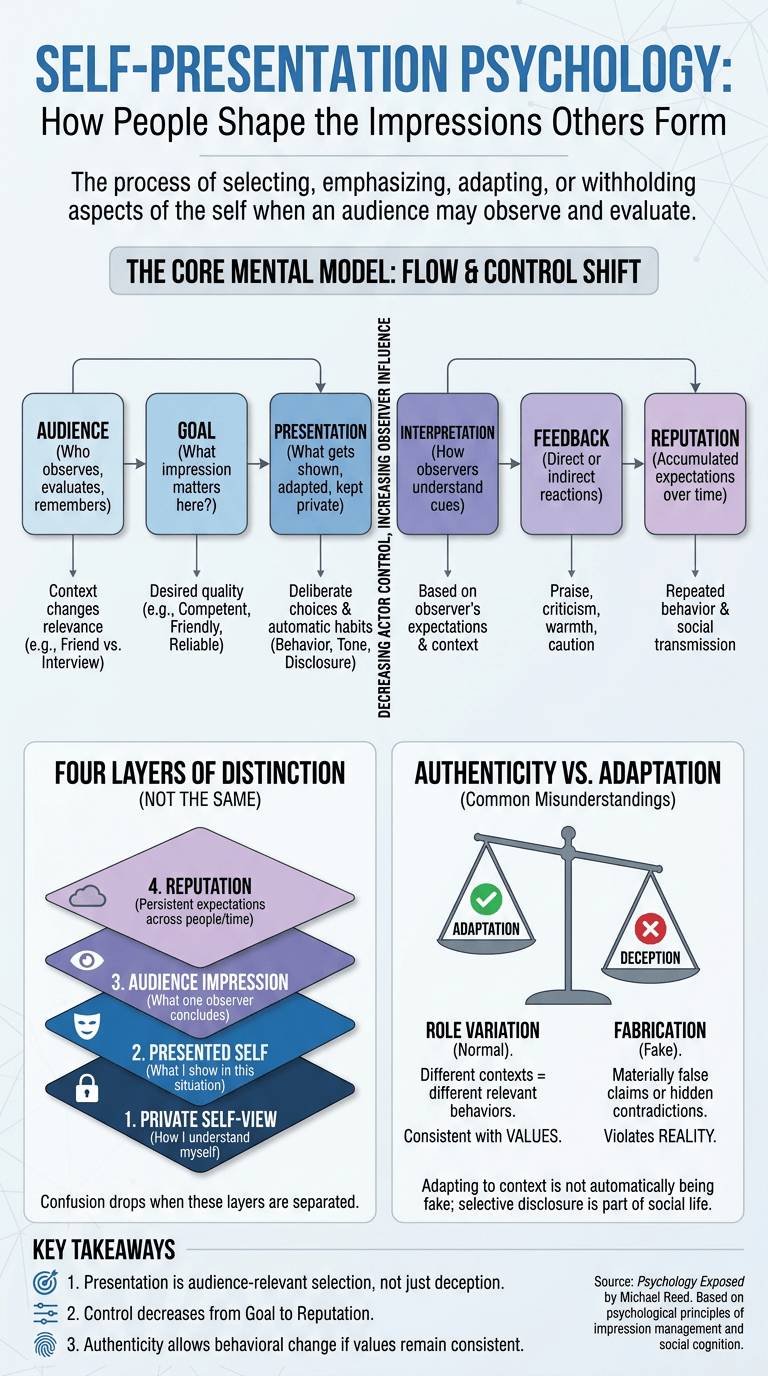
Self-presentation psychology examines how people select, emphasize, adapt, or withhold aspects of themselves when an audience may observe and evaluate them. It is not automatically deception or manipulation. A useful way to understand it is: audience, goal, presentation, interpretation, feedback, and reputation. The presentation is yours to shape, but the final impression always depends partly on the observer and the context.
What Self-Presentation Means in Psychology
The APA Dictionary of Psychology definition of self-presentation centers on behavior intended to convey an image of, or information about, the self to other people. The essential feature is audience relevance: someone else may watch, listen, remember, or draw conclusions.
The actor side of social evaluation
Imagine a group interview. One applicant emphasizes careful planning, another creativity, and a third calm teamwork under pressure. All three may be truthful while selecting different parts of a larger history because a particular audience is evaluating them.
This is the actor side of social evaluation. The person being observed makes choices about what to display. Social perception looks from the other direction: the observer notices cues and decides what they mean. Those two processes interact, but they are not the same psychological question.
Why self-presentation and impression management overlap in the literature
In psychology, self-presentation and impression management are often used with substantial overlap. A classic model by Mark Leary and Robin Kowalski describes impression management in terms of impression motivation and impression construction: first, how motivated a person is to influence an impression, and second, how that person tries to construct the desired image.
For clarity, it is useful here to treat self-presentation as the broader audience-facing territory and impression management as the more focused effort to influence how one is seen. Researchers do not universally draw that boundary.
Why Other People Change What We Show
Social situations have consequences. A teacher may grade your work, a new friend may judge whether you seem trustworthy, and a teammate may decide whether you are dependable. As the stakes rise, attention to the impression you create often rises too.
Audience relevance, stakes, and desired identities
Different audiences make different qualities relevant. At a family gathering, you may care about seeming considerate. In a technical meeting, competence may matter more. In a new community, you may want to show that you understand the norms without pretending to be someone else.
Work by Leary and colleagues on self-presentation in naturalistic settings highlights how real social life involves multiple images at once. A person may want to seem capable, warm, honest, independent, and cooperative, with tradeoffs among those goals.
Deliberate choices and relatively automatic adjustment
Some choices are planned, such as selecting a photograph or rehearsing a talk. Others happen with little conscious planning: your voice becomes more formal with an official, more playful with an old friend, or more restrained in a quiet ceremony.
Not every adjustment is strategic calculation. Roles and norms become learned habits, so context-sensitive behavior can happen quickly without a conscious plan to manage an impression.
The Core Mental Model: Audience → Goal → Presentation → Interpretation → Feedback → Reputation
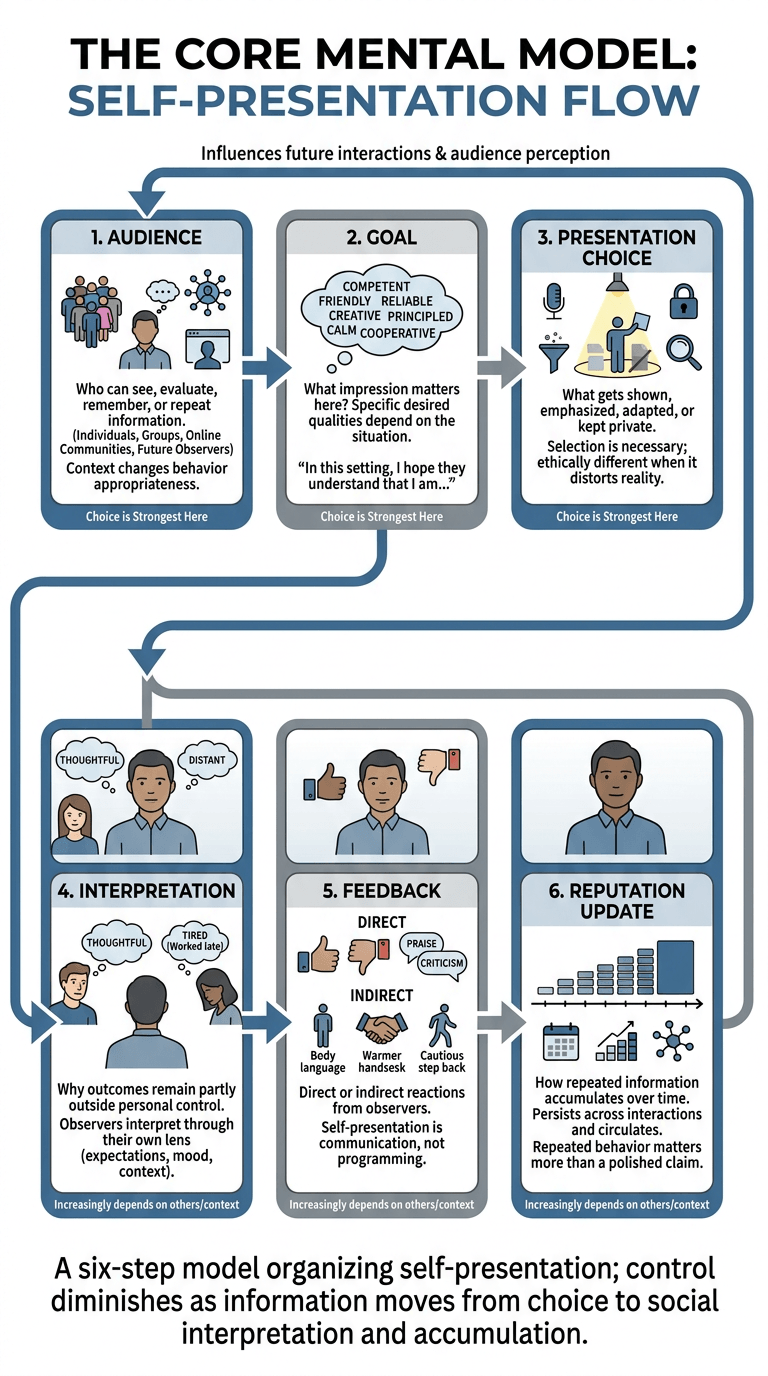
A six-step model organizes many self-presentation questions without assuming total control. Choice is strongest at the audience, goal, and presentation stages; interpretation, feedback, and reputation increasingly depend on other people and context.
Audience: who can see, evaluate, remember, or repeat information
An audience can be one person, a group, an online community, or people who may encounter information later. What matters is that someone else can receive information about you and use it to form a judgment.
A joke that works among close friends may confuse a public audience. A disclosure that feels appropriate with a sibling may feel excessive in a first professional meeting. Audience changes the context around the same behavior.
Goal: what impression matters here
People usually care about a specific quality rather than being seen as simply “good”: competent, friendly, reliable, sincere, creative, principled, calm, or cooperative. The desired impression depends on the situation.
Try finishing the sentence, “In this setting, I hope they understand that I am…” The answer clarifies the goal and may reveal when the desired image goes beyond what the evidence can honestly support.
Presentation choice: what gets shown, emphasized, adapted, or kept private
Presentation requires selection because no interaction can contain every fact about you. You may choose one relevant experience, adjust formality, keep private information private, or add context to prevent misunderstanding.
Selection becomes ethically different when it changes a reasonable audience’s understanding of reality. Claiming leadership after coordinating two meetings may create a false belief about responsibility. Omitting every difficulty behind a real achievement does not automatically make the achievement false.
Interpretation and feedback: why outcomes remain partly outside personal control
Observers interpret behavior through their own expectations, experience, mood, and context. Quietness may look thoughtful to one person, distant to another, and simply tired to someone who knows you worked late.
Feedback may be direct, such as praise or criticism, or indirect, such as another person becoming warmer or more cautious. Because interpretation is not fully controllable, self-presentation is better understood as communication than as programming another person’s opinion.
Reputation update: how repeated information accumulates over time
A single impression belongs to one observer at one point in time. Reputation develops when information persists across interactions or circulates among people. A systematic review of personal reputation examines this broader social phenomenon across research traditions.
Repeated behavior therefore often matters more than a polished claim. Calling yourself reliable may affect an initial impression, but consistently meeting commitments gives people stronger evidence for future expectations.
Private Self, Presented Self, Impression, and Reputation Are Not the Same
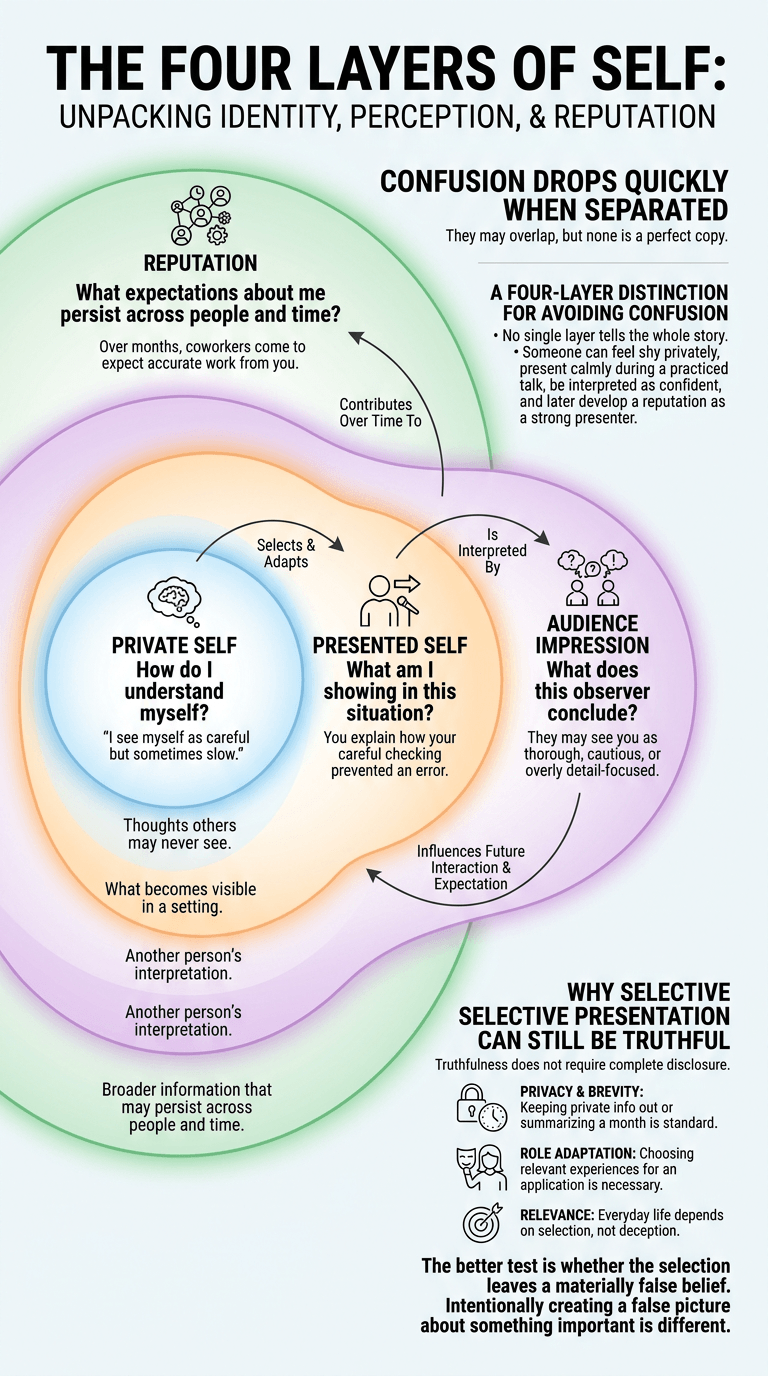
Confusion drops quickly when these four layers are separated. They may overlap, but none is a perfect copy of the others.
| Layer | Main question | Example |
|---|---|---|
| Private self-view | How do I understand myself? | “I see myself as careful but sometimes slow.” |
| Presented self | What am I showing in this situation? | You explain how your careful checking prevented an error. |
| Audience impression | What does this observer conclude? | They may see you as thorough, cautious, or overly detail-focused. |
| Reputation | What expectations about me persist across people and time? | Over months, coworkers come to expect accurate work from you. |
A four-layer distinction for avoiding common confusion
Your private self-view includes thoughts others may never see. The presented self is what becomes visible in a setting. The audience impression is another person’s interpretation, while reputation is broader information that may persist across people and time.
Someone can feel shy privately, present calmly during a practiced talk, be interpreted as confident, and later develop a reputation as a strong presenter. No single layer tells the whole story.
Why selective presentation can still be truthful
Truthfulness does not require complete disclosure. Everyday life depends on selection: you summarize a complicated month, choose a few relevant experiences for an application, or keep private information out of a casual conversation.
The better test is whether the selection leaves a materially false belief. Privacy, brevity, role adaptation, and relevance are not deception; intentionally creating a false picture about something important is different.
Self-Presentation vs Social Perception
These ideas sit on opposite sides of the same interaction. Self-presentation asks what the actor shows while knowing others may interpret it. Social perception asks how an observer notices cues and forms judgments about another person.
Presenting the self versus interpreting another person
Suppose you meet a new neighbor. You choose to mention that you enjoy quiet weekends and community events because those details feel relevant. That is self-presentation. Your neighbor notices your tone, clothes, eye contact, and comments, then concludes that you seem reserved but friendly. That is social perception.
The distinction protects against a common mistake: assuming that because someone tried to create a certain impression, the observer necessarily received it. Presentation is an input to perception, not a guaranteed result.
Why first-impression research belongs to the observer side
Questions such as “How quickly do people judge strangers?” or “Which cues shape first impressions?” are mainly about how observers form judgments. Self-presentation becomes relevant when the question changes to “What do people choose to show when they know a first impression may be forming?” The direction of attention matters.
Four Questions for Evaluating a Presentation Choice
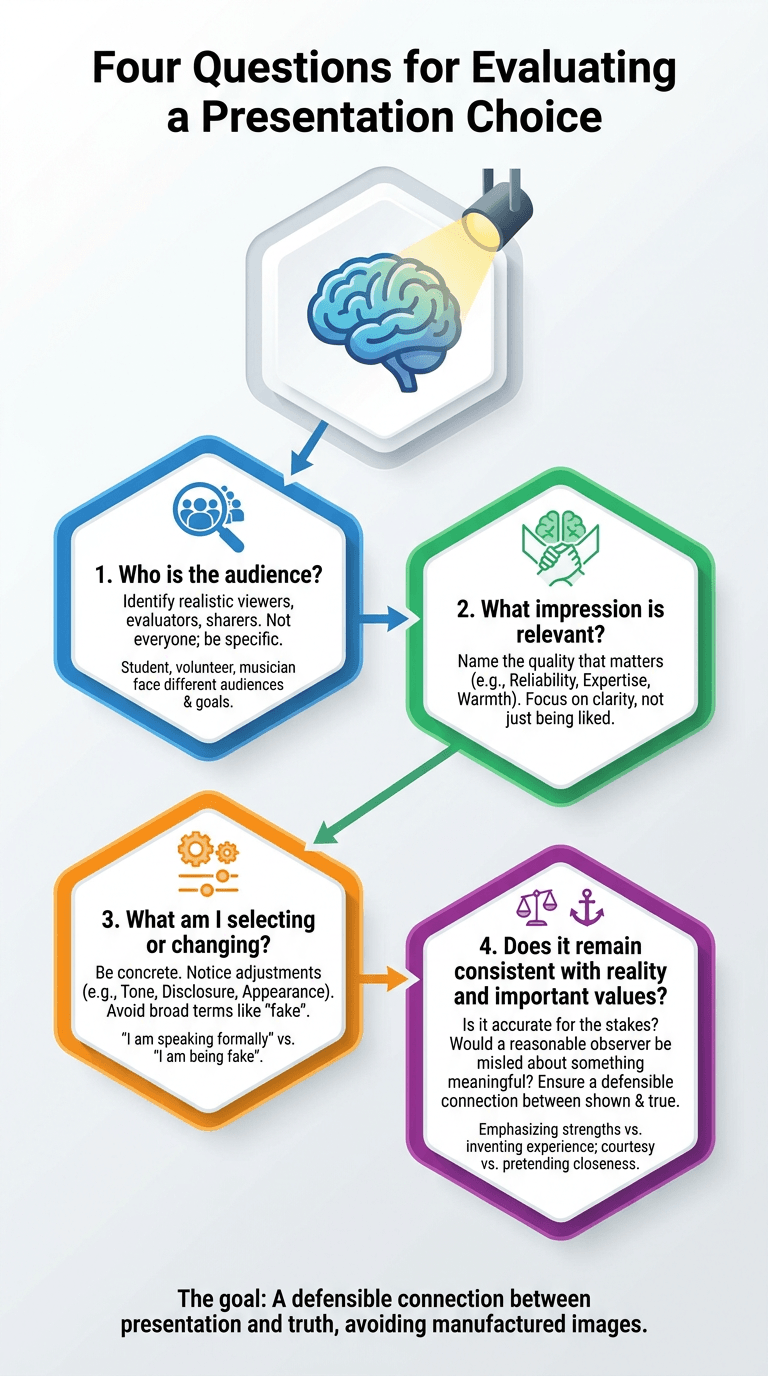
When a social adjustment feels sensible in one moment and fake in another, four questions can separate ordinary audience awareness from pressure to manufacture an image.
- Who is the audience? Identify the people who can realistically see, evaluate, remember, or share the information.
- What impression is relevant? Name the quality that actually matters here, such as reliability, warmth, expertise, seriousness, or openness.
- What am I selecting or changing? Notice whether you are adjusting tone, disclosure, emphasis, appearance, examples, or behavior.
- Does it remain consistent with reality and important values? Ask whether a reasonable observer would be misled about something meaningful.
Who is the audience and what impression is relevant
Trying to be liked by everyone is different from communicating clearly to a specific audience. A student, volunteer, and musician face different audiences and therefore different legitimate presentation goals.
What am I selecting or changing
Be concrete. “I am being fake” is too broad. “I am speaking more formally” or “I kept a personal story private” identifies the actual change you can evaluate.
Is the presentation consistent with reality and important values
Ask whether the presentation is accurate enough for the stakes. Emphasizing real strengths differs from inventing experience, and courtesy differs from pretending closeness. The aim is a defensible connection between what is shown and what is true.
Impression Goals and the Strategies People Use
Self-presentation becomes more focused when a person actively cares about creating a particular impression. The next distinction is between the process itself and the strategy chosen to express it.
Impression management focuses on why and when the goal becomes important
Sometimes the central issue is not self-presentation in general but the process of wanting to influence an audience’s view. Impression management becomes especially relevant when an outcome matters, an audience has influence, or the current image seems far from the image a person wants to create.
That focused process is different from simply noticing that behavior changes around others. It asks what makes impression control motivating and how a person constructs a presentation once that motivation is active.
Different strategies aim at different desired impressions
Psychologists have described recognizable approaches such as trying to seem likable, competent, dedicated, powerful, or in need of help. Those categories are useful for understanding behavior, but they should not be treated as recipes for controlling people. Any strategy can fail if it is exaggerated, unsupported by evidence, poorly matched to the audience, or perceived as insincere.
Positive Versus Accurate Self-Presentation
Not every audience-facing choice is about looking better. People may also want feedback that feels consistent with who they believe they are, or they may be deciding how much adaptation still feels authentic.
Self-enhancement concerns a favorable view of the self
Self-enhancement is broader than trying to impress other people. A person may interpret their own performance favorably even when no audience is present. That makes it an important contrast: self-enhancement asks whether the self is being understood positively, while impression management asks what an audience is being encouraged to believe.
The two can overlap. Someone may privately believe they are highly capable and also present evidence of competence to others. But positive self-belief is not automatically distortion, and favorable public presentation is not automatically self-enhancement.
Self-verification concerns consistency with an existing self-view
People do not always seek the most flattering possible reaction. At times they prefer feedback that fits a stable view of themselves because predictable social feedback makes interactions easier to interpret. This helps explain why praise can occasionally feel uncomfortable when it sharply conflicts with a person’s established self-understanding.
Self-verification does not prove that an existing self-view is correct. A familiar negative belief can still be inaccurate or overly harsh. The useful distinction is motivational: favorable feedback and consistent feedback do not always point in the same direction.
Authenticity does not require identical behavior everywhere
Authenticity is often confused with behavioral sameness. Yet a person can be more playful with friends, more careful with a child, more formal with a doctor, and more concise in a public meeting without becoming four different people. Different roles make different parts of the same person relevant.
A stronger test is value consistency. Does the adjusted behavior remain compatible with important values and reality? If yes, adaptation may be flexible rather than fake. If the presentation depends on false claims, hidden contradictions that materially mislead others, or behavior that violates core commitments, the authenticity question becomes more serious.
Audience, Evaluation, and Visibility
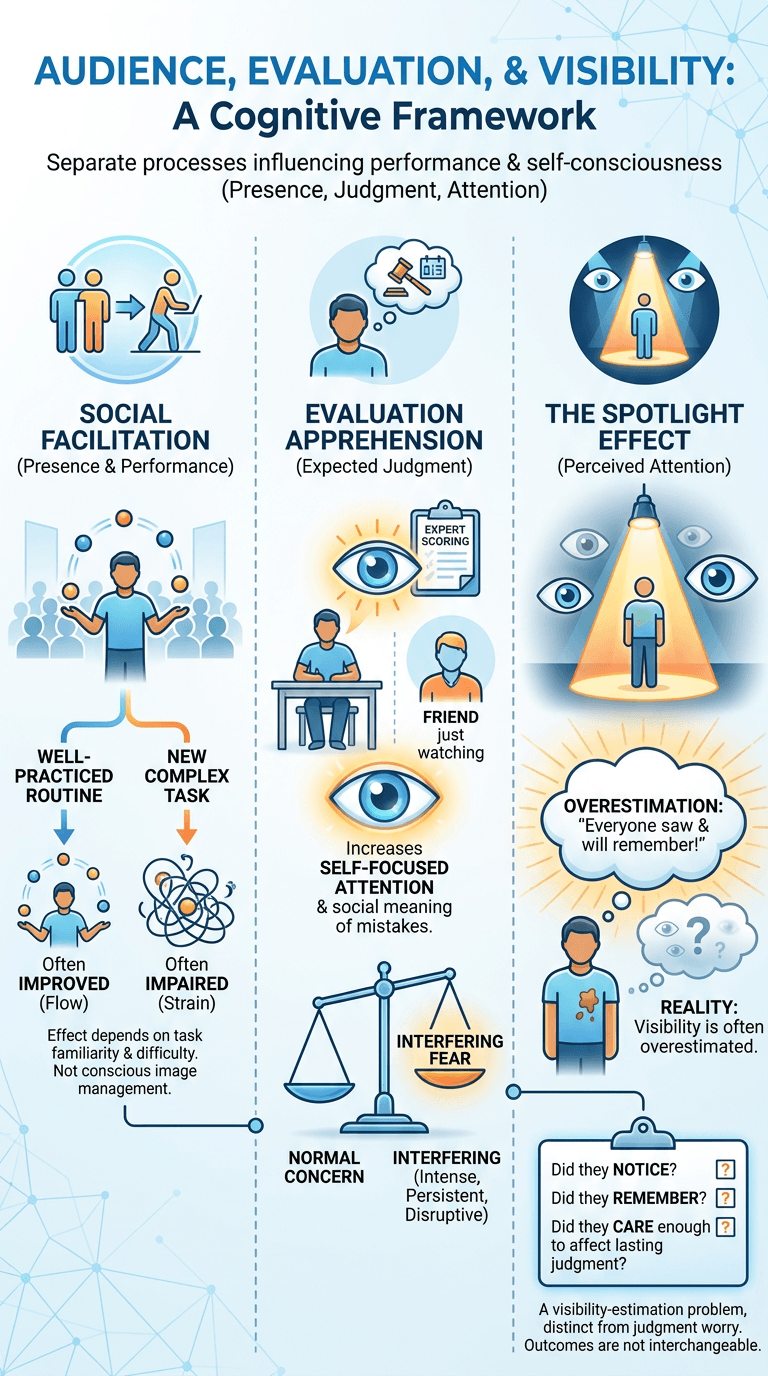
An audience can affect more than image. Presence, expected judgment, and perceived attention are separate processes that can influence performance and self-consciousness in different ways.
Social facilitation asks how the presence of others changes performance
Sometimes the most important effect of an audience is not image management but performance. People can perform differently when others are present, with the result depending on factors such as task familiarity, difficulty, attention, and the meaning of the audience. A well-practiced routine and a new complex task may respond very differently to observation.
This topic is narrower than self-presentation because it asks what audience presence does to task performance. It does not require the person to be consciously shaping an image.
Evaluation apprehension asks what changes when judgment is expected
Being observed and expecting evaluation are not identical. You may feel relaxed working beside a friend but tense doing the same task while an expert scores you. The second situation gives the audience a clearer evaluative role, which can increase self-focused attention and make mistakes feel socially meaningful.
Concern about evaluation is common and does not, by itself, indicate a mental health disorder. The difference becomes important when fear is intense, persistent, difficult to control, and significantly interferes with daily life.
The spotlight effect concerns how much attention you think others are paying
After an awkward comment or noticeable clothing mistake, people can feel as if everyone saw it and will remember it. The spotlight effect describes a tendency to overestimate how much other people notice aspects of the self. It is a visibility-estimation problem, not the same question as worrying about how an evaluator will judge you.
A practical check is to separate three questions: Did anyone notice? Did they remember? Did they care enough for it to affect a lasting judgment? Those outcomes are not interchangeable.
Online Identity and Longer-Term Reputation
Digital settings extend self-presentation across time and audiences. They also make it easier for selected information to persist, travel, and contribute to expectations that outlast the original interaction.
Digital settings change how presentation choices are made
Online spaces make some presentation choices more editable and persistent. People can select photographs, revise bios, delay a post, segment audiences, or discover that content intended for one group reaches another. A review indexed in PubMed describes how features such as multiple audiences, feedback, and asynchronous communication can shift the balance between self-disclosure and self-presentation on social media.
Curated does not mean false. A profile is necessarily incomplete. The more useful question is what the curation leaves out, whether the remaining presentation is accurate, and how mixed audiences may interpret it without the original context.
Reputation is what social information leaves behind
Self-presentation happens in moments. Reputation develops across moments. If multiple people repeatedly observe similar behavior, exchange information, and form stable expectations, those expectations can become harder to change than a single impression.
This also limits how much image management can accomplish. Reputation is partly owned by the social environment because other people decide which evidence they find diagnostic, what they remember, and what they tell others. Long-term change usually depends more on repeated behavior than on announcing a new image.
Which Question Are You Actually Trying to Answer?
Several nearby ideas become much easier to separate when you identify the question beneath them.
| If your question is… | The most relevant concept is… |
|---|---|
| Why am I trying to shape what this audience thinks of me? | Impression management |
| What recognizable approach am I using to create that impression? | Impression-management strategies |
| Why do I prefer a favorable view of myself? | Self-enhancement |
| Why do I want feedback that fits the person I believe I am? | Self-verification |
| Does acting differently with different people mean I am fake? | Authenticity and self-presentation |
| How do profiles, posts, and mixed audiences change what I show? | Online self-presentation |
| Why does another person’s presence change how I perform? | Social facilitation |
| Why does expecting judgment change my attention or behavior? | Evaluation apprehension |
| Why does it feel like everyone noticed my mistake? | Spotlight effect |
| How do expectations about me persist across people and time? | Reputation |
Process, strategies, favorable self-view, accurate self-view, authenticity, and online presentation
If the concern is what you choose to show, focus on audience, goal, and presentation. Favorable private self-view points toward self-enhancement; wanting confirming feedback points toward self-verification; discomfort about acting differently across settings raises the authenticity question.
Performance, expected judgment, perceived visibility, and reputation
If performance changes around others, examine audience-performance effects. If judgment is central, focus on evaluation concern. If the worry is that everyone noticed, examine perceived visibility. If expectations have accumulated across time, the issue is reputation.
Common Misunderstandings About Self-Presentation
Several common assumptions make self-presentation sound more deceptive or pathological than it is. The distinctions below keep ordinary adaptation separate from dishonesty and unsupported conclusions.
Adapting to context is not automatically fake
Context changes what is appropriate to reveal and how it is expressed. A person who jokes freely with friends and speaks carefully at a memorial is not necessarily hiding a “real” self in one setting. Both behaviors may reflect genuine values responding to different demands.
Selective disclosure is not automatically deception
Privacy is a normal part of social life. You are not required to reveal every belief, weakness, achievement, relationship detail, or private experience whenever someone could form an impression. The ethical concern is whether selective disclosure intentionally creates a false belief about something important.
Consistency does not require identical behavior everywhere
Useful consistency can exist at the level of values rather than surface behavior. Respect might look like warmth with a friend, patience with a child, punctuality with a colleague, and careful listening with a doctor. The expressions differ, but the underlying commitment can remain stable.
A polished presentation does not prove competence or credibility
Confidence, fluency, attractive design, and strong self-description can affect impressions, but they are not direct proof of expertise, honesty, or reliability. Those judgments need evidence. Presentation can invite attention to evidence, but it should not substitute for it.
When Evaluation Concern Becomes More Than Ordinary Self-Consciousness
Most people care at least sometimes about being judged. That alone does not mean something is clinically wrong. Concern becomes more important to address when fear is intense, persistent, leads to major avoidance, or substantially interferes with work, school, relationships, or daily functioning.
The National Institute of Mental Health explains that social anxiety disorder involves significant fear in situations where a person may be scrutinized or judged, with diagnosis requiring more than ordinary self-consciousness. If fear of evaluation is controlling your choices, causing severe distress, or making everyday activities difficult, individualized support from a qualified health professional is worth considering. If self-harm thoughts are present, seek immediate local crisis or emergency support rather than relying on general educational material.
FAQ About Self-Presentation Psychology
These questions address the boundaries that most often cause confusion: intention, impression management, authenticity, control, and the transition from one interaction to a broader reputation.
Is self-presentation always intentional?
No. Some choices are deliberate, while others are learned and relatively automatic, such as changing formality around authority figures. The defining feature is the social context in which other people may form impressions, not conscious planning in every moment.
Is self-presentation the same as impression management?
The terms overlap substantially and are sometimes used interchangeably. For clarity, self-presentation can describe the broad audience-facing process, while impression management can describe the more focused motivation and construction of a desired impression. This is a practical distinction, not a universal rule.
Can someone be authentic while presenting differently to different audiences?
Yes. Authenticity does not require identical behavior in every role. Tone, formality, disclosure, and emphasis can change while remaining truthful and value-consistent. Concern rises when the presentation depends on materially false claims or sharp contradictions with stated values.
Can a person control the impression others form?
Only partly. You influence what information is available and how you express it, but observers interpret that information through their own expectations and context. The same presentation may look confident to one person and rehearsed to another, so no conclusion is guaranteed.
How does self-presentation become reputation?
Self-presentation contributes information, but reputation usually requires repetition, memory, and social transmission. Over time, people compare claims with repeated behavior, and stable expectations may form when similar evidence appears across situations and observers.
Key Takeaways
- Self-presentation is the audience-relevant process of selecting, emphasizing, adapting, or withholding aspects of the self while others may form impressions.
- A useful model is audience → goal → presentation → interpretation → feedback → reputation, with personal control decreasing as the process moves toward other people’s interpretations.
- Private self-view, presented self, audience impression, and reputation are related but distinct layers.
- Changing behavior across roles is not automatically inauthentic, and selective disclosure is not automatically deceptive.
- Audience presence, expected judgment, perceived visibility, and long-term reputation answer different psychological questions even though they can interact.
- When fear of evaluation becomes severe, persistent, or substantially impairing, a clinical assessment is more appropriate than treating the problem as ordinary self-presentation alone.
About the author: Michael Reed is the Founder & Lead Writer at Psychology Exposed. He writes about human behavior, relationships, emotional patterns, self-awareness, and everyday decisions in clear, research-aware language for general readers.

Michael Reed is the Founder and Lead Writer at Psychology Exposed. He writes about human behavior, relationships, emotional patterns, self-awareness, and practical psychology topics using research-informed, easy-to-understand content.
Read More About Michael Reed: https://psychologyexposed.com/michael-reed/