

You may notice yourself speaking more carefully around someone whose opinion matters, choosing one example instead of another when introducing yourself, or becoming unusually aware of how a mistake could look in public. These shifts do not necessarily mean you are pretending. Often, they reflect a basic social problem: other people form impressions, and those impressions can affect belonging, cooperation, opportunity, conflict, and how future interactions unfold.
Impression management psychology focuses on what happens when a person becomes motivated to influence that social picture. The process can be deliberate, but it can also be partly habitual. You might consciously prepare how to explain a setback to a supervisor, while automatically becoming more formal around an unfamiliar authority figure. In both cases, the important question is not simply whether behavior changed. It is why the audience mattered, what impression felt relevant, and how the person constructed a presentation from the information available.
This topic is often confused with manipulation or deception. That is too broad. Choosing truthful information that fits the situation is different from inventing facts, hiding information in a way that materially misleads, or trying to control another person’s choices. Impression management is better understood as an audience-facing process whose outcome is uncertain because other people still interpret what they see for themselves.
Quick Answer
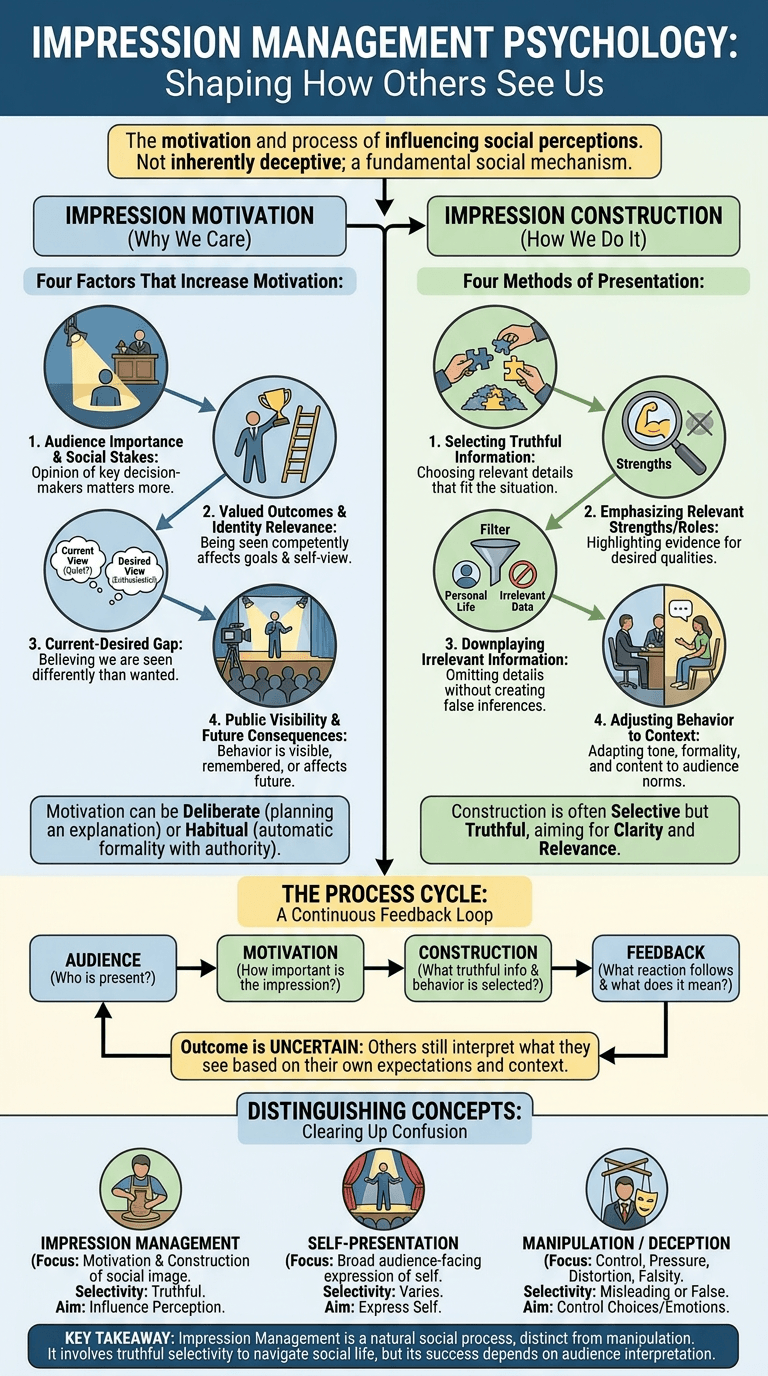
Impression management is the process of trying to influence how other people see us. A useful model separates it into two parts: impression motivation, or how much we care about managing a particular impression, and impression construction, or how we decide what to show, emphasize, explain, or leave private. It is common in social life and is not automatically deceptive, manipulative, or fully conscious.
What Impression Management Means in Psychology
The APA Dictionary of Psychology entry on impression management describes the concept in terms of managing the impressions other people form. The emphasis is on an interpersonal audience. Someone is not merely thinking about who they are in private. They are considering, explicitly or implicitly, how another person may interpret what is visible.
That audience may be one person or many. It might be a friend listening to an explanation, a group deciding whether to trust your contribution, a teacher evaluating a presentation, or a new community trying to understand what kind of member you are. The audience does not need to be hostile. Impression management can happen when the stakes are positive, such as wanting to be seen as warm, competent, dependable, serious, creative, cooperative, or honest.
Terminology overlap with self-presentation
Psychology research often uses self-presentation and impression management with substantial overlap. It is safest not to pretend there is a universal hard boundary between them. A practical distinction, however, is useful: self-presentation can be treated as the broad audience-facing display of the self, while impression management zooms in on the process of becoming motivated to shape an impression and then constructing a presentation for that purpose.
This distinction keeps attention on mechanism. Instead of asking only, “How am I presenting myself?” the more specific questions become, “Why does this impression matter right now?” and “What information or behavior am I using to shape it?”
Why impression management is not automatically deceptive or manipulative
Imagine a person introducing themselves at a volunteer organization. They mention that they are reliable, enjoy planning, and have organized community events before. They do not mention every hobby, every past mistake, or every opinion they hold. That is selective, but it may still be completely truthful because the information chosen is relevant to the setting.
Deception becomes a different issue when a presentation includes false claims or intentionally creates a materially misleading picture. Manipulation is also broader because it can involve pressure, distortion, exploitation, or attempts to control another person’s feelings or choices. Impression management can overlap with either of those, but ordinary impression management does not require them.
The Two-Part Process: Impression Motivation and Impression Construction
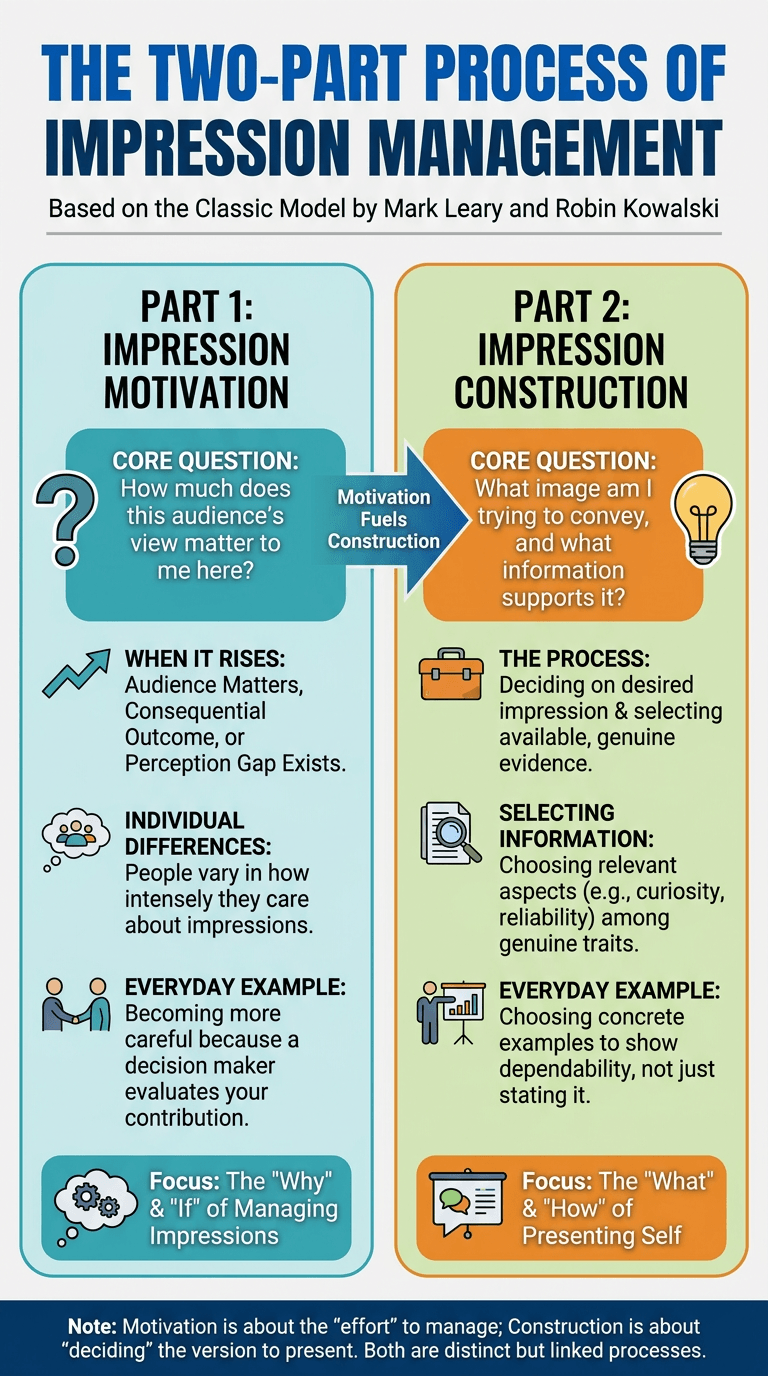
A classic model by Mark Leary and Robin Kowalski separates impression management into two processes: impression motivation and impression construction. Their two-component model of impression management is useful because it prevents two different questions from being blurred together.
The first question is whether a person is motivated to manage an impression at all. The second is what kind of impression they try to create and how they attempt to create it. You can care intensely about an impression but have no clear idea how to present yourself. You can also know exactly how you could present yourself but feel little reason to do so.
| Part of the process | Core question | Everyday example |
|---|---|---|
| Impression motivation | How much does this audience’s view matter to me here? | You become more careful because a decision maker will evaluate your contribution. |
| Impression construction | What image am I trying to convey, and what information supports it? | You choose concrete examples that show dependability rather than simply saying you are dependable. |
Impression motivation: when managing an impression feels worth the effort
People are unlikely to monitor every impression with equal intensity. Motivation tends to rise when an audience matters, when the outcome feels consequential, or when there is a noticeable gap between how a person thinks they are currently seen and how they would prefer to be seen. A casual interaction with a stranger on a train may invite little effort. A conversation with a person whose decision affects an important opportunity may invite much more.
Research on self-presentation also suggests meaningful individual differences. In a review of personality processes in self-presentation, Mark Leary discusses how people vary in how much they care about others’ impressions, what images they try to convey, how comfortable they are with self-disclosure, and how effective they believe their presentation will be. The review on personality processes in self-presentation is a useful reminder that the same situation does not create the same level of impression concern for everyone.
Impression construction: deciding what version of relevant information to present
Once impression motivation is active, the problem shifts. The person needs to decide what impression they want and what available evidence could support it. This is not the same as inventing a new identity. Often it means selecting among genuine aspects of the self.
Suppose a student is meeting a research team for the first time. They could emphasize curiosity, careful note-taking, reliability, technical skill, or willingness to learn. All may be true, but not all are equally relevant. Construction involves selecting, wording, timing, and displaying information so that an audience has a reasonable chance of seeing the desired quality.
What Makes Impression Management More Important
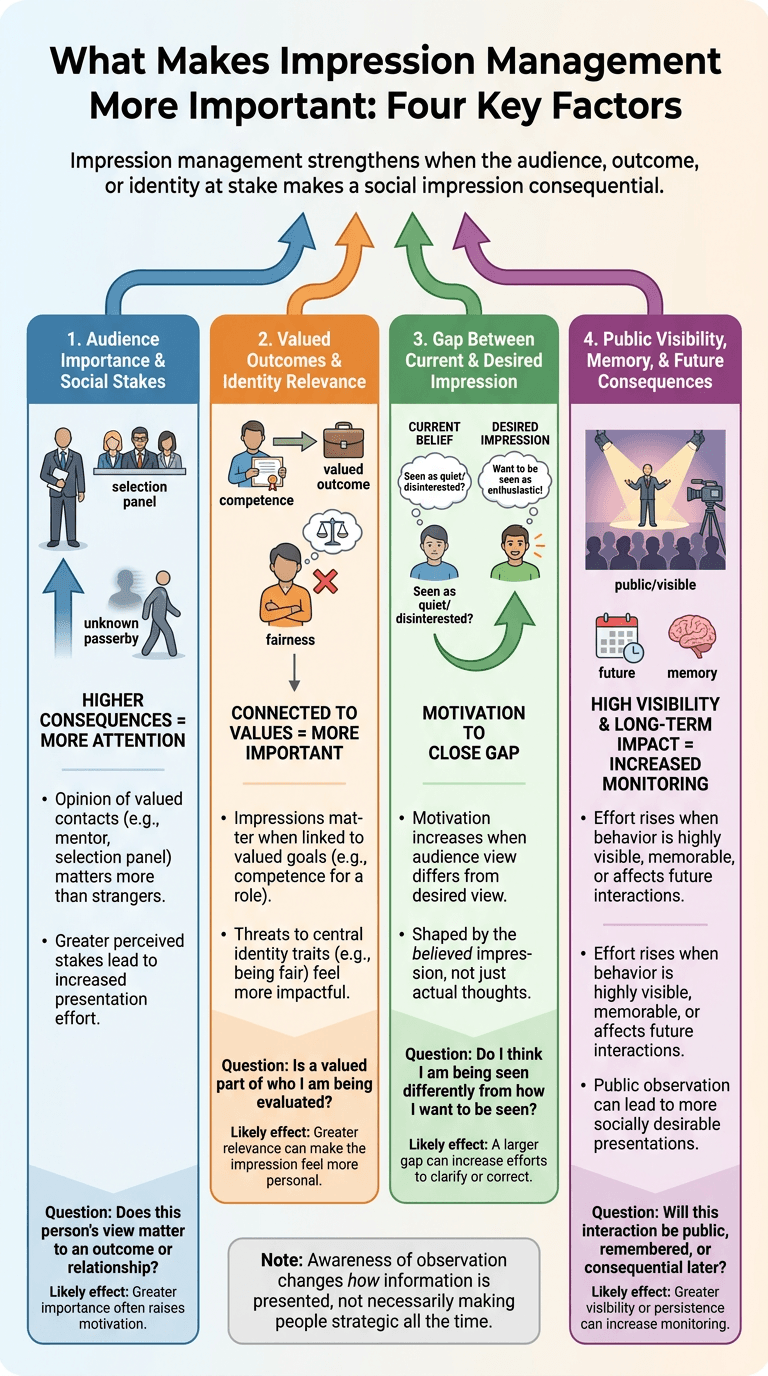
Impression management does not switch on simply because another person is nearby. It becomes stronger when the audience, outcome, or identity at stake makes a social impression consequential. Four factors are especially useful for understanding why.
Audience importance and social stakes
The opinion of a close friend, respected mentor, selection panel, teammate, or community leader may matter more than the opinion of an unknown passerby. The higher the perceived consequences of being seen one way rather than another, the more attention a person may devote to presentation.
Valued outcomes and identity relevance
Impressions matter more when they are connected to something the person values. If being seen as competent affects access to a desired role, competence becomes especially important. If a person strongly values being fair, an accusation of unfairness may feel more threatening than criticism of a trait they consider less central.
A gap between current and desired impression
Motivation can increase when people believe the audience currently sees them in a way they do not want. If a person thinks colleagues have interpreted quietness as disinterest, they may become more explicit about enthusiasm. If a new group sees someone as inexperienced, that person may be more likely to mention relevant past work.
The gap may be based on a mistaken reading of the audience. Impression management is shaped partly by the impression a person believes exists, not only by what others actually think.
Public visibility, memory, and future consequences
Presentation effort may rise when behavior is highly visible, likely to be remembered, or likely to affect future interaction. A small mistake in a private rehearsal may feel different from the same mistake during a public demonstration. A comment made in a group that meets once may carry different weight from a comment made in a long-term team.
One laboratory study found that people who believed their responses were being observed changed some self and friend evaluations in a more socially desirable direction. The study, available through PubMed Central research on impression management under social observation, does not mean people always become strategic when watched. It does show that awareness of observation can change how socially relevant information is presented.
| Factor | Question to ask | Likely effect on impression motivation |
|---|---|---|
| Audience importance | Does this person’s view matter to an outcome or relationship? | Greater importance often raises motivation. |
| Identity relevance | Is a valued part of who I am being evaluated? | Greater relevance can make the impression feel more personal. |
| Current-desired gap | Do I think I am being seen differently from how I want to be seen? | A larger gap can increase efforts to clarify or correct. |
| Visibility and future consequences | Will this interaction be public, remembered, or consequential later? | Greater visibility or persistence can increase monitoring. |
How People Construct a Presentation
Construction is where impression management becomes concrete. It involves deciding which truthful information is relevant, how much context an audience needs, what behavior communicates the desired quality, and which details can remain private without changing the meaning in a misleading way.
Selecting information the audience can understand
An audience can only interpret information it has access to. If someone wants to be seen as reliable, saying “I care about reliability” gives weaker evidence than describing consistent follow-through. If someone wants to clarify that a missed deadline was unusual, the audience may need enough context to understand what happened without receiving a defensive autobiography.
Emphasizing relevant strengths or roles
Different settings make different aspects of a person more relevant. A coach may emphasize patience with beginners. A project lead may emphasize planning. A new member of a hobby group may emphasize curiosity and willingness to learn. The behavior changes because the social task changes, not necessarily because the person has become someone else.
Problems arise when emphasis outruns evidence. Saying “I have handled projects like this before” is different from turning vague experience into a claim of expertise. Evidence usually communicates more than a flattering label.
Downplaying information that is irrelevant without making false claims
People routinely leave irrelevant details out of social interactions. A person does not need to describe every uncertainty they have ever felt in order to speak confidently about a topic they know well. Nor does someone need to disclose every private difficulty to be sincere in a professional conversation.
The ethical line changes when omission helps create a materially false inference. Leaving out irrelevant personal details is ordinary selectivity; hiding a fact that directly contradicts a claimed qualification is not.
Adjusting behavior to audience values and prior knowledge
The same evidence can be interpreted differently depending on what an audience already knows and values. A detailed technical explanation may signal competence to one group and poor judgment to another if the group asked for a simple summary. An informal joke may signal warmth among friends and feel inappropriate in a solemn setting.
Deliberate Adjustment vs Relatively Automatic Self-Presentation
Impression management is sometimes pictured as a person calculating every move. Much of everyday behavior is less deliberate than that. People learn social roles, norms, and context cues over time, so some adjustments occur quickly and with little conscious planning.
Conscious planning
Deliberate impression management is easiest to notice when someone prepares. They may decide how to explain a career gap, select examples before an interview, rehearse an introduction, or plan how to acknowledge a mistake. Conscious planning can improve clarity, but it can also become overcontrolled if the person becomes more focused on monitoring themselves than on the actual interaction.
Habitual context sensitivity and learned role behavior
Other adjustments are learned habits. Many people automatically use different levels of formality with a child, a close friend, a doctor, and an unfamiliar authority figure. They do not need to stop and design a separate identity each time.
Automatic adjustment also weakens the stereotype that impression management is always cynical. Learned social behavior can be sincere and context-sensitive at the same time.
The Audience → Motivation → Construction → Feedback Cycle
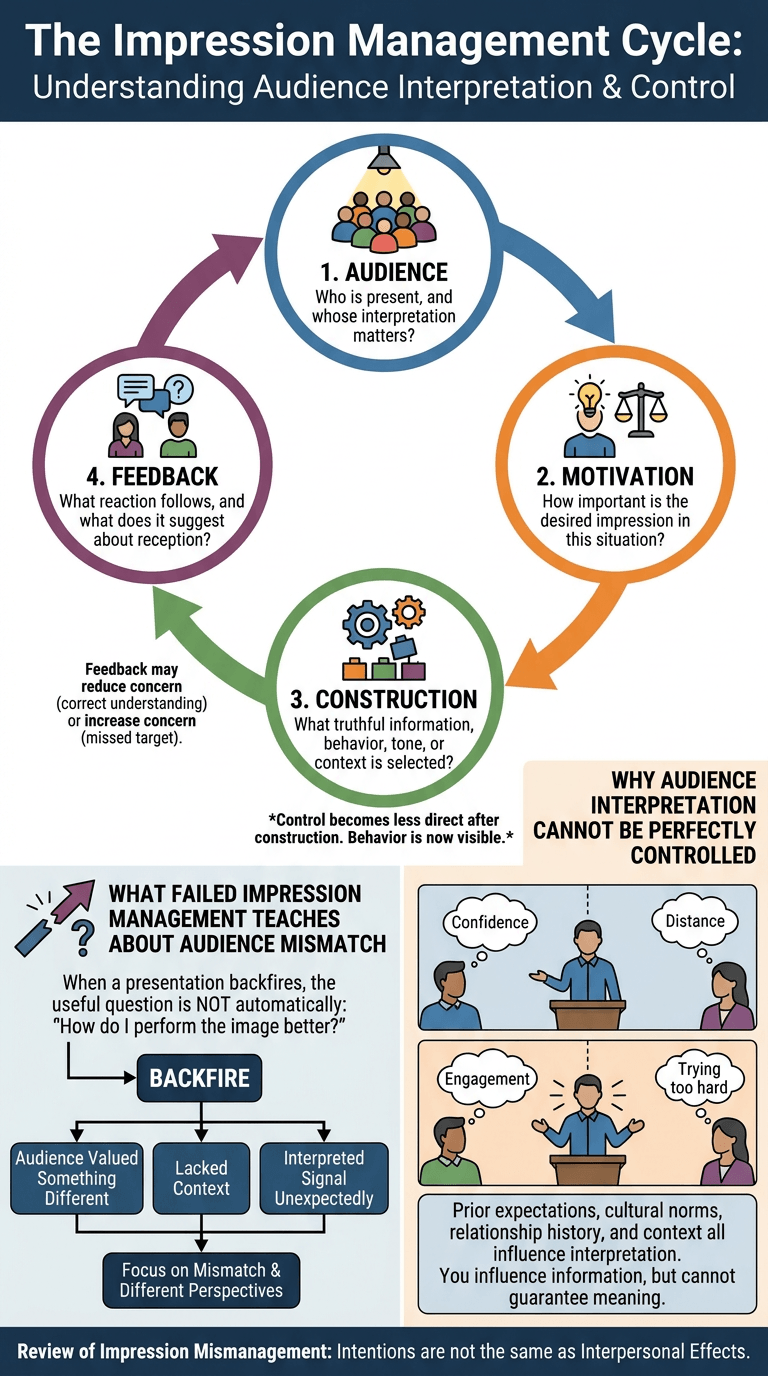
A useful way to visualize the process is as a four-stage cycle:
- Audience: Who is present, and whose interpretation matters?
- Motivation: How important is the desired impression in this situation?
- Construction: What truthful information, behavior, tone, or context is selected?
- Feedback: What reaction follows, and what does that reaction suggest about how the presentation was received?
The cycle can repeat. Feedback may reduce concern because the audience understood correctly, or it may increase concern because the person believes the impression missed its target. The important point is that control becomes less direct after construction. Once behavior is visible, interpretation belongs partly to the audience.
Why audience interpretation cannot be perfectly controlled
Two observers can watch the same behavior and reach different conclusions. One person sees concise speech as confidence. Another sees it as distance. One person sees visible enthusiasm as engagement. Another sees it as trying too hard.
Prior expectations, cultural norms, relationship history, and context all influence interpretation. You can influence the information available, but you cannot guarantee the meaning another person assigns to it.
What failed impression management can teach about audience mismatch
When a presentation backfires, the useful question is not automatically, “How do I perform the image better?” The mismatch may show that the audience valued something different, lacked context, or interpreted the signal in an unexpected way.
A review of impression mismanagement notes that people can misunderstand how their self-presentational behavior will be received, especially when actor and audience perspectives differ. The review of when impression management backfires highlights a useful limit: intentions are not the same as interpersonal effects.
Impression Management vs Self-Presentation, Manipulation, and Deception
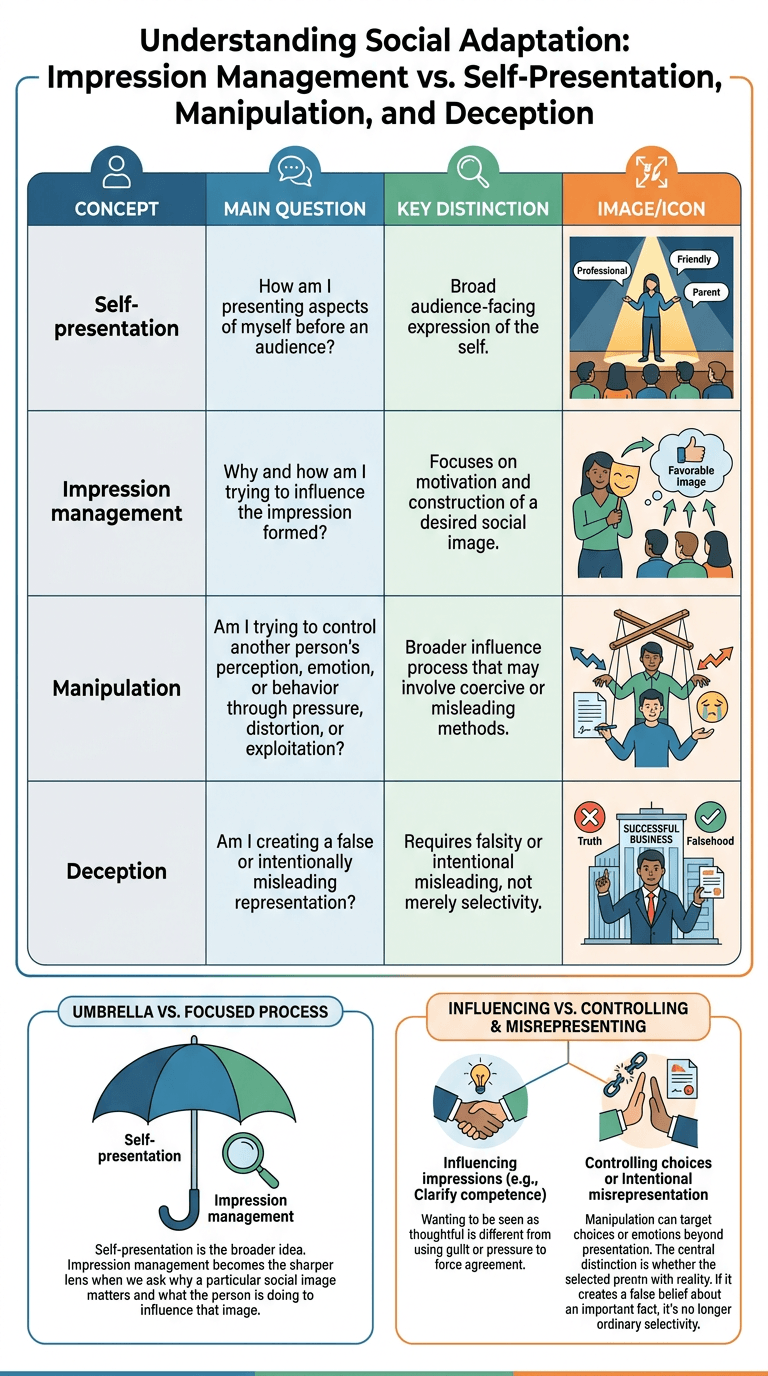
These ideas overlap enough to create confusion, but they answer different questions. Keeping the distinctions clear helps prevent ordinary social adaptation from being treated as inherently dishonest.
| Concept | Main question | What distinguishes it |
|---|---|---|
| Self-presentation | How am I presenting aspects of myself before an audience? | Broad audience-facing expression of the self. |
| Impression management | Why and how am I trying to influence the impression formed? | Focuses on motivation and construction of a desired social image. |
| Manipulation | Am I trying to control another person’s perception, emotion, or behavior through pressure, distortion, or exploitation? | Broader influence process that may involve coercive or misleading methods. |
| Deception | Am I creating a false or intentionally misleading representation? | Requires falsity or intentional misleading, not merely selectivity. |
Umbrella concept versus focused impression-regulation process
Self-presentation is the broader idea. A person may present differently across situations simply because roles and audiences differ. Impression management becomes the sharper lens when we ask why a particular social image matters and what the person is doing to influence that image.
Influencing impressions versus controlling another person’s choices
Wanting to be seen as thoughtful is different from using guilt or pressure to force agreement. Wanting to clarify competence is different from fabricating authority. Impression management concerns the image an audience forms; manipulation can target the audience’s choices or emotions in ways that go beyond presentation.
Selective truthful presentation versus intentional misrepresentation
Every social interaction is selective because no one can communicate everything about themselves at once. The central distinction is whether the selected presentation remains compatible with reality. If it does, selectivity may simply reflect relevance and privacy. If the selection is designed to create a false belief about an important fact, the problem is no longer ordinary selectivity.
Why Context Changes the Same Behavior
Behavior does not carry a fixed social meaning. The same action can suggest confidence, arrogance, warmth, insecurity, professionalism, or awkwardness depending on the setting and the observer. That makes context central to impression construction.
Audience expectations, role norms, and situational meaning
Consider a person who talks extensively about their achievements. In a structured interview, evidence of relevant accomplishments may be expected. During a friend’s difficult moment, the same amount of self-focus may seem insensitive. The behavior is similar, but the social task is different.
When a signal can look appropriate to one audience and excessive to another
Signals work only through interpretation. A detailed portfolio may reassure an audience that values evidence and overwhelm an audience that needs a brief answer. Humor may create connection in one group and reduce perceived seriousness in another. Directness may be valued in one cultural setting and read as discourteous in another.
The goal is not endless shape-shifting. It is enough audience awareness to communicate clearly without abandoning accuracy or important values.
When a Different Concept Explains the Situation Better
Impression management is only one way to frame an audience-facing situation. The central question changes when the reader is really asking about a specific strategy, authenticity, or a belief that has persisted across time.
When you are trying to name a specific presentation strategy
If the main question is whether someone is using ingratiation, self-promotion, exemplification, intimidation, or supplication, the issue is no longer the general process of impression motivation and construction. It is the type of strategy being used and the tradeoffs attached to that strategy.
When the main concern is whether adaptation feels fake
If the person is asking, “Am I being inauthentic because I act differently with different audiences?” the central issue becomes the relationship between authenticity, role adaptation, privacy, and deception. That question requires more than a process model because it involves values and consistency across contexts.
When the concern is what people believe over time
If the issue is what a group has come to expect from someone after repeated interactions, the focus shifts from a moment of presentation to reputation. Reputation can be influenced by self-presentation, but it also depends on repeated behavior, secondhand information, memory, and what other people say to one another.
What to Do Next: A Reflective Check Before You Manage an Impression
Impression management becomes more useful when it helps you communicate relevant truth, not when it turns every interaction into a performance. Before adjusting a presentation, four questions can make the process clearer.
- Who is the audience? Identify whose interpretation actually matters in this situation rather than imagining a vague crowd.
- What impression feels important? Name the quality you want to communicate, such as reliability, warmth, competence, seriousness, or openness.
- What evidence supports that impression? Prefer concrete behavior, examples, and context over unsupported self-labels.
- What value boundary should not be crossed? Decide what you are unwilling to exaggerate, conceal, or misrepresent simply to produce a better image.
If you want a new project group to see you as dependable, a realistic timeline and consistent follow-through usually communicate more than announcing, “I am extremely reliable.” The desired impression is still present, but the evidence does more work than the claim.
Identify the audience, desired impression, evidence, and value boundary
Before a high-stakes interaction, writing down those four items can reveal whether the concern is concrete or vague. “I need everyone to like me” offers little direction. “I want this committee to understand that I can organize complex work, and I can show that with two relevant examples” is specific and evidence-based.
Ask what remains true even if the presentation is selective
Selective presentation is unavoidable. The better test is whether the part you are showing remains true when placed back into the larger picture. If you describe yourself as experienced, would a reasonable person who knew the full context agree that the description is fair? If you present a mistake as unusual, does your broader behavior support that claim?
You do not need to disclose every private detail to be honest. The stronger test is whether the desired impression still holds when the relevant context is added.
FAQ About Impression Management Psychology
These questions clarify the most common boundaries of the concept without treating every socially aware adjustment as a calculated performance.
Is impression management always conscious?
No. Some impression management is deliberate, such as preparing how to introduce yourself or explain a mistake. Other adjustments are partly automatic because people learn social roles, norms, and audience cues over time. The presence of an impression goal does not require constant conscious calculation.
Why do high-stakes audiences increase impression motivation?
When an audience can affect a valued outcome, relationship, identity, or future opportunity, its interpretation carries more weight. That often makes people more attentive to how they are being seen. The effect still varies by person and situation, so high stakes do not produce the same response in everyone.
Can impression management fail even when the presentation is accurate?
Yes. Accuracy does not guarantee the intended interpretation. An audience may have different expectations, miss relevant context, or read the same behavior differently. A truthful presentation can therefore fail to produce the desired impression without becoming deceptive.
Is impression management the same as manipulation?
No. Impression management concerns attempts to influence how an audience sees a person. Manipulation is a broader form of influence that may involve pressure, distortion, concealment, or exploitation aimed at another person’s perceptions, emotions, or decisions. They can overlap, but ordinary impression management does not automatically involve manipulation.
How is impression management different from reputation?
Impression management is something a person does in an effort to shape how they are perceived. Reputation is the set of beliefs or expectations about that person that can persist across interactions and circulate among other people. A person can influence a reputation, but cannot control it through presentation alone.
Key Takeaways
- Impression management is best understood as an audience-facing process, not as proof that someone is fake or manipulative.
- The two-part model separates impression motivation, how much the audience’s view matters, from impression construction, how the person builds a presentation.
- Motivation tends to increase when the audience is important, the outcome is valued, the current impression feels wrong, or the interaction has visible future consequences.
- Truthful selectivity is different from deception. The key question is whether the presentation remains compatible with reality when relevant context is added.
- Audience interpretation cannot be perfectly controlled, so even accurate self-presentation can miss its intended effect.
- A useful next step is to identify the audience, desired impression, supporting evidence, and the value boundary you do not want to cross.

Michael Reed is the Founder and Lead Writer at Psychology Exposed. He writes about human behavior, relationships, emotional patterns, self-awareness, and practical psychology topics using research-informed, easy-to-understand content.
Read More About Michael Reed: https://psychologyexposed.com/michael-reed/