
You can look at the same result and reach two very different conclusions depending on the standard you choose. A presentation may feel weak beside a polished colleague’s talk, yet clearly better than the presentation you gave six months ago. A language learner may rank near the bottom of an advanced class while also speaking with far more ease than last year. Neither comparison is automatically wrong. They answer different questions.
Social comparison uses other people or social standards as the reference point. Temporal comparison uses your own performance, condition, or experience at another point in time. The practical challenge is not choosing one forever. It is matching the comparison standard to the question you are trying to answer, then noticing what that standard leaves out.
Quick Answer: The Two Comparisons Answer Different Questions
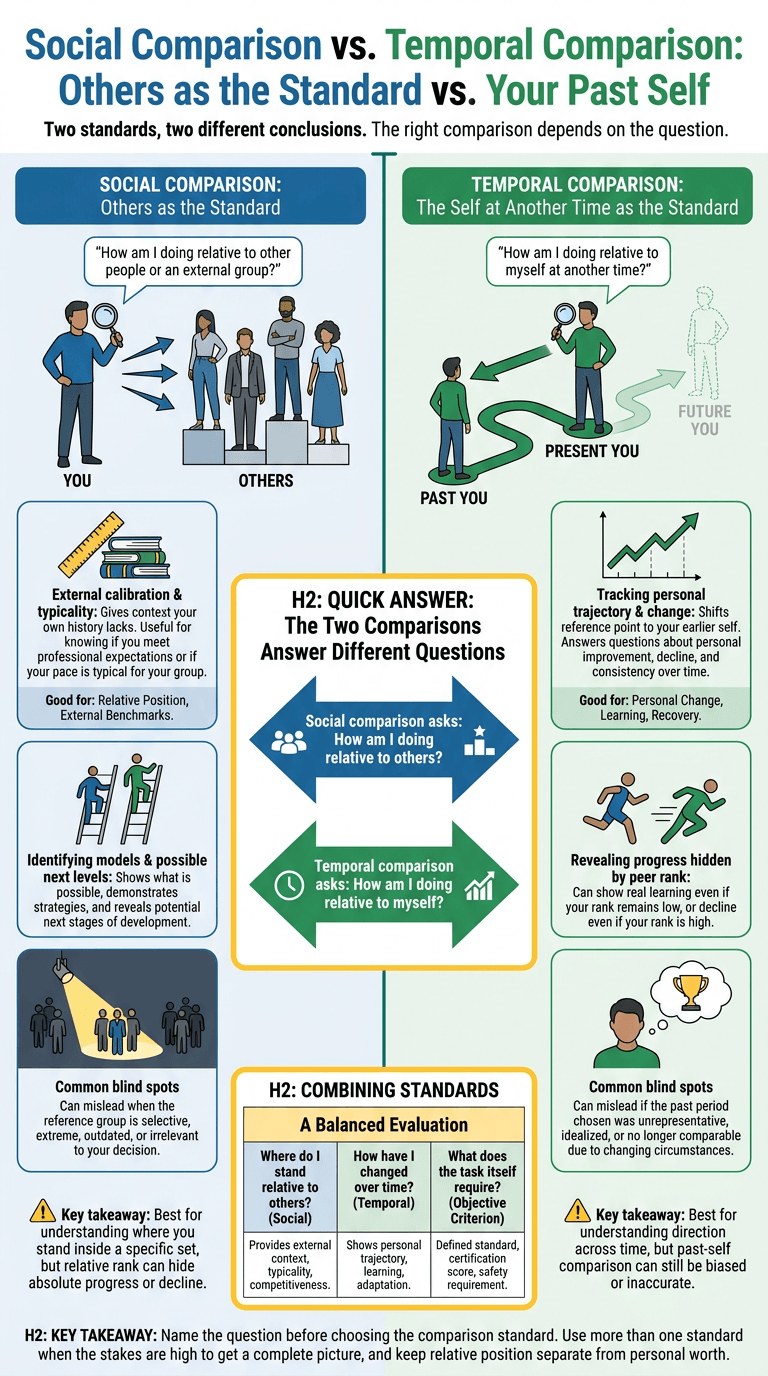
Social comparison asks, “How am I doing relative to other people or an external group?” Temporal comparison asks, “How am I doing relative to myself at another time?” Social comparison is useful for calibration, typicality, and external benchmarks. Temporal comparison is useful for seeing personal change and trajectory. Both can inform self-evaluation, and both can mislead when the reference point is selective, outdated, unusually extreme, or irrelevant to the decision at hand.
Social Comparison: Other People as the Standard
External calibration, typicality, and relative position
Social comparison gives you information that your own history cannot provide. If you want to know whether a work sample meets the level expected in your profession, whether your running pace is typical for your training group, or whether a skill is advanced for someone at your stage, other people can provide a useful frame of reference.
The result is usually relative. Being faster than most people in a group tells you where you stand inside that group. It does not, by itself, tell you whether the pace meets a safety standard, whether you improved, or whether the group is representative. Likewise, being slower than an elite group does not prove poor absolute performance. It may simply describe the level of the group you selected.
When peers or professional benchmarks add useful information
Other-person standards are particularly helpful when the environment has shared expectations. A new accountant can compare work quality with experienced colleagues to learn what careful documentation looks like. A student can compare an essay with well-graded examples to understand the level of argument expected. A musician can listen to performers at a similar stage to calibrate timing and technique.
Research on self-evaluation treats social comparison as one important information source rather than a simple emotional habit. In experimental work, social information about where a person stood relative to others affected self-evaluations even when information about personal improvement or decline was also available. Zell and Alicke’s research on social and temporal comparison illustrates why these two standards should not be treated as interchangeable.
Temporal Comparison: The Self at Another Time as the Standard
Past-self comparison
Temporal comparison shifts the reference point from another person to an earlier version of you. Stuart Albert’s foundational formulation described temporal comparison by adapting ideas from social comparison to the same person at different points in time. Albert’s 1977 Temporal Comparison Theory provides the historical basis for this distinction.
Past-self comparison can answer questions that social ranking cannot. Are you more fluent than you were last year? Can you now complete a task that once required help? Has your concentration returned after a difficult period? Are your practice sessions more consistent than they were three months ago? These questions are about change within a person, not rank between people.
Present-versus-expected-future comparison at a careful level
People also compare the present self with an expected future version of themselves. That can be useful for noticing a gap between current performance and a realistic future standard. However, future-self comparison is not the same thing as goal setting. A future image can function as a comparison point even when it is vague, emotionally loaded, or not attached to a concrete plan.
This distinction matters because imagined standards can become unrealistically clean. The future self does not have bad days, competing responsibilities, changing health, or unexpected setbacks unless you deliberately include them. A useful future comparison therefore asks what evidence supports the expectation and what conditions would make it reasonable.
Why personal trajectory can reveal change hidden by peer ranking
Relative position can stay the same while personal performance improves. Imagine five people taking the same course. Everyone becomes better each month, so your rank remains fourth. A purely social comparison says, “I am still fourth.” A temporal comparison may say, “I can now solve problems that were impossible for me at the beginning.” Both statements can be true.
The reverse can happen too. You may remain near the top of a group while your own performance quietly declines. Temporal information can reveal that change even when your relative rank still looks favorable. This is one reason it is useful to keep position and trajectory separate.
A Side-by-Side Map: Others vs Past Self
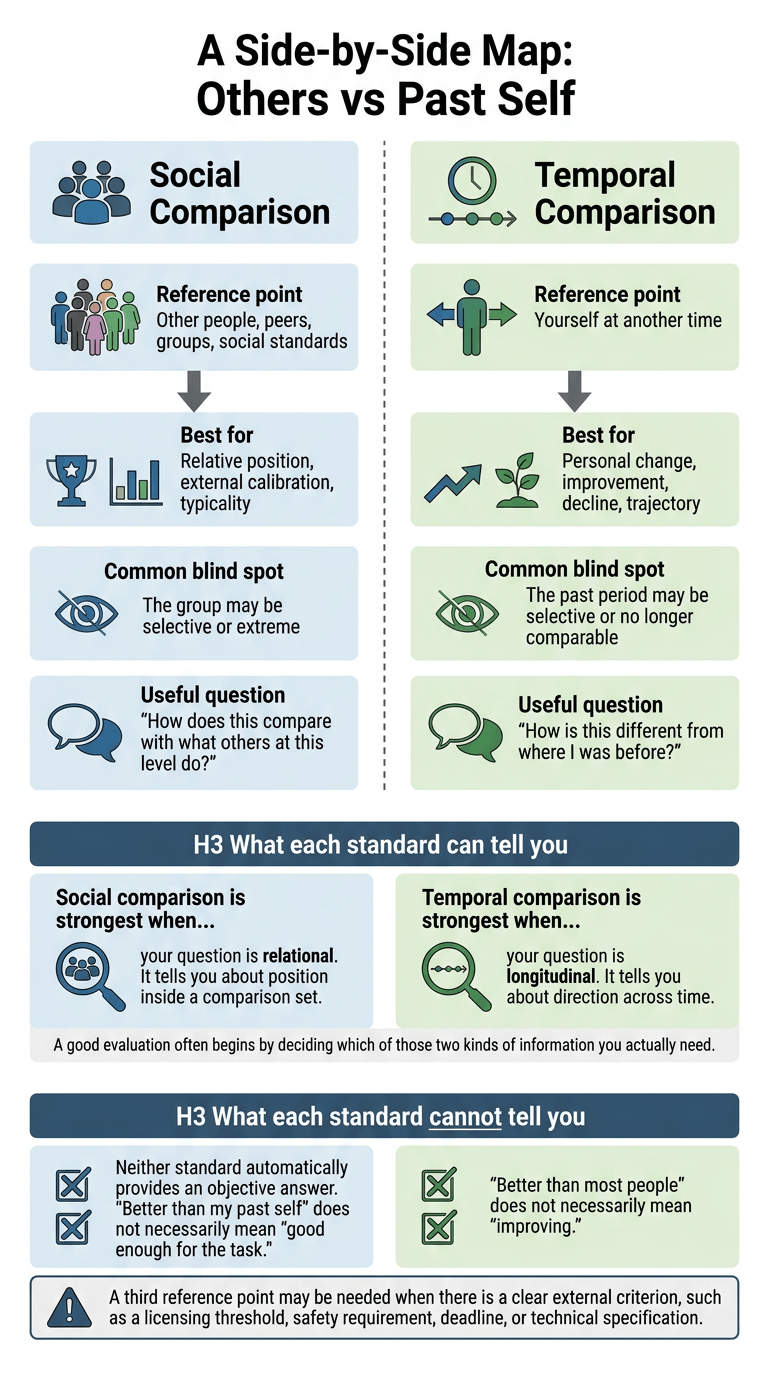
| Question | Social comparison | Temporal comparison |
|---|---|---|
| Reference point | Other people, peers, groups, social standards | Yourself at another time |
| Best for | Relative position, external calibration, typicality | Personal change, improvement, decline, trajectory |
| Common blind spot | The group may be selective or extreme | The past period may be selective or no longer comparable |
| Useful question | “How does this compare with what others at this level do?” | “How is this different from where I was before?” |
| What it does not prove | Your absolute ability, value, or progress | Your standing relative to others or whether you meet an external requirement |
What each standard can tell you
Social comparison is strongest when your question is relational. It tells you about position inside a comparison set. Temporal comparison is strongest when your question is longitudinal. It tells you about direction across time. A good evaluation often begins by deciding which of those two kinds of information you actually need.
What each standard cannot tell you
Neither standard automatically provides an objective answer. “Better than my past self” does not necessarily mean “good enough for the task.” “Better than most people” does not necessarily mean “improving.” A third reference point may be needed when there is a clear external criterion, such as a licensing threshold, safety requirement, deadline, or technical specification.
When Social Comparison Is More Informative
Learning whether performance meets an external standard
Some questions are inherently social or institutional. If you are applying for a competitive role, presenting at a professional level, or entering a class with shared criteria, your past improvement is useful but incomplete. You also need to know how your current work relates to the standard expected in that setting.
This does not mean copying the strongest person you can find. The comparison set should be relevant. A beginner comparing with international experts may learn what excellence looks like, but that benchmark is usually poor for estimating what is normal at the beginner stage.
Calibrating what is typical in a field or stage
Other people can also help answer “Is this common here?” A first-time manager may wonder how long certain tasks normally take. A student may wonder whether a particular assignment is challenging for most classmates. A new volunteer may need to see how experienced members handle responsibilities before judging their own pace.
The key is to treat the information as contextual. “Typical in this group” is not the same as “universally normal,” just as “unusual here” does not automatically mean “wrong.”
Identifying models and possible next levels
Social standards can reveal possibilities that your own history cannot. Someone slightly ahead of you may demonstrate a strategy, level of fluency, or work process you had not considered. This is one reason social comparison is not merely a threat to well-being. It can be informative when the target is relevant and the conclusion stays specific.
A useful interpretation sounds like, “That person shows me what the next stage may involve,” rather than, “Their advantage proves something global about me.”
When Temporal Comparison Is More Informative
Skill development across changing baselines
If your main question is whether practice is working, your own earlier performance may be the most direct reference. A writer might compare current revision time with six months ago. A speaker might compare how often notes are needed now versus before. A learner might compare comprehension of the same type of material across several months.
This is especially useful when people around you are changing too. In a high-growth environment, everyone may improve at once. Relative rank can remain stable even while your competence changes substantially.
Recovery or rebuilding when peers are poor benchmarks
There are periods when peer comparison becomes less informative because circumstances are not comparable. Someone returning to exercise after illness, rebuilding concentration after prolonged stress, or restarting a skill after years away may gain more from comparing present capacity with a recent personal baseline than with people whose conditions are very different.
This is not medical guidance, and temporal comparison should not replace individualized professional advice when health is involved. It is simply a reminder that the fairest comparison set depends on the question and circumstances.
Tracking learning, practice, or adaptation over time
Temporal comparison can make small changes visible. A person learning to draw may still be far from professional quality, but older sketches can show improvements in proportion or line control. A new presenter may still feel nervous, yet recordings may show fewer pauses and clearer structure than before.
Those changes matter because they describe trajectory. They do not need to be converted into a claim about superiority or inferiority to others.
Temporal Comparison Can Be Biased Too
Choosing an unusually good or bad past period
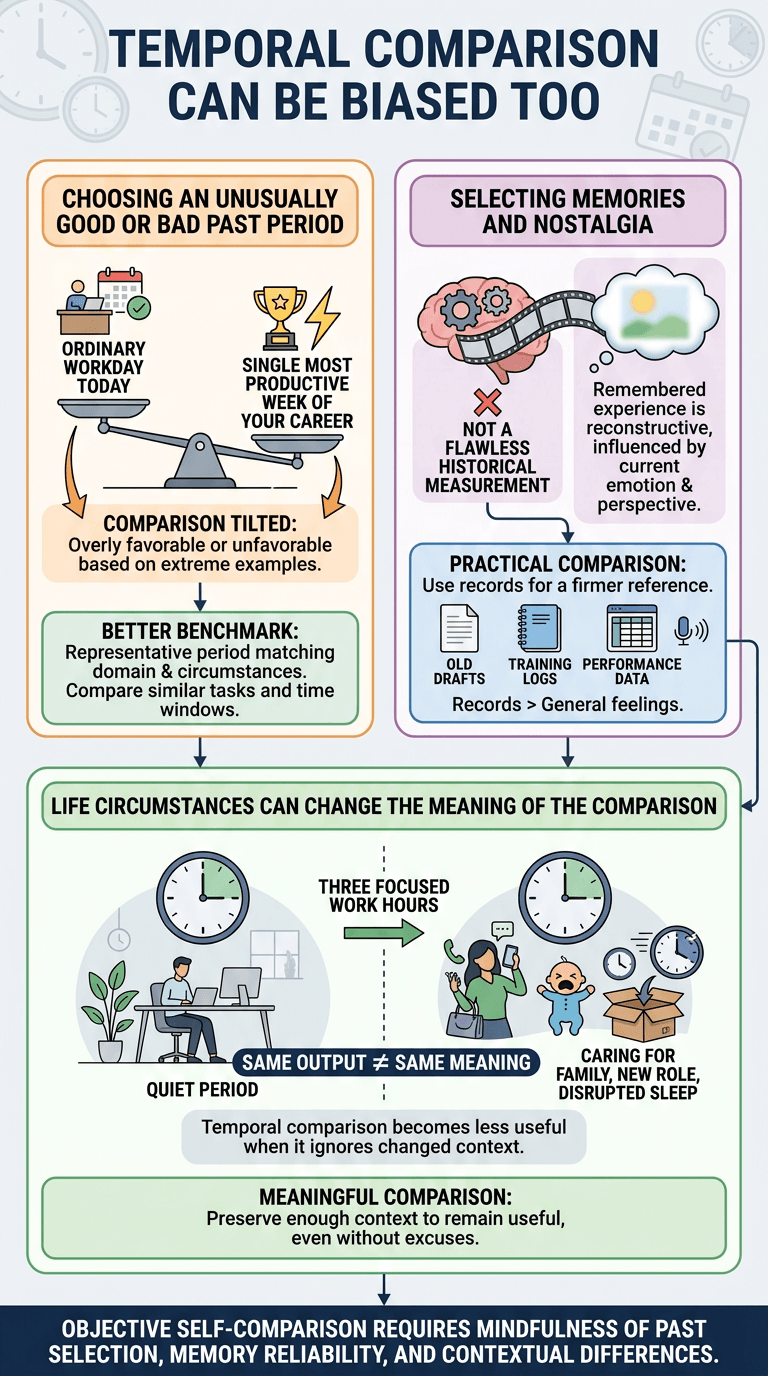
“Compared with my past self” sounds objective, but the chosen past self matters. If you compare today’s ordinary workday with the single most productive week of your career, the comparison is tilted. If you compare it with your worst week, the result may look overly favorable.
A better temporal benchmark is usually a representative period that matches the domain and circumstances. For a skill, compare similar tasks. For consistency, compare similar time windows. For recovery, compare stages that make sense for your situation rather than selecting a dramatic high or low point.
Selecting memories and nostalgia
Remembered experience is not a perfect recording of the past. Reviews of autobiographical memory research describe memory as reconstructive, with retrieval influenced by current emotion, perspective, and context. A recent review of emotion and autobiographical memory is useful here because it shows why remembered past selves should be treated as evidence with limits, not as flawless historical measurements.
For practical comparison, records can sometimes help. Old drafts, training logs, performance data, calendars, or recordings may provide a firmer reference than a general feeling that “I used to be much better.”
Life circumstances can change the meaning of the comparison
The same output can have different significance under different conditions. Completing three focused work hours during a quiet period is not necessarily equivalent to doing the same while caring for a family member, adapting to a new role, or managing disrupted sleep. Temporal comparison becomes less useful when it ignores what changed around the person.
That does not mean every difference needs an excuse. It means the comparison should preserve enough context to remain meaningful.
Social Comparison Can Be Biased Too
Exceptional targets and selective reference groups
Social comparison can distort self-evaluation when the comparison set is unusually strong, unusually visible, or too narrow. A creator who compares only with accounts that already have large audiences may mistake an exceptional slice of the field for the ordinary baseline. A student in a highly selective program may underestimate ability because the local comparison group is stronger than the wider population.
The problem is not that the comparison is false. The people may genuinely be ahead. The problem is treating a selective reference group as if it answered every question about your own performance.
Relative rank can hide absolute progress
Suppose your test score rises from 65 to 78 while your cohort average rises from 70 to 85. Your relative position may fall even though your absolute performance improved. If you look only at rank, you could miss real learning. If you look only at personal improvement, you could miss the fact that the external standard moved faster.
This is exactly why the two comparison types work best as different instruments rather than competing philosophies.
Which Standard Answers Which Question?
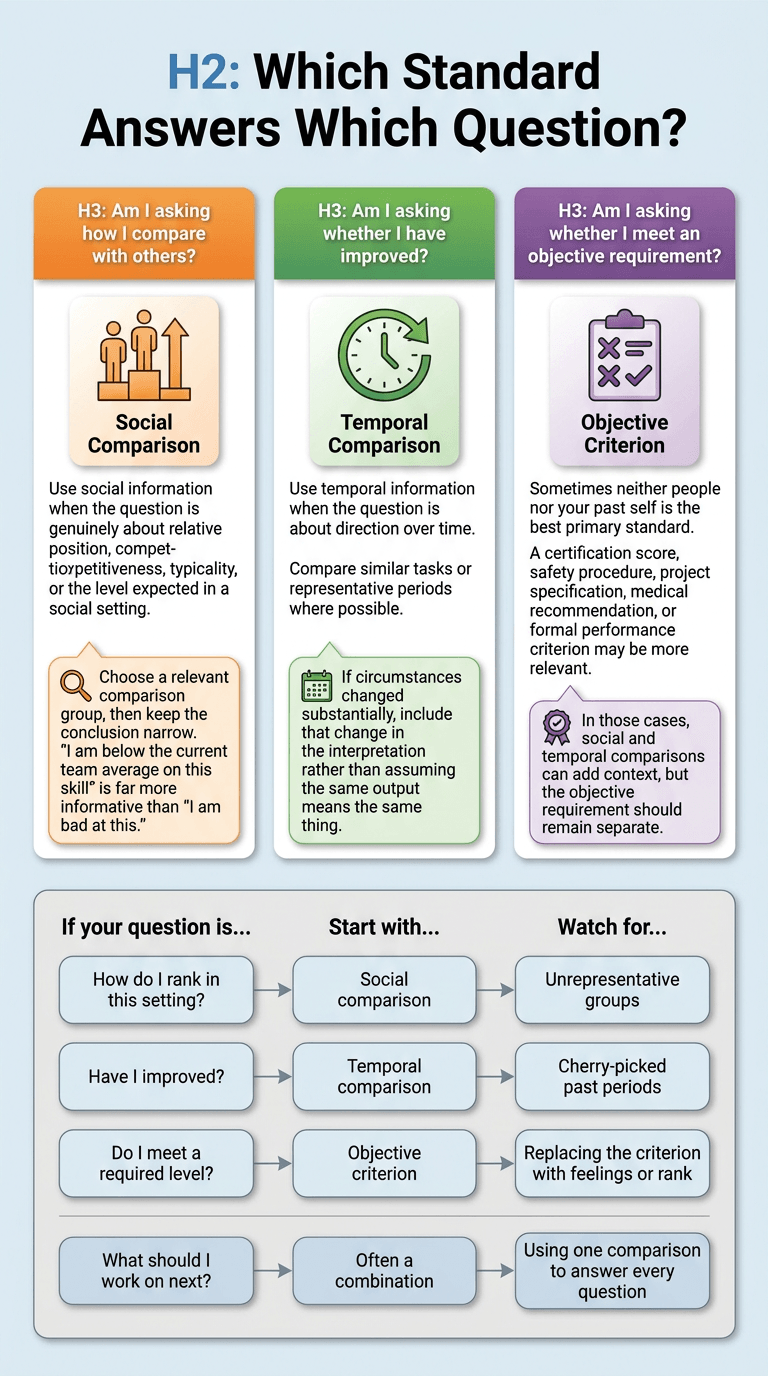
Am I asking how I compare with others?
Use social information when the question is genuinely about relative position, competitiveness, typicality, or the level expected in a social setting. Choose a relevant comparison group, then keep the conclusion narrow. “I am below the current team average on this skill” is far more informative than “I am bad at this.”
Am I asking whether I have improved?
Use temporal information when the question is about direction over time. Compare similar tasks or representative periods where possible. If circumstances changed substantially, include that change in the interpretation rather than assuming the same output means the same thing.
Am I asking whether I meet an objective requirement?
Sometimes neither people nor your past self is the best primary standard. A certification score, safety procedure, project specification, medical recommendation, or formal performance criterion may be more relevant. In those cases, social and temporal comparisons can add context, but the objective requirement should remain separate.
| If your question is… | Start with… | Watch for… |
|---|---|---|
| How do I rank in this setting? | Social comparison | Unrepresentative groups |
| Have I improved? | Temporal comparison | Cherry-picked past periods |
| Do I meet a required level? | Objective criterion | Replacing the criterion with feelings or rank |
| What should I work on next? | Often a combination | Using one comparison to answer every question |
Combining Social, Temporal, and Objective Standards
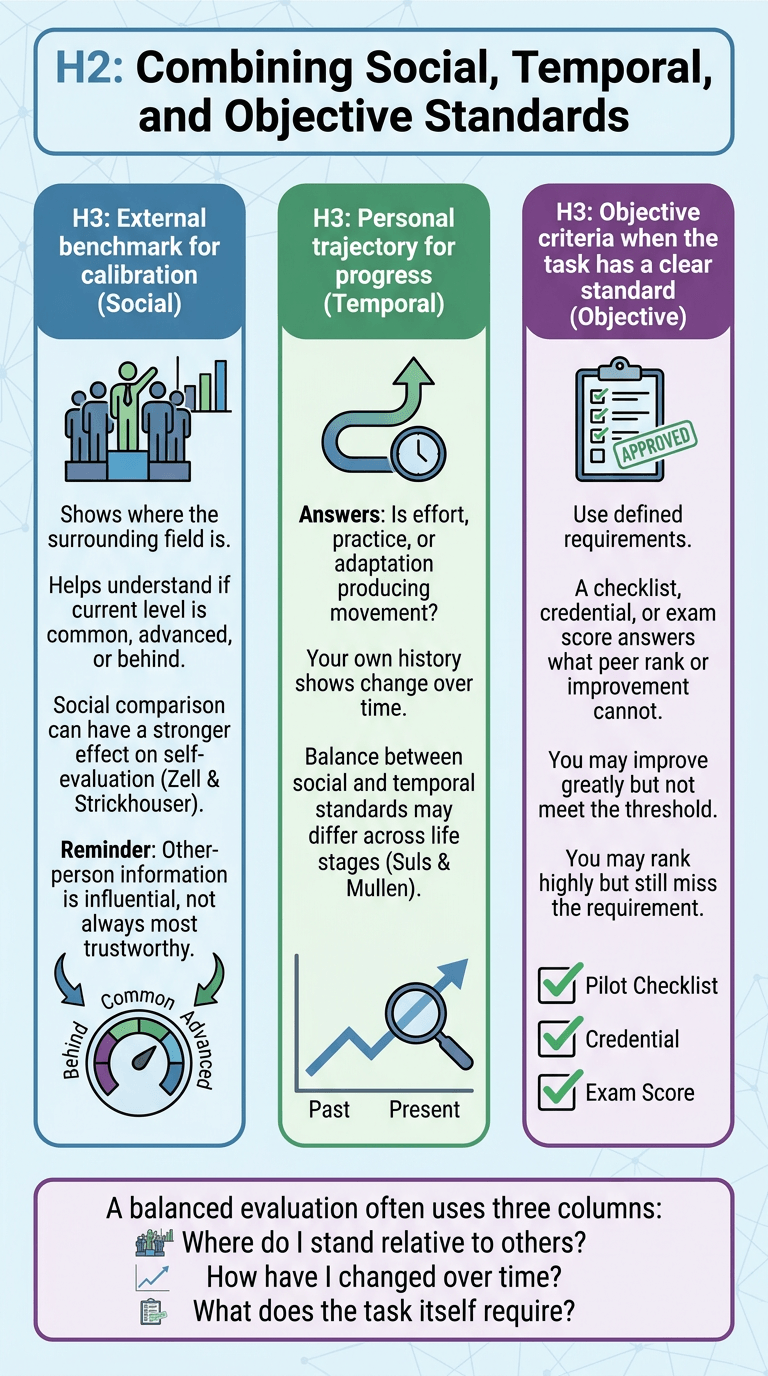
External benchmark for calibration
A social benchmark can show where the surrounding field is. It helps you understand whether your current level is common, advanced, or behind within a defined group. In one set of experiments comparing dimensional, social, and temporal feedback, social comparison had a stronger effect on self-evaluation than the other comparison types under the tested conditions. Zell and Strickhouser’s comparison research is a useful reminder that other-person information can be psychologically influential, not that it should always be trusted more.
Personal trajectory for progress
Your own history answers a different question. It can show whether effort, practice, adaptation, or changing conditions are producing movement. Research has also examined how the balance between social and temporal standards may differ across stages of life. Suls and Mullen’s work on social and temporal bases of self-evaluation is one example of this line of inquiry.
Objective criteria when the task has a clear standard
When a task has a defined requirement, use it. A pilot checklist, professional credential, language exam score, or technical specification answers something that neither peer rank nor personal improvement can settle. You may have improved greatly and still not meet the threshold. You may rank highly in a weak comparison set and still miss the requirement.
A balanced evaluation often uses three columns: Where do I stand relative to others? How have I changed over time? What does the task itself require?
Social vs Temporal Comparison Without Turning It Into Identity Development
The comparison standard changes across time
As circumstances change, the reference point that feels most informative may change too. A beginner may initially rely heavily on examples from others because there is little personal history to compare. After months of practice, personal records become more useful. Later, entering a new environment may make external standards relevant again.
This is about the source of evaluative information. It does not require a claim that a person’s identity has fundamentally changed.
Identity formation belongs to a different question
Identity development asks how a person’s sense of self forms, reorganizes, and gains continuity across time. Temporal comparison asks something narrower: what happens when the self at one time becomes the standard for evaluating the self at another time.
Those ideas can overlap, but keeping them separate prevents every past-self comparison from becoming a story about identity. Sometimes a person is simply checking whether a skill improved.
A Balanced First Step
Name the question before choosing the comparison standard
Before comparing, finish this sentence: “I am trying to find out whether…” If the answer is “I meet the level expected here,” you probably need external calibration. If it is “I have improved,” you need temporal information. If it is “this is safe or acceptable,” you may need an objective criterion or professional guidance instead.
Use more than one standard when the stakes are high
Important decisions deserve more than one snapshot. If you are evaluating a career skill, look at relevant professional expectations and your own trajectory. If you are assessing learning, look at the course criteria, peer context, and changes in your own work. Multiple standards make it easier to see where one reference point is distorting the picture.
Keep relative position separate from personal worth
Comparison provides information about a dimension. It does not establish human value. Being behind someone in public speaking, coding, income, fitness, or creative skill does not logically mean being lesser as a person. The same is true of temporal decline. A difficult period does not turn a performance change into a verdict on worth.
Worked Examples
Learning a language: cohort ranking versus personal fluency gains
Situation: Maya joins an advanced language class and ranks near the bottom on weekly quizzes. She feels as if she is getting worse.
What she may feel: Discouraged, exposed, and uncertain about whether months of study have mattered.
What it may mean: Her social comparison changed because she entered a stronger cohort. Her temporal comparison may still show better listening comprehension, larger vocabulary, and more fluent conversation than six months earlier.
What to do next: Keep the cohort score for external calibration, but compare a repeated speaking task or similar reading sample across time. The two standards together show both current level and personal trajectory.
Public speaking: peer skill versus your prior performance
Situation: Daniel gives a competent presentation, then watches a colleague who is exceptionally polished. His own talk suddenly feels poor.
What he may feel: Smaller, less capable, and tempted to discount what went well.
What it may mean: The colleague provides a useful model of advanced skill, but a single upward comparison does not reveal Daniel’s trajectory. His recording from last year shows fewer pauses, clearer transitions, and better timing now.
What to do next: Use the colleague to identify one next-level behavior, then use past recordings to evaluate whether Daniel’s own delivery is improving. One standard shows possibility; the other shows change.
Fitness: training peers versus your own capacity and history
Situation: Priya returns to recreational training after a long interruption and notices that friends complete sessions she cannot yet match.
What she may feel: Impatient and tempted to judge current capacity against the group’s pace.
What it may mean: Her peers provide social context, but they may not be appropriate baselines for her current circumstances. A safer and more informative temporal comparison may involve her own recent capacity, functional comfort, and gradual return, especially if health factors are involved.
What to do next: Track function and consistency rather than appearance, body ideals, or someone else’s numbers. If health, pain, or recovery is a concern, individualized professional guidance matters more than either comparison style.
FAQ
Is comparing yourself with your past self always healthier?
No. Past-self comparison may reduce the noise of peer ranking, but it can still be harsh or inaccurate. You might choose your best-ever period as the benchmark, forget how circumstances differed, or remember the past selectively. The better question is whether the past reference is representative and relevant to what you are evaluating now.
When do other people provide a better benchmark than your past self?
Other people are often more informative when you need external calibration. Examples include understanding professional expectations, seeing what is typical at your stage, evaluating competitiveness, or identifying what a higher level of skill looks like. Your own improvement cannot answer all of those questions.
Can temporal comparison make progress look worse than it is?
Yes. If you compare the present with an unusually strong period, ignore changed circumstances, or rely on an idealized memory, current progress may look smaller than it really is. Using repeated measures, representative periods, and concrete records can make the comparison more informative.
Is future-self comparison the same as goal setting?
No. An expected future self can serve as a comparison standard even without a specific goal or plan. Goal setting usually adds an intended outcome, criteria, and some form of action. A future-self image may be useful, but it can also become unrealistic when the conditions needed to reach it are left unspecified.
Should I use both social and temporal comparison?
Often, yes, especially when the question matters. Social information can show where you stand in a relevant environment, while temporal information can show your direction of change. Add objective criteria when the task has a clear requirement. The goal is not to collect more judgments, but to use the standard that actually answers the question in front of you.
Key Takeaways
- Social comparison evaluates you relative to other people or social standards; temporal comparison evaluates the present self relative to the self at another time.
- Social comparison is especially useful for relative position, typicality, professional calibration, and seeing possible next levels.
- Temporal comparison is especially useful for personal trajectory, learning, rebuilding, and changes that peer ranking may hide.
- Neither standard is automatically healthier or more accurate. Social reference groups can be selective, and past-self benchmarks can be cherry-picked or remembered imperfectly.
- When a task has an objective requirement, add that criterion rather than asking social or temporal comparison to answer a question it cannot settle.
- A practical next step is to name the question first, then choose the comparison standard that provides the kind of information you actually need.

Michael Reed is the Founder and Lead Writer at Psychology Exposed. He writes about human behavior, relationships, emotional patterns, self-awareness, and practical psychology topics using research-informed, easy-to-understand content.
Read More About Michael Reed: https://psychologyexposed.com/michael-reed/