

Two people can watch the same talented colleague give an excellent presentation and walk away with opposite conclusions. One thinks, “They started where I started. I could learn to do that.” The other thinks, “They are on another level. I am nowhere close.” The comparison target is the same. The direction is the same. What changes is the effect the comparison has on self-evaluation.
This is the distinction between assimilation and contrast in social comparison. Assimilation means your judgment of yourself shifts psychologically toward the comparison target. Contrast means the difference between you and the target becomes more salient, so your self-evaluation shifts away from the target. Neither response is automatically healthy or unhealthy, and neither is determined by whether the comparison is upward or downward.
The useful question is not simply, “Am I comparing up or down?” It is also, “What is this comparison doing to the way I evaluate myself, and why?” Similarity, attainability, relevance, psychological closeness, and the extremity of the standard can all influence the answer.
Quick Answer: The Same Target Can Pull Self-Evaluation Closer or Push It Further Away
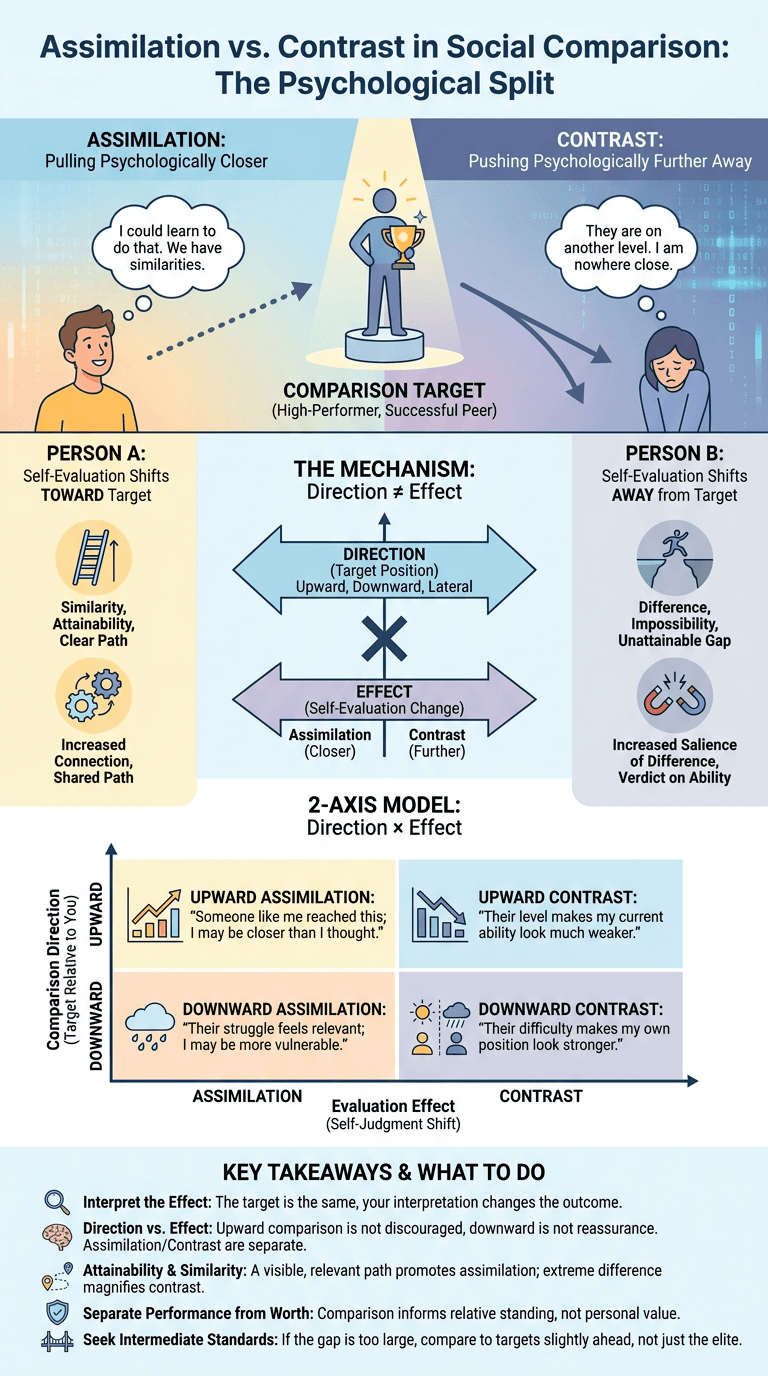
Assimilation occurs when a comparison makes you judge yourself as more similar to the target, while contrast occurs when the comparison makes the gap feel larger. An upward target can inspire a “maybe I can do this” response or a “they prove how far behind I am” response. The target’s direction matters, but interpretation, similarity, attainability, and relevance help determine the effect.
What Assimilation and Contrast Mean in Social Comparison
Assimilation and contrast describe how comparison information changes a judgment. They do not describe the target’s position by themselves. In research on comparative judgment, the same standard can sometimes pull a self-evaluation toward it and sometimes push the self-evaluation away from it.
A classic line of work by Thomas Mussweiler and colleagues showed that social comparison can produce both outcomes. Their experiments found that focusing on similarities to a comparison standard tended to produce assimilation, while focusing on differences tended to produce contrast. The findings are summarized in research on the mechanisms of assimilation and contrast.
Assimilation: self-evaluation moves psychologically toward the target
Assimilation means the target becomes evidence that pulls your self-evaluation in the same direction. If you compare yourself with a highly skilled person and think, “We have similar backgrounds, and they learned this through steps I can also take,” your estimate of what is possible for you may move upward.
Assimilation can also occur in a downward context. If a struggling peer feels very similar to you, their difficulty might make your own vulnerability feel more relevant rather than making you feel superior. The point is not that assimilation always feels good. It is that the target is being incorporated into the way you think about yourself.
Contrast: the difference between self and target becomes more salient
Contrast occurs when the target functions as a reference point that sharpens the difference. A brilliant performance can make your own performance seem weaker than it did five minutes earlier. A person who is struggling badly can make your own situation seem better by comparison.
In a large meta-analysis covering more than sixty years of social comparison research, contrast was the more common reaction across many studies, especially for ability judgments. That finding does not mean contrast is inevitable. It does show why simple advice such as “look at successful people for inspiration” is incomplete. The meta-analysis of social comparison selection and reaction offers a useful overview of this broader evidence.
Direction and Effect Are Two Separate Axes
One of the easiest mistakes in social comparison is to treat upward, downward, assimilation, and contrast as if they were four versions of the same thing. They are not. Direction tells you where the target stands relative to you. Effect tells you what happens to your self-evaluation after the comparison.
Upward, downward, and lateral describe target position
An upward target appears better off or stronger on the focal dimension. A downward target appears worse off. A lateral target appears similar. Those labels answer a positional question: where does the other person stand relative to me on this particular dimension?
That dimension must stay specific. The same colleague can be upward for public speaking skill, lateral for years of experience, and downward for technical knowledge. Direction changes when the comparison dimension changes.
Assimilation and contrast describe the effect on self-evaluation
Assimilation and contrast answer a different question: after I compare, do I judge myself as psychologically closer to the target or farther from the target? This can involve ability, confidence about a specific task, predictions about future performance, or another self-evaluation tied to the comparison.
Keeping these axes separate prevents a common reasoning error. Upward comparison does not equal discouragement, and downward comparison does not equal reassurance. Those emotional reactions may happen, but they are not built into the definition of direction.
A 2-Axis Model: Comparison Direction × Evaluation Effect
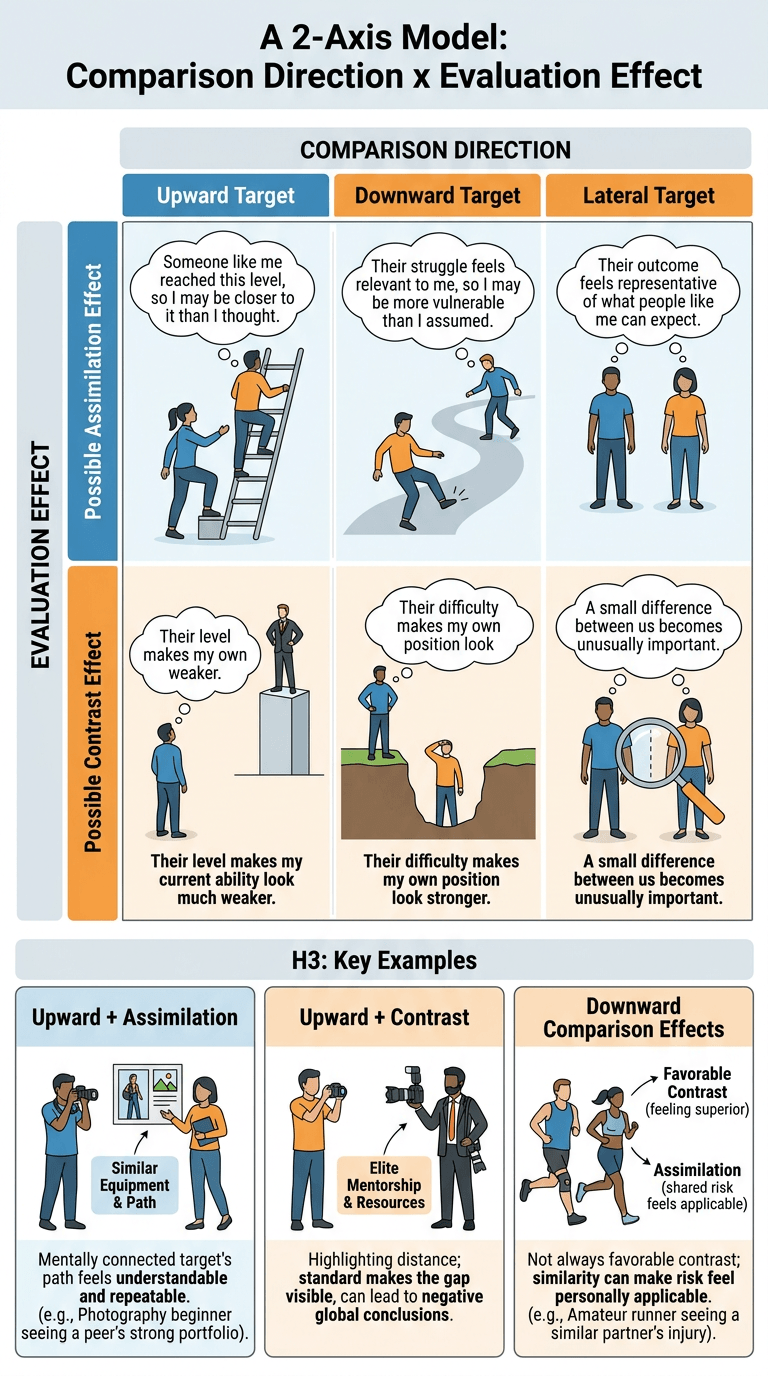
The simplest way to organize the possibilities is to cross comparison direction with evaluation effect.
| Comparison situation | Possible assimilation effect | Possible contrast effect |
|---|---|---|
| Upward target | “Someone like me reached this level, so I may be closer to it than I thought.” | “Their level makes my current ability look much weaker.” |
| Downward target | “Their struggle feels relevant to me, so I may be more vulnerable than I assumed.” | “Their difficulty makes my own position look stronger.” |
| Lateral target | “Their outcome feels representative of what people like me can expect.” | “A small difference between us becomes unusually important.” |
Upward + assimilation
Suppose you are learning photography and see a strong portfolio from someone who began two years ago with similar equipment and no formal training. If their path feels understandable and repeatable, the comparison may pull your self-evaluation upward. You may think your current stage is not proof of low potential, but an earlier point on a path that another similar person has already traveled.
The important ingredient is not admiration alone. It is the way the target is mentally connected to the self.
Upward + contrast
Now imagine the same portfolio belongs to someone with a decade of elite mentorship, expensive equipment, full-time practice, and access to opportunities you do not have. Their quality may still be impressive, but the target can now highlight distance. You may see your own work as weaker because the standard makes the gap more visible.
That contrast is not necessarily irrational. A strong standard can improve calibration. The problem begins when a narrow gap in one domain becomes a global conclusion such as “I am not talented” or “people like me cannot succeed.”
Downward comparison can also produce more than one effect
Downward targets are often assumed to produce favorable contrast: “They are doing worse, so I feel better about where I am.” That can happen, but it is not the only possibility. If the person seems highly similar and their setback appears relevant to your own situation, the comparison may pull your expectations downward through assimilation.
For example, an amateur runner who sees a very similar training partner develop the same overuse problem may not feel superior. The similarity may make the risk feel more personally applicable.
Why Similarity Can Promote Assimilation
Similarity matters because it can determine whether another person feels like a meaningful example of what may apply to you. Research on comparative judgment has long emphasized that the mind does not simply record the target’s outcome. It also searches for information that supports similarity or difference.
Mussweiler’s selective accessibility model proposes that similarity testing makes target-consistent self-knowledge more accessible, while dissimilarity testing makes differences more accessible. The model is laid out in a review of comparison processes in social judgment.
Shared background, stage, or path can increase psychological closeness
A target may feel similar because of age, experience, resources, training stage, work role, starting point, or constraints. A first-year teacher may learn more about their own likely development from another teacher who recently passed through the same stage than from a nationally recognized educator with twenty-five years of experience.
Similarity does not require people to be identical. It only needs to make the comparison feel diagnostic for the question being asked. “They faced a comparable problem using resources I could realistically access” can be enough to change the meaning of the target.
Similarity is not a guarantee of inspiration
Similarity can also intensify contrast. A coworker with nearly identical experience who advances much faster may make the gap feel more diagnostic, not less. Instead of thinking, “If they can do it, I can too,” you may think, “If we started in the same place and they are far ahead, what does that say about me?”
This is why similarity should be treated as one condition among several. The mind still has to interpret what the similarity means.
Attainability: Could This Outcome Be Possible for Me?
Attainability concerns whether the target’s outcome seems reachable under your circumstances. It is closely related to similarity but not identical to it. You can feel similar to someone in background while still believing their result depends on resources, timing, luck, or opportunities you do not have.
High target plus plausible path
A high-performing target is more likely to support assimilation when you can see a plausible path connecting their current position to yours. A pianist may be much better than you, but if their progress came from a practice structure you can understand and adopt, the comparison may provide information about what improvement looks like.
The target does not need to be immediately reachable. What matters is that the gap can be broken into believable steps rather than appearing as an unexplained leap.
High target plus perceived impossibility
When the path looks impossible, the same target may create stronger contrast. If a creator’s success depends on an existing audience of millions, a large production team, and years of accumulated distribution, using that person as a direct standard for your first six months may exaggerate the distance.
The useful correction is not to dismiss exceptional people. It is to ask whether they are useful for the question at hand. They may be excellent examples of what high-level work looks like while being poor benchmarks for where you should expect to be today.
Identification, Closeness, and Relevance
Assimilation becomes more likely when a target feels psychologically connected to the self. Contrast becomes more likely when the target is treated as a separate reference point against which the self is judged. Research on the “relative self” found that the same comparison can have opposing effects depending on how comparison information is represented and used. That work is described in research on comparative self-evaluation.
When the target feels like a useful model
A useful model answers practical questions. What did this person practice? What constraints did they face? Which parts of their path are transferable? What intermediate milestone came before the impressive result?
When those questions have clear answers, the target can feel less like a verdict and more like information. A junior analyst who studies a strong colleague’s process may discover that the difference is partly explained by preparation habits, feedback loops, or a specific technical skill. The comparison becomes more actionable.
When the target feels like evidence of distance
The same person can become evidence of distance when attention fixes on the gap rather than the pathway. “They speak confidently; I do not” is a contrastive frame. “They rehearsed ten times and use a clear structure; I rehearse once” introduces a mechanism that can reduce the psychological distance.
This does not mean every gap can be closed. Sometimes the target genuinely has different resources or advantages. Accurate contrast can be informative. The goal is to avoid turning difference into a broader statement than the evidence supports.
Comparison-Standard Extremity
Extremely high or low standards can change self-evaluation simply because they make the reference point dramatic. A beginner comparing with the top one percent of performers may see a huge gap that says little about whether their own progress is reasonable.
Exceptional targets can magnify contrast
Exceptional targets are memorable, visible, and often easy to access online. They can become psychologically common even when they are statistically unusual. If you repeatedly compare your ordinary workday with the career peak of a famous expert, your baseline for “normal” performance can shift upward.
Contrast is especially likely when the target is so extreme that similarity and attainability are difficult to imagine. The comparison may still teach you what excellence looks like, but it may be a poor tool for judging your current standing.
Why representative targets may support calibration instead
Representative targets answer a different question: how am I doing relative to people at a comparable stage? A language learner may get better calibration from other learners with similar study time than from a professional interpreter. A recreational athlete may learn more from people with similar training volume than from an Olympian.
Representative does not mean comfortable. A realistic peer group may still show that you are behind. The advantage is that the comparison is more likely to be diagnostic.
Worked Example: The Same Successful Peer, Two Meanings
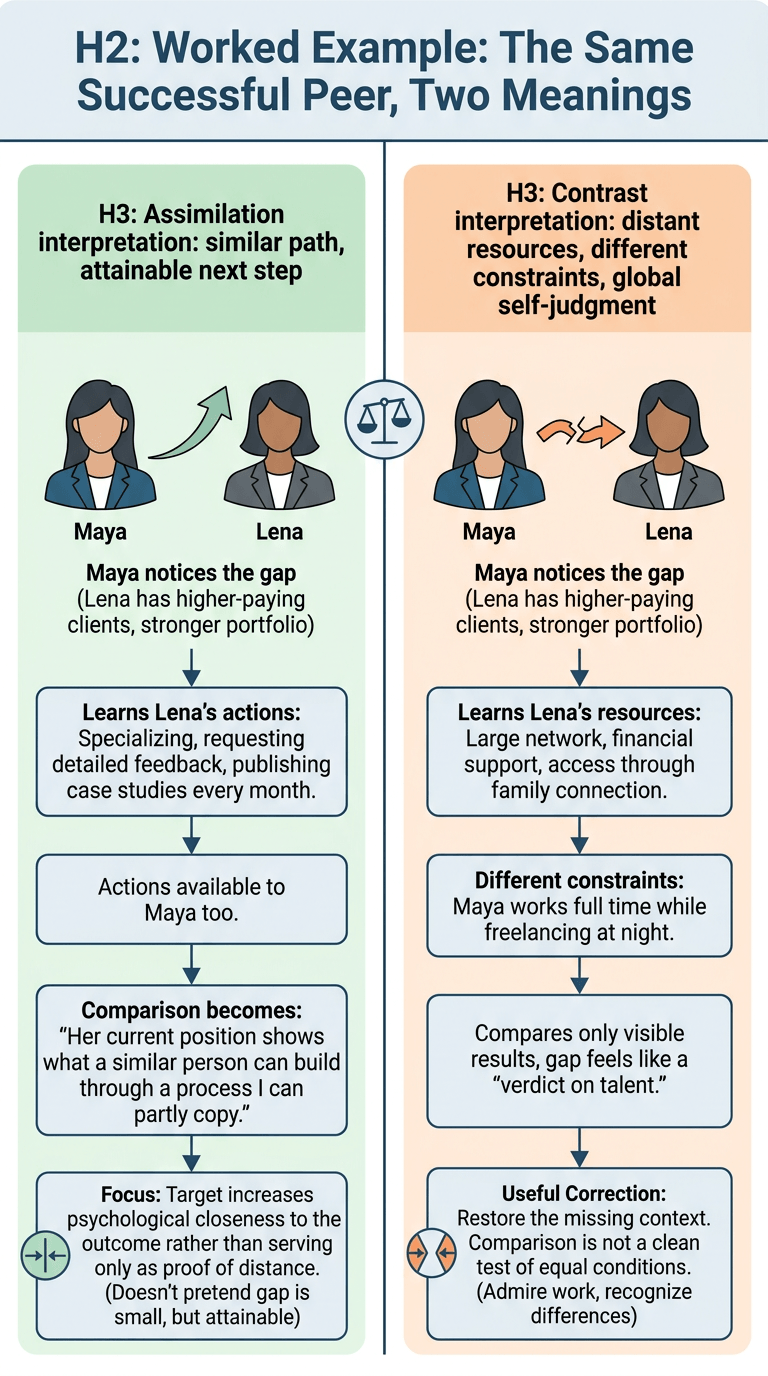
Consider Maya and Lena, two graphic designers who started freelancing at roughly the same time. Lena now has higher-paying clients and a stronger portfolio. Maya notices the gap. What happens next depends on how she interprets it.
Assimilation interpretation: similar path, attainable next step
Maya learns that Lena improved by specializing in a narrow type of work, requesting detailed feedback, and publishing a case study every month. Those actions are available to Maya too. The comparison becomes, “Her current position shows what a similar person can build through a process I can partly copy.”
Maya may still feel behind. Assimilation does not require pretending the gap is small. It means the target increases psychological closeness to the outcome rather than serving only as proof of distance.
Contrast interpretation: distant resources, different constraints, global self-judgment
Now imagine Maya learns that Lena had a large professional network, financial support that allowed her to work without immediate income, and access to major clients through a family connection. Maya works full time while freelancing at night. If she ignores those differences and compares only the visible results, the gap may feel like a verdict on talent.
The useful correction is not to explain away Lena’s success. It is to restore the missing context. Maya can admire the work while recognizing that the comparison is not a clean test of equal conditions.
Assimilation vs Envy and Motivation
Assimilation can feel positive, but it is not the same as envy or motivation. These concepts answer different questions.
Feeling closer to success is not the same as wanting another person’s advantage
Envy involves another person’s desired advantage and the emotional response to that advantage. Assimilation describes a shift in self-evaluation toward the target. You can assimilate without envy, for example by seeing a skilled peer as evidence that your own future performance may be better than you assumed.
You can also feel envy without assimilation. Someone else’s advantage may feel desirable while simultaneously making your own position seem farther away.
Motivation may follow but is not the construct being explained
Assimilation may increase effort if the target makes improvement feel attainable. Contrast may reduce effort if the gap looks hopeless, or increase effort if the gap feels like a useful challenge. Motivation is therefore a possible consequence, not the definition of assimilation or contrast.
This distinction keeps the concept precise. A change in self-evaluation may influence what you do next, but it does not determine behavior by itself.
Assimilation vs Self-Efficacy
Self-efficacy is a belief about whether you can perform a particular action or manage a particular task. Social comparison can contribute information to that judgment, but comparison effects and self-efficacy are not interchangeable.
Comparison can inform perceived capability without becoming the whole self-efficacy judgment
If someone with similar experience learns a difficult software tool, you may think, “I could probably learn it too.” That comparison may raise perceived capability. But self-efficacy is also shaped by your own past performance, practice, feedback, difficulty level, and other evidence.
A single comparison should therefore be treated as one data point. The target may change your estimate, but it should not erase direct evidence from what you have already done.
A Similarity–Attainability Decision Pathway
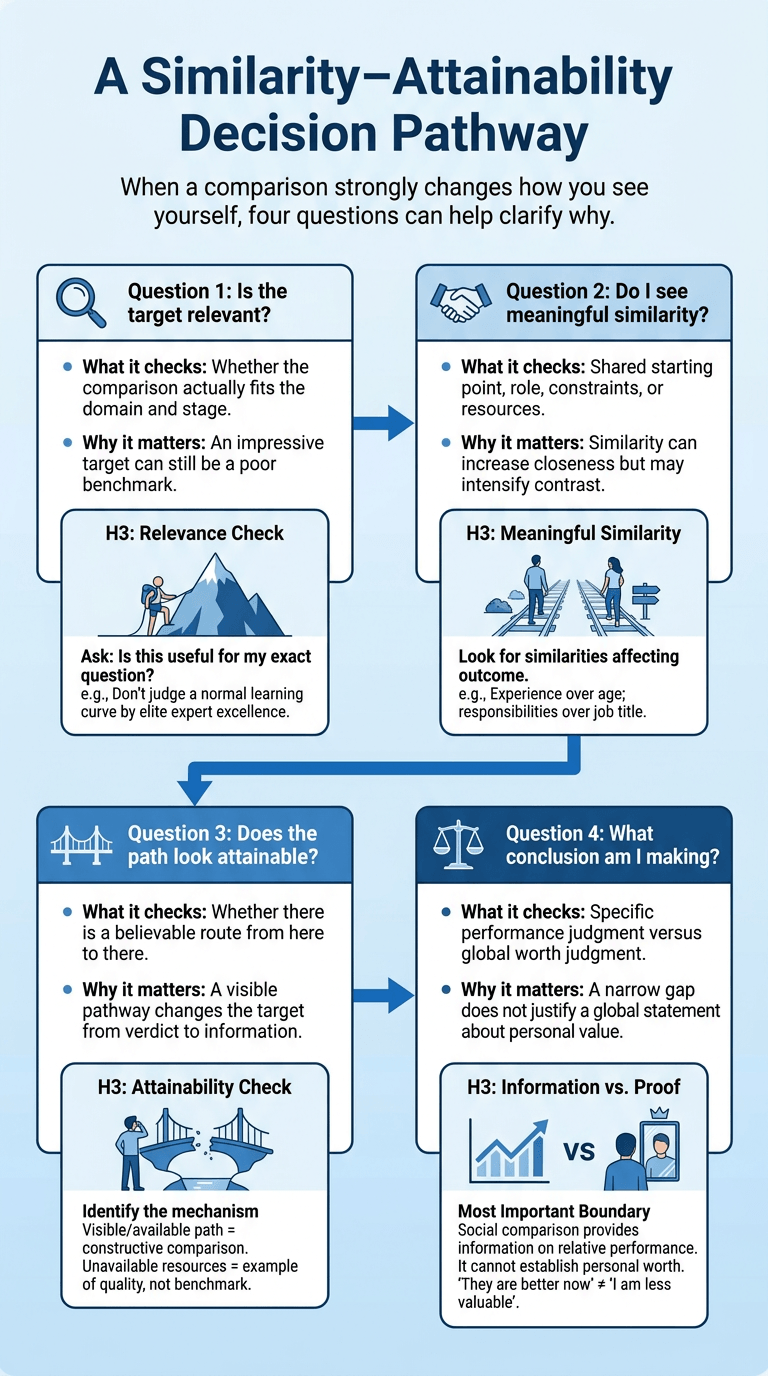
When a comparison strongly changes how you see yourself, four questions can help clarify why.
| Question | What it checks | Why it matters |
|---|---|---|
| Is the target relevant? | Whether the comparison actually fits the domain and stage | An impressive target can still be a poor benchmark. |
| Do I see meaningful similarity? | Shared starting point, role, constraints, or resources | Similarity can increase psychological closeness, but may also intensify diagnostic contrast. |
| Does the path look attainable? | Whether there is a believable route from here to there | A visible pathway often changes the target from verdict to information. |
| What conclusion am I making? | Specific performance judgment versus global worth judgment | A narrow gap does not justify a global statement about personal value. |
Is the target relevant?
Ask whether the target is useful for the exact question you are trying to answer. If you want to judge beginner progress, an elite expert may be informative about excellence but uninformative about a normal learning curve.
Do I see meaningful similarity?
Look for similarities that actually affect the outcome. Same age is less useful than similar experience if you are comparing professional skill. Same job title may be less useful than similar responsibilities, resources, and training.
Does the path look attainable under my circumstances?
Try to identify the mechanism between the target’s earlier stage and current result. If the path is visible and partly available to you, the comparison may become more constructive. If the path depends on unavailable resources, the target may be better used as an example of quality than as a direct benchmark.
Am I using the target as information or as proof about my worth?
This is the most important boundary. Social comparison can provide information about relative performance. It cannot establish personal worth. “They are currently better at this” may be accurate. “Therefore I am less valuable” is a different claim that the comparison does not prove.
What to Do Next When a Target Produces Contrast
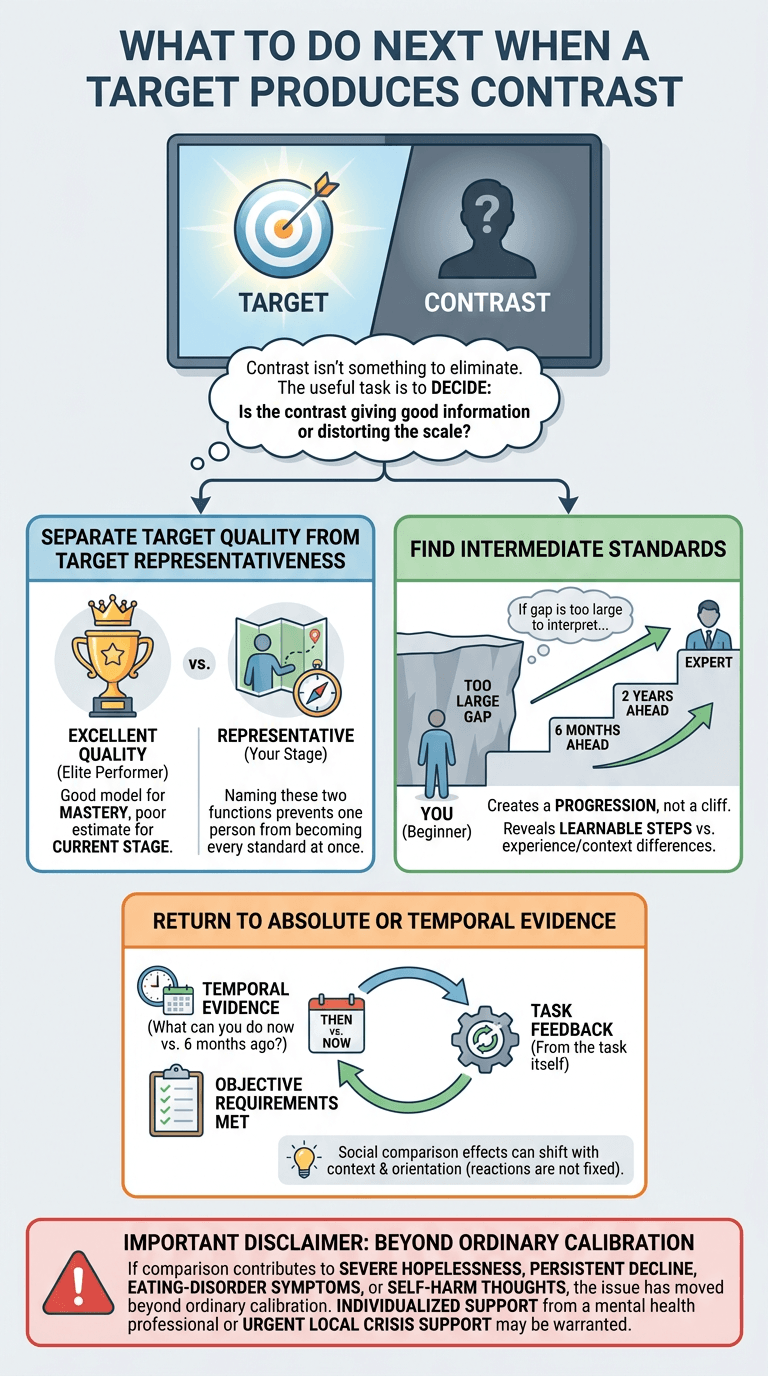
Contrast is not something you need to eliminate. Sometimes it is the most accurate response to a high standard. The useful task is to decide whether the contrast is giving you good information or distorting the scale.
Separate target quality from target representativeness
A target can be excellent without being representative. An elite performer may be a good model for what mastery looks like but a poor estimate of what someone at your stage should currently achieve. Naming those two functions prevents one person from becoming every standard at once.
Find intermediate standards
If the gap is too large to interpret, add comparison points between you and the extreme target. A beginner coder may compare with someone six months ahead, someone two years ahead, and an expert. This creates a progression rather than a single cliff.
Intermediate standards can reveal which differences are learnable steps and which are tied to experience, opportunity, or context.
Return to absolute or temporal evidence when appropriate
If another person’s performance is making your self-evaluation unstable, check information that does not depend entirely on relative rank. What can you do now that you could not do six months ago? What objective requirements have you met? What feedback have you received from the task itself?
Research in classroom settings also shows that social comparison effects can shift with context and processing orientation, reinforcing the point that these reactions are not fixed. One experimental example is available in research on assimilation and contrast in student self-evaluation and performance.
If comparison is contributing to severe hopelessness, persistent functional decline, eating-disorder symptoms, or thoughts of self-harm, the issue has moved beyond ordinary calibration. Individualized support from an appropriate mental health professional or urgent local crisis support may be warranted.
FAQ
Can an upward comparison produce assimilation instead of discouragement?
Yes. An upward target can make you feel psychologically closer to a desirable outcome when the person seems relevant, similar enough to be informative, and connected to a pathway you see as attainable. The upward direction only tells you that the target is ahead on the focal dimension. It does not determine whether your self-evaluation moves toward or away from that target.
Does feeling similar to a successful person always make comparison motivating?
No. Similarity can support assimilation, but it can also make a gap feel more diagnostic. If someone very similar to you is much further ahead, you may interpret the difference as evidence that you are underperforming. Motivation depends on additional factors such as attainability, current goals, perceived control, and the meaning you assign to the gap.
Is contrast the same as low self-esteem?
No. Contrast is a comparison effect in which the difference between self and target becomes more salient. You can experience contrast on one specific skill without holding a globally negative view of yourself. A strong speaker may make your own presentation feel weaker today, but that does not establish a broad judgment about your overall value or competence.
Can downward comparison produce assimilation?
Yes. If a lower-performing target feels highly similar and their situation seems relevant to your own future, their difficulty can pull your expectations downward. For example, seeing a similar trainee struggle with a task may make you think the task is harder for people like you than you previously assumed.
Why can an aspirational figure inspire one person and discourage another?
The same figure may represent possibility to one person and distance to another. Differences in perceived similarity, resources, starting point, attainability, goals, and current self-evaluation can change how the target is processed. The figure’s objective success stays the same, but the psychological relationship to that success changes.
Key Takeaways
- Comparison direction and comparison effect are separate: upward, downward, and lateral describe target position, while assimilation and contrast describe changes in self-evaluation.
- Assimilation means the self-evaluation moves toward the target; contrast means the difference between self and target becomes more salient.
- Similarity can encourage assimilation, but it can also intensify contrast when the gap feels especially diagnostic.
- Attainability matters because a visible pathway can turn an impressive target into useful information rather than a verdict.
- Extreme targets may be excellent examples of quality while still being poor benchmarks for judging your current stage.
- A comparison can inform relative performance, but it does not prove anything about personal worth.

Michael Reed is the Founder and Lead Writer at Psychology Exposed. He writes about human behavior, relationships, emotional patterns, self-awareness, and practical psychology topics using research-informed, easy-to-understand content.
Read More About Michael Reed: https://psychologyexposed.com/michael-reed/