
A profile photo, a short bio, a post you decide not to publish, a story shared only with close friends, and a comment written differently in a professional community can all reflect the same basic problem: online, we rarely show everything about ourselves at once. We select. We edit. We choose an audience, or at least imagine one. Then we make decisions about what feels relevant, private, safe, useful, or too easy to misunderstand.
That does not automatically make online identity fake. Face-to-face life is selective too. You probably reveal different details to a sibling, a coworker, a doctor, a neighbor, and a hobby group. Digital environments change the process because information may be easier to edit before sharing, easier to search or copy, visible to mixed audiences, and followed by public feedback such as likes, replies, views, or silence.
Understanding online self-presentation psychology helps explain why people curate profiles, divide audiences, revise posts, and present different genuine parts of themselves in different spaces. It also helps separate three questions that are often confused: what you choose to show, how you feel after seeing other people, and what other people come to expect about you over time.
Quick Answer
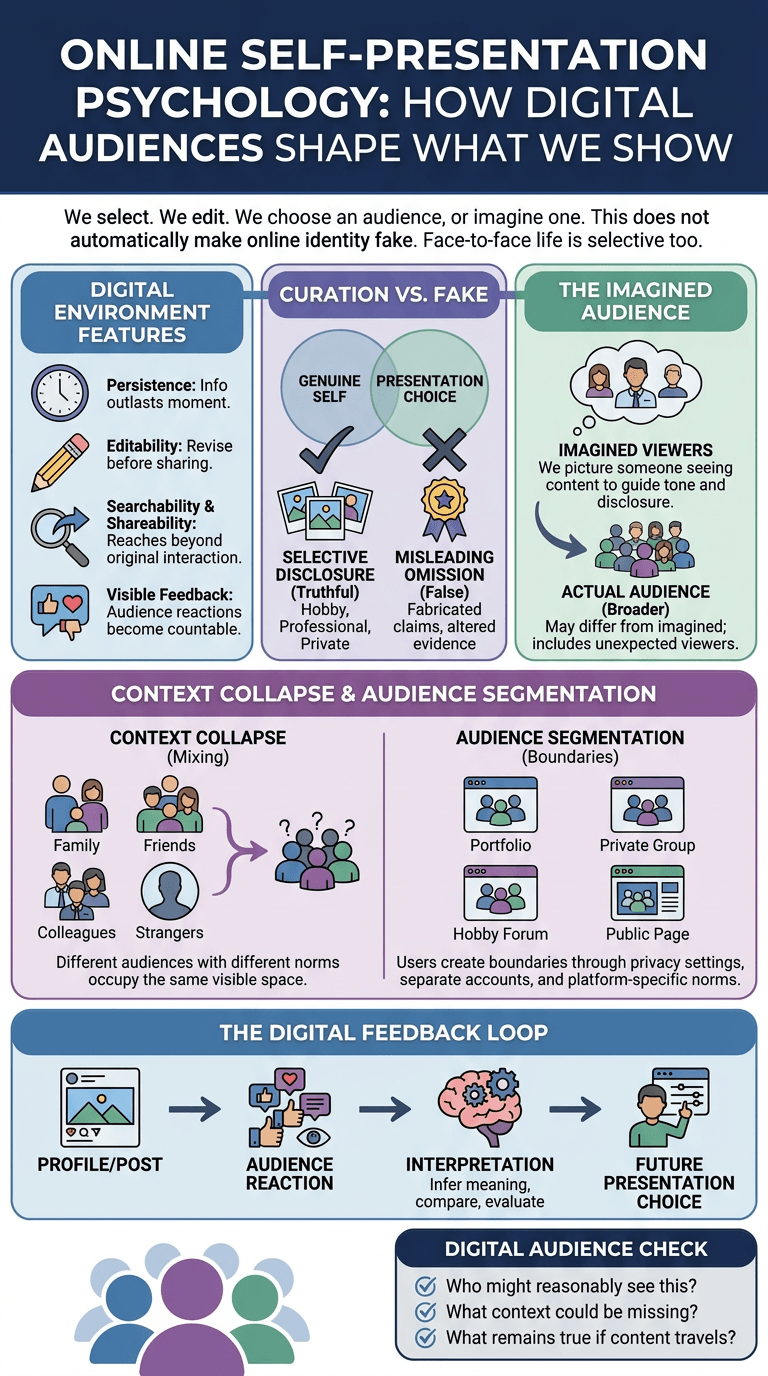
Online self-presentation is the way people select, organize, edit, and disclose information about themselves when digital audiences may see it. Profiles and posts can be curated without being false. Digital features such as persistence, editability, visibility, audience mixing, and feedback make presentation choices more deliberate in some situations and harder to control in others.
What Online Self-Presentation Means
Self-presentation is audience-facing. The central question is not simply, “Who am I?” It is, “What part of me is being shown here, to whom, and under what conditions?” Online spaces give that question a distinctive structure because a person can shape a profile before anyone sees it, but cannot fully control who eventually sees the material or what meaning they take from it.
The same self-presentation problem in a different information environment
Offline, a conversation usually happens in a recognizable setting. You can see who is in the room, hear their response, notice whether they look confused, and clarify quickly. Online, the audience can be less visible. A post may be read hours later by someone you did not have in mind. A screenshot may detach a statement from the conversation around it. A profile can remain visible when the mood or role that shaped it has already changed.
Research on online presentation describes social network sites as environments in which people can customize profiles, share selectively, and adjust who can see personal information. One recent open-access study of online self-presentation discusses how affordances such as persistence, editability, anonymity, and association can shape the ways people present themselves. The important point is not that technology determines behavior. Digital features create possibilities and constraints, while users still make choices within them.
Why curated does not automatically mean false
Curation means selection. If you post three photos from a week in which you took fifty, the profile does not contain the whole week. That alone does not make the three photos untrue. A hobby account may show paintings but not family conflict. A professional profile may emphasize training and projects but omit weekend routines. A private account may show humor that would make little sense on a public portfolio.
Problems begin when selection creates a materially false impression through fabricated claims, altered evidence, or deliberate misrepresentation. But incompleteness and deception are not the same thing. Research on idealized online presentation also shows that online spaces can contain both favorable presentation and genuine self-expression, rather than fitting a simple “real versus fake” split. An open-access study of Instagram self-presentation illustrates why idealization, disclosure, and accuracy need to be considered separately.
What Makes Digital Self-Presentation Different
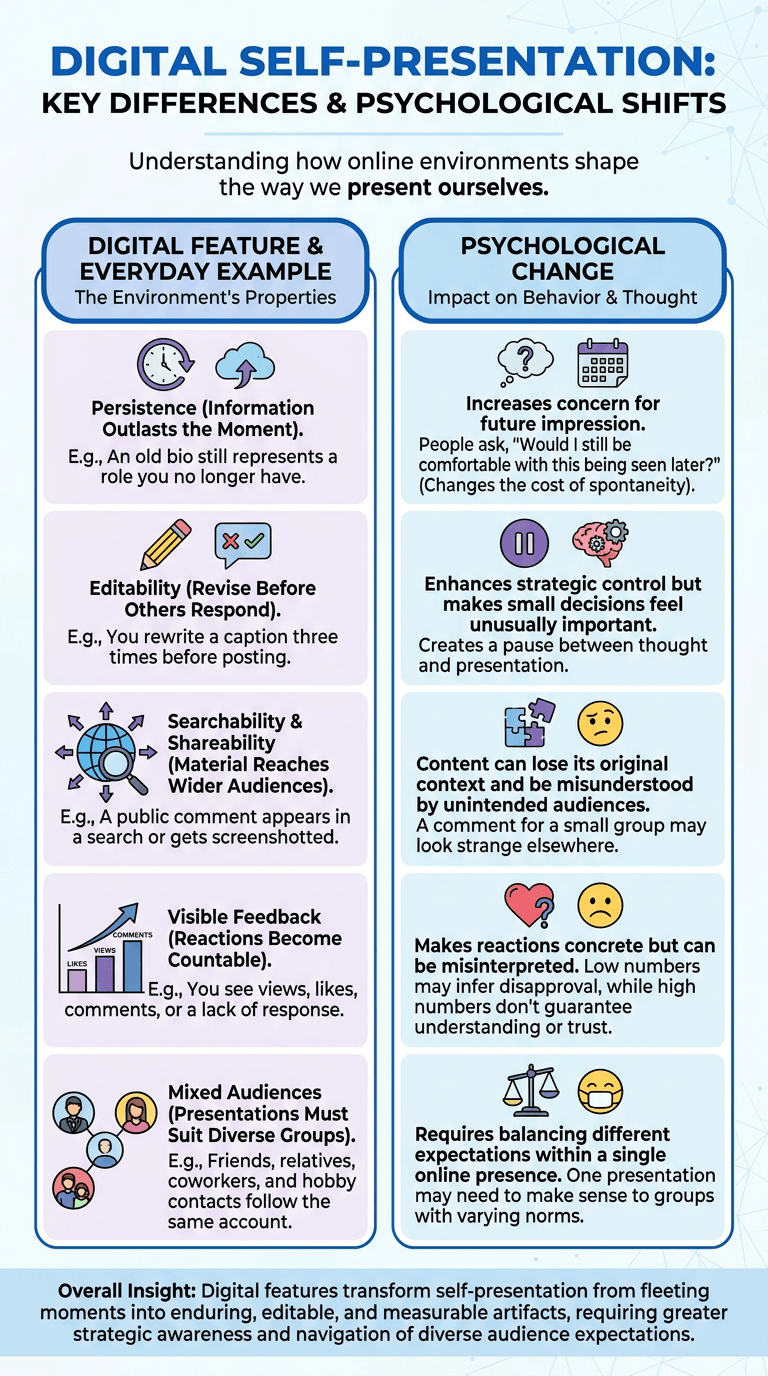
A useful way to understand online presentation is to look at the properties of the environment. The same person may make different choices when a message disappears, stays searchable, can be edited before posting, or is visible to thousands of loosely connected people.
| Digital feature | What changes psychologically | Everyday example |
|---|---|---|
| Persistence | A presentation can outlast the moment that produced it. | An old bio still represents a role you no longer have. |
| Editability | You can revise wording, images, and timing before others respond. | You rewrite a caption three times before posting. |
| Searchability and shareability | Material can reach people outside the original interaction. | A public comment appears in a search or gets screenshotted. |
| Visible feedback | Audience reactions become countable and easy to compare. | You see views, likes, comments, or a lack of response. |
| Mixed audiences | One presentation may need to make sense to groups with different expectations. | Friends, relatives, coworkers, and hobby contacts follow the same account. |
Persistence of information
Offline presentation is often temporary. A joke told at dinner may disappear with the evening. Online information can remain attached to an account, be copied by someone else, or become visible long after the original context is forgotten. This changes the cost of spontaneity. People may ask not only, “Does this represent me now?” but also, “Would I still be comfortable with this being seen later?”
Editability before posting
Digital communication often creates a pause between having a thought and presenting it. You can crop a photo, reorder a gallery, change a username, rewrite a paragraph, or decide not to post. This can increase strategic control, but it can also make small presentation decisions feel unusually important.
Searchability and shareability
Online information can move beyond the audience a person pictured when sharing it. Search functions, forwarding, reposting, screenshots, tagging, and public profiles can all widen exposure. A comment written for a small community may be understandable there but look strange when separated from the shared history of that group.
Visible feedback metrics
Many online environments turn audience response into visible numbers. These numbers are psychologically powerful because they make reactions concrete, but they do not provide a complete explanation of what an audience thought. A person may see a low number of likes and infer disapproval, even though many viewers simply did not react. A high view count may mean exposure without agreement, attention without trust, or curiosity without lasting memory.
It is useful to treat metrics as signals rather than verdicts. They describe a form of activity around content. They do not measure the full value of the person who posted it, the quality of a relationship, or the accuracy of the identity being presented.
Profile Construction as a Presentation Choice
A profile is a compressed representation. It takes a person with many roles, experiences, contradictions, and private details and reduces that person to a limited set of visible cues. Because the space is limited, omission is unavoidable. What matters is how those cues are selected and what an observer may reasonably infer from them.
Photos, bios, usernames, and profile fields
A profile photo can emphasize warmth, formality, creativity, affiliation, or simply recognizability. A username can signal a real name, a hobby identity, anonymity, or a long-standing online persona. A bio may foreground occupation, values, fandoms, location, humor, or nothing at all. None of these elements reveals the complete person, yet together they establish expectations about what kind of interaction belongs in that space.
What profiles highlight and what they leave out
Imagine someone who uses one profile for photography. The account may show technical work, travel images, editing experiments, and comments about cameras. It may reveal almost nothing about parenting, political opinions, finances, or health. That narrowness can be appropriate because the account has a clear social purpose.
The same principle applies to a professional directory profile or an online gaming identity. A selective profile can be accurate within its scope. The more serious concern is whether the profile invites an inference the person knows is false, such as claiming expertise they do not have or presenting borrowed work as their own.
Selective Disclosure Online
Self-presentation is not only about what is shown. It is also about what stays private, what is shared with a limited group, and what is disclosed only after trust or relevance changes. Digital tools make these choices visible through account settings, audience lists, private messages, pseudonyms, and separate communities.
Public, private, and limited-audience sharing
People often manage several layers of visibility. A public account might contain work samples. A private account may include everyday photos. A small group chat may contain frustrations that the person would never post publicly. This is not necessarily inconsistency. Each space has a different audience and social function.
Research on social networking sites has found that privacy concerns and perceived control are related to self-disclosure decisions. An open-access study of self-disclosure and privacy on social networking sites provides one example of how disclosure is shaped by perceived privacy risk, privacy awareness, and control. The exact pattern varies by person and setting, but disclosure is clearly more than a simple choice between “open” and “secretive.”
Privacy boundaries versus misleading omission
A privacy boundary says, “This is not information I owe this audience.” Misleading omission is different. It occurs when leaving out a fact is intended to create a false belief about something material. If a person chooses not to list their family members on a public hobby profile, that is ordinary privacy. If someone presents another person’s professional qualification as their own, the issue is no longer selective privacy.
The Imagined Audience
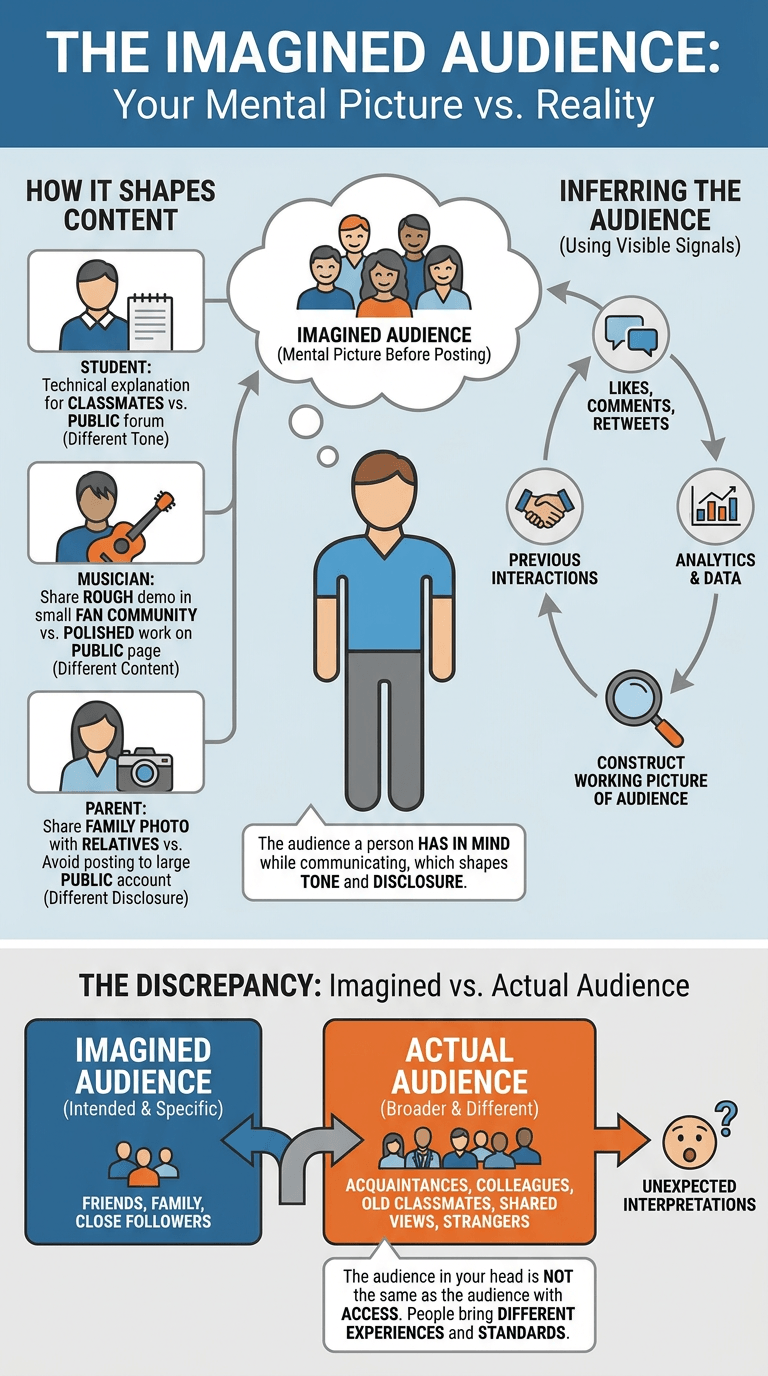
Before posting, people usually picture someone seeing the content. That mental picture may be specific, such as “my close friends,” or vague, such as “people who follow this account.” Researchers use the idea of an imagined audience to describe the audience a person has in mind while communicating, even though the actual viewers may differ.
Who people think will see a post
The imagined audience shapes tone and disclosure. A student may write a technical explanation differently for classmates than for a public forum. A musician may share a rough demo in a small fan community but post only polished work on a public page. A parent may share a family photo with relatives but avoid posting it to a large public account.
People do not always have complete information about who their audience is. Research on imagined audiences notes that users may rely on visible reactions, comments, analytics, or previous interactions to infer who is paying attention. An open-access study of imagined audiences and information sharing describes how likes, comments, retweets, and analytics can help people construct a working picture of their audience.
Why actual audiences can be broader or different
The problem is that the audience in your head is not the same as the audience with access. A post intended for friends may also be seen by acquaintances, a colleague, an old classmate, or someone who arrives through a share. Even within the intended audience, people bring different experiences and standards to the same message.
Context Collapse: When Different Audiences Meet
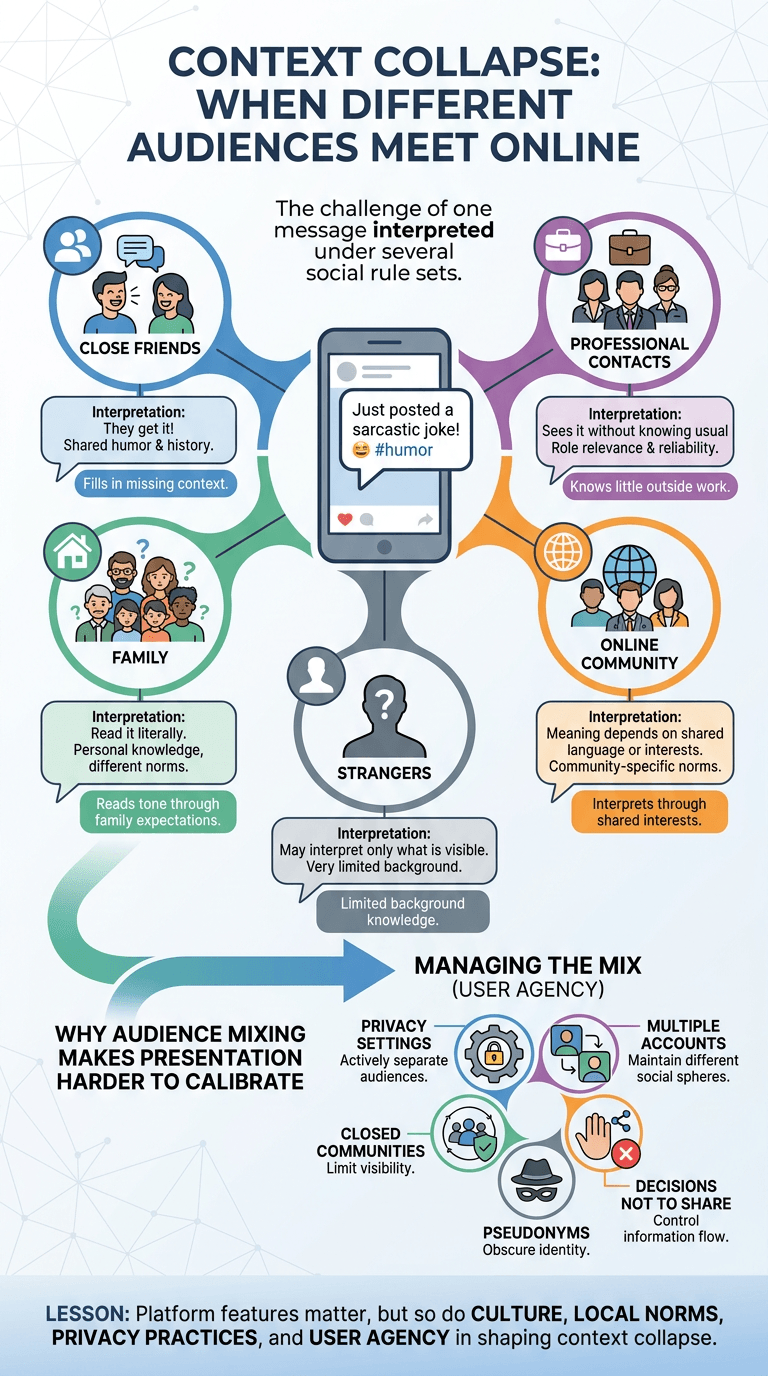
In everyday offline life, social settings help organize behavior. The expectations of a family dinner are different from those of a classroom, a sports club, or a professional meeting. Online, those social boundaries can become less clear when people from several parts of life occupy the same visible space.
Family, friends, colleagues, clients, and strangers in one space
Suppose someone posts a sarcastic joke that their close friends understand instantly. A relative reads it literally. A client sees it without knowing the person’s usual humor. A former classmate reads it months later. One message is now being interpreted under several different social rule sets.
| Audience | Possible expectation | Why the same post may land differently |
|---|---|---|
| Close friends | Shared humor and history | They can fill in missing context. |
| Family | Personal knowledge but different norms | They may read tone through family expectations. |
| Professional contacts | Role relevance and reliability | They may know little about the person outside work. |
| Online community | Community-specific norms | Meaning may depend on shared language or interests. |
| Strangers | Very limited background | They may interpret only what is visible in the post. |
Why audience mixing makes one presentation harder to calibrate
This mixing is often described as context collapse, but it should not be treated as an unavoidable feature of every online space. People actively separate audiences through privacy settings, multiple accounts, closed communities, pseudonyms, and decisions not to share. Cultural norms also shape whether audiences actually collapse in practice.
An open-access ethnographic analysis of context collapse and social media affordances is especially useful here because it challenges the assumption that digital architecture automatically flattens every social context. In the setting studied, users actively maintained different social spheres. The broader lesson is that platform features matter, but so do culture, local norms, privacy practices, and user agency.
Audience Segmentation and Platform Differences
People respond to mixed audiences by creating boundaries. Sometimes those boundaries are technical, such as private groups. Sometimes they are social, such as using one account for a hobby and another for family. Sometimes they are linguistic, such as choosing a level of formality that fits a community.
Different norms across platforms and communities
A portfolio site, multiplayer game, neighborhood forum, professional network, private messaging app, and public video account invite different kinds of identity cues. A real-name professional profile may reward clarity about experience. A hobby forum may make specialized knowledge more relevant than occupation. A game community may organize identity around an avatar, role, or team history.
Why cross-platform consistency does not require identical content
A person can be truthful across platforms while showing different material. Consistency is better understood as compatibility, not duplication. A teacher’s public professional page, private hiking account, and music forum profile do not need the same photographs or tone. They simply should not depend on mutually contradictory false claims.
The Digital Feedback Loop: Profile → Audience → Reaction → Future Presentation
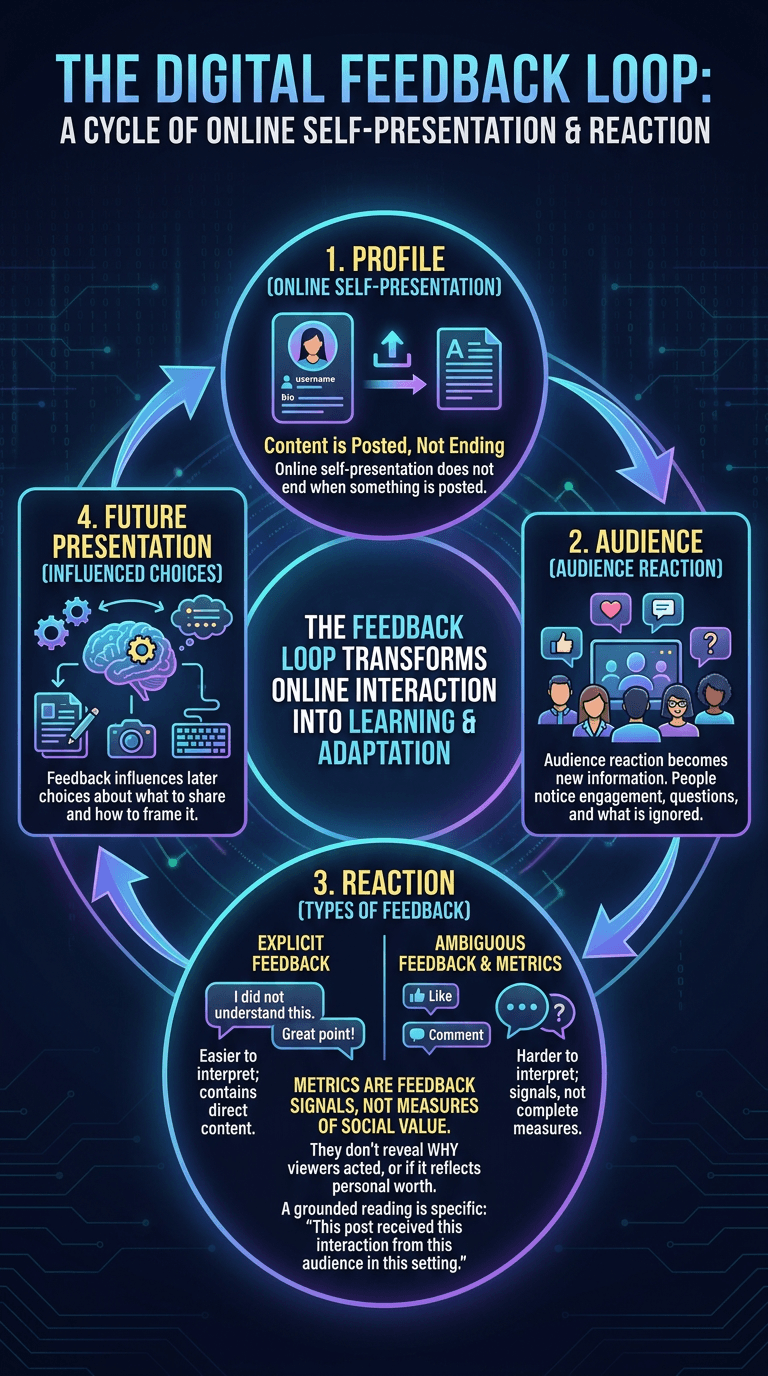
Online self-presentation does not end when something is posted. Audience reaction becomes new information. People notice what gets engagement, what attracts questions, what is ignored, and what is misunderstood. That feedback can influence later choices about what to share and how to frame it.
Likes, comments, silence, and interpretation
Feedback can be explicit, such as a comment saying, “I did not understand this,” or ambiguous, such as silence. Explicit feedback is easier to interpret because it contains content. Metrics are harder. A post with fewer reactions than usual could reflect timing, audience availability, content relevance, visibility, or simple chance. The presenter often does not know.
Why metrics are feedback signals, not complete measures of social value
A reaction count measures a narrow behavior on a particular system. It does not reveal why every viewer acted as they did, whether the post changed a relationship, or whether the content represented the person accurately. Turning metrics into a global statement such as “people like me” or “nobody cares about me” asks the number to answer a question it was not designed to answer.
A more grounded reading is specific: “This post received this amount of visible interaction from this audience in this setting.” That interpretation may still be useful. It is simply smaller than a judgment about personal worth.
Online Self-Presentation vs Social Media Comparison
These two processes often occur on the same screen, so they are easy to blend together. But they point in opposite directions.
What I show them versus what seeing them makes me conclude about me
| Process | Core question | Typical focus |
|---|---|---|
| Online self-presentation | What do I choose to show when other people may evaluate me? | Profiles, posts, disclosure, audience, visibility, curation. |
| Social media comparison | What do I conclude about myself after seeing other people? | Upward or downward comparison, self-evaluation, standards, relative standing. |
If you choose a flattering photo because you know others may see it, that is a presentation decision. If you see someone else’s vacation photos and conclude that your own life is less exciting, that is a comparison process. One can influence the other, but they are not the same psychological question.
Why the two processes can interact without being the same intent
This distinction is especially useful when trying to understand discomfort. If the problem is “I feel worse after looking at other people,” comparison may be central. If the problem is “I keep changing what I post because I am thinking about how others will read me,” self-presentation is the closer fit.
Online Self-Presentation vs Authenticity and Reputation
Online presentation also touches two other ideas: whether the presentation feels aligned with the person, and what others come to believe about that person across time. Those are related questions, but neither is identical to the act of choosing what to show.
Curation, truthful selectivity, and misrepresentation
A curated account can show a narrow but genuine part of a person’s life. A maker who posts finished projects but not every failed attempt is being selective. A researcher who lists published work but not every abandoned idea is doing the same. Selectivity becomes misleading when the audience is pushed toward a false belief about something material, such as invented achievements or altered evidence.
This is why authenticity does not require posting every emotion or revealing every private fact. A better test is whether the presentation is compatible with reality and important values, given the purpose of the space.
When repeated digital information begins to shape reputation
Self-presentation describes what a person puts forward. Reputation concerns the expectations that form around that person as information accumulates across time and people. A single carefully written profile is presentation. If others repeatedly experience the person as reliable, knowledgeable, funny, hostile, inconsistent, or generous, those repeated experiences can contribute to reputation.
Online material may become part of that process because it is visible and repeatable, but the presenter does not control the final result. Other people interpret the material, compare it with behavior, talk to one another, and update their expectations. Reputation therefore extends beyond curation.
What to Do Next: A Digital Audience Check
Before sharing something that feels sensitive, identity-relevant, or easy to misread, a three-part check can make the decision clearer. The point is not to make every post perfect. It is to notice the parts of digital communication that are easiest to forget when attention is focused on the content itself.
Who might reasonably see this
Think beyond the person you most hope will see the post. Who actually has access? Is the space public, private, searchable, or easy to forward from? Are several social groups present? This is an audience question, not a demand to imagine every possible stranger.
What context could be missing
Ask what a reasonable reader would need in order to understand the message. Inside jokes, sarcasm, technical language, fragments of conflict, and emotionally intense statements often rely heavily on background knowledge. If the audience lacks that background, a short clarification may prevent a meaning you never intended.
What remains true if the post travels beyond the intended audience
The final question is about portability. If the content is copied, quoted, or viewed later, what remains accurate without the original moment around it? You do not need to write every post as if it were a legal document. But for claims about qualifications, achievements, other people, or serious events, accuracy should survive a wider audience.
| Check | Useful question | Possible adjustment |
|---|---|---|
| Audience | Who can realistically see this? | Change visibility or choose a different space. |
| Context | What background does the message depend on? | Add enough explanation for the intended audience. |
| Travel | What remains true if the content is separated from the moment? | Remove exaggeration or material that creates a false claim. |
FAQ About Online Self-Presentation
Online presentation is often discussed in extremes, as though people must choose between total transparency and a completely manufactured persona. The questions below address more realistic situations.
Does a curated profile mean someone is fake?
No. A curated profile is selective, and all profiles are selective because they cannot contain a complete life. The more useful question is whether what is shown is truthful within its scope. Curation becomes more concerning when it relies on fabricated claims, manipulated evidence, impersonation, or deliberate attempts to create a materially false belief.
What is an imagined audience?
An imagined audience is the person or group someone pictures while creating a message or post. It helps guide tone, disclosure, and presentation choices. The imagined audience can differ from the actual audience, especially in public or shareable spaces, which is one reason online communication can be misunderstood.
What is context collapse?
Context collapse describes situations in which social groups that would usually be separated, such as family, friends, coworkers, and strangers, become part of the same audience. The concept is useful, but it is not inevitable. People often rebuild boundaries through privacy settings, separate accounts, closed groups, and community-specific practices.
Why do people present themselves differently across platforms?
Different spaces have different audiences, purposes, norms, and technical features. A person may emphasize professional experience in one place, creative work in another, and close relationships in a private group. Different content does not automatically imply different identities. It may reflect appropriate audience adaptation.
Is online identity the same as offline identity?
They can overlap substantially, but an online identity is usually a partial representation shaped by the possibilities and limits of a particular digital setting. Research on observable social-network profiles has found that online behavior can reflect offline personality rather than simply replacing it. An open-access study of personality and Facebook behavior is one example. It is safer to think of online and offline identity as connected contexts rather than two completely separate selves.
Key Takeaways
- Online self-presentation is about what people choose to show when a digital audience may form impressions of them.
- Persistence, editability, searchability, shareability, visible feedback, and mixed audiences can change how carefully people select and frame information.
- Curation is not automatically deception. A profile can be selective and still be truthful within its purpose.
- The imagined audience may differ from the actual audience, which helps explain why posts sometimes travel into contexts the presenter did not anticipate.
- Online self-presentation and social media comparison move in different directions: one concerns what I show others, the other concerns what seeing others makes me conclude about myself.
- A practical digital audience check asks who may see the content, what context may be missing, and what remains true if the content travels.
Author note: Michael Reed, Founder & Lead Writer at Psychology Exposed, writes about human behavior, self-awareness, relationships, and everyday social psychology in clear, research-aware language.

Michael Reed is the Founder and Lead Writer at Psychology Exposed. He writes about human behavior, relationships, emotional patterns, self-awareness, and practical psychology topics using research-informed, easy-to-understand content.
Read More About Michael Reed: https://psychologyexposed.com/michael-reed/