
A person tells you about an unfair experience, and their distress immediately matters to you. You picture what the situation felt like, become more willing to help, and judge the harm more seriously. In moments like this, empathy can make moral concern vivid enough to change behavior.
Yet empathy does not reach everyone equally. People often respond more strongly to someone familiar, similar, nearby, or represented through a compelling story. One visible person may attract more concern than many people whose experiences remain statistical or distant. Empathy can support kindness and repair, but it can also narrow the field of attention.
The practical question is not whether empathy is good or bad. It is how to use empathic information without treating emotional intensity as the entire moral decision. Care becomes more reliable when it is combined with consistent standards, attention to missing people, evidence, scale, and accountability.
Quick Answer
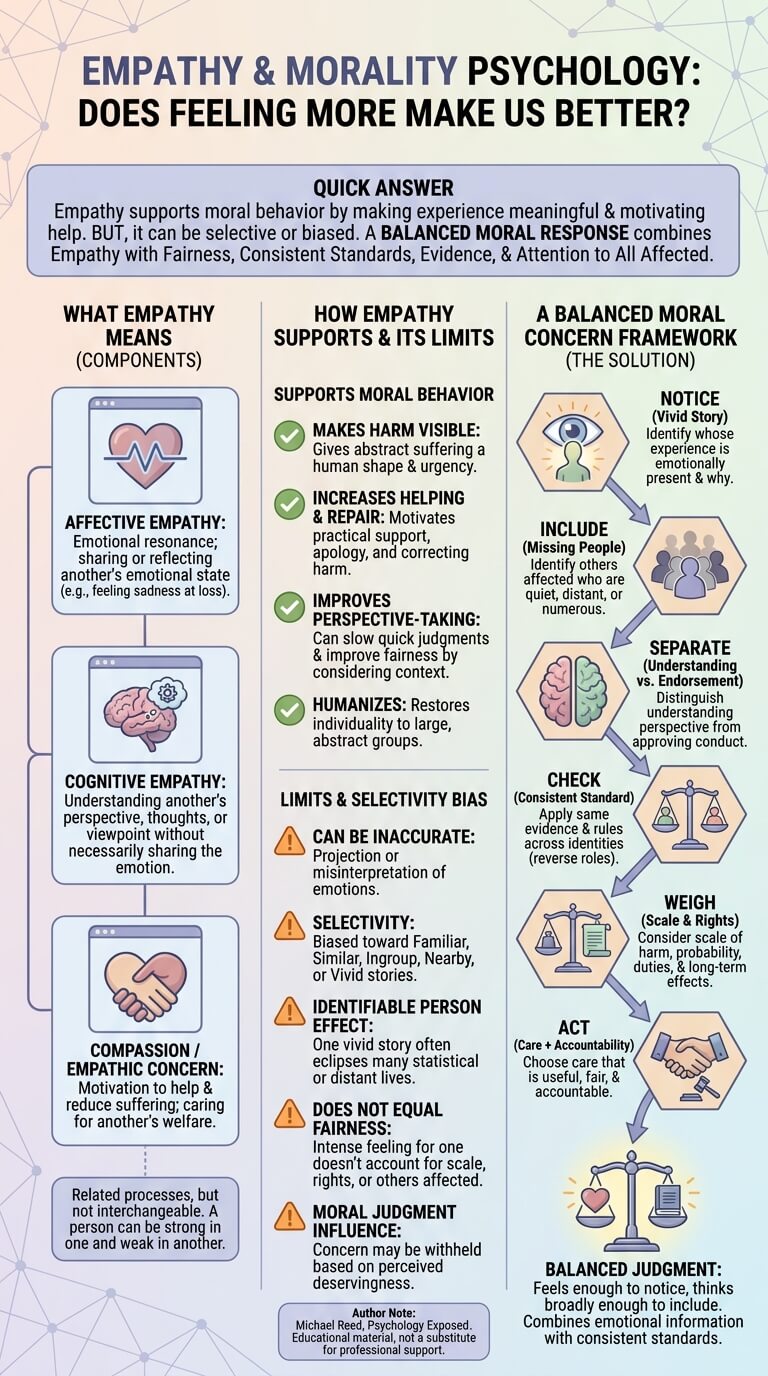
Empathy can support moral behavior by making another person’s experience emotionally and cognitively meaningful. It may increase helping, perspective-taking, repair, and concern for harm. However, empathy can be selective, inaccurate, overwhelming, or biased toward familiar and identifiable people. A balanced moral response combines empathy with fairness, broader evidence, consistent standards, and attention to everyone affected.
What Empathy Means in Moral Psychology
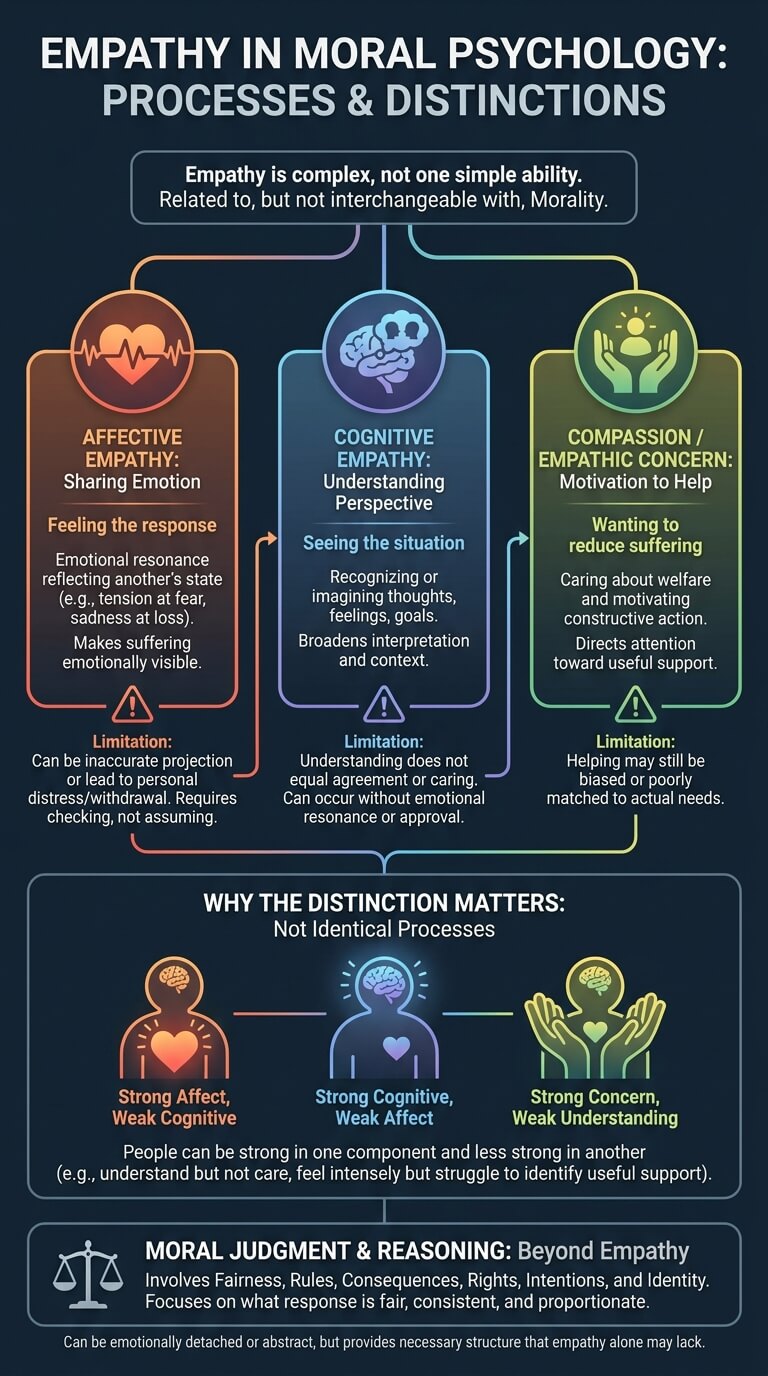
Empathy is often used as if it were one simple ability, but it includes several related processes. A person may understand another perspective without sharing the emotion. They may emotionally resonate without understanding the situation accurately. They may understand and feel the distress but lack the capacity or motivation to help.
This matters because morality and empathy are related but not interchangeable. A review asking whether empathy is necessary for moral behavior argues that the connection is more complicated than the common assumption that empathy automatically produces morality. Moral judgment also involves fairness, rules, consequences, rights, intentions, identity, and reasoning.
Affective empathy: sharing or resonating with emotion
Affective empathy refers to an emotional response that reflects another person’s state. You may tense when someone describes fear, feel sadness while hearing about a loss, or experience discomfort when witnessing pain. This resonance can make the other person’s experience difficult to ignore.
Emotional resonance is not always accurate. You may feel what you imagine the person feels rather than what they actually feel. A quiet person may be interpreted as hurt when they are concentrating, or as calm when they are frightened. Empathy benefits from checking rather than assuming.
Cognitive empathy: understanding another perspective
Cognitive empathy involves recognizing or imagining another person’s thoughts, feelings, goals, or viewpoint. It can help explain behavior that initially appears irrational. A friend who cancels may be protecting limited energy rather than expressing indifference. A family member who resists help may be protecting autonomy rather than rejecting care.
Understanding does not equal agreement. You can understand why someone lied without deciding that the lie was acceptable. You can recognize a person’s fear while maintaining a boundary around harmful behavior.
Compassion or empathic concern: motivation to help
Compassion and empathic concern involve caring about another person’s welfare and wanting to reduce suffering. This motivational element is important because emotional resonance alone may lead to distress or withdrawal. Concern directs attention toward useful action.
A review of empathy as a driver of prosocial behavior describes empathy as sensitivity to others’ emotional states that can, but does not always, include motivation to care. The distinction explains why feeling another person’s pain and helping that person are related but not identical.
Why these processes should not be treated as identical
A person may be strong in one component and less strong in another. They may understand emotions clearly but feel little resonance. They may feel others’ distress intensely but struggle to identify what support is useful. They may care deeply while needing time to understand a perspective different from their own.
| Process | Main question | Possible strength | Possible limitation |
|---|---|---|---|
| Affective empathy | What emotion do I feel in response? | Makes suffering emotionally visible | May become personal distress or inaccurate projection |
| Cognitive empathy | How might this situation look to them? | Broadens interpretation and context | Understanding can occur without caring or approval |
| Compassion | What would support their welfare? | Motivates constructive helping | Helping may still be biased or poorly matched |
| Moral reasoning | What response is fair, consistent, and proportionate? | Includes rules, scale, evidence, and missing people | Can become emotionally detached or overly abstract |
How Empathy Can Support Moral Behavior
Making another person’s harm emotionally visible
People may understand suffering abstractly without feeling its urgency. Empathy gives the experience a human shape. A rule that once seemed neutral may look different when you recognize how it affects someone with fewer choices or greater vulnerability.
This does not mean the most emotionally vivid account should decide the issue. It means the account provides information that a detached analysis might miss.
Increasing helping, care, and repair
Empathy can motivate practical support: checking on someone, correcting a harmful decision, offering time, sharing resources, or changing behavior after learning its impact. It can also make an apology more responsive because the person is not focused only on protecting their own intention.
Research reviewing empathy-related responding and prosocial behavior has connected empathy, sympathy, and personal distress with helping, aggression, and intergroup relations. The findings support a nuanced view: other-focused concern often supports prosocial action, while self-focused distress may produce a different response.
Improving perspective-taking before judgment
Perspective-taking can slow a quick character judgment. Instead of “They are irresponsible,” you may ask what information, pressure, ability, or role shaped the choice. This can improve fairness by separating conduct from assumptions about the whole person.
Perspective-taking should not become excuse-making. Context may reduce blame, increase blame, or leave responsibility largely unchanged. The purpose is accuracy.
Humanizing people who would otherwise remain abstract
Large groups are easy to reduce to labels. Empathy can restore individuality by reminding us that each person has goals, fears, relationships, and a point of view. This is especially important when social categories encourage people to treat outsiders as interchangeable.
Why Empathy Is Not the Same as Morality
Empathy can be accurate, inaccurate, or absent
An empathic guess can be wrong. Someone may project their own experience onto another person, misread silence, or assume that a familiar emotional response is universal. Accuracy improves when empathy includes curiosity: “Is that close to what this felt like for you?”
Empathy may also be weak simply because the situation is unfamiliar or emotionally distant. A person can still act responsibly through principle, duty, evidence, or respect.
A strong feeling does not settle what is fair
You may feel deeply for one person while a decision affects many others. Helping the visible person may transfer serious costs to people who are not present. Moral evaluation therefore needs both the felt experience and the wider distribution of benefits and burdens.
Compassion asks whose suffering needs attention. Fairness asks whether standards and resources are being applied consistently. Neither question should automatically erase the other.
People can act from duty, principle, or concern without emotional resonance
Someone may return lost property because honesty matters, even if they do not imagine the owner’s distress. A decision-maker may protect confidentiality because people have rights, not because every case evokes strong feeling. Reliable moral systems cannot depend entirely on whether an individual happens to feel emotionally moved.
Understanding another person does not require agreeing with every action
Empathy can explain why a person acted without making the act acceptable. A parent may understand a teenager’s fear and still address the lie. A friend may understand the pressure behind a betrayal and still decide that trust requires distance.
Separating understanding from approval protects empathy from becoming permission.
The Selectivity of Empathy
Similarity and familiarity bias
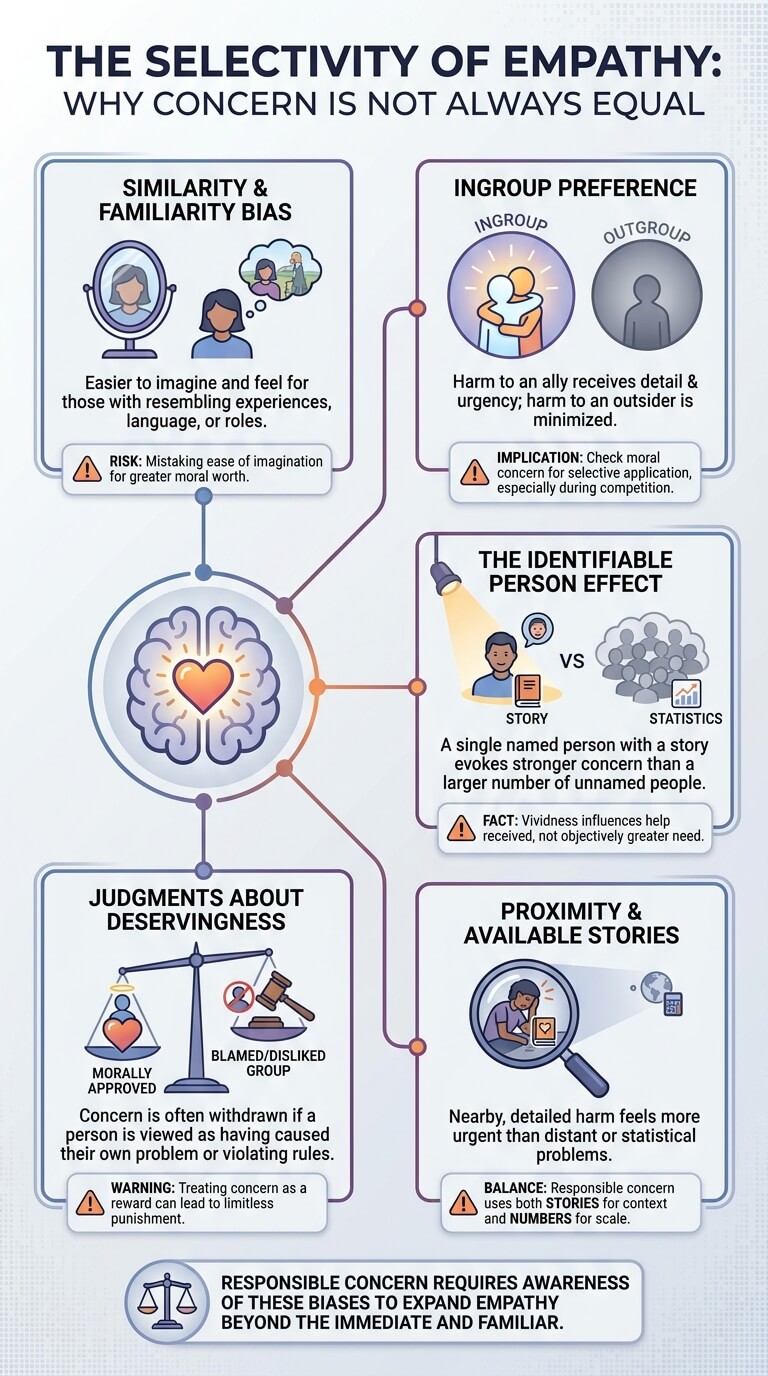
People often find it easier to empathize with those who resemble them in experience, language, age, role, values, or background. Familiar experiences are easier to imagine, so the emotional response arrives with less effort.
The risk is not caring about familiar people. The risk is mistaking ease of imagination for greater moral worth.
Ingroup preference
Group identity can alter empathic attention. Harm to an ally may receive detail, context, and urgency, while harm to an outsider is minimized or treated as deserved. A review of intergroup dynamics and empathy describes how people often show less empathy for members of an outgroup and how competition can intensify that gap.
This does not mean every group bond produces hostility. It means moral concern should be checked for selective application.
The identifiable person effect
A single named person with a face and story can evoke stronger concern than a larger number of unnamed people. The identified person is easier to imagine, remember, and emotionally represent.
Research on the identifiable victim effect in prosocial decisions found that identifiability can influence mentalizing and valuation processes. In practical terms, vividness can change how much attention and help a person receives, even when the underlying need is not objectively greater.
Proximity, vividness, and available stories
Nearby harm often feels more urgent than distant harm. A detailed story can seem more real than a reliable statistic. Frequent exposure can make one type of suffering easier to recall, while quieter problems remain invisible.
Stories provide context and meaning. Numbers provide scale. Responsible concern uses both.
Judgments about whether a person deserves concern
Empathy is influenced by moral evaluation. People may withdraw concern when they believe someone caused their own problem, violated an important rule, or belongs to a disliked group.
A study of selective empathy based on moral evaluation found that people’s empathic responses changed according to whether a person was viewed as morally good or bad. Accountability may be appropriate, but treating concern as something only morally approved people deserve can make punishment limitless.
When Empathy Can Distort a Moral Choice
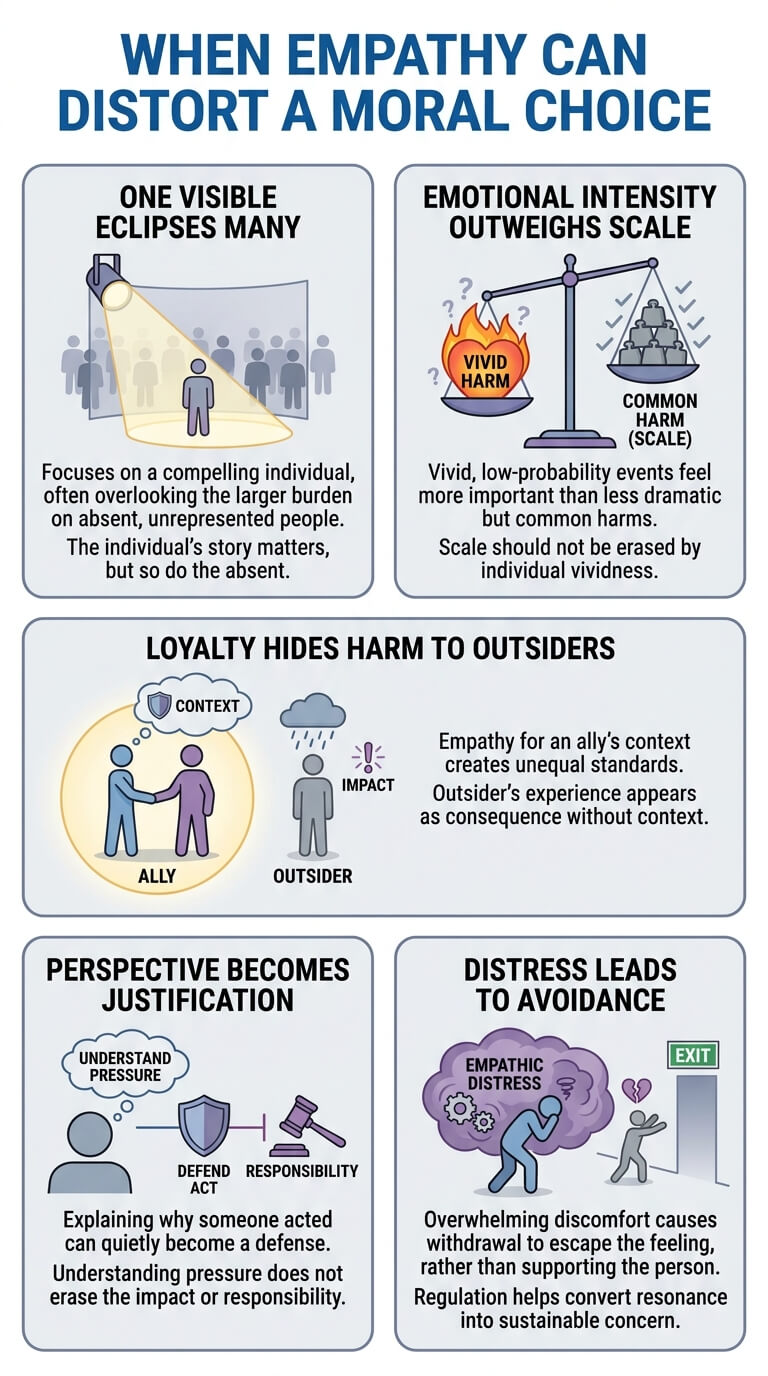
One visible person eclipses many less visible people
Imagine a policy exception that helps one compelling individual but creates an equal or larger burden for many people who are not represented in the room. The individual’s story matters. The absent people matter too.
A balanced response asks whether the visible case reveals a wider problem, justifies a limited exception, or should change the rule for comparable cases.
Emotional intensity outweighs probability or scale
A vivid low-probability harm may feel more important than a less dramatic but common harm. This can pull decisions toward what is emotionally imaginable rather than what affects the most people or causes the greatest total burden.
Scale should not erase individuals. It should prevent individual vividness from erasing everyone else.
Concern for an ally hides harm to outsiders
Loyalty may focus empathy on the person you know. You see their intentions, stress, and regret. The outsider’s experience appears as a consequence without context. This difference can produce unequal standards even when the concern for the ally is sincere.
Ask how the event would look if the identities were reversed. Then identify any relevant difference that truly justifies a different response.
Perspective-taking becomes justification rather than understanding
Explaining why someone acted can quietly become a defense of the act. “They were afraid” may be useful context. It does not automatically erase deception, harm, or responsibility.
Keep two sentences separate: “I understand the pressure they felt” and “The behavior still had this impact.” Both may be true.
Empathic distress leads to avoidance or shutdown
When another person’s suffering creates overwhelming personal discomfort, the observer may withdraw, change the subject, rush to fix the emotion, or avoid future contact. The response is organized around escaping distress rather than supporting the person.
Regulation helps convert emotional resonance into sustainable concern. A small useful action is often better than intense feeling followed by disappearance.
Empathy, Fairness, and Impartial Reasoning
What empathy sees well
Empathy is good at revealing lived experience, emotional cost, vulnerability, humiliation, fear, and needs that abstract rules may overlook. It reminds decision-makers that policies and judgments affect real people.
What rules and procedures see well
Rules protect consistency, predictability, and people whose stories are not emotionally compelling. Procedures can reduce favoritism by stating criteria before knowing who benefits.
Rules still need review. A consistent process can preserve a harmful arrangement if the criteria ignore relevant needs or power differences.
Why equal concern may require more than equal feeling
You will not feel the same intensity for every person. Equal moral concern does not require manufacturing identical emotions. It requires refusing to make emotional vividness the only measure of importance.
You can compensate for uneven feeling through questions, data, role reversal, representation, and consistent criteria.
Combining emotional information with consistent standards
Empathy and reasoning solve different parts of a moral problem. Empathy can reveal whose experience is being overlooked. Reasoning can check consistency, scale, evidence, rights, and alternatives. Treating them as partners is more useful than asking which one should replace the other.
A balanced judgment feels enough to notice and thinks broadly enough to include.
Empathy Versus Nearby Concepts
| Concept | What it involves | What it does not automatically mean |
|---|---|---|
| Empathy | Understanding or resonating with another experience | Agreement, approval, accuracy, or fair action |
| Sympathy | Concern or sorrow for another person | Sharing their emotion or understanding their viewpoint |
| Compassion | Caring about suffering with motivation to help | Knowing which help is wanted or effective |
| Emotional validation | Recognizing that a feeling is real and understandable | Agreeing with every interpretation or behavior |
| Agreeableness | A broad tendency toward cooperation and consideration | Accurate empathy or morally fair judgment |
| Moral approval | Judging conduct as acceptable or right | Understanding why the person acted |
Empathy versus sympathy
Sympathy usually means feeling concern for someone. Empathy places more emphasis on understanding or resonating with their experience. A person can feel sympathy without imagining the perspective closely.
Empathy versus compassion
Empathy concerns understanding or feeling. Compassion includes a caring motivation. Feeling another person’s pain may lead to compassion, personal distress, anger, or withdrawal. The outcome depends on regulation and context.
Empathy versus emotional validation
Validation is a communication response. It tells someone that their feeling is recognized as real or understandable. Empathy may support validation, but a person can validate without fully sharing the emotion.
“I can see why that was disappointing” recognizes the experience. It does not require agreeing that every conclusion drawn from the disappointment is correct.
Empathy versus agreeableness
Agreeableness is a broader personality tendency involving cooperation, trust, and concern for social harmony. A highly agreeable person may avoid conflict even when accountability is needed. A less agreeable person may still understand another person accurately and act from a strong fairness principle.
Empathy versus moral approval
You can understand a person’s fear, anger, or loyalty and still judge their behavior as harmful. Empathy gives information about the person’s position. Approval is a judgment about the action.
The Balanced Moral Concern Framework

This six-step framework helps preserve care while widening the decision beyond the most emotionally vivid person.
When empathy is only one part of a larger tradeoff, a structured ethical decision-making process can help weigh care alongside rights, fairness, consequences, and duties.
- Notice: Identify whose experience is emotionally present.
- Include: Identify people whose interests or harms are missing.
- Separate: Distinguish understanding, feeling, helping, and approving.
- Check: Apply the same evidence and behavior standard across identities.
- Weigh: Consider scale, probability, rights, duties, power, and long-term effects.
- Act: Choose care that is useful, fair, and accountable.
Notice whose experience is emotionally vivid
Name the person whose story currently holds attention and why. Are they familiar, similar, visible, nearby, vulnerable, or represented through a detailed narrative? This does not reduce their importance. It reveals the source of emotional salience.
Identify who is missing from the picture
List other people affected directly or indirectly. Include those who are quiet, distant, numerous, less familiar, or unable to present their own story. Ask who carries the cost of the preferred response.
Separate understanding from endorsement
Write what you understand about the person’s perspective. Then evaluate the conduct separately. This prevents empathy from becoming automatic permission and prevents accountability from requiring emotional coldness.
Check the same standard across people and groups
Reverse the identities while keeping the conduct and evidence similar. Would intention, harm, or responsibility suddenly receive different weight? If so, identify the relevant difference rather than relying on group preference.
Consider scale, probability, rights, and longer-term effects
Ask how many people are affected, how serious and likely the harm is, what rights or duties apply, and what precedent the response creates. Do not use scale to dismiss one person. Use it to prevent one story from hiding a larger pattern.
Choose a response that combines care with accountability
A balanced response may include support, a boundary, an apology, resource allocation, a fair procedure, or a change in behavior. It should address the person’s experience without ignoring the consequences for others.
How to Expand Concern Without Emotional Overload
Use perspective-taking in manageable doses
You do not need to absorb every emotion fully. Ask one focused question: “What burden might this person be carrying that is not immediately visible?” Then return to the decision.
Move from distress to one concrete action
Choose a step that matches your capacity: listen for ten minutes, verify a need, share a resource, correct a mistake, make a referral, or change one behavior. Action reduces the pressure to solve everything emotionally.
Use principles when emotion is uneven
When you do not feel naturally connected to someone, rely on standards: honesty, dignity, due process, proportionality, consent, and equal protection. Principles extend concern beyond emotional preference.
Protect boundaries without dehumanizing the other person
Empathy does not require unlimited access, forgiveness, trust, or contact. You can recognize another person’s fear or history while refusing behavior that harms you.
If there are threats, coercion, stalking, humiliation, violence, or fear of retaliation, prioritize safety and qualified support. Trying harder to empathize is not a substitute for protection.
Accept that sustainable concern is not constant emotional intensity
Care can be quiet, structured, and consistent. You may not feel a strong emotional response every time you act responsibly. Sustainable morality depends partly on habits, rules, and commitments that continue when emotion is weak.
How Group Identity and Ethical Decisions Change Empathy
How group identity changes empathic attention
Group labels affect who appears familiar, innocent, threatening, or deserving. A person may notice an ally’s pain immediately while needing deliberate effort to notice the same pain in an outsider.
Widening concern begins by describing the experience without group labels, then checking whether the judgment changes when the labels return.
Why ethical decisions need both concern and consistent process
High-stakes choices often involve several affected people. Empathy helps identify needs and emotional costs. A consistent process protects those who are absent, unpopular, or less expressive.
When guilt and empathy motivate repair
Guilt may focus attention on your responsibility, while empathy focuses attention on the other person’s experience. Together, they can support repair. The risk is centering your guilt so strongly that the other person must comfort you or accept an apology before behavior changes.
When Empathy-Related Distress Needs Support
Empathic distress may need more support when exposure to others’ suffering leads to persistent overwhelm, intrusive thoughts, avoidance, sleep disruption, inability to function, or repeated loss of boundaries. Caregivers, helpers, and people exposed to traumatic material may need structured support rather than greater emotional immersion.
Seek urgent help when distress includes thoughts of self-harm, inability to stay safe, or immediate danger. Educational reflection cannot replace crisis, medical, or mental health care.
Frequently Asked Questions About Empathy and Morality
Can someone be moral without strong empathy?
Yes. People may act through fairness, duty, rights, principle, habit, or respect even when emotional resonance is limited. Empathy can enrich moral understanding, but reliable moral behavior should not depend entirely on how strongly someone feels in a particular moment.
Why do people empathize more with one victim than many?
A single identifiable person is easier to imagine and emotionally represent than a large group. Numbers communicate scale, but they may not evoke the same vivid response. Combining personal stories with reliable information helps preserve both humanity and proportion.
Is cognitive empathy enough for moral behavior?
Cognitive empathy can improve understanding, but it does not guarantee concern or fair action. A person may accurately understand another perspective and still use that knowledge selfishly. Moral behavior also involves motivation, standards, accountability, and choices.
Can empathy make decisions less fair?
Yes. Empathy may favor familiar, similar, visible, or morally approved people. It can also make one intense story outweigh broader effects. Fairness checks, role reversal, and attention to missing stakeholders reduce this risk.
How can I care without absorbing every emotion?
Focus on understanding enough to respond usefully rather than reproducing the full emotional experience inside yourself. Use boundaries, manageable actions, rest, shared responsibility, and professional support when exposure becomes overwhelming.
Key Takeaways
- Empathy includes emotional resonance, perspective-taking, and concern, but these processes are not identical.
- Empathy can make harm visible and motivate helping, repair, and humanization.
- Strong empathy does not automatically produce accurate, fair, or proportionate decisions.
- Similarity, group identity, vivid stories, proximity, and moral approval can make empathy selective.
- The Balanced Moral Concern Framework combines empathy with missing stakeholders, consistent standards, scale, evidence, rights, and accountability.
- Empathy does not require agreement, unlimited access, forgiveness, or remaining in an unsafe situation.
Think of one decision currently shaped by a powerful personal story. Keep that person’s experience visible, then add two questions: who else is affected, and what standard should apply if the identities changed? The goal is not to feel less. It is to make care wide enough to remain fair.
Author note: Michael Reed is the Founder and Lead Writer at Psychology Exposed. He explains human behavior, emotional patterns, self-awareness, relationships, and everyday decisions in clear, research-aware language. This material is educational and is not a substitute for mental health, medical, legal, safety, or crisis support.

Michael Reed is the Founder and Lead Writer at Psychology Exposed. He writes about human behavior, relationships, emotional patterns, self-awareness, and practical psychology topics using research-informed, easy-to-understand content.
Read More About Michael Reed: https://psychologyexposed.com/michael-reed/