
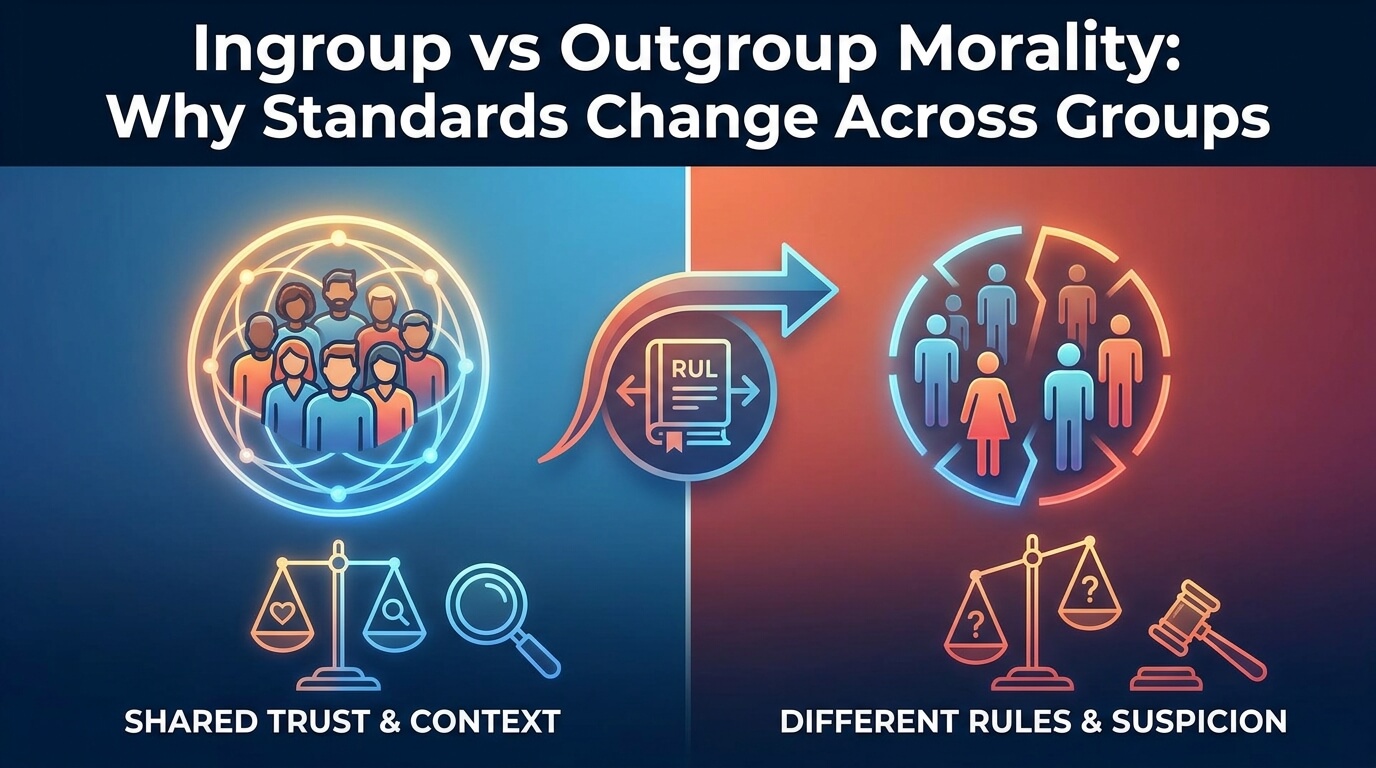
You hear that a close friend made a harmful mistake and immediately think about their stress, intentions, and usual character. You hear that a stranger from a disliked group did something similar and feel less need for context. The friend appears complicated. The stranger appears obvious.
This difference is one way group membership can shape morality. People often extend more trust, patience, empathy, resources, and favorable explanations to those they experience as “us.” Those seen as “them” may receive less benefit of the doubt, harsher judgment, or less attention when they are harmed.
Group loyalty is not automatically unethical. Families, friendships, teams, and communities create real obligations. The problem begins when special concern becomes a license to ignore outsiders’ suffering, excuse comparable wrongdoing, or apply standards that cannot survive a role reversal. Understanding this distinction helps preserve belonging without letting belonging decide who counts.
Quick Answer
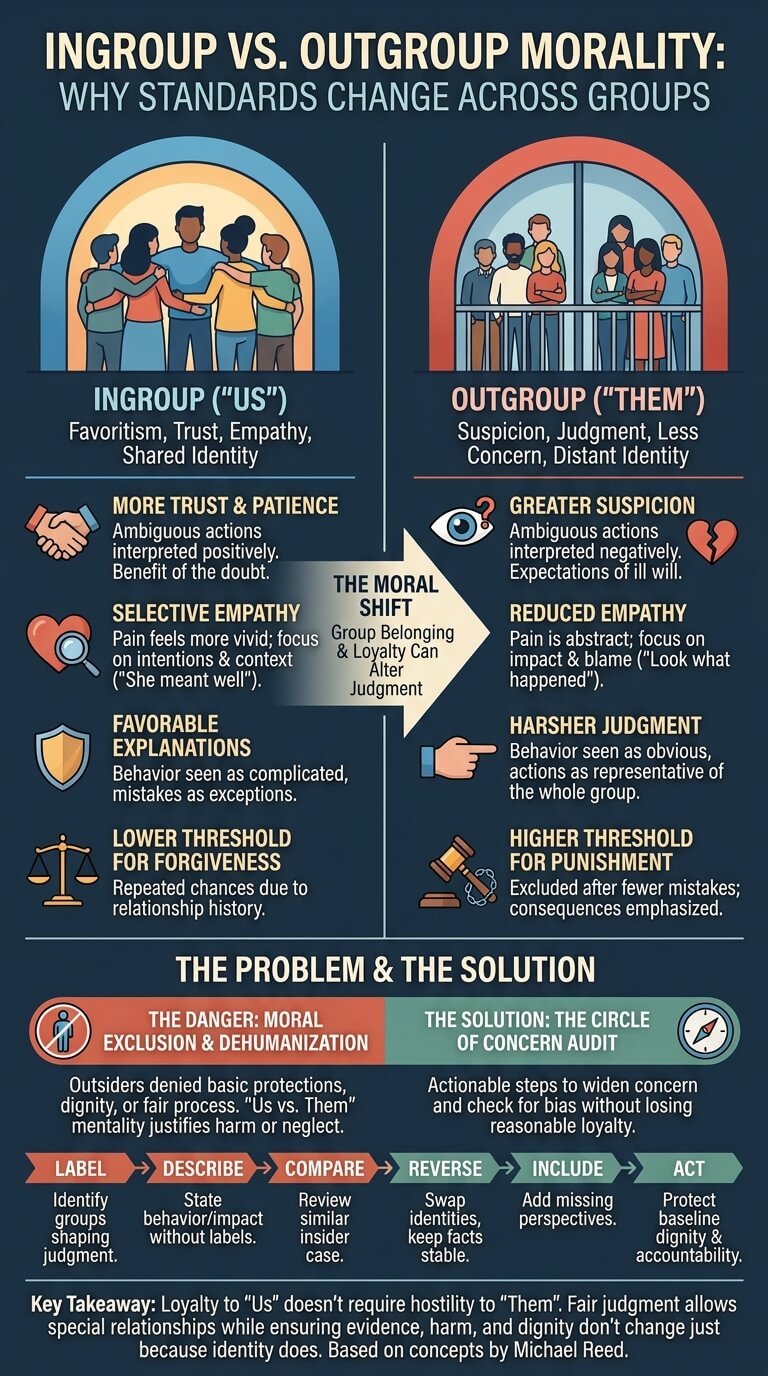
Ingroup morality favors people seen as part of “us,” while outgroup morality concerns how standards are applied to people seen as “them.” Group belonging can increase trust, empathy, cooperation, and forgiveness within the group, but it may also reduce concern or raise suspicion across group boundaries. Fair moral judgment allows special relationships while checking whether evidence, harm, dignity, and accountability change merely because identity changes.
What Ingroup and Outgroup Mean in Psychology
An ingroup is a group a person identifies with or experiences as part of the self. An outgroup is a group experienced as outside that shared identity. These categories can involve family, friendship, profession, neighborhood, school, nationality, hobby, language, generation, online community, or almost any meaningful boundary.
Group categories are flexible. The same person can be “one of us” in one setting and “one of them” in another. Two strangers may become temporary allies when they discover a shared hometown, task, interest, or challenge. This flexibility matters because moral concern is not permanently fixed to one set of identities.
Group membership can be meaningful or minimal
Some groups reflect long histories, shared responsibilities, and deep emotional ties. Others are created by a minor label or temporary assignment. Research has repeatedly found ingroup preferences even in minimal group settings where the distinction has little practical meaning.
A review of ingroup favoritism in economic decisions describes how preferences and beliefs can both contribute to differential treatment. People may care more about ingroup outcomes, expect greater cooperation from insiders, or interpret identical behavior differently depending on membership.
Identity turns another person’s outcome into “our” outcome
When a group becomes part of identity, another member’s success can feel personally meaningful. Their humiliation may feel like a threat to the group’s status. Their misconduct may create pressure to defend the group’s reputation.
This emotional connection supports solidarity. It also makes impartial judgment harder because criticism of one member can feel like criticism of the self.
Moral boundaries can expand or contract
People differ in how widely they extend concern, obligation, trust, and protection. A moral circle may focus mainly on close relationships, extend to a broader community, or include distant strangers and future people.
The circle is not all-or-nothing. Someone may believe they owe more practical help to family while still believing outsiders deserve safety, truthful judgment, and basic dignity. Problems arise when those outside the favored circle are treated as if ordinary moral limits no longer apply.
How Group Membership Changes Moral Judgment
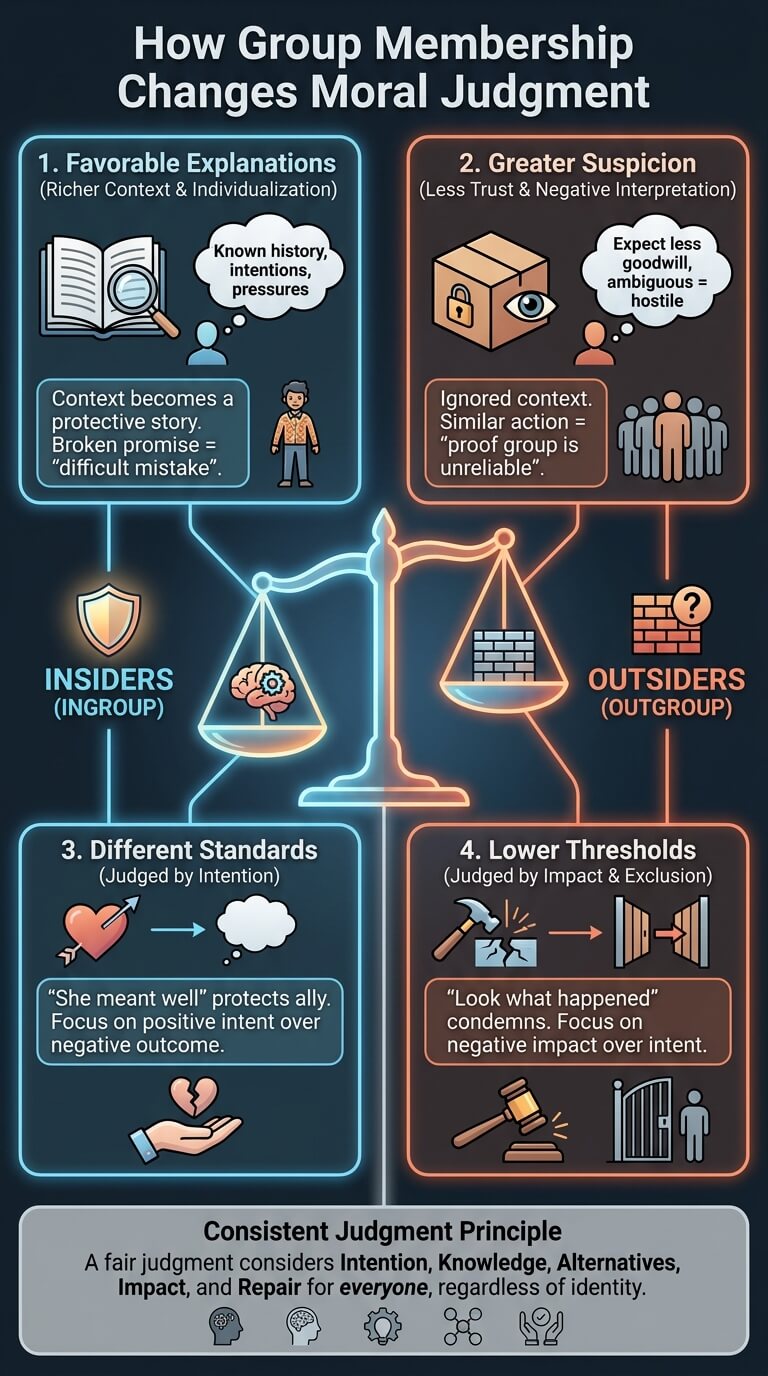
More favorable explanations for insiders
People often have richer information about insiders. They know the friend’s pressures, history, intentions, and positive behavior. This context can support a fairer judgment. It can also become a protective story that is offered automatically, even when the same context would be ignored for an outsider.
An insider’s broken promise may be called a difficult mistake. An outsider’s similar action may be called proof that the group is unreliable. One person is individualized while the other becomes representative.
Greater suspicion toward outsiders
Outgroup members may receive less trust before any behavior occurs. Ambiguous actions are more likely to be interpreted as hostile, selfish, or threatening. A neutral disagreement can appear deliberate because the observer expects less goodwill.
Suspicion can be shaped by experience, group narratives, competition, or repeated warnings. The question is whether current evidence is being evaluated or whether category-based expectation is filling the gaps.
Different standards for intention and impact
People may judge insiders by intention and outsiders by impact. “She meant well” protects an ally, while “Look what happened” condemns the outsider. In another context, the standard may reverse if emphasizing impact protects the ingroup.
A consistent judgment considers intention, knowledge, alternatives, impact, and repair for everyone. Relevant context may justify different conclusions, but identity alone should not decide which dimension matters.
Different thresholds for forgiveness and punishment
An insider may receive repeated chances because the relationship has history and future value. An outsider may be excluded after one ambiguous event. Special patience can be reasonable in close relationships, but it becomes questionable when the same serious harm is minimized indefinitely.
Forgiveness, trust, contact, and consequences are separate decisions. A person can retain concern for someone while reducing trust or setting a firm boundary.
Ingroup Love Is Not Always Outgroup Hate
Favoring insiders and harming outsiders are related but distinct. A person may give more time to family without wanting strangers to suffer. A community may prioritize its members while cooperating respectfully with neighboring groups.
Research on parochial cooperation often distinguishes ingroup favoritism from direct outgroup hostility. A cross-societal study of parochial trust and cooperation describes favoritism as one pathway and active harm as another. This distinction prevents every special obligation from being treated as prejudice.
Special obligations can be morally legitimate
Parents have responsibilities toward their own children that they do not have toward every child. Friends make commitments to one another. Community members may pool resources for shared risks. These obligations come from relationships, promises, dependence, and roles.
Legitimate special concern does not erase baseline duties to outsiders. You may owe your friend more time while still owing a stranger honesty and safety.
Favoritism can disadvantage outsiders without active hostility
A person does not need to dislike outsiders to create unequal outcomes. If all opportunities, patience, information, and support flow toward familiar people, others may remain excluded even without openly hostile intent.
This is why “I do not hate anyone” does not settle the fairness question. Examine who receives access, forgiveness, credibility, and representation.
Competition can turn preference into hostility
When groups believe resources, safety, status, or identity are threatened, ordinary preference can intensify. Helping outsiders may be seen as betrayal. Neutrality may be interpreted as disloyalty. Rumors about the other group become easier to believe.
When a perceived group violation becomes emotionally charged, it can also fuel moral outrage, especially when people interpret the event as a threat to shared values or identity.
Threat does not prove the group is irrational. It can reflect real conflict. It also increases the need to distinguish evidence from fear-driven generalization.
Selective Empathy Across Group Boundaries
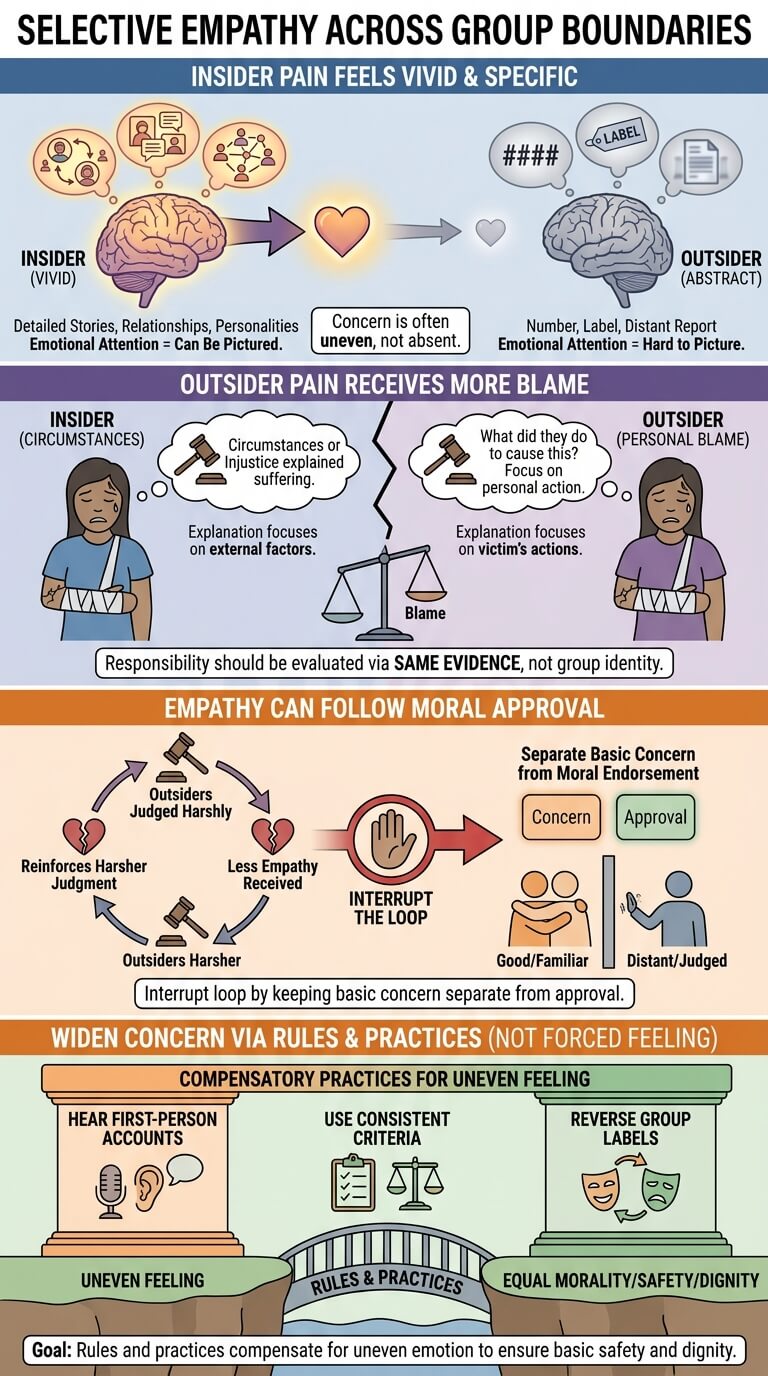
Insider pain feels more vivid and specific
People often know the names, stories, relationships, and personalities of insiders. Their suffering has detail. Outsider suffering may arrive as a number, label, or distant report. Emotional attention follows what can be pictured.
A review of intergroup empathy bias describes how empathy can be reduced for outgroup members and how competitive contexts may produce counter-empathic responses. The practical lesson is not that people lack all concern for outsiders. It is that concern is often uneven.
Outsider pain receives more blame
If a harmed person belongs to a distrusted group, observers may focus on what the person did to cause the outcome. An insider’s suffering is more likely to be explained through circumstances or injustice.
Responsibility may be relevant, but it should be evaluated through the same evidence. A person does not lose all claim to safety or dignity because they made a mistake.
Empathy can follow moral approval
People often empathize more with those they view as good, innocent, familiar, or deserving. This creates a loop: outsiders are judged more harshly, then receive less empathy because they have been judged harshly.
Interrupting the loop does not require approving the person’s behavior. It requires keeping basic concern separate from moral endorsement.
How to widen concern without forcing identical feelings
You may never feel the same emotional closeness to a stranger that you feel toward family. Equal morality does not require equal emotion. It requires rules and practices that compensate for uneven feeling.
Useful checks include hearing first-person accounts, using consistent criteria, adding representatives who are missing, reviewing aggregate impact, and reversing the group labels in your imagination.
Loyalty, Betrayal, and the Pressure to Defend the Group
Why criticism can feel disloyal
When identity is shared, criticism of a member may seem to provide ammunition to outsiders. People fear weakening the group, exposing private conflict, or abandoning someone who depends on them.
These fears can be sincere. The moral question is whether protection requires denying harm, silencing affected people, or attacking anyone who raises evidence.
Protecting reputation versus protecting people
A group may focus on how a violation looks instead of what happened. The response becomes reputation management: minimize the event, isolate the complainant, or emphasize the group’s good record.
Protecting people asks different questions. Who was harmed? Is the behavior continuing? What evidence should be preserved? What boundary, repair, or formal process is needed?
When internal accountability strengthens belonging
Accountability can signal that membership includes responsibility, not only protection. Groups become more trustworthy when insiders know that status will not erase consequences.
Internal correction is not necessarily betrayal. It can protect the group from becoming dependent on denial.
When loyalty becomes moral cover
Loyalty becomes moral cover when it is used to excuse repeated harm, demand silence, or punish people for acknowledging facts. Statements such as “You should defend your own” become dangerous when defending the group means abandoning the person harmed by it.
If loyalty is enforced through threats, humiliation, stalking, financial control, isolation, or retaliation, prioritize safety and qualified support rather than trying to prove your commitment through compliance.
Double Standards Between “Us” and “Them”
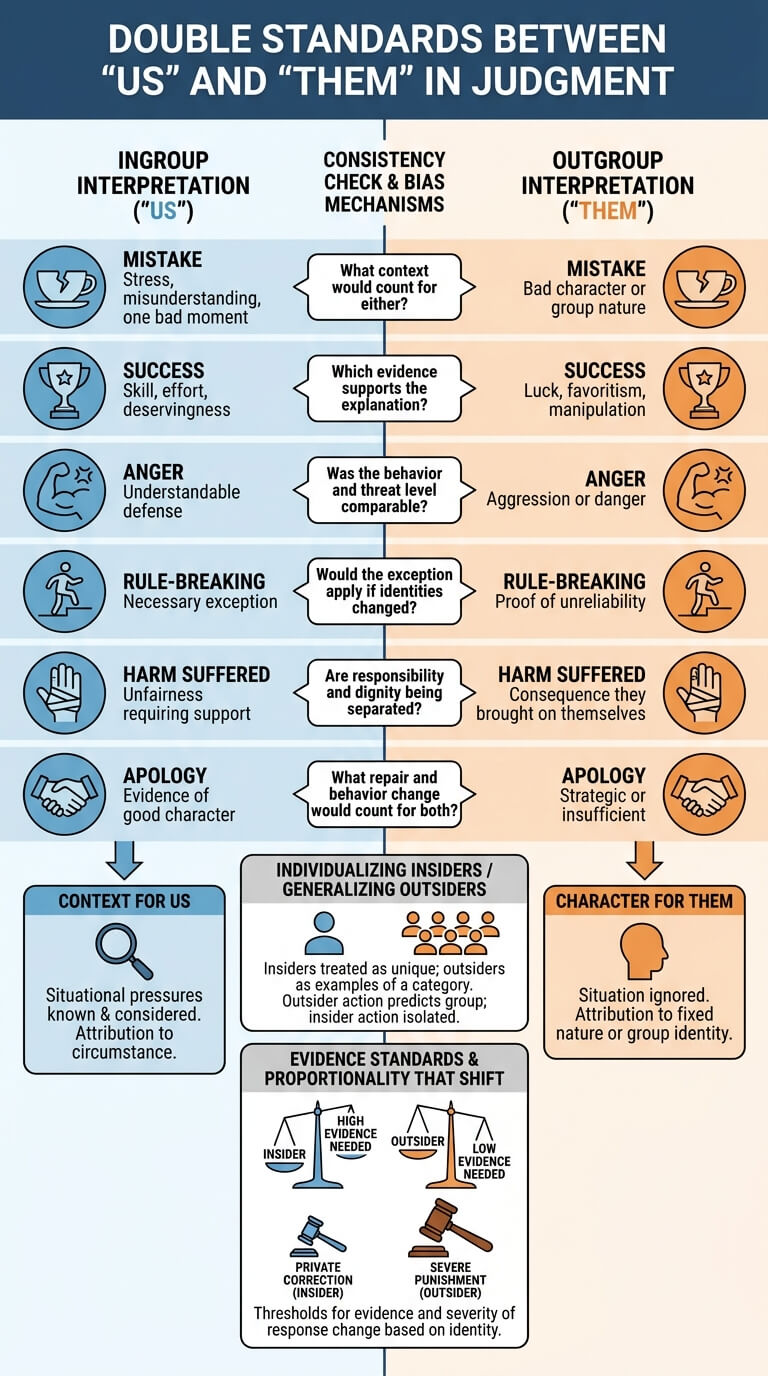
| Judgment area | Common ingroup interpretation | Common outgroup interpretation | Consistency check |
|---|---|---|---|
| Mistake | Stress, misunderstanding, one bad moment | Bad character or group nature | What context would count for either person? |
| Success | Skill, effort, deservingness | Luck, favoritism, manipulation | Which evidence supports the explanation? |
| Anger | Understandable defense | Aggression or danger | Was the behavior and threat level comparable? |
| Rule-breaking | Necessary exception | Proof of unreliability | Would the exception apply if identities changed? |
| Harm suffered | Unfairness requiring support | Consequence they brought on themselves | Are responsibility and dignity being separated? |
| Apology | Evidence of good character | Strategic or insufficient | What repair and behavior change would count for both? |
Individualizing insiders and generalizing outsiders
Insiders are treated as unique individuals. Outsiders are treated as examples of a category. One outsider’s action is used to predict the group, while an insider’s action is isolated from group identity.
A fair description keeps the unit of judgment stable. Evaluate the person and the evidence before deciding whether a wider pattern is supported.
Context for us, character for them
People know the situational pressures affecting their own side. They may not seek the same information about outsiders. This creates an attribution gap even without deliberate prejudice.
Evidence standards that shift with identity
A rumor about an outgroup may be accepted because it fits expectations. Strong evidence against an insider may be dismissed as biased. The standard changes according to the desired conclusion.
Decide in advance what evidence is needed for a serious claim. Use the same threshold across groups whenever the stakes and circumstances are comparable.
Proportionality that changes across groups
People may demand severe punishment for outsiders and private correction for insiders. Different relationships can justify different responsibilities, but the seriousness of harm should not disappear because the person is familiar.
Moral Exclusion and Dehumanization
What it means to place someone outside the moral circle
Moral exclusion occurs when a person or group is treated as outside the community to which ordinary rules of fairness, care, or restraint apply. Their suffering matters less, their voice is dismissed, and harsh treatment appears acceptable.
This can happen without openly claiming that outsiders are less human. People may simply decide that the group is dangerous, undeserving, contaminating, or beyond concern.
Dehumanizing language and reduced restraint
Language that turns people into animals, objects, disease, or a faceless mass can make individual experience less visible. It simplifies the outgroup and may support exclusion or aggression.
The safest practical response is not to diagnose a hidden mental process. Focus on the observable language, the unequal rule it supports, and the treatment it makes easier to justify.
Why research language requires care
Some classic research has interpreted differences in emotion or trait attribution as subtle dehumanization. More recent work has questioned whether certain findings are better explained by ordinary intergroup preference rather than denial of humanity.
One set of studies reported limited evidence that outgroups are denied uniquely human characteristics once preference was distinguished from trait attribution. This does not show that dehumanization never occurs. It shows that specific measurement claims should not be stretched beyond their evidence.
Look at treatment, not only labels
The moral concern is clearest in behavior. Are outsiders denied help, due process, safety, medical care, housing, voice, or proportionate judgment? Are threats and humiliation tolerated when directed at them?
Actions reveal the boundary of concern more reliably than asking whether someone privately sees another group as fully human.
Ingroup Morality Versus Nearby Concepts
| Concept | Core feature | What distinguishes it |
|---|---|---|
| Ingroup favoritism | More trust, help, or favorable treatment for insiders | Does not require active hostility toward outsiders |
| Outgroup hostility | Active punishment, aggression, exclusion, or harm | Goes beyond preferential help |
| Loyalty | Special obligation to a relationship or group | Can remain consistent with baseline duties to outsiders |
| Prejudice | Negative evaluation based on group membership | May exist before individual evidence is considered |
| Moral hypocrisy | Unequal standards protect image or advantage | Can occur within or across group boundaries |
| Empathy bias | Unequal emotional concern across groups | May influence helping without explicit hostility |
| Moral exclusion | Ordinary moral protections no longer apply to a group | Represents a contraction of the moral circle |
Favoritism versus hostility
Giving more to insiders may disadvantage outsiders, but it is not identical to wanting them harmed. The distinction helps identify whether the intervention should widen access, reduce suspicion, or stop active aggression.
Loyalty versus prejudice
Loyalty begins with a relationship or commitment. Prejudice judges people through category-based assumptions. Loyalty can become prejudicial when it requires negative conclusions about outsiders without individual evidence.
Empathy bias versus moral exclusion
Empathy bias means concern is uneven. Moral exclusion is more severe: the outsider’s welfare is treated as if it falls outside normal moral protection. Uneven emotion can be corrected through procedures before it becomes exclusionary behavior.
Group-based hypocrisy versus sincere special responsibility
Special responsibility can be stated openly: “I owe my family more direct care because of our relationship.” Hypocrisy hides or changes the rule: “Our harmful behavior deserves context, but theirs proves they are bad.”
The Circle of Concern Audit
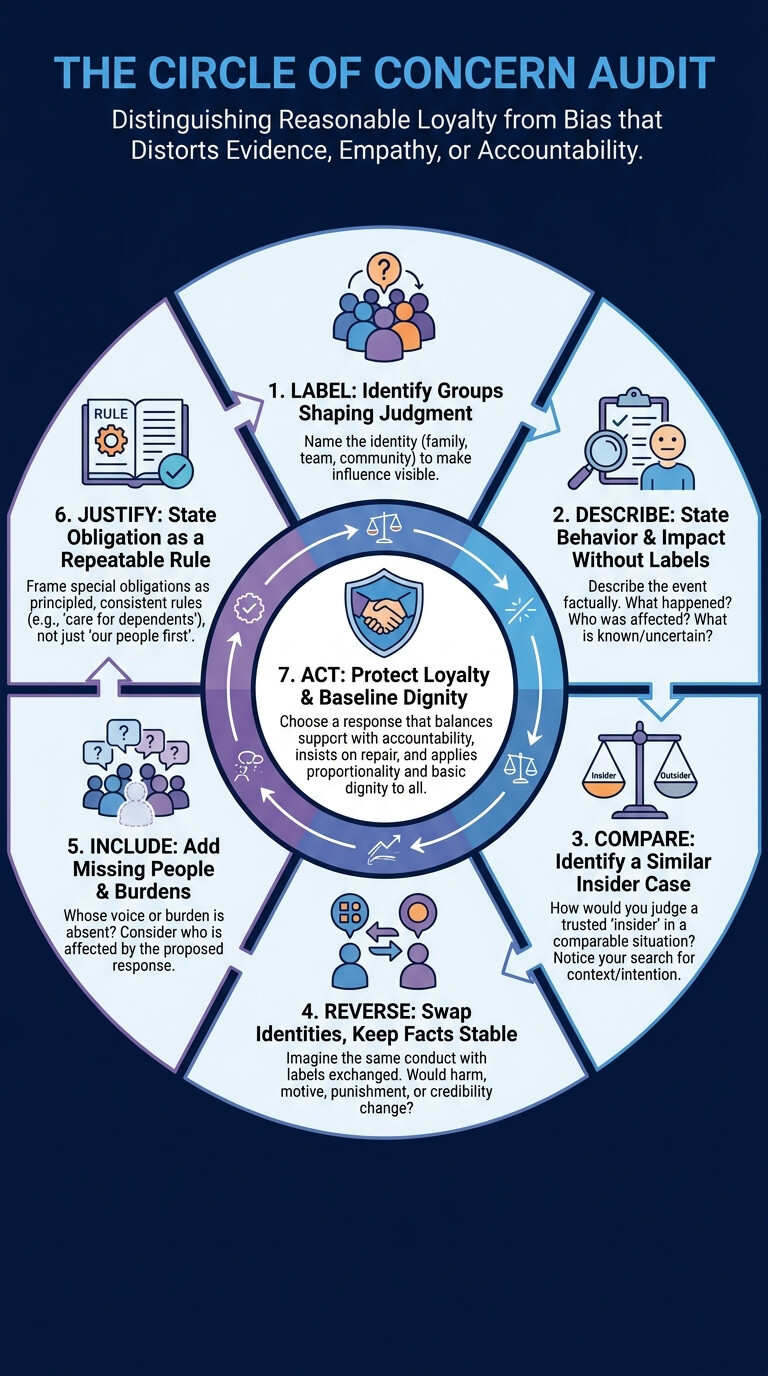
The Circle of Concern Audit helps identify when loyalty is reasonable and when identity is quietly changing evidence, empathy, or accountability.
- Label: Identify the groups currently shaping your judgment.
- Describe: State the behavior and impact without group labels.
- Compare: Identify how you judge a similar insider case.
- Reverse: Swap identities while keeping the facts stable.
- Include: Add missing people, burdens, and perspectives.
- Justify: State any special obligation or exception as a repeatable rule.
- Act: Choose a response that protects both legitimate loyalty and baseline dignity.
Label the group boundary
Name the identity that currently matters: family, friend group, profession, neighborhood, generation, team, or online community. Group influence is easier to examine after it is visible.
Describe the event without identity labels
Replace “one of them did this” with a behavioral description. Include what happened, who was affected, what is known, and what remains uncertain.
Compare a similar insider case
Find a genuinely comparable example involving someone you trust. Notice whether you search for context, intention, or repair more actively.
Reverse the identities
Imagine the same conduct and evidence with the group labels exchanged. Would the harm, motive, punishment, or credibility change? If so, name the specific relevant difference.
Include people missing from the preferred story
Ask whose burden is absent, whose voice is discounted, and who would be affected by the proposed response. Insider stories may be vivid while outsider consequences remain abstract.
State the special obligation as a general rule
A principled obligation can be explained consistently. “People should provide extra care to dependents for whom they have accepted responsibility” is clearer than “Our people always come first.”
Choose a response that preserves dignity and accountability
You may support an insider while acknowledging harm, insisting on repair, or setting a boundary. You may disagree with an outsider while applying evidence, proportionality, and basic dignity.
How to Widen the Moral Circle in Daily Life
Use cross-group contact that includes cooperation and equal status
Contact is most useful when people meet as individuals, work toward a shared goal, and have enough safety and equality for real interaction. Mere exposure can reinforce stereotypes when the setting is hostile or unequal.
Research on intergroup contact and outgroup humanization suggests that contact and humanization may reinforce one another. The implication is practical: meaningful cooperation can change how people are represented, and more humanized representation can make contact easier.
Replace category stories with individual information
Learn names, roles, constraints, and specific behavior. Individual information weakens the tendency to treat one person as proof of an entire category.
Create rules before knowing which group benefits
Decide evidence standards, allocation criteria, exceptions, and consequences in advance. This reduces the temptation to rewrite the rule around the favored identity.
Make outsider impact visible
Use first-person accounts, representative data, and direct consultation. Affected people should not exist only as numbers, but one vivid story should not replace scale.
Practice loyalty with accountability
Support does not require denial. You can accompany a friend through consequences, help them repair harm, and refuse public humiliation while still acknowledging what happened.
Notice language that turns people into categories
Watch for phrases that describe an entire group as one mind, motive, or character. Replace category claims with specific evidence and avoid forwarding stories that cannot be verified.
When Group Pressure Becomes Unsafe
Group belonging can become coercive when members are threatened, humiliated, isolated, stalked, financially controlled, or punished for questioning a leader, rule, or harmful act. Pressure may be framed as loyalty, purity, protection, or proof of commitment.
If disagreement creates credible fear or retaliation, prioritize safety, documentation, trusted support, and qualified help. Do not assume that confronting the group alone or exposing every inconsistency will be safe.
Frequently Asked Questions About Ingroup and Outgroup Morality
Is caring more about family morally wrong?
No. Close relationships create legitimate responsibilities, dependence, and promises. The concern is whether special care for family is used to deny outsiders basic dignity, safety, truthful judgment, or fair access to shared systems.
Does ingroup favoritism require prejudice?
No. People may favor insiders because of familiarity, trust, expected reciprocity, or special obligation without holding openly negative beliefs about outsiders. Favoritism can still produce unequal outcomes, so behavior and access should be examined separately from hostility.
Why are people more forgiving of their own group?
They often know more context, feel greater emotional connection, expect future interaction, and experience criticism as a threat to identity. These factors can support compassion, but they may also lower accountability unfairly.
Can loyalty and impartial fairness coexist?
Yes. A person can owe extra care to specific relationships while applying baseline rules consistently. The balance becomes clearer when special obligations are stated openly and do not erase outsiders’ rights or excuse serious harm.
How can I tell whether my judgment is group-biased?
Describe the behavior without labels, compare a similar insider case, reverse the identities, and check whether evidence, intention, impact, or punishment changes. A different conclusion may be justified, but the relevant difference should be explicit.
Key Takeaways
- Group identity can change trust, empathy, explanations, forgiveness, and punishment even when the behavior is similar.
- Ingroup favoritism does not automatically require active hostility toward outsiders, but it can still create unequal access and concern.
- Loyalty can be legitimate while remaining compatible with baseline dignity, evidence, and accountability for outsiders.
- Selective empathy, unequal evidence standards, and identity-based exceptions are common routes to moral double standards.
- Moral exclusion occurs when ordinary protections are withdrawn from people outside the favored circle.
- The Circle of Concern Audit tests labels, facts, comparable cases, role reversal, missing people, special obligations, and action.
Choose one judgment involving “our side” and “their side.” Remove the labels, describe the behavior, and reverse the identities. Then state what special obligation, if any, justifies different treatment. Loyalty becomes more trustworthy when the exception is visible, limited, and compatible with everyone’s basic dignity.
Author note: Michael Reed is the Founder and Lead Writer at Psychology Exposed. He explains human behavior, emotional patterns, self-awareness, relationships, and everyday decisions in clear, research-aware language. This material is educational and is not a substitute for mental health, legal, safety, or crisis support.

Michael Reed is the Founder and Lead Writer at Psychology Exposed. He writes about human behavior, relationships, emotional patterns, self-awareness, and practical psychology topics using research-informed, easy-to-understand content.
Read More About Michael Reed: https://psychologyexposed.com/michael-reed/