

You see someone being mocked, cheated, exploited, or treated as if their pain does not matter. Before you have planned a response, anger arrives with a sense of urgency: this should not be happening, someone is responsible, and something needs to change.
That combination of moral judgment and emotion is often described as moral outrage. It can help people notice overlooked harm, defend vulnerable people, and communicate that a shared standard has been violated. It can also narrow attention, increase certainty, reward public condemnation, and make punishment feel more urgent than accuracy or repair.
The useful question is not whether outrage is sincere. Sincere outrage can still be misdirected, and socially rewarded outrage can still point to real harm. The more practical task is to examine what triggered the reaction, what information supports it, and what response is most likely to protect people or improve the situation.
Quick Answer
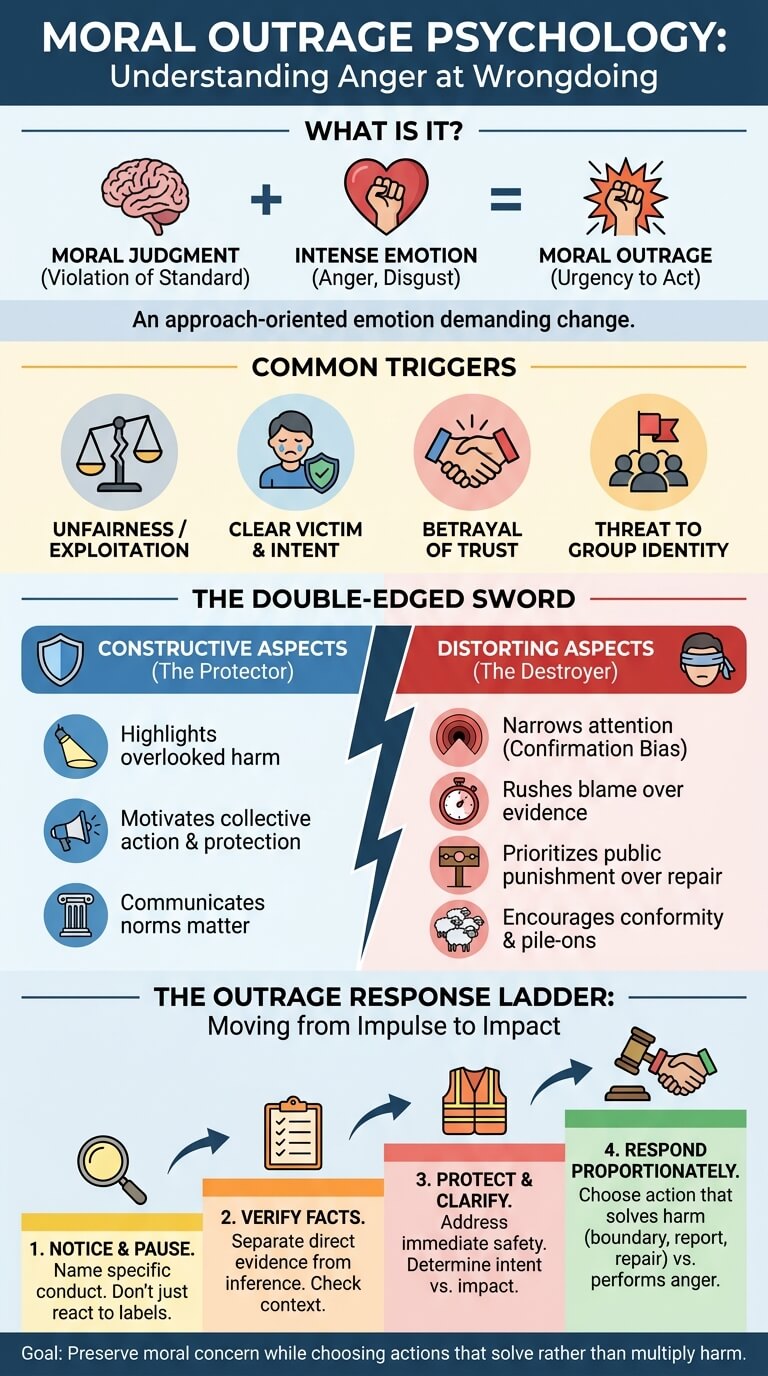
Moral outrage is intense anger, often mixed with disgust or contempt, that follows a judgment that someone violated an important moral standard. It can motivate protection, accountability, and collective action. It can also encourage rushed blame, public punishment, group conformity, or exaggerated certainty. A responsible response keeps the concern visible while checking evidence, proportionality, and the likely effects of acting.
What Moral Outrage Is
Moral outrage differs from ordinary frustration because it includes a judgment about what people should or should not do. A delayed delivery may make you angry because it is inconvenient. Deliberately withholding essential help from someone who depends on it may produce outrage because the situation appears harmful, unfair, and avoidable.
Outrage is often directed at another person, organization, or group, but it can also arise after learning that a trusted institution ignored a preventable problem. The emotion prepares people to approach the issue, assign responsibility, communicate condemnation, or support consequences.
A moral appraisal plus an approach-oriented emotion
Outrage begins with appraisal. The observer interprets an event as a meaningful violation involving harm, betrayal, unfairness, exploitation, dishonesty, or another important standard. Anger then supplies energy to challenge, correct, expose, or punish.
This approach tendency explains why outrage feels active. Sadness may produce withdrawal or grief. Fear may emphasize danger and escape. Moral anger more often says, “Move toward this and do something.” That energy can support protection, but it also increases the risk of acting before uncertainty has been examined.
First-person anger versus third-party outrage
First-person anger occurs when you believe someone wronged you. Third-party outrage occurs when you witness or learn about harm to another person. The second form matters socially because people can enforce norms even when they are not the direct victim.
Third-party responses may include confronting the person, reporting the conduct, supporting the affected individual, refusing cooperation, sharing information, or demanding consequences. The observer’s distance can make impartiality easier in some cases. In other cases, distance means the observer has only a partial story and may rely heavily on framing supplied by others.
Why disgust sometimes appears beside anger
People often use words associated with disgust when rejecting moral violations. They may describe conduct as sickening, corrupt, dirty, or repulsive. Anger tends to push toward confrontation, while disgust more often pushes toward distance, exclusion, or refusal of contact.
Research comparing anger and disgust after moral violations found that the emotions were related to different aggressive response tendencies. This distinction does not make every angry response direct or every disgust response indirect. It helps explain why one person wants to confront while another wants to ostracize.
What Triggers Moral Outrage

Perceived harm, betrayal, unfairness, exploitation, or norm violation
Outrage often follows a belief that a person knowingly crossed an important line. Common triggers include abusing power, exploiting dependence, humiliating someone, violating trust, taking an unfair advantage, or refusing responsibility for preventable harm.
The violation does not need to affect the observer personally. People may react strongly because they believe the conduct threatens a shared rule that protects cooperation. “If this is accepted, anyone in that position could be treated the same way” turns one event into a wider concern.
Clear victims and visible intentions
Outrage becomes easier when the story contains an identifiable harmed person and an actor whose intention appears obvious. A short video, quotation, or personal account can make the emotional structure immediate: a victim, a wrongdoer, and a violation.
Clarity can be genuine. It can also be produced by missing context. An edited clip may remove what happened before or after. A confident description of motive may be an inference. The presence of a compelling victim should increase concern, but it should not eliminate factual checking.
Threats to group identity or shared values
A violation can feel like an attack on the group itself. Criticism of a respected member may be interpreted as contempt for everyone who identifies with that person. Harm by an outsider may receive more attention than similar harm by an ally. A challenge to a custom may feel like a threat to belonging, loyalty, or social order.
Identity raises the stakes because the observer is no longer judging only one act. The event seems to say something about who “we” are and what “they” intend. This can intensify solidarity, but it can also make consistent standards harder to maintain.
Repeated violations and accumulated frustration
One event may activate anger built across months or years. A small incident becomes the final example in a familiar pattern of dismissal, favoritism, corruption, or neglect. The observer’s reaction may therefore seem disproportionate if only the latest event is visible.
Accumulated context deserves attention. At the same time, earlier examples should not be used to fill gaps in the current case automatically. A repeated pattern strengthens concern when the cases are genuinely comparable and supported by evidence.
Ambiguous events framed as obvious wrongdoing
Moral language can simplify uncertain events. Words such as abuse, betrayal, corruption, cruelty, or exploitation carry strong meaning. They may accurately describe what happened, but they can also settle the judgment before the details are known.
A useful check is to describe the behavior without the moral label first. “The manager changed the rule after seeing who would benefit” provides a claim that can be examined. “The manager is corrupt” states a conclusion about character and motive.
The Outrage Cycle
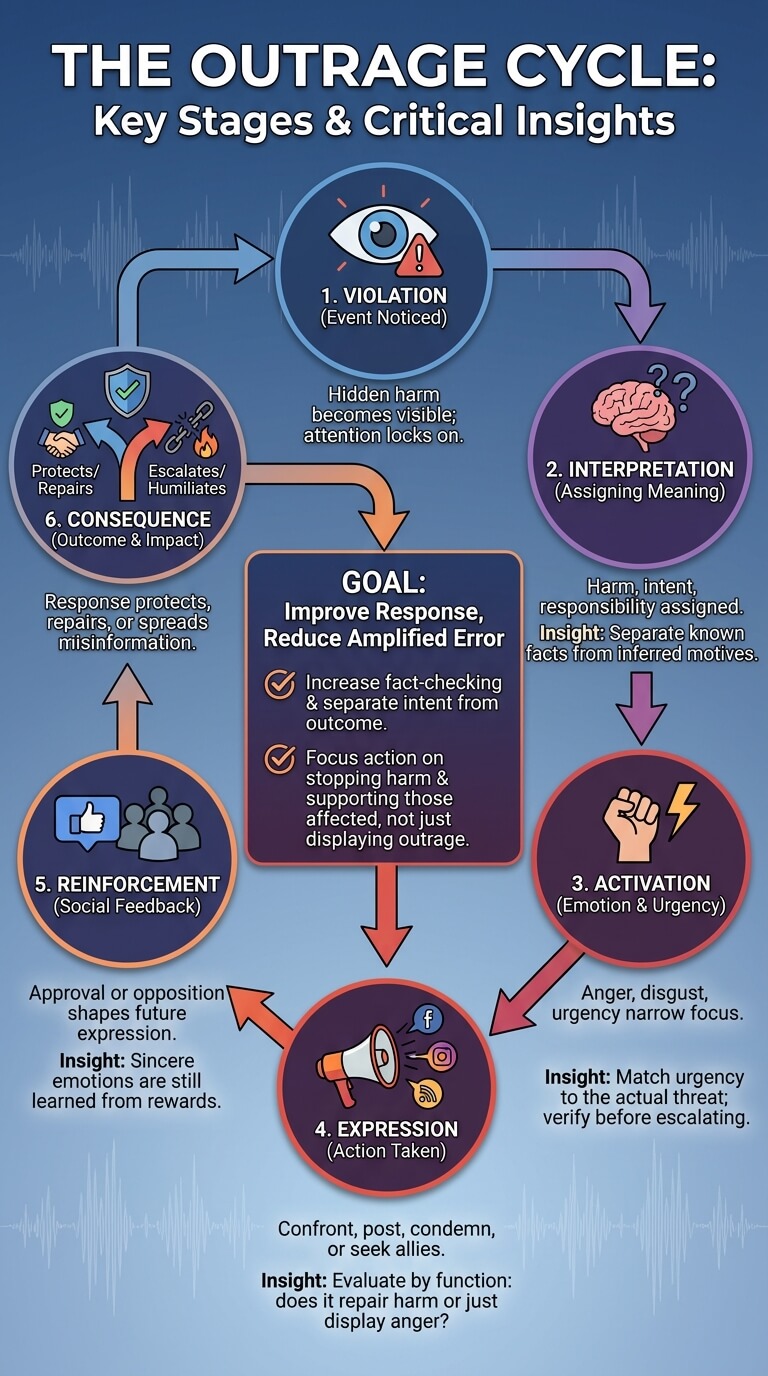
Moral outrage often moves through a recognizable sequence. Each stage can either improve the response or amplify error.
- Violation: An event is noticed or reported.
- Interpretation: Harm, intention, responsibility, and moral meaning are assigned.
- Activation: Anger, disgust, contempt, or urgency narrows attention.
- Expression: The person confronts, reports, posts, shares, condemns, or seeks allies.
- Reinforcement: Social approval, opposition, or new information changes future expression.
- Consequence: The response protects, repairs, deters, escalates, humiliates, or spreads misinformation.
Attention locks onto a violation
Outrage makes the event difficult to ignore. This is one of its strengths. Harm that was normalized or hidden may finally become visible because people refuse to look away.
Focused attention also creates selection effects. Details that support the violation story become memorable. Details that complicate it may feel irrelevant or suspicious. Deliberately asking what evidence could change the interpretation can reduce this narrowing.
Motive and blame are assigned
Observers want to know whether the act was intentional, reckless, careless, constrained, or accidental. Intent affects condemnation, but people often infer it from limited behavior. An unfavorable outcome can make hostile motive seem obvious.
Accountability does not require pretending that intention is irrelevant. It requires separating what is known from what is inferred. A person may need to repair harm even without malicious intent, while deliberate exploitation may justify stronger protective action.
Emotion increases certainty and urgency
Strong anger can make delay feel morally wrong. The person may believe that asking questions minimizes the harm or protects the accused. Sometimes immediate intervention is necessary, especially when someone is in danger. In many other situations, a brief verification step improves rather than weakens protection.
Urgency should match the threat. Stop immediate harm first. For a past event or disputed report, identify what can be confirmed before escalating the response.
Expression receives social feedback
Public reactions teach people which forms of outrage receive attention and approval. Likes, supportive comments, reposts, and group praise can reinforce stronger expression. A study of social learning and online moral outrage found that positive feedback and visible group norms were associated with future outrage expression.
This does not prove that people are faking concern. It shows that sincere emotions are still shaped by learning. A person may become more likely to express outrage in the style that their social environment rewards.
Punishment, protection, sharing, or withdrawal follows
The same emotion can lead to very different actions. One observer checks on the harmed person. Another documents evidence. Another calls for dismissal, exclusion, or public shaming. Another quietly withdraws support.
Evaluate the action by its function. Does it stop harm, improve accountability, preserve evidence, support the affected person, or reduce recurrence? Or does it mainly display anger, increase status, or make suffering visible without improving the problem?
Why Outrage Spreads Through Groups
Social learning and repeated exposure
People learn emotional norms by observing others. If every moral claim in a group receives highly intense language, calmer concern may appear weak. If members are rewarded for correcting misinformation and acknowledging uncertainty, those responses can also become normal.
Repeated exposure affects perception. A community that constantly highlights violations may increase vigilance, even when the highlighted events are real. The emotional environment shapes how quickly people identify blame and how much intensity seems appropriate.
Norm enforcement and belonging
Expressing outrage can communicate, “I recognize the rule, and I stand with the people it protects.” This can strengthen cooperation and reassure harmed members that the group takes the violation seriously.
The belonging function becomes risky when silence, questions, or proportionality are treated as disloyalty. Members may express more certainty than they feel because the social cost of hesitation is high.
Identity signaling and reputation
Moral expression tells others what a person values. It may also affect status. Some people gain trust by showing that they will defend group standards. Others may compete to appear more committed, more pure, or more willing to punish.
Research on moral grandstanding and status-seeking motives found associations with greater moral and interpersonal conflict. Grandstanding should not be assumed whenever someone speaks strongly. The concept is useful when the performance of moral commitment begins to overshadow the actual issue.
Escalation through simplified stories and missing context
Simple stories travel easily: one clear villain, one innocent victim, one obvious solution. Complexity slows sharing because it requires conditions, uncertainty, and distinctions. Yet those complications may determine whether the response is accurate.
A responsible summary can still be clear. It should distinguish confirmed facts from allegations, describe the specific conduct, and avoid turning one event into proof about an entire person or group.
Why online environments reward high-arousal expression
High-arousal emotions capture attention. Short formats favor certainty and memorable condemnation. Audiences often see the public accusation before they see a correction, response, or later finding.
Before amplifying a claim, ask whether you would be willing to correct it with equal visibility. If the answer is no, the social reward of immediate expression may be outrunning your willingness to accept responsibility for error.
When Moral Outrage Is Constructive
It directs attention toward overlooked harm
Outrage can break through indifference. It tells others that a harmful practice is not merely unfortunate or normal. People who were ignored may receive recognition, witnesses, and practical support.
It motivates boundaries, accountability, and collective protection
Anger can help a person say no, document a pattern, report misconduct, refuse participation, or organize support. It is especially useful when politeness has been used to keep a problem invisible.
Constructive outrage moves beyond expression. It asks what the affected person needs, what evidence should be preserved, who has authority to intervene, and what change would reduce future harm.
It communicates that a norm matters
A calm explanation may be ignored when a violation has been repeatedly minimized. Visible anger can communicate seriousness. It can show that exploitation, humiliation, or betrayal will not be treated as ordinary.
The message remains strongest when the standard is specific and consistent. Condemning behavior from opponents while excusing the same behavior from allies weakens the norm.
It supports proportionate action with evidence and process
Outrage and due process are not opposites. Emotion can motivate investigation and accountability while a fair process protects against error, exaggeration, and selective punishment.
A reflective discussion of the promise and peril of moral outrage emphasizes that the emotion can motivate change but may also erode empathy, collaboration, or clear thinking. The practical aim is to preserve moral concern while choosing actions that solve rather than multiply harm.
When Outrage Becomes Distorting or Harmful
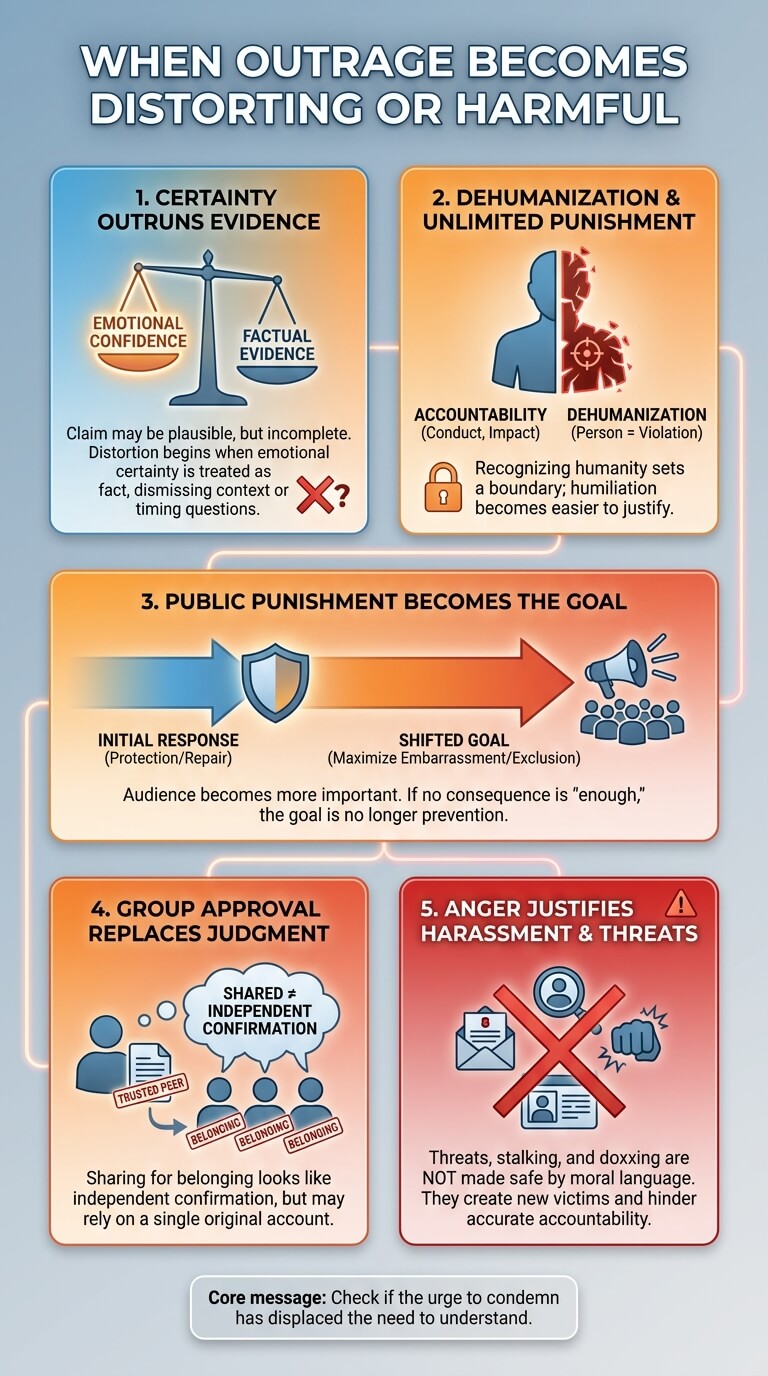
Certainty outruns available evidence
A claim may be plausible, serious, and still incomplete. Distortion begins when emotional confidence is treated as factual confidence. Questions about timing, source, context, or alternative explanations are then dismissed as moral failure.
The person is reduced to the worst interpretation
Accountability focuses on conduct, impact, responsibility, and future protection. Dehumanization treats the person as nothing more than the violation. Once this happens, humiliation and unlimited punishment become easier to justify.
Recognizing someone’s humanity does not require minimizing harm or restoring trust. It sets a boundary around what accountability is allowed to become.
Public punishment becomes the goal
A response may begin with protection and shift toward maximizing embarrassment, exclusion, or reputational damage. The audience becomes more important than the affected person. New accusations are added because the emotional momentum rewards escalation.
Ask what outcome would count as enough. If no correction, apology, boundary, loss of privilege, or formal consequence could ever be sufficient, the response may no longer be organized around prevention or repair.
Group approval replaces independent judgment
People may share a claim because trusted peers have already endorsed it. Joining the response communicates belonging and reduces the risk of being seen as indifferent. The number of condemnations can then look like independent confirmation even when everyone relied on the same original account.
Anger justifies humiliation, threats, or harassment
Threats, stalking, exposure of private information, intimidation, and coordinated harassment are not made safe by moral language. They can create new victims and make accurate accountability harder.
Research on reputation and punishment without seeking opposing perspectives suggests that reputational motives can shape punishment choices. This does not explain every punitive response, but it supports checking whether the urge to be seen condemning has displaced the need to understand.
Moral Outrage Versus Nearby Experiences
| Experience | Main focus | Typical urge | Key distinction |
|---|---|---|---|
| Ordinary anger | Blocked goal, insult, frustration, or personal wrong | Confront, correct, or resist | May not involve a wider moral standard |
| Moral outrage | Perceived violation of harm, fairness, trust, or shared norms | Condemn, protect, punish, report, or mobilize | Includes a judgment about what should be unacceptable |
| Disgust | Rejection, contamination, or profound aversion | Distance, exclude, or refuse contact | Often supports avoidance more than direct correction |
| Moral disagreement | Different judgments about the applicable value or rule | Explain, persuade, debate, or set boundaries | Does not always include intense condemnation |
| Grandstanding | Using moral talk partly to gain status or recognition | Display commitment or compete in condemnation | Concerns motive for expression, not whether the issue is real |
Moral outrage versus ordinary anger
Ordinary anger may be entirely personal. Moral outrage adds a standard that seems relevant beyond the immediate inconvenience. Someone may be angry that a friend was late, but outraged if the friend abandoned a dependent person in danger.
Moral outrage versus disgust
Anger tends to approach and confront. Disgust tends to reject and distance. They can occur together, and both can communicate condemnation. Identifying which urge is stronger helps explain whether you want correction, punishment, exclusion, or no contact.
Moral outrage versus moral disagreement
People can disagree sincerely about harm, fairness, responsibility, or proportionality. Outrage may arise when one side interprets the other’s conclusion as evidence of indifference or bad character. Before escalating, identify whether the conflict concerns facts, values, priorities, or an actual violation.
Moral outrage versus moral grandstanding
Grandstanding refers to status-seeking through moral expression. Strong language alone does not prove it. A person can speak forcefully because the harm is serious, because quieter attempts failed, or because public action is needed.
The concern arises when appearing morally committed becomes more important than helping affected people, applying consistent standards, or correcting false information.
Fairness concerns before outrage
Many outrage episodes begin with a fairness judgment: someone received an undeserved benefit, carried an unequal burden, was denied a fair process, or was treated with less dignity. Naming the fairness rule can clarify the concern before anger expands it into a judgment about the whole person.
The Outrage Response Ladder
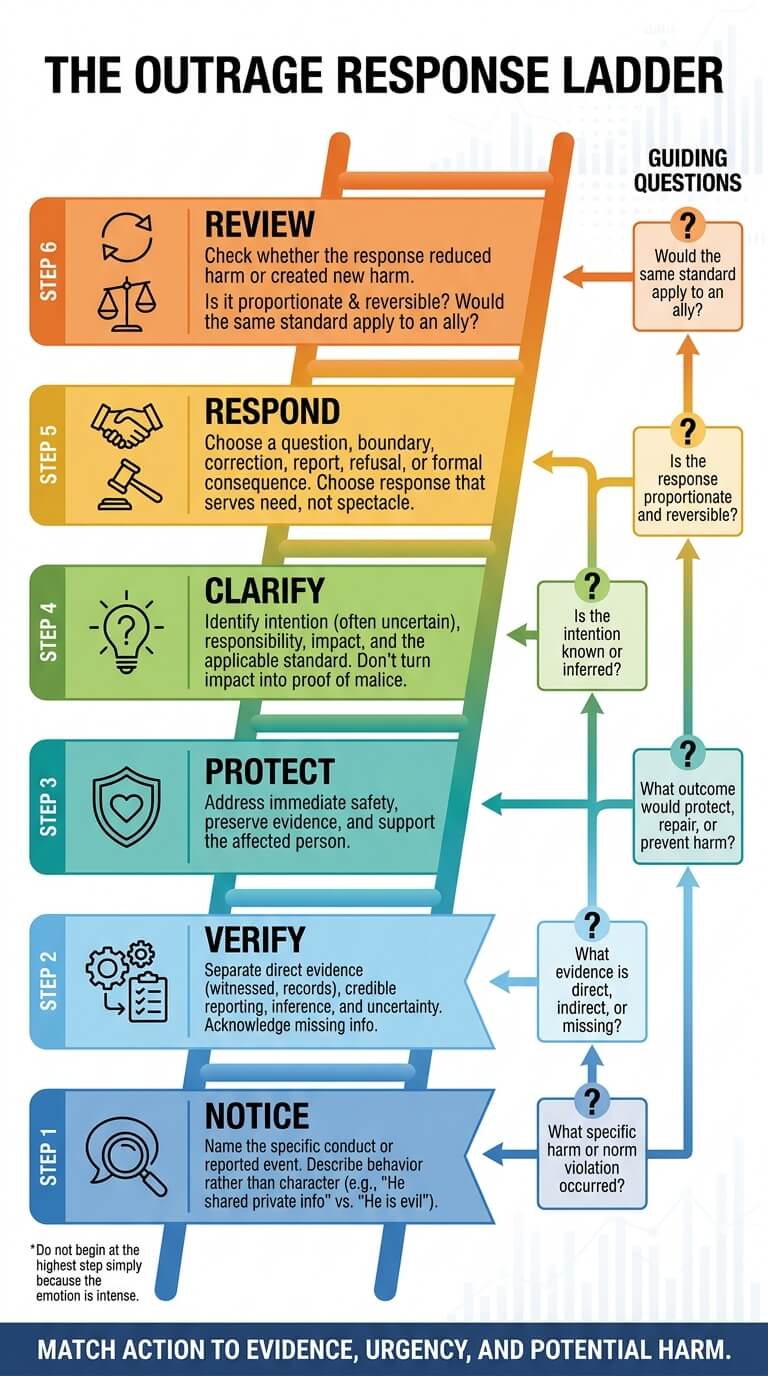
The Outrage Response Ladder helps match action to evidence, urgency, and potential harm. Do not begin at the highest step simply because the emotion is intense.
- Notice: Name the specific conduct or reported event.
- Verify: Separate direct evidence, credible reporting, inference, and uncertainty.
- Protect: Address immediate safety, preserve evidence, and support the affected person.
- Clarify: Identify intention, responsibility, impact, and the applicable standard.
- Respond: Choose a question, boundary, correction, report, refusal, or formal consequence.
- Review: Check whether the response reduced harm or created new harm.
What specific harm or norm violation occurred?
Describe behavior rather than character. “He shared private medical information after being asked not to” is clearer than “He is evil.” Specificity makes evidence, impact, and accountability easier to examine.
What evidence is direct, indirect, or missing?
Direct evidence may include what you witnessed, original records, or a first-person account. Indirect evidence includes summaries, screenshots without context, or retellings. Missing information should remain missing rather than being filled with the worst possible motive.
Is the intention known or inferred?
Intention affects judgment but is often uncertain. Ask what the person knew, what alternatives were available, and whether the result was predictable. Do not let uncertainty erase impact, but do not turn impact into proof of malice.
What outcome would protect, repair, or prevent harm?
Possible outcomes include stopping contact, correcting false information, restoring resources, changing a procedure, documenting a pattern, reporting through an appropriate channel, or supporting the person affected. Choose the response that serves the need rather than the emotional spectacle.
Is the response proportionate and reversible?
Proportionality compares the seriousness of the conduct, certainty of evidence, power differences, likelihood of recurrence, and consequences of the response. When evidence is incomplete, begin with actions that protect people while preserving the ability to correct an error.
Would the same standard apply to an ally?
Role reversal checks selective outrage. If an ally behaved the same way, would you demand the same evidence and consequence? Context may justify differences, but group membership alone is not a principled reason.
How to Pause Without Abandoning Your Values
Separate urgency from impulsivity
Urgency asks how quickly protection is needed. Impulsivity acts to relieve emotional pressure. In immediate danger, act for safety. When the event is past and the facts are disputed, a verification pause is often responsible rather than passive.
Confirm the claim before amplifying it
Look for the original statement, full recording, direct report, or independent confirmation. Check dates and whether a correction already exists. If you cannot verify the claim, use language that reflects uncertainty instead of presenting it as settled.
Move from identity labels to observable behavior
Labels compress a complicated event into a total judgment. Observable descriptions make it easier to identify what must stop, what evidence exists, and what repair is possible.
Choose boundary, report, dialogue, repair, or non-engagement
Not every violation requires public confrontation. A private boundary may fit a personal breach. A formal report may fit a repeated power-based violation. Dialogue may fit a misunderstanding. Non-engagement may fit provocation designed only to attract attention.
Reassess after emotional intensity falls
Return to the decision after sleep, new information, or a calmer conversation. Ask whether the action still seems accurate, proportionate, and useful. Revising a response is not betrayal of the original concern.
How Fairness, Group Identity, and Disagreement Shape Outrage
When outrage begins with an unfairness judgment
Unequal treatment, hidden exceptions, favoritism, and broken reciprocity often provide the moral appraisal beneath anger. Clarifying whether the issue concerns equality, equity, procedure, or respect can produce a more precise demand.
How group loyalty changes who receives condemnation
People often give allies more context and outsiders less. An ally’s conduct is explained as a mistake, while an opponent’s conduct is treated as character. Consistent moral standards require checking this difference explicitly.
Why good people can disagree about the same alleged violation
One person may prioritize the visible harm. Another may prioritize intention, process, loyalty, freedom, or the risk of false accusation. Disagreement does not prove that either person lacks values. It may reveal different facts, weights, or fears.
When Anger or Retaliation Becomes Unsafe
Outrage does not justify threats, stalking, doxxing, intimidation, violence, humiliation, or retaliation. Publicly identifying someone can create serious risk, especially when claims are unverified or when an audience is encouraged to act independently.
If you fear that someone may harm you or another person, prioritize immediate safety, local emergency support where appropriate, documentation, and qualified professional guidance. Do not rely on a direct conversation when there is coercion, credible threat, or fear of retaliation.
Frequently Asked Questions About Moral Outrage
Is moral outrage always sincere?
No single motive explains every expression. A person may sincerely care about harm, want group approval, protect their identity, gain status, or experience several motives at once. The presence of social reward does not prove the concern is false. Evaluate both the underlying issue and the behavior used to express it.
Why is online outrage often more intense than private concern?
Online expression is public, brief, measurable, and exposed to rapid social feedback. Strong language may receive more attention, while nuance can look uncertain. Group norms also teach users how much intensity is expected when reacting to a violation.
Can outrage improve accountability?
Yes. It can draw attention to ignored harm, support witnesses, motivate reporting, and communicate that a standard matters. It is most constructive when paired with evidence, proportionality, clear desired outcomes, and practical support for affected people.
Why do people excuse the same behavior from their own group?
Group loyalty changes attention and interpretation. People know more context about allies, assume better intentions, and fear helping an opposing group. A role-reversal check helps reveal whether the standard changes because of identity rather than relevant facts.
How can I speak up without joining a pile-on?
Describe the specific conduct, state what standard matters, avoid repeating unverified claims, and choose an action tied to protection or accountability. You can support the affected person, request a fair process, or set a boundary without encouraging mass humiliation.
Key Takeaways
- Moral outrage combines a judgment about wrongdoing with an emotion that pushes toward confrontation, protection, punishment, or public expression.
- Outrage can reveal ignored harm, but emotional certainty should not replace factual certainty.
- Social feedback and group norms can strengthen future outrage expression without proving that the original concern was insincere.
- Constructive responses stay connected to evidence, proportionality, consistent standards, and a clear protective outcome.
- The Outrage Response Ladder moves from noticing and verifying to protecting, clarifying, responding, and reviewing impact.
- Threats, stalking, humiliation, exposure of private information, and retaliation create new harm rather than responsible accountability.
When outrage rises, write one sentence describing the specific conduct and one sentence naming the outcome you want. If those sentences are unclear, pause before escalating. A precise concern and a useful outcome are more likely to protect people than the strongest available condemnation.
Author note: Michael Reed is the Founder and Lead Writer at Psychology Exposed. He explains human behavior, emotional patterns, self-awareness, relationships, and everyday decisions in clear, research-aware language. This material is educational and is not a substitute for mental health, legal, safety, or crisis support.

Michael Reed is the Founder and Lead Writer at Psychology Exposed. He writes about human behavior, relationships, emotional patterns, self-awareness, and practical psychology topics using research-informed, easy-to-understand content.
Read More About Michael Reed: https://psychologyexposed.com/michael-reed/