
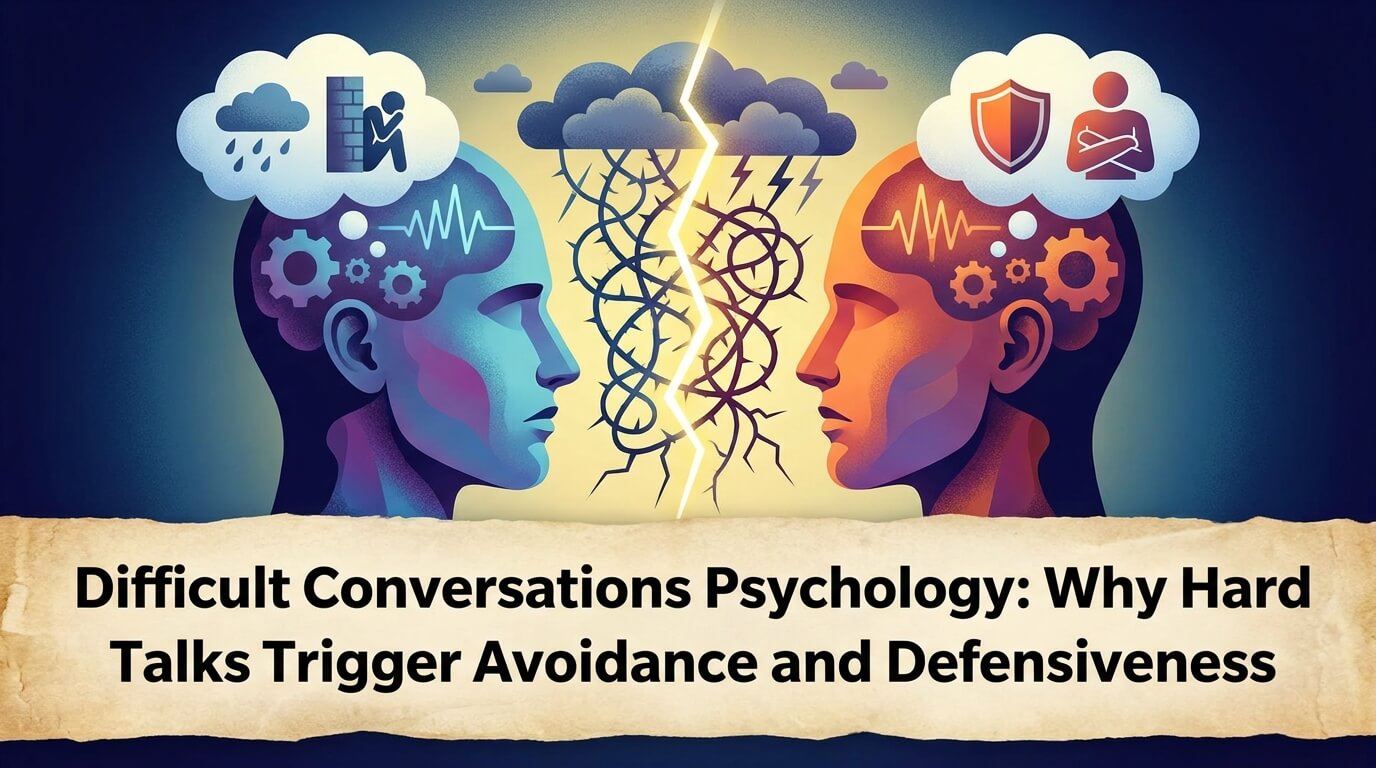
A difficult conversation rarely feels difficult because the topic is complicated on paper. It feels difficult because something important may change. You may risk disappointing someone, being misunderstood, losing status, hearing an answer you do not want, or discovering that the relationship cannot continue in the same form.
That pressure can create two opposite mistakes. You may delay the conversation until resentment grows, or enter it with so much stored emotion that the opening sounds like a verdict. In both cases, the nervous system is trying to reduce uncertainty quickly. Avoidance reduces it for the moment. Attack tries to force an outcome.
A more useful approach is to prepare for clarity rather than control. You decide what happened, what matters, what you are asking for, what you can realistically influence, and what conditions make the exchange safe enough to attempt. The goal is not a flawless conversation. It is a bounded process that can produce better information, a workable decision, or a clear next step.
Quick Answer
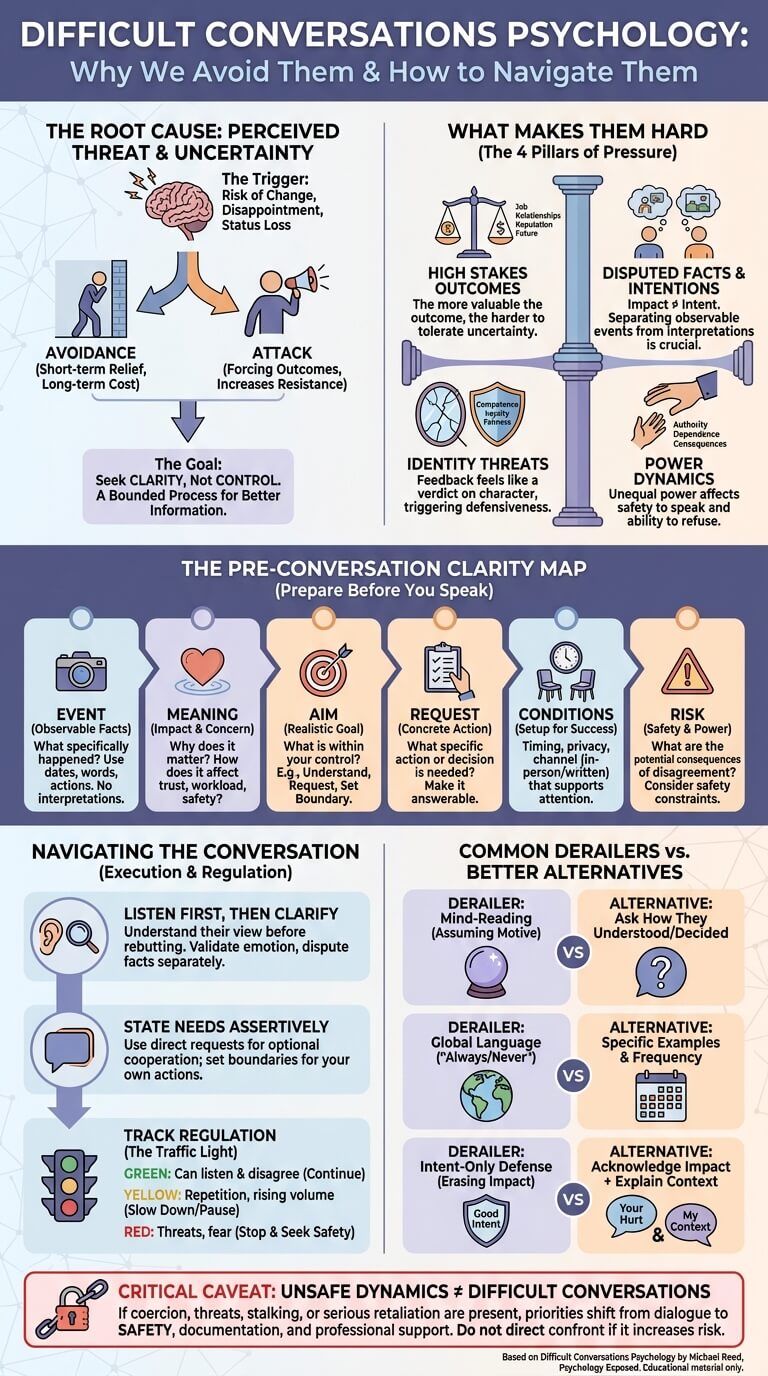
Difficult conversations feel threatening when important outcomes, identity, emotion, uncertainty, or power are involved. Preparation helps by separating observable events from interpretations, choosing one realistic purpose, and deciding whether you need clarification, a request, a boundary, a pause, or outside support. Productive dialogue requires enough safety and regulation for both people to speak, listen, disagree, and make meaningful choices.
What Makes a Conversation Difficult

The subject alone does not determine difficulty. A routine scheduling question can feel high-stakes when it touches loyalty or job security, while a serious topic may feel manageable when expectations and trust are clear.
The relationship or outcome matters
Hard conversations often involve something you value: continued employment, a friendship, family harmony, privacy, money, caregiving, reputation, or a shared future. The more important the outcome feels, the harder it becomes to tolerate uncertainty about how the other person will respond.
This is why people sometimes overprepare every sentence. They hope perfect wording will remove the risk. Wording matters, but it cannot guarantee understanding, agreement, or a particular decision.
Hard talks bring together many parts of communication psychology, including threat, interpretation, tone, listening, and response.
The facts or intentions are disputed
Two people may agree that an event occurred and disagree about what it meant. One sees a delayed reply as ordinary distraction. The other sees it as disregard. One sees direct feedback as necessary. The other experiences it as public embarrassment.
A conversation becomes harder when facts, impact, intention, and motive are treated as one question. They need to be separated. You can acknowledge impact without admitting an intention you did not have, and you can correct a fact without dismissing the emotional effect.
Identity, competence, loyalty, fairness, or belonging feels at risk
Feedback may sound larger than the behavior being discussed. “The report needs changes” can be heard as “You are not capable.” “I need more space” can be heard as “You are not lovable.” “We need to revisit the agreement” can be heard as “You cannot be trusted.”
The Harvard Program on Negotiation’s overview of the three layers of difficult conversations highlights the interaction among what happened, feelings, and identity. Recognizing the identity layer helps explain why a narrow issue can produce a large reaction.
Power affects who can speak and what consequences may follow
A conversation with a friend is not the same as a conversation with a manager who controls scheduling, a relative who controls housing, or a partner who controls access to money. Power influences whether refusal is safe, whether documentation matters, and whether the person can leave without punishment.
Advice that assumes equal freedom can be harmful. Before choosing direct confrontation, consider what the other person can realistically do in response and what protections are available.
Why People Avoid Hard Conversations
Avoidance is understandable because it works in one narrow sense: it reduces immediate discomfort. The problem is that relief can train continued delay while the unresolved issue keeps affecting decisions and trust.
Immediate relief reinforces delay
The APA Dictionary of Psychology describes an avoidance response as an attempt to prevent contact with an anticipated aversive event. In daily communication, postponing a feared discussion can bring quick relief, which makes postponement more likely the next time.
Delay is not always avoidance. Waiting can be wise when you need accurate information, privacy, regulation, or advice. The distinction is whether the waiting period has a purpose and a return point.
Uncertainty invites catastrophic prediction
When you do not know what will happen, the mind often fills the gap with the most threatening possibility. “They will be disappointed” becomes “They will end the relationship.” “My manager may disagree” becomes “I will lose my job.”
Preparation should identify these predictions without treating them as facts. Ask what outcome is possible, what outcome is probable, and what you would do if the difficult outcome occurred.
Past conflict creates an expectation of escalation
If earlier discussions involved shouting, mockery, endless circular argument, or unexplained withdrawal, the body may prepare for the same sequence. Even a neutral opening can feel dangerous because it resembles the beginning of an old experience.
This expectation should not be dismissed as irrational. It is information about history. The next conversation may need clearer limits, a different setting, a third party, or a decision not to conduct it privately.
The person lacks a clear request or boundary
Sometimes avoidance continues because the issue is emotionally vivid but practically undefined. You know you are unhappy, yet you do not know whether you want an explanation, an apology, a changed behavior, a decision, or a limit.
A conversation is easier to begin when you can complete one sentence: “By the end, I need us to understand, decide, request, or document…”
Research on why professionals avoid difficult conversations has identified concerns such as negative consequences, dislike of confrontation, lack of confidence, limited time, and contextual barriers. Although that study concerned healthcare workplaces, the findings illustrate why delay is often shaped by both personal fear and the surrounding environment.
Why Difficult Conversations Escalate

Escalation usually has more than one cause. The opening may feel accusatory, the receiver may become defensive, and the speaker may intensify because the concern does not seem to register.
Escalation often accelerates when defensive communication replaces curiosity with self-protection.
The opening sounds like a verdict
“You are selfish and impossible to rely on” gives the other person an identity to defend. “The last two pickup times changed without notice, and I was left waiting” gives them an event to examine.
A clear opening does not need to be soft to the point of vagueness. It needs to make the topic visible without announcing that the other person’s character has already been decided.
Too many issues are introduced at once
Stored resentment creates a temptation to discuss every example. The receiver then faces a case file rather than one solvable issue. They may challenge the weakest example and avoid the central concern.
Choose the issue that requires action now. Mention a repeated pattern only when frequency changes the decision, and use a small number of examples.
Tone communicates threat before content is processed
Pace, volume, pauses, and vocal tension affect how the message is interpreted. A formally polite sentence can still sound contemptuous or menacing. A nervous speaker may also sound sharper than intended because they are rushing to finish.
Slow the first two sentences. A slower start gives both people more time to process the topic before the exchange gathers momentum.
Defensiveness blocks accurate reception
The receiver may deny, explain intention, counterattack, or shift to the speaker’s past behavior before understanding the current claim. The speaker then repeats the concern more forcefully, which confirms the receiver’s sense of attack.
Interrupt this loop by summarizing the specific concern before rebutting it. Accurate reception does not mean agreement.
No pause or return plan exists when regulation drops
People often continue because stopping feels like losing or abandoning the issue. Yet once attention narrows and respectful speech becomes difficult, more discussion may produce more damage rather than more clarity.
A planned pause protects the exchange: name why you are stopping, specify when you will return, and communicate if that timing must change.
The Pre-Conversation Clarity Map

Before the conversation, write one or two sentences for each part of this map: Event, Meaning, Aim, Request, Conditions, and Risk. The purpose is not to create a speech. It is to reduce confusion about what you are doing and what remains outside your control.
Event: what happened that can be described specifically
Use observable details, dates, words, decisions, or repeated actions. Replace “You do not value my time” with “The meeting was moved twice after I confirmed availability, and I was not consulted.”
Specificity allows correction. If your memory is incomplete, say so rather than building certainty around an assumption.
Meaning: what impact or concern needs to be discussed
Explain why the event matters. It may affect trust, workload, privacy, emotional safety, finances, or the ability to plan. Meaning gives the topic importance without turning it into a character judgment.
Aim: what realistic outcome is within your control
Choose an aim such as understanding a decision, communicating impact, making a request, setting a boundary, or deciding whether further discussion is useful. “Make them understand and apologize” is not fully within your control.
A workable aim might be: “State what happened, ask how they understood it, and decide what I will do if the process does not change.”
Request: what action, answer, or decision is needed
Requests should be concrete enough to answer. “Please tell me by Thursday whether you can take the shift” is easier to respond to than “Show more commitment.”
If the issue concerns your own participation rather than their voluntary cooperation, state a boundary: “If schedules continue changing without notice, I will stop accepting this assignment.”
Conditions: what timing, setting, and channel support attention
Consider privacy, time pressure, fatigue, audience, access needs, and whether written communication would reduce ambiguity. A sensitive work issue may need a scheduled meeting rather than a hallway confrontation. A complex family decision may need more than a late-night phone call.
Risk: what safety or power constraints must be considered
Ask what could happen if the person disagrees. Ordinary disappointment is different from threats, stalking, financial punishment, forced isolation, or retaliation at work. Risk may change who should be present, what should be documented, or whether direct conversation is appropriate.
How to Open Without Starting With an Attack
The opening should make the topic, purpose, and first question understandable. It does not need to present your entire case.
A clear opening often depends on assertive communication rather than hints, accusations, or forced agreement.
Name the topic and purpose
Try: “I want to discuss how weekend coverage is being assigned so we can agree on a process,” or “I need to talk about what happened after the party and decide what we do next.”
A purpose reduces uncertainty. It tells the other person whether you are seeking understanding, action, or a decision.
Separate observation from character judgment
Describe behavior before interpretation. “You shared the information with the group before asking me” is easier to examine than “You cannot be trusted.” You may still need to discuss trust, but begin with the event that changed it.
Use a manageable first question
A narrow question gives the other person somewhere to enter: “What did you understand the deadline to be?” “How did you decide to make that change?” “Can you tell me what you heard when I said I needed space?”
Avoid questions that are accusations in disguise, such as “Why do you always disrespect me?”
State that understanding and action may be separate steps
High-stakes issues may not be resolved in one sitting. Say, “I want us to understand the problem today. We may need time before deciding the final plan.” This lowers pressure to produce premature agreement.
What to Do During the Conversation
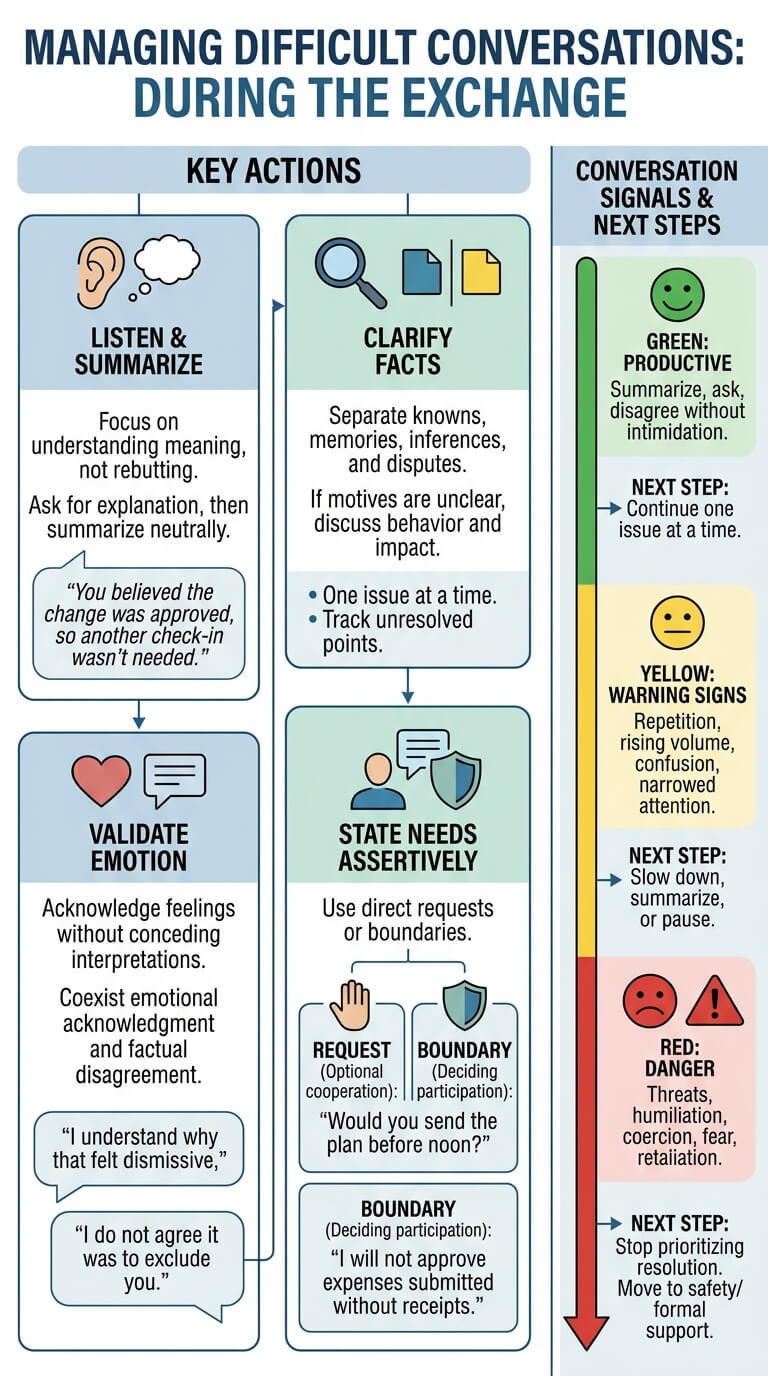
During the exchange, your task is to keep the issue specific, receive new information, and monitor whether both people still have enough regulation and choice to participate.
Listen for the other person’s meaning before rebutting
Ask them to explain their view, then summarize it in neutral language. “You believed the change had already been approved, so you did not think another check-in was needed.”
During the exchange, active listening helps each person check meaning before preparing a response.
Conflict guidance in an open-access review on managing difficult conversations emphasizes self-awareness, listening, and choosing responses rather than relying on avoidance or reflexive competition.
Clarify facts and assumptions one issue at a time
Separate what is known, remembered, inferred, and disputed. If a motive cannot be verified, discuss the behavior and impact instead. Keep a list of unresolved points rather than forcing each one into the current minute.
Emotional validation can recognize impact without settling every disputed fact.
Validate emotion without conceding every interpretation
You can say, “I understand why the lack of notice felt dismissive,” while adding, “I do not agree that it was done to exclude you.” Emotional acknowledgment and factual disagreement can coexist.
State needs and boundaries assertively
Use a direct request when cooperation is optional and a boundary when you are deciding your own participation. “Would you send the plan before noon?” is a request. “I will not approve expenses submitted without receipts” is a boundary.
Track whether the conversation is still productive
| Signal | What it looks like | Next step |
|---|---|---|
| Green | Both people can summarize, ask questions, and disagree without intimidation | Continue one issue at a time |
| Yellow | Repetition, rising volume, narrowed attention, or confused claims | Slow down, summarize, or schedule a pause |
| Red | Threats, humiliation, coercion, stalking concerns, or fear of retaliation | Stop prioritizing resolution and move toward safety or formal support |
Pausing Without Stonewalling or Disappearing
A pause is useful when it protects attention and respectful participation. It becomes harmful when it is used to punish, control, or avoid any return.
Name the reason for the pause
Say what is happening without blaming: “I am too activated to listen accurately,” or “We are repeating the same points and becoming less respectful.”
Set a realistic return time
Choose a time you can keep: “Let us return at 7:30,” or “I will email tomorrow morning to schedule a meeting this week.” A vague “later” leaves the other person in uncertainty.
Decide what each person should reflect on
A pause should reduce confusion, not provide time to collect more accusations. Identify one task, such as checking the timeline, clarifying the requested outcome, or deciding what boundary is realistic.
Return as promised or communicate a revised plan
If circumstances change, send an update before the return time. Reliability is part of the pause. Without it, the pause can resemble abandonment or strategic silence.
Common Derailers and Better Alternatives
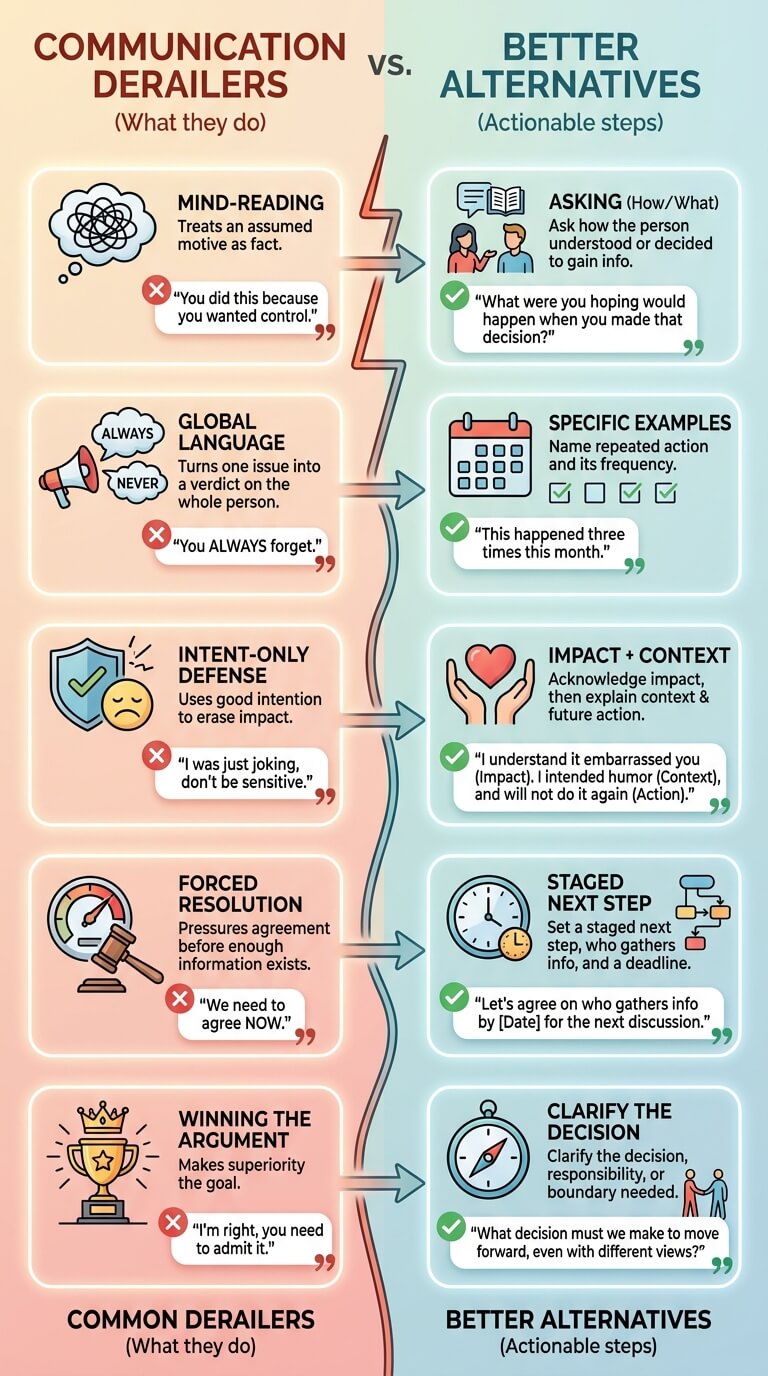
| Derailer | What it does | Better alternative |
|---|---|---|
| Mind-reading | Treats an assumed motive as fact | Ask how the person understood or decided |
| Global language | Turns one issue into a verdict on the whole person | Use specific examples and frequency |
| Intent-only defense | Uses good intention to erase impact | Acknowledge impact, then explain context |
| Forced resolution | Pressures agreement before enough information exists | Set a staged next step and deadline |
| Winning the argument | Makes superiority the goal | Clarify the decision, responsibility, or boundary |
Mind-reading versus asking
Replace “You did this because you wanted control” with “What were you hoping would happen when you made that decision?” The answer may not be satisfying, but it gives you information instead of an untestable accusation.
Global language versus specific examples
Words such as “always” and “never” invite a search for exceptions. Name the repeated action and its frequency instead: “This happened three times this month.”
Intent-only defense versus impact plus context
A better sequence is: “I understand the comment embarrassed you. I intended humor, not humiliation, and I will not make that joke again.” Impact, intention, and future action each receive a place.
Forced resolution versus a staged next step
Some decisions require records, advice, or time. Agree on what happens next: who will gather information, when the next discussion occurs, and what remains unresolved.
Winning the argument versus clarifying the decision
The Harvard Program on Negotiation’s discussion of conflict resolution strategies stresses understanding perceptions, managing emotion, and looking beneath positions rather than treating correction of the other person as the main route forward.
Ask what decision must be made even if the two accounts never become identical.
Difficult Conversations With a Power Imbalance
Power differences do not automatically make a conversation unsafe, but they affect available choices and possible consequences.
Workplace authority, financial dependence, family hierarchy, or social consequences
A person may risk reduced hours, housing instability, withdrawal of financial support, family exclusion, or reputational damage. These consequences can make apparent agreement less voluntary than it looks.
Documentation, witnesses, formal channels, or professional advice
Workplace and institutional issues may require written summaries, a representative, human resources, a union, an ombuds office, or legal advice. A family or caregiving dispute may benefit from mediation when participation is voluntary and safe.
Why direct confrontation is not always the safest first step
If the person has threatened, stalked, monitored, isolated, or retaliated against you, a private confrontation may increase risk. The National Domestic Violence Hotline offers a personalized safety planning resource for people experiencing abuse or preparing for change.
You do not owe direct dialogue to someone who uses fear or coercion to remove your choice.
What to Do After the Conversation
The end of the meeting is not the end of the process. Clarity becomes useful through accurate summaries, follow-through, and decisions about whether another exchange is worth attempting.
After the talk, repair attempts in communication may be needed if the process itself caused new harm.
Summarize agreements and unresolved points
State what each person agreed to, what remains disputed, and what information is still needed. Written confirmation is especially useful when responsibilities, money, deadlines, or formal consequences are involved.
Identify follow-through and timing
Assign the action, owner, and time. “We will communicate better” is not a follow-through plan. “I will send the revised schedule by Wednesday, and you will confirm by Thursday” is.
Use repair when harm or misunderstanding occurred
If someone interrupted, insulted, minimized, or misunderstood, address that rupture directly. A useful repair names the behavior, acknowledges its effect, and changes what happens next.
Reassess whether another conversation is useful
Another discussion may help when new information exists or both people can return with greater clarity. Repeating the same exchange is less useful when one person refuses every factual process, repeatedly violates boundaries, or uses conversation to intimidate.
Difficult Conversation vs Unsafe Dynamic
Discomfort is normal in a hard conversation. Fear of retaliation, coercion, or loss of basic freedom is a different category.
Ordinary discomfort allows meaningful choice and repair
Both people may feel upset, but they can disagree, pause, leave, seek advice, and return without being threatened. Mistakes can be named, and boundaries are not punished through intimidation.
Coercion, threats, humiliation, stalking, or retaliation change the goal
When one person uses fear to control the other, the goal should shift from mutual understanding to protection, documentation, confidential advice, or emergency support. Communication skill cannot make coercion collaborative.
A First-Step Decision Guide
The right first move depends on the problem you are actually facing.
Clarify when the issue is confusion
Ask a narrow question and compare what each person understood. Do not begin with a demand for apology when the basic facts are still unclear.
Request when the need is specific
Ask for one observable action, answer, or decision. Leave room for a genuine response and decide what you will do if the answer is no.
Set a boundary when your action must change
State the condition and your own next step: “If the payment remains overdue, I will pause further work.” A boundary is not a threat to punish disagreement.
Pause when regulation is too low
Use a time-limited pause with a return plan when either person can no longer listen or speak without escalation.
Seek support when power or safety makes direct conversation risky
Use a trusted person, advocate, formal channel, professional adviser, or emergency resource appropriate to the situation. Safety is not a communication failure.
How Other Communication Skills Fit Into Hard Talks
A difficult conversation draws on several skills, but none of them replaces the whole process.
Assertiveness helps shape the message
It helps you state observations, needs, requests, and limits without hiding the point or trying to force compliance.
Understanding defensiveness helps manage threat responses
It helps both people notice denial, counterattack, overexplaining, or shutdown before self-protection replaces the topic.
Validation supports emotional reception
It acknowledges the emotional experience without automatically endorsing every interpretation or action.
Repair addresses what happens after impact
It becomes relevant when words land badly, trust is damaged, or the conversation needs a credible path back to cooperation.
FAQ About Difficult Conversations
These questions address timing, preparation, defensiveness, and the limits of direct dialogue.
How do you know when to have a difficult conversation?
Consider a conversation when the issue affects decisions, trust, boundaries, safety, workload, or repeated behavior and cannot be resolved through simple information. Do not raise every irritation. Ask whether silence is likely to create continuing cost and whether a specific outcome can be named.
What is the best time to raise a sensitive issue?
Choose a time with privacy, enough attention, and no immediate deadline when possible. Avoid surprising someone in public or beginning when either person is exhausted or intoxicated. Urgent safety or operational issues may require immediate action, but that action does not always need to be a full conversation.
Should you prepare exact words in advance?
Prepare the opening, the central request, and the boundary rather than memorizing a speech. Exact scripts can make it harder to listen when the other person says something unexpected. Notes are useful when the issue is formal, emotionally charged, or easy to confuse.
What if the other person becomes defensive or shuts down?
Return to one specific behavior and ask them to summarize the concern before responding. If regulation drops, propose a pause with a return time. If shutdown is used repeatedly to prevent any discussion, you may need a boundary, formal process, or decision that does not depend on their participation.
When is it better not to have the conversation alone?
Do not meet alone when you reasonably fear threats, stalking, violence, serious retaliation, or coercion. Support may also be appropriate when there is a major workplace or legal power imbalance, a need for documentation, or a history of severe escalation.
Key Takeaways
- Difficult conversations feel threatening because important outcomes, identity, uncertainty, emotion, or power are involved.
- Avoidance brings short-term relief but may allow resentment, confusion, and practical consequences to grow.
- The Pre-Conversation Clarity Map separates the event, meaning, aim, request, conditions, and risk.
- A productive opening names one topic and purpose without turning the concern into a character verdict.
- Pauses work best when they include a reason, a return time, and reliable follow-through.
- Threats, coercion, stalking, humiliation, and retaliation require safety-focused support rather than better conversation technique.
Before your next hard conversation, write the six parts of the clarity map in plain language. Then choose only the first step you need: clarify, request, set a boundary, pause, or seek support. A difficult conversation becomes more manageable when you stop trying to control every response and prepare to act on the information you actually receive.
Author note: Michael Reed is the Founder and Lead Writer at Psychology Exposed. He explains human behavior, relationships, emotional patterns, self-awareness, and everyday decisions in clear, research-aware language. This material is educational and is not a substitute for individualized mental health, workplace, legal, organizational, or safety advice.

Michael Reed is the Founder and Lead Writer at Psychology Exposed. He writes about human behavior, relationships, emotional patterns, self-awareness, and practical psychology topics using research-informed, easy-to-understand content.
Read More About Michael Reed: https://psychologyexposed.com/michael-reed/