

You can choose your words carefully and still be misunderstood. A short reply may sound efficient to you but cold to someone else. A helpful suggestion may be heard as criticism because of timing, relationship history, or what the listener expects next.
Communication psychology looks at what happens between a message being formed and a meaning being received. It includes words, tone, attention, emotion, context, memory, power, and the response after impact becomes visible. This explains why good intentions are not enough and why listening matters as much as speaking.
The aim is not perfect calm or total agreement. People can understand each other and still want different things. The goal is to identify where meaning changed and what would make the next exchange clearer.
Quick Answer

Communication is the co-creation of meaning, not the simple transfer of words
Communication psychology examines how people express, receive, interpret, and respond to messages. Meaning is shaped jointly by the speaker, the listener, the situation, and their shared history. Misunderstandings often arise when intention, wording, tone, attention, or interpretation do not align. Better communication begins by locating that gap rather than assuming one person simply failed.
What Communication Psychology Studies
The National Communication Association describes communication as the use of messages to generate meaning across different contexts. That wording matters because people do not merely move information from one mind to another. They select what to say, package it in a particular form, and interpret the response through their own expectations.
The message a person intends to send
Intention is the private purpose behind a message. A person may want to inform, request, reassure, protect a boundary, correct a mistake, gain support, or reduce uncertainty. The listener cannot directly observe that purpose. They only receive the words, delivery, timing, and surrounding behavior.
The meaning another person actually receives
Received meaning is the listener’s best interpretation of the available cues. They may hear a request, criticism, joke, warning, dismissal, invitation, or demand. Their interpretation can be accurate, partly accurate, or shaped by missing information.
The APA Dictionary of Psychology defines communication as transmitting information through verbal or nonverbal means for interpersonal and social purposes. In life, however, receiving information does not guarantee receiving the intended significance. “Can we talk later?” may convey simple scheduling to one person and impending rejection to another.
How language, tone, attention, emotion, context, and history shape the gap
Words carry conventional meanings, but conversations add layers. Tone can imply warmth, impatience, uncertainty, or contempt. Attention affects how much of the message is processed. Emotion changes which details stand out. Context explains why a sentence matters now. Relationship history provides a prediction about what similar sentences have meant before.
Why Communication Matters in Everyday Life
Coordination, trust, belonging, and influence
Communication helps people coordinate practical life: who will do what, when something will happen, what changed, and what support is needed. It also carries relational information. A response may tell someone whether their concern matters, whether disagreement is safe, and whether promises are likely to be followed by action.
Why ordinary conversations can trigger threat or self-protection
A conversation does not need to involve danger for the body to react defensively. Feedback may raise fears about competence. A delayed reply may stir uncertainty about closeness. A request may sound like loss of freedom. A correction may awaken shame, especially when it happens publicly.
How culture, roles, power, and prior experience change interpretation
Communication rules vary across families, workplaces, communities, and cultures. Directness may signal honesty in one setting and disrespect in another. Silence, eye contact, interruption, humor, and emotional expression also carry different social meanings.
Power changes what a message costs. A manager’s “suggestion” may feel compulsory, and someone who depends on another person for housing, money, care, or opportunity may not feel free to disagree. Clarity requires attention to both the message and the conditions surrounding it.
The Communication Meaning Map
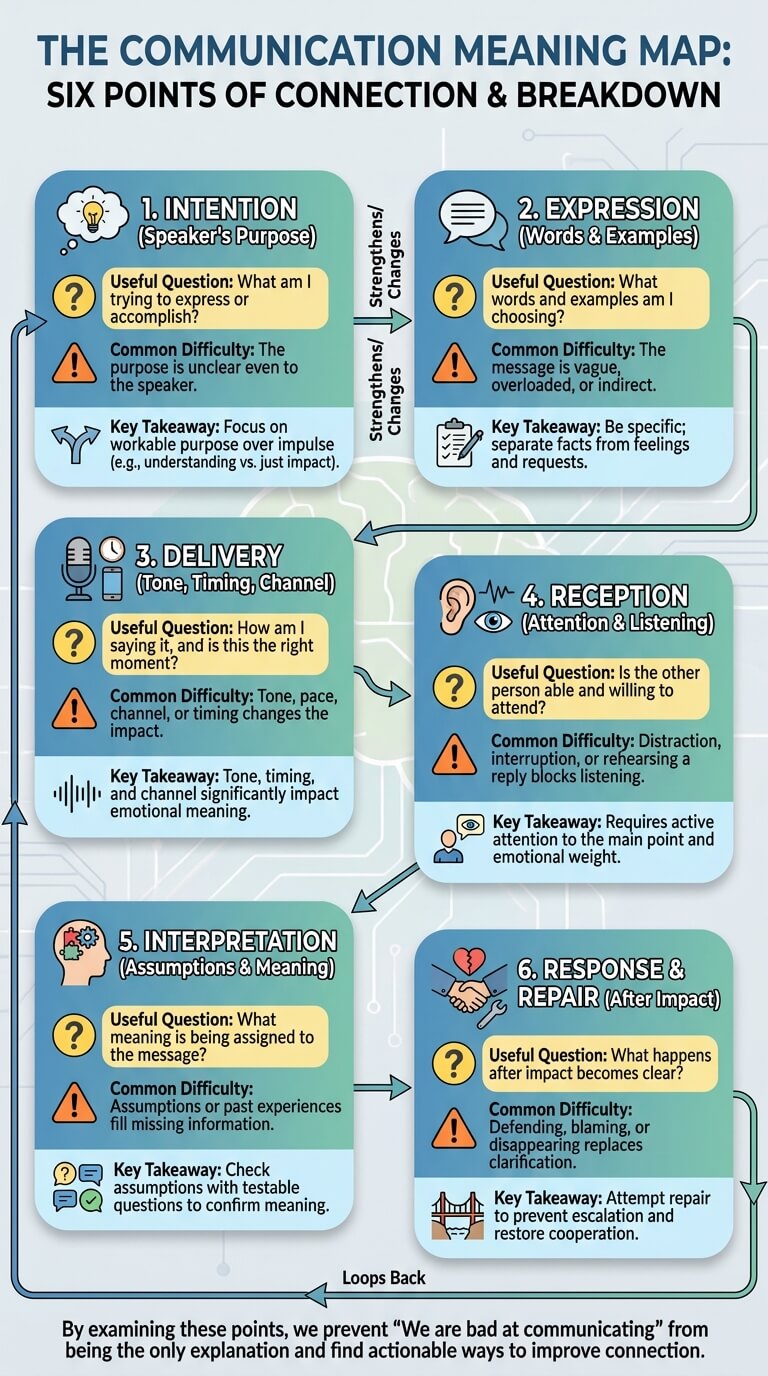
Examine six points where meaning can strengthen, change, or break down. Separating them prevents “We are bad at communicating” from becoming the only explanation.
| Part of the exchange | Useful question | Common difficulty |
|---|---|---|
| Intention | What am I trying to express or accomplish? | The purpose is unclear even to the speaker. |
| Expression | What words and examples am I choosing? | The message is vague, overloaded, or indirect. |
| Delivery | How am I saying it, and is this the right moment? | Tone, pace, channel, or timing changes the impact. |
| Reception | Is the other person able and willing to attend? | Distraction, interruption, or rehearsing a reply blocks listening. |
| Interpretation | What meaning is being assigned to the message? | Assumptions or past experiences fill missing information. |
| Response and repair | What happens after impact becomes clear? | Defending, blaming, or disappearing replaces clarification. |
Intention: what the speaker wants to express
Distinguish purpose from impulse. “I want them to feel as bad as I do” seeks impact. “I want them to understand what happened and agree on a different plan” gives the message a workable direction without trying to control their feelings.
Expression: the words and examples chosen
Expression turns a private intention into observable language. Specific descriptions usually travel better than global judgments. “The report arrived after the deadline twice this month” gives the listener something concrete to address. “You are never reliable” asks them to defend their whole character.
Clear expression separates facts, interpretations, feelings, and requests: “The meeting started before I received the updated time. I assumed my input was no longer needed, and I felt excluded. Next time, please confirm the change with me directly.”
Delivery: tone, pace, emphasis, timing, and channel
Delivery adds emotional meaning. A fast pace may convey urgency or anxiety. Long pauses may suggest care, hesitation, anger, or uncertainty. High volume may make a reasonable request feel unsafe. A sensitive topic sent by text may lose the vocal cues that would have shown warmth or uncertainty.
Reception: attention, listening, and memory
Reception begins before agreement. A listener needs enough attention to notice the main point, the emotional weight, and any request. The APA description of communication skills includes listening and reading with comprehension, expressing thoughts clearly, recognizing different perspectives, and anticipating how a message may affect others.
Interpretation: assumptions, emotion, and context
A useful check is to replace certainty with a testable question. Instead of “You clearly do not care,” try “When you looked at your phone while I was speaking, I read that as disinterest. Is that what was happening?” This does not deny the impact. It gives the other person a chance to confirm, correct, or add context.
Response and repair: what happens after impact appears
Repair begins when someone notices that the conversation has gone off course and tries to restore enough cooperation to continue. The Gottman Institute’s explanation of repair attempts focuses on statements or actions that prevent negativity from escalating. Although much of that work concerns couples, the underlying idea also applies to family, friendship, and teamwork: a correction matters most when the other person can recognize and accept it.
Why Miscommunication Happens

Ambiguity, assumptions, missing context, emotional load, and unclear needs
Miscommunication occurs when intended meaning and received meaning do not match. The speaker may use an ambiguous phrase, assume shared knowledge, or leave the actual request unstated. The listener may miss a detail, interpret through a recent hurt, or treat a prediction as a fact. Text-based exchanges add another difficulty because timing, emphasis, facial expression, and immediate clarification may be absent.
To examine the point where a message changes between speaker and listener, see why miscommunication happens.
Emotion can widen the gap. A person expecting criticism may hear a neutral question as an accusation, while someone who feels ignored may compress several requests into one frustrated statement. Locate the missing piece: wording, tone, assumed context, incomplete listening, or genuine disagreement.
Was the problem wording, interpretation, or missing information?
Try asking each person to state the message in one sentence. Then compare the sentences. If they differ, clarification is needed. If they match but the desired outcomes differ, the issue is disagreement or negotiation rather than misunderstanding.
Active Listening and the Psychology of Feeling Understood

Attention, reflection, clarification, and emotional safety
Active listening is not silent waiting. It is the process of receiving a message, checking its meaning, and showing the speaker what was understood before adding a competing perspective. Useful listening may include a short paraphrase, one clarifying question, and a check about what the speaker wants next: attention, advice, action, reassurance, or debate.
Feeling understood can reduce the pressure to repeat or intensify. An open-access review on responsiveness and relationship quality discusses responsiveness as important in close bonds. Listening does not require agreement, but it should make the other person’s meaning more visible.
Did the listener receive the meaning before responding?
A simple test is whether the listener can summarize the speaker’s point in language the speaker recognizes. If the summary sounds exaggerated, dismissive, or incomplete, the conversation is not ready for rebuttal.
How Tone of Voice Changes Meaning
Pace, pitch, volume, pauses, emphasis, and word-tone mismatch
Tone of voice carries information about urgency, confidence, warmth, irritation, hesitation, and social position. The words “Take your time” may sound supportive, sarcastic, impatient, or defeated depending on emphasis and pace. A mismatch between friendly words and a cutting tone often makes listeners trust delivery more than the literal sentence.
Tone should not be treated as mind reading. A flat voice may reflect fatigue, concentration, cultural style, neurodivergence, stress, or limited emotional expression rather than hostility. The responsible response is to name the cue and ask about it: “Your voice sounds tense to me. Are you upset with this plan, or is something else going on?”
Did delivery change the emotional meaning?
Repeat the same sentence with a neutral pace and lower intensity. If the meaning changes dramatically, delivery is part of the problem. If the conflict remains, the underlying request or disagreement needs attention.
Communication Styles as Repeating Patterns

Passive, aggressive, passive-aggressive, and assertive patterns
Communication styles describe recurring ways people express needs and disagreement. Passive communication hides preferences, aggressive communication relies on pressure, passive-aggressive communication expresses resistance indirectly, and assertive communication states needs directly while respecting another person’s choices.
Most people do not use one style in every situation. Someone may be direct with friends, passive around authority, and aggressive when they feel cornered. Style becomes useful as a description of behavior under certain conditions, not a permanent label for identity.
Which pattern appears under pressure?
Notice what happens when the answer may be no. Do you disappear, hint, push, punish indirectly, or make a clear request? Pressure reveals the habits that calm conversations may hide.
Recurring passive, aggressive, passive-aggressive, and assertive patterns are compared in the guide to communication styles.
Assertiveness, Clarity, and Respect
Direct needs, boundaries, requests, and mutual respect
Assertiveness makes a message visible without making compliance the price of peace. It often includes a specific observation, a personal position, a clear request, and the consequence of one’s own choices. “I cannot discuss this while we are shouting. I am going to pause and can return at seven” is different from “You need to calm down right now.”
A practical method for stating needs and limits clearly appears in the guide to assertive communication.
A boundary describes what you will do to protect time, safety, energy, privacy, or dignity. A request asks another person to act. A demand removes meaningful choice through threat or punishment. Clear communication becomes stronger when these are not disguised as one another.
Can the message be clearer without becoming controlling?
Replace character judgments with observable behavior and replace vague pressure with a specific request. Then ask whether the other person is allowed to disagree, negotiate, or decline.
Defensive Communication and Self-Protection
Identity threat, shame, fairness concerns, counterattack, denial, and shutdown
Defensiveness often appears when feedback feels like a verdict on character. A person may explain intention before hearing impact, search for the other person’s faults, reject every detail because one detail is inaccurate, or shut down to escape shame. These reactions can protect self-image in the moment while blocking accountability and useful context.
The self-protective side of feedback is examined in defensive communication.
Not every explanation is defensive. Additional information can correct a false assumption. The difference is whether the explanation makes room for the concern. “That was not my intention, and I can see why the joke embarrassed you” holds two realities. “You are too sensitive, and everyone else laughed” makes the listener’s experience the problem.
Is protection blocking understanding or accountability?
Before answering criticism, identify one part you can accurately acknowledge. You can disagree with the overall conclusion while still addressing a specific impact, missed task, or hurtful phrase.
Emotional Validation Without Automatic Agreement
Recognizing emotional experience while keeping room for different interpretations
Emotional validation communicates that a feeling makes sense in light of what the person perceived or experienced. It does not require agreeing with every fact, prediction, or accusation attached to that feeling. “I understand why that delay worried you” is not the same as “Your fear proves I was doing something wrong.”
Validation is most useful when emotion is blocking the exchange of information. Naming the understandable part can reduce the need to prove the feeling’s legitimacy. After that, both people can examine interpretation and next steps. Premature reassurance, advice, or correction often fails because it answers the problem before the emotional meaning has been received.
Does the person need agreement, understanding, or acknowledgment?
Ask directly: “Would it help most if I listen, explain what happened, or help decide what to do?” The answer prevents well-meant problem solving from becoming another experience of dismissal.
Why Difficult Conversations Feel Threatening
Stakes, uncertainty, timing, power, emotional load, and avoidance
A difficult conversation carries a meaningful risk. The topic may affect belonging, employment, money, trust, family stability, reputation, or future plans. Uncertainty adds strain because no one knows whether the discussion will bring relief, rejection, escalation, or no change at all.
Preparation, timing, and emotional load become especially important in difficult conversations.
Preparation should clarify the purpose, the observable facts, and the minimum next step. It should also account for power. An employee raising a concern with a supervisor faces different consequences than two friends discussing a canceled plan. When someone expects punishment for honesty, “just communicate openly” is not adequate advice.
What makes this conversation feel risky?
Name the actual stake. Is it fear of conflict, fear of losing the relationship, concern about practical consequences, or uncertainty about your own position? Different risks require different preparation.
Repair Attempts After a Communication Rupture
Softening, clarification, responsibility, pauses, apologies, and concrete correction
Repair is what people do after a conversation becomes hurtful, confusing, or unproductive. A repair attempt may be small: lowering the pace, acknowledging that a phrase came out harshly, asking to restart, accepting a fair point, or proposing a timed pause. Larger ruptures may require a specific apology, corrected information, restored privacy, or changed behavior.
When an exchange has already gone off course, repair attempts in communication can help restore enough cooperation to continue.
The clearest repair contains evidence. “I am sorry you felt that way” avoids responsibility. “I interrupted you three times and then left before you could answer. I will listen now, and tomorrow I will send the correction to the team” names behavior and follow-through. Acceptance matters too. A repair cannot work if every attempt is mocked, ignored, or used as an opportunity for another attack.
What would help both people re-enter the conversation?
Choose the smallest action that restores enough cooperation for the next step. That may be a calmer restatement, a factual correction, a break with a return time, or acknowledgment of harm before discussing solutions.
Why People Feel Unheard
Interruption, advice, defensiveness, invalidation, and missing follow-through
Feeling unheard is broader than not being allowed to speak. A person may finish every sentence and still feel that the meaning was not received. The listener might answer a minor detail, offer advice before understanding the concern, defend intention, dismiss the emotion, or agree verbally without changing anything that was requested.
Being heard is also different from being agreed with. A listener can accurately understand the message and still decline the request. What reduces confusion is making the response explicit: “I understand that you want the schedule changed because the current plan leaves you without childcare. I cannot approve the full change, but I can move the start time on Tuesdays.”
Was the person not heard, not understood, not validated, or not responded to?
These failures require different remedies. Interruption needs space to finish. Misunderstanding needs clarification. Emotional dismissal needs acknowledgment. Missing follow-through needs a decision, action, or honest refusal.
Choose the Right Communication Topic Next
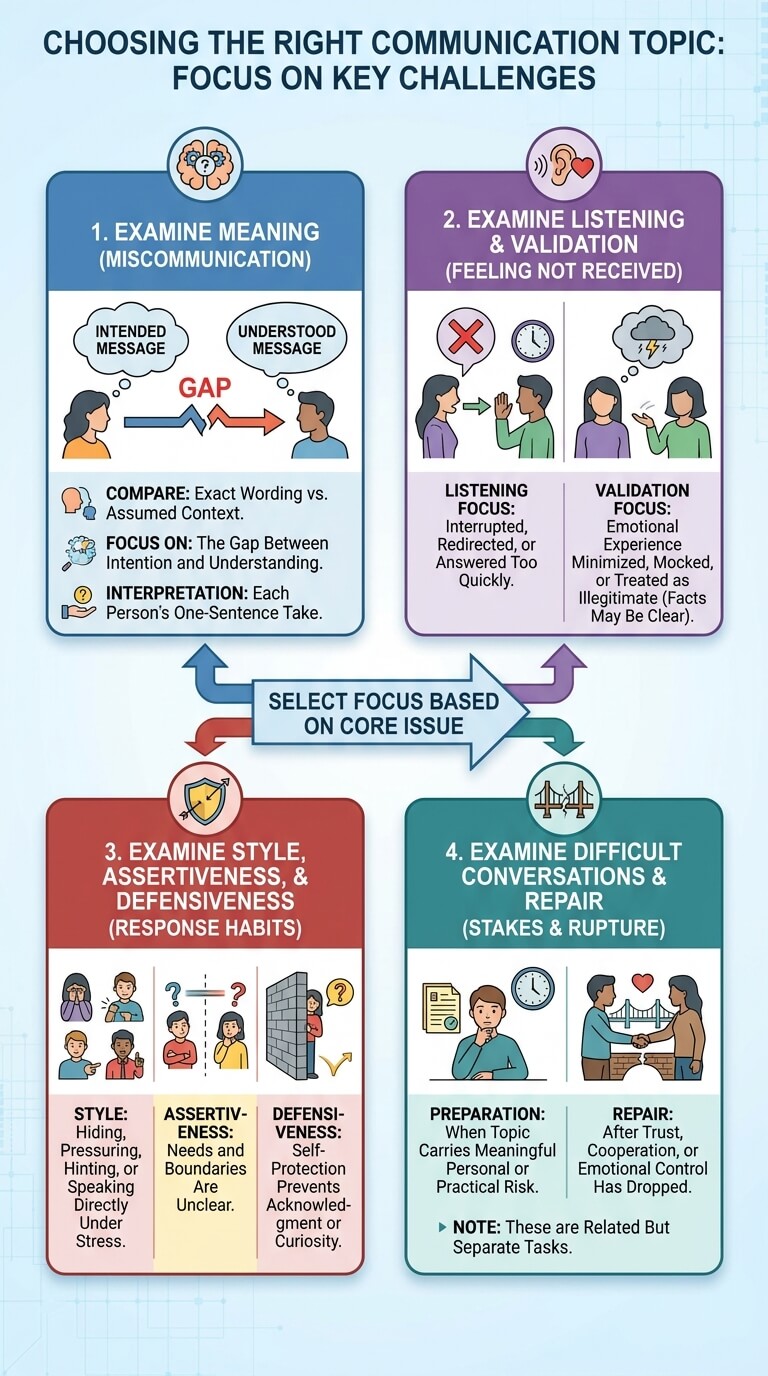
Examine meaning when sender and receiver heard different messages
Focus on miscommunication when the central problem is a gap between what was intended and what was understood. Compare exact wording, assumed context, and each person’s one-sentence interpretation.
Examine listening or validation when someone does not feel received
Focus on listening when the message was interrupted, redirected, or answered too quickly. Focus on validation when the facts may be understood but the emotional experience is being minimized, mocked, or treated as illegitimate.
Examine style, assertiveness, or defensiveness when response habits are the problem
Look at style when a person repeatedly hides, pressures, hints, or speaks directly under stress. Look at assertiveness when needs and boundaries are unclear. Look at defensiveness when self-protection prevents acknowledgment or curiosity.
Examine difficult conversations or repair when stakes and rupture are central
Preparation matters when the topic carries meaningful personal or practical risk. Repair matters after trust, cooperation, or emotional control has already dropped. These are related but separate tasks.
Common Misunderstandings About Good Communication
Clear words do not guarantee shared meaning
A sentence can be grammatically clear while its purpose remains uncertain. “Do whatever you want” contains familiar words but may communicate permission, anger, resignation, or a test. Shared meaning requires context and, when stakes are high, confirmation.
Understanding is not the same as agreeing
People sometimes repeat their point because they assume disagreement proves poor listening. A useful distinction is: “Can you explain my position accurately?” If the answer is yes, the next task is negotiation, decision, or acceptance of difference.
Calm delivery is not always emotional safety
A quiet voice can accompany respect, but it can also accompany contempt, intimidation, or calculated control. Emotional safety depends on whether a person can speak, disagree, pause, and set limits without ridicule, threats, punishment, or retaliation.
Better communication cannot resolve every value conflict or unsafe dynamic
Communication can clarify a conflict without solving it. Two people may understand each other and still have incompatible priorities. In unsafe situations, greater openness may increase risk rather than connection. Communication advice should never require someone to confront a person who controls, threatens, stalks, humiliates, or retaliates against them.
When Communication Problems Need More Support
Repeated distress, panic, shutdown, or impairment
Consider professional support when conversations repeatedly trigger overwhelming distress, long shutdowns, panic-like reactions, or serious impairment in work, sleep, parenting, or daily functioning. Individual support may help a person understand their reactions and choices without assigning a diagnosis through a web page.
Joint counseling may be useful when both people can participate voluntarily and safely. It is not a substitute for individual safety planning when one person is afraid of retaliation or violence.
Fear, coercion, threats, humiliation, stalking, retaliation, or control
These concerns are not ordinary communication mistakes. Prioritize safety, privacy, and specialized help rather than trying to find better wording. The National Domestic Violence Hotline provides information on identifying abuse and options for support in the United States. People elsewhere can look for a trusted local domestic violence or safeguarding service. If there is immediate danger, contact local emergency services when it is safe to do so.
FAQ About Communication Psychology
Is communication psychology the same as body language?
No. Body language is one part of communication and includes cues such as posture, gesture, facial expression, distance, and movement. Communication psychology is broader. It also examines language, tone, listening, interpretation, emotion, context, roles, power, response, and repair. A body cue may influence meaning, but it should not be treated as a reliable detector of hidden thoughts.
Why do people interpret the same words differently?
People use context, expectations, emotion, culture, and prior experience to fill in what a message leaves unstated. Asking each person to paraphrase the message often reveals where interpretations separated.
Can communication habits change over time?
Yes. Interrupting, avoiding requests, overexplaining, and defensive reactions can change through awareness, practice, feedback, and better conditions for conversation. Change is most credible when it appears in behavior, not only promises. Professional guidance may help when strong anxiety, shame, or long-standing conflict is involved.
Does better communication solve every conflict?
No. Better communication can reveal the real disagreement and support clearer decisions. It cannot create shared values, consent, resources, or willingness where those are absent. Sometimes the honest outcome is a negotiated limit or recognition that the disagreement will remain.
What should someone examine first after a misunderstanding?
Compare intention with received meaning. Ask what the speaker meant, what the listener heard, and what context each person assumed. Then identify whether the issue was wording, tone, listening, interpretation, missing information, or genuine disagreement.
Key Takeaways
- Communication creates meaning through words, delivery, listening, interpretation, context, and response.
- Good intention and harmful impact can exist at the same time, so both deserve examination.
- A misunderstanding is different from disagreement because the received meaning itself has changed.
- Listening, validation, assertiveness, and repair solve different parts of a difficult exchange.
- Clear communication includes observable facts, a specific purpose, and room for the other person’s perspective or choice.
- Fear, coercion, threats, stalking, humiliation, and retaliation call for safety-focused help, not more openness with the person causing harm.
Final Thoughts
After the next conversation that goes wrong, choose one point on the Communication Meaning Map. Compare what was intended with what was received, then identify whether expression, delivery, reception, interpretation, or repair needs attention. Locating the gap is more useful than repeating the same message with greater force.
Educational note: Michael Reed is the Founder and Lead Writer at Psychology Exposed. This information is educational and does not replace individualized mental health, medical, legal, or safety advice.

Michael Reed is the Founder and Lead Writer at Psychology Exposed. He writes about human behavior, relationships, emotional patterns, self-awareness, and practical psychology topics using research-informed, easy-to-understand content.
Read More About Michael Reed: https://psychologyexposed.com/michael-reed/