

You can care deeply about a goal and still avoid it. The application remains unfinished. The work is revised repeatedly but never submitted. You choose a safer opportunity, delay until the deadline makes your best effort impossible, or quit before the result can reveal what you can actually do.
This pattern can look like low motivation from the outside. Psychologically, it may reflect the opposite. The goal matters so much that failure feels personally dangerous. A disappointing result may seem capable of proving inadequacy, inviting humiliation, changing how others see you, or damaging an identity you want to protect.
Avoidance then becomes protective. Not trying preserves possibility. Endless preparation postpones judgment. Self-handicapping creates an explanation in advance. These behaviors reduce fear in the short term, but they also prevent corrective experiences, useful feedback, and evidence that an imperfect result can be survived.
Quick Answer
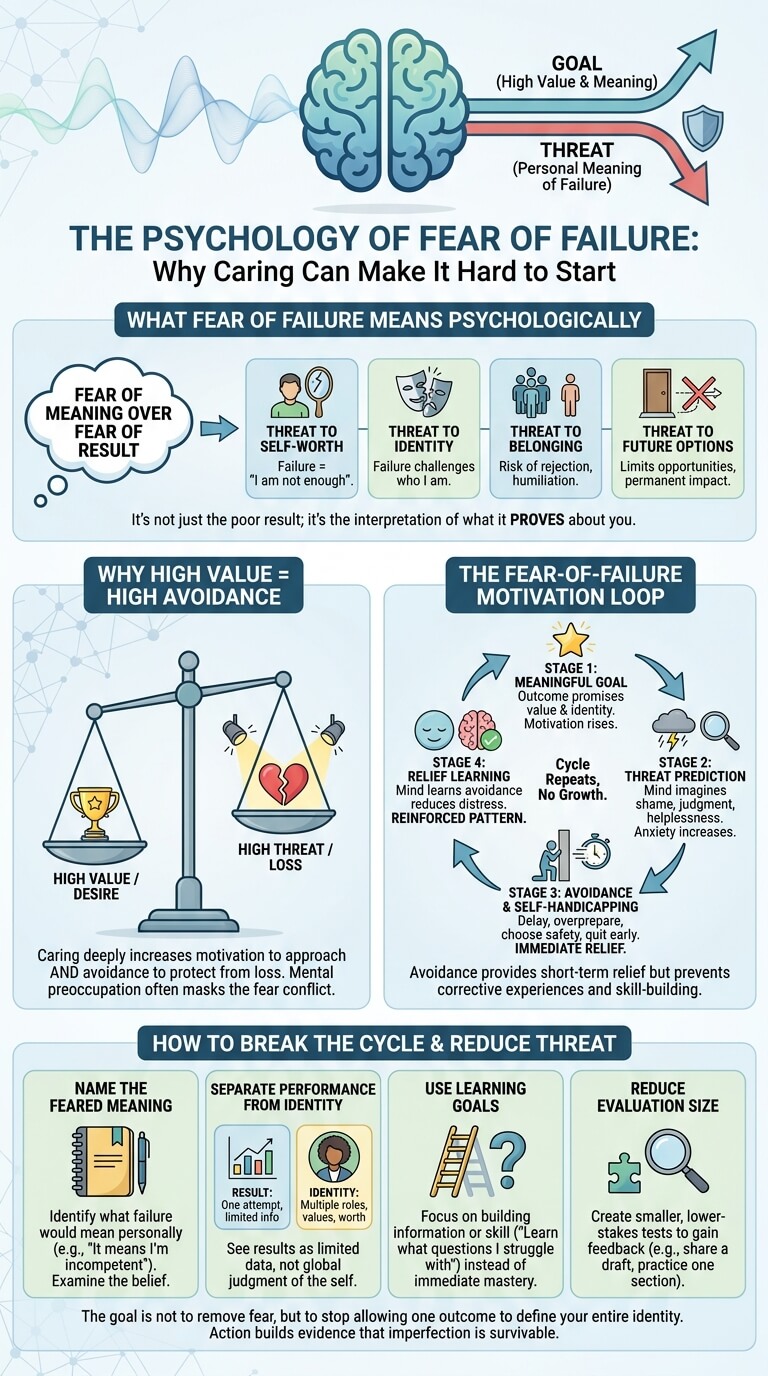
Fear of failure reduces motivation when a possible poor result is interpreted as a threat to self-worth, identity, belonging, or future options. Avoidance, procrastination, perfectionism, and self-handicapping can provide immediate relief by delaying evaluation. That relief teaches the mind to avoid again. Helpful first steps include naming the feared meaning, separating performance from identity, reducing the size of the evaluation, and using learning goals when the outcome is uncertain.
What Fear of Failure Means Psychologically
Fear of an outcome versus fear of what the outcome means
People rarely fear a score, rejection email, unfinished performance, or mistake in isolation. They fear the meaning attached to it. A failed interview may be interpreted as evidence of permanent inadequacy. A weak draft may seem to prove that the person was never talented. A mistake in public may feel like a threat to respect or belonging.
An open-access study of fear of failure in achievement settings describes it as a tendency to avoid failure when humiliation and embarrassment feel overwhelming. The definition highlights interpretation, not only the objective result.
Threat to self-worth, identity, belonging, or future options
Failure becomes more threatening when the goal carries several psychological functions at once. Passing an exam may represent competence, family approval, financial opportunity, and proof that past sacrifices were worthwhile. One outcome begins to feel responsible for the person’s entire future and identity.
The more meanings attached to the result, the harder it becomes to treat feedback as limited information. A setback no longer says, “This strategy was not enough.” It says, “I am not enough.”
Why high value can increase both motivation and avoidance
High value creates approach motivation because the outcome matters. It can also increase avoidance because there is more to lose. The person is pulled toward possibility and away from exposure at the same time.
This explains why someone may think constantly about a goal while doing little that allows the goal to be evaluated. Mental preoccupation is not evidence that the goal lacks importance. It may reflect unresolved conflict between desire and protection.
The Fear-of-Failure Motivation Loop

| Stage | What happens | Short-term effect | Long-term effect |
|---|---|---|---|
| Meaningful goal | The outcome promises value, identity, approval, or opportunity. | Hope and motivation rise. | The result begins carrying more psychological weight. |
| Threat prediction | The mind imagines shame, judgment, regret, or helplessness. | Anxiety and self-monitoring increase. | Action becomes associated with personal exposure. |
| Avoidance | The person delays, overprepares, chooses safety, or creates an excuse. | Fear decreases temporarily. | No corrective evidence or skill-building occurs. |
| Relief learning | The mind learns that avoiding the evaluation reduced distress. | The person feels safer for the moment. | Avoidance becomes more likely before the next opportunity. |
A meaningful goal creates possibility and threat
At first, the goal may feel inspiring. It offers a valued future and a chance to express ability. As evaluation becomes closer, the same importance increases risk.
The person may respond by making the goal even more important, believing stronger pressure will force action. Instead, the added meaning can make the evaluation feel more dangerous.
The mind predicts shame, judgment, regret, or helplessness
Fear can involve several imagined consequences. Other people may judge the result. The person may regret investing effort. Failure may seem to close future options or confirm that improvement is impossible.
These predictions may contain realistic elements, but fear often combines them into a total conclusion. One result becomes permanent, public, and personally defining.
Avoidance reduces fear in the short term
Putting the task away can create immediate relief. The difficult emotion becomes quieter because the evaluation has been postponed.
A conceptual review of procrastination and short-term mood regulation explains why people may prioritize immediate emotional relief even when delay creates later stress. Avoidance solves the feeling of the moment while leaving the goal unchanged.
Short-term relief teaches more avoidance
Relief provides learning. The mind notices that not submitting, not asking, or not beginning reduced distress. The next time a similar evaluation appears, avoidance becomes easier to select.
Fear can also explain why someone may begin with strong motivation and withdraw as evaluation approaches.
The long-term cost is that the person receives no evidence that they can tolerate an imperfect result, learn from feedback, or remain respected after a mistake.
How Fear of Failure Shows Up
Procrastination before evaluation
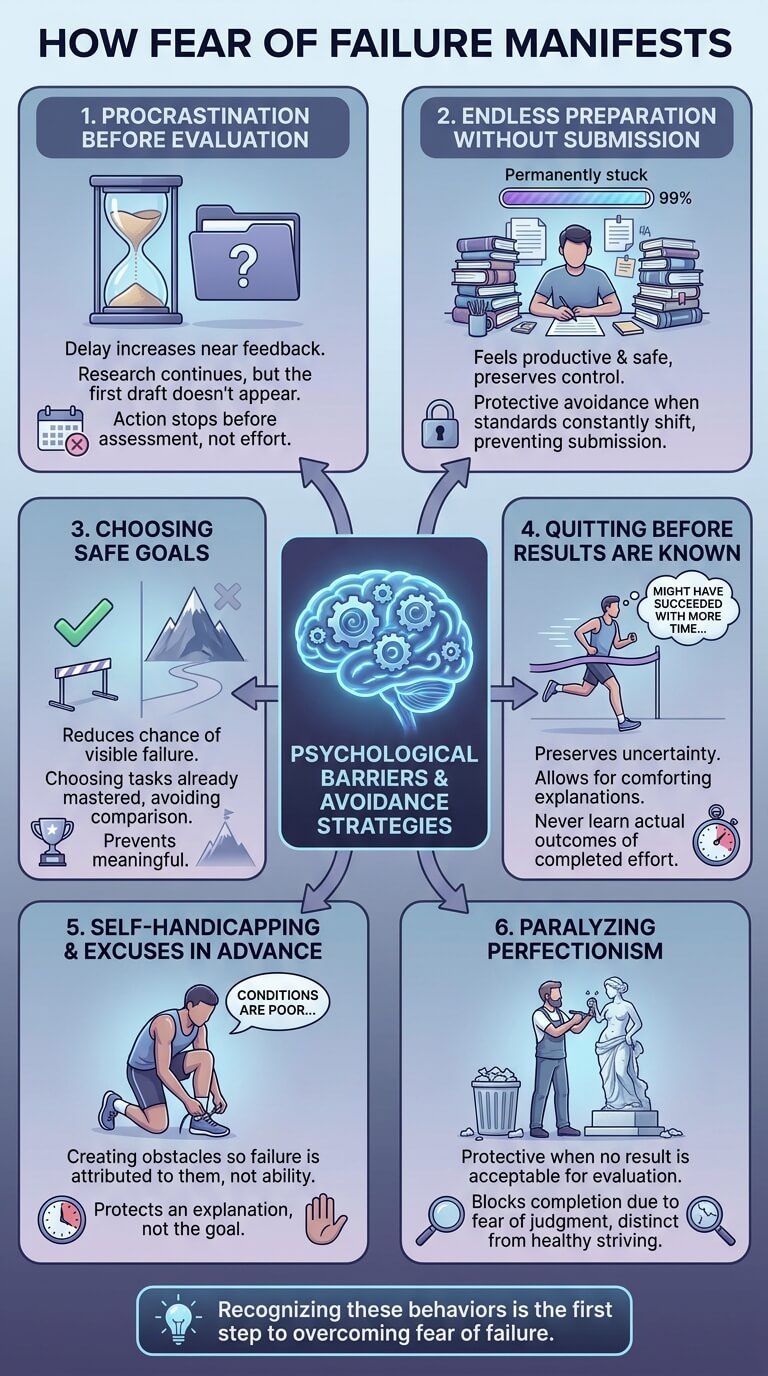
Delay becomes especially likely when the next step will produce feedback. Research may continue for weeks, but the first complete draft does not appear. Practice continues, but the application is never sent.
The timing is revealing. If action stops near evaluation rather than near effort itself, fear may be more relevant than simple disinterest.
Endless preparation without submission
Preparation feels productive and safe because it preserves control. The person can keep improving without allowing another person or reality to respond.
More preparation is useful when it addresses a defined gap. It becomes protective avoidance when the required standard keeps moving and no amount of readiness permits submission.
Choosing goals that are too easy to threaten identity
A very safe goal reduces the chance of visible failure. It also reduces information about current ability and may prevent meaningful growth.
The person may choose tasks they have already mastered, apply only where acceptance is nearly guaranteed, or avoid situations in which comparison would be possible.
Quitting before results are known
Stopping early preserves uncertainty. The person can tell themselves that success might have occurred with more time, better conditions, or full effort.
This protection carries a cost. The person never learns whether the feared outcome would actually occur or what their completed effort could produce.
Self-handicapping and creating excuses in advance
The APA Dictionary of Psychology defines self-handicapping as creating obstacles to performance so that failure can be attributed to the obstacle rather than lack of ability. Success despite the obstacle can also appear more impressive.
Examples include delaying until preparation time is limited, taking on unnecessary commitments, refusing useful help, or emphasizing poor conditions before a result is known. These actions protect an explanation, not the goal.
Perfectionism that blocks completion
Perfectionism can involve high standards and careful work without preventing action. It becomes protective when no result is acceptable enough to risk evaluation.
A study of medical students found that fear of academic failure changed the relationship between self-oriented perfectionism and procrastination in that sample. The perfectionism and procrastination study is one example of research showing why striving and fear should not be treated as the same thing.
Why Not Trying Can Feel Safer
Preserving the belief that you could have succeeded
Unfinished effort protects potential. A person can continue believing that ability exists but was never fully tested.
A completed attempt gives a more definite result. That information can support learning, but it can also threaten a self-image built around untested possibility.
Avoiding public evidence of limits
Private uncertainty may feel easier than visible imperfection. The person worries that other people will remember the mistake, revise their opinion, or use the result as evidence of weakness.
The actual audience may be small, yet an internalized audience can remain powerful. The person imagines a judging observer even when nobody is currently watching.
Protecting against disappointment or criticism
Not trying can reduce the intensity of disappointment because the outcome can be blamed on incomplete effort. It also allows a person to avoid direct criticism of their best work.
This protection is understandable. It becomes costly when the person repeatedly sacrifices opportunity, learning, and self-trust to avoid a temporary emotional experience.
Keeping identity separate from the result
Self-handicapping and early withdrawal create distance between identity and performance. “That was not the real me” feels safer than allowing a result to stand.
A healthier separation does not require sabotaging the attempt. It recognizes that a genuine result is still limited evidence about one performance under particular conditions.
Shame, Approval, and Conditional Self-Worth
Failure as information versus failure as identity
Failure as information concerns the task: the preparation was insufficient, the strategy was weak, or the standard was not reached. Failure as identity concerns the person: “I am defective, exposed, or unworthy.”
Fear of failure shows how threat can compete with the processes described in motivation psychology.
The APA Dictionary of Psychology describes shame as an unpleasant self-conscious emotion involving a negative sense of the self. This helps explain why shame-based interpretations make feedback feel larger than the task.
Approval-based goals
A goal can become a way to secure acceptance. Success promises praise or relief from criticism, while failure appears capable of changing the relationship.
The threat often depends on how the goal defines success, failure, and evaluation.
These goals may produce strong effort, but the motivation is fragile. The person monitors other people’s reactions and may choose what protects approval rather than what supports learning.
Humiliation memories and anticipated judgment
Past ridicule or harsh criticism can influence what a current evaluation means. A person may expect another mistake to produce the same social pain.
This does not mean every fear response is trauma or that a present situation is harmless. It means previous learning can make anticipated judgment feel immediate and credible.
When social comparison intensifies threat
Comparison turns performance into rank. A result no longer answers whether the person improved. It answers where they stand relative to others.
Comparison is especially threatening when the group feels central to identity or belonging. A learning setback can then feel like social exclusion.
Fear of Failure vs Low Motivation
| Question | Fear of failure may be more likely when | Broad low motivation may be more likely when |
|---|---|---|
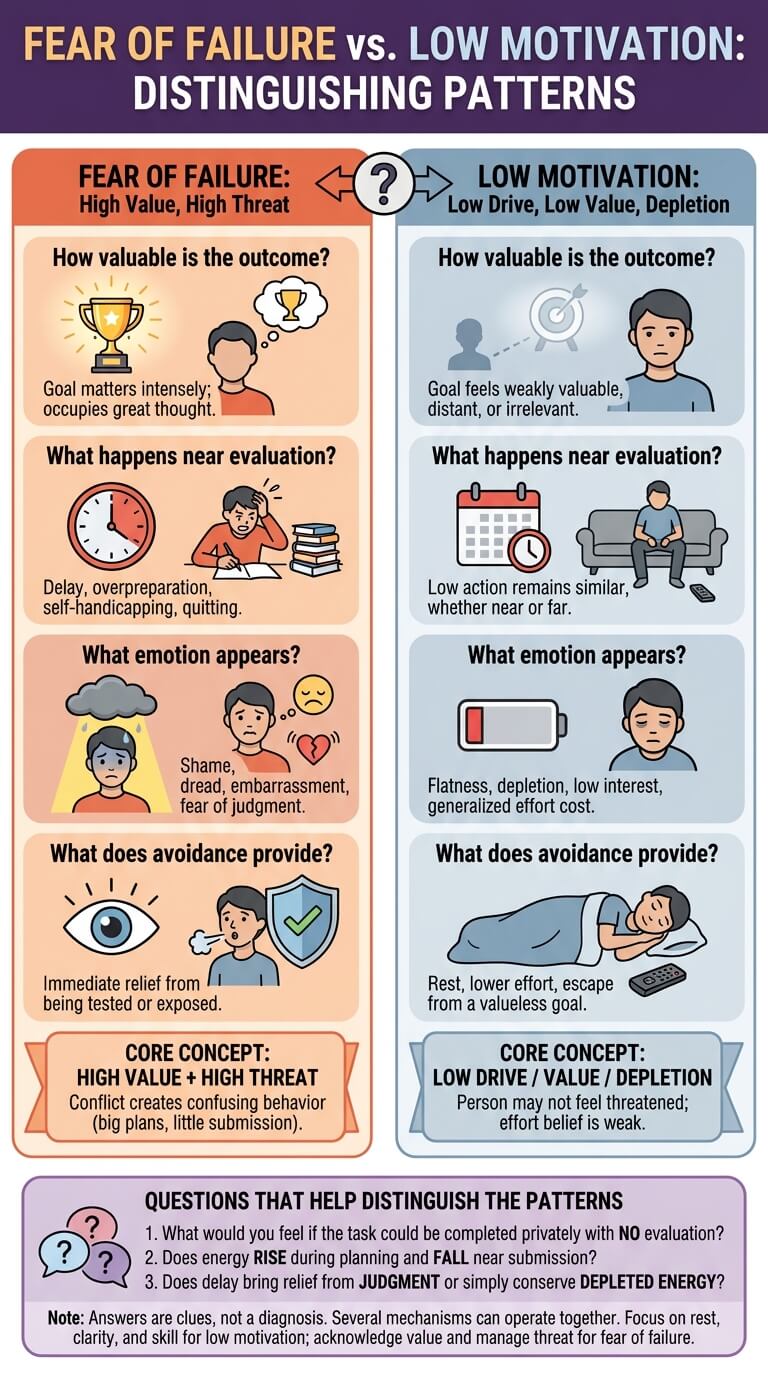
| How valuable is the outcome? | The goal matters intensely and occupies a great deal of thought. | The goal feels weakly valuable, distant, or irrelevant. |
| What happens near evaluation? | Delay, overpreparation, self-handicapping, or quitting increases. | Low action remains similar whether evaluation is near or far. |
| What emotion appears? | Shame, dread, embarrassment, or fear of judgment becomes prominent. | Flatness, depletion, low interest, or generalized effort cost is more prominent. |
| What does avoidance provide? | Immediate relief from being tested or exposed. | Rest, lower effort, or escape from a goal that lacks value. |
Low drive, low value, or depletion
Low motivation can reflect low value, fatigue, health factors, weak reward, poor feedback, or the belief that effort will not work. The person may not feel strongly threatened by evaluation.
Rest, clearer meaning, skill support, or goal revision may be more relevant than reducing fear.
This pattern differs from broader low motivation, which may reflect low value, depletion, overload, or weak expectancy.
High value combined with high threat
Fear of failure often involves intense value and intense threat at the same time. The person wants the outcome, thinks about it frequently, and avoids the step that would make the result real.
This conflict can create confusing behavior: large plans, long preparation, little submission, and strong self-criticism.
Questions that help distinguish the patterns
Ask what you would feel if the task could be completed privately with no evaluation. Ask whether energy rises during planning and falls near submission. Ask whether delay brings relief from judgment or simply conserves depleted energy.
The answers are clues, not a diagnosis. Several mechanisms can operate together.
Fear of Failure vs Realistic Caution
Evidence-based risk assessment
Realistic caution examines consequences, probability, resources, and alternatives. It may lead to more preparation, a smaller commitment, or a decision not to proceed.
Caution remains open to evidence. It can identify what information would make the action reasonable.
Avoidance that continues after reasonable preparation
Fear-based avoidance often keeps moving the threshold. More information is collected, but certainty never feels sufficient. Each solved problem reveals another reason to wait.
A practical sign is whether the person can define what “prepared enough” would mean. If no possible condition permits action, the problem may not be missing preparation.
When changing direction is wise rather than fearful
Leaving a goal can be rational when costs become too high, values change, or evidence shows the path is not viable. Persistence is not automatically courageous.
The distinction lies in the reasoning. Wise change responds to evidence and priorities. Protective avoidance mainly prevents emotional exposure while leaving the desired goal unresolved.
How Goals Can Increase Fear
All-or-nothing outcomes
A goal such as “succeed completely or prove I am a failure” creates no middle category for learning. One result is asked to settle a much larger question about identity.
Adding stages, ranges, and learning criteria makes feedback more specific without pretending the final outcome does not matter.
Public identity commitments
Announcing a goal can create accountability, but it can also make changing the plan feel humiliating. The person now fears both the result and the social meaning of revision.
Public commitment is most useful when the audience supports learning rather than demanding a performance of certainty.
Avoidance goals focused on not failing
“Do not embarrass yourself” and “do not make a mistake” keep attention close to threat. They describe what must not happen but provide little direction for effective action.
An approach goal can be added: explain the main idea clearly, ask one useful question, or submit a complete draft that can receive feedback.
How goal design changes the threat
Goal design affects what counts as failure. A learning goal treats the next attempt as a way to build information. A rigid outcome goal may treat anything below the final standard as proof of inadequacy.
The aim is not to remove standards. It is to create standards that guide effort without making one performance responsible for the whole self.
First Steps That Lower Threat Without Removing the Goal

Name the feared meaning, not only the feared event
Complete the sentence: “If this goes badly, I am afraid it will mean…” The answer may concern ability, rejection, wasted effort, future options, or loss of identity.
Naming the meaning makes the problem more precise. A poor result and the conclusion attached to it can then be examined separately.
Separate performance from identity
Describe the result using limited language: one attempt, one setting, one method, one period of preparation, and one standard. Avoid turning the outcome into a global description of the person.
This is not an excuse to dismiss feedback. It allows feedback to remain useful because it does not need to defend or destroy the whole self.
Reduce the size of the evaluation
Create a smaller test that still produces real information. Share one section with a trusted reader, practice one part under realistic conditions, or submit a lower-stakes version where appropriate.
The purpose is not to avoid all evaluation. It is to make the next evaluation specific enough to learn from.
Choose a learning goal when the outcome is uncertain
When you do not yet know the correct strategy, define what capability or information the attempt should build. “Learn which three questions I struggle to answer” is more useful than demanding immediate mastery.
Learning goals allow difficulty to produce direction rather than only judgment.
Create a response plan for an imperfect result
Decide what you will do if the result is disappointing. The plan may include waiting before interpreting it, asking for specific feedback, identifying one change, and choosing whether to try again.
A response plan reduces the sense that failure leads into an unknown emotional and practical void.
What Helpful Support Looks Like
Feedback that is specific and non-humiliating
Helpful feedback identifies what happened, what standard was missed, and what action could improve the next attempt. It does not use ridicule, contempt, or global labels.
Specific feedback protects learning even when the result is poor.
Autonomy and realistic choice
Support should not turn into another form of control. The person needs honest information about consequences and meaningful input into timing, method, and whether the goal remains personally endorsed.
Choice does not require pretending every option is available. It means unnecessary pressure is not added to an already threatening evaluation.
Competence-building steps
Break the difficulty into a skill that can be practiced. Provide examples, criteria, feedback, and a challenge matched to current ability.
Competence grows from evidence that effort can improve performance, not from reassurance that failure is impossible.
How need support and learning conditions help
Autonomy, competence, and relatedness help explain why respectful environments make evaluation easier to approach. Learning psychology also helps distinguish mistakes that guide correction from repeated failure with no useful feedback.
The goal is not permanent comfort. It is an environment where difficulty produces information rather than humiliation.
When Fear of Failure Needs Professional Support
Severe avoidance that limits education, work, relationships, or daily life
Consider professional support when avoidance repeatedly closes important opportunities, prevents ordinary responsibilities, or makes daily functioning increasingly narrow.
The National Institute of Mental Health recommends seeking professional help for severe or distressing symptoms, especially when they persist and interfere with usual tasks or activities.
Panic, persistent hopelessness, or intense shame
Fear of failure alone does not identify an anxiety disorder, depression, or another condition. Persistent panic, hopelessness, severe sleep disruption, loss of interest across many areas, or overwhelming shame deserve assessment beyond general motivation advice.
Seek urgent local support if you have thoughts of self-harm, suicide, or immediate danger.
Fear linked to threats, coercion, humiliation, or retaliation
Sometimes the feared consequences are not imagined. A person may face retaliation, stalking, humiliation, financial control, or another credible threat if they fail, disagree, or leave.
In that situation, the priority is safety and qualified local support, not increasing willingness to perform. Do not treat coercion as a personal motivation problem.
Frequently Asked Questions About Fear of Failure
Why do I procrastinate on goals I care about?
The goal may carry a threatening evaluation. Delay provides short-term relief from shame, uncertainty, or judgment, even though it damages the goal later. Notice whether procrastination increases near submission, testing, or public feedback.
Is perfectionism always fear of failure?
No. High standards, care, and improvement can exist without severe avoidance. Fear is more likely when standards become impossible, completion feels unsafe, mistakes threaten identity, or no amount of preparation permits evaluation.
Can fear of success and fear of failure happen together?
Yes. Success may bring visibility, responsibility, changed relationships, or pressure to repeat the performance. A person may fear failing and also fear what success would require. Both can make staying untested feel safer.
Why do I lose motivation after criticism?
Criticism can reduce confidence, increase expected social cost, or make the next attempt feel like another threat. Specific and respectful criticism is easier to use than humiliation or global judgment. Separate useful information from the evaluator’s tone and decide what evidence deserves action.
How can failure feel less personal?
Describe the result narrowly, identify the conditions that influenced it, and ask what it reveals about strategy or skill. Build identity from multiple values and roles so one performance does not carry the entire self.
Key Takeaways
- Fear of failure concerns not only a poor result but what the result may seem to prove about worth, identity, belonging, or future options.
- Avoidance can reduce fear immediately, teaching the mind to procrastinate, overprepare, self-handicap, or quit again.
- High motivation and high threat can exist together, which is why a deeply valued goal may produce very little visible action.
- Self-handicapping protects an explanation for failure but prevents an honest test of ability and strategy.
- Helpful first steps include naming the feared meaning, separating performance from identity, reducing the evaluation, and using learning goals.
- Professional or safety support is important when fear severely restricts life or is connected to panic, hopelessness, coercion, humiliation, or retaliation.
Choose one valued action you keep delaying. Write down the event you fear and the personal meaning you attach to it. Then design one smaller evaluation that can produce real information without asking the result to define your entire identity. The purpose is not to eliminate fear before acting. It is to stop allowing one possible outcome to carry more meaning than it can reasonably prove.
Author note: Michael Reed is the Founder and Lead Writer at Psychology Exposed. He explains human behavior, emotional patterns, self-awareness, and everyday decisions in clear, research-aware language. This content is educational and is not a substitute for diagnosis, therapy, medical care, crisis support, or safety planning.

Michael Reed is the Founder and Lead Writer at Psychology Exposed. He writes about human behavior, relationships, emotional patterns, self-awareness, and practical psychology topics using research-informed, easy-to-understand content.
Read More About Michael Reed: https://psychologyexposed.com/michael-reed/