

You can be highly motivated and still feel controlled. You can complete every task someone gives you while feeling increasingly detached from the reason you started. You can also struggle with an activity not because you lack ambition, but because you feel incapable, isolated, or unable to make meaningful choices.
Self-Determination Theory offers a framework for understanding these differences. It does not ask only how much motivation a person has. It asks what kind of motivation is operating and whether the surrounding conditions support three basic psychological needs: autonomy, competence, and relatedness.
These needs help explain why the same goal can feel energizing in one setting and draining in another. A clear structure may support one person while making another feel controlled. A difficult challenge may build confidence when feedback is useful, or destroy motivation when failure is public and humiliating. Connection may make effort feel meaningful, while conditional approval can turn the same effort into pressure.
Quick Answer
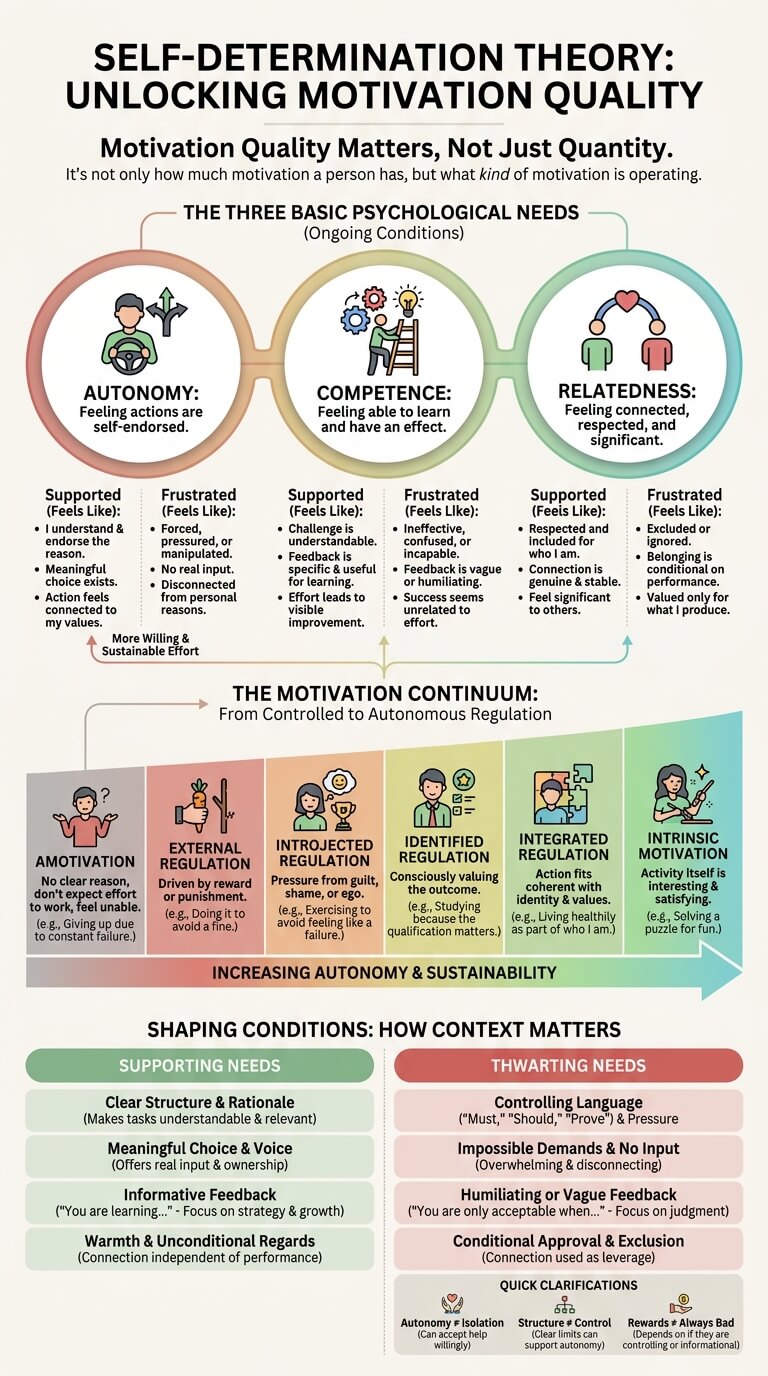
Self-Determination Theory explains motivation through three basic psychological needs. Autonomy is the feeling that your actions are self-endorsed. Competence is the feeling that you can learn, improve, and have an effect. Relatedness is the feeling of being respected, cared for, and connected. Motivation tends to be more willing and sustainable when these needs are supported, and more pressured or fragile when they are repeatedly frustrated.
What Self-Determination Theory Says About Motivation
Motivation quality matters, not only motivation quantity
A person who studies because the subject matters to them and a person who studies because they fear humiliation may both work for three hours. The visible effort is similar, but the psychological quality of the motivation differs.
The first person may experience choice, curiosity, and growing competence. The second may experience tension, self-surveillance, and relief only when the threat is temporarily removed. Both are motivated, but one form is more self-directed and the other is more controlled.
The official overview of Self-Determination Theory describes conditions that support autonomy, competence, and relatedness as important for more volitional and higher-quality forms of motivation. This is why simply increasing pressure or rewards does not always improve engagement.
People interpret pressure, choice, skill, and connection
Motivation is shaped by what an event means to the person. A deadline can feel like useful structure when its purpose is clear and the time is realistic. The same deadline can feel controlling when it is paired with threats, no input, and impossible demands.
Feedback can communicate, “You are learning and your effort is working,” or “You are acceptable only when you perform.” A reward can feel like appreciation, or it can feel like a tool used to control behavior. The external event matters, but so does the interpretation created by the relationship and context.
Basic psychological needs are ongoing conditions
Autonomy, competence, and relatedness are not prizes people earn after succeeding. They are conditions that help people engage, adapt, and function well during the process.
A person does not satisfy autonomy once and keep it permanently. A new environment may support choice while another restricts it. Competence grows and falls as demands change. Relatedness can be strong in one relationship and weak in another. These needs therefore help explain fluctuations in motivation across settings.
The Three Basic Psychological Needs
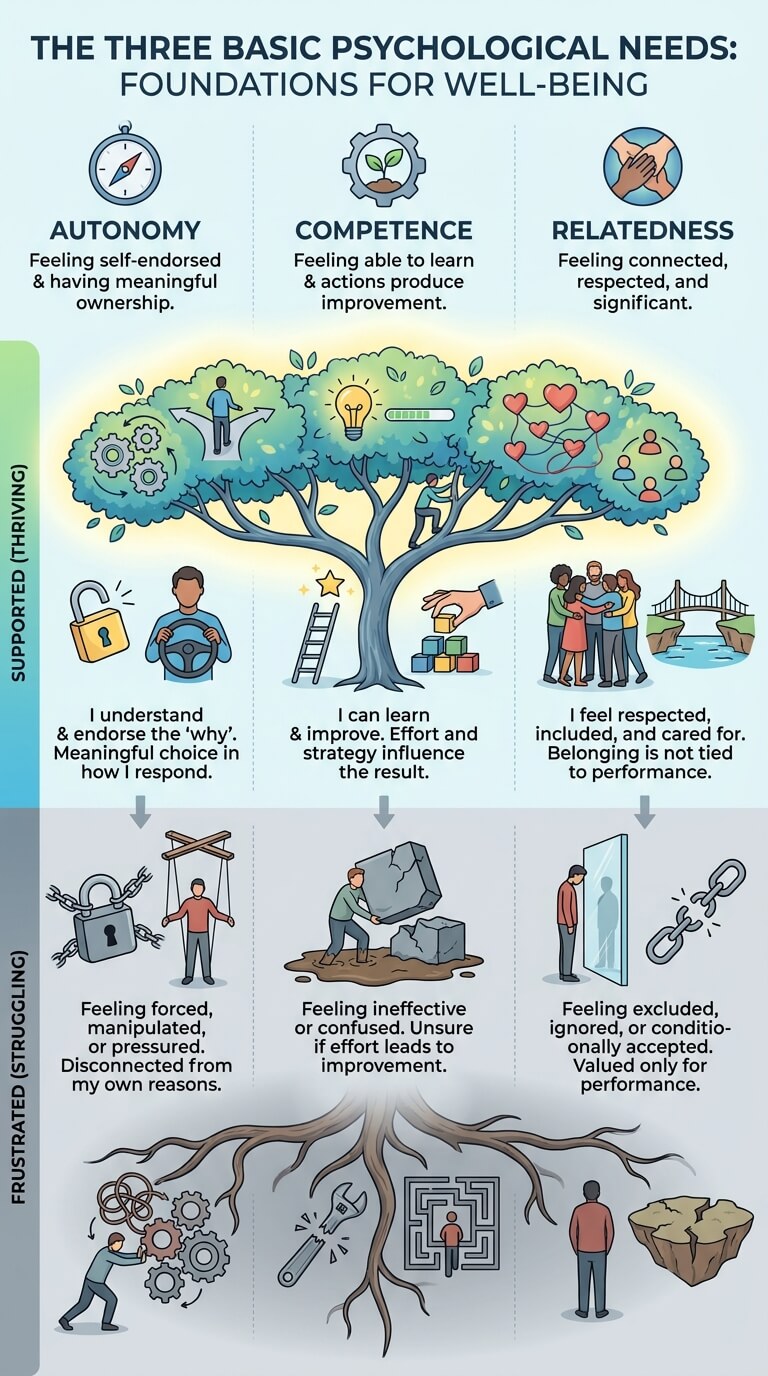
| Psychological need | What it feels like when supported | What it may feel like when frustrated |
|---|---|---|
| Autonomy | I understand and endorse why I am doing this. I have meaningful choice in how I respond. | I feel forced, manipulated, pressured, or disconnected from my own reasons. |
| Competence | I can learn, improve, and influence the result through effort and strategy. | I feel ineffective, confused, incapable, or unable to tell whether I am improving. |
| Relatedness | I feel respected, included, cared for, and significant to other people. | I feel excluded, conditionally accepted, ignored, or valued only for performance. |
Autonomy: feeling that your action is self-endorsed
Autonomy means experiencing your behavior as something you can stand behind. You may not have chosen every circumstance, but you can understand the reason for your action and experience some meaningful ownership.
A person can act autonomously while following rules, meeting responsibilities, or accepting guidance. A student may freely endorse preparing for an exam because the qualification matters. A parent may choose a difficult caregiving task because it expresses love and responsibility. The action is not effortless, but it is connected to a reason the person accepts.
Competence: feeling able to learn and have an effect
Competence is the sense that your actions can produce improvement. It grows when challenge is understandable, feedback is useful, and effort leads to visible learning.
Competence does not mean feeling talented all the time. A beginner can feel competent while making many mistakes if those mistakes provide information and the next step seems learnable. In contrast, an experienced person may lose motivation when expectations are vague and success appears unrelated to effort.
Relatedness: feeling connected, respected, and significant
Relatedness involves feeling that you matter to other people and belong in the social setting. It is supported by warmth, respect, honest interest, and a sense that connection does not depend entirely on performance.
What Autonomy Is and Is Not
Autonomy is not isolation
Autonomy does not require doing everything alone. Accepting advice, depending on others, and cooperating with a group can all be autonomous when the person willingly endorses the relationship and understands the reason for the action.
Independence describes how much a person relies on others. Autonomy describes whether the action feels self-endorsed. Someone may independently follow a harsh internal rule and feel controlled, while another person may ask for help and still act with strong autonomy.
Autonomy is not doing whatever you want
Limits do not automatically remove autonomy. Real life includes laws, shared responsibilities, health needs, financial constraints, and obligations to other people. The important question is whether a person has meaningful input, receives an understandable rationale, and can respond without unnecessary control or humiliation.
A child may not choose whether a safety rule exists, but a caregiver can explain the reason, acknowledge frustration, and offer choice within the limit. Structure and autonomy can coexist.
Choice, rationale, and ownership
Choice supports autonomy when the options are real and relevant. Offering two meaningless options while withholding the actual decision is not the same as participation. Too many choices can also overwhelm someone who lacks information.
This needs-based model is one part of the broader field of motivation psychology.
A clear rationale can help an unavoidable task feel more understandable. Ownership grows when the person can connect the action to a value, choose part of the method, or have a voice in how the demand is carried out.
How controlling language changes motivation
Words such as “must,” “should,” and “prove” are not always harmful, but repeated controlling language can make an action feel imposed. Statements like “If you cared, you would do this” tie behavior to guilt and conditional approval.
Autonomy-supportive language is direct without pretending there is unlimited choice. It might sound like, “This needs to be completed today because another person depends on it. Which part do you want to handle first?” The requirement remains, but the person receives context and some agency.
How Competence Builds or Breaks Motivation
Challenge that is difficult but learnable
Tasks are often motivating when they stretch current ability without making success feel impossible. A challenge that is too easy provides little information. A challenge far above current skill can create confusion and helplessness.
Clear feedback and visible skill growth
Competence needs information. People need to know what improved, what remains unclear, and which action might produce a better result. General praise may feel pleasant, but specific feedback is usually more useful for learning.
“Your explanation became easier to follow when you added a concrete example” gives the person a repeatable strategy. “You are brilliant” may create approval, but it does not show what to do next.
Why repeated confusion can reduce effort
When effort does not produce understandable change, people may stop investing. This can look like indifference from the outside, even when the original goal still matters.
Before adding more pressure, examine the learning environment. Is the task broken into workable steps? Is feedback available soon enough to guide another attempt? Does the person know what success means? Low motivation may reflect a competence problem rather than a value problem.
Support without taking over
Helping can unintentionally weaken competence when the helper removes every difficult part. The person may finish the task but receive no evidence that they can manage it themselves.
Better support identifies the next learnable step, provides tools, and gradually returns responsibility. The aim is not to prevent all frustration. It is to make effort informative rather than humiliating or pointless.
Why Relatedness Affects Motivation
Belonging makes effort feel socially meaningful
People are more willing to invest when they feel seen and included. A learner may tolerate confusion because they trust the teacher. A patient may follow a difficult plan more willingly when the professional listens and explains. A volunteer may continue because the group values their contribution.
Connection does not replace autonomy or competence. Warmth without useful guidance can still leave someone lost. Belonging is most supportive when it communicates both care and respect for the person’s agency.
Support without pressure or conditional approval
Relatedness is not the same as earning praise. Genuine connection allows disagreement, imperfect performance, and changing needs. Conditional approval communicates that belonging depends on compliance or success.
A person may work extremely hard to avoid losing acceptance. That effort can be intense, but it is often fragile because mistakes threaten both the goal and the relationship.
When disconnection makes a meaningful goal feel empty
Some goals are sustained partly through shared meaning. Studying alone, caring for someone without support, or creating for an unresponsive audience can become emotionally costly even when the activity remains important.
The Self-Determination Motivation Continuum

Self-Determination Theory does not place every behavior into only “intrinsic” or “extrinsic.” It describes several forms of motivation that differ in how fully the reason has been accepted by the person. A major review of the theory explains this continuum from amotivation through controlled and increasingly autonomous forms of regulation. The open-access review of intrinsic and extrinsic motivation also emphasizes that external motivation can vary greatly in quality.
| Form of motivation | Typical inner experience | Everyday example |
|---|---|---|
| Amotivation | I do not see a reason, do not expect my effort to work, or feel unable to act. | A learner stops trying because the instructions never make sense and feedback never helps. |
| External regulation | I am doing this to gain a reward or avoid a consequence. | Completing a form only because a penalty is approaching. |
| Introjected regulation | I am pushing myself through guilt, shame, ego, or the need to prove worth. | Exercising mainly to avoid feeling like a failure. |
| Identified regulation | I may not enjoy this activity, but I personally value what it accomplishes. | Practicing rehabilitation exercises because mobility matters. |
| Integrated regulation | This action fits my broader values and sense of who I choose to be. | Continuing education because learning is part of a personally endorsed identity. |
| Intrinsic motivation | I participate because the activity itself is interesting or satisfying. | Solving a difficult problem because the process is absorbing. |
Amotivation: no clear reason or expected effect
Amotivation is not simply weak enthusiasm. It can arise when the person sees no value, expects no effect from effort, or feels unable to perform the action. Increasing rewards may do little if the person believes success is impossible.
Useful questions include: Does the outcome matter? Does the person understand the action? Have repeated failures lowered expectancy? Is the cost beyond current capacity?
External regulation: reward and consequence
This is the clearest externally controlled form. Behavior depends on obtaining something or avoiding something. It can be practical for immediate coordination, but it may stop when the consequence disappears.
External regulation is not always unethical. Contracts, deadlines, and rules can be necessary. Problems arise when control becomes excessive, deceptive, humiliating, or disconnected from meaningful choice.
Introjected regulation: guilt, shame, and ego pressure
Introjected motivation feels internal because the pressure comes from inside the person. Yet the person does not fully endorse the action. They act to avoid guilt, protect pride, or prove worth.
This form can produce considerable effort. It can also make setbacks emotionally costly because failure is interpreted as a verdict about the self.
Identified regulation: recognizing personal value
With identified regulation, the person understands and accepts why the action matters. They may not enjoy the process, but they choose it because the outcome serves an important value.
Many durable responsibilities rely on this form. Paying bills, attending appointments, and practicing foundational skills may never become intrinsically enjoyable, yet they can feel self-directed.
Integrated regulation: fitting the goal into identity
Integrated regulation occurs when an external goal has been brought into harmony with other values and identities. The action feels coherent with how the person chooses to live.
Intrinsic motivation: interest and inherent satisfaction
Intrinsic motivation comes from the activity itself. It supports curiosity, play, exploration, and mastery. It is especially valuable where flexible thinking and voluntary engagement matter.
Not every useful activity must become intrinsic. Expecting passion for every responsibility can create a false standard. Personally valued extrinsic motivation can also be stable and meaningful.
How Motivation Becomes More Internalized
Understanding the reason behind a task
People are more likely to accept a task when the reason is clear and credible. “Because I said so” supplies authority but not meaning. An understandable rationale allows the person to decide how the task relates to their own values.
A rationale should not disguise manipulation. It needs to be honest about constraints and acknowledge costs.
Connecting the task to personal values
A person may begin with an external reason and discover a personally meaningful one. Studying statistics may support a goal of evaluating health claims responsibly. Saving money may express independence or care for family.
The connection should come from the person, not be imposed by someone telling them what they ought to value.
Building competence through workable challenges
Internalization becomes easier when the person can experience success through effort. Clear instruction, realistic challenge, and feedback provide evidence that the action is manageable.
Competence is easier to sustain when progress and feedback provide credible evidence of improvement.
Repeated failure without support can make even a valued goal feel alien. Competence is not a luxury added after motivation. It helps make continued effort believable.
Receiving support without being controlled
Respectful support allows questions, acknowledges emotion, and offers help without taking over. It communicates, “You are capable of making sense of this,” rather than “I know what is best and your role is to comply.”
The classic overview by Ryan and Deci describes how social contexts can either facilitate or undermine motivation by affecting these psychological needs. Their foundational paper on Self-Determination Theory remains useful for understanding why control and support have different effects.
Need Support Versus Need Thwarting
Autonomy support versus coercion
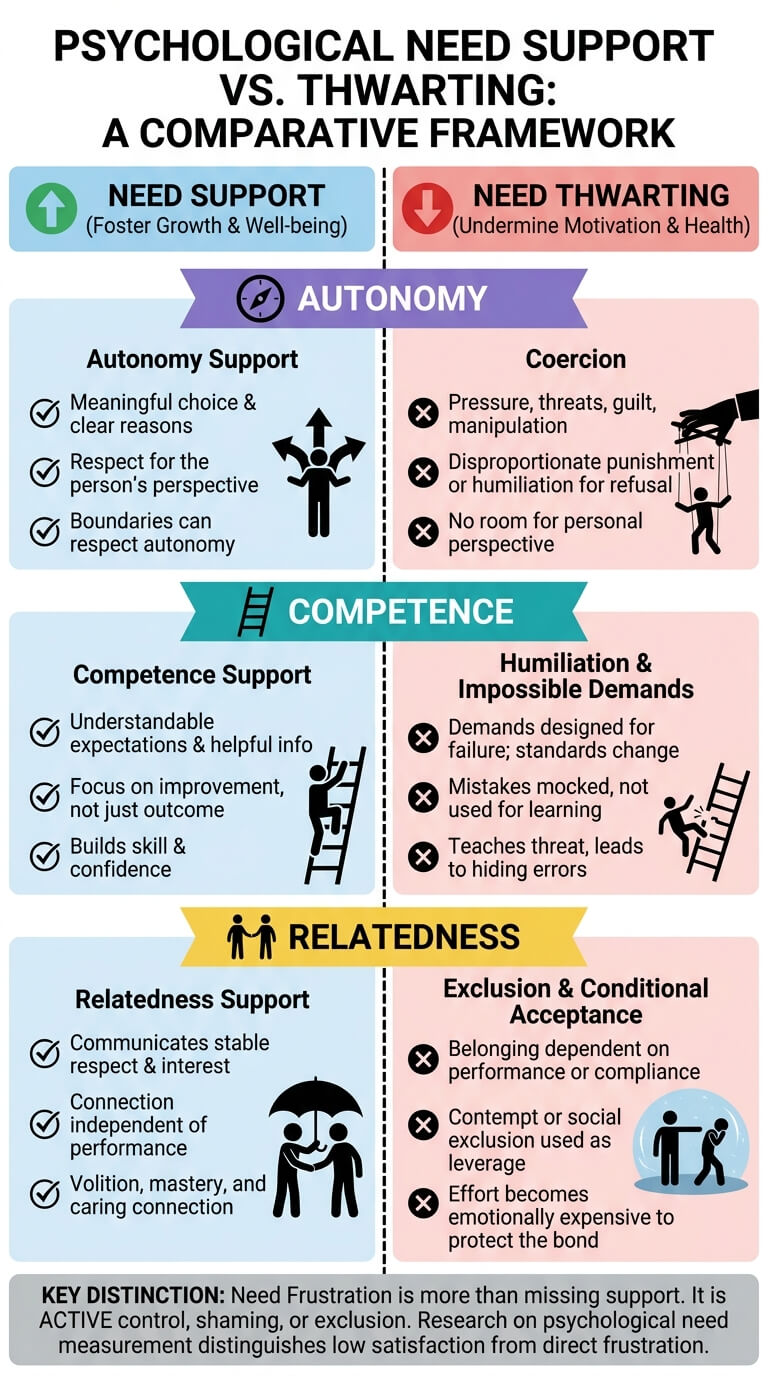
Autonomy support offers meaningful choice, clear reasons, and respect for the person’s perspective. Coercion uses pressure, threats, guilt, or manipulation to force a preferred response.
The effect of incentives depends partly on whether rewards support competence or create control.
Not every firm request is coercive. A boundary can be clear and still respect autonomy. The distinction depends on whether the person is allowed to have a perspective and whether refusal triggers disproportionate punishment, humiliation, or fear.
Competence support versus humiliation or impossible demands
Competence support provides understandable expectations and information that helps improvement. Need thwarting occurs when demands are designed so the person cannot succeed, mistakes are mocked, or standards constantly change.
Humiliation may increase immediate compliance in some settings, but it teaches threat rather than competence. The person learns to hide errors, avoid evaluation, or stop attempting unfamiliar work.
When autonomy, competence, or relatedness is repeatedly blocked, the experience may appear as low motivation rather than simple unwillingness.
Relatedness support versus exclusion or conditional acceptance
Relatedness support communicates stable respect and interest. Exclusion, contempt, and conditional warmth make belonging feel dependent on performance.
When connection is used as leverage, effort may become intense but emotionally expensive. The person is not only pursuing a task. They are trying to protect the relationship.
Need frustration is more than simply missing support
There is a difference between not receiving much encouragement and being actively controlled, shamed, or excluded. Research on psychological need measurement distinguishes low satisfaction from more direct frustration of autonomy, competence, and relatedness. An open-access review discusses these constructs and their importance for understanding functioning. This review of psychological need measures also clarifies the meanings of volition, mastery, and caring connection.
Self-Determination Theory in Everyday Contexts
Learning and skill development
A supportive learning environment gives students meaningful input, explains why tasks matter, and provides feedback that builds competence. It does not remove challenge or standards.
A recent practical review of Self-Determination Theory in education describes autonomy-supportive practices as ways to encourage engagement and resilience while still maintaining structure. The central idea is not to let learners avoid difficulty. It is to help them understand and participate in the process.
Health and exercise goals
A health goal is more likely to feel self-directed when the person understands the benefit, chooses a workable method, and notices growing competence. Pressure based on shame or appearance may produce action, but it can also make the goal emotionally fragile.
Parenting and caregiving
Caregivers can support autonomy without abandoning limits. They can acknowledge resistance, explain reasons, offer developmentally appropriate choices, and help the child experience competence.
Relatedness is especially important because children may interpret correction as a threat to connection. Warmth and clear limits can coexist when acceptance is not made conditional on perfect behavior.
Relationships and shared responsibilities
Shared responsibilities become more sustainable when both people have a voice, understand why the task matters, and believe their contribution is respected. Repeated guilt, scorekeeping, or conditional affection can turn cooperation into controlled compliance.
Autonomy does not mean each person does only what they prefer. It means agreements are discussed honestly rather than enforced through emotional punishment.
Work as one specific setting
At work, autonomy may involve discretion over methods, competence may depend on clear roles and feedback, and relatedness may be influenced by leadership and team culture. These conditions can shape engagement, but workplace motivation also includes pay, fairness, job security, workload, and organizational structure.
A general personal-motivation explanation should not be used to excuse harmful job design or unreasonable demands.
Self-Determination Theory Versus Nearby Motivation Ideas
More than intrinsic versus extrinsic motivation
The theory includes intrinsic motivation, but it also explains several forms of extrinsic motivation. An action done for a separate outcome can still be autonomous when the person identifies with its value.
The continuum becomes easier to understand after comparing intrinsic and extrinsic motivation.
This prevents a simplistic division between enjoyable activities and fake motivation.
More than a reward-only explanation
Rewards matter, but their effect depends on what they communicate. A reward may support competence, acknowledge contribution, or create controlling pressure. The same incentive cannot be evaluated without context.
Different from discipline and habit
Discipline concerns intentional follow-through, while habit concerns behavior that becomes easier to repeat through cues and learning. Self-Determination Theory asks whether the underlying reason and environment support ownership, capability, and connection.
A routine can be efficient yet controlled. A disciplined person can persist in a goal they no longer endorse. Structure is useful, but it does not answer why the behavior deserves continuation.
A Reflection Map for a Goal That Feels Hard to Sustain
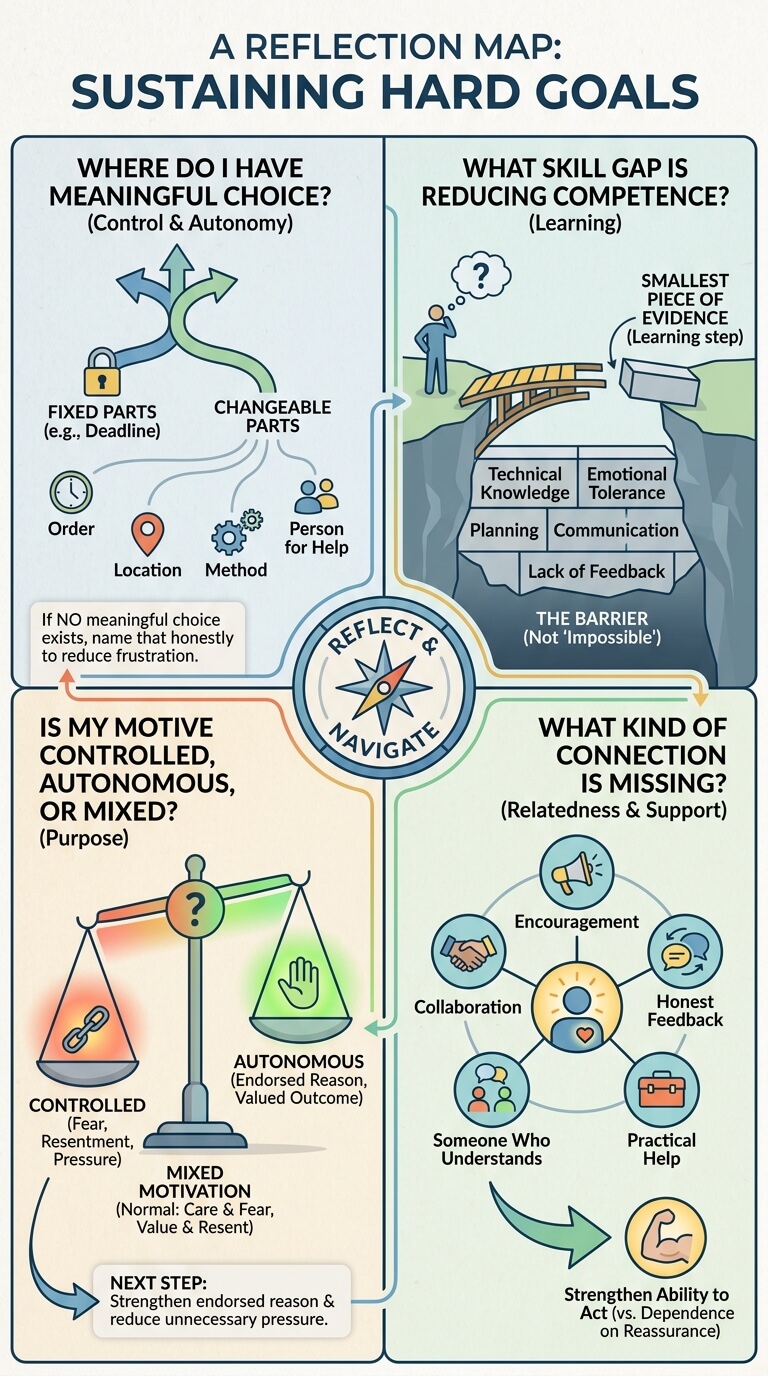
Where do I have meaningful choice?
List the parts that are fixed and the parts that can change. You may not control the deadline, but you may control the order, location, method, or person you ask for help.
If no meaningful choice exists, name that honestly. Pretending a demand is voluntary can increase frustration.
What skill gap is reducing competence?
Identify what you do not yet know rather than labeling the whole task impossible. Is the barrier technical knowledge, emotional tolerance, planning, communication, or lack of feedback?
Choose the smallest piece that can produce evidence of learning.
What kind of connection is missing?
Ask whether you need encouragement, collaboration, honest feedback, practical help, or simply someone who understands why the goal matters.
Support is most useful when it strengthens your ability to act rather than making you dependent on constant reassurance.
Is my motive controlled, autonomous, or mixed?
Name the forces without judging them. You may care about the goal and also fear criticism. You may value the outcome and resent the method. Mixed motivation is normal.
The next step is to strengthen the reason you endorse and reduce unnecessary pressure where possible.
Common Misunderstandings About Self-Determination Theory
Autonomy does not eliminate structure
Clear expectations, deadlines, and guidance can support motivation when they are understandable and proportionate. The absence of structure may reduce competence by creating confusion.
Competence does not require being the best
Competence means experiencing effectiveness and growth. It can exist while someone is a beginner, performs below others, or needs help.
Relatedness is not approval-seeking
Relatedness involves secure respect and connection. Approval-seeking makes acceptance feel dependent on producing the preferred result.
Extrinsic goals can still be autonomously chosen
Income, qualifications, health outcomes, and practical responsibilities are external results. They can still be pursued willingly when the person understands and endorses their value.
Frequently Asked Questions About Self-Determination Theory
Are autonomy, competence, and relatedness universal needs?
Self-Determination Theory proposes that these needs are broadly relevant to human functioning across cultures. Their expression varies. Autonomy may involve personal choice in one setting and willing participation in family or community obligations in another.
Can rewards fit Self-Determination Theory?
Yes. Rewards are not automatically harmful. Their effects depend on whether they communicate competence, acknowledge contribution, support a chosen goal, or function mainly as control. A fair payment is not psychologically identical to a prize used to manipulate compliance.
What is the difference between identified and integrated regulation?
Identified regulation means the person accepts the importance of an action. Integrated regulation means the action also fits coherently with broader values and identity. In both cases the activity may still be performed for a result separate from the activity itself.
Can someone be highly motivated but still feel controlled?
Yes. Fear, guilt, shame, status concerns, and conditional approval can produce intense effort. High effort does not prove high autonomy. Controlled motivation may be effective in the short term while carrying emotional costs.
What happens when one psychological need is repeatedly frustrated?
The person may disengage, comply resentfully, avoid challenge, hide mistakes, or depend heavily on external pressure. The exact response varies, and repeated need frustration is not a diagnosis. It is a reason to examine the environment, relationship, and demands more closely.
Key Takeaways
- Self-Determination Theory evaluates the quality of motivation, not only how much effort a person produces.
- Autonomy means acting with ownership, competence means feeling capable of learning and having an effect, and relatedness means feeling respected and connected.
- External motivation ranges from direct reward and punishment to personally endorsed values that fit a chosen identity.
- Structure can support autonomy when reasons are clear, choices are meaningful, and expectations are not enforced through humiliation or manipulation.
- Low motivation may reflect blocked competence, missing connection, controlled pressure, or lack of personal ownership rather than simple unwillingness.
- A useful first step is to examine one difficult goal through the three needs and change the condition that is most clearly undermining engagement.
Choose one goal that has become difficult to sustain. Write one sentence for each need: where you still have meaningful choice, what skill or feedback would increase competence, and which relationship or source of support would make the effort feel less isolated. Then change one condition rather than demanding a stronger feeling of motivation.
Author note: Michael Reed is the Founder and Lead Writer at Psychology Exposed. He explains human behavior, emotional patterns, self-awareness, and everyday decisions in clear, research-aware language. This content is educational and is not a substitute for diagnosis, therapy, medical care, or professional advice.

Michael Reed is the Founder and Lead Writer at Psychology Exposed. He writes about human behavior, relationships, emotional patterns, self-awareness, and practical psychology topics using research-informed, easy-to-understand content.
Read More About Michael Reed: https://psychologyexposed.com/michael-reed/