

Low motivation can feel confusing because the problem is often described with one sentence: “I just cannot make myself care or start.” That sentence may refer to very different experiences. A goal may no longer matter. The task may feel impossible. Your attention may be overloaded, the reward may be too distant, or action may feel emotionally unsafe.
This is why low motivation should not be treated as a character verdict. It is a description of reduced drive, direction, willingness, or persistence, not an explanation by itself. The same outward behavior can arise from low value, low confidence, fatigue, unclear instructions, stress, fear, health factors, or several causes operating together.
A useful first step is not to force more effort. It is to identify what is making effort feel unnecessary, ineffective, too costly, unrewarding, or threatening. Once the likely mechanism is clearer, the response can become more specific and less judgmental.
Quick Answer
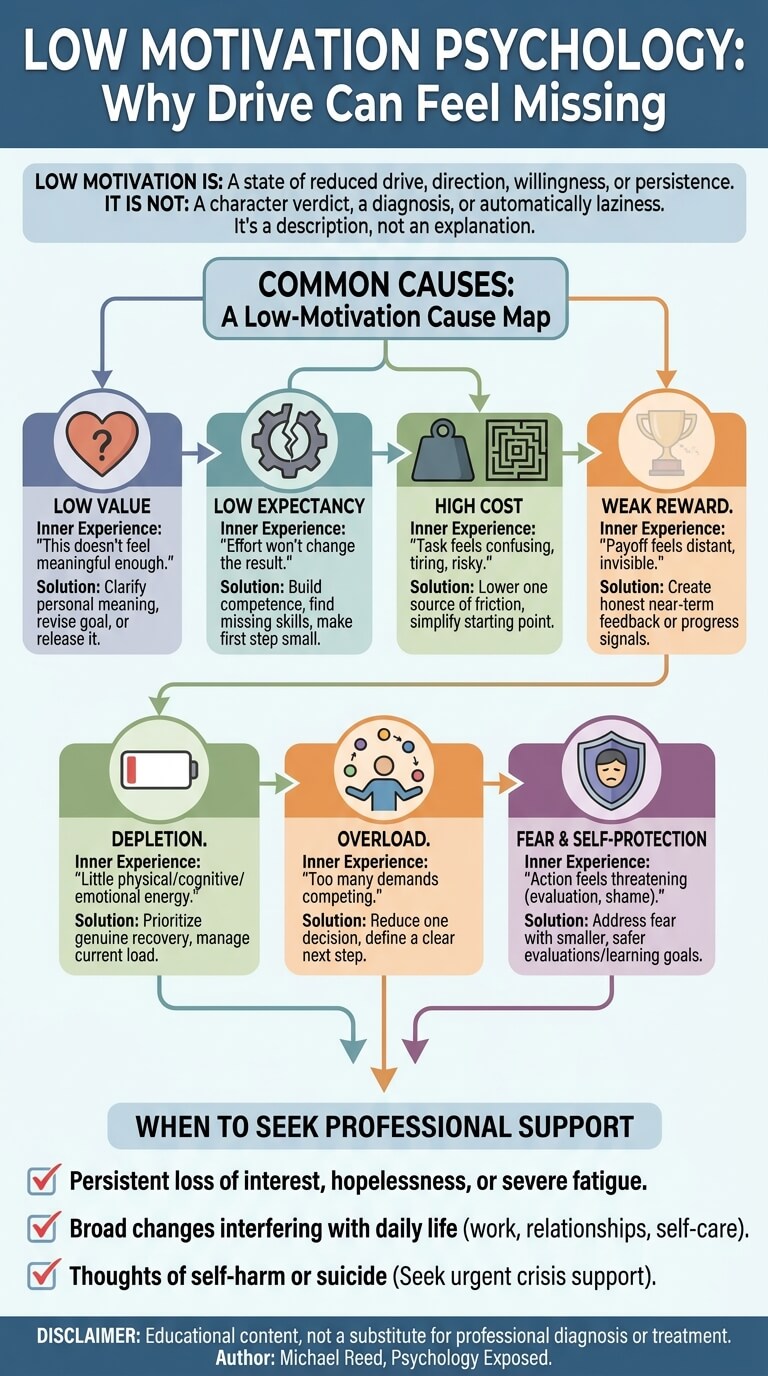
Low motivation means that the willingness or energy to begin, direct, or sustain action feels reduced. It is not a diagnosis and is not automatically laziness. Common causes include low personal value, low expected success, high effort cost, weak reward, depletion, overload, and fear of evaluation. Temporary low drive may improve when conditions change. Broad, persistent loss of interest, severe fatigue, hopelessness, self-harm thoughts, or major impairment requires timely professional support.
What Low Motivation Means and Does Not Mean
A state of reduced drive, direction, willingness, or persistence
The APA Dictionary of Psychology describes motivation as an impetus that gives purpose or direction to behavior. Low motivation can therefore involve weak direction, reduced willingness to spend effort, difficulty starting, or trouble continuing after action begins.
Some people still know exactly what they want but cannot mobilize enough energy. Others have energy but no goal that feels worth choosing. These experiences may sound similar while requiring different responses.
Low motivation is not a diagnosis
Low drive can appear during stress, sleep disruption, physical illness, emotional distress, medication changes, grief, overload, depression, and many other circumstances. It can also occur without a disorder.
One symptom cannot identify its cause. A diagnosis requires a qualified professional to consider duration, severity, other symptoms, medical history, functioning, and context.
Low motivation is not automatically laziness
“Lazy” is a moral label that hides useful questions. It does not tell you whether the person lacks value, confidence, energy, clarity, safety, or resources.
Someone may be working hard to manage pain, uncertainty, caregiving, or emotional strain that is invisible to others. Another person may be avoiding a goal that never belonged to them. Both situations deserve investigation rather than contempt.
One symptom can have many causes
Imagine two people postponing an online course. One no longer values the subject. The other values it intensely but feels incapable after repeated failure. A third person may be exhausted, while a fourth fears the exam at the end.
The outward action is the same. The mechanism is not. Generic advice works poorly when it assumes every case is a shortage of discipline.
A Low-Motivation Cause Map
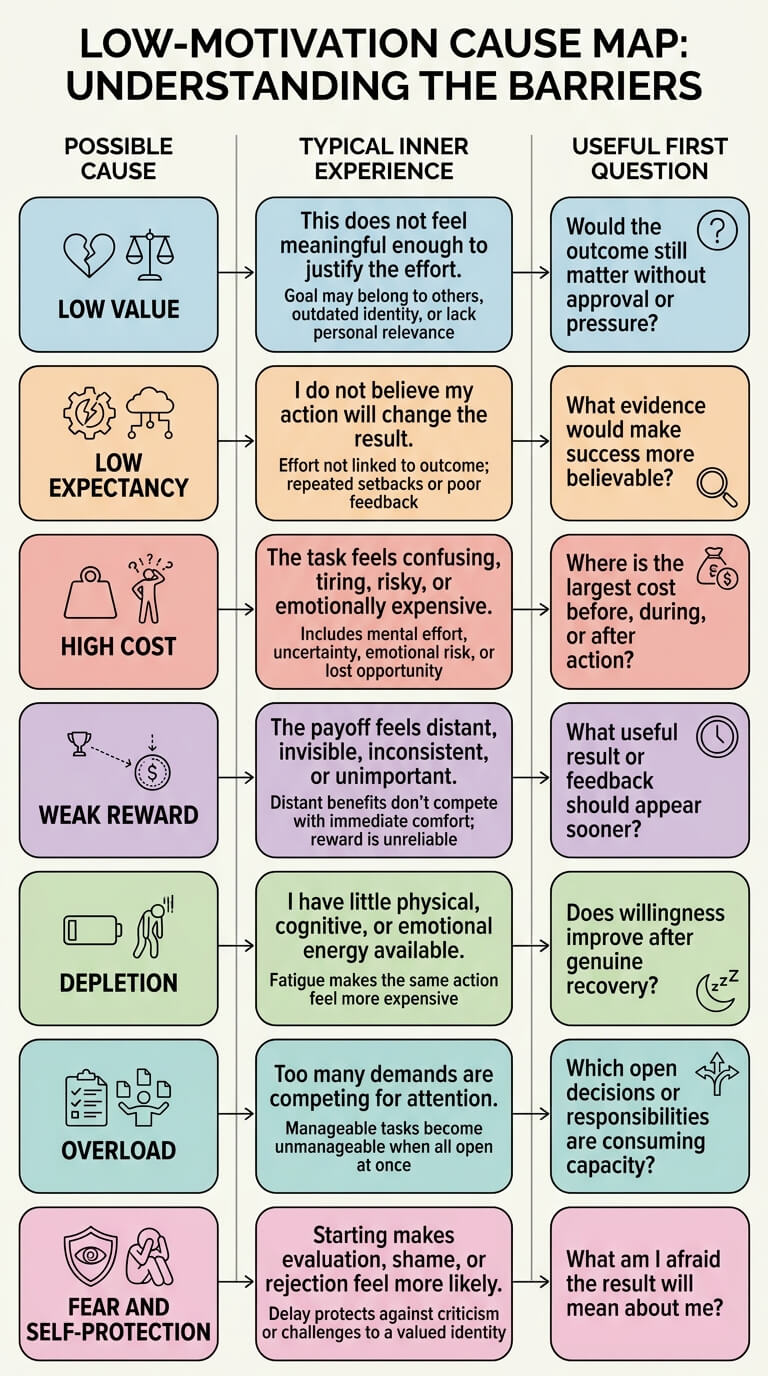
| Possible cause | Typical inner experience | Useful first question |
|---|---|---|
| Low value | This does not feel meaningful enough to justify the effort. | Would the outcome still matter without approval or pressure? |
| Low expectancy | I do not believe my action will change the result. | What evidence would make success more believable? |
| High cost | The task feels confusing, tiring, risky, or emotionally expensive. | Where is the largest cost before, during, or after action? |
| Weak reward | The payoff feels distant, invisible, inconsistent, or unimportant. | What useful result or feedback should appear sooner? |
| Depletion | I have little physical, cognitive, or emotional energy available. | Does willingness improve after genuine recovery? |
| Overload | Too many demands are competing for attention. | Which open decisions or responsibilities are consuming capacity? |
| Fear and self-protection | Starting makes evaluation, shame, or rejection feel more likely. | What am I afraid the result will mean about me? |
Low value: the goal does not feel meaningful
A goal may be clear and possible but still fail to create willingness. The outcome may belong to another person’s expectations, an outdated identity, or a standard that sounds impressive without improving the person’s life.
Low expectancy: effort does not seem likely to work
People invest less when they expect little connection between effort and outcome. Repeated setbacks, poor instruction, or inconsistent feedback can make action feel pointless.
Low expectancy can improve when progress and feedback provide credible evidence that effort is working.
High cost: the task feels too effortful, confusing, or emotionally expensive
Cost includes more than time. It can involve setup, uncertainty, concentration, embarrassment, conflict, pain, lost opportunity, or the emotional risk of being evaluated.
Weak reward: little immediate or visible payoff
A distant benefit may not compete effectively with immediate comfort. Motivation can also weaken when the reward is unreliable, no longer valued, or disconnected from the behavior.
Depletion: limited physical, cognitive, or emotional energy
When energy is low, the same action feels more expensive. Research on cognitive fatigue and effort-based choice suggests that fatigue can reduce willingness to select demanding cognitive activity.
Overload: too many demands competing for attention
Several manageable tasks can become unmanageable when they remain open at the same time. The mind must repeatedly decide what deserves attention and what can safely be ignored.
Fear and self-protection: action feels threatening
A person may want the result and still avoid the evaluation attached to it. Delay can protect against shame, criticism, rejection, or evidence that challenges a valued identity.
When action drops mainly near evaluation, fear of failure may be more relevant than low value or low energy.
Low Value and Unclear Meaning
Goals inherited from other people
Some goals begin as family expectations, cultural standards, school requirements, or advice from admired people. External guidance can be useful, but a goal remains fragile when the person never develops a reason they personally accept.
Ask what the goal would provide if nobody praised the result. A practical benefit may remain. If nothing remains, the resistance may be giving accurate information.
Outcomes that no longer match current priorities
A goal selected last year may conflict with current health, caregiving, finances, relationships, or values. Continuing only because of past investment can consume resources needed elsewhere.
Reviewing a goal does not erase earlier effort. It uses new information to decide whether the same direction still deserves commitment.
Before forcing action, examine whether the goal fits your values, current capacity, and available feedback.
Wanting the result but not valuing the process
A person may want the status of expertise but dislike learning, want a finished book but dislike writing, or want an appearance linked to an activity they consistently hate.
The question is whether another process can produce the desired result or whether the fantasy matters more than the lived experience required to reach it.
Low Expectancy and Reduced Self-Efficacy
Repeated setbacks
Repeated failure without useful explanation teaches doubt. The person may stop investing because effort appears unable to change the outcome.
One smaller success can help only when it is credible. Empty encouragement does not replace evidence that a new strategy or skill produces a different result.
Unclear instructions or missing skills
Confusion can look like low motivation. A person delays because each attempt requires guessing what to do, how to judge quality, and what should happen next.
Identify the missing skill or decision. “I cannot do this” becomes more workable when translated into “I do not yet know how to structure the first section.”
No evidence that effort changes the outcome
The APA Dictionary of Psychology defines self-efficacy as a person’s perception of their capability to perform or attain desired results. Motivation weakens when effort repeatedly provides no evidence of capability.
Useful feedback should show what changed, what remains difficult, and which action could improve the next attempt.
How progress and learning rebuild expectancy
Progress signals show whether movement is happening. Learning feedback explains how skill is changing. Together, they can make future effort more believable.
Track evidence that represents actual capability, not merely time spent or material collected.
Overload, Friction, and Depletion

Too many open decisions
Every unresolved choice creates another starting cost. Which task comes first? Which tool should be used? What standard is enough? When several goals require these decisions, avoidance may become the simplest option.
Reduce one decision at the point where action repeatedly stops. A default starting place or clearly prepared next step may be enough.
Emotional carryover and attention fragmentation
Conflict, uncertainty, caregiving, financial strain, and unfinished worries continue occupying attention after the immediate event ends. The person may have time for a task without having enough undivided mental capacity.
A realistic plan should account for current load rather than comparing performance with an ideal week.
Sleep, health, and life stress as contextual factors
Sleep disruption, physical symptoms, medication effects, illness, pain, and long-term stress can affect energy and concentration. Cleveland Clinic’s overview of fatigue and related symptoms notes that fatigue can occur with very low energy, low motivation, concentration difficulty, irritability, and other changes.
This overlap does not reveal the cause. Persistent, unexplained, worsening, or functionally limiting fatigue is a reason to speak with a qualified healthcare professional rather than assuming it is a mindset problem.
Why reducing friction is not the same as fixing every cause
Preparing the workspace or simplifying the first step can help when setup is the barrier. It will not restore health, create meaning, teach a missing skill, or remove a credible threat.
These causes fit within the broader framework of motivation psychology.
Use friction reduction as a test. If action becomes easier, friction was contributing. If nothing changes, investigate another mechanism.
Weak Reward and Delayed Payoff
Benefits that are too distant to feel real
Saving money, learning, rehabilitation, and long projects may provide little immediate benefit. The future matters, but the present action receives weak emotional support.
A nearer milestone or meaningful self-reward can help the person remain connected to the long-term reason.
Tasks with no visible completion signal
Work that lacks a clear stopping point can feel endless. The person receives no moment of completion and cannot tell whether enough has been done.
Define a meaningful unit such as one reviewed section, one corrected error set, or one completed decision. The unit should represent real movement rather than arbitrary activity.
How reward timing shapes motivation
Rewards influence anticipation, attention, and learning about what follows an action. They help most when they arrive soon enough to be connected with the behavior and do not replace the underlying reason.
When the payoff feels distant or weak, reward psychology helps explain how timing and anticipation affect drive.
If an incentive stops working, increasing it is not the only option. Check value, competence, friction, and whether the reward is teaching the behavior you actually want.
Fear Can Look Like Low Motivation
Avoidance before evaluation
Notice whether motivation drops specifically near submission, testing, publication, conversation, or another moment when the result can be judged. Planning may feel energetic while evaluation feels impossible.
This pattern suggests that threat, not low value, may be blocking action.
Shame, perfectionism, and self-protection
Perfectionism can keep the standard moving so the work never becomes ready. Procrastination can create an excuse for a poor result. Quitting early can protect the belief that success was still possible.
These behaviors reduce exposure in the short term. They also prevent useful feedback and evidence that an imperfect result can be tolerated.
When fear of failure needs closer attention
Ask what you believe a disappointing result would mean about worth, belonging, capability, or future options. Then separate that feared meaning from what one result can reasonably prove.
A smaller evaluation, a learning goal, or specific non-humiliating feedback may lower threat without removing the meaningful goal.
Low Motivation vs Motivation Fading
Low drive without a clear earlier high
Some people cannot identify a period when the goal felt energizing. The activity may have started with low value, high cost, weak reward, uncertainty, or external pressure.
The first question is, “What would make this worth choosing or possible to influence?”
A decline from previous motivation
Motivation fading describes a change. The person once felt more willing, interested, hopeful, or capable, and something later shifted.
The first question becomes, “What changed in value, expectancy, cost, reward, energy, feedback, or emotional risk?”
Why the distinction changes the first question to ask
Trying to recreate an earlier feeling makes sense only when that earlier state existed. When motivation was never strong, the task may require goal clarification, capability building, or a different reason entirely.
Low Motivation vs Depression, Burnout, or ADHD

Why overlap does not equal diagnosis
Low motivation, fatigue, concentration difficulty, procrastination, and reduced interest can appear in many conditions and in ordinary periods of strain. The overlap is real, but it is not specific enough for self-diagnosis.
Depression, ADHD, burnout, sleep disorders, medication effects, and physical health conditions require different assessments. A checklist cannot reliably determine which explanation applies.
Persistent loss of interest and broad functional change
The National Institute of Mental Health explains that major depression can include depressed mood or loss of interest most of the time for at least two weeks, together with symptoms that interfere with daily activities.
Loss of interest, hopelessness, low energy, concentration changes, sleep or appetite changes, and impaired functioning deserve attention when they are broad, sustained, or severe.
Context-specific low motivation versus cross-situation impairment
Context-specific low motivation appears mainly around one goal, relationship, setting, or type of evaluation. The person may function normally in other areas.
Cross-situation impairment affects several parts of life, including basic responsibilities, relationships, self-care, work, or activities that were previously meaningful. This wider pattern is more important to discuss with a professional.
When to speak with a qualified professional
Seek timely help when low drive is persistent, worsening, difficult to explain, accompanied by severe fatigue or hopelessness, or interfering with ordinary functioning. A healthcare professional can consider psychological, behavioral, medical, sleep-related, and medication-related factors.
Seek urgent local crisis or emergency support if you have thoughts of self-harm, suicide, or immediate danger.
A Non-Diagnostic Self-Check

| Question | What a “no” or concerning answer may suggest | Possible direction |
|---|---|---|
| Does the goal still matter to me? | Low value, external pressure, or changed priorities. | Clarify, revise, or release the goal. |
| Do I believe I can influence the outcome? | Low expectancy, weak self-efficacy, or missing skill. | Seek instruction, feedback, or a smaller test. |
| What makes the first step costly or confusing? | Friction, overload, uncertainty, or limited capacity. | Reduce one major barrier or decision. |
| Can I see any reward or progress signal? | Delayed payoff or invisible movement. | Create honest near-term feedback. |
| Is fear protecting me from evaluation or shame? | Threat-driven avoidance or perfectionism. | Use a smaller, safer evaluation and learning goal. |
| Is low drive affecting many areas for a sustained period? | A broader psychological, medical, sleep, or stress-related concern may need assessment. | Speak with a qualified professional. |
Does the goal still matter to me?
Imagine the outcome without praise, comparison, or guilt. Name what would remain valuable. If no personally meaningful benefit remains, motivation may be accurately reflecting low value.
Do I believe I can influence the outcome?
Ask what evidence supports success and what evidence weakens it. Replace a global judgment with one capability or condition that can be tested.
What makes the first step costly or confusing?
List the practical, cognitive, and emotional costs before action begins. Identify the largest barrier rather than redesigning the whole system.
Can I see any reward or progress signal?
Choose evidence that appears before the final result and represents real change. Avoid a metric that can improve while the true goal remains unchanged.
Is fear protecting me from evaluation or shame?
Notice whether delay creates immediate emotional relief. Name the meaning attached to a poor result and design a smaller test.
Is low drive affecting many areas for a sustained period?
Consider duration, breadth, severity, and functional impact. This question does not diagnose anything. It helps determine whether self-guided experimentation is enough or professional assessment is more appropriate.
Match the First Step to the Likely Cause
Clarify or release a low-value goal
Write the current reason in one sentence. Revise the outcome, choose a process that fits better, or release the goal when it no longer deserves resources.
Low drive can also reflect blocked autonomy, competence, or relatedness.
Build competence or reduce ambiguity
Find one missing skill, example, standard, or instruction. Make the next attempt small enough to produce useful information.
Lower one source of friction
Prepare the needed tool, choose the starting point, remove one unnecessary decision, or include setup and cleanup in the planned time.
Create honest feedback or a near-term reward
Use a signal connected to meaningful progress. A near-term reward can support a necessary task, but it should not become the only reason the goal exists.
Address fear with a smaller, safer evaluation
Share one section, practice privately, ask for specific feedback, or choose a learning target. The aim is real information with less unnecessary threat.
Seek support when symptoms are broad, persistent, or severe
Professional support is not a failure of self-discipline. It is the appropriate response when the problem may involve health, sustained emotional distress, major impairment, or safety risk.
What Not to Do
Add shame and moral judgment
Shame may create a short burst of action while increasing concealment, avoidance, and self-criticism. It does not identify the mechanism causing low drive.
Assume one routine solves every cause
A morning routine cannot make an unwanted goal meaningful, teach a missing skill, treat illness, or make an unsafe evaluation harmless.
Ignore severe distress or major functional change
Do not reduce persistent hopelessness, broad loss of interest, severe fatigue, or inability to manage ordinary tasks to a productivity problem.
Force a goal that no longer fits
Persistence is useful only when the direction remains valuable and the cost remains defensible. Changing direction can be a reasoned decision rather than avoidance.
Frequently Asked Questions About Low Motivation
Why do I have no motivation even for things I care about?
Caring about the result is only one part of motivation. Low expectancy, fatigue, overload, fear, delayed reward, friction, and missing progress signals can block action even when value remains high.
Can stress cause low motivation?
Yes. Stress can consume attention, disrupt sleep, increase emotional cost, and make immediate relief more attractive than long-term action. Persistent or severe changes should be discussed with a qualified professional.
How long is temporary low motivation likely to last?
There is no universal timeline. Consider whether it improves after rest, a change in stress, clearer instructions, or a revised goal. Duration matters most together with breadth, severity, other symptoms, and functional impact.
Is low motivation always a sign of depression?
No. Low motivation has many possible causes. Depression may include loss of interest, low energy, hopelessness, concentration changes, and impairment, but one symptom cannot establish the diagnosis.
Why do I feel motivated only when a deadline is close?
A close deadline makes consequences immediate, reduces ambiguity, and creates urgency. It can temporarily overpower weak reward or indecision. This pattern suggests that ordinary action may need clearer timing, smaller milestones, or a pre-decided starting condition.
Key Takeaways
- Low motivation is a state of reduced drive, direction, willingness, or persistence, not a diagnosis or moral defect.
- Common mechanisms include low value, low expectancy, high cost, weak reward, depletion, overload, and fear.
- The same lack of action can require completely different responses depending on the cause.
- Context-specific low drive differs from broad, sustained changes that affect many areas of functioning.
- A useful self-check examines meaning, expected success, friction, reward, fear, duration, and functional impact.
- Persistent loss of interest, hopelessness, severe fatigue, self-harm thoughts, or major impairment requires timely professional or emergency support.
Choose one activity that currently feels difficult to begin. Identify whether the strongest barrier is value, expectancy, cost, reward, energy, overload, or fear. Then test one response matched to that mechanism. Low motivation becomes more understandable when it stops being treated as one mysterious defect and starts being examined as information about the goal, the environment, and your current capacity.
Author note: Michael Reed is the Founder and Lead Writer at Psychology Exposed. He explains human behavior, emotional patterns, self-awareness, and everyday decisions in clear, research-aware language. This content is educational and is not a substitute for diagnosis, therapy, medical care, crisis support, or treatment.

Michael Reed is the Founder and Lead Writer at Psychology Exposed. He writes about human behavior, relationships, emotional patterns, self-awareness, and practical psychology topics using research-informed, easy-to-understand content.
Read More About Michael Reed: https://psychologyexposed.com/michael-reed/