

You can care deeply about an outcome and still struggle to begin. You can feel energized on Monday, indifferent on Wednesday, and ready to try again a month later. These changes are often treated as proof that someone is lazy, inconsistent, or not serious enough. Psychology offers a more useful explanation: motivation is not one permanent substance that you either possess or lack.
Motivation reflects how your mind evaluates a possible action. Does the outcome matter? Does success seem possible? How much effort, uncertainty, discomfort, or sacrifice will it require? Is there any sign that your effort is working? Those evaluations can change quickly, even when the goal itself stays the same.
Quick Answer

Motivation psychology examines the forces that give behavior direction, energy, and persistence. Motivation rises when an outcome feels valuable, achievable, and worth its cost. It often falls when value becomes unclear, success feels unlikely, effort becomes expensive, or feedback disappears. Low motivation is therefore not a single flaw. It is usually a changing response to meaning, expectation, reward, friction, energy, identity, and context.
What Motivation Means in Psychology
The APA Dictionary of Psychology defines motivation as an impetus that gives purpose or direction to behavior. That definition matters because motivation is not only about feeling excited. It helps explain why one action becomes more likely than another, why effort increases or decreases, and why a person continues, pauses, or stops.
Drive, direction, energy, and persistence
Four elements make motivation easier to understand. Drive is the pull or pressure to act. Direction determines which action receives attention. Energy affects how much effort is available. Persistence describes whether action continues when the task becomes difficult, repetitive, or uncertain.
A motive is not the same as feeling motivated
A motive is a reason, need, value, fear, incentive, or desired outcome that influences behavior. Feeling motivated is the conscious experience of readiness or willingness. The two do not always match.
For example, someone may value financial security yet feel little desire to open a complicated budgeting document. The motive is present, but the action carries friction and delayed reward. Another person may feel intensely motivated to reorganize a room because the task offers immediate control, even though it is less important than the assignment they are avoiding.
Motivation changes across situations and stages
Motivation is often specific to a task and a moment. A person can be highly motivated to support a friend, moderately motivated to study, and unable to begin exercise on the same day. This does not require a single personality explanation.
Why Motivation Matters in Everyday Life
Motivation influences more than achievement. It shapes what receives attention, which discomforts feel tolerable, how people interpret setbacks, and whether an intention becomes behavior.
Starting an action
Beginning requires the expected value of action to outweigh the immediate cost. A ten-minute task can remain untouched when it feels confusing, emotionally loaded, or connected to possible judgment. A much harder task may begin quickly when the next step is clear and the payoff feels meaningful.
Choosing one goal over another
People rarely pursue goals in isolation. Studying competes with rest, messages, chores, entertainment, and other responsibilities. Motivation helps prioritize among several valid possibilities.
Continuing when effort becomes costly
Persistence becomes relevant after the easiest part is over. The mind continues to compare expected benefit with effort, time, uncertainty, and missed alternatives. When the perceived cost rises faster than expected progress, motivation may decline.
Continuing does not require constant enthusiasm. It may depend on quieter reasons, useful structure, visible progress, and enough recovery to make the next effort possible. Persistence research also suggests that continuing a goal includes not only resisting the urge to quit, but recognizing chances to act and returning after interruptions.
Returning after interruption or failure
A missed day, rejected application, poor result, or stressful week can break a sequence without ending the goal. Motivation affects whether the interruption is interpreted as temporary information or permanent evidence of inadequacy.
A Four-Part Mental Model of Motivation
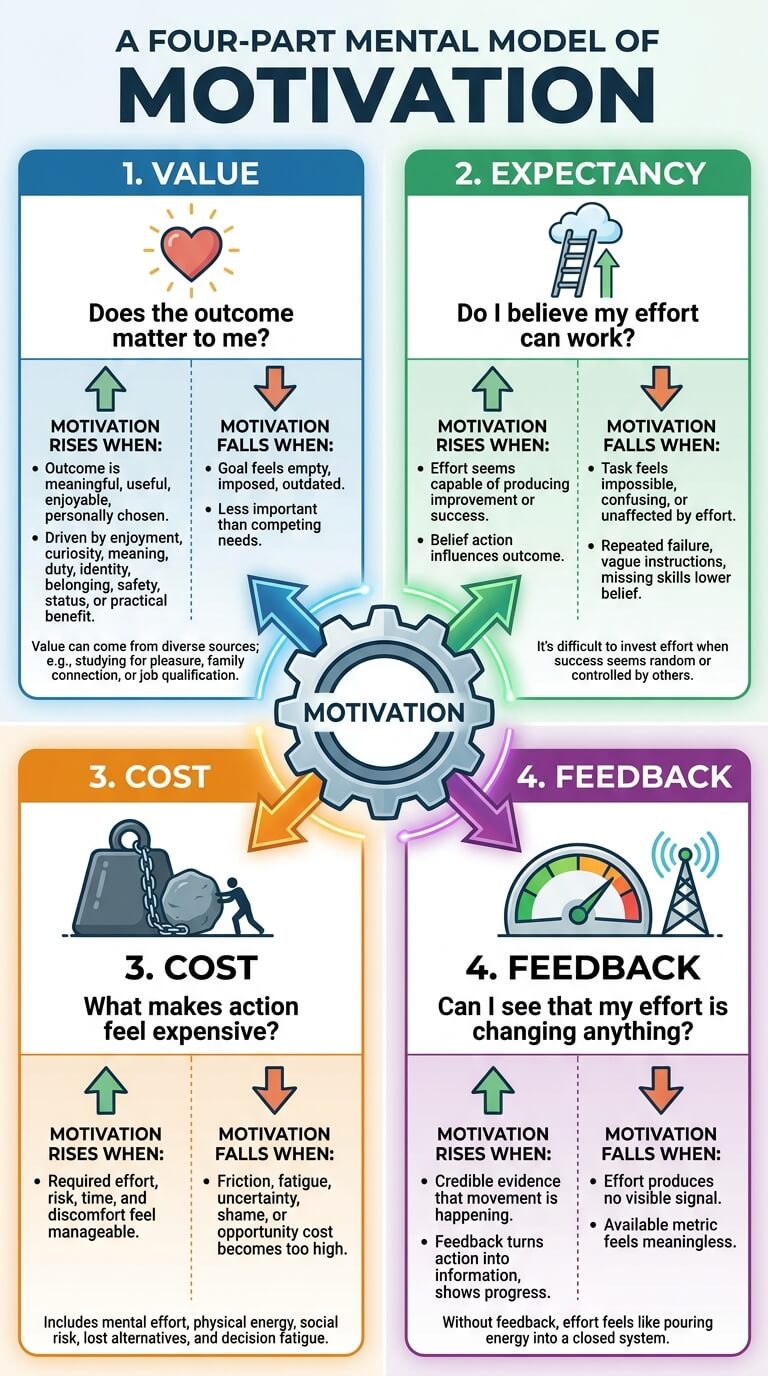
A practical way to examine motivation is to look at four moving judgments: value, expectancy, cost, and feedback. These are not separate switches. They influence one another.
| Question | When motivation tends to rise | When motivation tends to fall |
|---|---|---|
| Value | The outcome feels meaningful, useful, enjoyable, or personally chosen. | The goal feels empty, imposed, outdated, or less important than competing needs. |
| Expectancy | Effort seems capable of producing improvement or success. | The task feels impossible, confusing, or unaffected by effort. |
| Cost | The required effort, risk, time, and discomfort feel manageable. | Friction, fatigue, uncertainty, shame, or opportunity cost becomes too high. |
| Feedback | There is credible evidence that movement is happening. | Effort produces no visible signal, or the available metric feels meaningless. |
Value: does the outcome matter to me?
Value can come from enjoyment, curiosity, meaning, duty, identity, belonging, safety, status, or practical benefit. Two people can pursue the same action for entirely different reasons. One studies a language for pleasure, another for family connection, and another to qualify for a job.
Expectancy: do I believe my effort can work?
Expectancy is the belief that action can influence the outcome. It is difficult to invest effort when success seems random, impossible, or controlled by someone else. Repeated failure, vague instructions, and missing skills can all lower this belief.
Cost and friction: what makes action feel expensive?
Cost includes more than time. It can involve mental effort, physical energy, uncertainty, boredom, social risk, embarrassment, lost alternatives, or the number of decisions required before the real task starts.
Feedback: can I see that my effort is changing anything?
Feedback turns action into information. It shows whether a method is working, whether skill is developing, and whether the goal remains reachable. Without feedback, effort can feel like pouring energy into a closed system.
Where Motivation Comes From
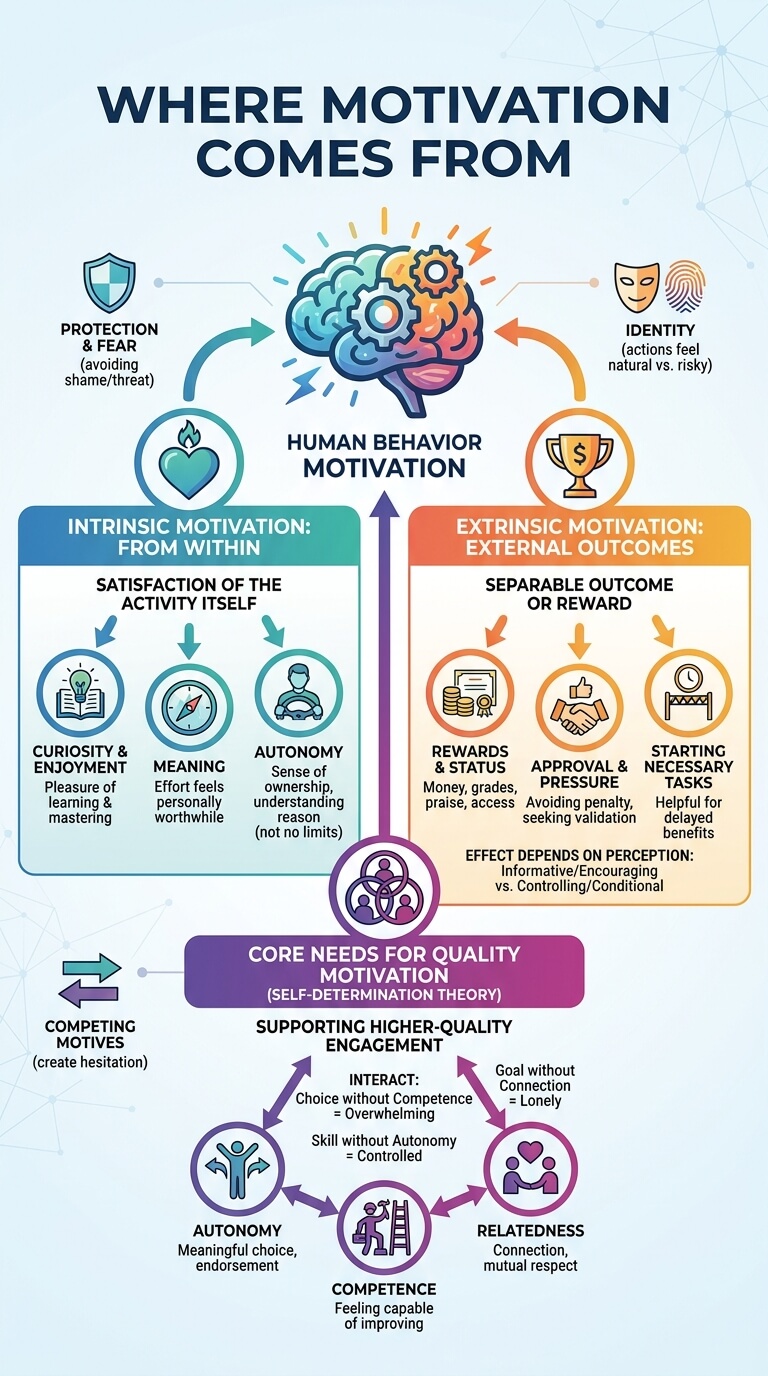
Human behavior rarely has one cause. Motivation may arise from enjoyment, need, reward, identity, fear, connection, obligation, or several of these at once.
A useful next step is to compare intrinsic and extrinsic motivation, because the source of a motive can change how willing and stable the effort feels.
Interest, meaning, autonomy, and intrinsic motivation
Intrinsic motivation comes from the satisfaction of the activity itself, such as curiosity, enjoyment, or the pleasure of mastering a challenge. Meaning can also make effort feel personally worthwhile, even when the activity is not enjoyable every minute.
Autonomy adds a sense of ownership. It does not mean having no limits or responsibilities. It means the person can understand and endorse the reason for acting rather than experiencing the action only as pressure.
Rewards, approval, pressure, and extrinsic motivation
Extrinsic motivation involves a separable outcome, such as money, a grade, praise, status, access, or avoiding a penalty. It is not automatically shallow or harmful. External reasons often help people begin necessary tasks whose benefits are delayed.
The effect depends partly on how the incentive is experienced. A reward may feel informative and encouraging, or controlling and conditional. Pressure can produce quick compliance while also making the activity feel less personally owned.
Autonomy, competence, and relatedness needs
Self-Determination Theory proposes that autonomy, competence, and relatedness help support higher-quality motivation. People tend to engage more willingly when they experience meaningful choice, feel capable of improving, and feel connected to others who respect them.
These needs interact. Choice without competence may feel overwhelming. Skill without autonomy may feel controlled. A meaningful goal without connection may become lonely. This framework helps explain why the same activity can energize one person and drain another.
Fear, protection, identity, and competing motives
Not all motivation moves toward pleasure or growth. People also act to avoid shame, rejection, uncertainty, loss, and threat. A person can want success while simultaneously wanting protection from evaluation.
Identity affects which actions feel natural or risky. When an action fits a valued identity, difficulty may be interpreted as part of the process. When it threatens identity, the same difficulty may feel like evidence that the person does not belong. Competing motives can create hesitation even when the stated goal is sincere.
How Motivation Changes Across a Goal

The starting phase: novelty and imagined reward
Beginnings are rich in possibility. The desired future is vivid, while the cost remains partly imaginary. New plans also offer a quick identity reward: buying materials, announcing a goal, or creating a schedule can make change feel underway before difficult practice begins.
This early energy is real, but it is not proof that the original pace is sustainable. A strong start becomes more useful when it is treated as a chance to learn what the process actually requires.
The pattern of starting strong and then losing motivation often appears when novelty fades before a sustainable pace and feedback system develop.
The middle phase: friction, uncertainty, and delayed payoff
The middle reveals repetitive work, hidden decisions, skill gaps, and slower progress. The final reward may be too distant to guide today’s action. This is where people often conclude that motivation has vanished.
Sometimes the goal still matters, but the cost estimate has changed. A workable response might involve reducing friction, getting instruction, changing the pace, or creating nearer feedback. More emotional intensity is not always the missing ingredient.
The persistence phase: progress signals and recovery
Longer pursuit depends on evidence that effort has meaning. Small wins can strengthen expectancy and competence when they represent genuine movement. Recovery also matters because depleted attention and energy raise the perceived cost of every action.
Progress psychology explains why small wins and credible feedback can make continued effort feel worthwhile.
Persistence is therefore not endless force. It involves effort, feedback, adjustment, and rest. A person who reviews the method may continue more intelligently than someone who follows the original plan rigidly.
The restart phase: learning without self-condemnation
Restarting asks a different question from starting. The person now has evidence about what caused friction, which expectations were unrealistic, and what support was missing. That information can improve the next attempt.
Self-condemnation hides useful detail. “I failed again” compresses many possibilities into one verdict. “The plan required ninety minutes on days when I reliably had twenty” points toward a change that can be tested.
A Map of Common Motivation Questions
Intrinsic vs extrinsic motivation: meaning, interest, reward, and pressure
This distinction asks where the reason for action comes from. Intrinsic motivation involves interest or satisfaction in the activity itself. Extrinsic motivation involves a separate result, such as money, approval, or avoiding consequences. Most real behavior contains a mixture.
The more useful question is not which type is morally better. It is whether the motive supports ownership, realistic effort, and long-term value, or whether it creates pressure that collapses when the incentive disappears.
Self-Determination Theory: autonomy, competence, and relatedness
This theory looks beyond the amount of drive and asks about its quality. Motivation tends to be more willing and sustainable when people understand their choices, feel able to improve, and experience respectful connection.
Self-Determination Theory explains this quality of motivation through autonomy, competence, and relatedness.
It is especially useful when a person is technically complying but feels controlled, incapable, or disconnected. The problem may not be a lack of incentives. It may be that the environment repeatedly undermines ownership or competence.
Why motivation fades: broad mechanisms behind declining drive
Motivation can decline because novelty fades, value changes, expected success drops, costs rise, rewards weaken, or feedback disappears. These causes may look identical from the outside, yet they require different responses.
A broader look at low motivation helps separate low value, low expectancy, high effort cost, depletion, overload, and fear.
A broad cause map is useful when drive existed before but has gradually or suddenly weakened at any stage. It prevents the common mistake of treating every decline as a need for stricter discipline.
Why you start strong then lose motivation: the early-burst pattern
This pattern is more specific. It begins with high enthusiasm, ambitious pacing, and a vivid imagined reward. The drop arrives when novelty fades and hidden friction becomes real.
The key issue may be a launch plan built for the most energized day rather than ordinary life. A better restart often uses a slower pace, an early feedback signal, and a clear return plan after interruptions.
Motivation vs discipline: drive compared with behavioral structure
Motivation supplies reasons, direction, and willingness. Discipline adds structure that helps action continue when feelings change. They are complementary, not enemies.
This is also why motivation and discipline should not be treated as interchangeable: one supplies direction and willingness, while the other protects follow-through.
Discipline cannot make every goal meaningful, and motivation cannot remove every repetitive demand. The important diagnosis is whether you lack a reason, a believable path, sufficient capacity, or a structure for follow-through.
Reward psychology: anticipation and reinforcement
Rewards affect attention and future choice. Their timing, predictability, meaning, and controlling quality all matter. A near-term reward may help bridge a delayed benefit, while a controlling reward may replace personal ownership.
Reward psychology helps explain how anticipation, timing, reinforcement, and perceived control can either strengthen or weaken drive.
Reward psychology is useful when incentives work briefly, require constant escalation, or make an activity feel less enjoyable than before. It also helps separate genuine progress feedback from a prize added only to force compliance.
Goal setting psychology: how goals direct or damage motivation
A goal organizes attention and defines what counts as progress. Clear, challenging, believable goals can guide effort. Vague, imposed, impossible, or all-or-nothing goals can create confusion and avoidance.
The quality of a goal matters before discipline enters the picture. If the destination is poorly designed, greater force may only produce more frustration in the wrong direction.
Goal setting psychology shows how clarity, difficulty, commitment, feedback, and identity fit shape the effort a goal receives.
Progress psychology: why visible movement keeps effort alive
Progress increases motivation when it offers credible evidence that effort is working. It can strengthen expected success, reduce uncertainty, and make a distant outcome feel closer.
Not every metric represents meaningful movement. A useful progress signal reflects the change you actually care about, arrives soon enough to guide the next action, and does not reward the wrong behavior.
Fear of failure psychology: when self-protection blocks action
Fear of failure can produce low action even when desire is high. The feared outcome may represent shame, rejection, loss of identity, or proof of inadequacy. Avoiding the task then provides short-term relief.
This pattern requires a different response from simple boredom. The person may need a smaller evaluation, a learning-focused goal, and a way to separate performance information from personal worth.
Low motivation psychology: understanding a low-drive state
Low motivation describes an experience, not a diagnosis. It may reflect low value, low expectancy, high cost, weak reward, depletion, overload, fear, or a wider change in emotional functioning.
The first useful step is to identify whether the low drive is specific to one task or persistent across many areas. That distinction helps determine whether to change the goal, reduce friction, build competence, rest, or seek professional support.
Motivation Compared With Nearby Psychology Concepts
Motivation vs discipline
Motivation concerns why and where behavior is directed. Discipline concerns intentional follow-through, especially when preference changes. A meaningful goal can still need structure, and a disciplined routine can still serve a goal that no longer deserves effort.
Motivation vs habit
Habits are learned responses that become easier to trigger with less deliberate choice. Motivation often helps establish or modify behavior, but repeated action can eventually depend less on feeling ready each time.
When the problem is remembering or repeating a small action in a stable context, habit design may matter more. When the person sees no value or possibility in the action, a cue alone will not solve the deeper issue.
Motivation vs flow
Flow is a state of deep involvement in an activity, often associated with clear goals, immediate feedback, and a workable balance between challenge and skill. Motivation can lead someone toward an activity, but flow describes the quality of engagement once involved.
You can be motivated without entering flow, and you can experience flow during an activity that is not your most important long-term priority.
Motivation vs success mindset
A success-oriented mindset concerns beliefs and interpretations about growth, setbacks, opportunity, and achievement. Motivation is broader. It includes value, reward, cost, energy, identity, and competing motives, not only optimistic thinking.
Changing a belief may help when expectancy is the problem. It will do less when the goal is unwanted, the environment is obstructive, or the person is severely depleted.
General motivation vs workplace motivation
General motivation appears across study, health, creativity, relationships, caregiving, leisure, and personal change. Workplace motivation adds conditions such as job design, leadership, compensation, role clarity, organizational justice, and team culture.
The basic psychological mechanisms overlap, but a work problem should not automatically be treated as an individual failure of drive. Sometimes the environment is creating unreasonable cost or removing autonomy and feedback.
Which Motivation Problem Best Matches Your Experience?
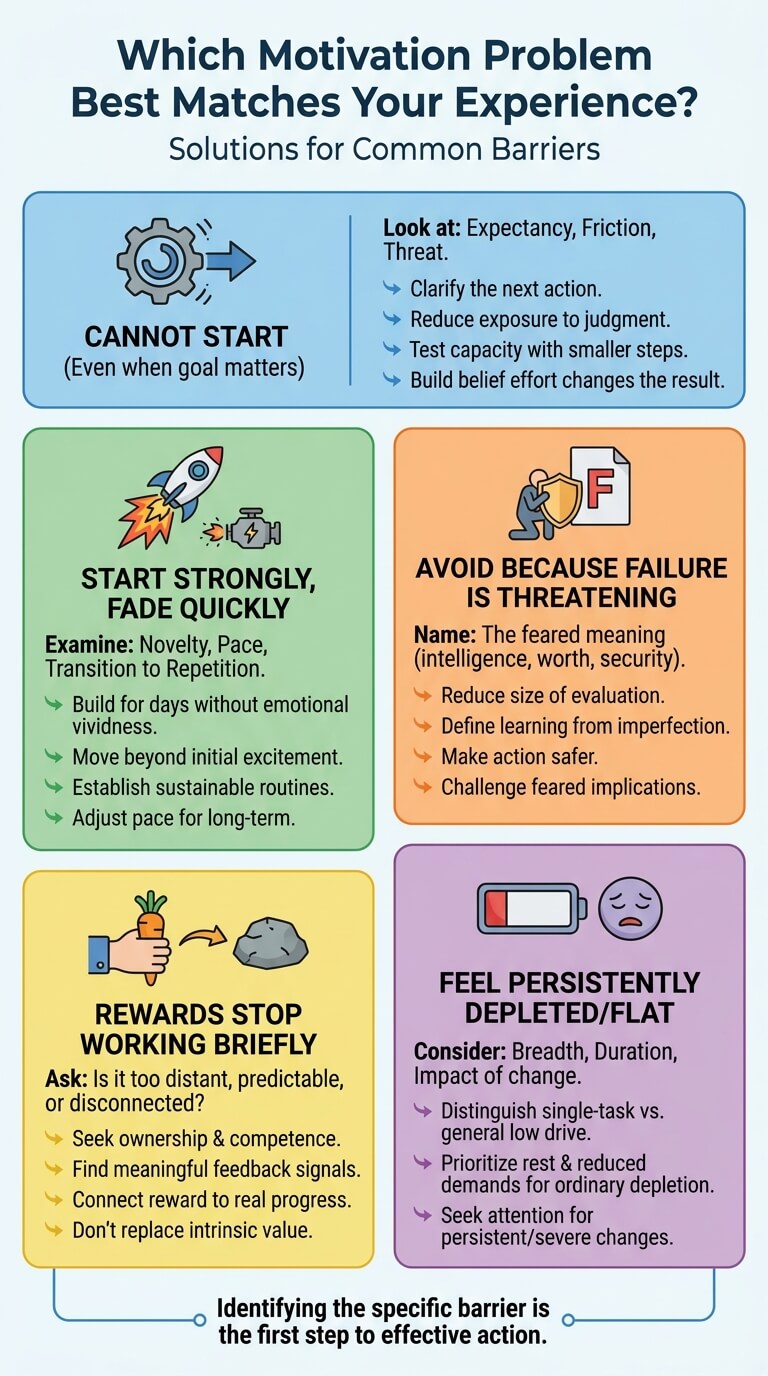
You cannot start even when the goal matters
Look first at expectancy, friction, and threat. Is the next action unclear? Does the task expose you to judgment? Do you believe effort can change the result? A smaller test may reveal whether the barrier is confusion, fear, or genuine lack of capacity.
You start strongly but fade quickly
Examine novelty, pace, and the transition into ordinary repetition. Your initial plan may have depended on unusual excitement. Build for the days when the goal matters but does not feel emotionally vivid.
Rewards work briefly and then stop working
Ask whether the reward is too distant, predictable in an unhelpful way, disconnected from real progress, or replacing the reason the activity once mattered. More reward is not always the answer. Sometimes the task needs ownership, competence, or a meaningful feedback signal.
You keep avoiding because failure feels threatening
Name what failure would seem to prove. The feared meaning may involve intelligence, worth, belonging, or future security. Reducing the size of the evaluation and defining what can be learned from an imperfect result may make action safer.
You feel persistently depleted or emotionally flat
Consider the breadth, duration, and impact of the change. Low drive tied to one unwanted task differs from losing interest across many activities. Rest and reduced demands may help ordinary depletion, but persistent or severe changes deserve more careful attention.
Common Misunderstandings About Motivation
Low motivation is not automatically laziness
“Lazy” is a judgment, not an explanation. It hides whether the person is depleted, afraid, unconvinced, overwhelmed, under-rewarded, or pursuing a goal they did not choose. Better explanations create better options.
More pressure does not always create more drive
Pressure can create urgent action when consequences are immediate. It can also increase threat, resistance, concealment, and dependence on external control. The fact that pressure produced behavior once does not prove it supports durable motivation.
Motivation does not need to feel intense to guide action
Quiet willingness is still motivation. A person may act from a steady value without excitement. Expecting every useful action to feel inspiring can make normal effort seem like evidence that something is wrong.
Knowing what is good for you does not guarantee action
Knowledge increases value only when it feels relevant and believable. It does not automatically reduce cost, create skill, supply energy, remove fear, or make the reward immediate. Information is one input in a larger motivational system.
When Low Motivation May Need More Support
Persistent loss of interest, severe distress, or impaired daily functioning
Low motivation alone does not establish a mental health condition. However, a persistent loss of interest or pleasure, major changes in energy or concentration, hopelessness, or difficulty managing daily life can be worth discussing with a qualified health professional. The National Institute of Mental Health describes these as possible depression-related symptoms, while also making clear that diagnosis depends on a fuller assessment.
Seek urgent local help if low drive is accompanied by thoughts of self-harm, suicide, or immediate danger. An educational article cannot assess risk or replace professional care.
How to seek professional support without self-diagnosing
You do not need to arrive with a diagnosis. Describe what has changed, how long it has lasted, which areas of life are affected, and any changes in sleep, appetite, energy, concentration, or safety. Concrete observations help a clinician understand the situation.
It can also be useful to note whether motivation improves in certain settings. Context-specific improvement does not settle the question, but it provides information about stress, demands, support, and the kinds of activities that still feel possible.
Frequently Asked Questions About Motivation Psychology
Is motivation an emotion, a thought, or a behavior?
Motivation is not identical to any one of these. It is a process that influences the direction, intensity, and persistence of behavior. Emotions can increase or reduce motivation, thoughts shape expected value and success, and behavior provides feedback that updates future motivation.
Why can motivation change from one day to the next?
The perceived value, cost, reward, and feasibility of an action change with sleep, stress, time pressure, recent feedback, social context, and competing needs. A change in motivation does not always mean the goal has become meaningless. It may mean the current conditions altered the calculation.
Can motivation return after a long period of low drive?
Yes, motivation may return when value becomes clearer, skill improves, friction decreases, energy recovers, or progress becomes visible. It may also return in a different form. The renewed drive may feel quieter and more realistic than the original enthusiasm.
Is intrinsic motivation always better than extrinsic motivation?
No. Intrinsic motivation is valuable for interest, exploration, and sustained engagement, but external incentives can help with necessary tasks and delayed benefits. The quality of motivation depends on context, personal ownership, pressure, competence, and what happens when the incentive ends.
Why do people act against goals they say they value?
A valued long-term goal competes with immediate relief, fear reduction, social approval, fatigue, and other motives. The person may sincerely value the goal while the current action feels too costly or unlikely to work. Contradictory behavior does not automatically prove insincerity.
Key Takeaways
- Motivation gives behavior direction, energy, and persistence, but these elements do not always rise and fall together.
- Value, expectancy, cost, and feedback provide a useful way to identify why drive has changed.
- Low motivation can reflect an unwanted goal, low confidence, hidden friction, delayed reward, depletion, fear, or several factors at once.
- Motivation, discipline, habit, and flow solve different psychological problems and should not be treated as interchangeable.
- Restarting is a separate skill from starting because it uses information gained from interruption, friction, and failed expectations.
- Persistent loss of interest, severe distress, major impairment, or self-harm thoughts should be taken seriously and discussed with appropriate professional or emergency support.
Final Thoughts
When motivation drops, do not begin with a verdict about your character. Choose one current goal and ask four questions: Does it still matter, do I believe my effort can work, what makes action expensive, and what evidence would show movement? Your answers may point toward a clearer reason, a smaller test, less friction, better feedback, recovery, or permission to change direction.
The next step is not always to push harder. It is to identify which part of the motivational system changed, then respond to that specific change.
Author note: Michael Reed is the Founder and Lead Writer at Psychology Exposed. He explains human behavior, emotional patterns, self-awareness, and everyday decisions in clear, research-aware language. This article is educational and is not a substitute for diagnosis, medical care, or mental health treatment.

Michael Reed is the Founder and Lead Writer at Psychology Exposed. He writes about human behavior, relationships, emotional patterns, self-awareness, and practical psychology topics using research-informed, easy-to-understand content.
Read More About Michael Reed: https://psychologyexposed.com/michael-reed/