
Two people can sit in the same meeting, hear the same sentence, and leave with opposite accounts. One remembers useful feedback. The other remembers public criticism. Both may be sincere because attention, expectation, emotion, experience, role, and memory shape what each person takes the event to mean.
A shared event is not automatically a shared experience, and not every interpretation is equally accurate. Understanding the gap helps people compare observations, identify missing context, and revise conclusions without treating disagreement as proof of dishonesty.
Quick Answer: The Event Is Shared, but the Perceptual Lens Is Not
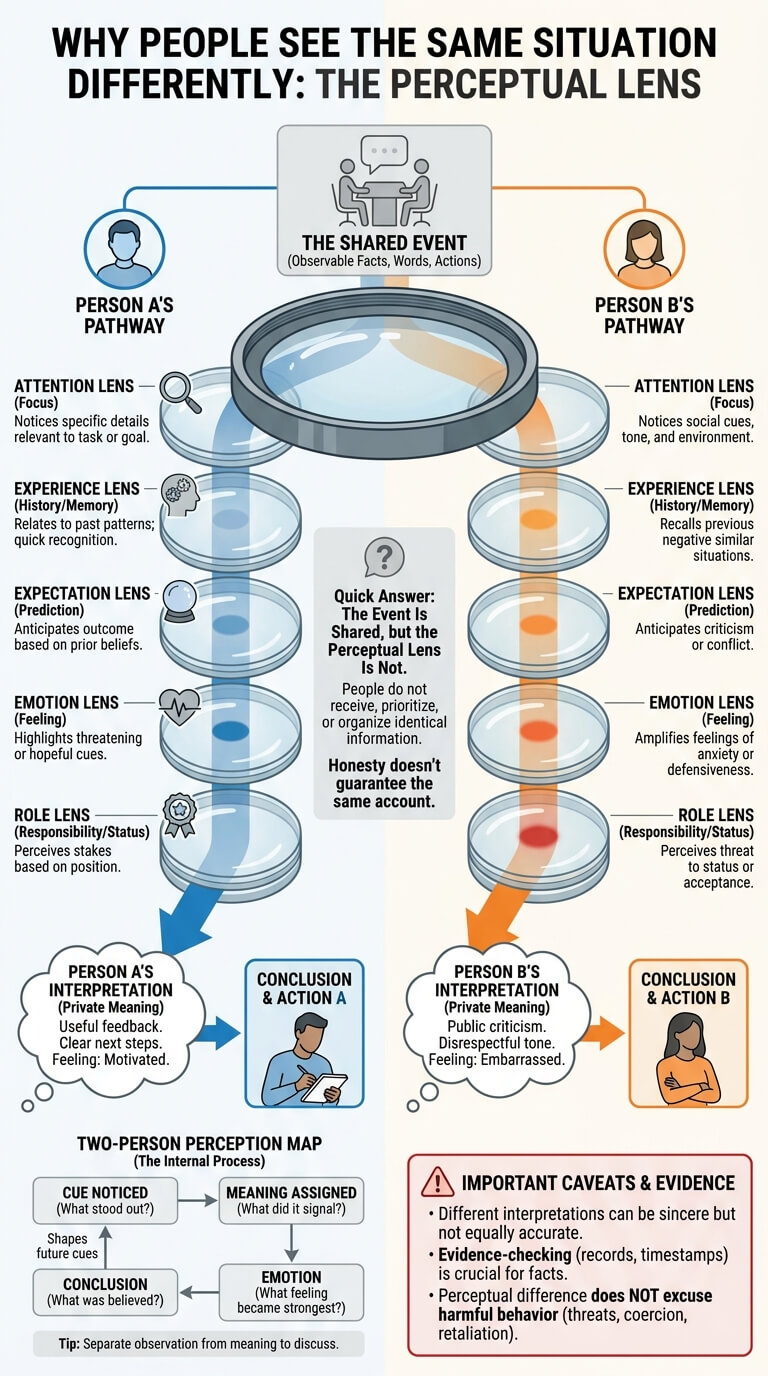
People see the same situation differently because they do not receive, prioritize, organize, or remember identical information. Viewing position, emotion, history, expectations, goals, roles, and cultural learning influence which details stand out and what they appear to mean.
People do not receive or prioritize identical information
People standing close together may still have different sensory access. One sees a facial expression that another misses; one hears a comment while another is distracted. The APA Dictionary description of selective perception captures the further limit that people attend to only part of what is available.
Meaning depends on history, emotion, role, and expectation
A detail does not arrive with one fixed meaning attached. A short reply may look efficient to a busy coworker, irritated to someone expecting conflict, or reassuring to someone who feared being ignored. The words are shared, but their significance is built from context and what each observer is prepared to notice.
Different interpretations do not automatically mean someone is lying
Honesty concerns deliberate misrepresentation; perceptual difference concerns how an event was noticed and understood. A confident account can be incomplete, and sincere accounts can conflict. Ask what each person observed and what meaning they added.
The Same Situation, Different Perceptual Pathways
Differences can enter through access, attention, expectation, interpretation, or later recall. Several small differences may accumulate before people compare accounts.
Different viewing positions and sensory access
Where someone stands matters. A person near the door notices who left first. Someone facing the presenter notices hesitation. A person reading a message lacks tone and facial expression entirely. The event may be shared in a broad sense while the available evidence is not identical.
Different details receive attention
Attention favors information that seems relevant to a current task, concern, or goal. During a family discussion, one person tracks the practical decision, another watches who is being interrupted, and another listens for signs of disrespect. Each later describes the part that received the strongest mental priority.
Different expectations organize the cues
Expectations act like a preliminary sorting system. If a manager is expected to be supportive, an ambiguous question may be heard as curiosity. If the manager is expected to be critical, the same question may sound like a challenge. Expectations do not invent every cue, but they influence how uncertain cues are grouped.
Different meanings are assigned
After details are selected, people infer significance. Silence may mean thoughtfulness, withdrawal, confusion, disagreement, or simple fatigue. The cue is observable, but its meaning is not directly visible. Interpretation fills that gap, often quickly and without deliberate analysis.
Different memories are formed afterward
Memory is reconstructed during recall, and later information can change what feels central or certain. A review in PubMed Central explains why confidence and accuracy do not always align. People may therefore remember different turning points from one conversation.
These differences begin within the broader process of perception, before people judge, remember, or respond.
The Seven-Lens Model
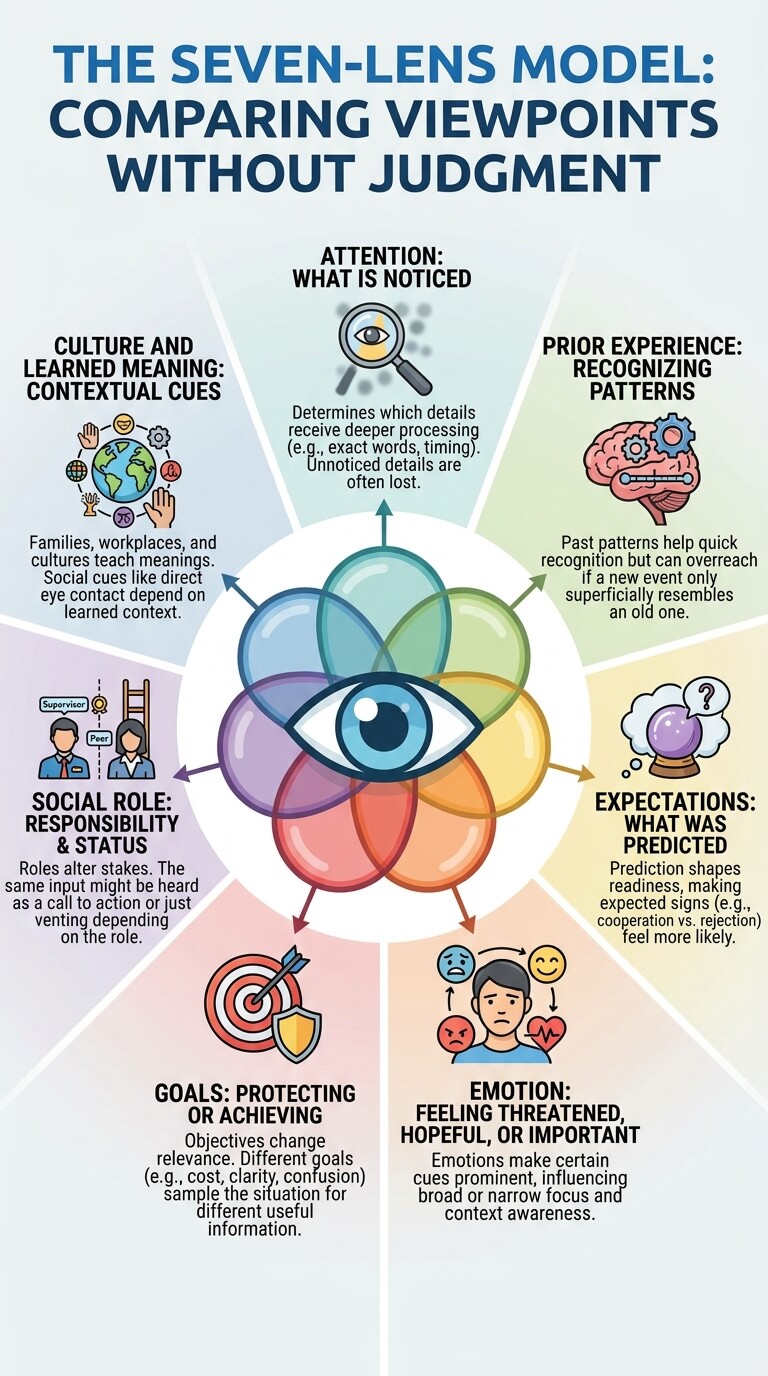
These seven lenses help compare viewpoints without deciding too early that one person is reasonable and the other is not. Several usually operate at once.
Attention: what each person noticed
Attention determines which details receive deeper processing. One observer may notice the exact words, another the timing, and another the reaction in the room. What is not attended to may never become part of the person’s later account, even though it was visible or audible.
Prior experience: what the event resembled
Past experience helps people recognize patterns quickly. This is often useful. Someone who has handled many technical failures may notice an early warning that others overlook. The same learning can also overreach when a new event resembles an old one only on the surface.
Expectations: what each person predicted
Prediction shapes readiness. Someone expecting cooperation notices cooperative signs; someone expecting rejection monitors delay, distance, or unclear language. Expectations are not proof, but they change which possibilities feel likely.
Emotion: what felt threatening, hopeful, or important
Emotion can make particular cues more prominent. Reviews of emotion and perception research describe how affective and motivational factors can influence whether people focus broadly or narrowly and whether context enters awareness. Feeling anxious, angry, hopeful, or ashamed may therefore change the apparent center of the same scene.
Goals: what each person was trying to protect or achieve
Goals change relevance. In one project discussion, finance tracks cost, design tracks clarity, and support tracks customer confusion. Each samples the situation for different useful information.
Social role: what responsibility or status changed
Roles alter stakes. A supervisor may hear a complaint as something requiring action, while a peer hears venting. A new employee notices signs of acceptance that an established employee barely registers.
Culture and learned meaning: what cues signaled in context
Families, workplaces, communities, and cultures teach meanings. Direct eye contact may signal confidence in one setting and disrespect in another. Research on emotion perception across cultures shows why social cues depend partly on learned context.
A Step-by-Step Example: The Same Meeting Feedback
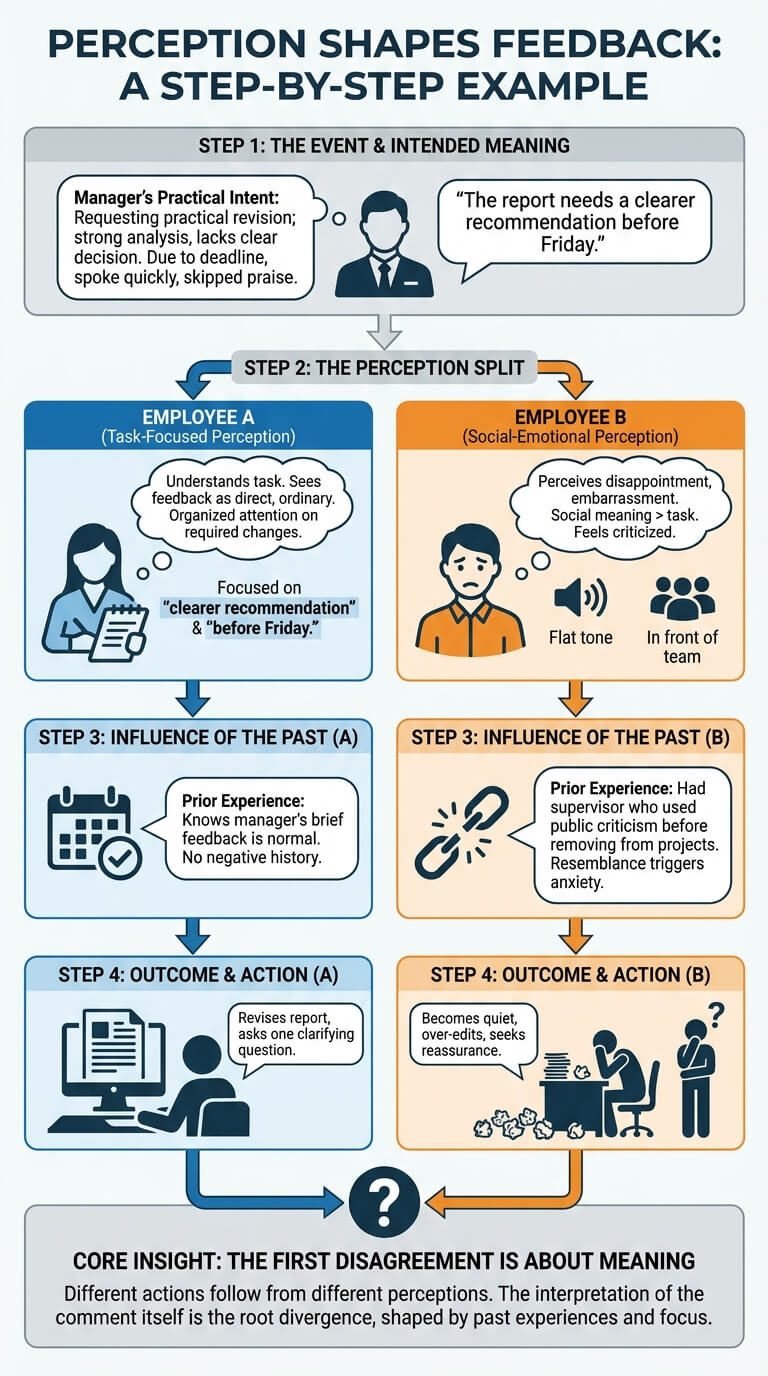
A manager says, “The report needs a clearer recommendation before Friday.” What each employee notices, and what the comment resembles from the past, changes the experience.
What the manager intended
The manager may intend a practical revision request. They believe the report contains strong analysis but lacks a clear decision. Because the deadline is close, they speak quickly and move to the next agenda item without explaining the positive part.
What one employee noticed
Employee A focuses on “clearer recommendation” and “before Friday.” They understand the task, write down two action steps, and perceive the feedback as direct but ordinary. Their attention is organized around what needs to be changed.
What another employee noticed
Employee B focuses on the manager’s flat tone and the fact that the criticism happened in front of the team. They perceive disappointment and possible embarrassment. The requested revision is heard, but the social meaning becomes more prominent than the task itself.
How prior experience changed the meaning
Employee A has worked with this manager long enough to know that brief feedback is normal. Employee B once had a supervisor who used public criticism before removing people from projects. The current situation is not identical, but the resemblance changes what feels important.
How behavior may diverge only after perception
Employee A may revise the report and ask one clarifying question. Employee B may become quiet, over-edit, or seek reassurance from a coworker. The different actions matter, but they appear after the perceptual difference. The first disagreement is about what the comment meant.
A Step-by-Step Example: The Unanswered Message

A read but unanswered message offers little evidence and considerable uncertainty, leaving several explanations possible.
One person perceives busyness
Person A knows the recipient is traveling and often opens messages between tasks. The delay fits an established pattern that usually has no relational meaning. Busyness becomes the most available explanation.
Another perceives rejection
Person B recently had a tense exchange with the same recipient. They notice the read receipt and the absence of a reply. Because the relationship already feels uncertain, the silence appears connected to the earlier disagreement.
Missing context keeps both interpretations plausible
Neither interpretation is yet established. The recipient may be busy, avoiding the conversation, unsure what to say, or planning a fuller reply. Uncertainty is uncomfortable because the mind prefers a complete story, but discomfort does not make one explanation more factual.
What additional evidence would update each view
A later response, a known work deadline, a repeated pattern of avoidance, or a direct clarification would change the balance. A useful conclusion remains proportional to the available evidence: “I do not know yet” may be more accurate than either reassurance or rejection.
A Step-by-Step Example: A Family Disagreement
Family history, unequal responsibilities, and different information make competing accounts especially likely.
Different roles create different stakes
An adult child may experience a holiday decision as a question of fairness. A parent may experience it as responsibility for keeping the gathering possible. A sibling caring for an elderly relative may focus on travel difficulty. Each person is responding to a different consequence inside the same decision.
Emotional history makes different cues salient
A joke that seems harmless to one sibling may echo years of being treated as less capable for another. The current words matter, but so does the emotional history that gives them weight. This does not settle whether harm was intended, yet it helps explain why the joke was not received uniformly.
Memory preserves different turning points
One person remembers the first criticism. Another remembers the raised voice that came later. A third remembers trying to calm everyone down. These are not interchangeable details. Each becomes the point around which the event is mentally organized.
Why Emotion Changes the Same Scene
Emotion influences attention and interpretation while events unfold. The resulting view is not automatically false, but it may favor emotionally relevant cues.
Anxiety increases uncertainty and threat weighting
When someone feels anxious, unclear information may receive more threat-focused interpretation. A pause can feel ominous, a neutral face can seem disapproving, and an unanswered question can feel like evidence of a larger problem. The person may be detecting a real concern, but anxiety increases the need to distinguish the cue from the prediction.
Anger highlights obstruction or disrespect
Anger prepares attention for barriers, unfairness, and violation. During a disagreement, an angry observer may notice interruption, dismissive wording, or broken agreements quickly. They may miss conciliatory details that seem less relevant to the immediate sense of being blocked.
Shame highlights evaluation and exposure
Shame directs attention toward how the self may be judged. Feedback that another person hears as specific may feel global: not “this needs revision,” but “everyone can see I am inadequate.” The emotional meaning expands beyond the literal content.
Positive expectation highlights cooperation
A hopeful or trusting observer may notice flexibility, goodwill, and opportunities to repair. This can support cooperation, yet optimism can also underweight warning signs. No emotional state provides a perfect view; each changes what becomes easiest to see.
Why Experience Changes the Same Scene
Experience supports fast pattern recognition, but familiar interpretations can feel more certain than current evidence warrants.
Familiar patterns are recognized faster
A teacher notices when a class is losing attention. A nurse notices subtle changes in a patient’s presentation. A musician hears timing differences that a casual listener misses. Familiarity makes some signals meaningful sooner because they fit a learned structure.
Old learning can be useful or outdated
A person who learned that silence usually preceded punishment may still react strongly to silence in a safer relationship. The learning once served a purpose, but the present cue may have a different meaning. The task is not to erase experience, but to test whether it still fits.
Expertise notices details that novices miss
Research comparing experts and novices in visual detection illustrates how training can speed recognition of task-relevant information. Expertise is still domain-specific. A skilled engineer may see a mechanical warning immediately while missing the social tension that another observer notices first.
Why Social Position and Role Matter
Authority, responsibility, dependence, and access to information shape what people see and what a situation may cost them.
Power changes what consequences are visible
A decision-maker may see a policy as efficient because they experience its aggregate result. A person affected by the policy may see delays, uncertainty, or loss of control. Neither viewpoint alone captures every consequence. Power often changes which consequences arrive directly and which remain distant.
Responsibility changes what information feels relevant
The person responsible for safety notices risk. The person responsible for speed notices delay. The person responsible for morale notices tone. Role-based attention is useful because complex situations require different forms of monitoring, but it can create disagreement about what “the main issue” is.
Insider and outsider knowledge create different context
An insider knows the history behind a decision but may overlook how confusing it looks from outside. An outsider notices contradictions but lacks background information. Comparing both views can reveal what is genuinely unclear and what only appears inconsistent because context is missing.
Different Perception vs Different Behavior
Perception and response are connected but distinct. Separating them keeps visible behavior from replacing the question of what each person believed was happening.
Interpretation comes before response
A person who interprets a question as curiosity may explain more. Someone who interprets it as accusation may defend themselves. The visible behavior begins after a private meaning has already formed, even if that meaning arose in seconds.
Similar perceptions can still produce different actions
Two people can both perceive criticism accurately and respond differently. One asks for examples, another goes quiet, and another disagrees openly. Temperament, habits, goals, and available choices help explain the action after the shared perception.
Do not reduce behavior to viewpoint alone
Perception explains one part of the pathway, not the whole person. Values, self-control, social rules, incentives, and consequences also shape behavior. Understanding someone’s interpretation does not remove responsibility for what they choose to do next.
Different Viewpoints vs Perception and Reality
Sometimes the task is to compare observers. At other times, an interpretation must be tested against records, timelines, physical evidence, or repeated outcomes.
Multiple sincere accounts versus evidence-checking
When two people emphasize different details, begin by mapping access and attention. When a claim concerns a checkable fact, such as whether a message was sent or an agreement was recorded, external evidence becomes more important. Sincerity does not override verifiable information.
Shared facts, private meanings, and unknown details
| Part of the situation | Example | Best question |
|---|---|---|
| Shared fact | The meeting ended ten minutes early | What can everyone verify? |
| Private meaning | “The manager wanted to escape the discussion” | What led you to that interpretation? |
| Unknown detail | Whether another urgent meeting had started | What information is missing? |
When to check the account against stronger evidence
Move toward evidence-checking when consequences are serious, the disagreement concerns a specific factual claim, records are available, or one explanation repeatedly conflicts with observable outcomes. The aim is not to humiliate anyone. It is to prevent uncertainty from being settled only by confidence or status.
How to Discuss Different Interpretations
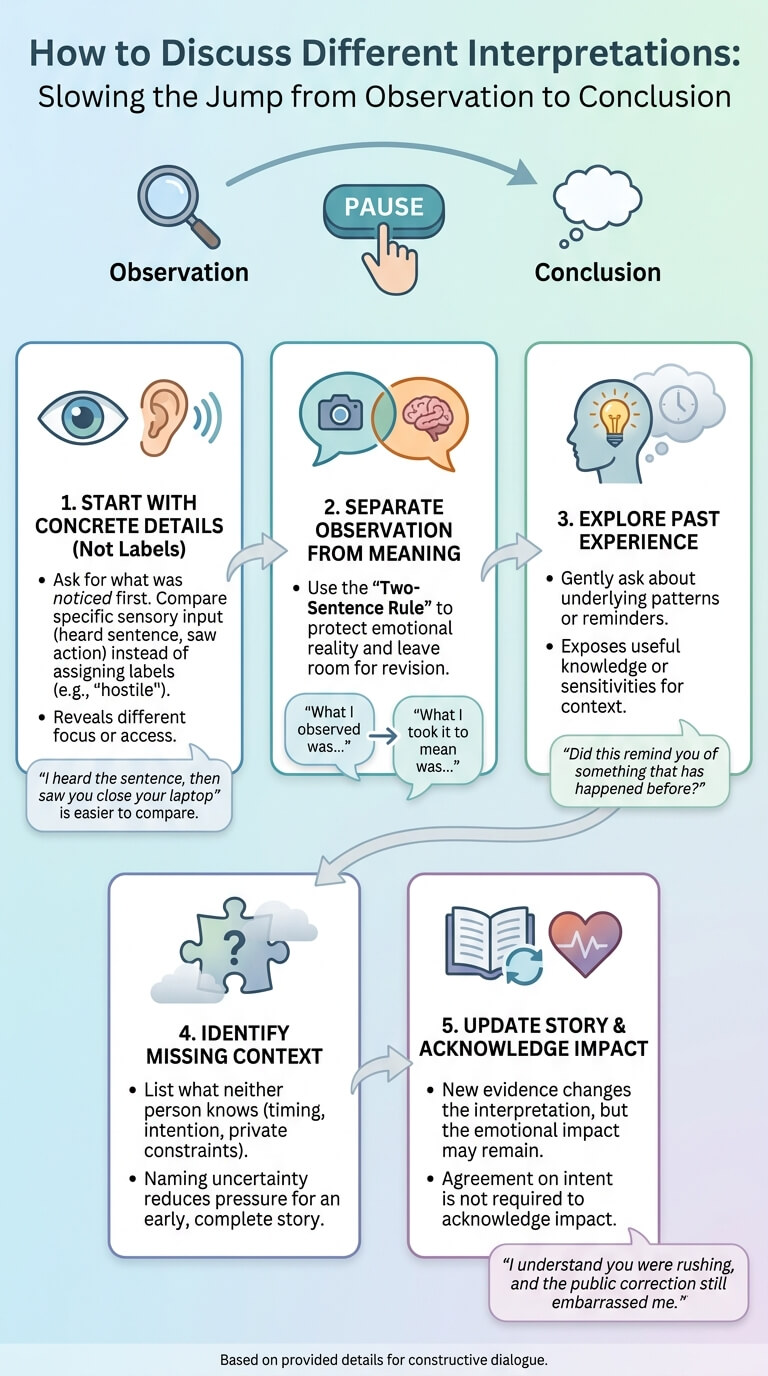
A useful discussion slows the jump from observation to conclusion. It makes the route from cue to meaning visible without demanding identical feelings.
Start with what each person noticed
Ask for concrete details before labels. “I heard the sentence, then saw you close your laptop” is easier to compare than “You were hostile.” Specific observations reveal whether people had different access or focused on different moments.
Separate observation from meaning
Use two sentences: “What I observed was…” and “What I took it to mean was….” This protects the emotional reality of the experience while leaving the interpretation open to revision. It also makes disagreement less personal because the disputed step becomes identifiable.
Ask what past experience shaped the interpretation
A gentle question can expose the pattern underneath the conclusion: “Did this remind you of something that has happened before?” The answer may reveal useful knowledge, an outdated expectation, or a sensitivity that deserves context rather than ridicule.
Identify missing context
List what neither person knows. Missing context might include timing, intention, private constraints, or what happened just before someone entered the room. Naming uncertainty reduces the pressure to choose a complete story too early.
Update the story without demanding identical feelings
New evidence may change the interpretation while the emotional impact remains. Someone can say, “I understand that you were rushing, and the public correction still embarrassed me.” Agreement about intent is not required before impact can be acknowledged.
What Different Perception Does Not Excuse
Perceptual difference is an explanation for disagreement, not a blanket defense. Facts, consequences, boundaries, and safety still matter.
Evidence can still contradict a claim
A person may sincerely remember an event incorrectly. Documents, recordings, timestamps, or multiple independent observations may show that a claim does not fit what happened. Correcting the factual record is compatible with treating the person respectfully.
Impact still matters
Good intentions and a different interpretation do not erase impact. A useful response can include both: “I did not mean it that way, and I can see that the wording affected you.” This keeps explanation from turning into dismissal.
Different interpretation does not excuse threats, coercion, humiliation, or retaliation
No one has to debate perception while feeling unsafe. If disagreement is met with intimidation, stalking, threats, forced isolation, humiliation, or retaliation, prioritize safety and outside support rather than trying to perfect the conversation. A viewpoint difference does not justify controlling behavior.
A Two-Person Perception Map
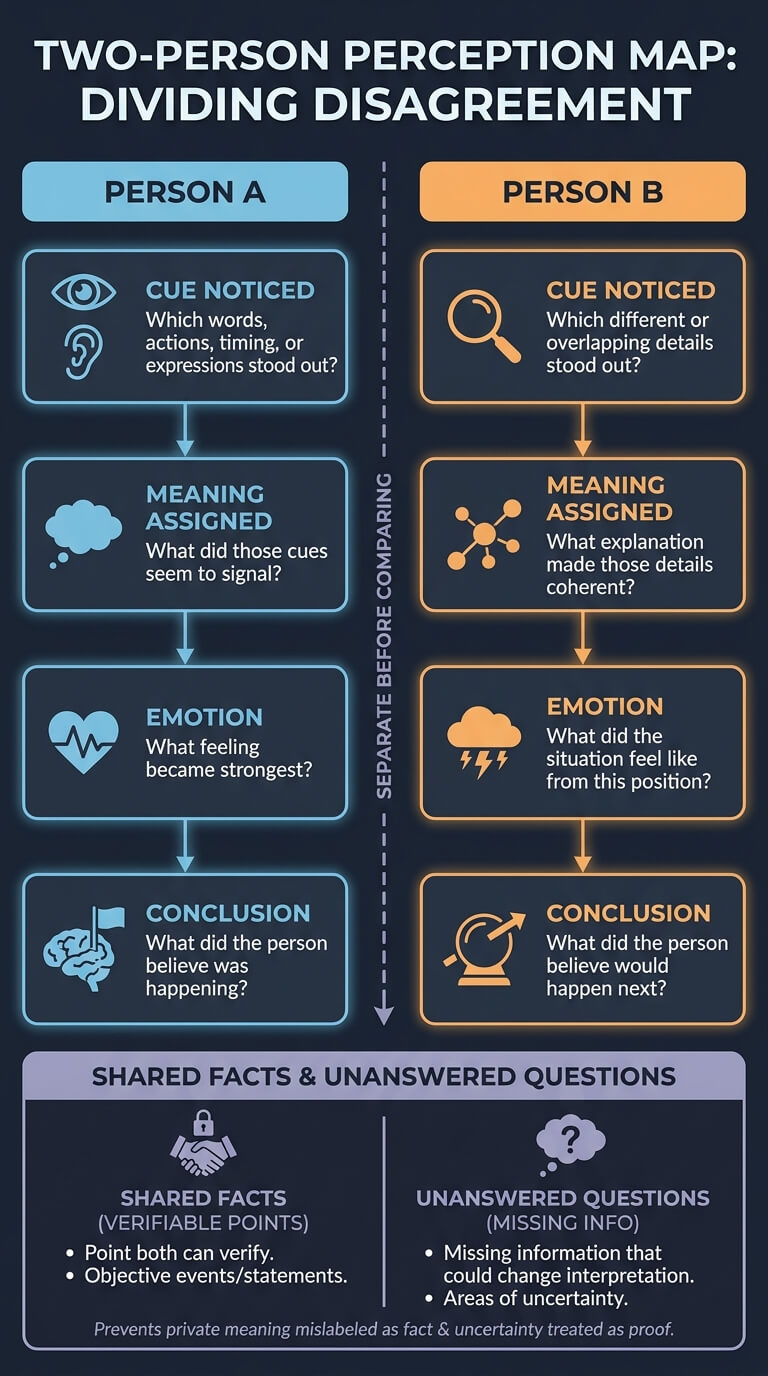
This map divides a vague disagreement into comparable parts. During a heated discussion, complete it separately before comparing accounts.
Person A: cue, meaning, emotion, conclusion
| Step | Person A |
|---|---|
| Cue noticed | Which words, actions, timing, or expressions stood out? |
| Meaning assigned | What did those cues seem to signal? |
| Emotion | What feeling became strongest? |
| Conclusion | What did the person believe was happening? |
Person B: cue, meaning, emotion, conclusion
| Step | Person B |
|---|---|
| Cue noticed | Which different or overlapping details stood out? |
| Meaning assigned | What explanation made those details coherent? |
| Emotion | What did the situation feel like from this position? |
| Conclusion | What did the person believe would happen next? |
Shared facts and unanswered questions
Finish with two lists. The first contains points both people can verify. The second contains missing information that could change the interpretation. This prevents private meaning from being mislabeled as shared fact and prevents uncertainty from being treated as proof.
How These Differences Connect to Other Perception Processes
Several psychological processes may be involved, but each answers a different question.
Selective perception explains different noticed details
Use selective perception when the central question is why one person attended to a detail that another missed. It concerns selection from available information, not the complete explanation for the final judgment.
Perceptual set explains different expectations
Use perceptual set when prior context prepared people to interpret an ambiguous cue in a particular way. It clarifies why one meaning became available faster than another before much evidence had accumulated.
Social perception explains how people interpret one another
Use social perception when the disagreement involves inferred traits, emotions, motives, or intentions. It highlights how words, behavior, roles, and context combine into an impression of another person.
Perception and reality questions call for evidence-checking
Use an evidence-focused approach when the issue is whether a personal impression fits external facts. The question changes from “Why did we experience this differently?” to “Which parts of this conclusion are supported, contradicted, or still unknown?”
When a claim is externally checkable, compare both accounts with the distinction between perception and reality rather than treating sincerity as proof.
Frequently Asked Questions About Different Perceptions
These questions address the points that most often create confusion when people compare accounts of a shared event.
Can two people remember the same event differently and both be honest?
Yes. People may notice different details, organize the event around different turning points, and reconstruct it from different emotional or social positions. Honesty does not guarantee completeness or accuracy. The best comparison separates observable facts, personal meanings, and missing information.
Why do experts and beginners see different things?
Training helps experts recognize patterns and task-relevant details that beginners have not yet learned to prioritize. This advantage is usually specific to the area of expertise. Experts may still miss unexpected information, and beginners may notice obvious contextual features that specialists take for granted.
Does mood change how a situation looks?
Mood and emotion can influence which cues stand out and how ambiguity is interpreted. Anxiety may increase attention to threat, anger to obstruction, and hope to cooperation. Emotion provides information about the person’s experience, but it is not by itself proof of what another person intended.
How can people find shared facts without agreeing on meaning?
Begin with concrete observations, records, sequence, and direct quotations where available. Then state meanings separately: “I interpreted that as…” People can agree that a sentence was said while disagreeing about whether it was supportive, dismissive, or rushed.
When is a different interpretation no longer reasonable?
An interpretation becomes harder to defend when it repeatedly conflicts with strong evidence, requires ignoring key facts, or is used to avoid responsibility for harm. Reasonableness also depends on willingness to update. A view held with absolute certainty despite clear contradiction is different from a tentative explanation under uncertainty.
Key Takeaways
- People can share an event without receiving or prioritizing identical information.
- Attention, experience, expectation, emotion, goals, role, and culture shape what details mean.
- Two conflicting accounts can be sincere, but sincerity does not guarantee accuracy.
- Separate observation, interpretation, emotion, and conclusion before deciding where the disagreement begins.
- Use external evidence when the dispute concerns a checkable fact or serious consequence.
- Different perception never excuses intimidation, coercion, humiliation, threats, or retaliation.
A practical next step is to choose one recent disagreement and complete the two-person map. Write what each person noticed before writing what either person meant. That small separation often reveals whether the conflict began with different access, different attention, different expectations, or a conclusion that was formed too quickly.

Michael Reed is the Founder and Lead Writer at Psychology Exposed. He writes about human behavior, relationships, emotional patterns, self-awareness, and practical psychology topics using research-informed, easy-to-understand content.
Read More About Michael Reed: https://psychologyexposed.com/michael-reed/