
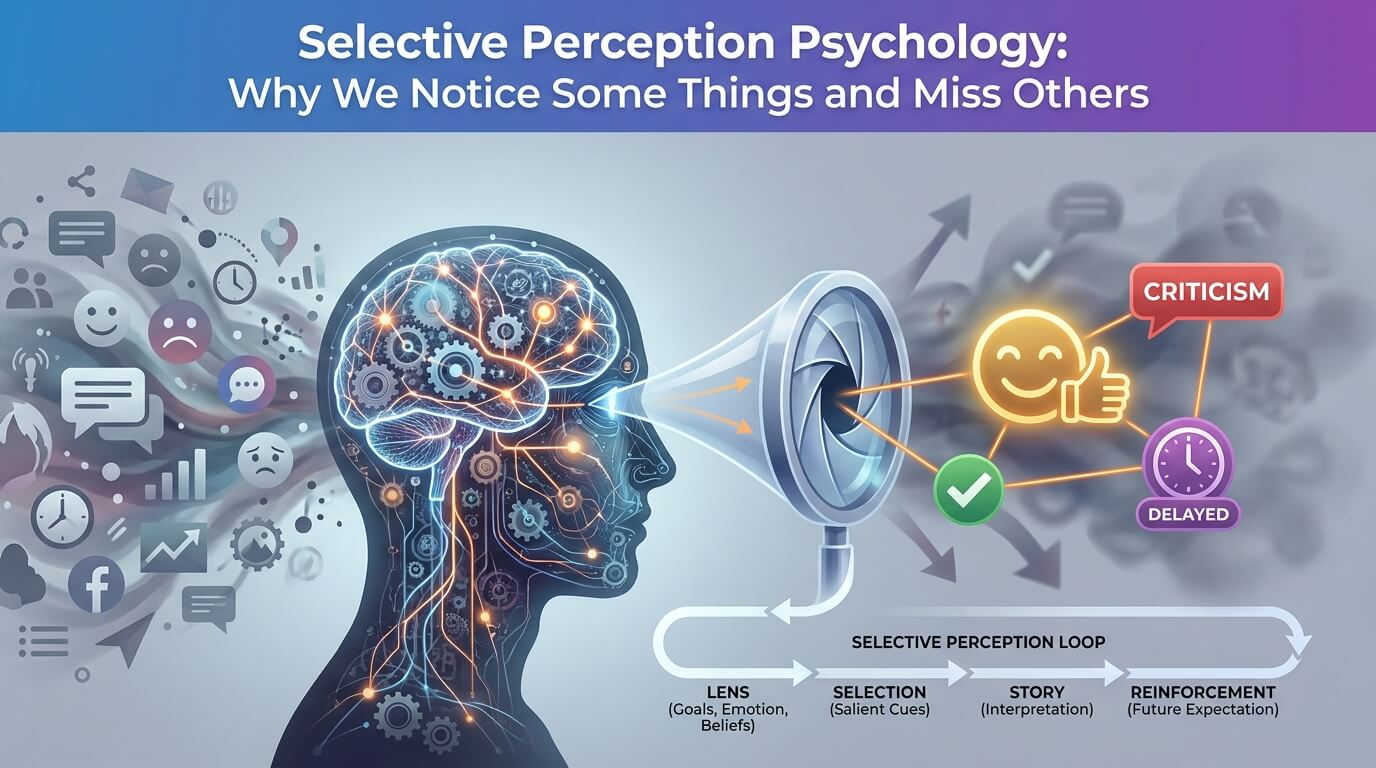
Two people can sit through the same meeting, read the same message, or witness the same disagreement and come away with different accounts. One remembers the criticism. Another remembers the reassurance. One notices a delayed reply. Another notices the warm tone that came before it. Neither person necessarily invented what happened. They may have selected different parts of the available information.
Selective perception describes this uneven filtering. The mind does not give every sound, facial expression, sentence, and background detail equal weight. Current goals, expectations, emotions, prior learning, and vivid features help determine what reaches the foreground. The details that stand out then influence the meaning a person builds.
Different filters help explain why two people can see the same situation differently without either person inventing every detail.
This does not mean that every disagreement is caused by a distorted mind, or that missing context is deliberate denial. Selection is a normal part of perception. The useful question is whether the filter is flexible enough to update when more evidence becomes available.
Quick Answer: Perception Begins With a Filter
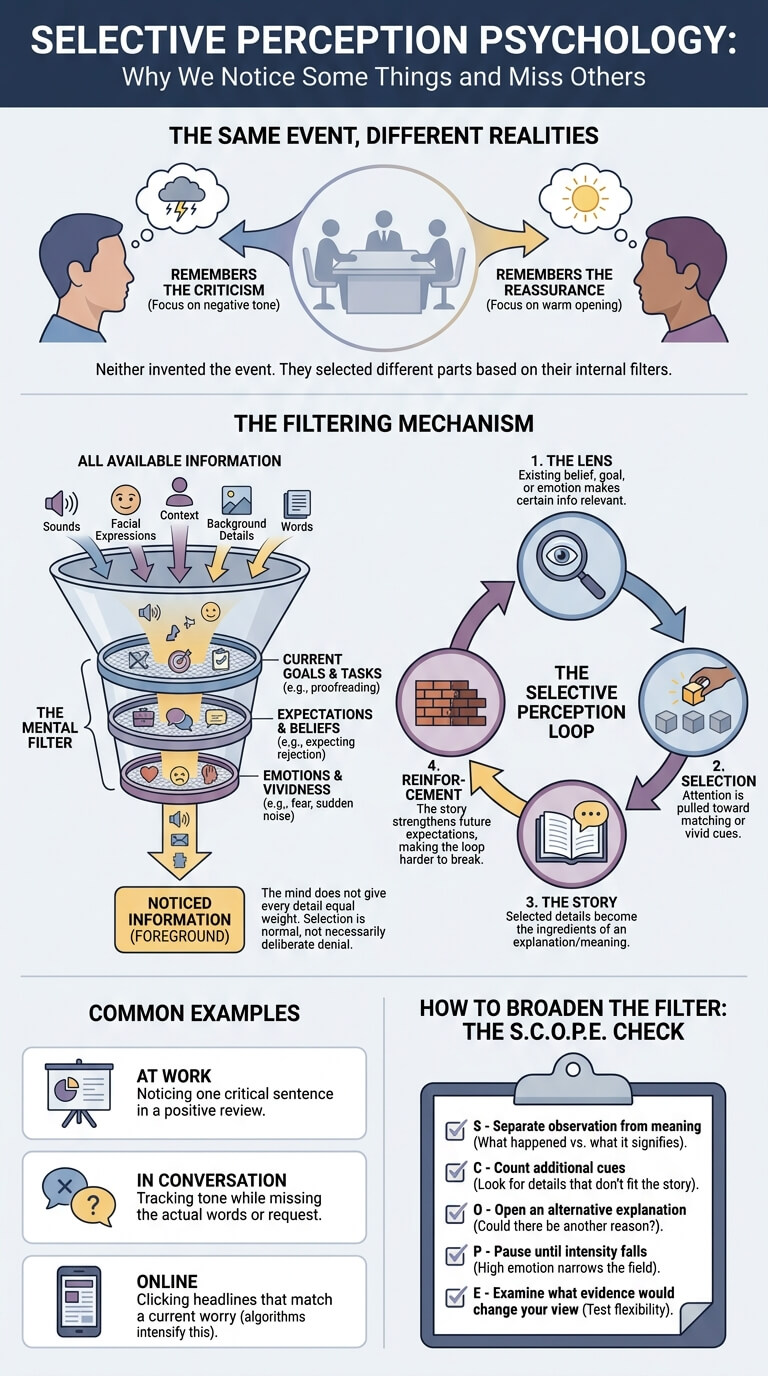
Not all available information receives equal weight
Selective perception is the tendency to notice or emphasize some stimuli while other available stimuli receive less attention. The APA Dictionary of Psychology definition of selective perception places this process at the point where people choose among the many stimuli presented to the senses.
Selection can be automatic, emotional, or goal-driven
Some selection follows intention. You scan a departure board for one flight number and ignore dozens of others. Some selection is captured by the environment, such as a sudden crash in a quiet room. Research overviews of attention distinguish between selection guided by current aims and selection pulled by salient stimuli, as described in an NCBI Bookshelf chapter on attentional selection.
Missing a detail is not always deliberate
People often assume that another person ignored a fact because it was inconvenient. That can happen, but it is not the only explanation. The detail may never have become prominent enough to guide the initial interpretation. It may have been heard but not weighted strongly. It may also have faded because another cue felt urgent.
This distinction matters. Deliberate concealment is a choice. Selective perception often begins earlier, as an uneven distribution of attention and meaning. Accountability may still be needed when someone repeatedly refuses correction, but it is unhelpful to treat every incomplete account as manipulation.
What Selective Perception Means
The difference between available facts and noticed facts
An event contains more information than any one person can fully process. Consider a performance review. Available information might include the exact words used, the order of comments, the manager’s tone, facial expression, examples, pauses, praise, criticism, and agreed next steps. The employee may consciously notice only three elements: the phrase “needs improvement,” a serious facial expression, and the absence of a promised raise.
Selective perception is one part of how the mind filters and interprets reality.
How attention and interpretation interact
Attention helps determine which cues receive deeper processing. Interpretation then gives those cues meaning. The two processes influence each other. A person who expects rejection may attend more closely to short replies. Once short replies are interpreted as distance, future short replies become even easier to detect.
Why selection happens before a full judgment
A judgment such as “the meeting went badly” usually arrives after certain cues have already been prioritized. The quiet room after a suggestion, one skeptical question, and a missed smile may form the evidence set. Other information, such as later agreement or supportive follow-up, may never enter the same mental summary.
The Selective Perception Loop
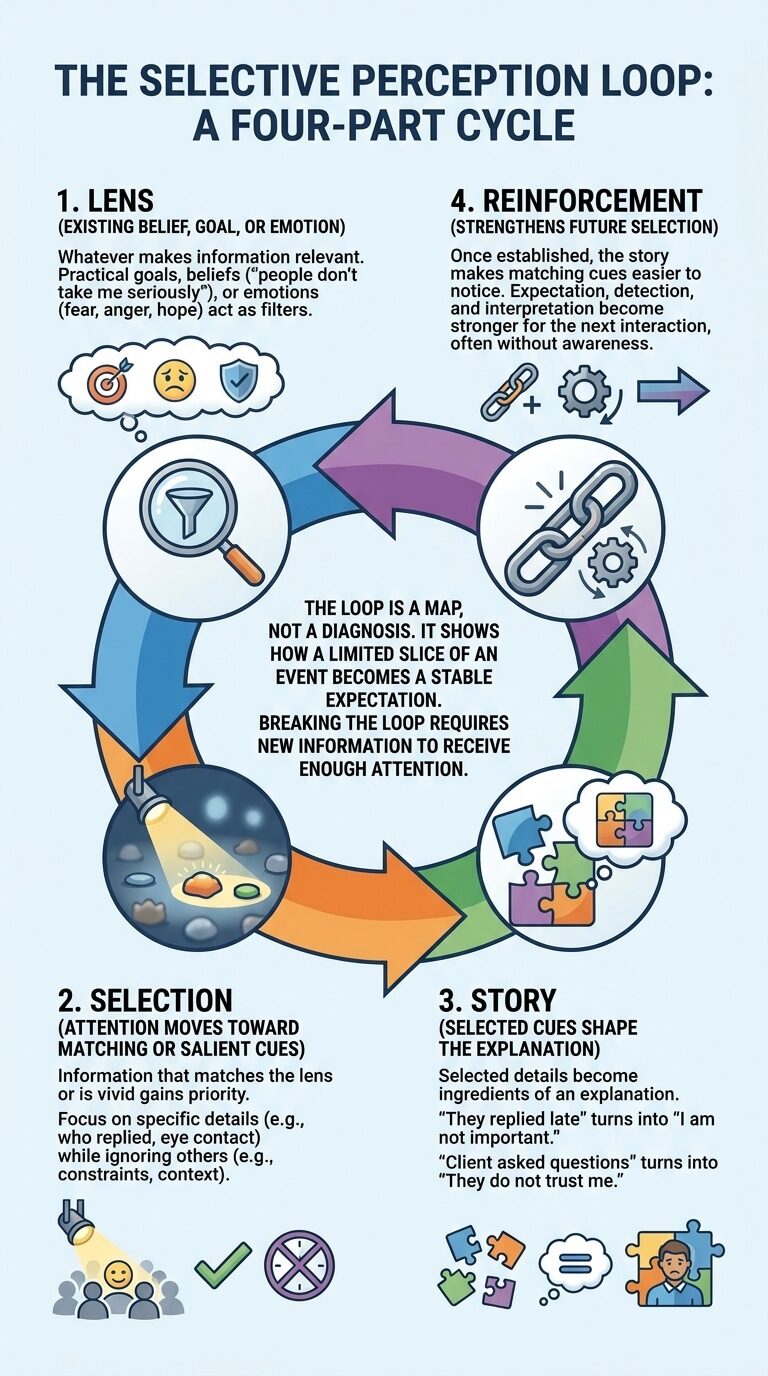
A useful way to understand the process is as a four-part loop: lens, selection, story, and reinforcement. The loop is not a diagnosis. It is a map for seeing how a limited slice of an event can become a stable expectation.
Existing belief, goal, or emotion
The lens is whatever makes some information especially relevant. It may be a practical goal, such as searching for errors in a document. It may be a belief, such as “people do not take my ideas seriously.” It may be an emotion, such as fear, anger, hope, or excitement.
Attention moves toward matching or salient cues
Next comes selection. Information that matches the active lens, or that is vivid enough to compete with it, gains priority. Someone feeling excluded may track who was invited, who made eye contact, and who replied in the group chat. They may pay less attention to scheduling constraints or the fact that several others were also left out.
Selected cues shape the story
The selected details become the ingredients of an explanation. “They replied late” becomes “I am not important.” “The client asked three questions” becomes “They do not trust me.” “My partner sounded tired” becomes “They are angry with me.”
The story strengthens future selection
Once a story is established, future cues that match it become easier to notice. Research on selection history and experience-driven attention describes how prior experience can shape what later receives attentional priority, often without full awareness of the learning history involved.
This creates reinforcement. A person expects dismissal, detects the quickest sign of dismissal, interprets the event through that sign, and carries a stronger expectation into the next interaction. Breaking the loop requires new information to receive enough attention to matter.
What Makes Information More Likely to Be Selected?
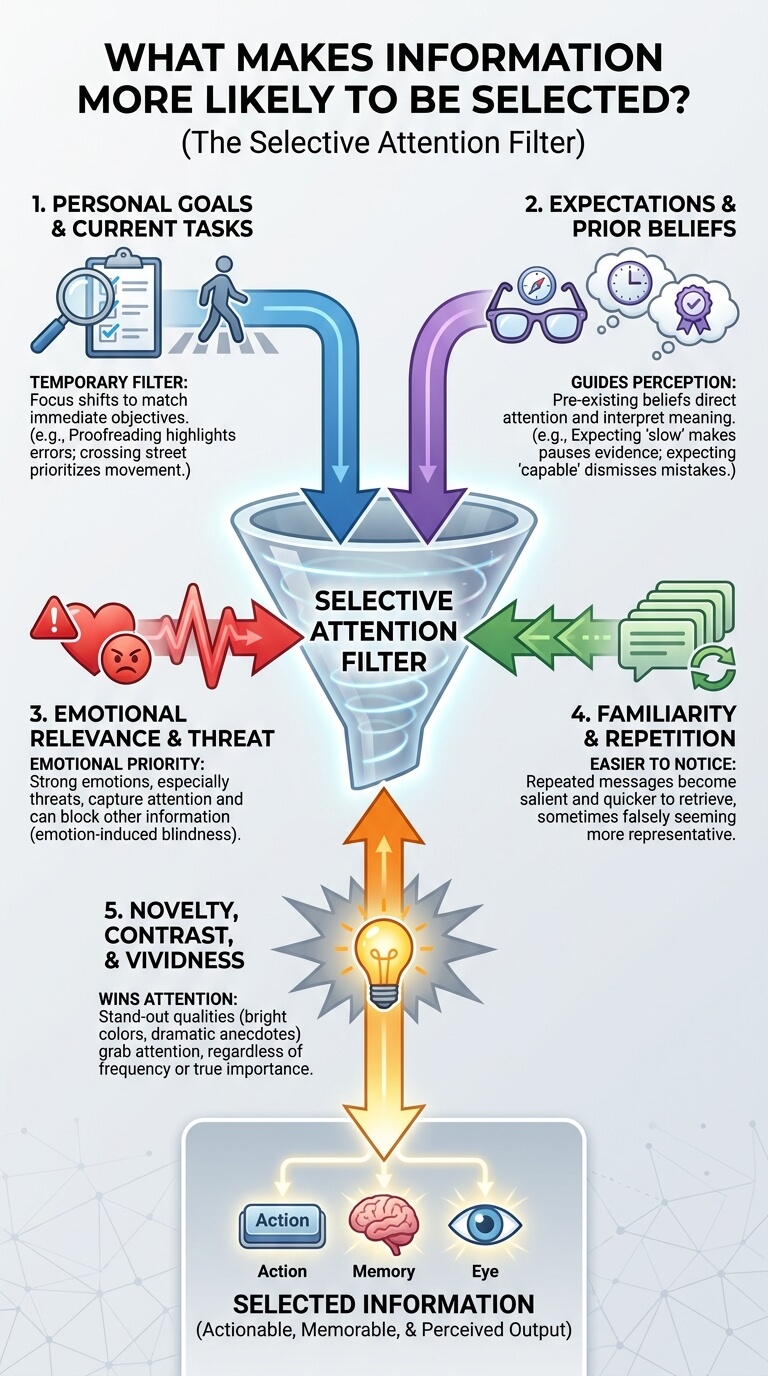
Personal goals and current tasks
Goals create a temporary filter. When proofreading, spelling errors become prominent while the strength of the argument may fade into the background. When crossing a busy street, vehicle movement matters more than the design of nearby buildings.
Expectations and prior beliefs
Expectations guide where people look and what they treat as meaningful. If a restaurant has been described as slow, every pause may become evidence. If a new coworker has been introduced as highly capable, an early mistake may be dismissed as unusual rather than treated as defining.
Emotional relevance and threat
Emotion changes priority. A harsh facial expression, a threatening word, or a reminder of a painful experience may capture attention and reduce awareness of less emotional details. A review of emotion-induced blindness describes how emotionally salient distractions can impair perception of other task-relevant information presented close in time.
Familiarity and repetition
Repeated messages become easier to notice and retrieve. A theme seen daily in headlines may begin to feel more common, central, or representative than it is. At work, a repeated complaint about one department can make every small delay from that department stand out.
Novelty, contrast, and vividness
A bright color in a muted room, an unusually blunt sentence, or a dramatic anecdote can win the competition for attention. Vivid information is memorable, but vividness is not the same as frequency or importance.
Everyday Examples of Selective Perception
| Situation | What stands out | What may fade into the background | A more complete next step |
|---|---|---|---|
| Receiving mixed feedback | One critical sentence | Specific praise and a practical improvement plan | Write down every distinct point before deciding what the review means |
| Waiting at a restaurant | Each delay after expecting poor service | Busy periods, updates, and helpful staff behavior | Separate actual wait times from the expectation you carried in |
| Entering a social gathering | One person who did not greet you | Several people who smiled, approached, or were distracted | Count multiple social cues before naming the atmosphere |
| Reading news online | A headline matching a current worry | Base rates, uncertainty, and stories that do not fit the theme | Read beyond the headline and compare more than one credible account |
| Remembering a crowded event | A surprising comment or embarrassing moment | Long neutral periods and ordinary interactions | Reconstruct the sequence, not only the most intense moment |
Hearing criticism but missing neutral feedback
Suppose a supervisor says, “Your analysis was strong, the structure was clear, and the final section needs more evidence.” A person sensitive to criticism may later remember only that the work lacked evidence. The missed praise does not cancel the criticism, but it changes the scale of the message.
A useful response is to record the feedback in separate units: what worked, what needs revision, and what action is expected. This protects against turning one corrective point into a total evaluation of the self.
Noticing delays after expecting poor service
Expectations make matching events easier to spot. Once a customer expects a long wait, every minute feels diagnostic. Quick moments may be treated as exceptions, while delays become proof of the original expectation.
Checking the clock at defined points, rather than relying on felt duration, can create a fuller record. The purpose is not to excuse poor service. It is to distinguish measured delay from expectation-amplified delay.
Focusing on one social cue while ignoring the wider context
A friend looks at their phone during a conversation. That cue may become “they are bored with me.” Yet the wider context may include an urgent family message, a habit they show with everyone, or a conversation that was otherwise engaged.
One cue can justify curiosity. It rarely justifies certainty on its own. Asking a simple question usually produces more reliable information than adding several layers of meaning to a glance.
Reading headlines that fit an existing concern
Online environments provide more information than anyone can evaluate. People naturally click what feels relevant, familiar, urgent, or emotionally charged. Over time, this creates a stream in which selected themes appear repeatedly.
The result may feel like direct observation of the world, even though it is partly observation of a filtered feed. Deliberately sampling credible material outside the usual theme can reveal what the filter has been excluding.
Remembering one detail from a crowded event
Memory is not a complete recording of perception. What received attention is more likely to be encoded, and intense moments may dominate later recall. At a wedding, someone may remember one awkward exchange and overlook hours of warmth.
Reconstructing the event in chronological order can reduce this compression. Ask what happened before, during, and after the striking moment. Sequence often restores context that emotional recall removed.
Selective Perception in Conversations
Listening for blame instead of the request
When someone expects criticism, they may scan for accusatory words. A sentence such as “I need more notice when plans change” may be heard as “You never consider me.” The listener responds to the implied accusation and misses the practical request.
A grounded reply would be: “I heard that the short notice was difficult. Are you asking me to tell you as soon as I know the plan may change?” This checks the selected meaning against the speaker’s intended message.
Tracking tone while missing the actual words
Tone carries useful social information, but it can overwhelm content. A tired or tense voice may make a neutral sentence sound hostile. The reverse also happens: a pleasant tone can make a dismissive message seem less serious than the words justify.
When tone and words conflict, hold both pieces. You might say, “Your words sound like you agree, but your tone sounds frustrated. Am I reading that correctly?” The question creates room for correction without pretending tone does not matter.
How emotional arousal narrows the field
During a heated exchange, people often become highly responsive to threat cues. They may hear interruption, contempt, or rejection while missing clarification and repair. This is one reason important conversations become less accurate when both people are overwhelmed.
A pause can help if it includes a clear return plan: “I am too activated to take in the whole message. I want to continue at 7 p.m. after I settle.” A pause without return may feel like avoidance, while continuing at peak intensity can deepen the filter.
Selective Perception at Work and Online
Performance expectations and feedback
Workplace expectations can shape who receives the benefit of context. An employee labeled “high potential” may have mistakes interpreted as learning. An employee labeled “unreliable” may have the same mistake treated as confirmation of character.
A fairer review uses defined behaviors, comparable time periods, and more than one example. The aim is not to remove judgment but to keep a prior label from deciding which evidence counts.
Repeated content and perceived importance
Repeated exposure increases accessibility. When a topic appears across meetings, chats, and dashboards, it may feel like the central problem even if it represents only one part of performance. The same effect occurs online when one theme appears in many posts.
Frequency of exposure should be compared with frequency of the underlying event. Those are not always the same. A heavily discussed problem may be common, newly important, emotionally compelling, or simply amplified by repetition.
Why algorithms and exposure can intensify the filter without fully determining it
Recommendation systems tend to offer more of what a person engages with. That can narrow the range of information encountered, especially when emotionally strong material receives more clicks. Yet algorithms do not fully determine perception. People still choose accounts, pause on certain posts, search for topics, and decide whether to verify claims.
A practical response is to diversify inputs intentionally. Follow credible voices with different areas of expertise, inspect original reporting when possible, and notice whether your feed repeatedly triggers the same conclusion.
Selective Perception vs Selective Attention
| Question | Selective attention | Selective perception |
|---|---|---|
| Main issue | Which input receives limited processing resources? | Which available cues are noticed or weighted as meaningful? |
| Common drivers | Task goals, capacity limits, salience, location | Beliefs, expectations, emotion, goals, relevance, prior learning |
| Example | Listening to one voice in a noisy room | Hearing the criticism in that voice more strongly than the reassurance |
| Useful question | What was attention directed toward? | Why did these details become the basis of the interpretation? |
Attentional selection as a capacity process
Selective attention is often discussed in terms of limited capacity. The mind cannot process every competing input equally, so it prioritizes a location, object, feature, or task.
Selective perception as meaning-shaped filtering
Selective perception adds the role of personal meaning. It focuses on why certain attended or available cues become more psychologically important than others. The distinction is conceptual rather than perfectly clean, because attention and perception interact continuously.
Where everyday language blurs the terms
Outside textbooks, people often use the two phrases interchangeably. That is understandable. Both describe selection. The most useful distinction is this: attention asks where processing went, while selective perception asks how relevance and expectation influenced what entered the person’s account of reality.
Selective Perception vs Perceptual Set
What gets noticed versus what interpretation feels ready
A perceptual set is readiness to perceive a stimulus or situation in a particular way. Selective perception emphasizes which cues become prominent. For example, expecting a tense meeting may create readiness to interpret ambiguity as conflict. Selective perception then shows up when sharp tones and crossed arms receive more weight than cooperative words.
How expectation can influence both
The two processes can reinforce each other. Expectation prepares an interpretation, and selection supplies matching details. Still, they answer different questions. Perceptual set asks what meaning the mind is prepared to see. Selective perception asks which pieces of information were elevated or filtered during the event.
Selective Perception vs Cognitive Bias
Early filtering versus broader errors in judgment
Cognitive bias is a broad label covering systematic tendencies in judgment, memory, decision-making, and reasoning. Selective perception is more specific. It concerns the unequal selection or weighting of available cues before a complete judgment is formed.
Research discussions of bias increasingly emphasize that belief-consistent processing may arise through multiple mechanisms rather than one universal cause, as outlined in a review proposing a common framework for bias research. That complexity is a reason to avoid treating every selective observation as the same bias.
Why confirmation bias should not swallow the whole concept
Confirmation bias involves seeking, interpreting, or remembering information in ways that favor an existing belief. Selective perception may contribute to it when belief-consistent cues stand out. However, selective perception also occurs without a strong belief, such as when novelty, task relevance, or emotional salience directs the filter.
Keeping the concepts separate prevents a normal capacity process from being treated as proof that someone is irrational or dishonest.
Signs Your Perceptual Filter May Be Too Narrow

The same conclusion appears across different contexts
If every delayed reply means disrespect, every question means doubt, or every quiet expression means disapproval, the interpretation may be traveling from situation to situation. Consistency alone does not prove error, but it is a reason to examine whether the same lens is selecting the same kind of evidence.
Contradictory details feel irrelevant before review
A narrow filter dismisses opposing information before it is understood. Praise becomes “just politeness.” A reliable action becomes “a one-time exception.” Context is treated as an excuse even when it changes the meaning of the event.
One cue carries the entire interpretation
A single look, word, pause, or anecdote may become the whole case. Ask whether the conclusion would survive if that cue were removed. If not, more evidence is needed before confidence rises.
Other observers consistently report missing information
Different observers will never agree perfectly. Still, repeated reports that important details are absent from your account deserve curiosity. The aim is not to surrender your perspective. It is to test whether another perspective contains information your filter did not prioritize.
How to Broaden the Perceptual Field
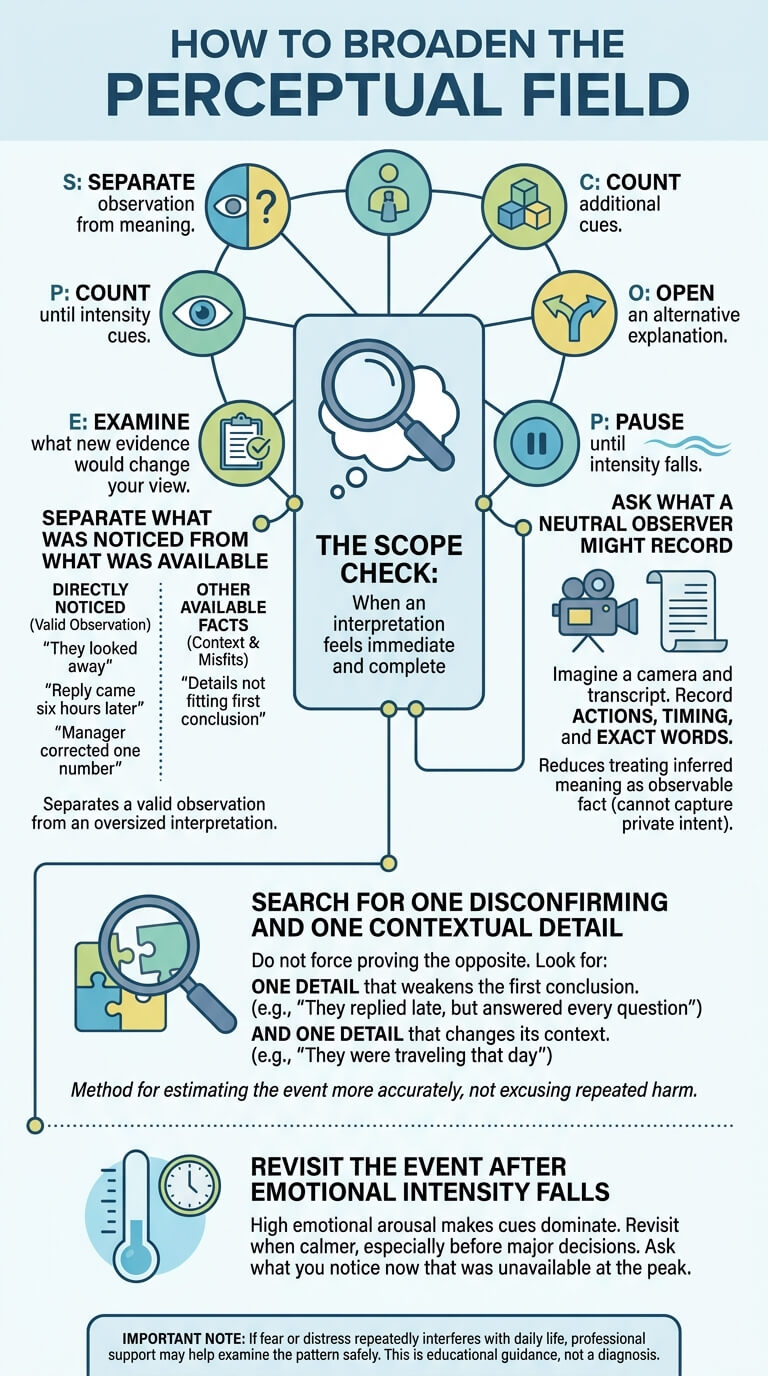
Use the SCOPE check when an interpretation feels immediate and complete: Separate observation from meaning, Count additional cues, Open an alternative explanation, Pause until intensity falls, and Examine what new evidence would change your view.
Separate what was noticed from what was available
Write two columns. In the first, list what you directly noticed: “They looked away,” “the reply came six hours later,” or “the manager corrected one number.” In the second, list other available facts, including details that do not fit your first conclusion.
This step separates a valid observation from an oversized interpretation.
Ask what a neutral observer might record
Imagine a camera and transcript. What actions, timing, and exact words would be recorded? A neutral record cannot capture private intent, but it can reduce the tendency to treat inferred meaning as observable fact.
Search for one disconfirming and one contextual detail
Do not force yourself to prove the opposite. Look for one detail that weakens the first conclusion and one detail that changes its context. For example: “They replied late, but they answered every question,” and “they were traveling that day.”
This is not an instruction to excuse repeated harm. It is a method for estimating the event more accurately before choosing a response.
Revisit the event after emotional intensity falls
High emotional arousal can make certain cues dominate. Revisit the event after your body is calmer, especially before sending a serious message or making a lasting decision. Ask what you notice now that was unavailable to you at the emotional peak.
If fear, suspiciousness, or distress repeatedly makes everyday situations feel threatening and interferes with sleep, work, or relationships, professional support may help you examine the pattern safely. This educational guidance is not a diagnosis.
What to Explore Next
Attention and perception for capacity and awareness
Explore attention when the central question is why a visible or audible event failed to reach awareness, especially under distraction or divided attention.
Perceptual set for expectation-driven readiness
Explore perceptual set when you want to understand why context or prior expectation makes one interpretation feel ready before ambiguous input is resolved.
Perceptual bias for distortions after selection
Explore perceptual bias when the concern extends beyond noticing and includes systematic interpretation of people, events, or evidence in a tilted direction.
Frequently Asked Questions About Selective Perception
Is selective perception the same as ignoring facts?
No. Ignoring facts often implies that a person recognized relevant information and chose not to consider it. Selective perception can happen before full recognition, when some cues become prominent and others remain weak. A person can be sincere and still have an incomplete account. Repeated refusal to examine clear contrary evidence is a different issue.
Can emotions cause selective perception?
Emotions can strongly influence what receives attention and weight. Fear may prioritize possible threat, anger may highlight unfairness, and excitement may emphasize potential reward. Emotion can provide useful information, but it does not guarantee that the selected details represent the whole situation.
Is selective perception always a bias?
No. Selection is necessary because the environment contains more information than the mind can process equally. It becomes problematic when the filter repeatedly excludes important context, resists correction, or supports conclusions that do not update with evidence.
How is selective perception different from confirmation bias?
Selective perception concerns which cues are noticed or weighted. Confirmation bias is broader and can include seeking, interpreting, evaluating, and remembering evidence in ways that support a prior belief. Selective perception may feed confirmation bias, but it can also be driven by goals, novelty, repetition, or emotion without a settled belief.
Can two people select different facts from the same event?
Yes. People bring different goals, histories, emotions, and expectations into the same situation. One person may track tone while another tracks words. One may notice risk while another notices opportunity. Comparing observations can improve accuracy when both people are willing to treat their first account as partial rather than complete.
Key Takeaways
- Selective perception is the unequal noticing or weighting of information that is available in a situation.
- Goals, expectations, emotion, repetition, familiarity, novelty, and prior learning all influence what moves into the foreground.
- The four-part loop is lens, selection, story, and reinforcement. A prior lens guides attention, selected details form a story, and that story shapes future selection.
- Selective perception is not automatically deliberate denial, dishonesty, or confirmation bias.
- A broader view comes from separating observation from meaning, counting additional cues, checking context, and revisiting events after emotional intensity falls.
- The next practical step is to choose one recent event and write down both the details that stood out and the details your first account left out.
Author note: Michael Reed is the Founder and Lead Writer at Psychology Exposed. He explains human behavior, emotional patterns, self-awareness, and everyday decisions in clear, research-aware language for general readers.

Michael Reed is the Founder and Lead Writer at Psychology Exposed. He writes about human behavior, relationships, emotional patterns, self-awareness, and practical psychology topics using research-informed, easy-to-understand content.
Read More About Michael Reed: https://psychologyexposed.com/michael-reed/