

You wake with the impression that you were just somewhere else. The room in the dream had depth, a voice sounded unmistakable, and the emotion remains in your body for several minutes. Even after recognizing that the event never happened, the experience can feel unusually close to waking life.
Vivid dreams are remembered as especially clear, detailed, immersive, realistic, or emotionally intense. Vividness describes the quality of the experience as a person reports it. It does not automatically tell us which sleep stage produced the dream, why it happened, whether the dreamer knew they were dreaming, or whether anything is wrong.
This distinction becomes useful when dreams suddenly feel stronger than usual. Several influences may coincide, including sleep timing, awakenings, emotional salience, schedule changes, medication or substance changes, and the simple fact that some dreams are remembered more completely. The goal is not to decode a vivid dream as a hidden message. It is to separate the original experience from later recall, compare it with nearby dream phenomena, and decide whether the change is merely noticeable or is disrupting sleep and daily life.
Quick Answer
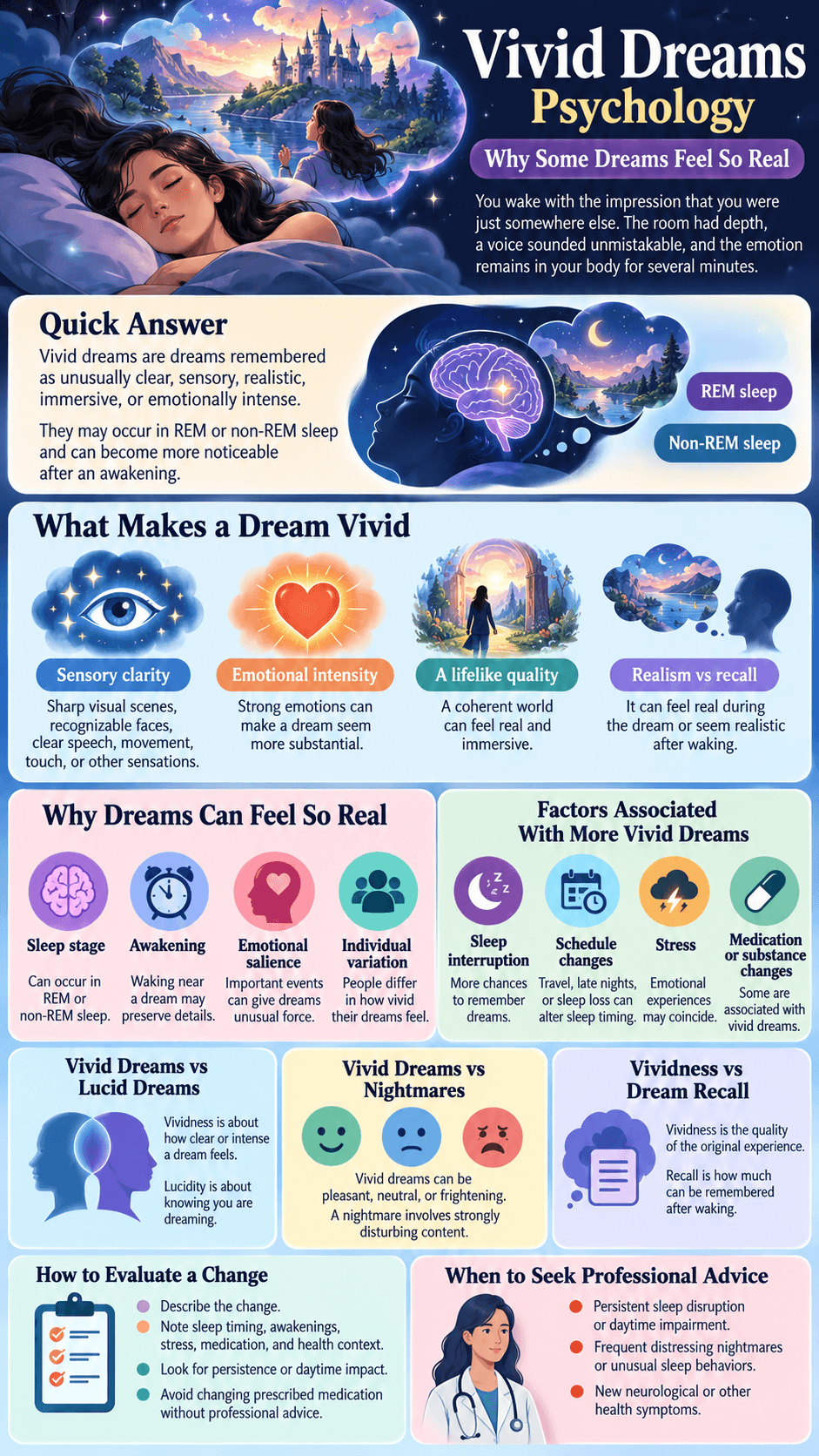
Vivid dreams are dreams remembered as unusually clear, sensory, realistic, immersive, or emotionally intense. They may occur in REM or non-REM sleep and can become more noticeable after an awakening. Vividness is not the same as knowing you are dreaming, having a nightmare, or remembering many details. One vivid dream rarely identifies a single cause or health condition.
Vividness is subjective clarity or intensity, not the same as lucidity
A dream can feel lifelike while the dreamer fully accepts it as reality. That is vividness without lucidity. Lucidity requires awareness during the dream that one is dreaming. The two qualities can overlap, but neither guarantees the other, and control is not required for either a vivid or a lucid experience.
Why one vivid dream rarely identifies one cause
A single episode offers too little information to separate sleep timing, emotion, recall, health context, or ordinary variation. The content may feel persuasive because the experience was strong, yet intensity is not evidence of a particular explanation. Patterns over time and accompanying changes are more informative than one memorable night.
What Makes a Dream Vivid
Sensory clarity and detail
Vividness can involve sharp visual scenes, recognizable faces, clear speech, movement, touch, temperature, or other sensations. Not every sense needs to be present. A dream with an ordinary setting may feel vivid because one sound or physical sensation is unusually precise, while an elaborate dream may still feel vague.
Emotional intensity
Strong awe, affection, embarrassment, grief, anger, relief, or fear can make a dream seem more substantial. Emotion may also remain after the storyline fades. This creates an important distinction: emotional intensity can contribute to vividness, but vivid dreams are not defined by negative emotion and are not automatically nightmares.
A lifelike or immersive quality
Some dreams feel real because the dreamer is absorbed in a coherent world rather than observing disconnected images. Familiar places, believable conversations, and normal physical rules can strengthen that impression. Other vivid dreams are bizarre, yet still immersive because the dreamer experiences the strange events as immediate and convincing.
Realism during the dream versus remembered realism after waking
Two judgments can be confused. One is how real the experience seemed while it unfolded. The other is how rich and convincing the memory seems after waking. A detailed report cannot perfectly reconstruct the first judgment, and a powerful in-dream experience may leave only a fragmentary memory.
| Dimension | Question to ask | What it does not prove |
|---|---|---|
| Sensory clarity | Were sights, sounds, movement, or touch unusually distinct? | That the dream occurred in only one sleep stage |
| Emotion | How strong was the feeling during or after the dream? | That the dream was a nightmare |
| Immersion | Did the dream world feel immediate and believable? | That the dreamer knew it was a dream |
| Recall | How much remained available after waking? | That the original experience was equally detailed |
A Vivid Dream Experience Model
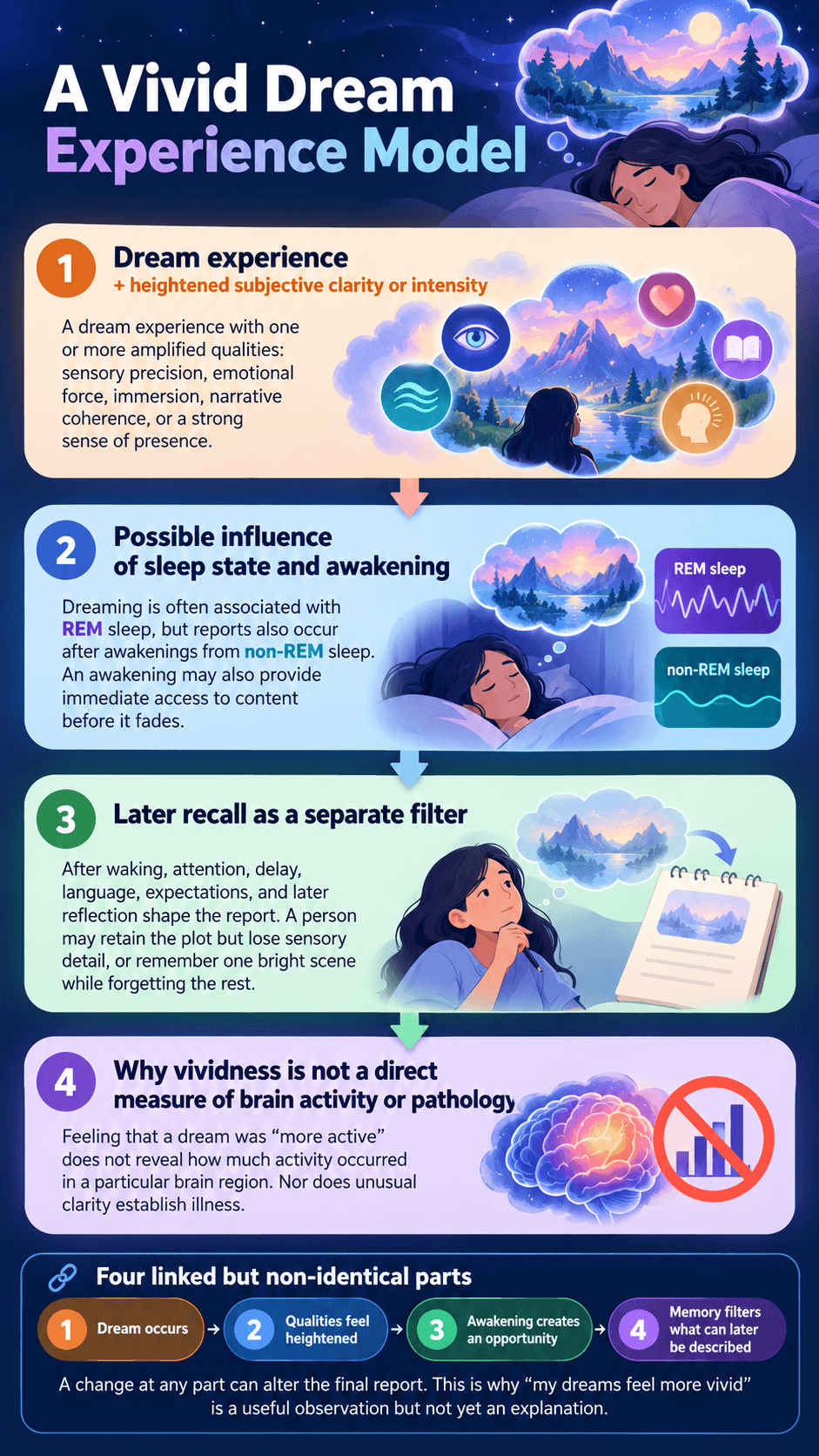
Dream experience plus heightened subjective clarity or intensity
The starting point is a dream experience with one or more amplified qualities: sensory precision, emotional force, immersion, narrative coherence, or a strong sense of presence. “Subjective” does not mean imaginary in a dismissive sense. It means vividness is reported from the dreamer’s perspective rather than measured like temperature.
Possible influence of sleep state and awakening
Dreaming is often associated with REM sleep, but reports also occur after awakenings from non-REM sleep. A review of dream phenomenology across sleep states describes meaningful variation within and between these states. An awakening may also provide immediate access to content before it fades.
Later recall as a separate filter
After waking, attention, delay, language, expectations, and later reflection shape the report. A person may retain the plot but lose sensory detail, or remember one bright scene while forgetting the rest. The remembered dream is therefore evidence about the experience, but not a complete recording of it.
Why vividness is not a direct measure of brain activity or pathology
Feeling that a dream was “more active” does not reveal how much activity occurred in a particular brain region. Nor does unusual clarity establish illness. Connecting experience with physiology requires controlled measurements, timed awakenings, and careful reporting, not an inference from intensity alone.
The model can be summarized as four linked but non-identical parts: a dream occurs, certain qualities feel heightened, an awakening creates an opportunity to access the experience, and memory filters what can later be described. A change at any part can alter the final report. This is why “my dreams feel more vivid” is a useful observation but not yet an explanation.
Why Some Dreams Feel So Real
Dream phenomenology across REM and non-REM sleep
REM dreams are often described as vivid and elaborate, but sleep experience is not divided into a simple REM-equals-dreaming rule. The review of dreaming and the brain discusses reports from REM and non-REM sleep, along with the difficulty of connecting subjective experience to physiology.
Emotional salience
An emotionally important person, conflict, hope, or anticipated event may give dream content unusual force. Salience can affect what captures attention and what remains memorable. This does not mean the dream delivers a hidden verdict about the issue. It may simply reflect that certain material carries more weight for the dreamer.
Awakening near a dream and access to detail
When someone wakes during or soon after a dream, details may be easier to retrieve than after uninterrupted sleep followed by a later awakening. Frequent awakenings can therefore increase opportunities to notice dreams. This may create the impression that dreaming itself became more intense when access and recall also changed.
Individual variation
People differ in imagery, emotional responsiveness, sleep patterns, recall habits, attention to dreams, and the language they use for vividness. The same dream report might be rated moderately vivid by one person and extremely vivid by another. Changes should be compared with the person’s own usual experience, not an imagined universal standard.
Why current research cannot give one explanation for every vivid dream
Dreams cannot be observed directly in the way an external behavior can. Researchers often rely on reports collected after awakening, and timing or questioning can affect those reports. A review of new strategies for studying dreams explains both these methodological limits and emerging ways to examine dream experience more carefully.
Factors Associated With More Vivid Dreams
Sleep interruption and timing of awakening
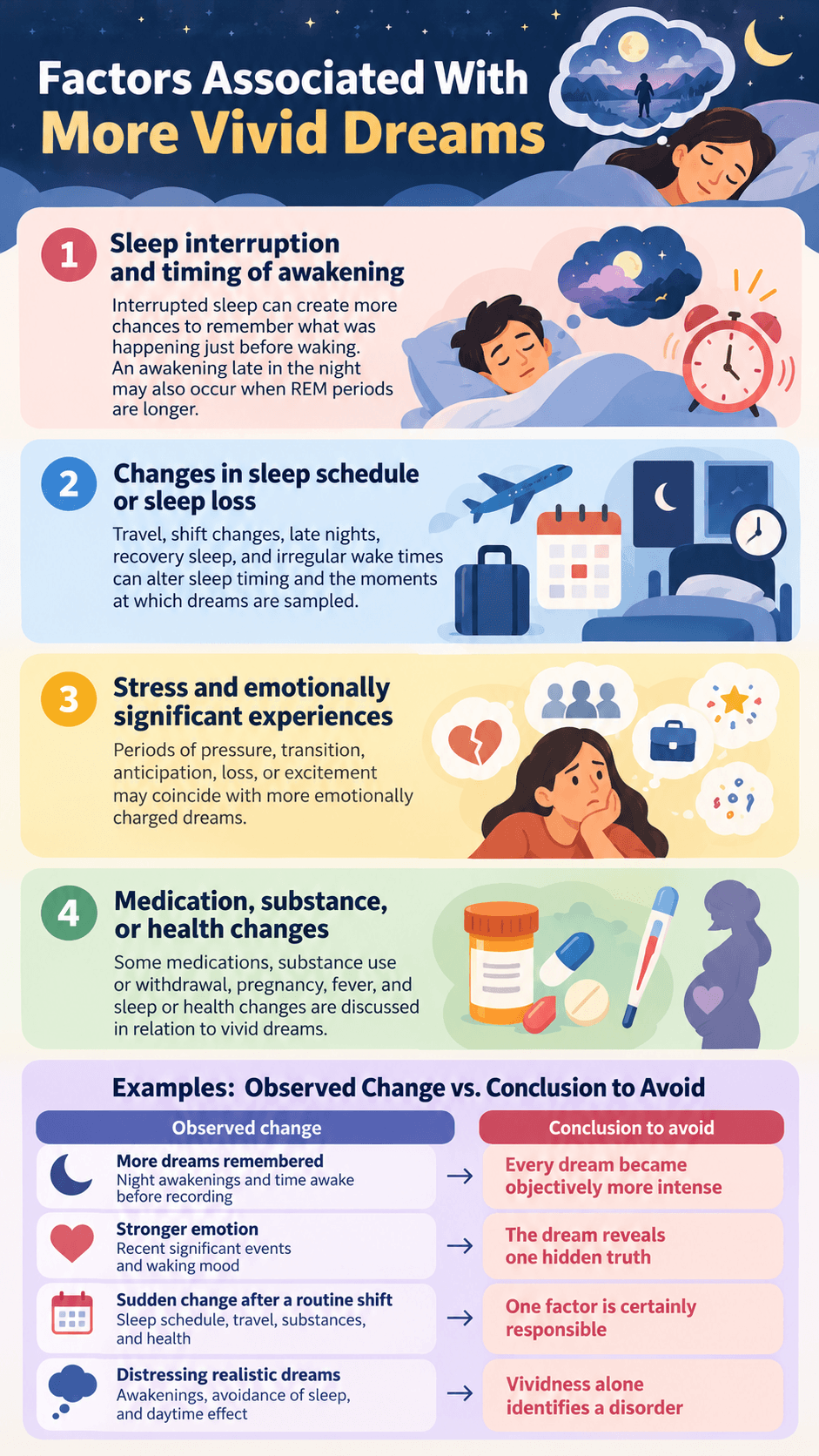
Interrupted sleep can create more chances to remember what was happening just before waking. An awakening late in the night may also occur when REM periods are longer. Neither observation means that every vivid dream came from REM or that interruption is the sole reason the dream felt intense.
Changes in sleep schedule or sleep loss
Travel, shift changes, late nights, recovery sleep, and irregular wake times can alter sleep timing and the moments at which dreams are sampled. Sleep loss can also coexist with rebound changes in sleep architecture. The practical point is to note the schedule change, not to assume a precise mechanism from the dream alone.
Stress and emotionally significant experiences as possible correlates
Periods of pressure, transition, anticipation, loss, or excitement may coincide with more emotionally charged dreams. “Coincide” is the careful word. Stress may be relevant, but a vivid dream is not a stress test, and an intense dream does not prove the dreamer is avoiding or suppressing something.
Medication, substance, or health changes at a broad educational level
Some medications, substance use or withdrawal, pregnancy, fever, and sleep or health changes are discussed in relation to vivid dreams. The medically reviewed overview of vivid dreams summarizes several broad associations. Personal effects require individual clinical context, especially when multiple changes occurred together.
Why an association does not prove the cause in one person
A factor can be associated with vivid dreams across groups without explaining a particular night. Timing, dose, baseline sleep, co-occurring stress, recall, and other variables may differ. Treat a possible association as a question to investigate, not a verdict. Do not stop or alter prescribed medication without professional advice.
| Observed change | Useful context to note | Conclusion to avoid |
|---|---|---|
| More dreams remembered | Night awakenings and time awake before recording | Every dream became objectively more intense |
| Stronger emotion | Recent significant events and waking mood | The dream reveals one hidden truth |
| Sudden change after a routine shift | Sleep schedule, travel, substances, and health | One factor is certainly responsible |
| Distressing realistic dreams | Awakenings, avoidance of sleep, and daytime effect | Vividness alone identifies a disorder |
Vivid Dreams vs Lucid Dreams
Intensity versus awareness
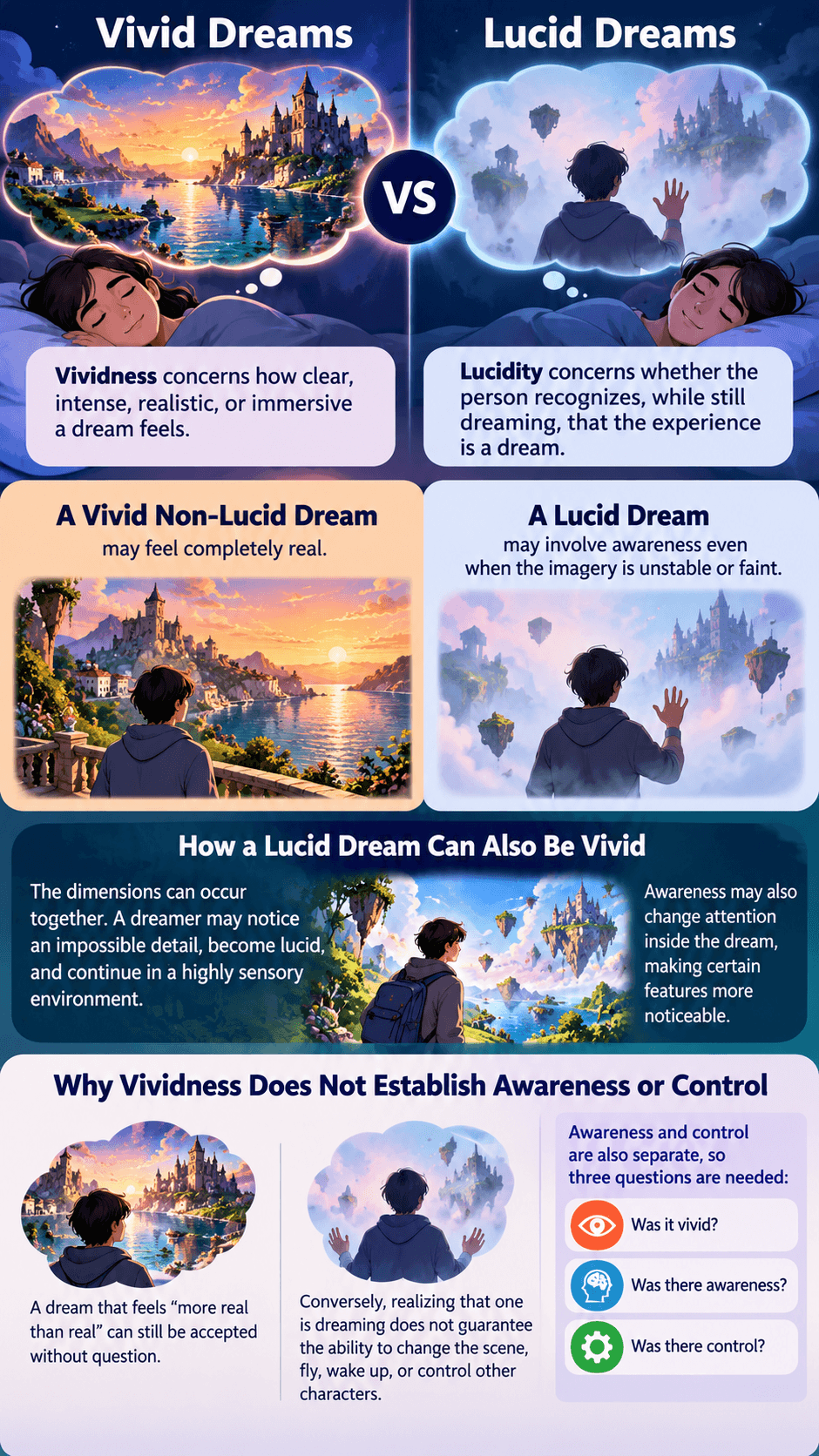
Vividness concerns how clear, intense, realistic, or immersive a dream feels. Lucidity concerns whether the person recognizes, while still dreaming, that the experience is a dream. A vivid non-lucid dream may feel completely real. A lucid dream may involve awareness even when the imagery is unstable or faint.
How a lucid dream can also be vivid
The dimensions can occur together. A dreamer may notice an impossible detail, become lucid, and continue in a highly sensory environment. Awareness may also change attention inside the dream, making certain features more noticeable. That overlap does not turn vividness and lucidity into synonyms.
Why vividness does not establish awareness or control
A dream that feels “more real than real” can still be accepted without question. Conversely, realizing that one is dreaming does not guarantee the ability to change the scene, fly, wake up, or control other characters. Awareness and control are also separate, so three questions are needed: Was it vivid? Was there awareness? Was there control?
Vivid Dreams vs Nightmares
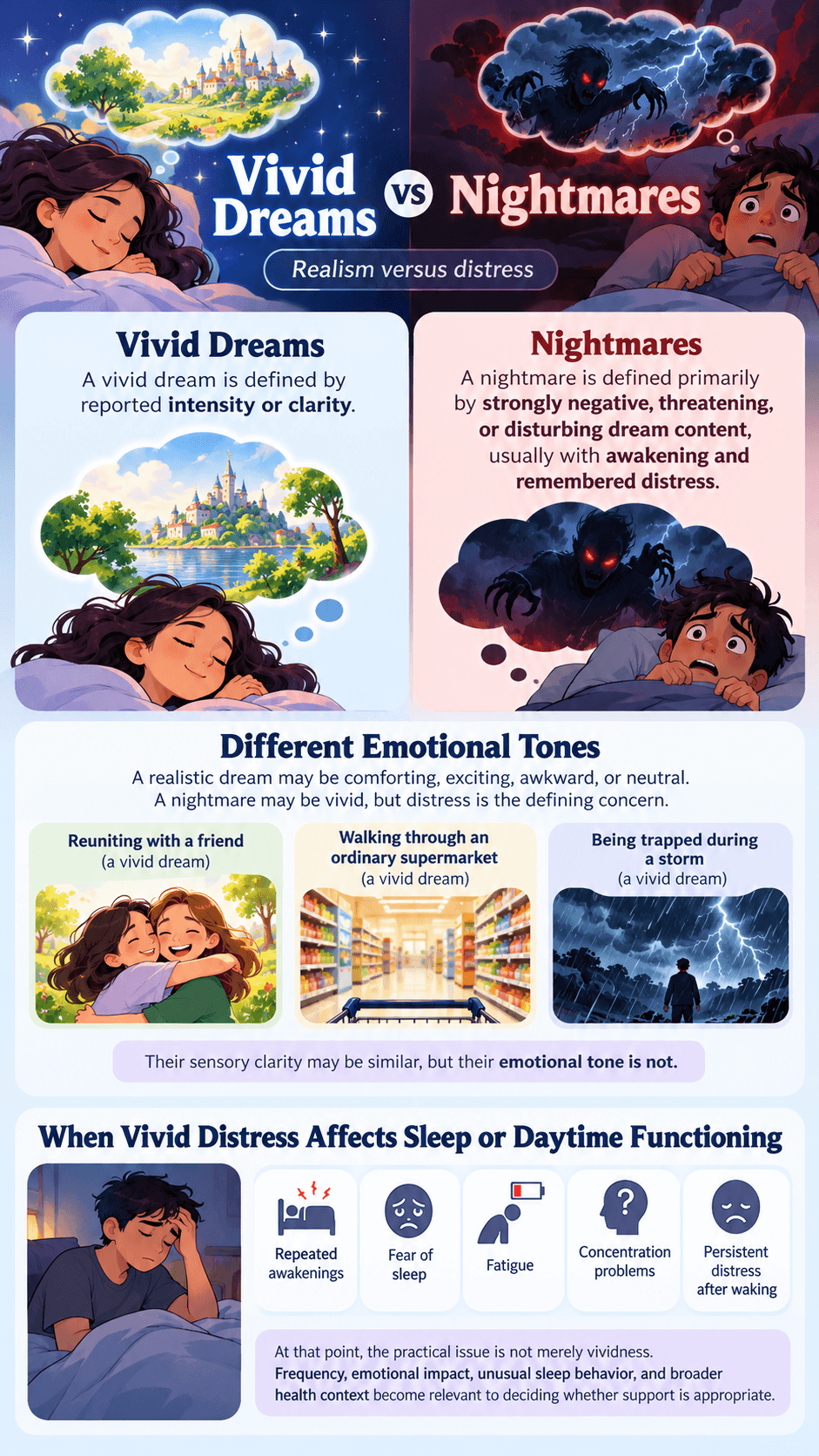
Realism versus distress
A vivid dream is defined by reported intensity or clarity. A nightmare is defined primarily by strongly negative, threatening, or disturbing dream content, usually with awakening and remembered distress. A realistic dream may be comforting, exciting, awkward, or neutral. A nightmare may be vivid, but distress is the defining concern.
Positive, neutral, and frightening vivid dreams
Imagine three equally detailed dreams: reuniting with a friend, walking through an ordinary supermarket, and being trapped during a storm. Their sensory clarity may be similar, but their emotional tone is not. Grouping all three as nightmares would erase the feature that distinguishes the third experience.
When vivid distress affects sleep or daytime functioning
Pay attention when frightening dreams cause repeated awakenings, fear of sleep, fatigue, concentration problems, or persistent distress after waking. At that point, the practical issue is not merely vividness. Frequency, emotional impact, unusual sleep behavior, and broader health context become relevant to deciding whether support is appropriate.
Vividness vs Dream Recall
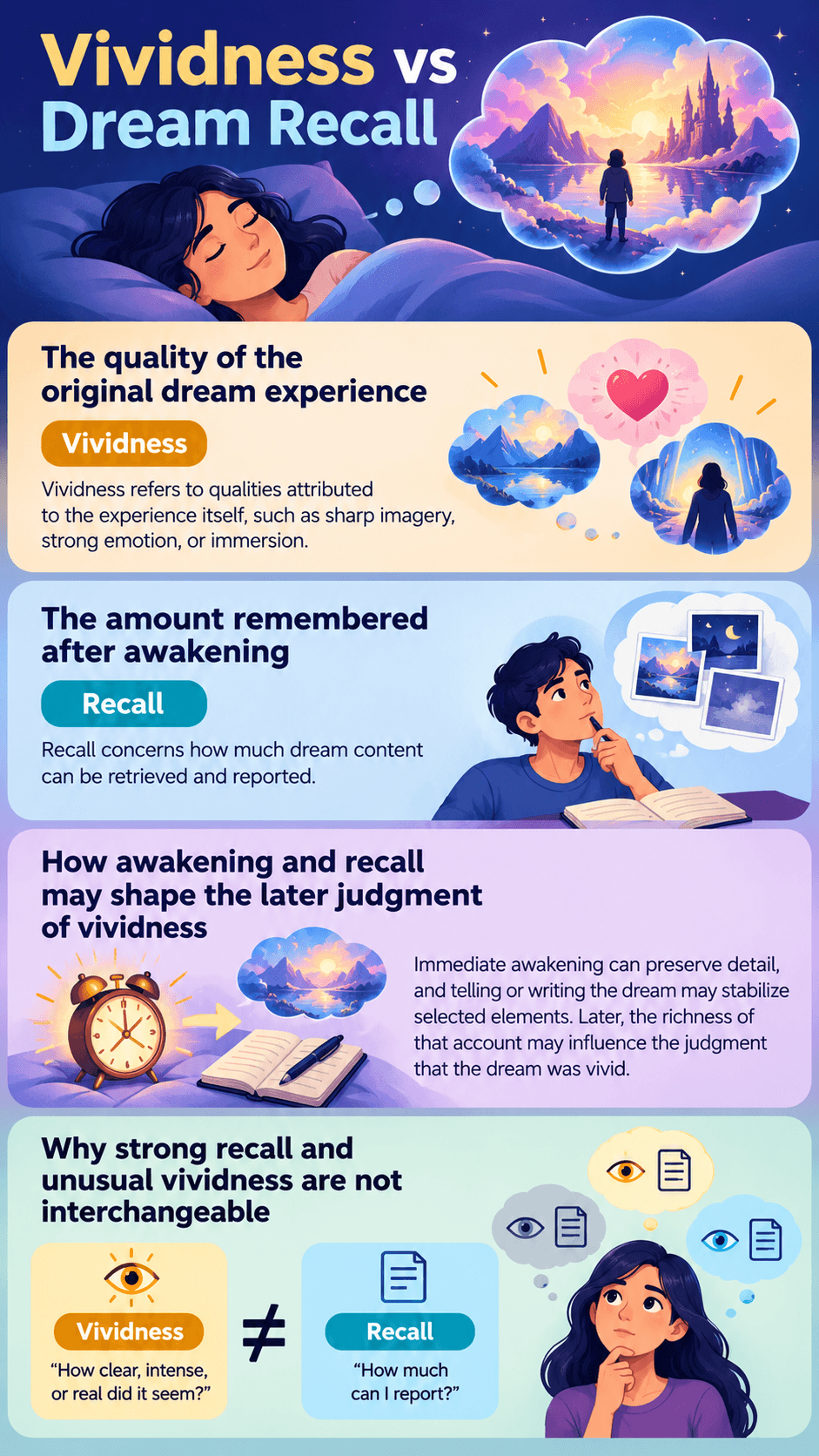
The quality of the original dream experience
Vividness refers to qualities attributed to the experience itself, such as sharp imagery, strong emotion, or immersion. In principle, a dream could be extraordinarily vivid at the time but leave only the memory that “something intense happened.” The quality and the surviving record are related but not identical.
The amount remembered after awakening
Recall concerns how much dream content can be retrieved and reported. Someone may remember a long sequence of dim, ordinary events, or one brief but brilliant image. Length and detail can help describe recall, but they do not provide a perfect scale of how vivid the entire dream felt.
How awakening and recall may shape the later judgment of vividness
Immediate awakening can preserve detail, and telling or writing the dream may stabilize selected elements. Later, the richness of that account may influence the judgment that the dream was vivid. This does not make the judgment false. It shows that remembering is part of how people evaluate an experience they can no longer revisit.
Why strong recall and unusual vividness are not interchangeable
Strong recall answers “How much can I report?” Vividness answers “How clear, intense, or real did it seem?” Keeping both ratings can reveal useful combinations: high vividness with low recall, low vividness with extensive recall, or high ratings on both. That is more precise than treating every detailed account as an unusually intense dream.
How to Evaluate a Change in Dream Vividness
Describe the change before interpreting it
Replace “My dreams are becoming strange” with observable details. Note whether the change involves color, sound, physical sensation, emotion, realism, narrative length, frequency, or ease of recall. Also record whether this happened once, for several nights, or over a longer period.
Note sleep timing, awakenings, stress, medication, and health context
A short record can include bedtime, wake time, awakenings, schedule shifts, significant events, substances, medication changes, illness, and how rested you feel. Record facts separately from guesses. “Woke at 4:20 after a realistic dream” is an observation; “the awakening caused it” is an interpretation.
Look for persistence, impairment, or additional symptoms
Intensity alone is less informative than its effect. Ask whether sleep is repeatedly interrupted, bedtime is being avoided, daytime functioning has changed, or new waking symptoms appeared. A stable pattern with no distress may call for curiosity, while a persistent change with impairment deserves more attention.
Avoid changing prescribed medication without professional advice
If vivid dreams began near a medication change, record the timing and discuss it with the prescribing clinician or pharmacist. Do not skip, reduce, or stop a prescribed treatment solely because of a dream pattern. The benefits, risks, dose, interactions, and safe adjustment process require individual guidance.
Misunderstandings About Vivid Dreams
Vivid means lucid
A highly realistic dream can contain no awareness that it is a dream. Lucidity is a metacognitive recognition during sleep, not a rating of image quality. Ask whether awareness occurred before waking rather than inferring it from the intensity of the later memory.
Vivid means prophetic or psychologically revealing
A strong feeling of reality can make dream content seem authoritative. Yet intensity does not validate a prediction, confirm another person’s intentions, or uncover a hidden event. Personal reflection may still be meaningful, but important waking decisions need waking evidence rather than the persuasive force of a dream.
Vivid means better sleep
Remembering a vivid dream does not measure overall sleep quality. It may follow an awakening that made recall easier, and a person can feel rested or unrefreshed afterward. Sleep quality is better judged through continuity, duration, daytime alertness, and individual health context than dream intensity alone.
Vivid means mental illness
Vivid dreams occur in many people and, by themselves, do not establish a mental-health condition. Dream experience happens during sleep and should not be equated with waking perception. New waking perceptual changes, confusion, severe mood changes, or impaired functioning are different concerns that deserve appropriate assessment.
When Medical or Mental-Health Advice May Be Appropriate
Persistent sleep disruption or daytime impairment
Consider speaking with a qualified professional if vivid dreams repeatedly interrupt sleep, cause fear of bedtime, or contribute to fatigue, poor concentration, mood changes, or difficulty handling daily responsibilities. Bring a brief record of timing and impact rather than trying to arrive with a self-diagnosis.
Frequent distressing nightmares or unusual sleep behaviors
Repeated frightening dreams, shouting, striking out, falling from bed, injury risk, or other unusual behaviors during sleep warrant attention. Make the sleep environment safer while seeking advice. A clinician may need information from a bed partner or household member, but a dream description alone cannot identify the underlying issue.
New neurological, waking perceptual, or other health symptoms
Prompt assessment is sensible when a new dream change accompanies weakness, fainting, seizures, marked confusion, waking hallucination-like experiences, severe headache, fever, or another significant health change. Urgency depends on the waking symptoms, not on vividness itself. Seek urgent care when symptoms are sudden or severe.
How Vividness Relates to Other Dream Questions
Return to the broad science of dreaming
Vividness is one dimension of dream experience, not a complete explanation of why dreams occur. The NINDS explanation of sleep cycles provides useful context for REM and non-REM sleep. Sleep stage information alone, however, cannot decode why one dream felt unusually real.
Compare vividness with lucid awareness, nightmare distress, and recall
Four separate questions create a cleaner picture: How intense or realistic was it? Did you know you were dreaming? Was it frightening or distressing? How much could you remember? One dream can score high on several dimensions, but the distinction directs attention to the feature that actually matters.
Bridge lightly to Perception Psychology without treating dreams as waking perception
Dreams can include experiences resembling vision, sound, touch, space, and movement, which makes comparison with perception interesting. A broad review of current questions in dream research emphasizes how much remains open. Dream imagery should not be treated as identical to receiving information from the waking environment.
FAQ About Vivid Dreams
Why have my dreams suddenly become more vivid?
A sudden change may coincide with awakenings, an altered sleep schedule, sleep loss, emotional events, medication or substance changes, illness, or greater attention to dreams. More than one influence may be present. Track timing and impact, and seek advice if the change persists, impairs functioning, or appears with other symptoms.
Can a vivid dream also be lucid?
Yes. A dream can be both highly vivid and lucid when it feels clear or immersive and the dreamer recognizes during the experience that it is a dream. It may still be difficult to control. Vividness, awareness, and control should be described separately.
Are vivid dreams always nightmares?
No. Vivid dreams may be pleasant, neutral, exciting, sad, embarrassing, or frightening. A nightmare involves strongly disturbing content and usually remembered distress after awakening. Vividness may intensify a nightmare, but it does not determine emotional tone.
Does remembering detail mean the dream itself was unusually vivid?
Not necessarily. Detailed recall may reflect waking close to the dream, recording it promptly, or remembering a long sequence. A dream may be well remembered without having felt especially intense, while an intensely vivid experience may leave only a small fragment after waking.
Are vivid dreams a reliable sign of a mental-health condition?
No. Vivid dreams alone are not a reliable diagnostic sign. Their meaning depends on frequency, distress, sleep disruption, waking symptoms, health context, and individual history. If concern comes from changes while awake or impaired daily functioning, discuss those specific changes with a qualified professional.
Key Takeaways
- Vividness describes subjective clarity, realism, immersion, sensory detail, or emotional intensity.
- A vivid dream can be lucid, distressing, or well remembered, but those qualities are not interchangeable.
- REM and non-REM sleep can both include dream reports, so vividness does not identify one sleep stage by itself.
- Awakening and memory influence what can be reported after the original dream experience.
- Schedule, stress, medication, substance, and health changes are possible contexts, not proof of individual causation.
- Persistent disruption, unusual sleep behavior, daytime impairment, or new waking symptoms may justify professional assessment.
If your dreams suddenly feel more real, make the first step descriptive: identify which quality changed, when it began, and whether sleep or daytime life changed with it. That small separation between experience, recall, context, and impact is more informative than forcing one meaning onto an unusually powerful night.

Michael Reed is the Founder and Lead Writer at Psychology Exposed. He writes about human behavior, relationships, emotional patterns, self-awareness, and practical psychology topics using research-informed, easy-to-understand content.
Read More About Michael Reed: https://psychologyexposed.com/michael-reed/