

The place is familiar, even though it may not exist. You are trying to reach a room, complete a task, find someone, or get away. The details change from night to night, but the structure feels unmistakable. On waking, the strongest thought is not simply “I had a strange dream.” It is “I have been here before.”
Recurring dreams are dream experiences that return across different nights. The recurrence may be nearly exact, or it may involve a repeated setting, conflict, role, emotion, or outcome inside a changing storyline. That distinction matters because people often overlook thematic repetition while treating one especially memorable dream as proof of a recurring pattern.
Researchers have examined repeated dream content in relation to waking concerns, emotional salience, psychosocial adjustment, and the continuity between waking and dreaming. These studies identify associations, not a universal decoding rule. A recurring dream can be personally meaningful without proving trauma, repression, or one unresolved conflict. The most grounded approach is to describe what actually returns, notice what changes, and evaluate distress and sleep impact separately from repetition itself.
Quick Answer
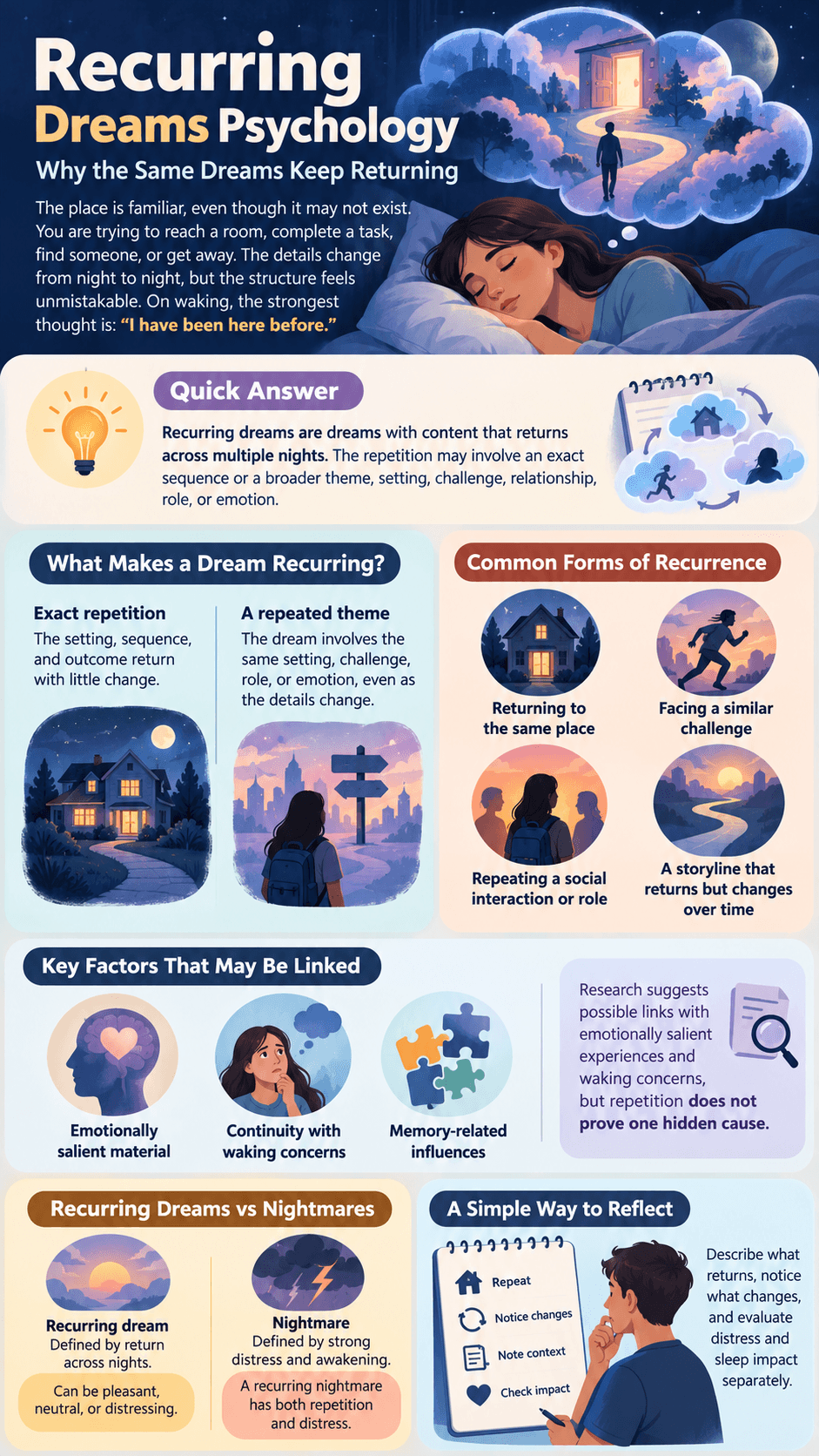
Recurring dreams are dreams with content that returns across multiple nights. The repetition may involve an exact sequence or a broader theme, setting, challenge, relationship, role, or emotion. Research suggests possible links with emotionally salient experiences and waking concerns, but repetition does not prove one hidden cause. Careful tracking can clarify the pattern without turning it into a diagnosis or universal symbol.
Recurrence means repeated content, not necessarily an identical replay
A recurring dream does not need to reproduce every scene. You may return to the same building with different people, face the same type of obstacle in new locations, or feel the same urgency in unrelated stories. The repeated structure can matter more than surface details.
Why repetition does not prove one hidden cause
A pattern can invite questions, but it cannot answer them by itself. Similar content may reflect emotional salience, familiar expectations, memory influences, ongoing concerns, or other processes. A recurring image does not independently establish trauma, repression, conflict, or a future event.
What Makes a Dream Recurring
Exact repetition versus a repeated theme
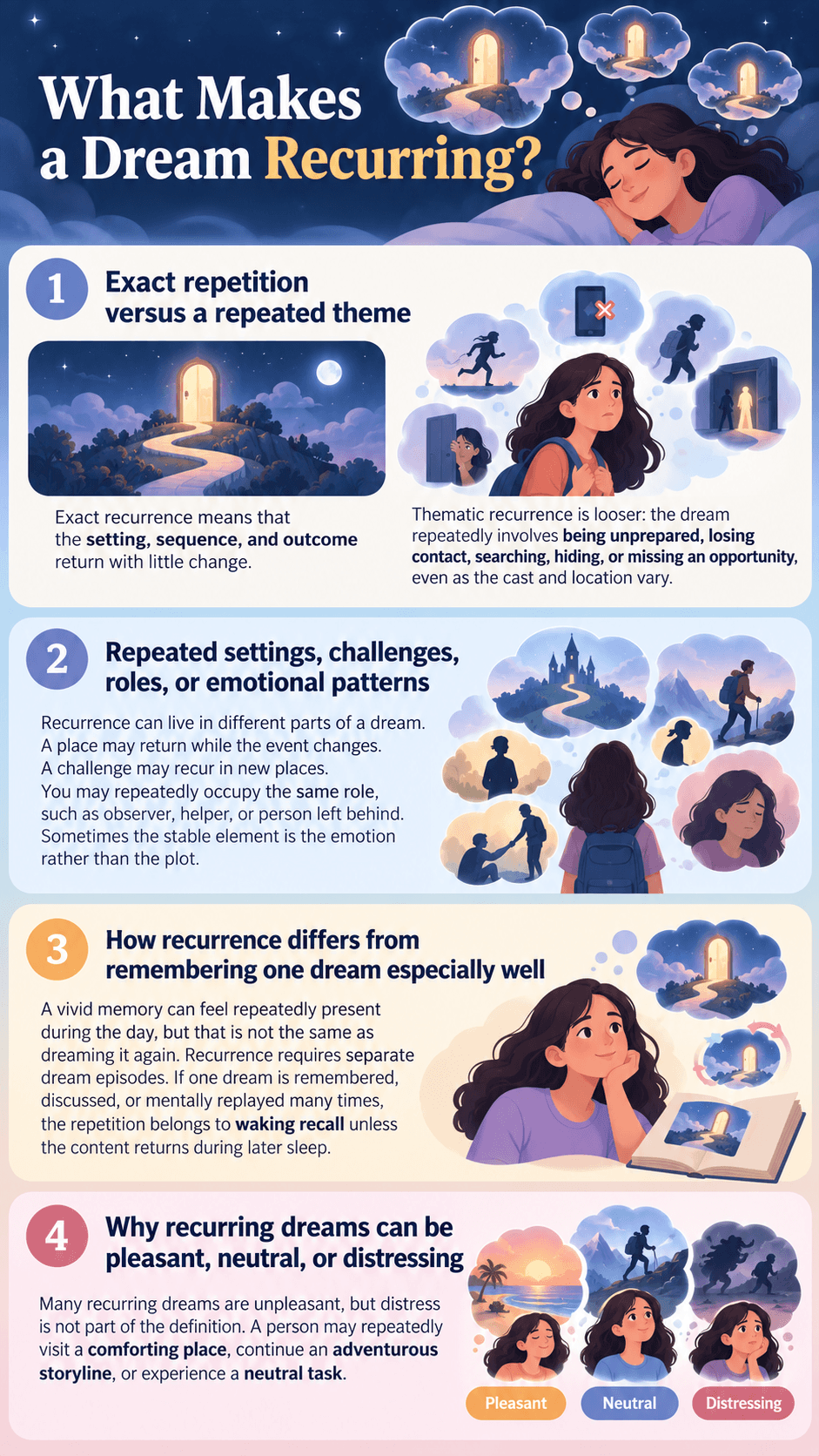
Exact recurrence means that the setting, sequence, and outcome return with little change. Thematic recurrence is looser: the dream repeatedly involves being unprepared, losing contact, searching, hiding, or missing an opportunity, even as the cast and location vary. Both forms count as repetition if they appear across different nights.
Repeated settings, challenges, roles, or emotional patterns
Recurrence can live in different parts of a dream. A place may return while the event changes. A challenge may recur in new places. You may repeatedly occupy the same role, such as observer, helper, or person left behind. Sometimes the stable element is the emotion rather than the plot.
How recurrence differs from remembering one dream especially well
A vivid memory can feel repeatedly present during the day, but that is not the same as dreaming it again. Recurrence requires separate dream episodes. If one dream is remembered, discussed, or mentally replayed many times, the repetition belongs to waking recall unless the content returns during later sleep.
Why recurring dreams can be pleasant, neutral, or distressing
Many recurring dreams are unpleasant, but distress is not part of the definition. A person may repeatedly visit a comforting place, continue an adventurous storyline, or experience a neutral task. The Sleep Foundation overview of recurring dreams likewise treats repeated content and negative impact as related but separate questions.
A Recurring Dream Pattern Model
Dream content that returns across nights
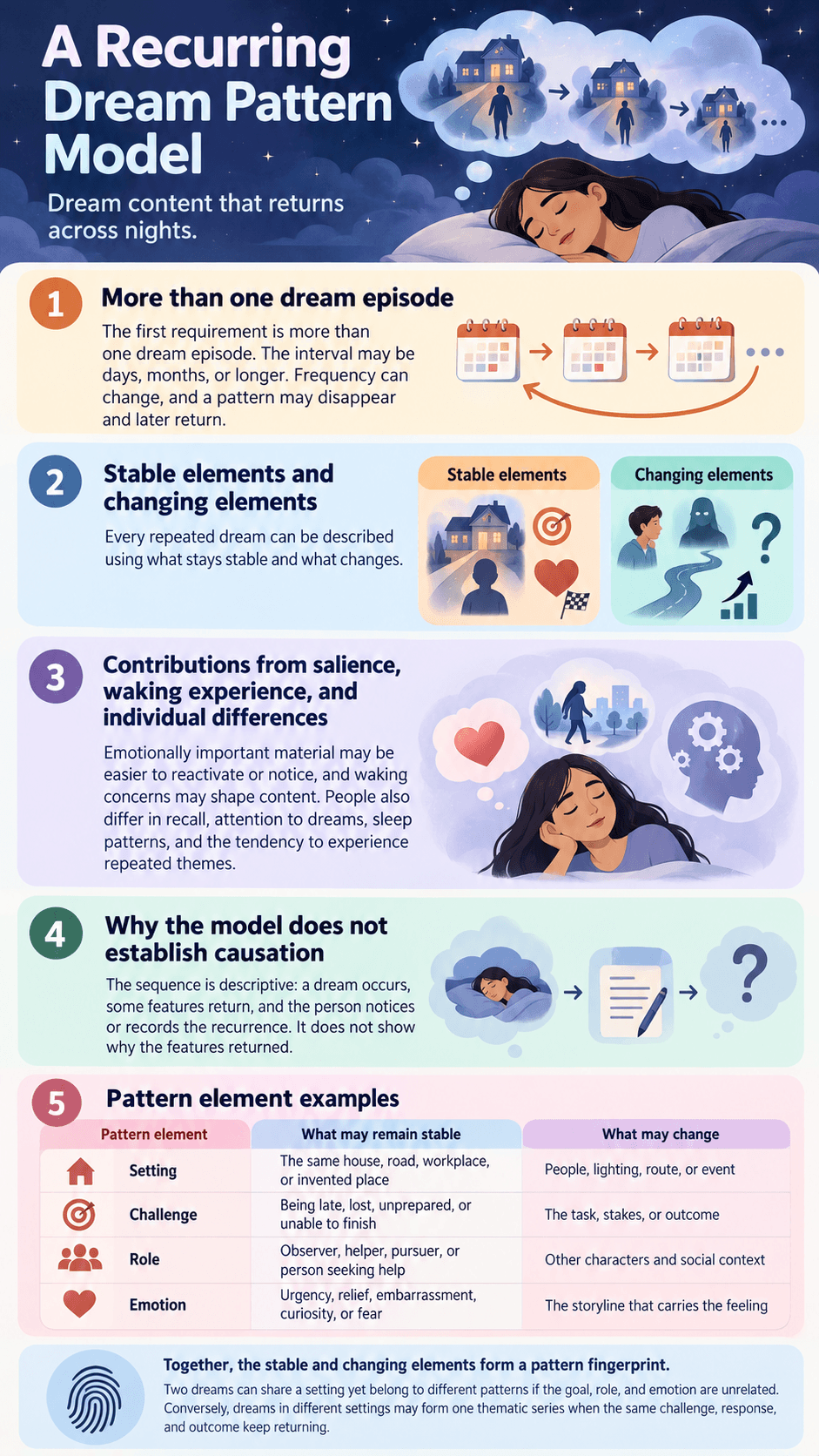
The first requirement is more than one dream episode. The interval may be days, months, or longer. Frequency can change, and a pattern may disappear and later return. Recurrence therefore describes a relationship among dream reports over time rather than one feature inside a single dream.
Stable elements and changing elements
Every repeated dream can be described using what stays stable and what changes. Stable elements might include the setting, goal, relationship, emotion, or ending. Changing elements might include who appears, how the problem begins, how much control the dreamer has, or whether the outcome improves.
Possible contributions from salience, waking experience, and individual differences
Emotionally important material may be easier to reactivate or notice, and waking concerns may shape content. People also differ in recall, attention to dreams, sleep patterns, and the tendency to experience repeated themes. These influences can combine without producing the same pattern for everyone.
Why the model does not establish causation
The sequence is descriptive: a dream occurs, some features return, and the person notices or records the recurrence. It does not show why the features returned. Later waking events, selective recall, expectation, and changes in attention can also shape the apparent pattern.
| Pattern element | What may remain stable | What may change |
|---|---|---|
| Setting | The same house, road, workplace, or invented place | People, lighting, route, or event |
| Challenge | Being late, lost, unprepared, or unable to finish | The task, stakes, or outcome |
| Role | Observer, helper, pursuer, or person seeking help | Other characters and social context |
| Emotion | Urgency, relief, embarrassment, curiosity, or fear | The storyline that carries the feeling |
Together, the stable and changing elements form a pattern fingerprint. Two dreams can share a setting yet belong to different patterns if the goal, role, and emotion are unrelated. Conversely, dreams in different settings may form one thematic series when the same challenge, response, and outcome keep returning.
This approach avoids two extremes. It does not require a perfect replay before acknowledging recurrence, and it does not label every dream with a similar feeling as the same dream. The pattern should be specific enough that another reader could understand what repeated without needing to accept an interpretation.
Why Dream Content May Repeat
Continuity with current concerns or experiences
The continuity hypothesis proposes that dreams often reflect waking activities, relationships, concerns, and emotions. Repetition could occur when a concern remains salient across time. The link may be literal or indirect, and many important waking experiences never appear in remembered dreams.
Emotionally salient material
Events and questions with strong personal importance may attract attention before sleep and after waking. A study connecting psychological need experiences with daily and recurring dreams found associations between need frustration and more negative dream themes. The results do not show that one dream identifies a specific unmet need.
Repeated expectations and unresolved questions as hypotheses
A person may repeatedly anticipate failure, rejection, conflict, or uncertainty in waking life, and a similar structure may appear in dreams. “Unresolved” should remain a hypothesis, not a diagnosis. Some questions have no simple resolution, and some recurring dreams persist even when the dreamer cannot identify a matching concern.
Memory-related influences without turning this into a general memory lesson
Dreams can incorporate fragments of recent and older experience, recombining them rather than replaying them exactly. Repeated activation of familiar material may contribute to recurrence. It remains difficult to separate the dream’s construction from what is later remembered and labeled as the same pattern.
Why there is no universal explanation for every recurring dream
Recurring dreams vary in emotion, frequency, age of onset, stability, and connection to waking life. A theory that fits a repeated examination dream may not explain a comforting place or a changing adventure. Research offers candidate influences and group-level patterns, not one cause that can be read from content.
Study design adds another limit. Retrospective questions ask people to summarize months or years from memory, while diaries capture a shorter period and may change attention to dreams. Studies of children or adolescents can reveal developmental patterns, but their findings cannot simply be transferred to adults. Confidence should match the population, method, and context actually studied.
Common Forms of Recurrence
Returning to the same place
A person may revisit a childhood home, unfamiliar city, large building, natural landscape, or invented environment. The place can remain stable while the activity changes. Its recurrence shows that the setting is part of the pattern, not that it carries one meaning for every dreamer.
Facing a similar challenge
The repeated element may be a task: finding a route, reaching a destination, preparing for an event, escaping an obstacle, or completing something under time pressure. The task can provide a stable structure even when the dream’s people and objects change.
Repeating a social interaction or role
Some dreams repeatedly position the dreamer as excluded, responsible, unheard, pursued, admired, or asked to help. This can invite reflection on relationships or expectations, but it cannot diagnose an attachment style, defense mechanism, or hidden wish.
A storyline that returns but changes over time
Recurring dreams sometimes develop. The obstacle becomes easier, the ending changes, a new person appears, or the dreamer responds differently. Change is part of the evidence. Focusing only on the repeated label can hide movement within the pattern.
Use examples as patterns, not symbol definitions
Falling, being chased, losing teeth, seeing an ex, or being unprepared are familiar examples, but none has a universal translation. The useful question is what repeats in this person’s reports and context. A popular symbol list cannot substitute for that description.
Recurring Dreams vs Recurring Nightmares
Repetition versus emotional distress
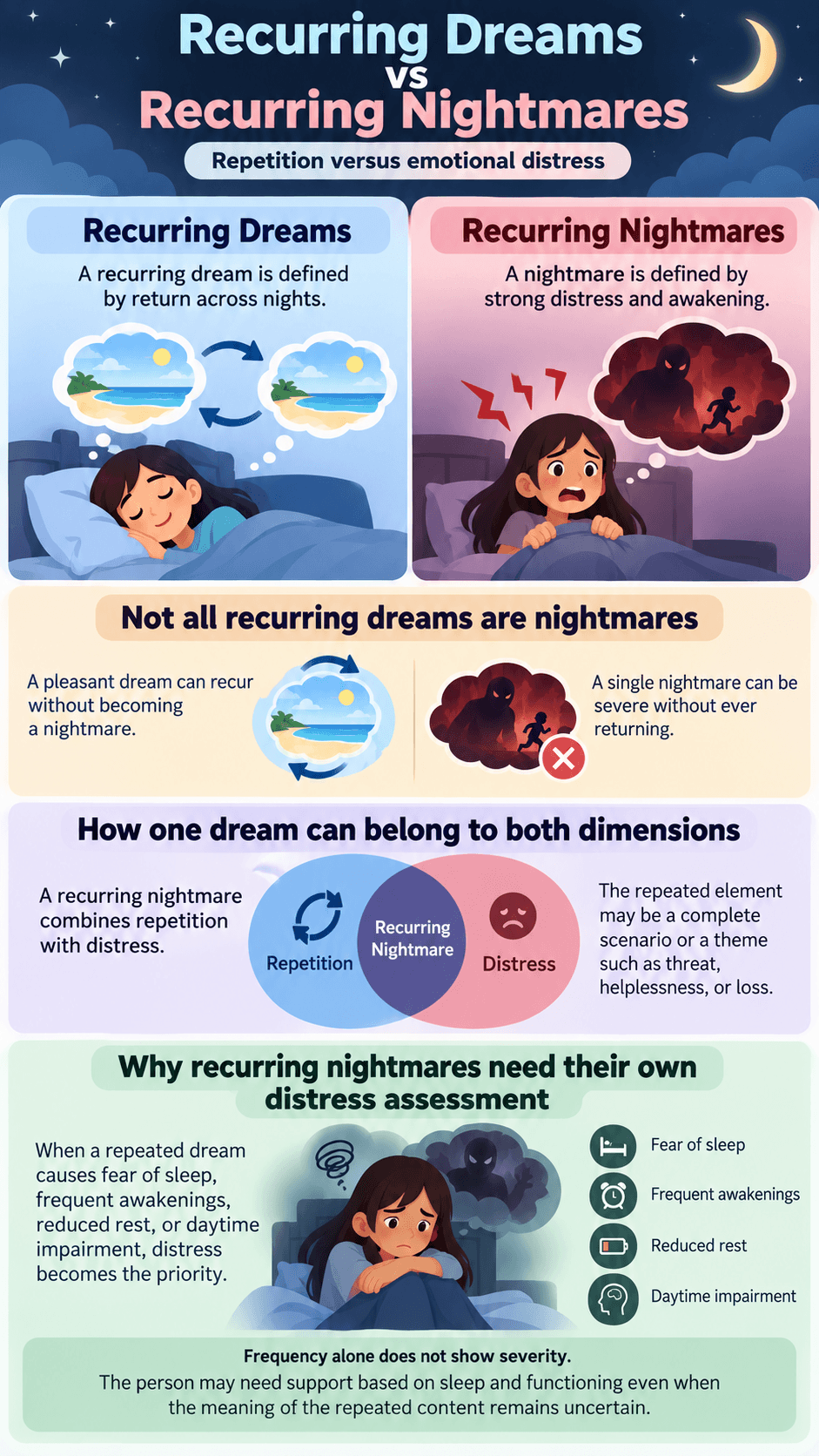
A recurring dream is defined by return across nights. A nightmare is defined by strong distress and awakening. A pleasant dream can recur without becoming a nightmare, while a single nightmare can be severe without ever returning.
How one dream can belong to both dimensions
A recurring nightmare combines repetition with distress. The repeated element may be a complete scenario or a theme such as threat, helplessness, or loss. Describing both dimensions prevents “recurring” from being treated as a synonym for frightening.
Why recurring nightmares need their own distress assessment
When a repeated dream causes fear of sleep, frequent awakenings, reduced rest, or daytime impairment, distress becomes the priority. Frequency alone does not show severity. The person may need support based on sleep and functioning even when the meaning of the repeated content remains uncertain.
Recurring Dreams vs Frequent Vivid Dreams
Repetition across nights versus intensity within a dream
Recurrence is a pattern across separate dreams. Vividness is the clarity, realism, sensory detail, or emotional intensity of one experience. Several unrelated dreams can all feel vivid, and the same recurring theme can return with different levels of intensity.
When a recurring dream is also vivid
The dimensions can overlap. A dream may return many times and feel exceptionally lifelike on each occasion. Vividness may make the pattern easier to notice and remember, but it does not explain why the content repeats.
Why vivid recall does not prove recurrence
One unusually memorable dream may be rehearsed in waking thought until it feels continually present. To identify recurrence, look for separate sleep episodes with returning content. Strong memory for one episode is not evidence of several episodes.
| Dimension | Core question | What it does not establish |
|---|---|---|
| Recurrence | Did content return across nights? | Distress, intensity, or cause |
| Distress | Was the dream frightening or severely upsetting? | That it has happened before |
| Vividness | How clear or lifelike did it feel? | That the dream was lucid or recurrent |
| Recall | What remained after waking? | A complete record of the experience |
Do Recurring Dreams Have Meaning?
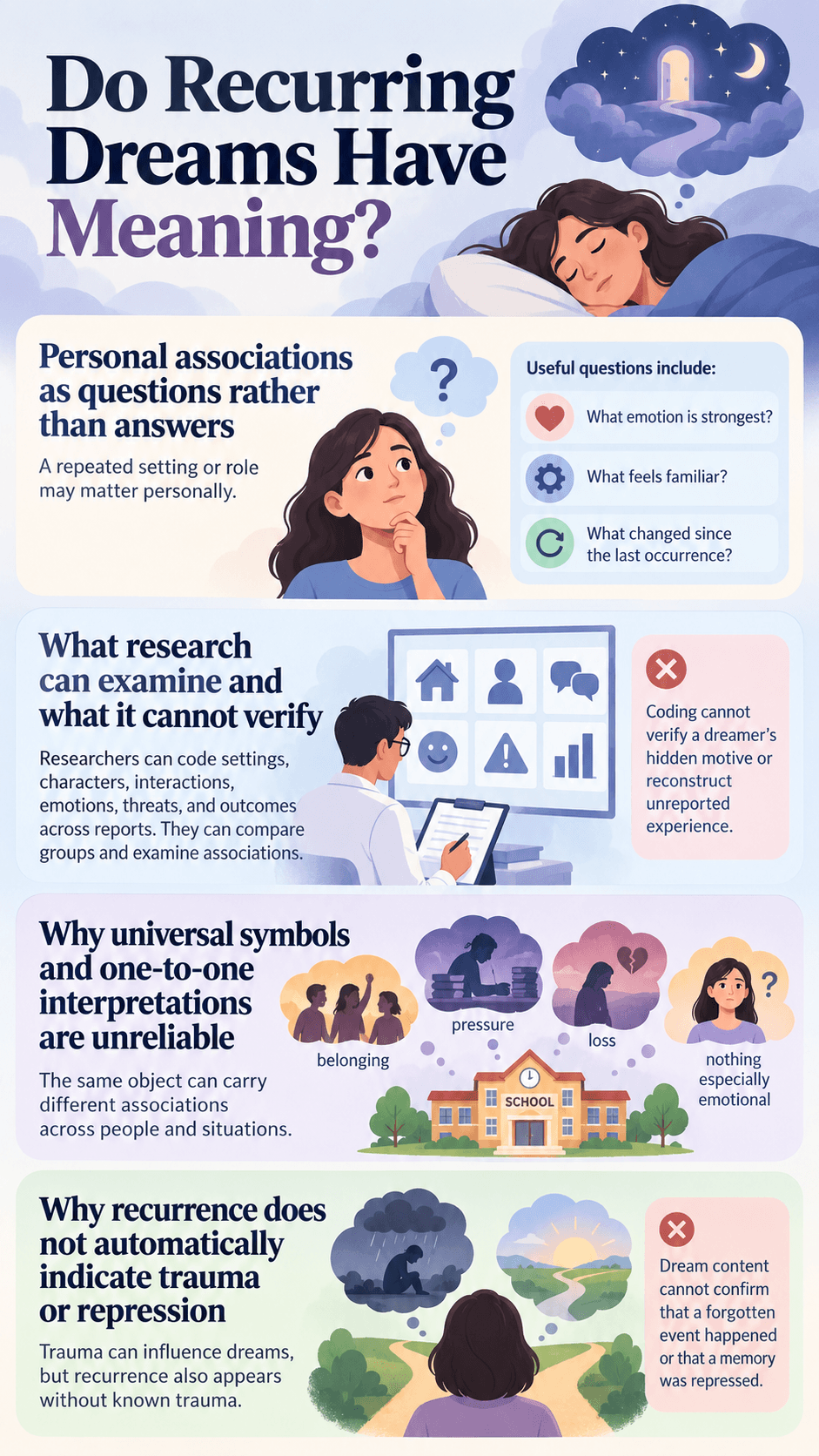
Personal associations as questions rather than answers
A repeated setting or role may matter personally. Useful questions include: What emotion is strongest? What feels familiar? What changed since the last occurrence? These questions can support reflection while leaving room for uncertainty and alternative explanations.
What research can examine and what it cannot verify
Researchers can code settings, characters, interactions, emotions, threats, and outcomes across reports. They can compare groups and examine associations. The UCSC discussion of dream-content measurement explains why objective categories, reproducibility, and report length matter. Coding cannot verify a dreamer’s hidden motive or reconstruct unreported experience.
Why universal symbols and one-to-one interpretations are unreliable
The same object can carry different associations across people and situations. A school may evoke belonging, pressure, loss, or nothing especially emotional. Assigning one meaning to every staircase, animal, or missing train removes personal and cultural context while claiming certainty research does not provide.
Why recurrence does not automatically indicate trauma or repression
Trauma can influence dreams, but recurrence also appears without known trauma. Dream content cannot confirm that a forgotten event happened or that a memory was repressed. Concerns about past events should be evaluated using waking evidence and appropriate professional support, not inferred from a repeated image.
A Practical Reflection Guide for Repeated Dreams
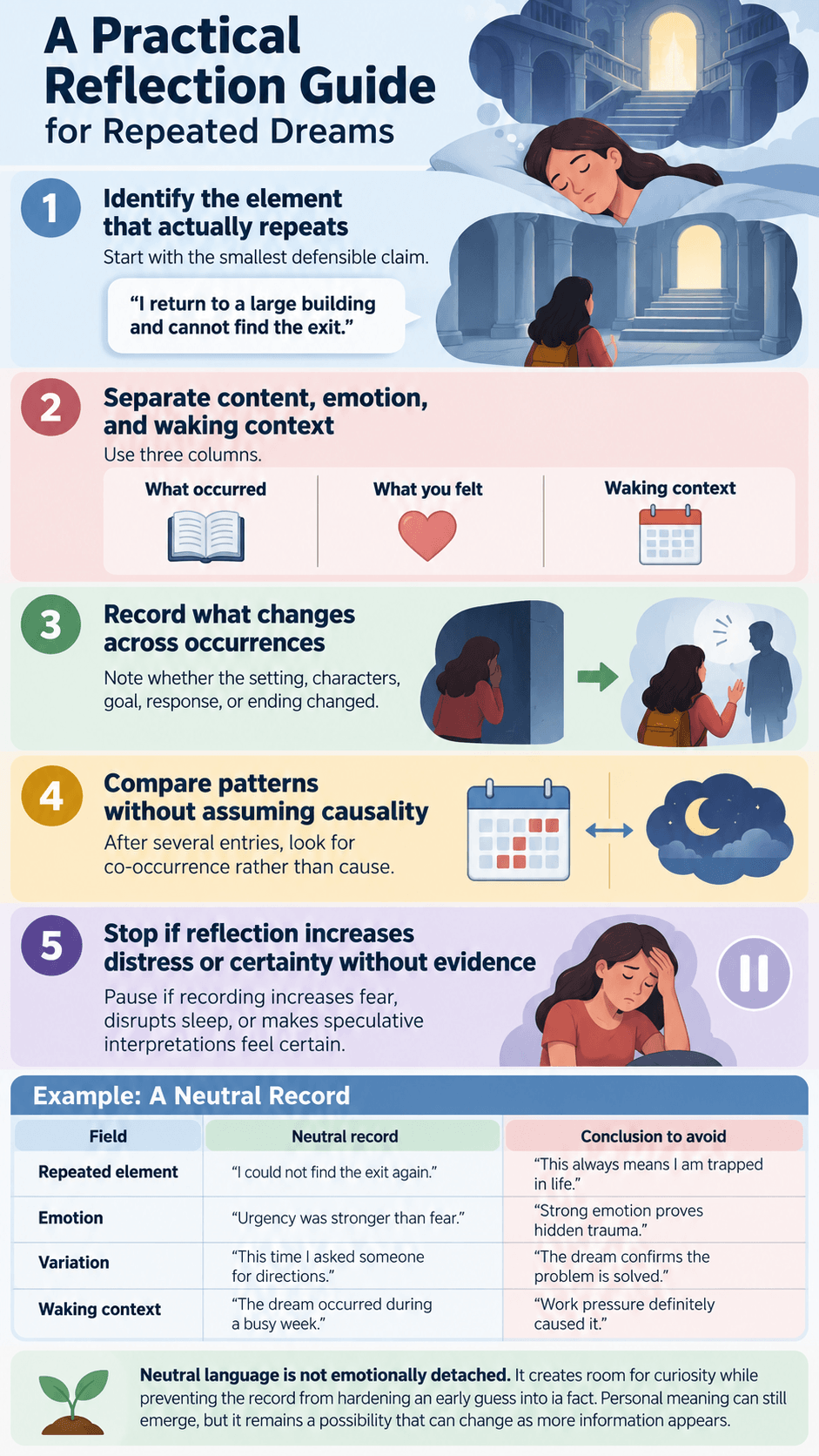
Identify the element that actually repeats
Start with the smallest defensible claim. Instead of “I always have the same dream,” write “I return to a large building and cannot find the exit.” This separates stable structure from details that may only have appeared once.
Separate content, emotion, and waking context
Use three columns: what occurred, what you felt, and what was happening around that period of waking life. Keeping the columns separate prevents a familiar emotion from being mistaken for proof that one waking event caused the dream.
Record what changes across occurrences
Note whether the setting, characters, goal, response, or ending changed. A shift from hiding to asking for help is different from an exact replay. Change can be informative even when its meaning remains uncertain.
Compare patterns without assuming causality
After several entries, look for co-occurrence rather than cause. The dream may appear during demanding weeks, after schedule changes, or without a clear pattern. “These happened together” is a more accurate conclusion than “this definitely produced the dream.”
Stop if reflection increases distress or certainty without evidence
Reflection should not become compulsive monitoring or a search for hidden catastrophe. Pause if recording increases fear, disrupts sleep, or makes speculative interpretations feel certain. The purpose is clearer description, not endless decoding.
- Repeat: name the setting, challenge, role, emotion, or outcome that returned.
- Variation: identify what was different this time.
- Context: note relevant waking circumstances without assigning a cause.
- Impact: record awakening, distress, sleep disruption, and next-day effects separately.
| Field | Neutral record | Conclusion to avoid |
|---|---|---|
| Repeated element | “I could not find the exit again.” | “This always means I am trapped in life.” |
| Emotion | “Urgency was stronger than fear.” | “Strong emotion proves hidden trauma.” |
| Variation | “This time I asked someone for directions.” | “The dream confirms the problem is solved.” |
| Waking context | “The dream occurred during a busy week.” | “Work pressure definitely caused it.” |
Neutral language is not emotionally detached. It creates room for curiosity while preventing the record from hardening an early guess into a fact. Personal meaning can still emerge, but it remains a possibility that can change as more information appears.
What a Dream Diary Can and Cannot Establish
Capturing frequency and variation
A diary can show when a dream was remembered, which elements recurred, and how the pattern changed. Recording soon after waking may preserve details that would otherwise fade. It can also reveal that supposedly identical dreams differ in important ways.
Recall bias and selective attention
Recording can increase attention to dreams, which may increase the number remembered. Distressing or unusual dreams may also be more likely to enter the diary. A change in recorded frequency can therefore reflect recall and attention as well as dream occurrence.
Why a record is not a diagnosis
A diary documents reports, not hidden memories or clinical conditions. It may help a clinician understand timing, distress, and sleep impact, but it cannot prove trauma, repression, or a specific psychological cause. Its strength is pattern description.
A useful diary also records nights when the dream did not occur. Without those entries, it is easy to see only the repeated episodes and miss changes in frequency. Even a complete diary remains a sample of remembered dreams rather than an inventory of every experience during sleep.
When Repeated Dreams Become Distressing
Sleep disruption or fear of sleep
A recurring dream becomes more concerning when anticipation delays bedtime, awakenings reduce rest, or the person struggles to return to sleep. The content may remain unchanged while its effect grows. Sleep impact deserves attention even if no clear explanation for the repetition is available.
Strong waking distress or impaired functioning
Consider the effect on concentration, mood, work, study, driving, relationships, and daily responsibilities. Studies of recurrent dream content in young adolescents document themes and emotions in that population, but child and adolescent findings should not be treated as direct explanations for an adult’s distress.
When a sleep or mental-health professional may help
Professional guidance may be appropriate when repeated dreams are persistently distressing, impair sleep, or occur alongside broader health or waking symptoms. Research on recurrent dreams and psychosocial adjustment in preteen children reports associations, not diagnoses or adult conclusions. Individual assessment remains necessary.
How Recurring Dreams Relate to Other Dream Questions
Return to the broad science of dreaming
Recurrence is one feature of dream content, not an explanation of why dreaming exists. The broader science includes sleep stages, memory, emotion, brain activity, and report methods. The NINDS overview of sleep provides that wider physiological context without explaining a repeated theme by itself.
Compare repetition with nightmare distress and vividness
If the main concern is return across nights, focus on recurrence. If fear and awakening dominate, the nightmare question becomes central. If realism or sensory intensity stands out, vividness may be the better next topic. One experience can involve all three dimensions.
Connect lightly with emotion and stress psychology
Emotional salience and waking pressure may help frame questions about recurrence, but they do not reduce every repeated dream to stress or an emotion problem. Broader emotion and stress research concerns waking regulation and responses, while this article remains focused on dream patterns across nights.
FAQ About Recurring Dreams
Does a recurring dream have to be exactly the same each time?
No. Recurrence may be exact, but it can also be thematic. The same setting, challenge, role, emotion, or outcome may return inside different storylines. Recording stable and changing elements is more precise than asking whether every detail matches.
Are recurring dreams always nightmares?
No. Recurring dreams can be pleasant, neutral, or distressing. A recurring nightmare has both repetition and strong distress, often with awakening. Repetition describes what happens across nights; nightmare describes the emotional and sleep-disrupting quality of an episode.
Does the same dream prove unresolved trauma?
No. Trauma can influence dreams, but a repeated dream cannot confirm trauma, a forgotten event, or repression. Recurrence has multiple possible influences and may occur without trauma. Concerns about past events require waking evidence and qualified support.
Can a dream diary show why a dream repeats?
A diary can show frequency, stable elements, variation, and possible co-occurring circumstances. It cannot prove causation. Increased attention may also improve recall, making the pattern appear more frequent even if the underlying occurrence did not change.
Why might a recurring dream change over time?
Dream content may shift with experience, expectations, emotion, memory, or simple variation in dream construction. A changed ending or role can be worth noting, but it does not carry one predetermined meaning. Development is evidence about the pattern, not automatic proof of resolution.
Key Takeaways
- Recurring dreams repeat content across separate nights, either exactly or through a shared theme.
- The stable element may be a setting, challenge, role, relationship, emotion, or outcome.
- Repetition, nightmare distress, vividness, and recall are separate dimensions that can overlap.
- Research can identify patterns and associations but cannot verify universal symbols or one hidden cause.
- A diary can clarify frequency and variation while remaining vulnerable to recall and attention bias.
- Persistent sleep disruption, fear of sleep, daytime distress, or impaired functioning may justify professional guidance.
When a dream returns, begin with description rather than interpretation. Name the smallest specific element that truly repeats, note what changed, and separate dream content from distress and waking context. That approach preserves personal meaning without turning uncertainty into a diagnosis.

Michael Reed is the Founder and Lead Writer at Psychology Exposed. He writes about human behavior, relationships, emotional patterns, self-awareness, and practical psychology topics using research-informed, easy-to-understand content.
Read More About Michael Reed: https://psychologyexposed.com/michael-reed/