
You wake suddenly with your heart racing. For a moment, the threat still feels close: the fall, the pursuit, the terrible news, or the sense that you could not escape. Then the room comes back into focus, and you realize the danger belonged to a dream.
Nightmares are not simply dreams with dark imagery. They involve strong negative emotion, often lead to awakening, and may remain vivid afterward. An isolated nightmare can follow an emotionally intense day, a disrupted night, or no obvious event at all. Repeated nightmares can have a larger impact when they reduce sleep, create fear of bedtime, or make daytime functioning harder.
There is no single explanation that fits every nightmare. Emotional concerns, stress, changing sleep patterns, medication or substance effects, health conditions, and individual differences may contribute in different combinations. None of these factors can be inferred from dream content alone. A frightening dream does not prove trauma, predict danger, or establish a mental-health condition. The most useful questions concern the pattern: what happened around the dream, whether it keeps returning, how sleep was affected, and what carries into the next day.
Quick Answer
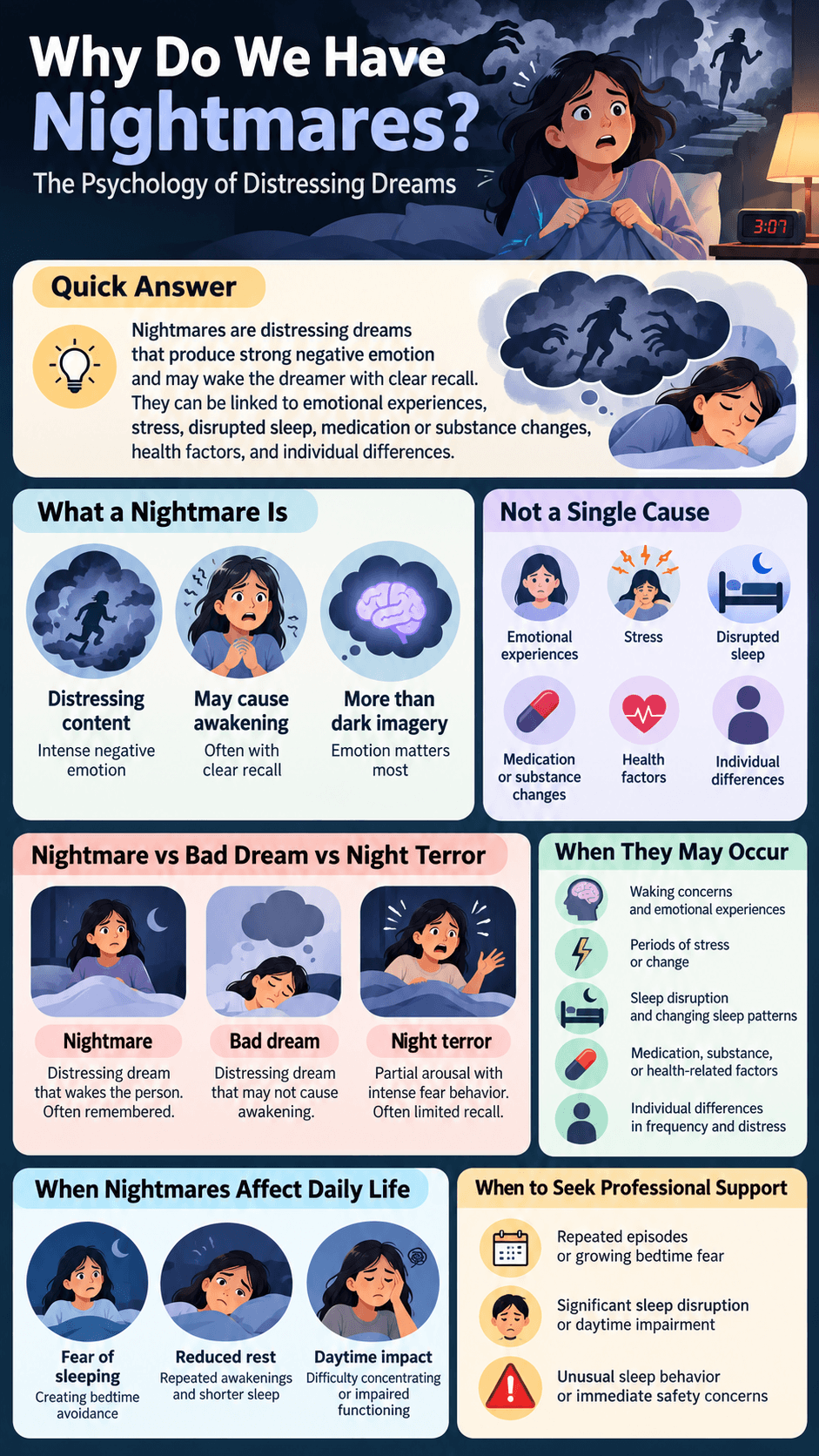
Nightmares are distressing dreams that produce strong negative emotion and may wake the dreamer with clear recall. They can be associated with emotional experiences, stress, disrupted sleep, medication or substance changes, health factors, and individual vulnerability, but one dream rarely reveals one cause. Repeated nightmares deserve more attention when they disturb sleep, create persistent fear, or impair daily life.
Nightmares are distressing dream experiences with no single universal cause
A nightmare can involve fear, helplessness, grief, disgust, shame, or another painful emotion. The scene may draw on waking life, transform familiar concerns, or seem unrelated to anything recent. Several influences can operate together, and the same influence does not produce nightmares in everyone.
Why one nightmare does not establish trauma or a disorder
Occasional nightmares occur in people with and without trauma histories or health conditions. Clinical assessment considers frequency, duration, distress, impairment, sleep behavior, medication, health, and waking symptoms. A dream image by itself cannot confirm trauma, repression, anxiety, depression, or any diagnosis.
What a Nightmare Is
Distressing content and strong negative emotion
Nightmares are dreams marked by intense negative emotion. Fear is common, but it is not the only possibility. Anger, sadness, disgust, guilt, and helplessness may also dominate. The emotional experience matters more than whether the storyline contains a stereotypically frightening image.
Awakening, orientation, and dream recall
A nightmare often ends with awakening. The person generally becomes oriented and can recall part of the dream, although details may fade. Cleveland Clinic’s medical overview of nightmares describes strong emotion, recall, sleep disruption, and daytime effects while distinguishing an occasional episode from a persistent pattern.
Nightmares versus bad dreams
In research, a practical distinction is whether the distressing dream causes awakening. A nightmare wakes the dreamer, while a bad dream may remain unpleasant without producing an awakening. Everyday language is less consistent, so someone may call any disturbing dream a nightmare. The label matters less than describing emotion, awakening, recall, and impact clearly.
Occasional nightmares versus a persistent clinical concern
An isolated nightmare can be upsetting without indicating a disorder. Concern grows when episodes are frequent, continue over time, interfere with returning to sleep, create bedtime avoidance, or impair daytime functioning. Diagnosis requires individualized evaluation; frequency alone is not enough.
A Nightmare Experience Model
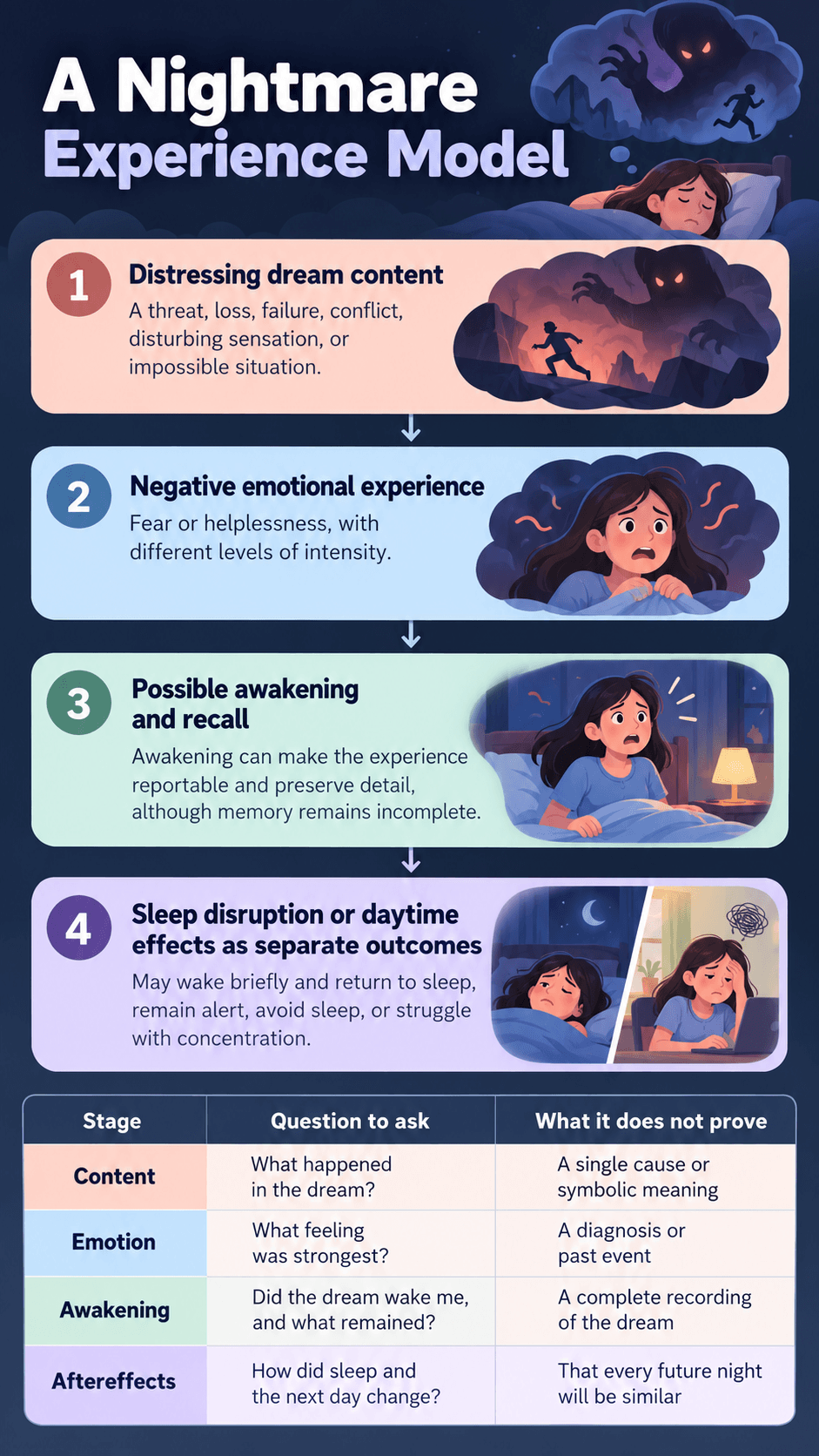
Distressing dream content
The first part is what happens within the dream: a threat, loss, failure, conflict, disturbing sensation, or impossible situation. Content supplies the scenario, but it does not reveal its cause automatically. Similar scenes can arise in very different personal and sleep contexts.
Negative emotional experience
The second part is the emotion felt during the dream. Two people could report a similar scene while experiencing different levels of fear or helplessness. Emotional intensity helps distinguish a mildly unpleasant dream from one that becomes a major distressing event.
Possible awakening and recall
The third part is the transition out of sleep. Awakening can make the experience reportable and preserve detail, although memory remains incomplete. Strong recall may make the event feel especially important, but remembering more does not prove that the dream carried a hidden message.
Sleep disruption or daytime effects as separate outcomes
The fourth part is what follows. One person may wake briefly and return to sleep; another may remain alert, avoid sleep the next night, or struggle with concentration. Dream distress, sleep loss, and daytime impairment are related outcomes, not interchangeable measures.
| Stage | Question to ask | What it does not prove |
|---|---|---|
| Content | What happened in the dream? | A single cause or symbolic meaning |
| Emotion | What feeling was strongest? | A diagnosis or past event |
| Awakening | Did the dream wake me, and what remained? | A complete recording of the dream |
| Aftereffects | How did sleep and the next day change? | That every future night will be similar |
Why Nightmares May Occur

Emotional experiences and recent concerns
Dreams can incorporate people, situations, and emotions from waking life without replaying events exactly. A conflict may return as pursuit, uncertainty may become a failed journey, or grief may appear through an invented scene. This continuity is possible, but the resemblance does not show that the dream processed or resolved the concern.
Stress-related associations without reducing every nightmare to stress
Periods of pressure, change, or emotional strain can coincide with more disturbing dreams for some people. Stress is therefore a relevant question, not a universal answer. A nightmare can occur during a calm period, and many stressed people do not report nightmares. Association should not be treated as a verdict about one night.
Sleep disruption and changing sleep patterns
Irregular schedules, sleep loss, repeated awakenings, or changes in sleep timing may alter dream recall and the opportunity to wake from an intense dream. The NINDS guide to sleep stages explains the cycling of non-REM and REM sleep that provides the physiological context for dreaming.
Medication, substance, and health-related factors at a broad educational level
Some medications, substance use or withdrawal, fever, pain, breathing-related sleep problems, and other health changes may be associated with disturbing dreams. These possibilities are too individual for a dream to identify. Do not stop prescribed medication or attempt withdrawal based on nightmares alone; discuss meaningful changes with a qualified clinician.
Individual differences in frequency and distress
People differ in dream recall, emotional sensitivity, sleep patterns, and the degree to which an awakening remains upsetting. Two people may experience comparable content but report different distress and next-day effects. The relevant baseline is the person’s own pattern, not someone else’s dream frequency.
Why associations do not prove one cause
Several factors often change together. A demanding week may alter bedtime, shorten sleep, increase awakenings, and change substance use. If nightmares increase, no single observation reveals which factor mattered. A useful explanation remains probabilistic and open to multiple contributors.
| Area to notice | Useful observation | Common reasoning error |
|---|---|---|
| Emotional context | Recent concerns, losses, conflicts, or major changes | Assuming emotion explains every dream detail |
| Sleep context | Schedule shifts, sleep loss, awakenings, or irregular timing | Treating recall as a direct measure of dream production |
| Health context | Medication, substance, illness, pain, or breathing changes | Changing treatment without clinical guidance |
| Impact | Fear of sleep, reduced rest, distress, or impaired functioning | Judging severity from imagery alone |
The goal is not to find a culprit after one night. It is to notice whether changes repeatedly travel together. Even then, a pattern can guide questions without proving causation. A clinician may need to examine several areas before deciding what is relevant for one person.
The Psychology of Frightening Dreams
Threat-related scenarios and fear responses
Nightmares often organize experience around threat: being pursued, trapped, injured, exposed, abandoned, or unable to protect someone. The body may respond with intense arousal around awakening. Yet a threat theme is a description of content, not evidence that a matching event occurred or will occur.
Continuity with waking experience as one hypothesis
The continuity hypothesis proposes that waking concerns and emotional preoccupations can influence dreams. Continuity may involve a recognizable person or only a similar feeling. A dream about missing an impossible train might resemble waking pressure without corresponding to one literal event. The hypothesis predicts overlap, not a reliable decoding system.
Threat-simulation and emotional-processing accounts
Threat-simulation accounts suggest that some dreams rehearse detecting or responding to danger. Emotional-processing accounts propose that dreaming may reactivate or reorganize emotional material. Both can generate testable questions, but neither explains every nightmare or proves that a distressing dream was useful.
Limits of interpreting content after waking
Dream reports are reconstructed after a state change. Details may fade, emotion can influence the remembered story, and the mind may impose a clearer sequence afterward. Personal reflection can identify associations, but universal symbols and confident claims about hidden trauma exceed what the dream can establish.
Nightmare vs Bad Dream vs Night Terror
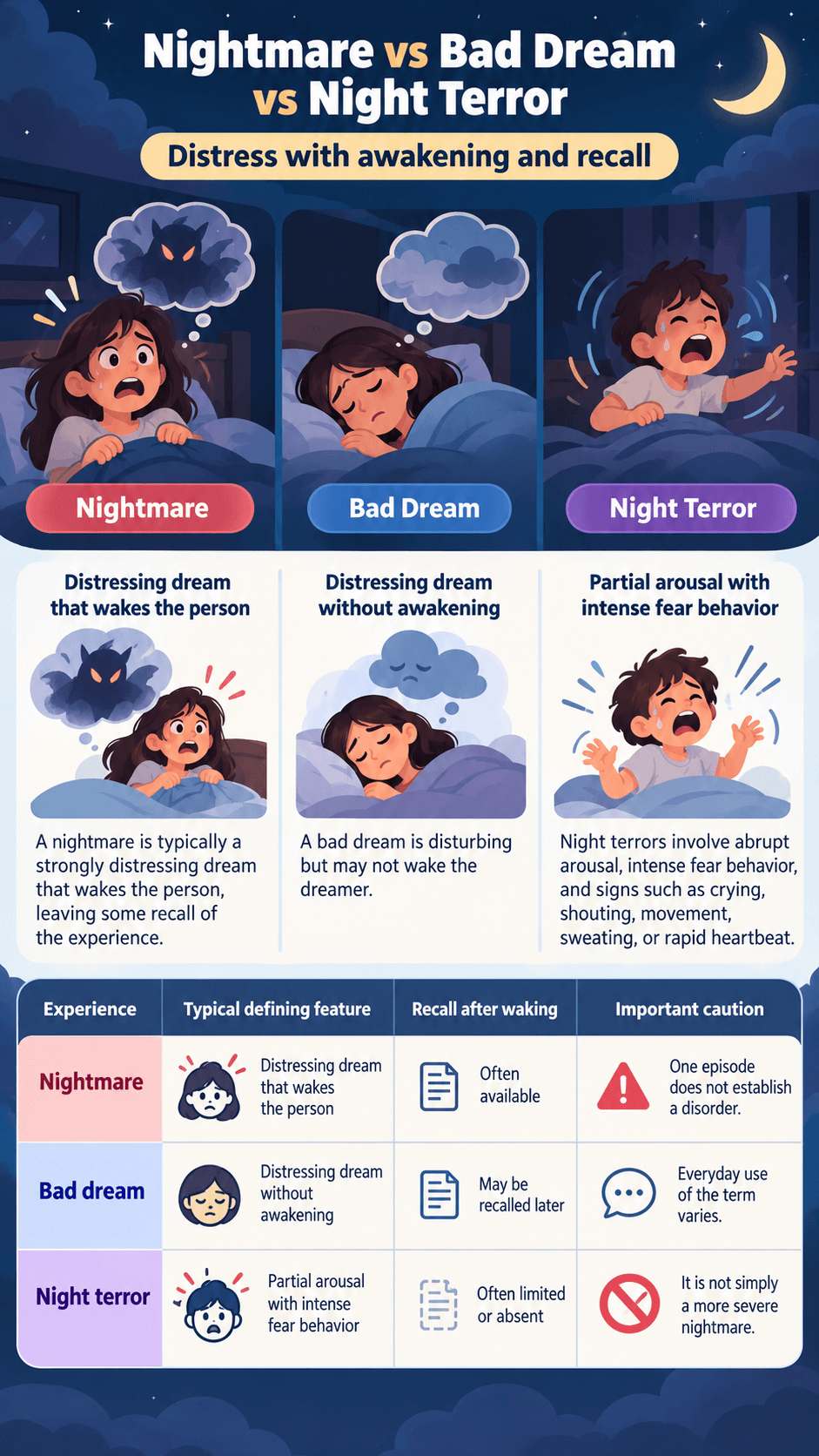
Distress with awakening and recall
A nightmare is typically a strongly distressing dream that wakes the person, leaving some recall of the experience. Orientation usually returns quickly, although the emotion may remain. This pattern helps distinguish it from other nighttime events without allowing a self-description to settle every clinical question.
A bad dream that may not cause awakening
A bad dream is disturbing but may not wake the dreamer. In a prospective study comparing idiopathic nightmares and bad dreams, nightmares were rated as more emotionally intense, while both categories included more than fear alone. The results describe group patterns, not a test for classifying every remembered dream.
Night terrors as a different sleep event
Night terrors involve abrupt arousal, intense fear behavior, and signs such as crying, shouting, movement, sweating, or rapid heartbeat. They usually arise from non-REM sleep, and detailed dream recall may be limited. Nightmares are more closely associated with remembered dream content and often occur during REM sleep.
Why a content memory alone cannot settle every distinction
People may use “nightmare,” “terror,” and “bad dream” interchangeably. Timing, behavior, responsiveness, recall, and orientation add important information. Unusual movement, injury risk, confusion, or repeated episodes deserves professional assessment rather than classification from a story fragment.
| Experience | Typical defining feature | Recall after waking | Important caution |
|---|---|---|---|
| Nightmare | Distressing dream that wakes the person | Often available | One episode does not establish a disorder |
| Bad dream | Distressing dream without awakening | May be recalled later | Everyday use of the term varies |
| Night terror | Partial arousal with intense fear behavior | Often limited or absent | It is not simply a more severe nightmare |
Nightmares vs Recurring Dreams
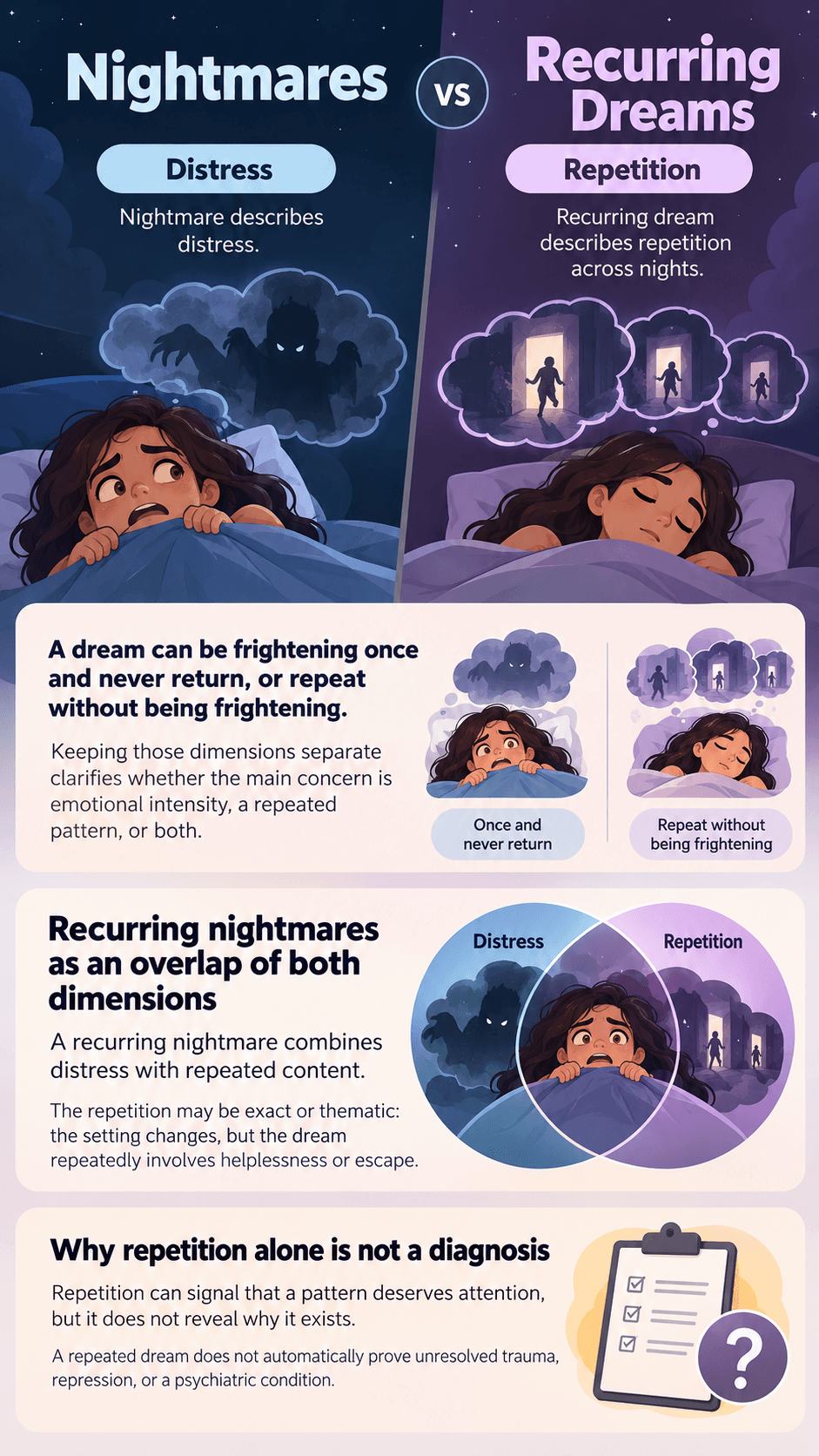
Distress versus repetition
Nightmare describes distress. Recurring dream describes repetition across nights. A dream can be frightening once and never return, or repeat without being frightening. Keeping those dimensions separate clarifies whether the main concern is emotional intensity, a repeated pattern, or both.
Recurring nightmares as an overlap of both dimensions
A recurring nightmare combines distress with repeated content. The repetition may be exact or thematic: the setting changes, but the dream repeatedly involves helplessness or escape. This overlap can be especially disruptive because anticipation of the next episode may affect bedtime and sleep.
Why repetition alone is not a diagnosis
Repetition can signal that a pattern deserves attention, but it does not reveal why it exists. Frequency, duration, awakening, daytime distress, health context, and functional impact matter. A repeated dream does not automatically prove unresolved trauma, repression, or a psychiatric condition.
Nightmares, Vividness, and Recall
A nightmare may feel vivid without all vivid dreams being nightmares
Vividness describes clarity, realism, sensory detail, or emotional intensity. Nightmares often feel vivid, but vivid dreams can also be neutral or pleasant. A dream’s lifelike quality does not make its events external, predictive, or more diagnostically meaningful.
Remembering frightening content after awakening
Awakening close to a distressing scene can preserve images and emotion. The memory may still change as the person explains it, thinks about it, or encounters new information. Strong recall is access to part of the experience, not a perfect recording of everything that happened during sleep.
Why strong recall can magnify concern without revealing a hidden message
A detailed nightmare can occupy attention the next day because it is emotionally salient and easy to rehearse. Repeatedly reviewing it may strengthen memory and concern. That psychological importance can be real without the content functioning as prophecy, recovered memory, or a universal symbol.
When Nightmares Affect Daily Life
Fear of going to sleep
After a frightening awakening, someone may delay bedtime, stay alert for danger, or worry that sleep will bring the dream back. Occasional hesitation may pass. Persistent avoidance can reduce sleep and create a difficult cycle in which fatigue and disrupted sleep become additional problems.
Repeated awakenings and reduced rest
Even brief nightmares can matter when they occur repeatedly or make it hard to return to sleep. The effect may appear as shorter sleep, fragmented rest, morning exhaustion, or irregular schedules adopted in an attempt to avoid the episodes.
Persistent daytime distress or impaired functioning
Nightmares deserve more attention when distress continues into the day, concentration falls, mood is affected, or work, study, driving, caregiving, or relationships become harder. Impact can matter even when a person cannot remember every detail or count every episode.
| Pattern | What to focus on | Reasonable response |
|---|---|---|
| Isolated episode, little lasting impact | Recovery and ordinary sleep routine | Observe without forcing an interpretation |
| Repeated episodes or growing bedtime fear | Frequency, awakenings, rest, and recent changes | Track the pattern and consider professional guidance |
| Major impairment or unusual sleep behavior | Safety, health symptoms, and daytime functioning | Arrange timely clinical assessment |
| Immediate danger or self-harm thoughts | Immediate safety | Use urgent local crisis or emergency support |
Supportive First Steps
Notice frequency, sleep disruption, and recent changes
Begin with description rather than interpretation. Note how often the episodes occur, whether they wake you, how long returning to sleep takes, and whether the next day changes. Also note recent shifts in schedule, health, medication, substance use, or emotional circumstances without deciding immediately that one is the cause.
Record patterns without treating symbols as diagnoses
A brief log can capture date, approximate timing, strongest emotion, awakening, and next-day effect. Detailed storytelling is optional. The record may help reveal a pattern or improve a clinical conversation, but it cannot diagnose trauma or turn a recurring image into objective evidence.
Keep the record light enough that it does not become another source of bedtime vigilance. A few factual notes are sufficient: “woke once,” “fear was strongest,” “took about twenty minutes to settle,” and “felt tired in the morning.” Exact timing is unnecessary when it cannot be known reliably.
Protect basic sleep routines without promising a cure
Regular sleep and wake times, enough opportunity for sleep, and a calmer transition into bed support sleep generally. They cannot guarantee that nightmares will stop. Avoid turning sleep into a performance test or adding elaborate rituals that increase anxiety when a simple routine is more sustainable.
Review new medication or health changes with a qualified clinician
If nightmares began or changed around a new medication, dose change, substance pattern, illness, pain problem, or other symptom, bring the timing to a clinician. Do not alter prescribed treatment alone. The temporal connection is useful information, not proof that the medication or condition caused the dreams.
When Professional Assessment May Be Important
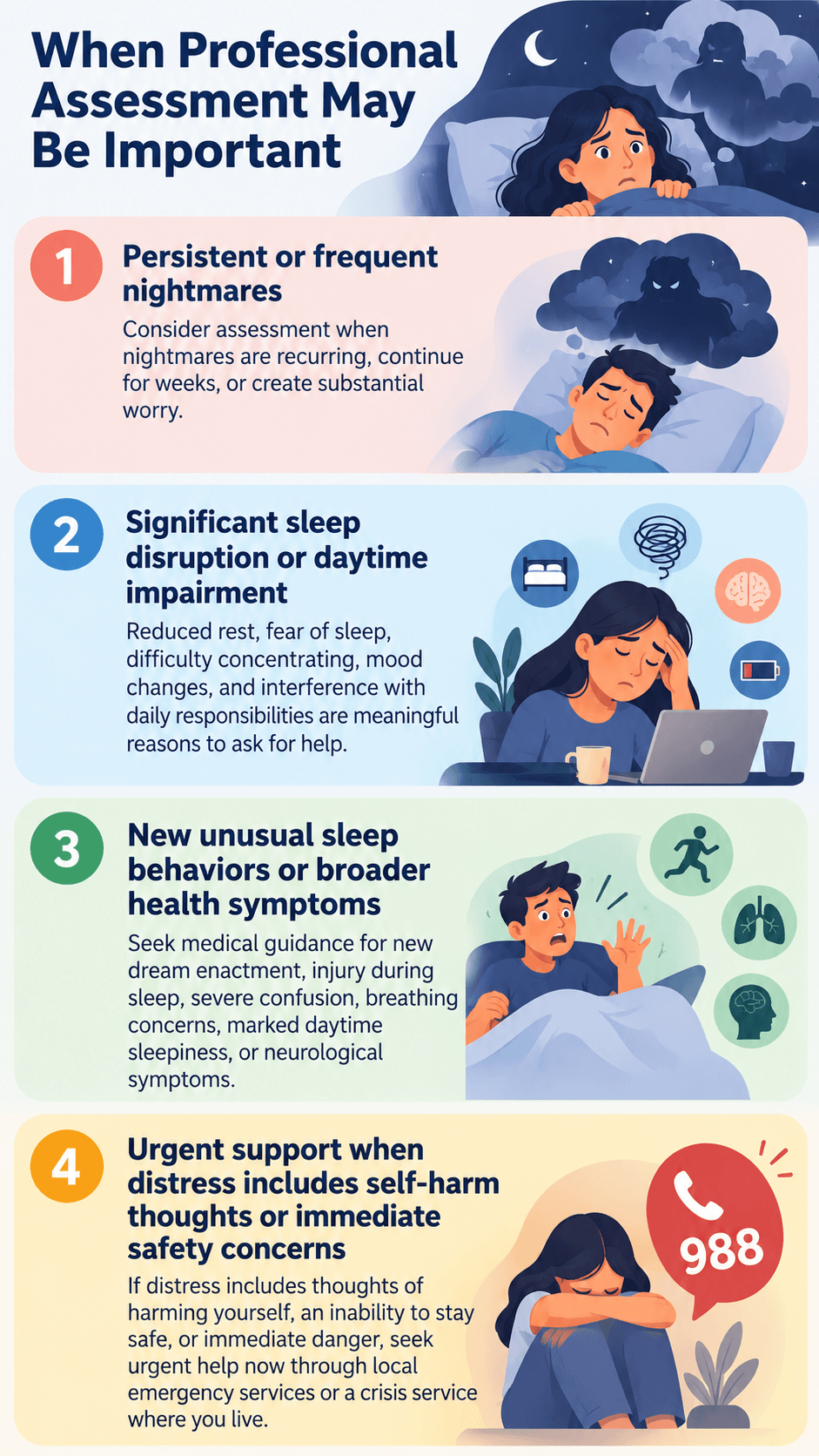
Persistent or frequent nightmares
There is no single episode count that decides when everyone should seek help. Consider assessment when nightmares are recurring, continue for weeks, or create substantial worry. A clinician can distinguish occasional distress from a pattern that may need focused evaluation.
Significant sleep disruption or daytime impairment
Reduced rest, fear of sleep, difficulty concentrating, mood changes, and interference with daily responsibilities are meaningful reasons to ask for help. A review of the causes and clinical understanding of nightmare disorder emphasizes that distress and impairment are central, while multiple pathways may contribute.
New unusual sleep behaviors or broader health symptoms
Seek medical guidance for new dream enactment, injury during sleep, severe confusion, breathing concerns, marked daytime sleepiness, or neurological symptoms. These signs may involve more than dream content. An American Academy of Sleep Medicine position paper also shows why adult nightmare care depends on clinical context and evidence, not one universal approach.
Urgent support when distress includes self-harm thoughts or immediate safety concerns
A nightmare alone does not imply self-harm risk. If distress includes thoughts of harming yourself, an inability to stay safe, or immediate danger, seek urgent help now through local emergency services or a crisis service where you live. In the United States, the NIMH help page lists crisis and treatment resources, including 988.
How Nightmares Relate to Other Dream Questions
Return to the broad science of dreaming
Nightmares are one form of dream experience. The broader question of why people dream includes memory, emotion, brain activity, and competing theories that cannot be answered by frightening dreams alone. Nightmare research contributes one piece rather than a complete explanation of dreaming.
Compare distress with recurrence and vividness
Distress defines the nightmare question, repetition defines recurring dreams, and intensity defines vividness. These features often overlap, which is why one dream may belong to several descriptions. Separating them identifies the most useful next question without forcing every experience into one category.
Connect carefully with stress psychology
Stress can influence sleep and dream experience, but the psychology of stress covers broader responses to demands in waking life. A nightmare-focused view asks how distress appears during dreaming, whether the person wakes, and how sleep is affected. It should not reduce every nightmare to stress.
FAQ About Why We Have Nightmares
What is the difference between a nightmare and a bad dream?
Researchers often distinguish them by awakening. A nightmare is a distressing dream that wakes the person, while a bad dream may be unpleasant without causing awakening. Everyday language varies, so emotion, awakening, recall, and impact are more informative than the label alone.
Does a nightmare mean I have unresolved trauma?
No. Trauma can be associated with nightmares, but nightmares also occur without trauma. One dream cannot confirm a past event, repression, or a mental-health diagnosis. Assessment relies on waking history, symptoms, duration, distress, and functioning, not symbolic interpretation.
Why do some nightmares keep returning?
Researchers consider emotional salience, waking-life continuity, sleep disruption, learned anticipation, and other influences, but recurrence has no single universal cause. Repeated content may be exact or thematic. A recurring nightmare describes a pattern; it does not explain the pattern by itself.
Are nightmares and night terrors the same thing?
No. Nightmares are remembered distressing dreams that often cause awakening, commonly from REM sleep. Night terrors are partial arousals usually arising from non-REM sleep, often with intense behavior and limited detailed recall. Unusual or risky sleep behavior merits professional assessment.
When are nightmares frequent enough to discuss with a professional?
Consider discussion when nightmares persist, repeatedly interrupt sleep, cause fear of bedtime, produce substantial daytime distress, or impair functioning. New medication or health changes and unusual sleep behavior are additional reasons. You do not need to wait for a particular number if the impact is already significant.
Key Takeaways
- Nightmares are strongly distressing dreams that may cause awakening and clear recall.
- Emotional experiences, stress, sleep disruption, medication, substances, health, and individual differences may contribute without revealing one universal cause.
- A nightmare is defined by distress, while recurrence and vividness describe separate dimensions that can overlap.
- Night terrors are different sleep events and often involve partial arousal, intense behavior, and limited recall.
- Dream content cannot diagnose trauma, repression, mental illness, or future danger.
- Persistent sleep disruption, daytime impairment, unusual sleep behavior, or immediate safety concerns are reasons to seek appropriate support.
A useful first step is to separate the experience from the explanation. Record the strongest emotion, whether you woke, what happened to sleep afterward, and whether the next day was affected. That pattern offers more reliable guidance than trying to decode one frightening image.

Michael Reed is the Founder and Lead Writer at Psychology Exposed. He writes about human behavior, relationships, emotional patterns, self-awareness, and practical psychology topics using research-informed, easy-to-understand content.
Read More About Michael Reed: https://psychologyexposed.com/michael-reed/