
Someone may contribute confidently in a small, collaborative classroom yet struggle in a highly competitive one. A capable employee might enjoy solving difficult problems but feel worn down by a workplace that gives little time for careful work. Neither example, by itself, shows that the person lacks ability or that the setting is universally bad. The more useful question may be whether the demands and resources of that particular setting match what the person brings and needs.
This is the central concern of person-environment fit psychology. Instead of asking only what an environment does to people, it considers the relationship between a person’s characteristics and those of the environment. That distinction helps explain why a setting can be suitable in one respect and unsuitable in another, or why someone may function differently after a change in circumstances without becoming a different person.
Fit is not a personality score, a diagnosis, or proof that someone belongs in one place rather than another. It is a way to examine compatibility carefully, including the possibility that the person or environment can change.
Quick Answer: What Is Person-Environment Fit?

Person-environment fit refers to the compatibility between a person’s characteristics and the features of an environment. It may involve whether a setting meets someone’s needs, whether their abilities meet its demands, or whether their values align with its expectations. Fit depends on both sides of the relationship, so a good match in one context does not guarantee the same outcome everywhere.
Compatibility, Not a Label for the Person
Calling someone a “poor fit” without naming the setting hides half the explanation. A person who values quiet concentration may work well where uninterrupted time is available and struggle where every task requires immediate responses. The meaningful comparison is between a characteristic and a corresponding environmental condition, not between a person and an imagined universal ideal.
Why Fit Is About the Relationship
Imagine two people with equally strong writing skills. One prefers clear assignments and regular feedback; the other prefers freedom to experiment. An independent project may suit the second person’s preferences while a structured program better meets the first person’s needs. The environment has not changed between these comparisons, but the match has. Fit is relational rather than a property of either side alone.
These compatibility questions also sit within the broader person-situation debate about how personal characteristics and current circumstances work together to shape behavior.
The Core Person-Environment Fit Model

A useful mental model is PERSON ↔ ENVIRONMENT → FIT OR MISFIT → POSSIBLE OUTCOMES. The arrows remind us to compare relevant qualities and then ask what the comparison may help explain. This is an organizing model, not a formula that predicts an individual’s happiness or performance.
Person: Needs, Values, Abilities, and Preferences
Needs concern what someone requires or seeks from a setting, such as guidance, autonomy, reliable resources, or social connection. Values concern what they consider worthwhile, such as fairness, learning, or community service. Abilities concern what they can currently do; preferences concern ways they would rather work or participate. These are related but not interchangeable. Enjoying a particular task does not mean having every skill it demands.
Environment: Demands, Supplies, Resources, and Expectations
An environment sets requirements, offers resources, rewards some activities, and limits others. A school may expect independent study while providing few opportunities for tutoring. A volunteer organization may provide strong social support but require irregular hours. The relevant environment is not just a building or physical location. It includes roles, practices, relationships, and opportunities within that setting.
Fit and Misfit May Be Specific Rather Than Global
A person can match the technical demands of a job and still need resources that the workplace does not offer. Someone else may share an organization’s values but lack experience in a demanding role. Saying only “good fit” or “bad fit” compresses several different questions into one verdict. Identifying which characteristics match is more informative than assigning a single overall label.
Why Fit Is Different From an Environmental Effect
The difference is subtle but essential. An environmental effect asks how a condition influences behavior in general. Person-environment fit asks how that condition compares with the qualities, needs, or abilities of a particular person. An environment may have widespread effects while also fitting some individuals better than others.
When the Environment Changes Everyone’s Options
A building with an unreliable elevator changes access for many people. A strict deadline narrows the time available to everyone. These are environmental features and potential constraints. Explaining their direct effects does not necessarily require a claim about compatibility, although individual circumstances may alter how much they matter.
When the Same Setting Matches People Differently
Consider a course requiring several hours of independent reading each week. The demand is shared. A student who has the required background knowledge and enough uninterrupted time may manage it comfortably. Another student may have the ability but lack the resources needed to meet that demand. Fit analysis separates ability from access to support, avoiding an unfair assumption that difficulty reveals a personal deficiency.
Why the Distinction Matters in Everyday Judgments
If someone struggles, a quick judgment may focus entirely on motivation or competence. A fit question is more precise: Which requirement is hard to meet, which resource is missing, or which value is in conflict? The answer does not automatically excuse a missed responsibility, but it can reveal realistic changes worth considering.
Three Important Forms of Person-Environment Fit
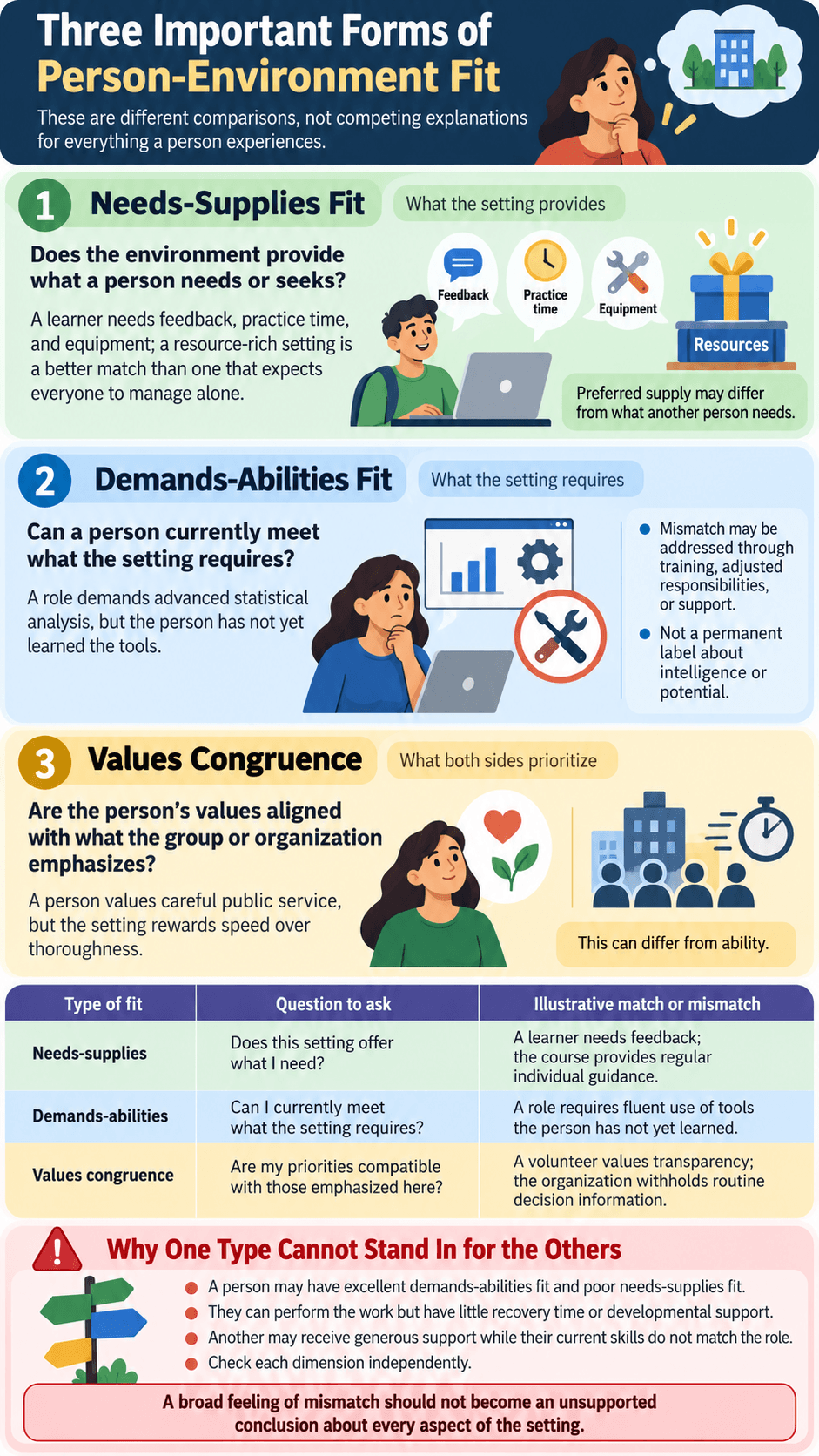
Psychologists have developed several ways to describe compatibility. In organizational research, especially, a review by Annelies van Vianen examines key claims and limitations of person-environment fit theory. The terms below describe different comparisons, not three competing explanations for everything a person experiences.
Needs-Supplies Fit: What the Setting Provides
Needs-supplies fit concerns whether the environment provides what a person needs or seeks. Someone learning a complex skill may need feedback, practice time, and access to equipment. A setting rich in those resources can be a better match on that dimension than one that assumes everyone should manage alone. Importantly, a person’s preferred supply may differ from what another person needs.
Demands-Abilities Fit: What the Setting Requires
Demands-abilities fit compares environmental requirements with what a person can currently provide. A role demanding advanced statistical analysis may not match someone’s present training, even if they value the work and enjoy the organization. The mismatch can sometimes be addressed through training, adjusted responsibilities, or additional support. It should not become a permanent label about intelligence or potential.
Values Congruence: What Both Sides Prioritize
Values congruence concerns alignment between what a person values and what is emphasized by a group or organization. Someone who values careful public service may experience friction where speed is rewarded at the expense of thoroughness. That can be different from ability: the person may perform the tasks well but question whether the surrounding priorities match their own.
| Type of fit | Question to ask | Illustrative match or mismatch |
|---|---|---|
| Needs-supplies | Does this setting offer what I need? | A learner needs feedback; the course provides regular individual guidance. |
| Demands-abilities | Can I currently meet what the setting requires? | A role requires fluent use of tools the person has not yet learned. |
| Values congruence | Are my priorities compatible with those emphasized here? | A volunteer values transparency; the organization routinely withholds routine decision information. |
Why One Type Cannot Stand In for the Others
A person may have excellent demands-abilities fit and poor needs-supplies fit. They can perform the work but have little recovery time or developmental support. Another may receive generous support while their current skills do not match the role. Checking each dimension independently prevents a broad feeling of mismatch from becoming an unsupported conclusion about every aspect of the setting.
Person-Job and Person-Organization Fit as Examples
Person-environment fit research has been especially influential in workplace psychology, but the underlying question is broader than employment. Work provides useful examples because tasks and organizational expectations are often visible enough to compare.
Person-Job Fit: Matching the Particular Role
Person-job fit concerns compatibility with what a specific job asks and provides. A person might enjoy their employer and colleagues yet struggle with a role that requires continuous public speaking. Alternatively, the same person may be effective at the job’s tasks but find the schedule incompatible with an important need. A job is not one indivisible environment: its demands and supplies can point in different directions.
Person-Organization Fit: Matching the Wider Organization
Person-organization fit concerns compatibility with organizational characteristics, often including values. A research-focused employee may value open debate while the wider organization discourages disagreement. The employee’s task performance might remain high, even as the relationship with the organization feels increasingly strained. The distinction between different levels of fit appears in Kristof-Brown and colleagues’ meta-analysis of person-job, person-organization, person-group, and person-supervisor fit.
Why Work Is an Illustration, Not the Whole Subject
Compatibility questions can also arise in study groups, recreational programs, community activities, and family routines. Still, the strongest research base for many specific fit measures comes from organizational settings. A concept may be useful for reflection outside work without every research finding transferring directly to those environments.
Fit Versus Misfit: What Actually Changes?
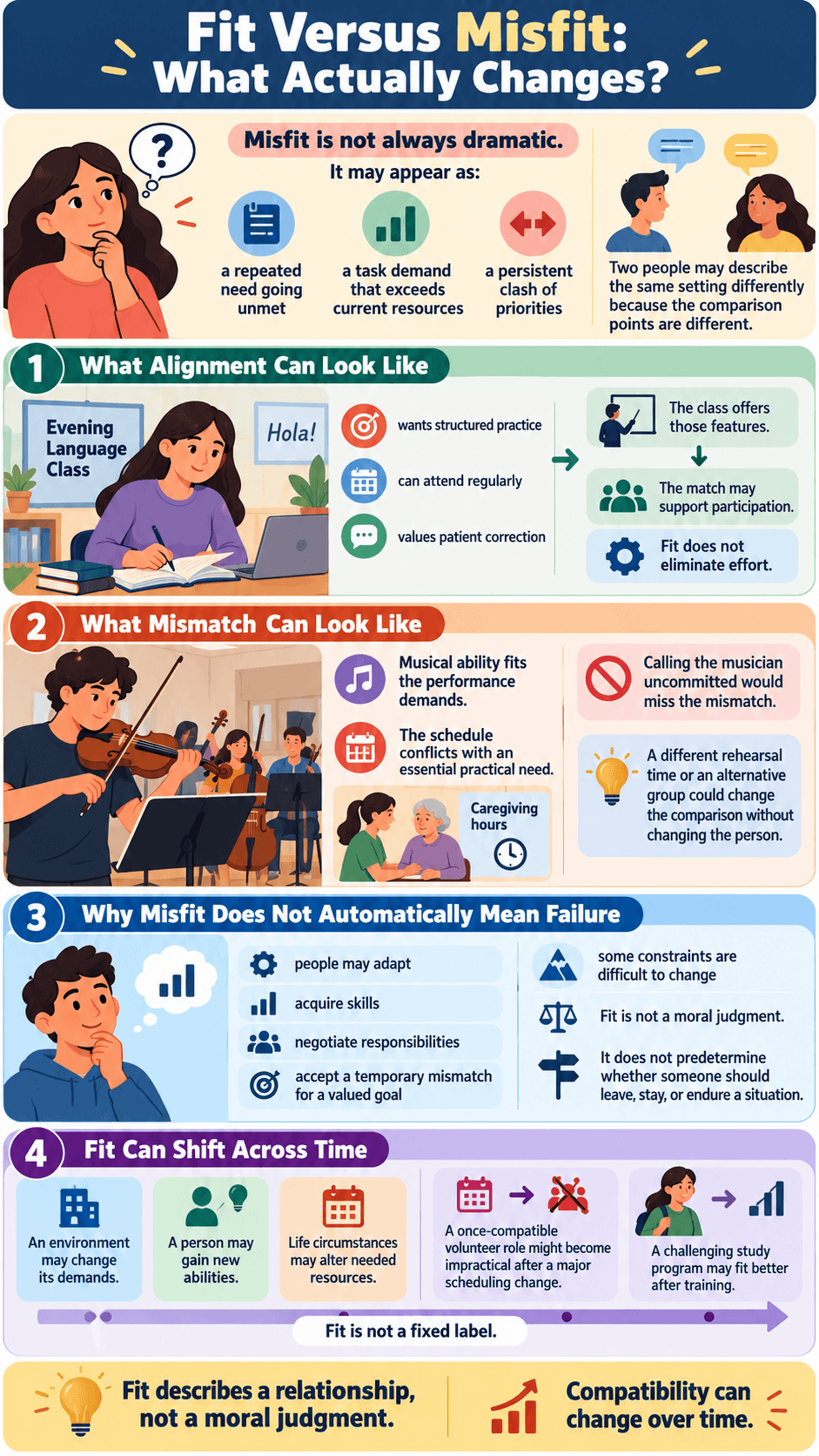
Misfit is not always dramatic. It may appear as a repeated need going unmet, a task demand that exceeds current resources, or a persistent clash of priorities. Two people may describe the same setting differently because the comparison points are different, not because one is necessarily misreading it.
What Alignment Can Look Like
Consider an adult taking an evening language class. They want structured practice, can attend regularly, and value patient correction. The class offers those features. The match may support participation, but it does not mean every lesson will be easy. Fit makes some requirements and resources compatible; it does not eliminate effort.
What Mismatch Can Look Like
Now imagine a skilled musician joining a community ensemble that rehearses during their caregiving hours. Musical ability fits the performance demands, but the schedule conflicts with an essential practical need. Calling the musician uncommitted would miss the mismatch. Depending on the situation, a different rehearsal time or an alternative group could change the comparison without changing the person.
Why Misfit Does Not Automatically Mean Failure
People may adapt, acquire skills, negotiate responsibilities, or accept a temporary mismatch for a valued goal. At the same time, some constraints are difficult to change. Fit describes a relationship that may have consequences; it is not a moral judgment and does not predetermine whether someone should leave, stay, or endure a particular situation.
Fit Can Shift Across Time
An environment may change its demands, a person may gain new abilities, or life circumstances may alter what resources they need. A once-compatible volunteer role might become impractical after a major scheduling change. A challenging study program may fit better after training. This time dimension prevents fit from becoming a fixed label.
Subjective and Objective Fit Are Not Identical
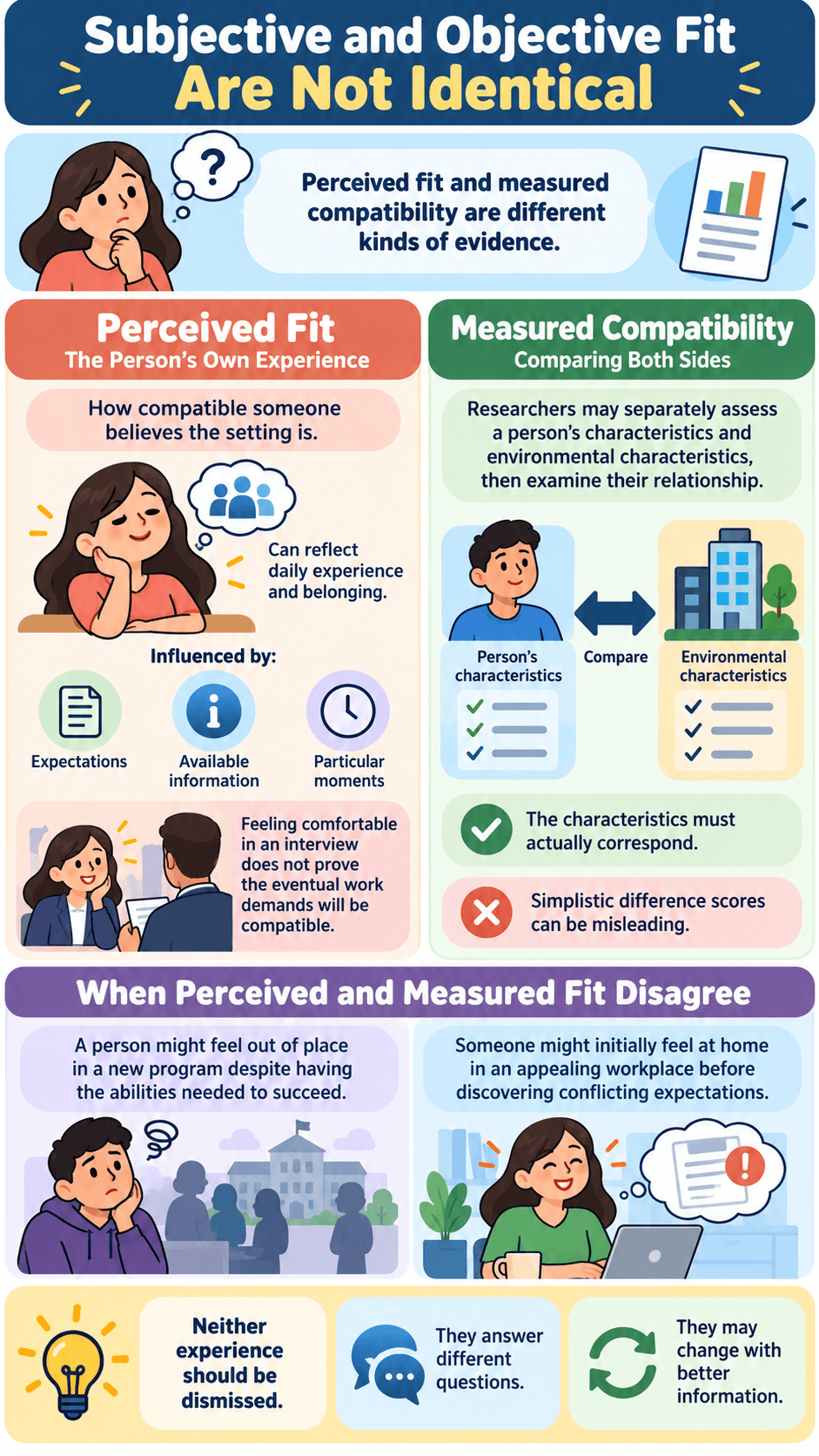
Sometimes a person strongly feels that a setting fits. At other times, an outside comparison finds that the person’s skills, values, or needs correspond to the setting’s characteristics. These are different kinds of evidence, and each can reveal something the other misses.
Perceived Fit: The Person’s Own Experience
Perceived fit asks how compatible someone believes the setting is. It can reflect important information about daily experience and belonging, but it is influenced by expectations, available information, and particular moments. Feeling comfortable in an interview, for example, does not prove that the eventual work demands will be compatible.
Measured Compatibility: Comparing Both Sides
Researchers may separately assess a person’s characteristics and environmental characteristics, then examine their relationship. Such measures require care: the characteristics must actually correspond, and simplistic difference scores can be misleading. Jeffrey Edwards’ theoretical review discusses the challenges of defining and testing person-environment fit rather than treating a match score as self-explanatory.
When Perceived and Measured Fit Disagree
A person might feel out of place in a new program despite having the abilities needed to succeed. Familiarity or social uncertainty could affect perceived fit. Conversely, someone might initially feel at home in an appealing workplace before discovering conflicting expectations. Neither experience should be dismissed. They answer different questions and may change with better information.
Fit Is Not the Same as Comfort
A comfortable setting is not necessarily a compatible setting for every goal. Fit is about correspondence on particular characteristics; comfort is one possible experience. Confusing the two can make people reject meaningful challenges or stay in easy settings that frustrate something they value.
A Demanding Environment Can Still Be a Good Match
A student who wants rigorous training may prefer a challenging course with clear teaching and reliable support. The course can be tiring and still match the student’s learning aims and preparation. It would be misleading to infer misfit simply from the presence of effort, uncertainty, or temporary discomfort.
A Pleasant Environment Can Still Conflict With Values
A community committee may be friendly and flexible while repeatedly avoiding decisions that matter to someone who values timely follow-through. The person may feel welcomed yet dissatisfied with how the group works. Social warmth and values congruence are not identical, even though both can influence an overall impression.
Always Name the Outcome You Are Trying to Explain
Fit may be discussed in relation to satisfaction, engagement, strain, performance, or remaining in a setting. Those outcomes are different. An environment that supports satisfaction might not maximize learning, and a role that helps someone develop skills may still impose costs. A useful fit question includes the phrase “fit for what?” rather than assuming one ideal match applies to everything.
Person-Environment Fit vs Trait Activation
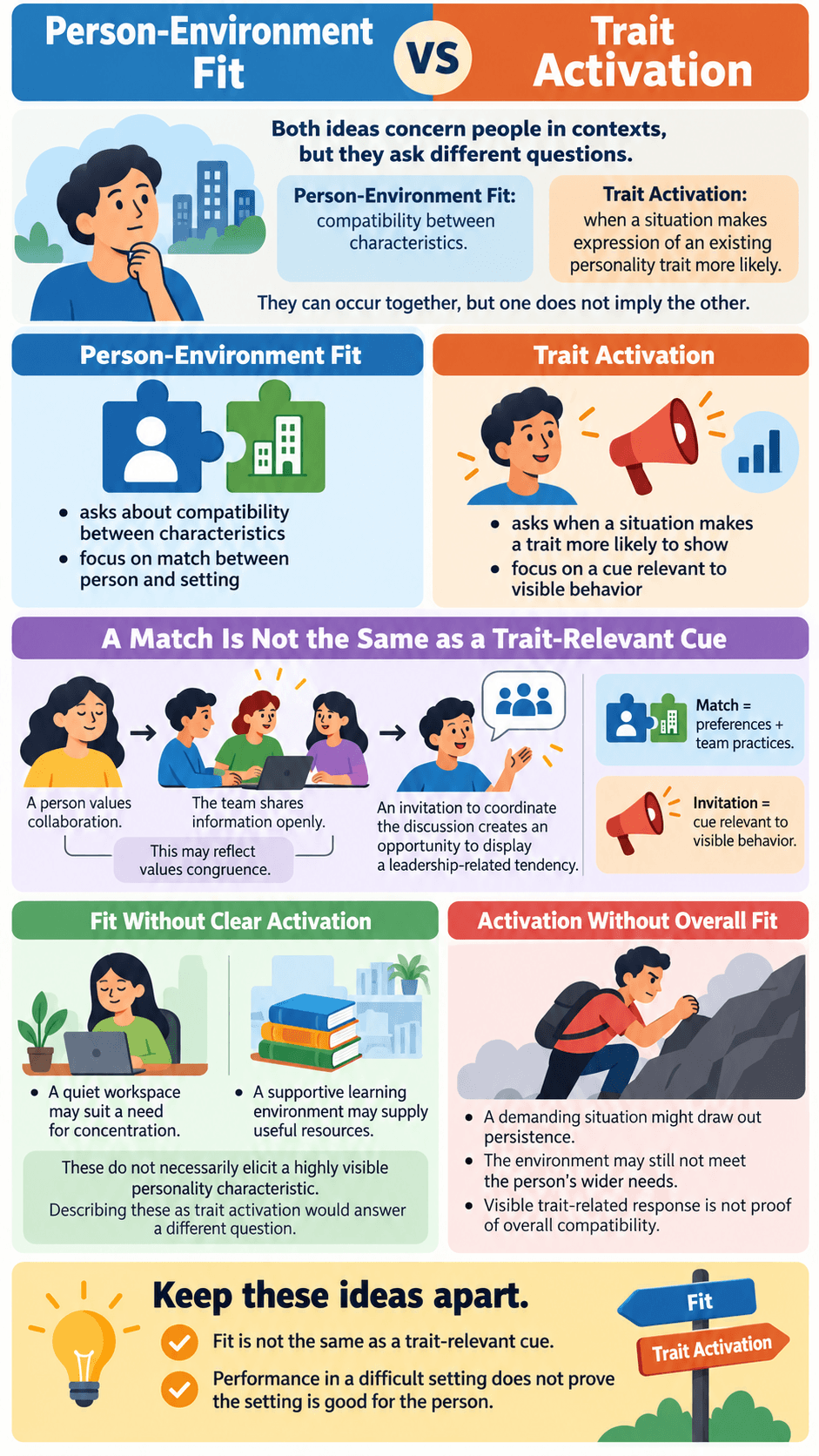
Both ideas concern people in contexts, but they ask different questions. Person-environment fit asks about compatibility between characteristics. Trait activation asks when a situation makes the expression of an existing personality trait more likely. They can occur together, but one does not imply the other.
A Match Is Not the Same as a Trait-Relevant Cue
Suppose a person values collaboration and joins a team that shares information openly. That may reflect values congruence. During a difficult meeting, an invitation to coordinate the discussion might also create an opportunity to display a leadership-related tendency. The match concerns the person’s preferences and the team’s practices. The invitation concerns a cue relevant to visible behavior.
Fit Without Clear Activation
A quiet workspace might suit someone’s need for concentration without providing any particular opportunity to express assertiveness. Likewise, a supportive learning environment may supply useful resources even if it does not elicit a highly visible personality characteristic. Describing these as trait activation would answer a different question.
Activation Without Overall Fit
A demanding situation might draw out someone’s persistence even when the environment does not meet their wider needs. The visible trait-related response is not evidence that the person and setting are compatible in every respect. Keeping these ideas apart helps avoid treating performance in a difficult setting as proof that the setting is good for the person.
What Research Can and Cannot Tell Us About Fit
Person-environment fit has a substantial research history, yet its conclusions depend on definitions, measurement methods, settings, and the outcome being examined. The cautious question is not whether fit matters at all, but what kind of fit has been studied and how strongly the evidence supports a particular claim.
Relationships Vary by the Type of Fit and Outcome
Studies of organizational fit have examined work attitudes, performance, strain, turnover-related outcomes, and other measures. A systematic review of staff outcomes in healthcare illustrates how different fit measures are used in a particular professional setting. The associations are not identical across each kind of fit or outcome. This matters because broad statements such as “people always perform better when they fit in” overlook the different relationships researchers actually measure.
Mismatch Direction Can Matter
There is a practical difference between having fewer resources than needed and receiving more of something than desired. A program offering too little feedback may create a different experience from one requiring more feedback meetings than a participant prefers. The 2018 Annual Review discussed earlier finds mixed support for simple assumptions about fit and highlights the importance of how needs and environmental supplies compare.
| Comparison | What it may indicate | What not to conclude |
|---|---|---|
| Supply falls short of need | A needed resource may be unavailable or insufficient. | The person is automatically incapable. |
| Supply exceeds preference | Something useful to others may feel excessive here. | More is always worse. |
| Demand exceeds current ability | Training, assistance, or redesign may be needed. | Ability can never improve. |
| Values diverge | Priorities may repeatedly conflict. | Either side must be morally wrong. |
Fit Can Depend on Time and Adaptation
People learn, environments reorganize, and priorities change. A review of fit theory in changing careers emphasizes continuing questions about how fit develops and how subjective impressions relate to measurable conditions. Much of this scholarship concerns work and career settings, so applying it elsewhere should remain tentative.
More Fit Is Not Automatically Better on Every Measure
Compatibility can support some outcomes while leaving other questions unanswered. A group whose members share similar priorities may coordinate smoothly, but similarity alone does not guarantee broad perspectives or sound decisions. Research about one kind of alignment cannot be used to promise success in every domain. Fit is one consideration among many, not a universal performance formula.
A Four-Part Check for Understanding Your Own Fit

Consider one specific setting, such as a course, work arrangement, community activity, or ongoing responsibility. The following questions are intended for reflection, not as a validated psychological assessment. They work best when focused on observations rather than on judging yourself or other people.
1. What Do You Bring, Need, and Value?
Write down a few relevant capabilities, needs, and priorities without treating them as permanent traits. For example: “I can work independently on complex tasks, I need predictable access to information, and I value careful decisions.” Notice that these statements refer to different dimensions. A person may have a strong ability and still need resources to use it well.
2. What Does the Environment Actually Demand or Provide?
Describe requirements you can observe: attendance expectations, available tools, how decisions are made, what kind of feedback is offered, and which activities are rewarded. Try to distinguish what is written in a policy from what happens in ordinary practice. That distinction may matter when formal promises and lived conditions do not match.
3. Where Is the Match, and Where Is the Mismatch?
Compare corresponding dimensions rather than making one overall judgment. Does a need for clear guidance meet an available source of guidance? Do current abilities meet a specific task requirement? Are stated values reflected in decisions? Mark uncertain areas as uncertain. One frustrating experience may justify closer examination without proving a stable mismatch.
4. Which Outcome Are You Trying to Understand?
Is the concern learning, satisfaction, sustained participation, fatigue, performance, or something else? Different outcomes may call attention to different forms of fit. Someone may perform very well while feeling that the setting does not meet important needs. That is not a contradiction; it is a reason to avoid defining fit by performance alone.
If the comparison reveals a problem, consider which element could realistically change. Skills can sometimes develop, resources can sometimes be requested, and roles can sometimes be adjusted. But not every person has equal freedom to negotiate or leave a setting. The analysis should acknowledge actual constraints instead of assuming change is entirely an individual’s responsibility.
Three Questions That Fit Alone Does Not Answer
How Does the Environment Influence Behavior Directly?
Lighting, interruptions, deadlines, access, and rules can shape what people do even without a distinct compatibility comparison. When the main concern is how a feature of a setting affects behavior, examine the environmental mechanism itself before concluding that someone personally fits or does not fit.
When the main question is how strongly contextual conditions shape behavior regardless of compatibility, the issue is closer to situationism psychology.
When Does a Situation Bring Out a Personality Trait?
If a person appears unusually outspoken during a debate but quiet during routine work, the question may concern cues that invite different forms of trait expression. Compatibility with the overall environment is a separate issue. A setting can reveal a tendency without being desirable or sustainable for that person.
Is a Reaction Temporary or Part of an Enduring Tendency?
Someone feeling uncertain on the first day of a program does not establish a long-term trait or a lasting mismatch. Current states, adjustment demands, and repeated experiences should be distinguished. Fit assessment becomes more useful when it considers time rather than treating one moment as the whole story.
If the main question is whether a reaction is temporary or reflects a more enduring pattern, the state-trait distinction is the more relevant framework.
FAQ About Person-Environment Fit Psychology
Is Person-Environment Fit the Same as Person-Job Fit?
No. Person-job fit is one application of the broader compatibility idea. It concerns the match between a person and a particular role’s demands or supplies. Person-environment fit can also concern a wider organization, group, educational setting, or other relevant context. Even within employment, matching the job’s tasks and sharing an organization’s values are separate questions.
What Is the Difference Between Needs-Supplies and Demands-Abilities Fit?
Needs-supplies fit asks whether the environment provides what someone needs or values. Demands-abilities fit asks whether the person can meet what the environment requires. For example, someone may have the ability to complete a technical task but lack the equipment needed to do it efficiently. The two kinds of fit should be evaluated separately rather than bundled into one assumption.
Can a High-Fit Environment Still Be Stressful or Challenging?
Yes. A setting can align with a person’s goals, skills, or values and still involve difficult work, uncertainty, or occasional discomfort. Whether that challenge is useful, manageable, or harmful depends on details beyond a simple fit label. The presence of strain does not always establish misfit, and apparent fit does not make excessive demands harmless.
Is Perceived Fit as Important as Objective Fit?
They provide different information. Perceived fit reflects how someone experiences compatibility; separately measured person and environmental characteristics aim to compare those characteristics more directly. Perception can matter for attitudes and decisions, but it may not capture every demand or resource accurately. Neither approach should be treated as a flawless verdict about a person’s future.
Can Person-Environment Fit Change Over Time?
Yes. A person’s skills, needs, and priorities can develop, while settings can alter their expectations, resources, and practices. Someone may find a course unsuitable at first and much more manageable after receiving preparation. The reverse can also happen when demands increase or essential support disappears. Reassessment is more sensible than assigning a permanent label.
Key Takeaways
- Person-environment fit compares characteristics on both sides of a relationship rather than labeling a person or setting in isolation.
- Needs-supplies fit, demands-abilities fit, and values congruence ask distinct questions and may point in different directions.
- An environment’s direct effect is not the same as compatibility, and trait activation is not the same as overall fit.
- Perceived compatibility and separately measured characteristics provide different kinds of evidence.
- Fit is specific to a context and outcome, may change over time, and does not guarantee comfort or success.
- A practical next step is to identify one concrete mismatch and ask whether the person, the demand, or the available support could realistically change.
Rather than asking whether you are simply “the right type of person” for an entire environment, choose one requirement, resource, or value that matters and compare it with what is actually available. That more specific question may reveal an adjustment worth exploring, or clarify why a setting feels difficult without turning the experience into a judgment about who you are.
Written for Psychology Exposed by Michael Reed, Founder & Lead Writer. This article is educational and is not a clinical evaluation or individualized employment, medical, or mental health advice.

Michael Reed is the Founder and Lead Writer at Psychology Exposed. He writes about human behavior, relationships, emotional patterns, self-awareness, and practical psychology topics using research-informed, easy-to-understand content.
Read More About Michael Reed: https://psychologyexposed.com/michael-reed/