
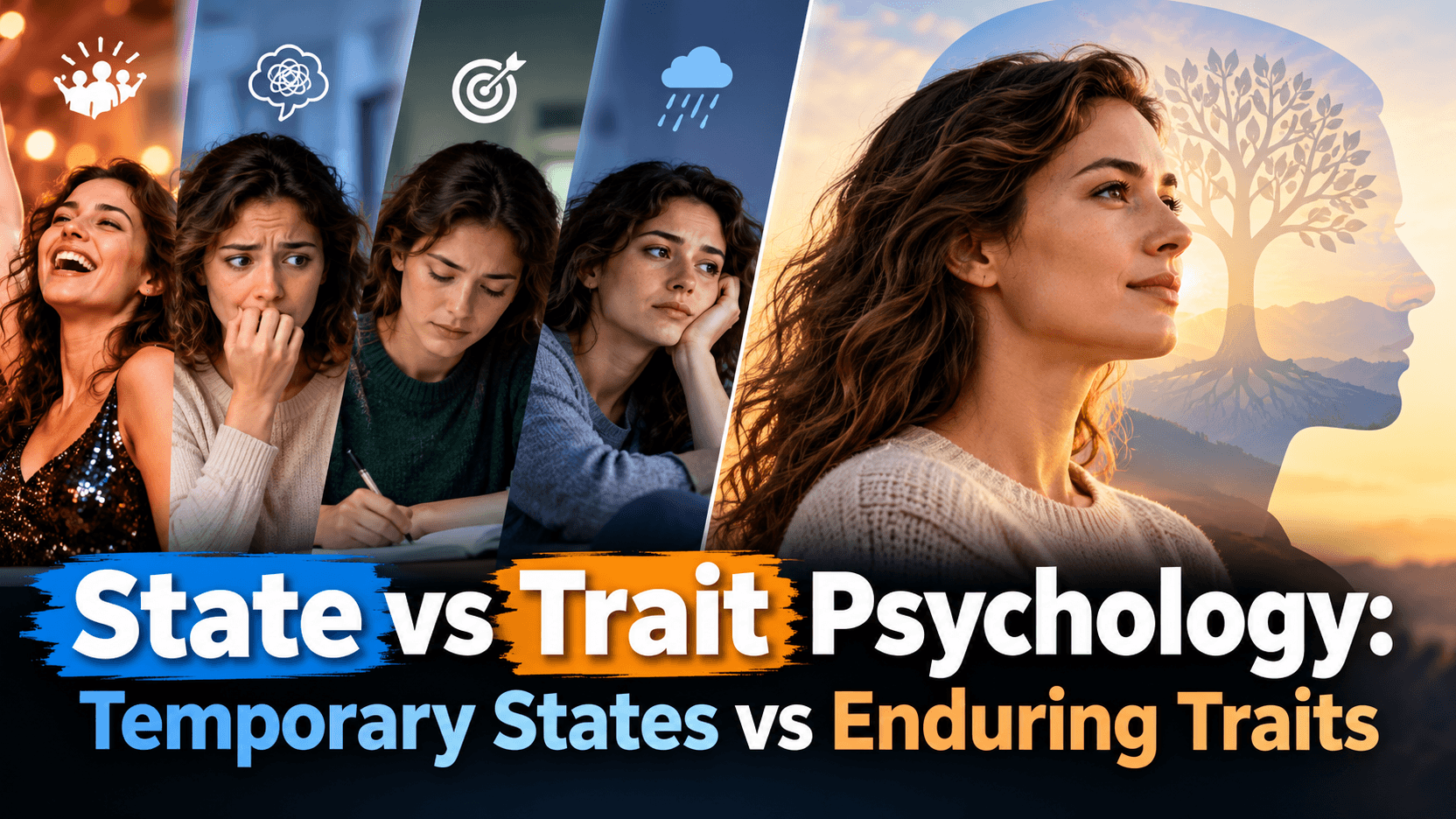
You might feel unusually outgoing at a friend’s celebration and barely speak during a formal meeting the next morning. Which version reflects your personality? Or suppose you feel nervous before an interview even though people usually describe you as calm. Does that moment reveal an anxious personality, or simply an understandable response to the occasion?
The distinction between a psychological state and a psychological trait helps answer questions like these. A state describes how someone is functioning at a particular time. A trait describes how the person generally tends to feel, think, or act across many occasions. The two can coexist without contradiction.
Understanding the difference matters when we interpret our own reactions or form impressions of others. It can prevent a brief episode from becoming a permanent label, while still recognizing that repeated patterns may tell us something useful. These terms are descriptive research concepts, not tools for diagnosing yourself or deciding someone’s character from a single encounter.
Quick Answer: What Is the Difference Between a State and a Trait?
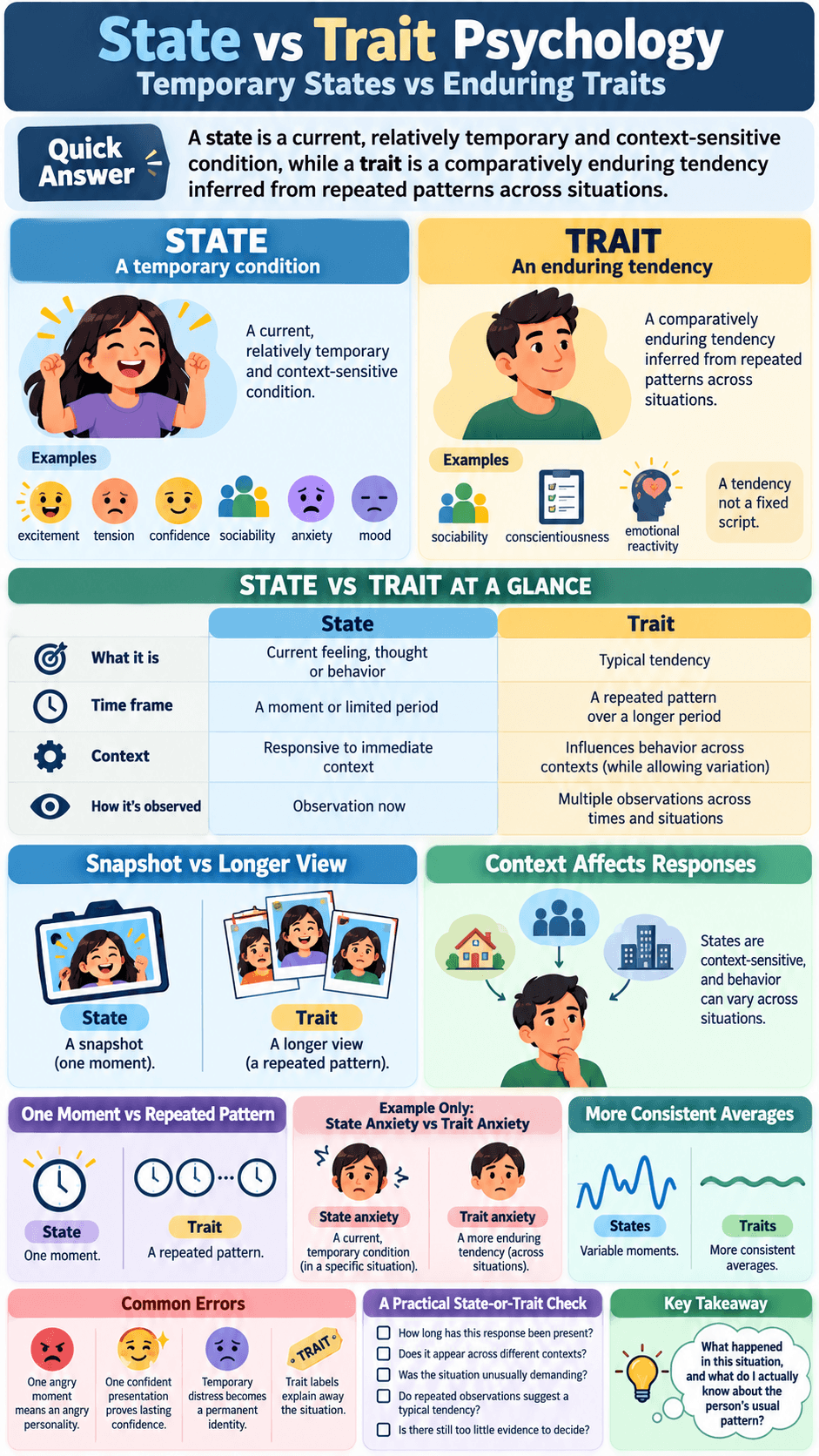
In psychology, a state is a current, relatively temporary condition that can change with time and context. A trait is a comparatively enduring tendency, inferred from patterns across situations and repeated observations. Someone can experience a nervous state while usually being calm, or act quietly today while generally being sociable. Neither one moment nor one label tells the whole story.
State Means Current and Context-Sensitive
A state answers, “How is this person right now?” Feeling excited, tense, focused, discouraged, or confident can describe a current condition. Some states pass quickly; others persist longer. Their defining feature is not that they must vanish in minutes, but that they refer to a condition at a particular period rather than a person’s usual tendency.
Trait Means a Relatively Enduring Tendency
A trait answers, “How does this person generally tend to be?” A sociable person may often seek interaction, but still welcome solitude. A conscientious person may usually prepare carefully, yet overlook a deadline during an unusually demanding week. The APA Dictionary of Psychology’s definition of a personality trait emphasizes enduring characteristics inferred from recurring patterns, not one isolated act.
Why Neither Definition Is Absolute
“Temporary” and “enduring” describe different time scales, not two perfectly separate boxes. A passing mood can last beyond a single afternoon. A trait can shift across the lifespan. The useful distinction is whether we are describing a person’s present condition or an established tendency supported by repeated evidence. It is not a promise that states always disappear quickly or traits never change.
State vs Trait at a Glance

These contrasts offer a starting point, especially when a behavior seems surprising. They are not rules for deciding who someone “really is.”
| Question | Psychological state | Psychological trait |
|---|---|---|
| What is being described? | A current feeling, thought, or way of acting | A person’s typical tendency |
| Time scale | Moment or limited period | Repeated pattern over a longer period |
| Relationship to context | Often especially responsive to immediate circumstances | Can influence behavior across contexts while allowing variation |
| Useful evidence | Observation of the current condition | Multiple observations across times and situations |
| Example | Feeling unusually confident before a familiar task | Usually approaching challenges with confidence |
| Common mistake | Assuming the moment defines the person | Assuming the person must act identically everywhere |
Time Scale: A Snapshot Versus a Longer View
Imagine taking a photograph of a runner halfway up a hill. The picture captures an effortful moment, not their average speed on every route. Similarly, a state describes a limited window. Trait judgments ask what becomes apparent when many windows are considered together. Even a longer-lasting episode does not automatically qualify as a trait.
Stability: Variable Moments and More Consistent Averages
Traits are relatively stable in the sense that people’s average tendencies can remain meaningfully recognizable over time. Their momentary behavior need not be stable. Someone might speak frequently on one day and little on another while still being, on average, more talkative than others across a sufficient range of occasions.
Context: Different Conditions Can Invite Different Responses
A quiet library, an urgent family task, and a relaxed dinner place different demands on the same individual. Context can affect whether a person speaks, plans, worries, or takes initiative. This variability is part of what researchers study. It does not automatically contradict the existence of enduring tendencies.
Evidence: What Can Support Each Interpretation?
One clearly observed moment may justify saying someone seemed impatient then. To claim that impatience is a general trait requires broader observations and attention to circumstances. Even repeated behavior in one unusually restrictive setting may be unrepresentative. The strength of an interpretation should match the scope of the available evidence.
What Is a Psychological State?
Psychological states include momentary emotions and current expressions of behavior. They are often shaped by what is happening, what a person expects, their physical condition, and what they are trying to accomplish. States are not merely noise around a more authentic personality. They are real experiences worth describing accurately in their own right.
A Current Condition That Can Shift Across Moments
Consider a student who begins an exam with high tension, becomes absorbed in a familiar problem, then feels relief when the exam ends. Those are changes in state within the same activity. They do not require the student to have changed into three different kinds of person. Observing the sequence helps explain what was happening at each point.
Confidence, Sociability, Anxiety, and Mood as Examples
Confidence may rise when a task is familiar and decline when the expectations are unclear. Sociability may be greater among close friends than strangers. Anxiety can increase before an uncertain event, and mood can change after good or difficult news. These examples illustrate temporary conditions; they do not establish a diagnosis or a stable trait by themselves.
Why a State Can Matter Without Defining Personality
A temporary response may still have consequences. Being distracted during an important explanation can lead to a mistake. Feeling unusually confident may help someone attempt a difficult conversation. Acknowledging the effect does not require turning that event into “I’m always careless” or “I’m naturally fearless.” The state helps explain this particular episode.
What Is a Psychological Trait?
Traits summarize enduring differences in tendencies such as sociability, conscientiousness, or emotional reactivity. They are useful precisely because behavior is not random from one occasion to the next. Yet the trait describes a tendency, not a script that must be followed at every moment.
A Tendency, Not a Fixed Script
Suppose a person ordinarily makes careful plans. They may still agree spontaneously to a weekend trip. The exception need not invalidate their planning tendency. Conversely, one carefully organized event does not prove that another person is consistently conscientious. A trait is a claim about a broader distribution of behavior, not the absence of exceptions.
Why Traits Are Inferred From Repeated Patterns
Researchers cannot simply look inside someone and read a trait directly. They infer tendencies from ratings, self-reports, behaviors, and repeated patterns, using methods appropriate to the question. A single measure can be informative, but interpreting a characteristic as enduring calls for evidence of consistency beyond the immediate episode.
How Traits Coexist With Situational Variation
In his influential research on traits as distributions of personality states, William Fleeson found substantial changes in individuals’ behavior from one occasion to another alongside stable average differences. The published study summary shows why a trait can be informative without predicting an identical reaction every time. Stability in typical levels and variability in moments are compatible observations.
One Moment vs a Repeated Pattern

Imagine someone interrupts a colleague during a busy meeting. The interruption happened, and its impact may deserve attention. But the leap from “interrupted once” to “is an inconsiderate person” adds a claim that the observation alone cannot support. State-trait reasoning helps separate what is visible from what is being inferred.
Current Response: Evidence of What Happened Now
“She sounded impatient in that conversation” is a narrow statement about an encounter. We might ask whether she was rushed, frustrated, or responding to competing demands. Those explanations remain possibilities, not conclusions. Describing the observable response accurately gives us a sounder basis for deciding what to address next.
Repeated Tendency: Stronger Evidence Across Occasions
If the same person regularly interrupts across informal chats, meetings, and unhurried discussions, it becomes more reasonable to investigate an enduring tendency. But repeated observations are not automatically decisive either. They might still occur in settings with shared pressures, or reflect a specific learned communication habit rather than a broad personality characteristic.
Why One Episode Usually Cannot Define a Person
A person who cries during one difficult exchange is not necessarily “overly emotional.” Someone who declines an invitation is not necessarily “antisocial.” Those labels are broader than the evidence and can crowd out ordinary explanations, such as exhaustion, competing obligations, or needing time alone. A precise description also leaves more room for a fair conversation.
How Psychologists Separate State and Trait
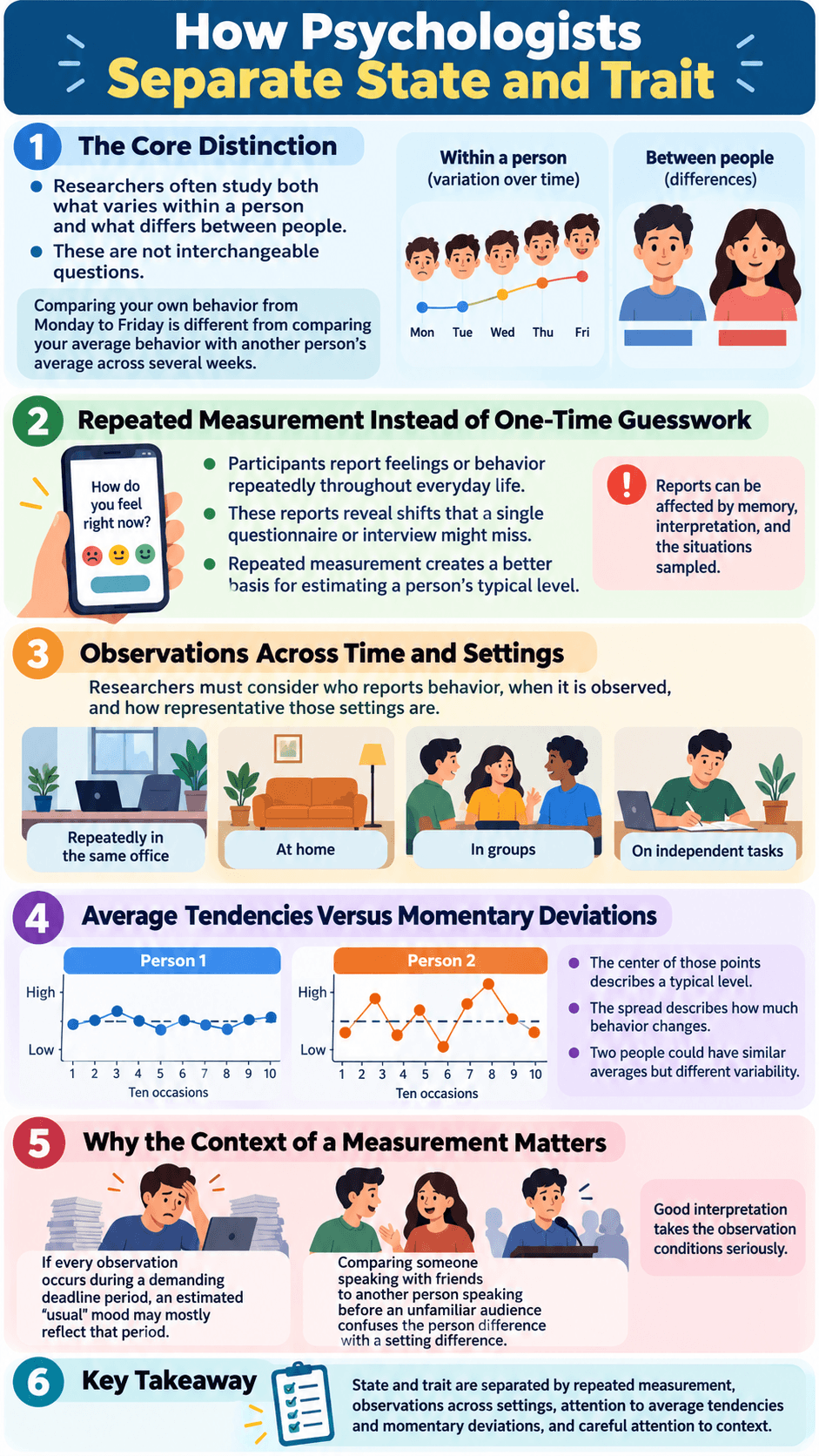
Researchers often study both what varies within a person and what differs between people. These are not interchangeable questions. Comparing your own behavior from Monday to Friday is different from comparing your average behavior with another person’s average across several weeks.
Repeated Measurement Instead of One-Time Guesswork
One research approach asks participants to report feelings or behavior repeatedly throughout everyday life. These reports reveal shifts that a single questionnaire or interview might miss. Repeated measurement also creates a better basis for estimating a person’s typical level, although reports can be affected by memory, interpretation, and the situations sampled.
Observations Across Time and Settings
Noticing someone repeatedly in the same office tells us about behavior in that office. Observing how they behave at home, in groups, and on independent tasks can broaden the picture, if such observations are appropriate and ethical. Researchers must consider who reports behavior, when it is observed, and how representative those settings are.
Average Tendencies Versus Momentary Deviations
Imagine a person’s sociability across ten occasions as points on a chart. The center of those points describes a typical level, while their spread describes how much behavior changes. Two people could have similar averages but different variability. A study by Fleeson and Law on trait enactments explores how stable overall tendencies can appear alongside meaningful variation across situations.
Why the Context of a Measurement Matters
If every observation occurs during a demanding deadline period, an estimated “usual” mood may mostly reflect that period. Likewise, comparing someone speaking with friends to another person speaking before an unfamiliar audience confuses the person difference with a setting difference. Good interpretation takes the observation conditions seriously rather than treating them as irrelevant background.
Why Traits Can Vary in Their Expression
It is tempting to imagine personality as a fixed amount of behavior that must appear at all times. A more useful picture is a tendency that can be expressed in different degrees, depending on what the situation makes possible or relevant. This distinction is especially helpful when someone’s conduct seems inconsistent.
Stable Does Not Mean Identical
A person may usually be curious but ask few questions during an emotionally charged conversation because listening matters more at that moment. Another person may usually be reserved but speak extensively when explaining a subject they know well. A departure from someone’s average is not automatically a departure from their personality.
Constraints and Opportunities Affect What Is Visible
A meeting with strict speaking rules may give little opportunity for talkativeness. A familiar, collaborative setting may invite more discussion. The observable difference can reflect a changed opportunity rather than an underlying change in sociability. This is one reason interpreting personality solely from public behavior is risky.
When Situations Make a Trait More Relevant
Trait activation theory examines how features of a situation can make particular traits more relevant to behavior. For example, a problem requiring independent decisions may create more opportunity for initiative than a tightly scripted task. That question concerns when a tendency is expressed; the state-trait question concerns whether the observation describes a moment or a more enduring pattern.
State vs Trait vs Personality Change
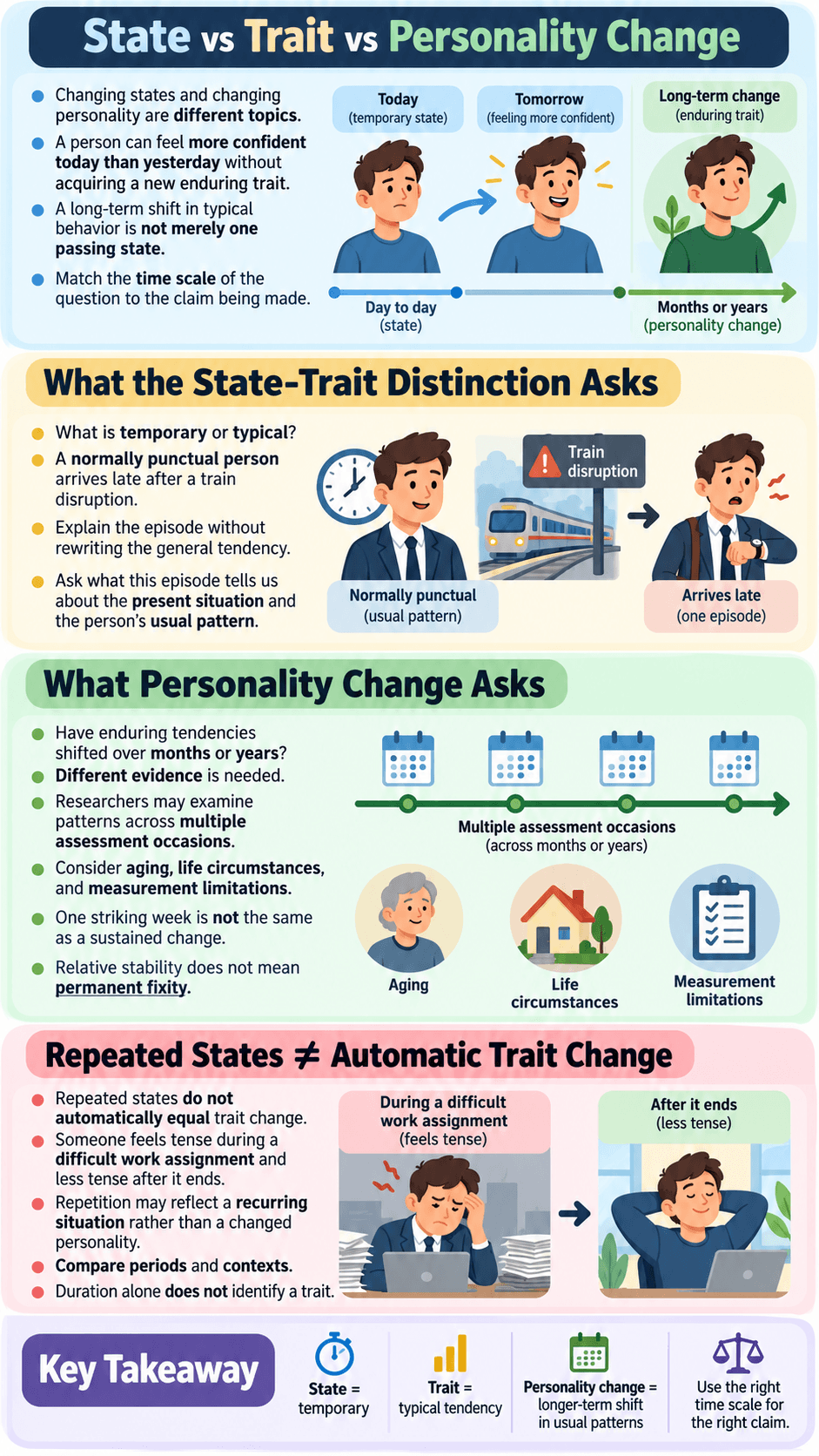
Changing states and changing personality are different topics. A person can feel more confident today than yesterday without acquiring a new enduring trait. On the other hand, a long-term shift in typical behavior is not merely one passing state. The key is to match the time scale of the question to the claim being made.
The State-Trait Distinction Asks What Is Temporary or Typical
Suppose a normally punctual person arrives late after a train disruption. It is reasonable to explain the episode without rewriting their general tendency. State-trait reasoning asks what this episode tells us about the present situation and how, if at all, it relates to their usual pattern. It does not require a theory of personality development.
Personality Change Asks Whether Enduring Tendencies Shift
Different evidence is needed to say a person’s usual tendencies have shifted over months or years. Researchers might examine patterns across multiple assessment occasions, while considering aging, life circumstances, and measurement limitations. One striking week is not the same as a sustained change. Nor does relative stability mean that enduring tendencies are permanently fixed.
Repeated States Do Not Automatically Equal Trait Change
Someone may repeatedly feel tense during a difficult work assignment and feel less tense once the assignment ends. The repetition matters, but it may reflect a recurring situation rather than a changed personality. To understand what changed, compare periods and contexts rather than assuming that duration alone identifies a trait.
State vs Trait Anxiety as One Example
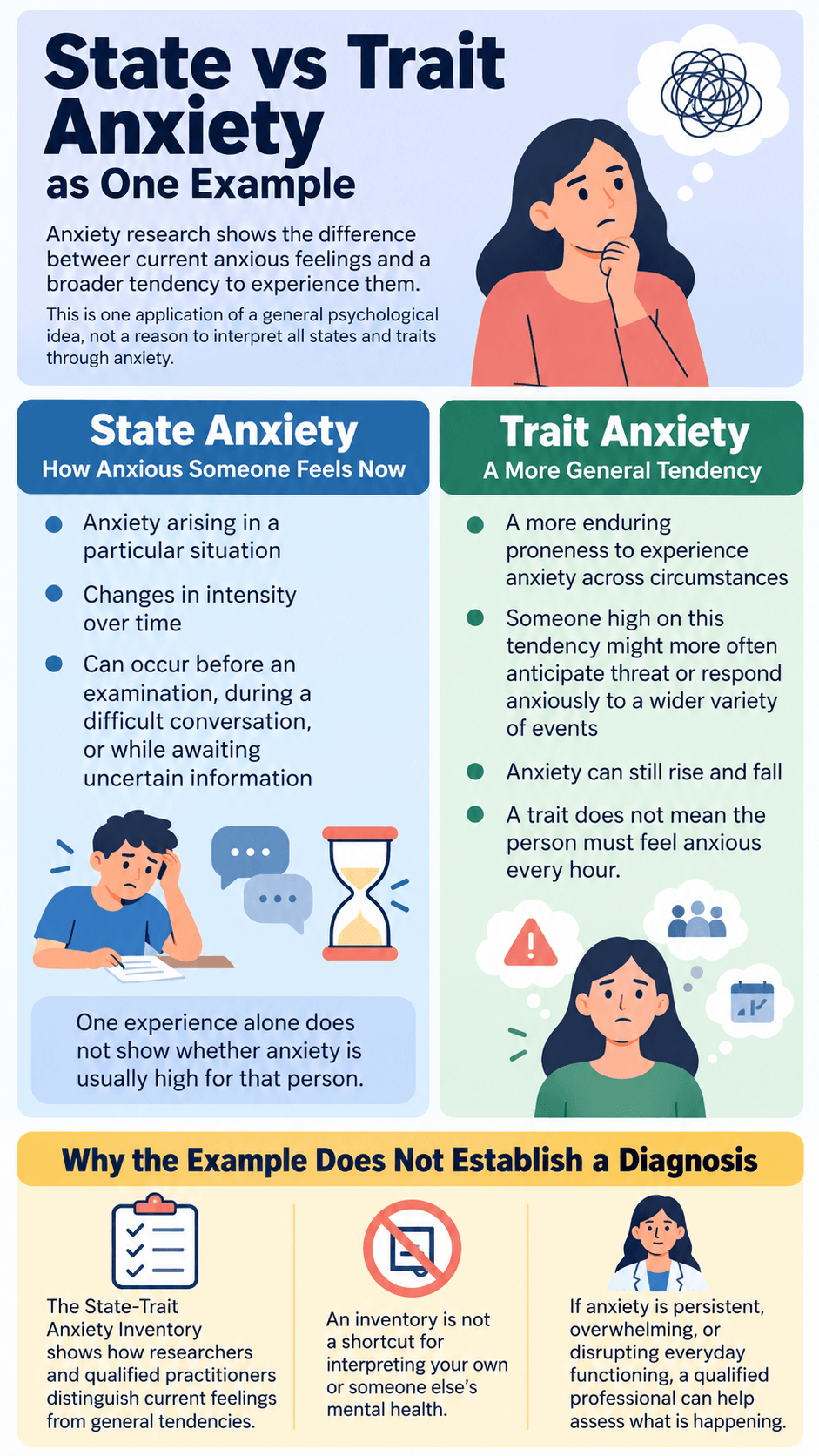
The distinction becomes particularly clear in research on anxiety, which separates current anxious feelings from a broader tendency to experience them. This is one application of a general psychological idea, not a reason to interpret all states and traits through anxiety.
State Anxiety: How Anxious Someone Feels Now
State anxiety refers to anxiety arising in a particular situation and changing in intensity over time. It can occur before an examination, during a difficult conversation, or while awaiting uncertain information. The APA Dictionary’s state-anxiety entry explicitly emphasizes its situational nature and fluctuation. Such an experience alone does not tell us whether anxiety is usually high for that person.
Trait Anxiety: A More General Tendency
Trait anxiety refers to a more enduring proneness to experience anxiety across circumstances. Someone high on that tendency might more often anticipate threat or respond anxiously to a wider variety of events, but their level of anxiety can still rise and fall. A trait is not a claim that the person must feel anxious every hour.
Why the Example Does Not Establish a Diagnosis
The APA’s description of the State-Trait Anxiety Inventory shows how researchers and qualified practitioners distinguish current feelings from general tendencies. An inventory is not a shortcut for interpreting your own or someone else’s mental health. If anxiety is persistent, overwhelming, or disrupting everyday functioning, a qualified professional can help assess what is happening.
Common Errors When Reading Behavior
Most mistakes arise when we make a broader claim than the observation warrants. The examples below illustrate ways to keep an interpretation accurate without dismissing behavior that may need attention.
“One Angry Moment Means an Angry Personality”
Anger in a particular disagreement may be understandable, excessive, harmful, or some mixture of these depending on what happened. It is worth evaluating the act and its effects. A single angry response, however, is not sufficient evidence of a stable angry disposition. You can hold someone accountable for conduct without defining their entire personality by it.
“One Confident Presentation Proves Lasting Confidence”
A person can appear composed because they rehearsed extensively or know the subject well. That achievement is real, even if they doubt themselves in unfamiliar settings. Praising the presentation is more accurate than insisting they must be confident about everything. It also respects the difference between observed performance and a broad trait inference.
“Temporary Distress Is a Permanent Identity”
Someone feeling upset after a loss, setback, or stressful change may understandably struggle for a period. Describing that distress as a fixed part of who they are can discourage curiosity about their circumstances and needs. Equally, calling distress “just a state” should not be used to minimize suffering or avoid seeking appropriate support.
“A Trait Label Explains Away the Situation”
Calling a colleague “introverted” may overlook that the meeting format gives them no opportunity to prepare. Calling a teenager “lazy” may ignore unclear instructions or exhausted schedules. Even when a relevant tendency exists, the current conditions still deserve attention. Descriptions are not complete explanations.
A Practical State-or-Trait Check
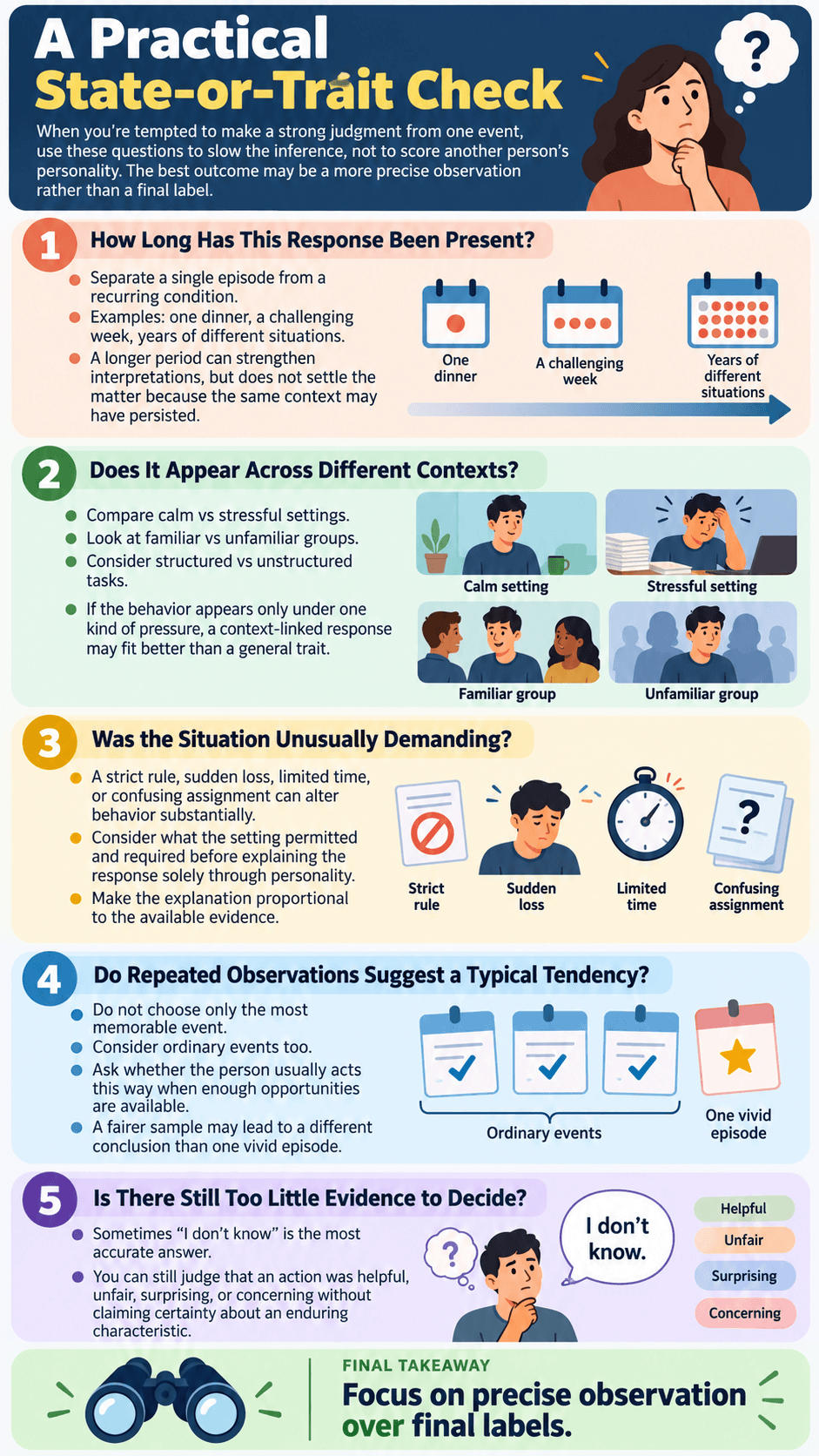
When you’re tempted to make a strong judgment from one event, use the questions below to slow the inference, not to score another person’s personality. The best outcome may be a more precise observation rather than a final label.
How Long Has This Response Been Present?
Separate a single episode from a recurring condition. Was the person unusually quiet for one dinner, throughout a challenging week, or across years of different situations? A longer period strengthens some interpretations but does not settle the matter, because the same context may have persisted throughout.
Does It Appear Across Different Contexts?
Ask whether you have seen the same response in calm and stressful settings, familiar and unfamiliar groups, or structured and unstructured tasks. If the behavior appears only under one type of pressure, describing a context-linked response may be more useful than assigning a general trait.
Was the Situation Unusually Demanding?
A strict rule, a sudden loss, limited time, or a confusing assignment can alter behavior substantially. Consider what the setting permitted and required before explaining the response solely through personality. This is not about excusing an outcome; it is about making the explanation proportional to the available evidence.
Do Repeated Observations Suggest a Typical Tendency?
Rather than choosing the most memorable event, consider the ordinary ones too. Does the person usually act this way when enough opportunities are available? Are you remembering dramatic exceptions more clearly than their routine behavior? A fairer sample may produce a different conclusion than a vivid single episode.
Is There Still Too Little Evidence to Decide?
Sometimes “I don’t know” is the most accurate answer. You can still decide that a particular action was helpful, unfair, surprising, or concerning. You do not need certainty about an enduring characteristic to discuss its consequences, express a preference, or ask for a change in behavior.
How States and Traits Help Explain Behavior Together
The broader person-situation perspective asks how enduring characteristics, immediate circumstances, and their interaction shape behavior. State-trait thinking adds a time dimension: what is happening in this instance, and how does it compare with the person’s usual tendencies?
States Show Change Within a Person
Across a week, the same person may feel socially energized, withdrawn, confident, and doubtful at different times. Those changes can be meaningful responses to tasks, relationships, and demands. Treating all variation as an error would obscure how everyday functioning actually unfolds.
Traits Show Continuity in Average Tendencies
When enough occasions are considered, recognizable tendencies may emerge. One person may usually volunteer ideas; another may usually listen first and contribute selectively. Neither must act the same way at every meeting. Typical levels help describe continuity without requiring an unchanging moment-to-moment display.
Person and Situation Help Explain Why Both Occur
The same person brings enduring tendencies into changing contexts. Different contexts permit or encourage different responses, and those responses can be described as states. Looking at the full picture reduces two opposite errors: assuming every behavior reveals a fixed personality and assuming enduring tendencies never help explain anything.
FAQ About State vs Trait Psychology
Some questions depend on how researchers define and measure a characteristic, while others come from ordinary misunderstandings of behavior. These answers clarify what can reasonably be inferred without reducing a person to a label.
Can a Temporary State Last for Days or Weeks?
Yes. “State” does not mean a feeling must last only seconds or minutes. A condition can continue through a difficult period while still being linked to present circumstances rather than describing a general tendency. Duration matters, but repeated observations across varied contexts are also relevant to deciding what a longer pattern may represent.
Can a Trait Change Over Time?
Traits are relatively enduring, not absolutely permanent. A trait describes a tendency that shows some stability, while research on personality development examines how such tendencies can shift over longer periods. Whether one person has changed requires more than noticing a short-lived burst of unfamiliar behavior.
Is State-Trait Anxiety the Same as the General State-Trait Distinction?
No. State-trait anxiety applies the distinction to anxious feelings and proneness to anxiety. Psychology also uses state and trait language for personality-related behaviors and other psychological experiences. Learning the anxiety example can clarify the distinction, but it should not narrow every discussion of states and traits to mental health symptoms.
Can Someone Have a Trait Without Showing It in Every Situation?
Yes. Trait language describes average tendencies rather than constant behavior. A sociable person may be quiet when tired or when listening closely. A conscientious person may sometimes forget an obligation. The broader question is what tends to occur across sufficient opportunities, not whether exceptions ever happen.
How Many Observations Are Needed Before Calling Something a Trait?
There is no universal number that works for every trait, measurement, or context. Researchers choose assessment methods based on the characteristic being studied and the quality of available information. In everyday life, it is safer to describe a recurring behavior specifically than to claim that a few observations reveal someone’s underlying personality.
Key Takeaways
- A psychological state describes a current condition; a trait summarizes a comparatively enduring tendency.
- One episode can reveal what happened at that moment without establishing how the person generally behaves.
- Traits can remain meaningful even when the same person acts differently across situations.
- Repeated observations, varied contexts, and typical levels are more informative than dramatic exceptions alone.
- State-trait anxiety is an illustrative application, not the definition of the entire distinction or a diagnostic shortcut.
- When the evidence is limited, describe the behavior precisely instead of assigning a permanent label.
The next time you notice an unexpected reaction, try replacing “That’s what this person is like” with two narrower questions: “What happened in this situation?” and “What do I actually know about their usual pattern?” That change preserves accountability for actions while leaving room for a more accurate understanding of personality.
Michael Reed is Founder & Lead Writer at Psychology Exposed. This educational explanation is not a psychological assessment or substitute for individualized clinical advice.

Michael Reed is the Founder and Lead Writer at Psychology Exposed. He writes about human behavior, relationships, emotional patterns, self-awareness, and practical psychology topics using research-informed, easy-to-understand content.
Read More About Michael Reed: https://psychologyexposed.com/michael-reed/