

You can agree with a group in public and still think something different in private. That gap matters because visible behavior is easy to observe, while private belief is not. A person may nod along in a meeting, choose the answer everyone else chose, or avoid challenging a group without actually becoming convinced that the group is right.
Social psychology uses the terms public compliance and private acceptance to separate these possibilities. Public compliance describes outward alignment that does not necessarily include an internal change of belief. Private acceptance means the person has genuinely adopted, or at least moved toward, the group-supported judgment or belief. The distinction is useful because behavior alone does not tell us exactly what happened inside someone’s mind.
There is also a terminology trap. In another research tradition, compliance means agreeing to a direct request. That is not the meaning used in the phrase public compliance. Keeping these meanings separate prevents a surprisingly common confusion.
Quick Answer
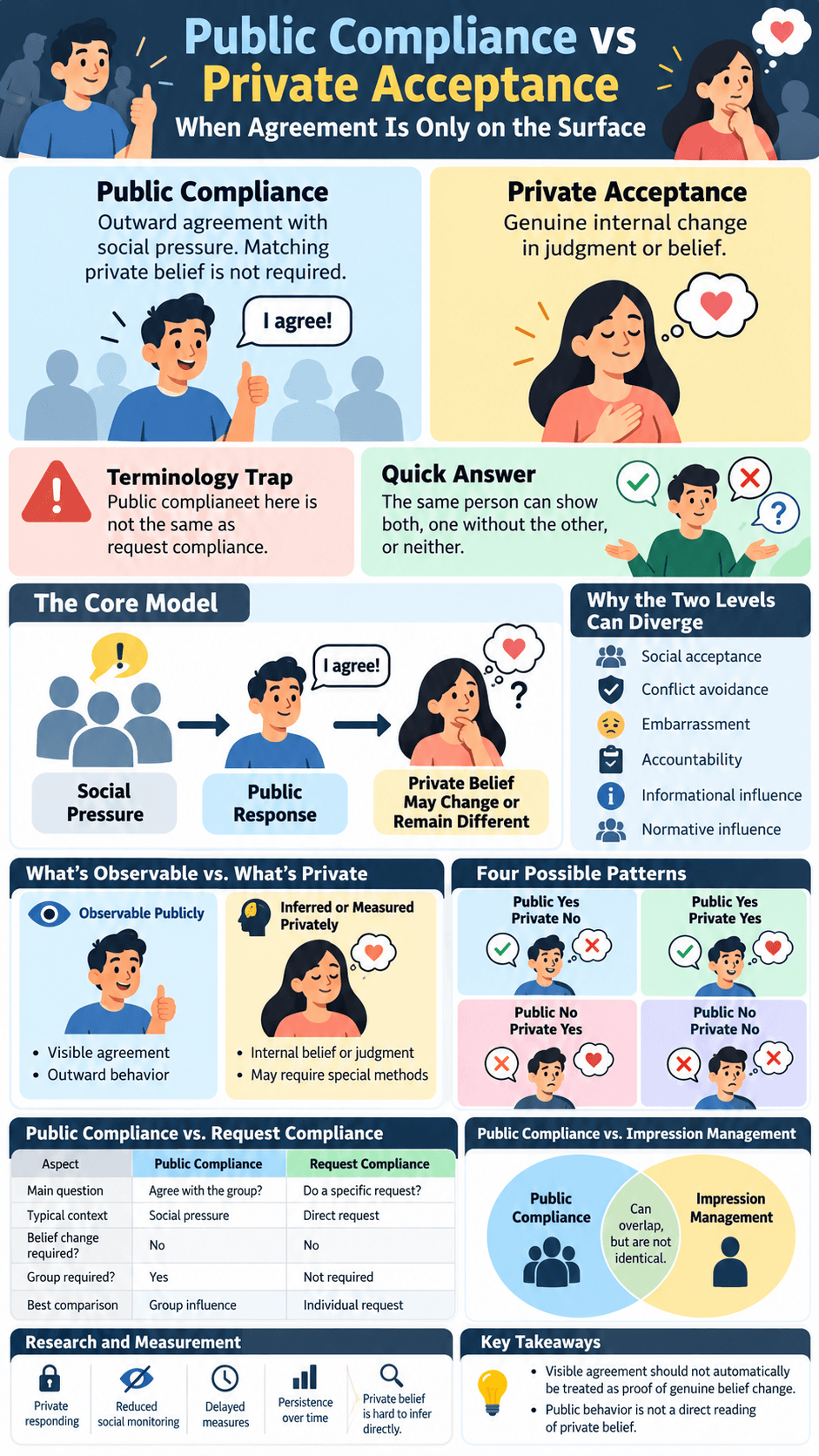
Public compliance is outward agreement or behavior that matches social pressure without requiring a matching private belief. Private acceptance is a more internal change in judgment or belief that can remain even when the group is absent. The same person can show both, one without the other, or neither, so public agreement should not automatically be treated as proof of genuine belief change.
First Clarify the Word Compliance

The word compliance appears in more than one part of social psychology. That does not make the term useless, but it does mean readers need to know which question a study or article is asking.
Public compliance as an outcome of social pressure or conformity
In conformity research, public compliance usually refers to a person expressing a response that matches a group while privately retaining a different view. The key contrast is therefore public response versus private belief.
A modern study that explicitly separated these outcomes described compliance as public conformity without matching private conformity, while acceptance involved influence that was expressed both publicly and privately. The researchers also noted that many conformity measures blur these outcomes together, which is one reason the distinction deserves attention. You can read the open-access study in Consciousness and Cognition.
Request compliance as agreeing to a direct request
Elsewhere, compliance means changing behavior because another person makes a request. Someone asks you to sign a form, move your seat, donate, help with a task, or attend an event, and you decide whether to do it. That is a request-response process.
This meaning does not require a group, a majority position, or a public-private belief gap. You can comply with a request privately, and you can refuse a request even when you agree with the requester’s reasons.
Why this article uses public compliance only for outward alignment versus private belief
Here, public compliance refers only to outward alignment under social influence. The central question is not “Did someone do what another person asked?” It is “Does the person’s public response reflect what they privately believe?”
That narrower use keeps the article focused on an outcome of social influence rather than on the psychology of requests.
Core Model: Social Pressure → Public Response → Private Belief May Change or Remain Different

A simple way to think about the distinction is to separate what other people can see from what the person actually thinks after the social situation has done its work.
| Stage | Question | What may happen |
|---|---|---|
| Social pressure | What does the group appear to expect, believe, or reward? | The person notices a majority view, expectation, or shared response. |
| Public response | What does the person say or do where others can observe it? | They may align, disagree, remain silent, or show uncertainty. |
| Private belief | What does the person think when social monitoring is reduced? | The belief may match the public response, remain different, or shift only partly. |
What is observable publicly
Public behavior includes spoken answers, visible choices, votes, posted opinions, hand-raising, or other responses that are potentially known to other people. These responses provide evidence about behavior in a social setting, but they are not direct access to belief.
Imagine eight colleagues endorsing a proposal in a meeting. That tells you what happened in the meeting. It does not automatically tell you whether all eight privately thought the proposal was best, whether some were uncertain, or whether some simply decided that open disagreement was not worth the social cost.
What is inferred or measured privately
Private belief is harder to study because researchers cannot directly observe a thought. Instead, they use measures intended to reduce social monitoring, such as private responses, anonymous or confidential judgments, delayed follow-up, or repeated choices outside the original group setting.
Even these measures are imperfect. A private answer may still reflect memory, uncertainty, self-presentation, habit, or the way a question is asked. “Private” is therefore a research condition, not a magical window into a person’s inner life.
Why the two levels can diverge
Public and private responses can diverge because social situations create more than one problem at once. A person may be trying to judge what is accurate while also managing belonging, conflict, embarrassment, accountability, or the consequences of standing apart.
Research on conformity often distinguishes normative influence, where social acceptance and group expectations matter, from informational influence, where other people’s judgments are treated as information about reality. A review in Trends in Cognitive Sciences emphasizes that these influences can interact rather than behaving like two perfectly separate switches.
Public Compliance

Outward behavior or expressed judgment aligns with social pressure
Public compliance occurs when a person’s visible response moves toward the group’s position while private agreement is absent or weaker. The person may say the answer the group expects, avoid objecting, or behave in the socially favored way while privately remaining unconvinced.
This does not automatically mean the person is lying. They may be uncertain, trying to avoid unnecessary conflict, following a temporary convention, or making a strategic choice about when to speak. The psychological point is simply that outward alignment and inward belief are not identical variables.
Private belief does not necessarily change
A public response can be temporary. When the group is no longer present, the person may return to their previous judgment. In other cases, they may continue to behave in the same way for practical reasons while still rejecting the group’s underlying view.
This is one reason researchers should not define influence only by visible agreement. If two people give the same public answer, one may privately agree while the other may not.
Social monitoring and audience presence can matter
When people know their responses are visible, reputational and relational concerns may become more relevant. A disagreement can signal independence, but it can also risk awkwardness, rejection, status loss, or prolonged argument depending on the setting.
The classic public-versus-private conformity literature found that changing response conditions can change how much people align with a group. This does not mean public responding always produces compliance. It means audience conditions are one factor that can alter the balance between visible alignment and private judgment.
Private Acceptance
Internal judgment or belief genuinely changes
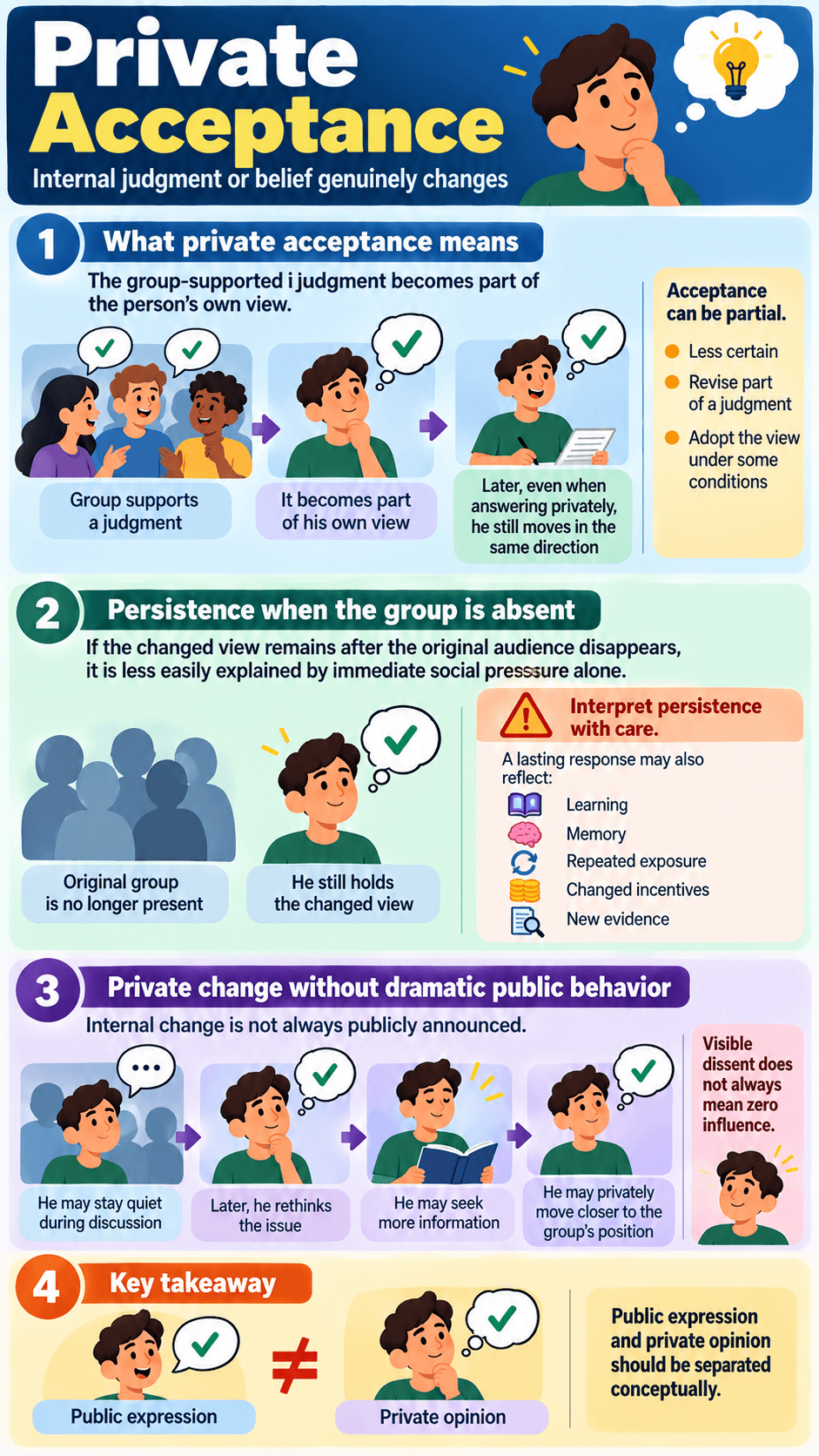
Private acceptance refers to a deeper form of change in which the group-supported judgment becomes part of the person’s own view. If they later answer privately, they still move in the same direction because the influence is no longer only about managing the immediate social situation.
Acceptance does not have to be total. Beliefs can shift in degree. Someone who began highly confident may become less certain, revise part of a judgment, or adopt the group’s view only under some conditions.
Acceptance may persist when the group is absent
Persistence is one clue that influence may have gone beyond surface alignment. If a person still holds the changed view after the original audience disappears, the response is less easily explained by immediate social pressure alone.
Persistence should still be interpreted carefully. A lasting response might reflect learning, memory, repeated exposure, changed incentives, or new evidence as well as social influence. The design of the research matters.
Private change can occur without dramatic public behavior
Not every internal change is publicly announced. Someone may remain quiet during a discussion but later rethink the issue, seek more information, or privately move closer to the group’s position. That matters because visible dissent does not always mean zero influence.
Laboratory research on social feedback has shown why public expression and private opinion should be separated conceptually. A study of social feedback and opinion change notes that a publicly expressed opinion may differ from privately held opinion, and it examines whether social feedback can affect private opinions rather than only public statements. The paper is available through PLOS ONE.
Four Public-Private Outcomes
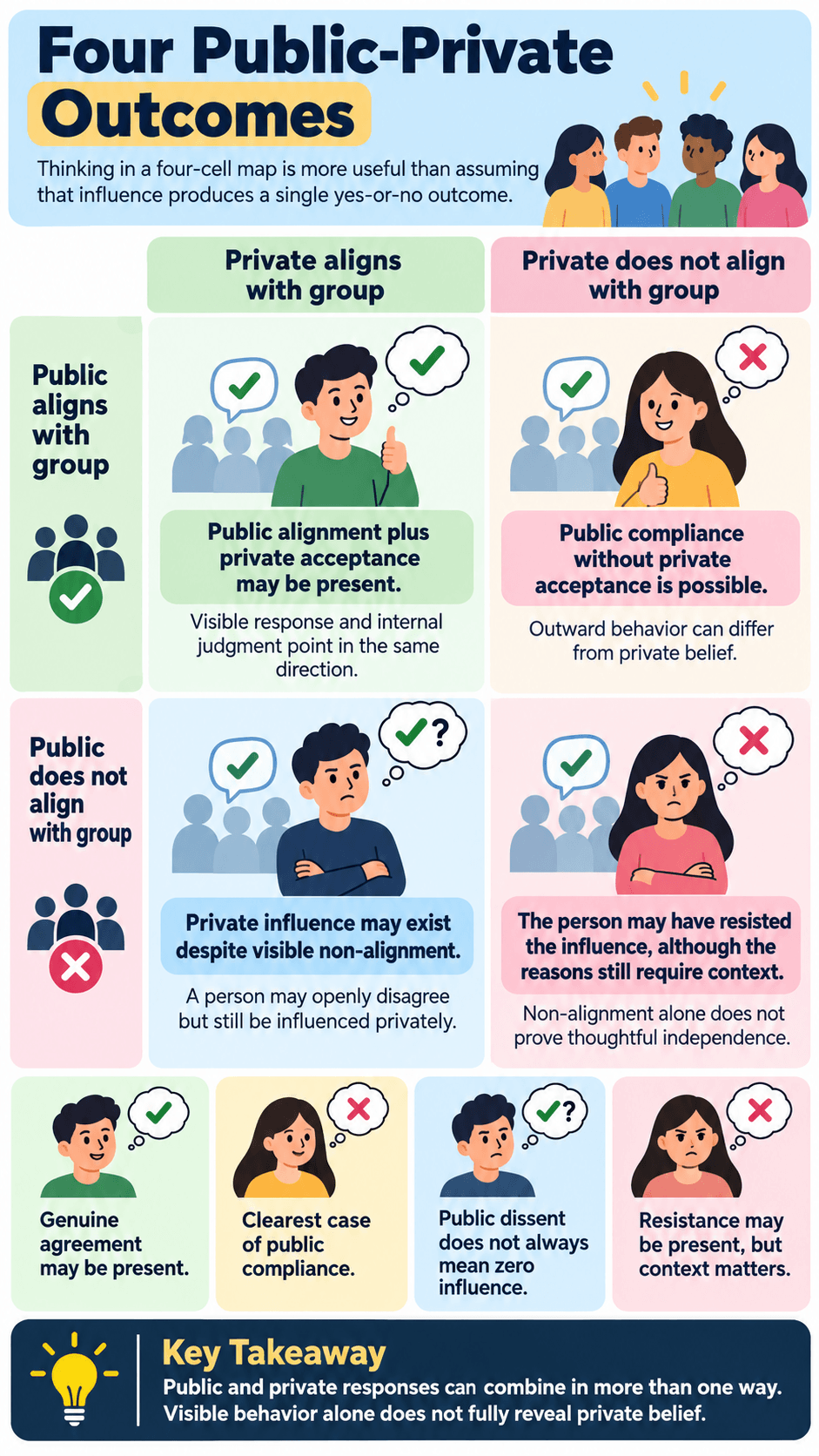
Thinking in a four-cell map is more useful than assuming that influence produces a single yes-or-no outcome.
| Public response | Private response | Possible interpretation |
|---|---|---|
| Aligns with group | Aligns with group | Public alignment plus private acceptance may be present. |
| Aligns with group | Does not align | Public compliance without private acceptance is possible. |
| Does not align | Moves toward group or becomes less certain | Private influence may exist despite visible non-alignment. |
| Does not align | Does not align | The person may have resisted the influence, although the reasons still require context. |
Public alignment plus private acceptance
A person may publicly agree because they genuinely came to believe that the group was correct. Their private answer later remains similar. Here, the visible response and internal judgment point in the same direction.
That still does not tell us exactly why the change occurred. The person may have learned something useful from the group, reassessed evidence, inferred expertise, or simply become more uncertain about the original belief.
Public alignment without private acceptance
This is the clearest case of public compliance. A student gives the answer most classmates gave but privately thinks it is wrong. An employee verbally supports a plan in a meeting but privately expects it to fail. A friend joins a group activity while privately disliking it.
The same outward behavior can arise from very different motives, so it is safer to describe the response than to invent a hidden motive.
Public non-alignment with some private movement or uncertainty
A person may openly disagree while still being influenced. Perhaps they become less certain, privately reconsider one assumption, or later adopt a modified version of the group’s position. This is especially relevant when influence operates through reflection rather than immediate visible agreement.
It is a reminder that public dissent and psychological independence are related but not identical.
Neither public alignment nor private acceptance
Sometimes the person simply maintains a different judgment. That may reflect strong evidence, confidence, prior commitment, support from others, or a belief that the group is mistaken. It may also reflect reflexive opposition. Nonconformity alone does not prove that the person is more accurate or more independent in a thoughtful sense.
Why Public and Private Responses Diverge

Normative pressure as a route to outward alignment
Normative influence is relevant when fitting in, avoiding rejection, preserving harmony, or meeting a group’s expectations matters. Under these conditions, a person may shift the public response even if their private judgment changes little.
This is one reason public responding can produce more group alignment than private responding in some laboratory settings. It does not mean every public agreement is driven by a desire for approval, and it does not mean normative motives are always conscious.
Informational influence can affect what a person privately believes
When the situation is ambiguous, other people’s responses can provide information. If several people independently appear confident, a person may reasonably wonder whether they have missed something. In that case, the group may change the person’s actual judgment rather than only the outward response.
A broad review in the Annual Review of Psychology describes social influence as shaped by multiple goals, including accuracy, social relationships, and maintaining a workable view of oneself. Those goals can pull in the same direction or in different directions.
Anonymity, group presence, and social monitoring
Reducing social monitoring can help researchers ask whether a response survives when immediate audience pressure is weaker. But anonymity is not a perfect test of truth. People can misunderstand questions, answer carelessly, or remain influenced by a group even when nobody sees their response.
The strongest interpretation therefore comes from patterns across conditions, measures, and time rather than from a single “public versus private” comparison.
Public Compliance vs Request Compliance
Surface alignment under social pressure versus agreeing to a request
| Feature | Public compliance | Request compliance |
|---|---|---|
| Main question | Does outward alignment match private belief? | Will the person do what someone asks? |
| Typical influence context | Group pressure, audience, norm, majority response | Direct request from another person |
| Private belief change required? | No | No |
| Group required? | Often relevant, though the key issue is public social alignment | No |
| Best comparison | Private acceptance | Refusal or agreement to a request |
Why the same word refers to different research traditions
Psychological terminology grows through different lines of research, and the same word can acquire a narrower meaning in one context and a broader meaning in another. That is what happened with compliance.
The safest approach is to look at the contrast being studied. If the contrast is request versus refusal, the topic is request compliance. If the contrast is public agreement versus private belief, the topic is public compliance and acceptance.
Examples that keep the two meanings separate
- Public compliance: A person repeats the group’s answer aloud, then chooses a different answer when responding privately.
- Request compliance: A neighbor asks the person to move a car, and the person agrees to do it.
- Both could occur: A person publicly agrees with a group’s preferred plan and also agrees to a specific request from a group member. These are two separate responses that happen in the same situation.
Public Compliance vs Impression Management
Public compliance concerns alignment under social influence
Public compliance is defined by the relationship between outward alignment and private belief. The person publicly moves with the group, while the private response may remain different.
The concept does not require a deliberate attempt to create a particular image. A person can comply publicly simply because disagreeing feels costly, awkward, or unnecessary.
Impression management concerns shaping how others see you
Impression management refers more specifically to efforts to influence the impressions other people form. The APA Dictionary of Psychology treats it as a distinct social process concerned with controlling or influencing how one is perceived.
Someone might express agreement to appear cooperative, knowledgeable, loyal, or easy to work with. In that case, impression management could contribute to public compliance, but it is not required for public compliance to occur.
Motives can overlap without making the constructs identical
Consider a team member who publicly supports a decision they privately doubt. They might be avoiding conflict, deferring to the group’s expertise, protecting a professional image, or waiting for more evidence. Several motives can coexist.
Psychological concepts are most useful when they identify different questions rather than pretending every behavior has one hidden cause.
How Researchers Study Private Acceptance
Private responding and reduced social monitoring
One method is to compare responses made publicly with responses made under more private conditions. If group alignment drops sharply when responses become private, that pattern is consistent with a stronger role for public social pressure. If alignment remains above a no-pressure baseline, some internal influence may also be present.
The 2018 public-private conformity study mentioned earlier used a within-person design to separate compliance and acceptance more directly. Its small sample means the results should not be treated as a final estimate of how much each process contributes, but the design illustrates why measurement matters.
Delayed measures and persistence
Researchers can also ask whether a changed response persists after the group is gone. A delayed measure may help distinguish a temporary public adjustment from a more durable change, although time introduces new influences such as memory, reflection, later information, and repeated exposure.
Persistence is therefore evidence to interpret, not a perfect stamp that says “true belief.”
Why private belief is difficult to infer directly
There is no single behavioral test that reveals private belief with certainty. Self-report depends on willingness and ability to report accurately. Behavior depends on context and incentives. Physiological or neural measures do not translate cleanly into a specific belief.
Good research builds a case from converging evidence. For everyday life, the same humility is useful: if someone’s public answer matters to you, ask rather than assume what they privately think.
Interpreting Public Agreement Carefully
Do not assume observable behavior reveals internal belief
If a room goes silent after a manager proposes an idea, silence is not proof of agreement. If everyone raises a hand, the vote records a public choice, not necessarily the strength or durability of each person’s private belief. If a teenager follows a peer group’s style, the behavior does not tell you whether they privately endorse every group value.
Public behavior is real behavior and may have real consequences. The caution is about psychological inference, not about pretending behavior does not matter.
Context, incentives, pressure, and measurement matter
Before concluding that someone “really believes” what they publicly expressed, consider what the situation rewarded or discouraged. Was disagreement safe? Was the task ambiguous? Did the group appear knowledgeable? Was the response visible? Was there time to think?
These questions do not excuse harmful behavior or erase responsibility. They simply help separate explanation from mind-reading.
When public dissent becomes possible
People may be more willing to show their private judgment when they have social support, a credible alternative, enough time to evaluate the evidence, or reduced fear of social consequences. That does not guarantee that dissent is correct. It makes independent responding more possible.
A useful personal check is: If nobody knew my answer, would I choose the same thing? A second is: What evidence, apart from the group’s reaction, actually supports my view? Those questions help distinguish social alignment from considered judgment without assuming that independence is always superior.
FAQ
Is public compliance the same as agreeing to a request?
No. In this context, public compliance means outward alignment under social influence without necessary private acceptance. Request compliance means doing what another person directly asks. The same word is used in both traditions, so the surrounding question matters.
Can someone publicly agree while privately disagreeing?
Yes. That is the central case described by public compliance. A person may outwardly align because of group expectations, audience pressure, conflict avoidance, uncertainty, or practical considerations while privately retaining a different judgment. The public response alone does not reveal which motive was present.
Can private acceptance happen without public conformity?
It can. A person may privately reconsider an issue without immediately displaying the change. They might remain publicly silent, openly disagree on part of the issue, or need time before their behavior catches up with their revised judgment. Internal change and public expression can follow different timelines.
How do researchers know whether a belief changed privately?
They infer it from methods such as private responses, reduced social monitoring, repeated measurement, delayed follow-up, and comparisons across conditions. None of these methods provides perfect access to belief, so strong conclusions depend on design quality and converging evidence rather than one response.
Is public compliance the same as impression management?
No. Public compliance describes a mismatch that may exist between outward alignment and private belief. Impression management is more specifically about influencing how others perceive you. Impression management can sometimes contribute to public compliance, but public compliance can occur without a deliberate image-management goal.
Key Takeaways
- Public compliance means outward alignment without requiring matching private belief.
- Private acceptance means the influence has been internalized enough to appear in private judgment, not only in front of the group.
- Request compliance is a different use of the word compliance: it concerns agreeing to a direct request.
- Public and private responses can form several combinations, so visible agreement should not be treated as a direct reading of someone’s mind.
- Audience conditions, social monitoring, uncertainty, information from others, and the design of measurement all affect how public-private differences should be interpreted.
- The most responsible conclusion is often descriptive: identify what someone did publicly, then remain cautious about claims concerning what they privately believe.

Michael Reed is the Founder and Lead Writer at Psychology Exposed. He writes about human behavior, relationships, emotional patterns, self-awareness, and practical psychology topics using research-informed, easy-to-understand content.
Read More About Michael Reed: https://psychologyexposed.com/michael-reed/