

A minority view can be easy to dismiss at first. One person questions a group decision, a small team challenges an established practice, or an unpopular interpretation keeps appearing even after most people have moved on. The interesting psychological question is not whether the minority is right. It is how a smaller or less dominant position can become difficult to ignore, prompt people to think again, and sometimes influence private judgment before public behavior changes.
Minority influence psychology studies this process. It helps explain why influence is not simply a matter of numbers, why consistency can make a dissenting position more noticeable, why flexibility matters, and why disagreement can alter the way people process an issue even when the majority does not openly switch sides. It also clarifies an important limit: minority status does not make a claim more truthful, innovative, or morally superior.
Quick Answer

Minority influence occurs when a smaller or less dominant position affects how a broader group thinks, judges, or behaves. Influence may develop through consistent advocacy, flexibility, cognitive conflict, closer attention, and private reconsideration. It may be delayed or appear more strongly in private than in public. A minority can stimulate thought without winning agreement, and being in the minority does not make a viewpoint correct. Minority influence is one part of the broader social influence framework, alongside group pressure, requests, authority, social information, and resistance.
What Minority Influence Means
Minority refers to social or numerical position, not factual correctness
In social psychology, a minority is a position held by fewer people or by a less dominant part of a group. The label describes social position, not quality. A minority can be well informed, poorly informed, correct, mistaken, principled, rigid, creative, conventional, or something in between.
This distinction matters because everyday discussions often romanticize dissent. The lone dissenter may be portrayed as the person who sees what everyone else missed. Sometimes that happens. Other times, the minority is simply wrong. Research on minority influence asks what happens when a smaller position is present, not whether that position deserves to prevail.
Influence can occur without immediate public agreement
Influence is often measured by visible agreement, but minority influence can be less obvious. A person may publicly stay with the majority while privately reconsidering an assumption. They may change their answer later, shift on a related issue, or become less certain about the majority position.
A large meta-analytic review of 97 experiments found that minority impact was especially evident on some private and indirect measures rather than on direct public measures. That pattern is one reason researchers have treated minority influence as more than a contest over immediate public votes. The Psychological Bulletin meta-analysis by Wood and colleagues is a useful synthesis of this evidence.
Majority and minority influence can operate differently
A majority often has an obvious numerical advantage. It can signal what most people believe, what is socially normal, or what position carries immediate acceptance. A minority does not have that advantage. Its influence may instead come from creating a reason to stop, inspect the issue, and ask why someone is willing to maintain a different position.
This does not mean majority influence is shallow and minority influence is deep in every situation. The distinction is a useful research pattern, not a universal law. Task type, public visibility, group identity, confidence, evidence quality, and the way the minority behaves can all change what happens.
Core Model: Minority Position → Consistency plus Flexibility → Cognitive Conflict → Reconsideration → Possible Private Change
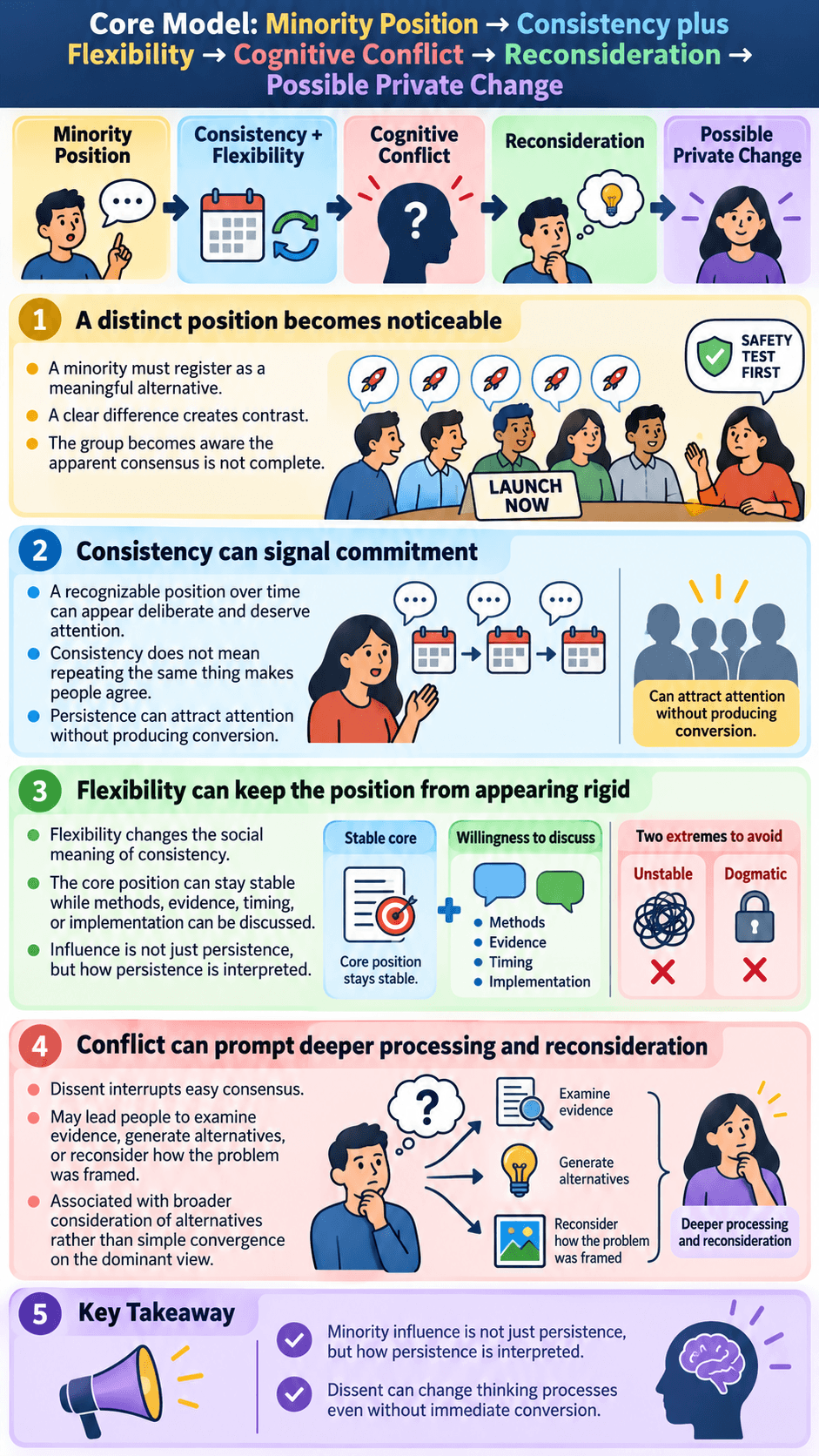
A distinct position becomes noticeable
A minority first has to register as a meaningful alternative. If its position is vague, constantly changing, or barely expressed, the majority may have little reason to engage with it. A clear difference creates contrast. That contrast can make the group aware that the apparent consensus is not complete.
Consider a six-person project team deciding whether to launch a product immediately. Five members favor the launch. One member argues that a safety test should happen first. The dissenter may not change the vote, but the disagreement introduces a competing interpretation: perhaps the decision is not simply “launch versus delay,” but “speed versus unexamined risk.”
Consistency can signal commitment
Consistency is one of the best-known ideas in minority influence research. A position that remains recognizable over time can appear more deliberate than a position that changes whenever social pressure rises. Consistency may signal that the dissenter is not speaking casually and that the viewpoint deserves attention.
Research reviews have repeatedly discussed consistency as an important factor, including a broader review in Social and Personality Psychology Compass. Still, consistency should not be translated into a simple rule that “repeating the same thing makes people agree.” Persistence can attract attention without producing conversion.
Flexibility can keep the position from appearing rigid
A minority that never adjusts wording, acknowledges evidence, or responds to reasonable concerns may be seen as closed rather than committed. Flexibility changes the social meaning of consistency. The position can stay stable at its core while showing willingness to discuss methods, evidence, timing, or implementation.
That balance is important. If the minority changes its central claim every few minutes, the position may seem unstable. If it refuses every modification, it may seem dogmatic. Influence is therefore not just persistence. It involves how persistence is interpreted.
Conflict can prompt deeper processing and reconsideration
A dissenting view can create cognitive conflict because it interrupts an easy consensus. The majority can no longer assume that everyone sees the issue in the same way. That conflict may lead people to examine evidence, generate alternatives, or reconsider how the problem was framed.
Charlan Nemeth’s work has been influential here. In one line of research, exposure to minority dissent was associated with broader consideration of alternatives rather than simple convergence on the dominant view. A study by Nemeth and Kwan reported that participants exposed to a minority position found more correct solutions in an anagram task by using a wider range of strategies. The Journal of Applied Social Psychology article illustrates why researchers became interested not only in whether minorities change opinions, but also in how dissent can change thinking processes.
Majority Influence vs Minority Influence

| Question | Majority influence | Minority influence |
|---|---|---|
| Typical social position | Larger or dominant position | Smaller or less dominant position |
| Immediate pressure | Can carry strong normative weight | Usually has less numerical pressure |
| Common research focus | Movement toward group or majority position | How an alternative position affects broader thinking |
| Visible outcome | May appear as public agreement | May be less visible or delayed |
| Private change | Possible | Also possible, sometimes without immediate public change |
| What it does not prove | That the majority is correct | That the minority is correct |
Majority pressure and movement toward a group norm
Conformity usually centers on movement toward a group norm, majority judgment, or perceived group position. That can involve wanting social acceptance, using others as information, or both. The central direction of movement is toward what the group appears to endorse.
Minority influence asks a different question. Instead of asking why someone moves toward the majority, it asks how a less dominant position can affect the thinking of people who initially outnumber it.
Minority influence and attention to an alternative position
The minority’s lack of numerical support can make its presence psychologically distinctive. If most people agree and one or two do not, the disagreement itself demands explanation. The group may ask whether the dissenter misunderstood the issue, possesses different information, values a different outcome, or noticed a problem the majority overlooked.
This attention is not the same as acceptance. A minority can become cognitively important without becoming socially dominant.
Public agreement versus private or delayed change
Public responses are shaped by more than private judgment. People may hesitate to align publicly with an unpopular position because they expect criticism, awkwardness, or reputational cost. That can make minority influence difficult to detect if researchers look only at immediate public responses.
Private measures and delayed measures can sometimes reveal effects that are not visible in the room. However, researchers also caution that private conversion is not automatic and can be difficult to measure cleanly. The distinction is useful when interpreting findings, not a guarantee that hidden agreement exists whenever public agreement is absent. This difference between visible agreement and internal judgment is explored more directly in public compliance vs private acceptance.
Consistency Has More Than One Form
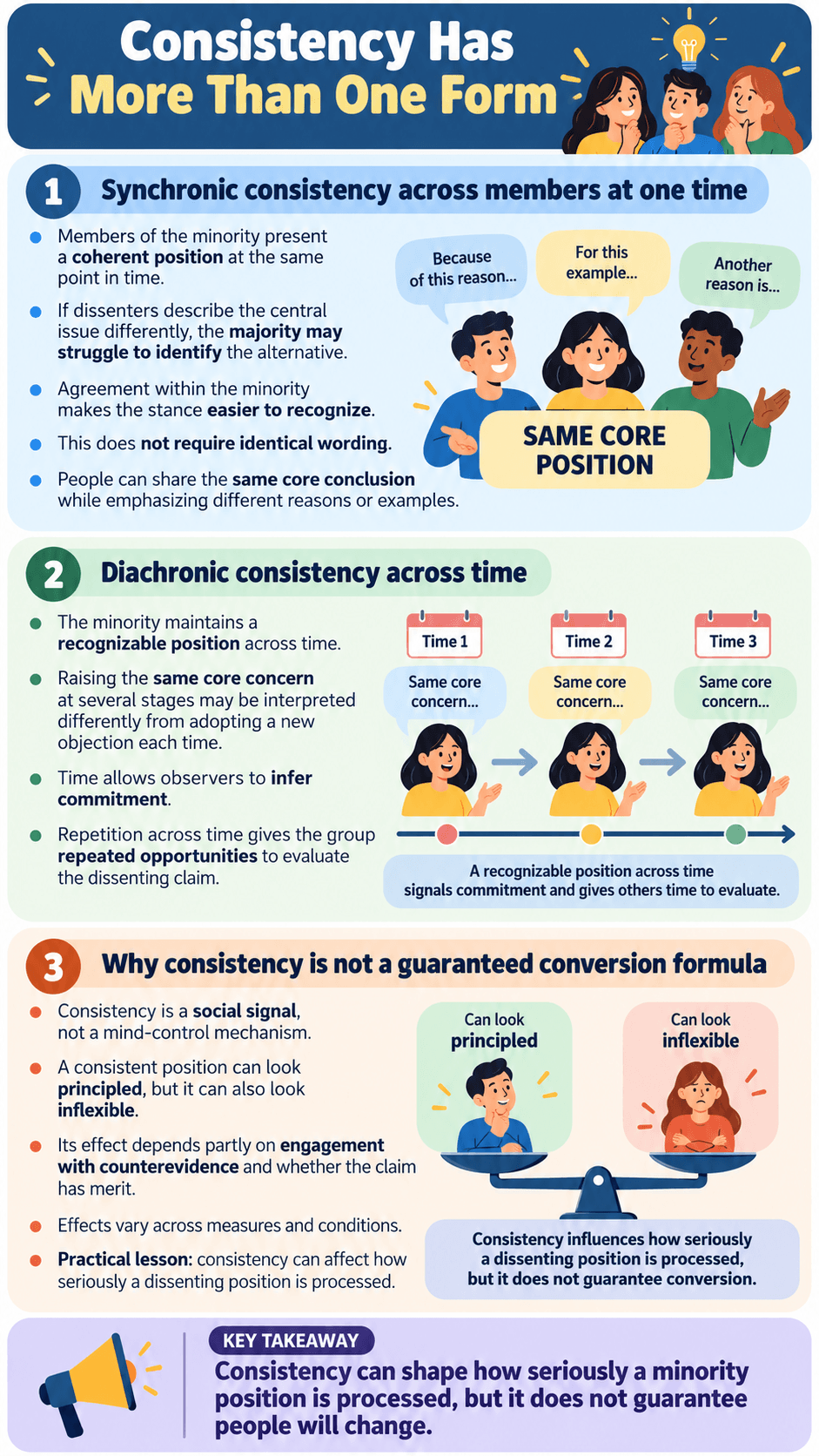
Synchronic consistency across members at one time
Synchronic consistency means that members of the minority present a coherent position at the same point in time. If three dissenters all describe the central issue differently, the majority may struggle to identify what the alternative position actually is. Agreement within the minority can make its stance easier to recognize.
This does not require identical wording. People can share the same core conclusion while emphasizing different reasons or examples.
Diachronic consistency across time
Diachronic consistency means that the minority maintains a recognizable position across time. A person who raises the same core concern at several stages of a discussion may be interpreted differently from someone who adopts a new objection each time the group responds.
Time allows observers to infer commitment. It can also give the group repeated opportunities to evaluate the dissenting claim rather than reacting only to its first presentation.
Why consistency is not a guaranteed conversion formula
Consistency is a social signal, not a mind-control mechanism. A consistent position can look principled, but it can also look inflexible. Its effect depends partly on whether the minority engages with counterevidence and whether the underlying claim has merit.
The 1994 meta-analysis found that perceived consistency was related to stronger minority influence, but the same evidence base also shows that effects vary across measures and conditions. The practical lesson is not “be consistent and people will change.” It is that consistency can affect how seriously a dissenting position is processed.
Flexibility vs Rigidity
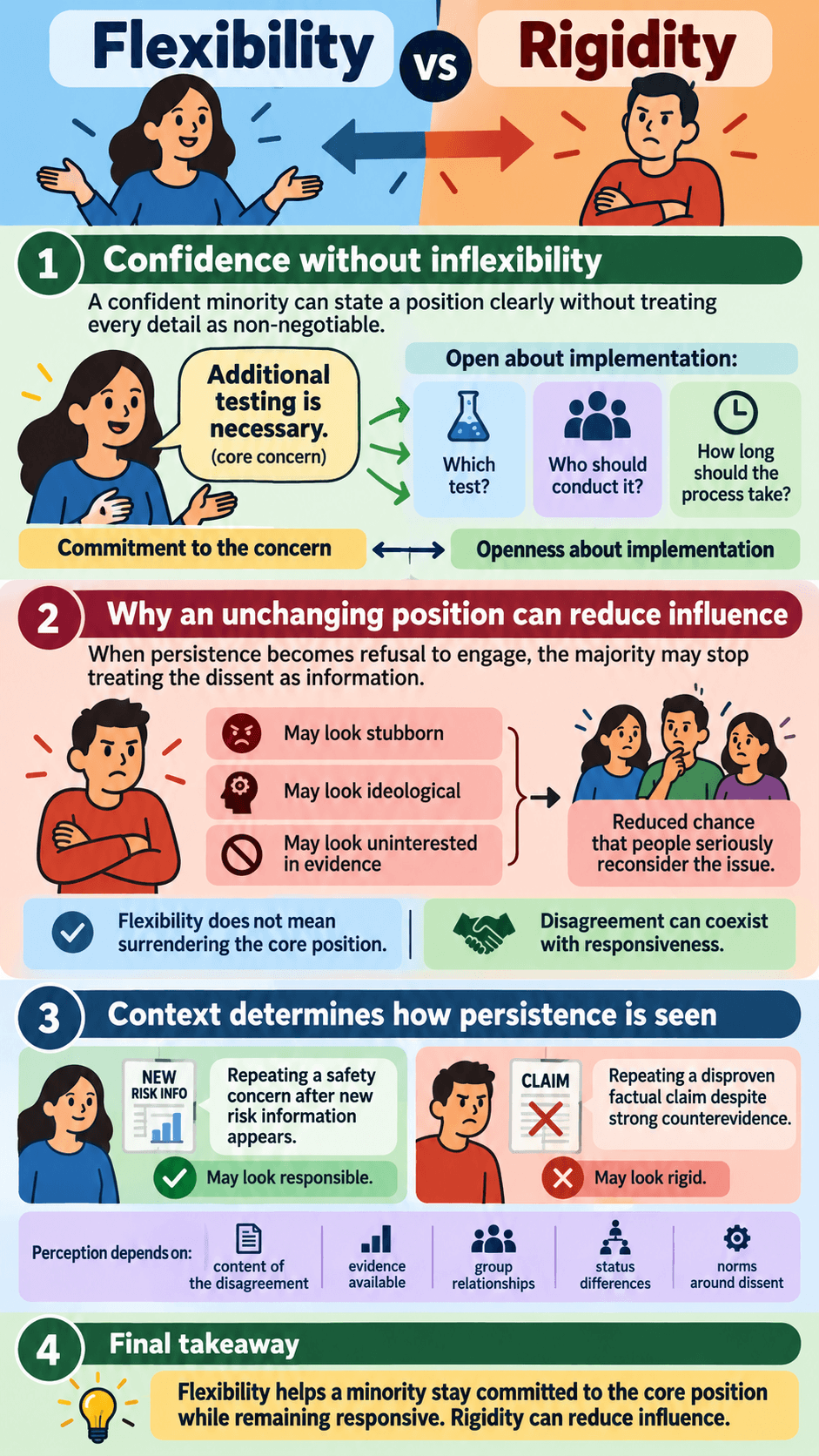
Confidence without inflexibility
A confident minority can state a position clearly without treating every detail as non-negotiable. For example, a team member might maintain that additional testing is necessary while remaining open about which test, who should conduct it, or how long the process should take.
This separates commitment to the underlying concern from attachment to one specific implementation.
Why an unchanging position can sometimes reduce influence
When persistence becomes refusal to engage, the majority may stop treating the dissent as information. The minority may then be categorized as stubborn, ideological, or uninterested in evidence. That interpretation can reduce the chance that people will seriously reconsider the issue.
Flexibility does not mean surrendering the core position. It means showing that disagreement can coexist with responsiveness.
Context determines whether persistence looks principled or closed
The same behavior can be interpreted differently depending on the setting. Repeating a safety concern after new risk information appears may look responsible. Repeating a disproven factual claim despite strong counterevidence may look rigid.
That is why minority influence cannot be reduced to a personality style. The content of the disagreement, evidence available, group relationships, status differences, and norms around dissent all shape how the minority is perceived.
Cognitive Conflict, Attention, and Deeper Processing
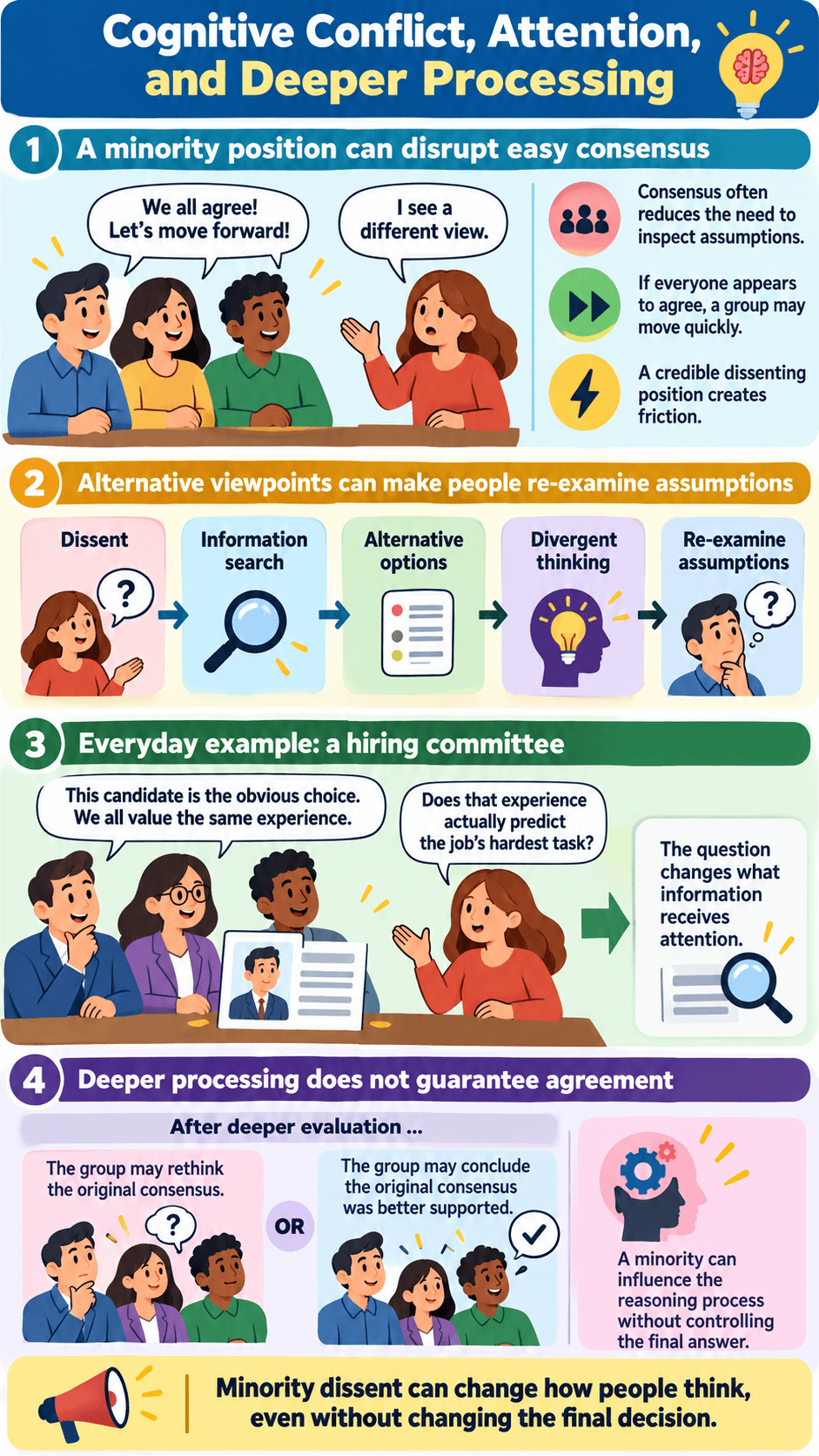
A minority position can disrupt easy consensus
Consensus often reduces the need to inspect every assumption. If everyone appears to agree, a group may move quickly. A credible dissenting position creates friction. It gives the group a reason to ask whether the shared answer came from careful evaluation or from everyone using the same starting assumptions.
That friction can be useful even when the minority’s proposed answer is not adopted.
Alternative viewpoints can make people re-examine assumptions
Nemeth’s broader theory of dissent argues that minority disagreement can widen the set of ideas people consider. Her overview of minority influence theory emphasizes research on dissent, information search, alternative options, and divergent thinking.
An everyday version is easy to imagine. A hiring committee agrees that one candidate is the obvious choice because everyone values the same experience. A dissenter asks whether that experience actually predicts the job’s hardest task. The group may still choose the original candidate, but the question changes what information receives attention.
Deeper processing does not guarantee agreement
Thinking harder can strengthen the majority position as easily as weaken it. People may examine the minority claim carefully and conclude that the original consensus was better supported. That still represents a meaningful cognitive effect because the judgment has been tested rather than merely repeated.
This is one reason it is misleading to define minority influence only as “getting the majority to switch.” A minority can influence the reasoning process without controlling the final answer.
Private Conversion and Delayed Effects

Why influence may appear privately before publicly
Public alignment with a minority can carry social costs. A person may worry about being associated with an unpopular view, disrupting cohesion, or appearing disloyal. These pressures can make private reconsideration easier than public endorsement.
Private change may therefore show up in anonymous judgments, later decisions, or responses to related questions. This possibility is supported by research traditions summarized in both the Wood meta-analysis and later reviews.
Why delayed change is difficult to measure
Delayed effects raise a measurement problem: many things happen between the original exposure and a later judgment. New evidence may appear. People may discuss the issue with others. Memory may change. A later response cannot automatically be attributed to the original minority.
Researchers therefore have to design studies carefully and avoid treating every later shift as proof of hidden minority influence.
Public behavior and private belief should be separated
A visible vote tells you what someone expressed, not necessarily everything they believe. This is true for both majority and minority influence. Public behavior may reflect social pressure, strategic compromise, uncertainty, or genuine acceptance.
For readers, the useful lesson is modest: do not assume that public consensus means complete private consensus, and do not assume that hidden agreement exists simply because a minority has been persistent.
Moscovici’s Blue-Green Research in Context
Historical purpose of the paradigm
Serge Moscovici and colleagues developed classic experiments to challenge the idea that social influence flows only from majorities to minorities. In the well-known color-perception paradigm, a consistent minority labeled blue slides as green. The setup was deliberately simple so researchers could study whether a small, consistent source could affect majority responses.
What the classic findings contributed
The studies helped establish minority influence as a serious research topic. They directed attention toward source consistency, conflict, conversion, and the possibility that a smaller position can influence a larger one even without obvious social power.
More recent scholarship treats those studies as historical foundations rather than final answers. A 2022 discussion in Frontiers in Psychology reviews how minority influence research developed beyond early laboratory paradigms and also discusses limits in reducing social change to individual attitude change.
Why classic effects are not universal formulas
A laboratory task involving color judgments is not the same as disagreement about medicine, workplace policy, ethics, or public decisions. The meaning of dissent changes with expertise, identity, stakes, culture, group structure, and evidence quality.
Classic experiments are useful because they isolate mechanisms. They should not be treated as proof that consistency always creates conversion or that minority influence works the same way in every real group.
Minority Influence Is Not the Same as Persuasion
Source position and group process versus message-based attitude influence
Persuasion focuses broadly on attempts to change attitudes, beliefs, intentions, or evaluations through communication. Minority influence focuses on what happens when the source occupies a smaller or less dominant social position within an influence context.
The two can overlap. A minority often communicates arguments. But the concepts are not interchangeable. Minority influence research cares about the social meaning of being a dissenting source, the reactions that source position creates, and the possibility of private or delayed effects.
A minority can use persuasive communication without making the constructs identical
If two members of a committee present evidence to change the other eight members’ minds, persuasive communication may be part of the event. Minority influence adds another layer: how does their numerical position affect attention, credibility, conflict, willingness to agree publicly, and subsequent processing?
Keeping the concepts separate prevents an overly broad explanation in which every attempt to influence someone becomes “minority influence.”
When Minority Dissent Helps Independent Judgment
Dissent as an alternative information source
A dissenter can expose assumptions that consensus has made invisible. This is especially useful when a group has considered too few alternatives or has treated agreement as evidence that no further checking is needed.
The value comes from adding information and perspective, not from automatically opposing the majority.
Social support can make disagreement easier to consider
Knowing that another person also questions the majority can reduce the social isolation of dissent. An ally may make it easier for people to express uncertainty, inspect evidence, or resist the assumption that consensus itself proves correctness. For the broader conditions that help people maintain independent judgment under social pressure, see resistance to social influence.
However, the goal should not be reflexive opposition. A group improves judgment when it can evaluate both consensus and dissent against evidence, reasoning, and context.
A practical reflection: separate the source from the claim
When you encounter a minority viewpoint, ask two different questions. First, what is socially happening here? Is the speaker genuinely outnumbered, lower in status, or challenging a dominant norm? Second, what is the quality of the claim itself? What evidence supports it, what evidence contradicts it, and what would change your mind?
This separation protects against two opposite mistakes: dismissing a claim because few people support it, and admiring a claim simply because it is unpopular.
FAQ
Does a minority have to be consistent to influence a majority?
Consistency can strengthen minority influence by making a position more noticeable and signaling commitment, but it is not a guarantee. A minority also needs to be interpretable as credible and responsive rather than merely rigid. Evidence quality, flexibility, context, group relationships, and how influence is measured all matter.
What is the difference between majority and minority influence?
Majority influence generally concerns how a larger or dominant position affects others, often through group norms, consensus, or pressure. Minority influence examines how a smaller or less dominant position can affect broader thinking. The two processes can overlap, and neither automatically produces accurate judgment.
Can minority influence happen without public agreement?
Yes. Research has found that minority effects can sometimes appear more clearly on private, indirect, or delayed measures than on immediate public responses. That does not mean hidden agreement should be assumed. It means public behavior alone may not capture every change in judgment.
Is minority influence the same as persuasion?
No. Persuasion is a broader communication process aimed at changing attitudes or beliefs. Minority influence focuses on the social dynamics created when the influencing position is held by a smaller or less dominant source. A minority may use persuasive arguments, but the concepts answer different questions.
Are minority viewpoints more likely to be correct or innovative?
No. Minority status does not establish truth, courage, originality, or intelligence. Dissent can stimulate broader thinking and expose neglected alternatives, but a minority can also be mistaken. The responsible response is to evaluate the claim and evidence rather than treating popularity or unpopularity as proof.
Key Takeaways
- Minority influence is the effect a smaller or less dominant position can have on broader thinking, judgment, or behavior.
- Consistency can make a dissenting position more noticeable, but consistency alone does not guarantee conversion.
- Flexibility matters because persistence may be interpreted as principled commitment or as rigidity depending on context.
- Minority dissent can create cognitive conflict and encourage people to consider alternatives, even when the majority does not publicly switch sides.
- Some minority effects may appear privately, indirectly, or after a delay, so public agreement is not the only possible outcome.
- A minority viewpoint is not automatically correct. Good judgment requires evaluating evidence separately from the social position of the speaker.
Final thought: The most useful lesson from minority influence psychology is not that the lone voice should win. It is that consensus should remain open to examination. When a smaller position raises a meaningful alternative, the better response is neither automatic conformity nor automatic admiration of dissent. It is careful reconsideration of the claim, the evidence, and the assumptions the group may have stopped noticing.

Michael Reed is the Founder and Lead Writer at Psychology Exposed. He writes about human behavior, relationships, emotional patterns, self-awareness, and practical psychology topics using research-informed, easy-to-understand content.
Read More About Michael Reed: https://psychologyexposed.com/michael-reed/