

Imagine arriving in an unfamiliar city and seeing two nearly identical food stalls. One has a long line of local customers. The other is empty. You know almost nothing about either stall, yet the crowd immediately feels informative. Maybe the busy stall is better. Maybe it is safer. Maybe people know something you do not.
That reaction captures the basic psychology behind social proof. When a situation is uncertain, other people’s visible behavior can become evidence. We use it to estimate what is normal, sensible, safe, effective, or worth choosing. This shortcut can be useful because other people sometimes do possess information we lack. It can also mislead us when everyone is copying the same weak signal, when visible behavior hides private doubt, or when popularity is mistaken for quality.
The useful question is not simply, “Are other people doing it?” It is, “What does their behavior actually tell me, and how much weight should I give it?”
Quick Answer
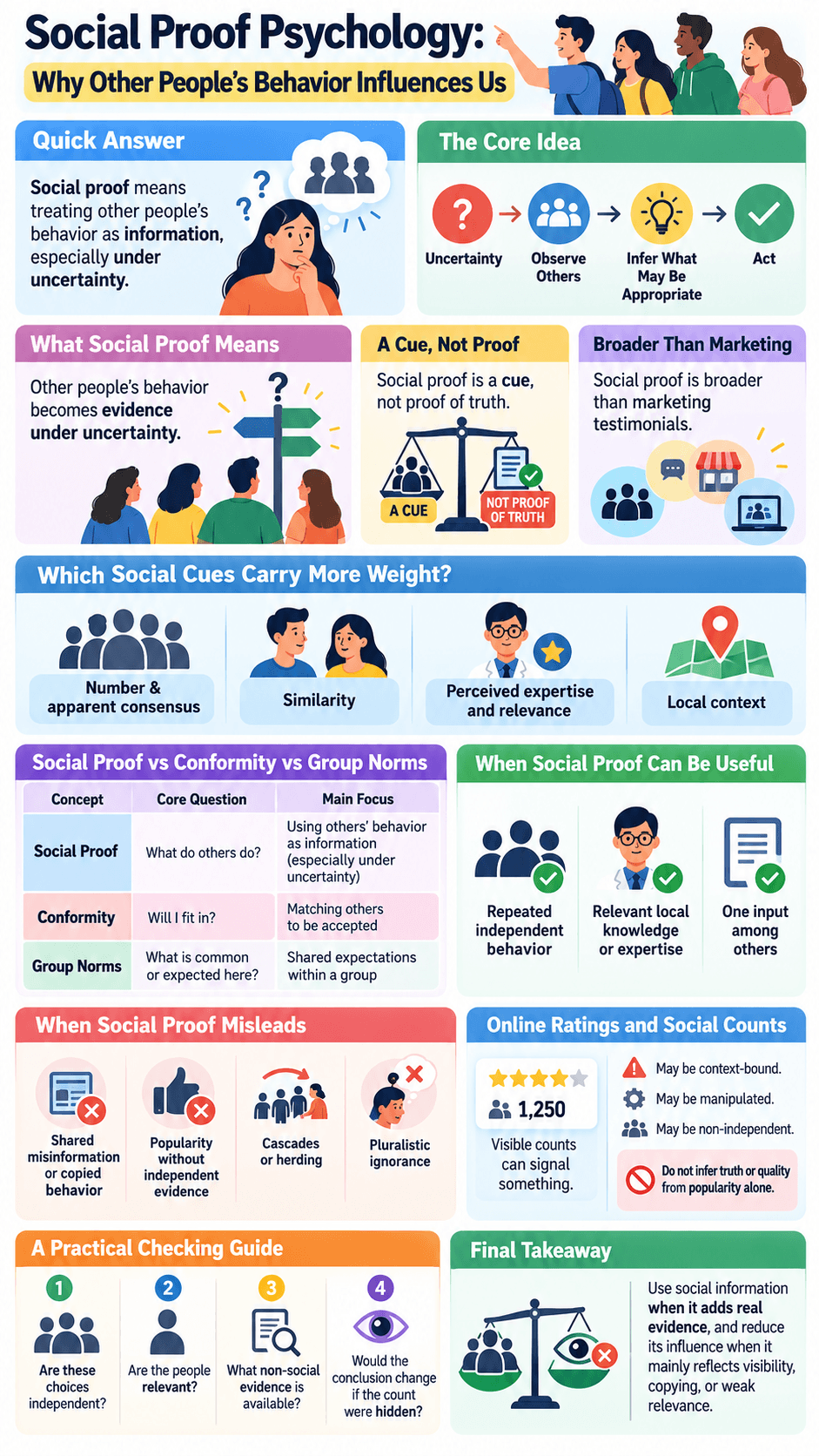
Social proof psychology describes the tendency to treat other people’s behavior as information, especially when we are uncertain about what to do. A crowd, rating, repeated choice, or local pattern may suggest what is normal or effective, but it does not prove that the behavior is correct. Social proof overlaps with conformity and group norms, yet the concepts focus on different parts of the influence process.
What Social Proof Means

Others’ behavior becomes evidence under uncertainty
When we have strong direct evidence, other people’s choices may matter very little. If you know exactly which train reaches your destination, a crowd walking toward another platform does not automatically override the timetable. But when information is incomplete, ambiguous, or costly to obtain, observing others may become a practical source of guidance.
This is especially common in situations where you cannot easily test every option yourself. A visitor may follow locals toward an exit. A new employee may notice which meeting-room customs everyone follows. A shopper may pay attention to which unfamiliar product is chosen repeatedly. In each case, observed behavior functions as a clue.
Research on descriptive norms helps clarify why visible behavior matters. A classic Journal of Personality and Social Psychology paper by Cialdini, Reno, and Kallgren distinguished information about what people actually do from information about what people approve or disapprove of. That distinction is useful here because social proof is primarily about reading behavior as evidence.
Social proof is a cue, not proof of truth
The phrase “social proof” can sound stronger than the psychology warrants. Other people’s actions may be informative, but they do not establish truth in the logical sense. Ten people can copy one mistaken person. A five-star average can reflect a narrow group with different needs from yours. A crowded place may be crowded because it is visible, not because it is best.
A better mental translation is: “This is social evidence worth considering.” That wording leaves room for independent information, context, and uncertainty.
Why the term should not be reduced to marketing testimonials
Online marketing often uses “social proof” to mean reviews, customer counts, endorsements, or popularity badges. Those are examples of visible social information, but the psychological process is much broader. It includes everyday situations in which people observe what others are doing and use those observations to interpret an uncertain environment.
The concept therefore belongs to social psychology, not merely to advertising. A line outside a restaurant, passengers choosing one exit, neighbors conserving energy, students remaining silent in a confusing lecture, and users upvoting an online comment can all provide social information. The important issue is how observers interpret the behavior and whether the cue deserves trust.
Core Model: Uncertainty → Observe Others → Infer What May Be Appropriate → Act
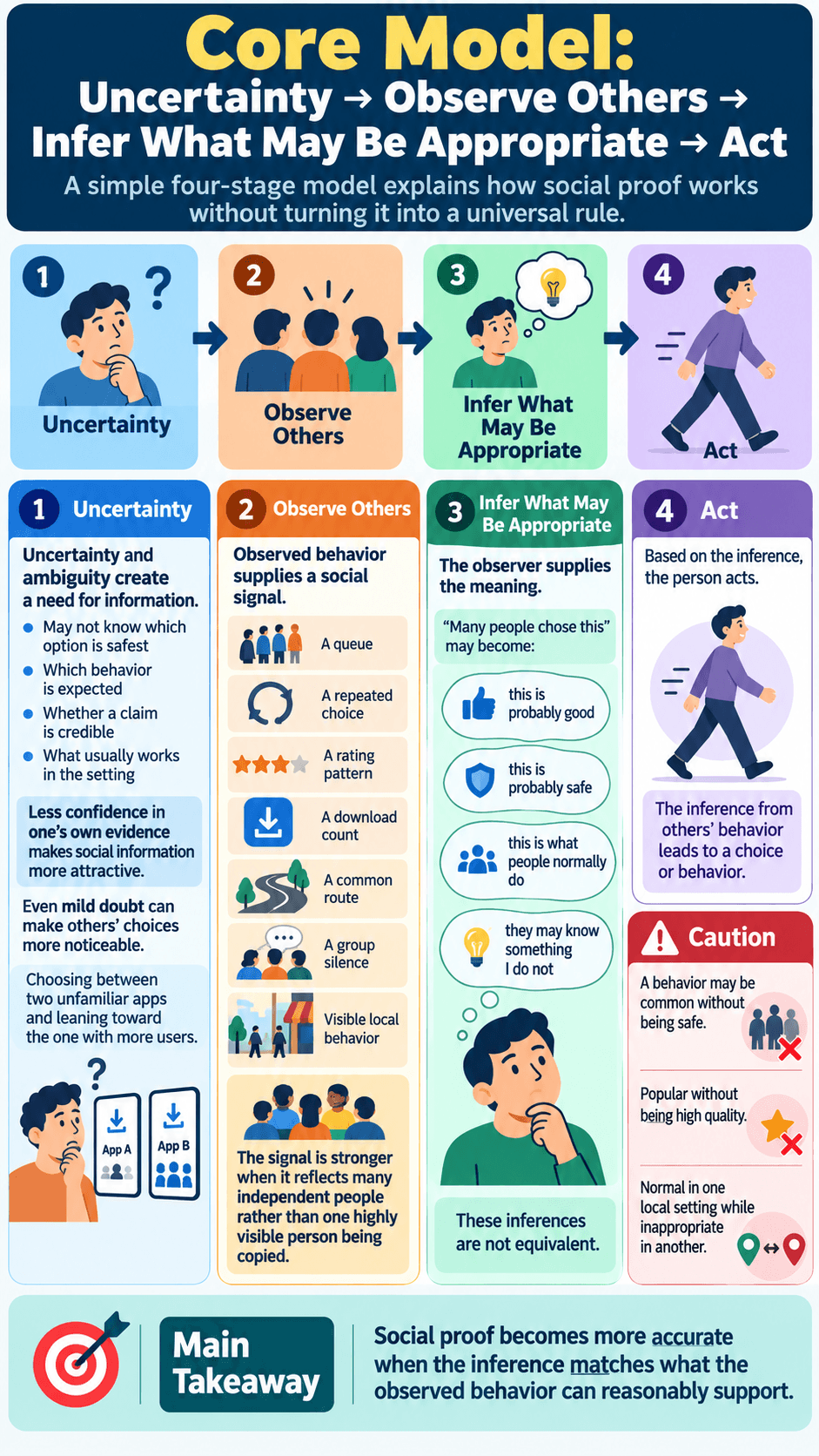
A simple four-stage model helps explain how social proof works without turning it into a universal rule.
Uncertainty and ambiguity create a need for information
The process often begins with a gap in knowledge. You may not know which option is safest, which behavior is expected, whether a claim is credible, or what usually works in the setting. The less confident you are in your own evidence, the more attractive social information may become.
Uncertainty does not have to mean complete confusion. Even mild doubt can make other people’s choices more noticeable. Someone deciding between two unfamiliar apps may know both are functional yet still lean toward the one with more users because the difference feels hard to judge directly.
Observed behavior supplies a social signal
Next, you notice what other people are doing. The signal may be a queue, repeated choice, rating pattern, download count, common route, group silence, or visible behavior in a local setting. What matters is that behavior becomes observable enough to influence your interpretation.
The signal is stronger when it appears to represent many independent people rather than one highly visible person being copied. That distinction becomes crucial when evaluating whether a consensus is genuinely informative.
The observer infers what may be normal, safe, or effective
The behavior itself does not contain an explanation. The observer supplies one. “Many people chose this” can become “this is probably good,” “this is probably safe,” “this is what people normally do,” or “they may know something I do not.”
Those inferences are not equivalent. A behavior may be common without being safe. It may be popular without being high quality. It may be normal in one local setting while inappropriate in another. Social proof becomes more accurate when the inference matches what the observed behavior can reasonably support.
Which Social Cues Carry More Weight?
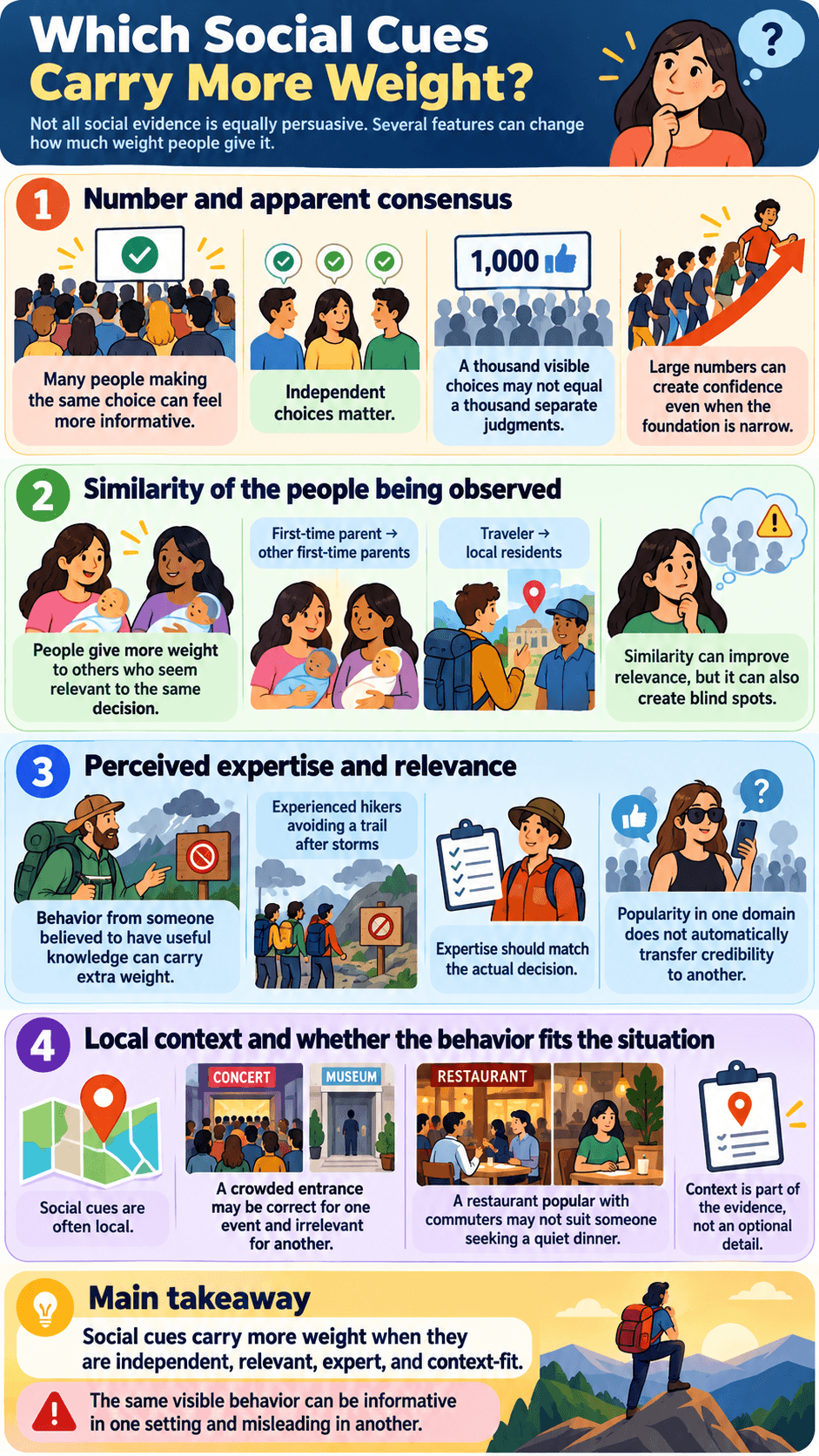
Not all social evidence is equally persuasive. Several features can change how much weight people give it.
Number and apparent consensus
Seeing many people make the same choice can feel more informative than seeing one person do it. The intuitive logic is straightforward: if multiple people independently reached the same conclusion, perhaps they each encountered evidence pointing in that direction.
The word independently matters. A thousand visible choices do not represent a thousand separate judgments if most people copied an early trend. Large numbers can create confidence even when the informational foundation is surprisingly narrow.
Similarity of the people being observed
People may give more weight to behavior from others who seem relevant to the same decision. A first-time parent may care more about the experiences of other first-time parents than those of people facing a different situation. A traveler may watch residents when choosing a transit route because locals appear to possess context-specific knowledge.
Similarity can improve relevance, but it can also create blind spots. A group that shares the same assumptions, information source, or bias may produce a highly consistent signal that is still incomplete.
Perceived expertise and relevance
Behavior from someone believed to have useful knowledge can carry extra weight. If several experienced hikers avoid a trail after recent storms, their behavior may contain more relevant information than the choices of tourists who arrived moments earlier.
Yet expertise should be tied to the actual decision. Popularity in one domain does not automatically transfer credibility to another. A widely followed person can still be poorly informed about the specific issue at hand.
Local context and whether the behavior fits the situation
Social cues are often local. A crowded entrance may be the correct entrance for one event and irrelevant for another. A restaurant popular with commuters may not suit someone seeking a quiet dinner. A behavior that works well in one culture, workplace, or neighborhood may mean something different elsewhere.
Context is therefore part of the evidence, not an optional detail added later.
Social Proof vs Conformity vs Group Norms

These ideas overlap, but treating them as synonyms makes social influence harder to understand.
| Concept | Core question | Main focus | Example |
|---|---|---|---|
| Social proof | What are other people doing, and what might that tell me? | Others’ behavior used as information | You choose a busy café because the crowd suggests it may be good |
| Conformity | Am I shifting toward the group’s position or behavior? | Movement toward a group or majority position | You publicly give the same answer as the group |
| Group norm | What behavior is expected or considered appropriate here? | Shared expectations about conduct | People in a workplace routinely mute phones during meetings |
Social proof: what are other people doing?
Social proof begins with observed behavior. The observer treats that behavior as a clue. The central object is the cue itself: the queue, choice, count, repeated action, or apparent consensus.
Conformity: am I shifting toward the group position?
Conformity focuses on the person’s movement toward a group position or norm. Someone may notice a crowd and use it as information, then change behavior in the same direction. The social proof is the evidence they observed; conformity describes the shift toward the group.
That distinction also keeps this topic from duplicating broader theories of conformity psychology, where majority influence and normative versus informational influence deserve fuller treatment.
Group norm: what is expected or appropriate here?
A group norm is about shared expectations. It answers a somewhat different question from simple prevalence. “Most people do this” and “people here believe you should do this” can point in the same direction, but they are not identical.
That difference is central to research separating descriptive from injunctive norms. In a field study of household energy use, Schultz and colleagues showed that information about what neighbors were doing could affect behavior differently depending on the recipient’s starting point. The findings are a reminder that visible prevalence does not operate like a simple command.
Why the same situation can contain all three without making them identical
Consider a new employee who notices everyone leaving laptops closed during a meeting. The observation itself provides social proof: “People here do not use laptops in this meeting.” If the employee closes their own laptop to match the group, conformity may also be present. If the behavior reflects a shared expectation that laptops are inappropriate during discussion, a group norm is involved too.
One event can contain multiple processes. Clear definitions help identify which part of the event a particular concept explains.
Informational Influence as a Bridge, Not a Duplicate
Why others can be treated as information
Other people sometimes know things we do not. If a group appears calm during an unfamiliar situation, we may infer there is no immediate danger. If everyone suddenly moves away from one area, we may infer they noticed a problem. Social information is useful precisely because human beings do not make every judgment from scratch.
But informational value depends on the quality and independence of the underlying observations. Ten people who personally examined the situation provide a different kind of signal from ten people who simply copied the first person.
Where conformity theory goes deeper
Classic conformity research examines broader questions about why people align with majority judgments, including both informational and normative pressures. Social proof is narrower here. The concern is not to retell conformity theory, but to understand why the visible behavior of others can be interpreted as evidence in the first place.
Keep the focus on the observable behavior cue
A useful test is to ask what started the inference. If the answer is “I saw many people doing X, so I assumed X was probably sensible,” the social-proof lens is especially relevant. If the main issue is fear of standing out, pressure to match the group, or shared expectations about what one should do, other concepts may explain more.
When Social Proof Can Be Useful
Repeated independent behavior in an uncertain setting
Social information becomes more credible when different people appear to have reached the same behavior independently. Imagine several experienced cyclists, arriving separately, all avoiding a flooded route. Their independent decisions provide stronger evidence than one cyclist turning around and everyone else automatically following.
The same principle applies online. A pattern of independent reports is generally more informative than a cascade of reposts tracing back to a single source.
Relevant local knowledge or expertise
Social proof is also more useful when the observed people plausibly know the environment. Residents may know which bus stop actually serves an altered route. Experienced users may know which setting prevents a common software problem. Their behavior can compress local knowledge into a visible cue.
This is not a reason to outsource judgment entirely. It is a reason to ask whether the people being observed have information relevant to the specific choice.
Social information as one input rather than the only input
The safest use of social proof is often additive rather than decisive. Other people’s behavior can be combined with direct evidence, official guidance, personal constraints, and the consequences of being wrong.
If the stakes are low, following a reasonable crowd may save time. If the stakes involve health, safety, money, or major commitments, popularity should carry less weight than stronger evidence.
When Social Proof Misleads

Shared misinformation or copied behavior
A crowd can look like many judgments when it is really one judgment multiplied. This happens when later people observe earlier choices and treat them as information. The more visible the early choices become, the easier it is for a cascade to form.
An experimental study of an artificial music market found that when participants could see previous participants’ choices, social influence increased inequality and made success more unpredictable. Quality still mattered, but social information changed which songs became successful. The Science study by Salganik, Dodds, and Watts illustrates why popularity can partly reflect earlier popularity rather than a clean measurement of intrinsic quality.
Popularity without independent evidence
Large numbers can feel objective because they are numerical. A rating count, number of downloads, number of likes, or crowded venue may look like data. But data can still be dependent, selective, outdated, or shaped by visibility.
Ask where the number came from. Did people evaluate independently? Were negative experiences less likely to be visible? Did an early ranking make one option easier to discover? A social count is most useful when you understand something about how it was produced.
Cascades and herding at an overview level
Herding and information cascades are broader topics with their own research traditions, but they reveal an important vulnerability in social proof. Once people can see earlier decisions, later decisions may no longer provide fully independent evidence.
This creates a feedback loop: early behavior influences later behavior, later behavior makes the apparent consensus stronger, and the stronger consensus attracts still more followers. The resulting popularity may look more certain than the original information justified.
Pluralistic ignorance when visible behavior hides private doubt
Visible behavior can also misrepresent what a group privately thinks. People may publicly follow a practice while privately questioning it. If everyone uses public behavior to infer private belief, the group can develop a mistaken picture of itself.
A recent review of a century of pluralistic ignorance research describes how groups can systematically misperceive members’ private attitudes, feelings, or behavior. This matters for social proof because an observer may treat public behavior as evidence of genuine agreement when the visible pattern is partly maintained by mutual misreading.
Online Ratings and Social Counts at an Overview Level
What visible counts can signal
Ratings and social counts can contain useful information. A large number of independent reviews may reveal recurring strengths or problems that one person could not discover quickly. A sudden change in user reports may alert people to a service issue. Popularity can also indicate that many people have at least tried an option.
The mistake is not noticing the count. The mistake is treating the count as a direct measurement of truth, quality, or suitability.
Why counts may be context-bound, manipulated, or non-independent
Online environments make social information highly visible, which can influence later users. In a large randomized experiment on a social news site, Muchnik, Aral, and Taylor found that an early positive rating could create a lasting positive influence on subsequent ratings. That finding does not mean every online rating system is unreliable. It shows that aggregated opinion can partly shape the opinions that later become part of the aggregate.
Counts can also reflect who bothered to rate, which content the platform displayed most prominently, whether choices were copied, and whether the audience resembles you. These are reasons to interpret popularity carefully rather than ignore it completely.
Do not infer truth or quality from popularity alone
Popularity answers one question reasonably well: “How much visible uptake or approval does this option appear to have?” It answers many other questions poorly. It does not, by itself, tell you whether a health claim is accurate, whether a financial choice is suitable, whether a rumor is true, or whether a behavior is ethically sound.
When consequences are meaningful, stronger evidence should outrank social counts.
How to Check a Social Cue Before Treating It as Evidence
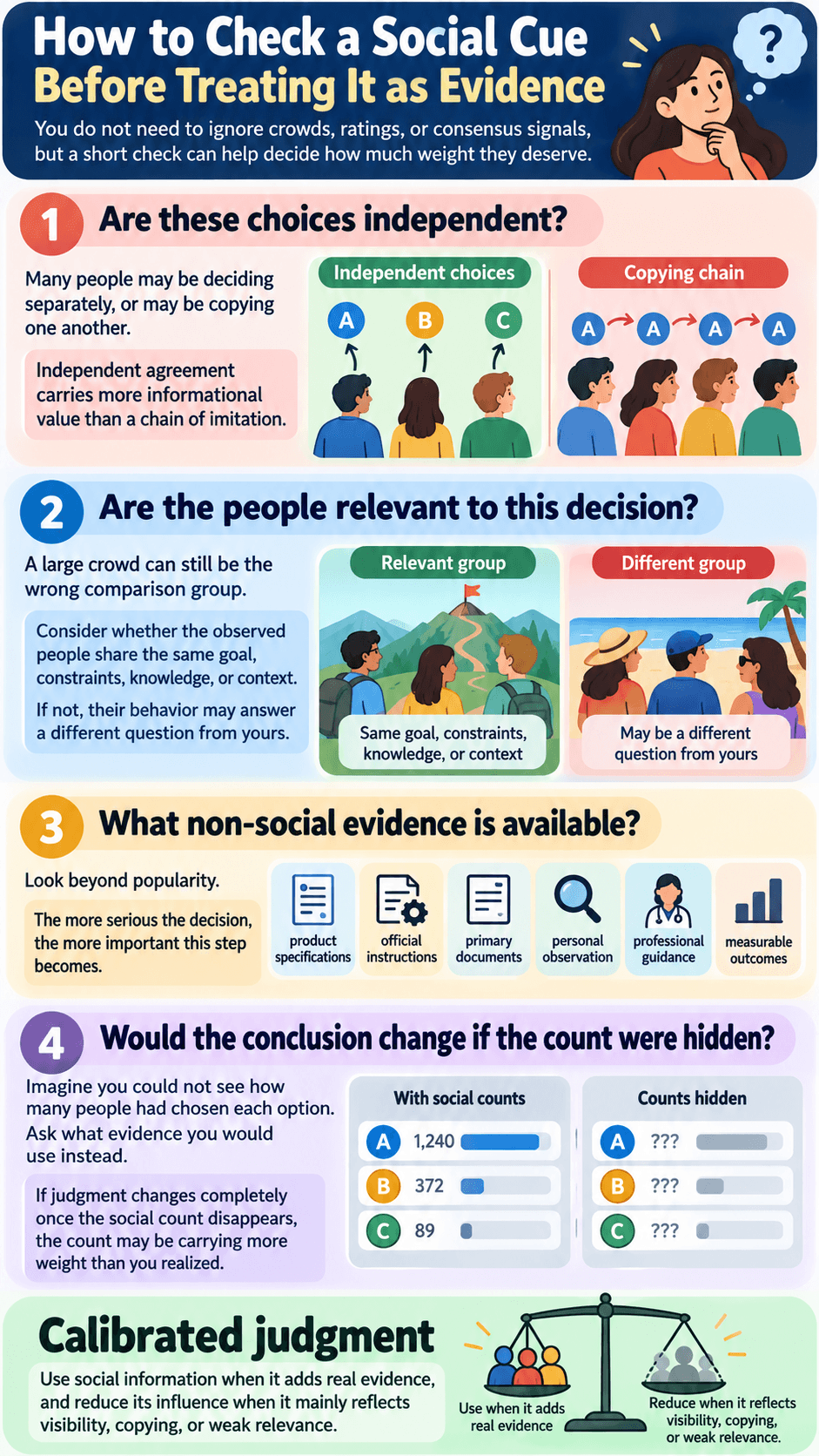
You do not need to ignore crowds, ratings, or consensus signals. A short check can help you decide how much weight they deserve.
Are these choices independent?
Ask whether many people appear to have reached the behavior separately or whether they could be copying one another. Independent agreement carries more informational value than a chain of imitation.
Are the people relevant to this decision?
A large crowd can still be the wrong comparison group. Consider whether the people observed share the same goal, constraints, knowledge, or context. If not, their behavior may answer a different question from yours.
What non-social evidence is available?
Look for direct evidence that does not depend on popularity. This might include product specifications, official instructions, primary documents, personal observation, professional guidance, or measurable outcomes. The more serious the decision, the more important this step becomes.
Would the conclusion change if the count were hidden?
This is a useful self-check for ratings, likes, rankings, and crowd size. Imagine you could not see how many people had chosen each option. What evidence would you use instead? If your judgment changes completely once the social count disappears, the count may be carrying more weight than you realized.
The goal is not independence for its own sake. It is calibrated judgment: use social information when it adds real evidence, and reduce its influence when it mainly reflects visibility, copying, or weak relevance.
FAQ
Is social proof the same as conformity?
No. Social proof focuses on treating other people’s behavior as information. Conformity focuses on shifting behavior, judgment, or expressed response toward a group position or norm. Social proof can contribute to conformity, especially under uncertainty, but the two concepts describe different parts of the process.
How is social proof different from a group norm?
Social proof asks what other people are doing and what that behavior might indicate. A group norm concerns shared expectations about what is appropriate, typical, or expected. Observed behavior can help people infer a norm, but common behavior and shared expectation are not automatically the same thing.
Why does uncertainty make social proof stronger?
When direct evidence is weak or ambiguous, people have more reason to look outside themselves for information. Other people’s behavior then becomes one available clue. The effect is not automatic, and it depends on whether observers see the other people as relevant, informed, and worth learning from.
Are ratings and popularity reliable social proof?
They can be useful signals, especially when many independent observations point in the same direction. They become less reliable when later ratings are influenced by earlier ones, when the sample is unrepresentative, when visibility drives attention, or when the crowd’s needs differ from yours. Popularity is evidence about uptake, not a guarantee of quality.
Can social proof be wrong even when most people agree?
Yes. A majority can share the same misinformation, copy an early trend, respond to the same misleading signal, or publicly follow behavior that many privately question. Consensus deserves attention, but its value depends on how the consensus formed and what independent evidence supports it.
Key Takeaways
- Social proof is best understood as using other people’s visible behavior as information, especially when a situation is uncertain.
- Other people’s behavior is a cue, not proof that a choice is true, safe, high quality, or right for you.
- Social proof differs from conformity, which focuses on movement toward a group position, and from group norms, which concern shared expectations.
- Consensus is more informative when choices are independent, relevant to the situation, and supported by non-social evidence.
- Popularity can become self-reinforcing when people copy earlier choices, making later counts look more informative than they really are.
- A practical check is to ask what you would conclude if the crowd, rating, or popularity number were hidden.

Michael Reed is the Founder and Lead Writer at Psychology Exposed. He writes about human behavior, relationships, emotional patterns, self-awareness, and practical psychology topics using research-informed, easy-to-understand content.
Read More About Michael Reed: https://psychologyexposed.com/michael-reed/