

A doctor tells a patient to stop eating before a procedure. A flight attendant gives evacuation instructions. A supervisor tells an employee to follow a safety protocol. In each case, the words carry weight partly because they come from someone seen as having a recognized role and some right to direct behavior in that setting.
Obedience psychology asks what happens next. Does the person follow the directive, question it, refuse it, or look to others before deciding? The topic is often associated with Stanley Milgram’s famous experiments, but obedience is broader than one study and more complicated than the idea of people becoming mindless in front of authority. Context, legitimacy, responsibility, social support, identification, and the meaning people give to the situation can all matter.
Understanding obedience does not mean excusing harmful conduct. Psychological explanation describes how influence may operate; it does not turn an unsafe, illegal, abusive, or unethical directive into an acceptable one.
Quick Answer
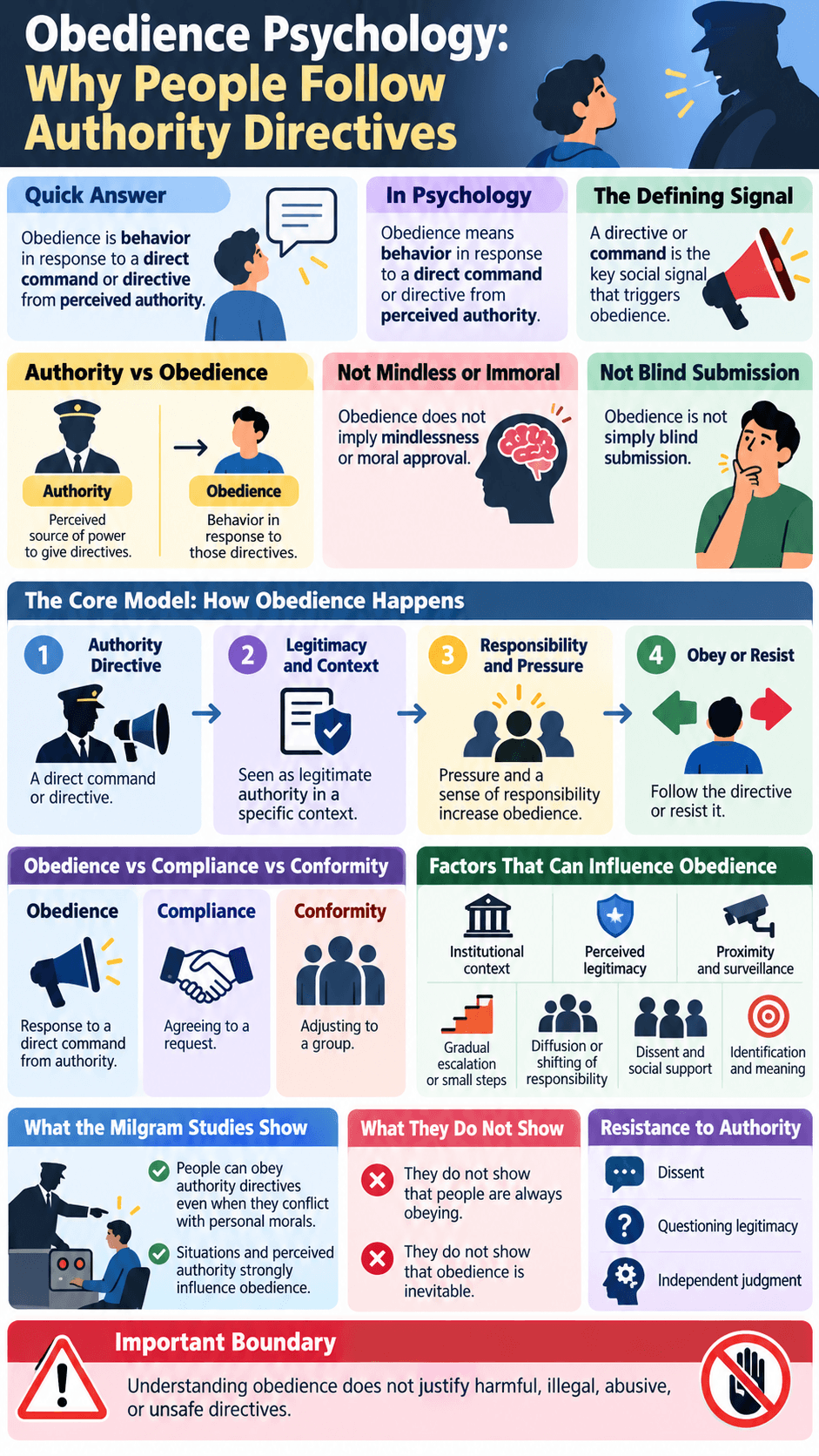
Obedience in psychology refers to behavior carried out in response to a direct command or directive, usually from someone perceived as having authority. People may obey because the authority seems legitimate, the setting supports the authority’s role, responsibility feels shifted upward, or resistance feels socially difficult. Obedience is not the same as conformity, ordinary request compliance, or unquestioning moral approval.
What Obedience Means in Psychology
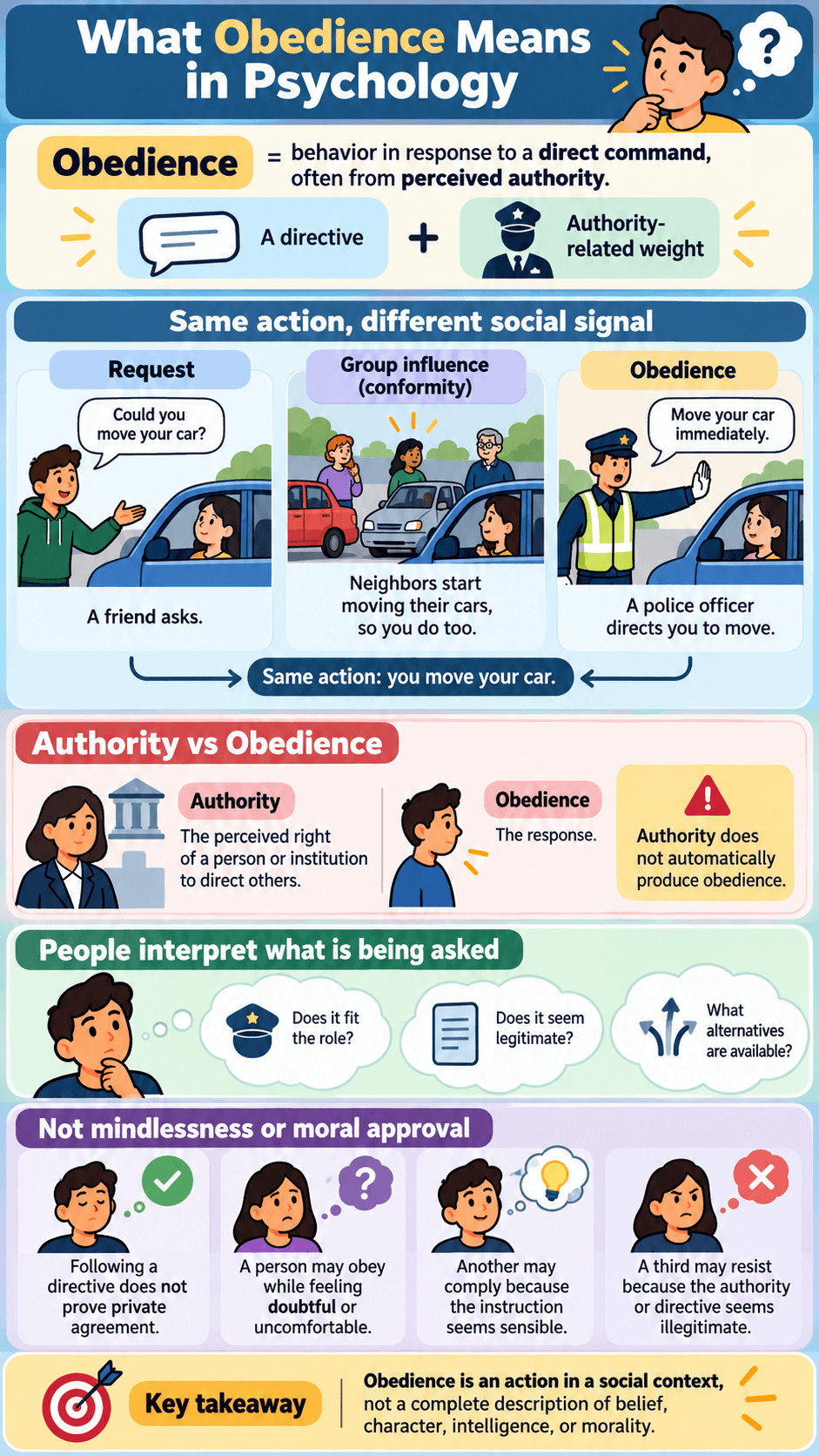
The APA Dictionary of Psychology defines obedience as behavior in compliance with a direct command, often one issued by a person in a position of authority. That definition points to two features that help separate obedience from nearby forms of social influence: there is a directive, and the directive carries authority-related weight.
Directive or command as the defining social signal
Imagine three versions of the same action. A friend says, “Could you move your car?” A group of neighbors starts moving their cars, so you do too. A police officer directing traffic tells you to move your car immediately. The behavior may look identical, but the social signal is different in each case.
The first situation is a request. The second involves group information or conformity pressure. The third is closer to obedience because the behavior follows a directive from a recognized authority role. Keeping the signal clear matters because different psychological processes can produce the same outward action.
Behavioral response rather than a property of the authority
Authority describes something about the social relationship or the perceived right of a person or institution to direct others. Obedience describes the response. A judge may possess legal authority whether or not a particular person follows an order. A manager may hold formal authority even when an employee refuses a directive.
This distinction also prevents a common mistake: assuming that stronger authority automatically produces obedience. Authority may create pressure or expectations, but people still interpret what is being asked, whether it fits the role, whether it seems legitimate, and what alternatives are available.
Obedience does not imply mindlessness or moral approval
Following a directive does not prove that the person agrees with it privately. Someone may obey while feeling doubtful, uncomfortable, or opposed. Another person may comply because they believe the instruction is sensible. A third may resist because they judge the authority or directive to be illegitimate.
Observed behavior therefore tells only part of the story. Obedience is an action in a social context, not a complete description of belief, character, intelligence, or morality.
Core Model: Authority Directive → Legitimacy and Context → Responsibility and Pressure → Obey or Resist
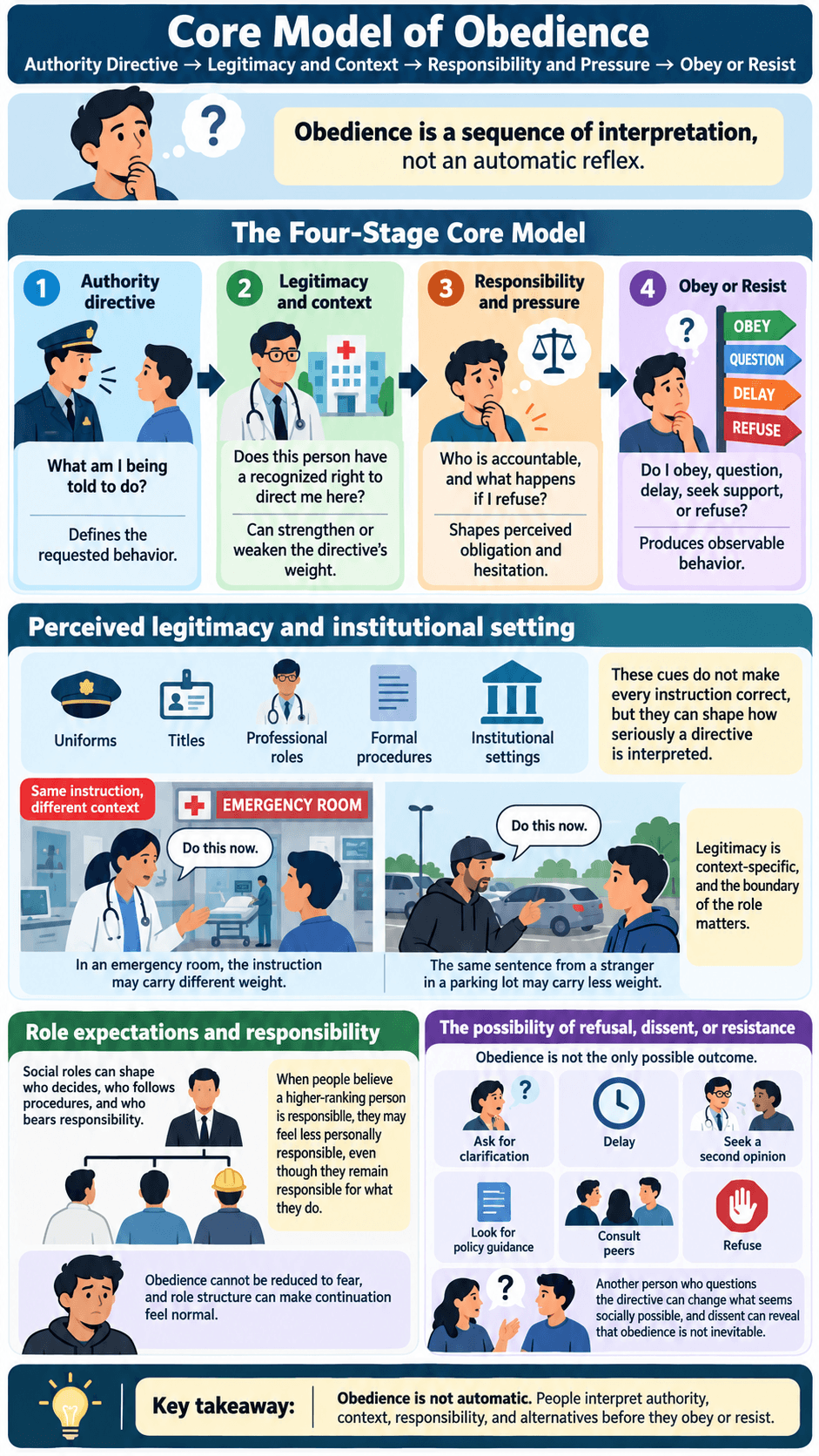
A useful way to understand obedience is as a sequence of interpretation rather than an automatic reflex. The directive arrives first. The person then evaluates who is giving it, what role that person occupies, what the setting implies, who is responsible for the consequences, and whether refusal feels possible.
| Stage | Question the person may be answering | Possible effect |
|---|---|---|
| Authority directive | What am I being told to do? | Defines the requested behavior |
| Legitimacy and context | Does this person have a recognized right to direct me here? | Can strengthen or weaken the directive’s weight |
| Responsibility and pressure | Who is accountable, and what happens if I refuse? | Shapes perceived obligation and hesitation |
| Response | Do I obey, question, delay, seek support, or refuse? | Produces observable behavior |
Perceived legitimacy and institutional setting
Uniforms, titles, professional roles, formal procedures, and institutional settings can all signal that a person has a recognized function. Those cues do not make every instruction correct, but they can shape how seriously a directive is interpreted. An instruction in an emergency room may carry different weight from the same sentence spoken by a stranger in a parking lot.
Legitimacy is also context-specific. A surgeon may have strong authority over a medical procedure but no special authority over a patient’s unrelated financial choices. The boundary of the role matters.
Role expectations and responsibility
Social roles often include expectations about who decides, who follows procedures, and who bears responsibility. When people believe a higher-ranking person is responsible for the decision, they may feel less personally responsible for choosing the action, even though they remain responsible for what they do.
This is one reason obedience cannot be reduced to fear. Sometimes people follow directions because the situation has been organized around a division of roles: one person is expected to decide, another to carry out the instruction. That structure can make continuation feel normal until something disrupts it.
The possibility of refusal, dissent, or resistance
Obedience is not the only possible outcome. People can ask for clarification, delay, seek a second opinion, look for policy guidance, consult peers, or refuse. The presence of another person who questions the directive can change what seems socially possible. Dissent can reveal that obedience is not inevitable and that alternatives exist.
Authority vs Obedience
Authority as source legitimacy or recognized right to direct
Authority concerns the standing of the person or institution giving the instruction. It can come from law, organizational role, expertise, procedure, tradition, or another recognized basis. The important psychological question is whether the authority is perceived as entitled to direct behavior in that situation.
Obedience as the behavioral response to a directive
Obedience begins after a directive is received. The central question is no longer “Why does this person have authority?” but “What does the recipient do with the directive?” The person may obey immediately, comply reluctantly, ask questions, resist, or reject the instruction.
Why the distinction matters
Separating authority from obedience helps explain why the same authority figure can receive different responses from different people or in different situations. It also helps explain why people sometimes obey one directive from an authority but refuse another. The social role may stay the same while the perceived legitimacy, consequences, or meaning of the specific instruction changes.
Obedience vs Compliance vs Conformity

These terms overlap in everyday speech, but they point to different influence signals in psychology.
| Process | Main social signal | Core question | Private agreement required? |
|---|---|---|---|
| Obedience | Authority directive | Will I follow this directive? | No |
| Compliance | Request | Will I do what this person asks? | No |
| Conformity | Group position, norm, or majority | Will I move toward what the group is doing or expressing? | No |
Request versus command or directive
A request leaves the relationship framed more clearly around asking and choosing. An authority directive carries an expectation linked to role or recognized power. Real language is not always neat, so tone alone is not enough. “Please complete this form now” could be a polite request from a friend or an official directive from a border officer, depending on context.
Vertical authority influence versus movement toward a peer or group norm
Obedience is often described as more vertical because the influence comes from an authority relationship. Conformity is usually more horizontal because the influence comes from peers, a majority, or a group norm. That is a useful distinction, but real settings can contain both at once.
Why real situations can contain more than one influence source
An employee may follow a supervisor’s directive partly because of formal authority and partly because every coworker appears to accept it. A student may follow a teacher’s instruction while also taking cues from classmates. When several pressures point in the same direction, it can be hard to tell which one mattered most from behavior alone.
What Can Increase or Reduce Obedience?
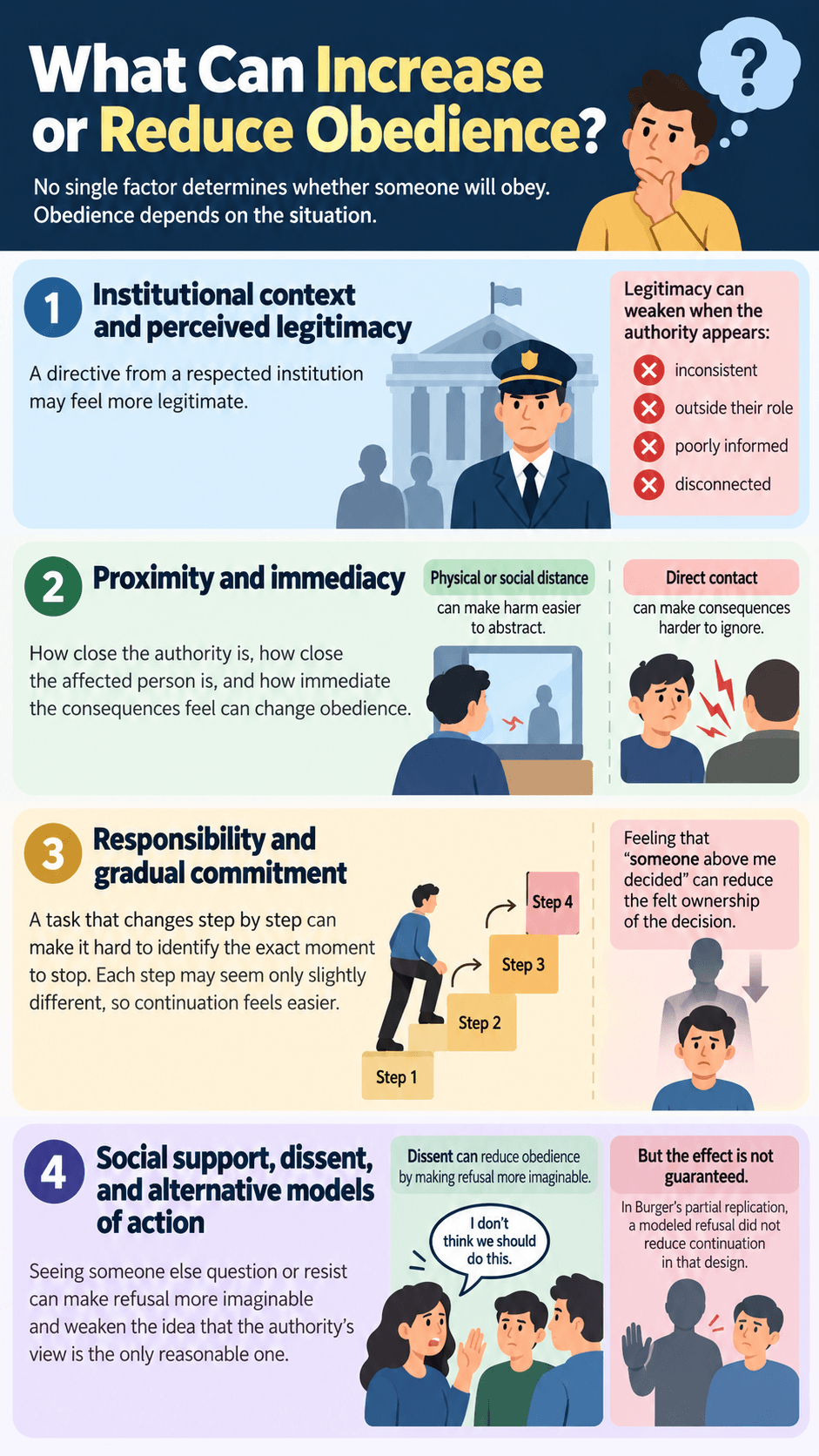
No single factor determines whether someone will obey. Classic experiments are useful partly because changing features of the situation produced different patterns of behavior. Those findings should be read as evidence about conditions, not as a formula for predicting a particular person.
Institutional context and perceived legitimacy
A directive embedded in a respected institution may feel more legitimate than the same instruction from an unfamiliar or questionable setting. Legitimacy can weaken when the authority appears inconsistent, outside their role, poorly informed, or disconnected from the institution that gives the role meaning.
Proximity and immediacy
How close the authority is, how close the affected person is, and how immediate the consequences feel may change the psychological situation. Physical or social distance can make harm easier to abstract, while direct contact can make consequences harder to ignore. Milgram varied several features of his experimental setup precisely because obedience was expected to depend on the situation, not simply on personality.
Responsibility and gradual commitment
People may find it difficult to identify the exact moment when they should stop if a task changes step by step. Each individual step can appear only slightly different from the one before it. Gradual escalation can therefore matter because the decision is experienced as a series of continuations rather than one dramatic choice.
At the same time, feeling that “someone above me decided” can reduce the felt ownership of the decision. That does not remove actual responsibility. It describes a psychological interpretation that may make continuation easier.
Social support, dissent, and alternative models of action
Seeing someone else question or resist can make refusal more imaginable. Dissent may also weaken the impression that the authority’s interpretation is the only reasonable one. This is especially important because people often use other people’s reactions to judge whether a situation is normal, risky, or contestable.
However, the effect of dissent is not mechanically guaranteed. Burger’s partial replication, discussed in the American Psychologist special issue on obedience, found that a modeled refusal did not reduce continuation in that particular design. The broader lesson is that social support can matter, but its effect depends on how the support is presented and interpreted.
What the Milgram Studies Show and Do Not Show

The historical research question and procedure at a high level
In the early 1960s, Stanley Milgram studied how far participants would continue following an experimenter’s instructions in a learning task that appeared to involve administering increasingly strong electric shocks to another person. The shocks were not real, but participants were led to believe the setup was genuine. In the best-known condition, a substantial proportion continued to the highest labeled level.
The APA overview of the behavioral study of obedience summarizes the basic procedure and the striking continuation rate that made the research famous. The enduring value of the studies is not that they reveal an unchangeable human tendency. It is that they made situational influence impossible to ignore.
Ethical and methodological context
The studies also became central to debates about research ethics. Participants experienced an intense deception about the learner’s suffering, and the procedure created significant tension for some of them. Modern research standards require much stronger protections around informed consent, withdrawal, risk, and debriefing than were typical when the original work was conducted.
Those ethical constraints are one reason exact replications are difficult. Researchers studying obedience today often use partial procedures, archival analysis, simulations, or other methods that reduce risk.
Why the findings do not prove that anyone will obey anything
“People obey authority” is too broad a conclusion. Milgram ran multiple conditions, and behavior varied across them. Participants hesitated, protested, argued, stopped, or continued at different points. The authority’s proximity, the learner’s proximity, the setting, and the behavior of peers were among the factors that changed the situation.
More importantly, no laboratory experiment can establish that any person will follow any directive from any authority in any setting. The studies demonstrate the power of situational arrangements under specific conditions, not a universal law of submission.
Modern reanalyses, interpretation debates, and partial replication evidence
Jerry Burger designed a partial replication that stopped at 150 volts and added screening and safeguards. His results suggested substantial continuation was still possible, but the design intentionally differed from Milgram’s full procedure. The Burger partial replication is therefore useful evidence, not a simple one-to-one replay of the original study.
Other researchers have challenged the familiar “blind obedience” interpretation. Haslam and Reicher argued that participants may sometimes continue because they identify with the experimenter’s scientific purpose rather than because they passively switch off their judgment. Their reanalysis of classic obedience and conformity research emphasizes conditional identification with authorities and shared goals.
A later immersive study by Haslam, Reicher, and Millard also found patterns consistent with the idea that identification and interpretation matter. In that work, the most command-like prod was especially ineffective, which complicates the simple story that stronger orders automatically create more obedience. The PLOS ONE study supports a more active picture of participants evaluating whom and what they are following.
Why Obedience Is Not Simply Blind Submission
Participants interpret the situation and the authority relationship
People do not encounter authority as empty labels. They ask, sometimes consciously and sometimes quickly, what the authority represents. Is the doctor protecting health? Is the firefighter managing an emergency? Is the experimenter conducting legitimate science? Is the supervisor acting within policy or asking for something outside the role?
These interpretations can support obedience, but they can also undermine it. A directive that appears inconsistent with the authority’s legitimate purpose may trigger questioning rather than automatic following.
Identification, legitimacy, and meaning can matter
One modern view proposes that people may follow an authority when they identify with the mission, group, or purpose that the authority represents. This shifts the explanation from “the person stopped thinking” to “the person accepted a particular meaning of the situation.”
That interpretation does not make harmful obedience harmless. It simply changes the psychological question. Instead of asking only how authority suppresses judgment, researchers can also ask how authorities gain commitment to a cause and how alternative identifications make resistance more likely.
Group-level findings do not predict a specific individual
Experimental averages describe patterns across participants. They cannot tell you with certainty how a particular person will behave in a real emergency, workplace, family, military, medical, or legal setting. Personal values, prior experience, culture, relationships, knowledge, institutional trust, perceived risk, and available support may all change the response.
This is why statements such as “you would have obeyed too” go beyond what the evidence can establish.
Resistance to Authority
Dissent and social support
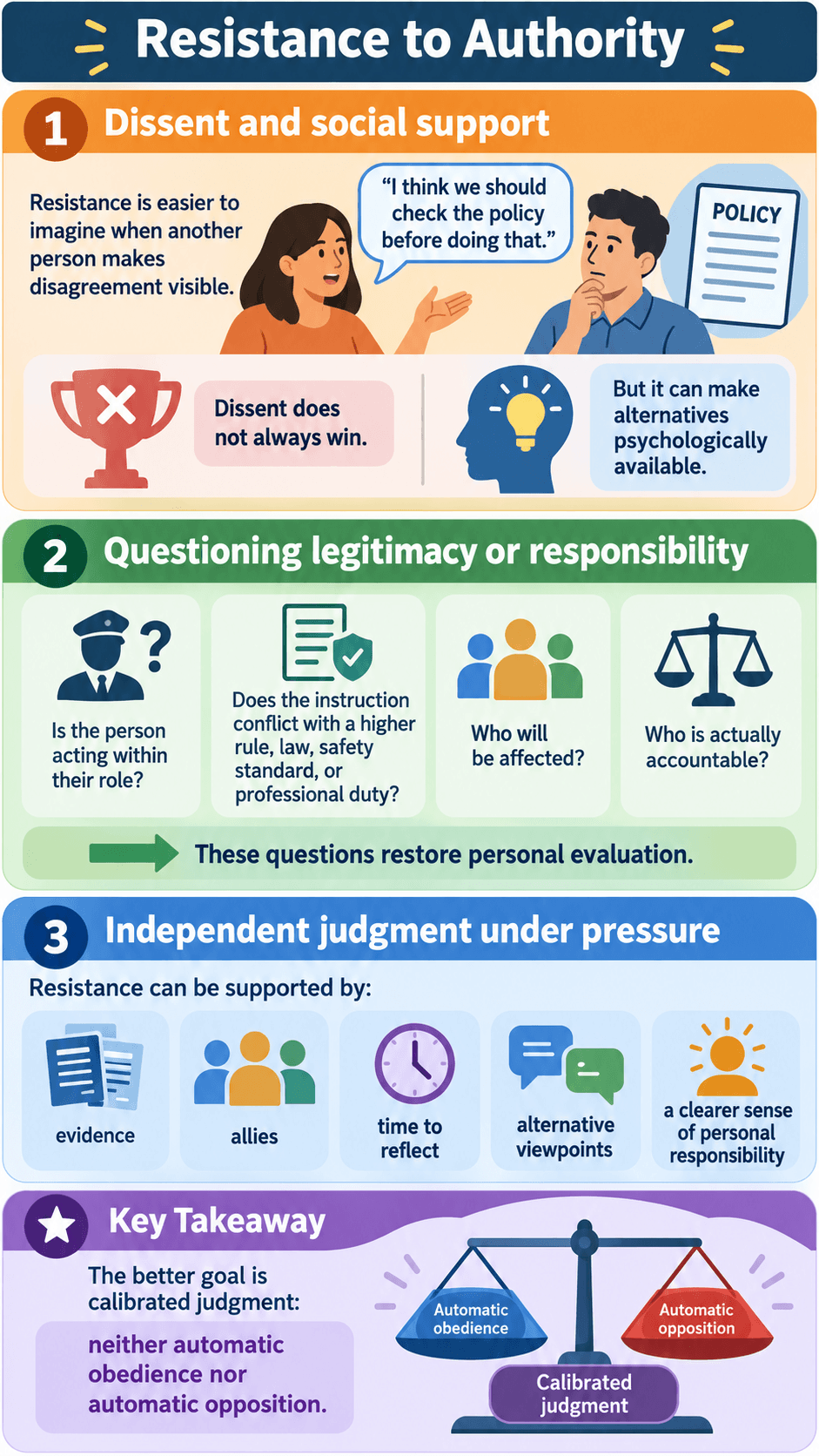
Resistance is easier to imagine when another person makes disagreement visible. A colleague who says, “I think we should check the policy before doing that,” can change the social landscape even before anyone else refuses. The point is not that dissent always wins. It is that it can make alternatives psychologically available.
Questioning legitimacy or responsibility
A person may also resist by examining the authority relationship itself. Is the person giving the directive acting within their role? Does the instruction conflict with a higher rule, law, safety standard, or professional duty? Who will be affected? Who is actually accountable?
These questions restore personal evaluation to a situation that may otherwise feel organized around simply carrying out instructions.
Independent judgment under pressure
Resistance to authority is part of a wider question about resisting social influence. It can be supported by evidence, allies, time to reflect, alternative viewpoints, and a clearer sense of personal responsibility. But resistance is not automatically wise simply because it is resistance. Authorities can possess real expertise, and many directives are useful or necessary.
The better goal is calibrated judgment: neither automatic obedience nor automatic opposition.
Harmful or Unsafe Directives Are a Separate Safety Question
Psychological explanation is not moral or legal justification
Knowing that authority pressure can shape behavior may help explain why people sometimes continue in troubling situations. It does not excuse harm or settle questions of legal responsibility. Psychology can describe pressures without deciding what a person was ethically or legally permitted to do.
Do not treat unsafe, illegal, abusive, or harmful directives as normal obligations
If a directive involves violence, threats, abuse, fraud, serious safety risks, illegal conduct, or retaliation for refusal, ordinary advice about “being cooperative” is not enough. The relevant next step may be to seek qualified legal, workplace, medical, safeguarding, or emergency guidance appropriate to the situation.
Likewise, a person should not be told that obedience is “normal” as a reason to follow an obviously harmful command. Understanding a psychological tendency is different from endorsing the behavior it may help explain.
FAQ
What is the difference between authority and obedience?
Authority refers to a person’s or institution’s recognized right, legitimacy, or role-based power to direct behavior. Obedience refers to what the recipient does in response to a directive. An authority can issue an instruction without being obeyed, and a person can evaluate different directives from the same authority differently.
How is obedience different from compliance?
Compliance usually centers on a request, while obedience centers on a command or directive linked to authority. The wording may sometimes sound similarly polite, so the relationship and context matter more than whether the sentence contains “please.” Neither process automatically means that private beliefs changed.
Did Milgram prove that most people will obey any authority?
No. Milgram demonstrated that many participants continued surprisingly far under particular experimental conditions, and the results varied across conditions. Later research and reanalysis also show that legitimacy, identification, context, interpretation, and the exact form of the authority’s pressure matter. The studies do not predict that any individual will obey any authority in any real-world situation.
Can dissent reduce obedience?
Dissent can make resistance more socially imaginable and can weaken the impression that everyone accepts the authority’s interpretation. Classic research suggests peer behavior can matter, although later studies show that the effect depends on the design and the meaning participants give to the dissent. It is better understood as one possible influence on resistance than as a guaranteed antidote.
Does refusing an authority directive always mean psychological reactance?
No. Reactance specifically involves resistance linked to a perceived threat to freedom. A person may refuse because the instruction appears unsafe, factually wrong, outside the authority’s role, inconsistent with a rule, morally unacceptable, or unsupported by evidence. Not all resistance is reactance.
Key Takeaways
- Obedience is a behavioral response to an authority directive, not the same thing as authority itself.
- Compliance centers on requests, conformity centers on group alignment, and obedience centers on authority-linked directives.
- Legitimacy, institutional context, responsibility, proximity, gradual commitment, dissent, and social support can shape how directives are interpreted.
- Milgram’s research showed powerful situational effects, but it did not prove that everyone will obey any authority or that obedience is mindless.
- Modern interpretations emphasize that people may actively evaluate, identify with, question, or reject what an authority represents.
- Understanding obedience never turns harmful, illegal, abusive, or unsafe directives into acceptable ones.

Michael Reed is the Founder and Lead Writer at Psychology Exposed. He writes about human behavior, relationships, emotional patterns, self-awareness, and practical psychology topics using research-informed, easy-to-understand content.
Read More About Michael Reed: https://psychologyexposed.com/michael-reed/