

A friend asks you to drive them to the airport. A colleague asks you to cover part of a task. A family member asks you to attend an event you would rather skip. None of these requests is a command, and nobody has to agree. Yet saying no can still feel surprisingly difficult.
Compliance psychology examines this kind of response: what happens when one person makes a request and another person decides whether to go along with it. The interesting part is not that people always say yes. They do not. The useful question is how the request, the relationship, the perceived cost, social expectations, and the person’s own priorities combine to make agreement or refusal more likely.
This is different from changing your behavior to match a group, following an authority directive, or changing a belief because of a persuasive message. It is also different from behavior produced by threats or severe control. Keeping those boundaries clear makes everyday agreement easier to understand without treating every social influence as manipulation.
Quick Answer
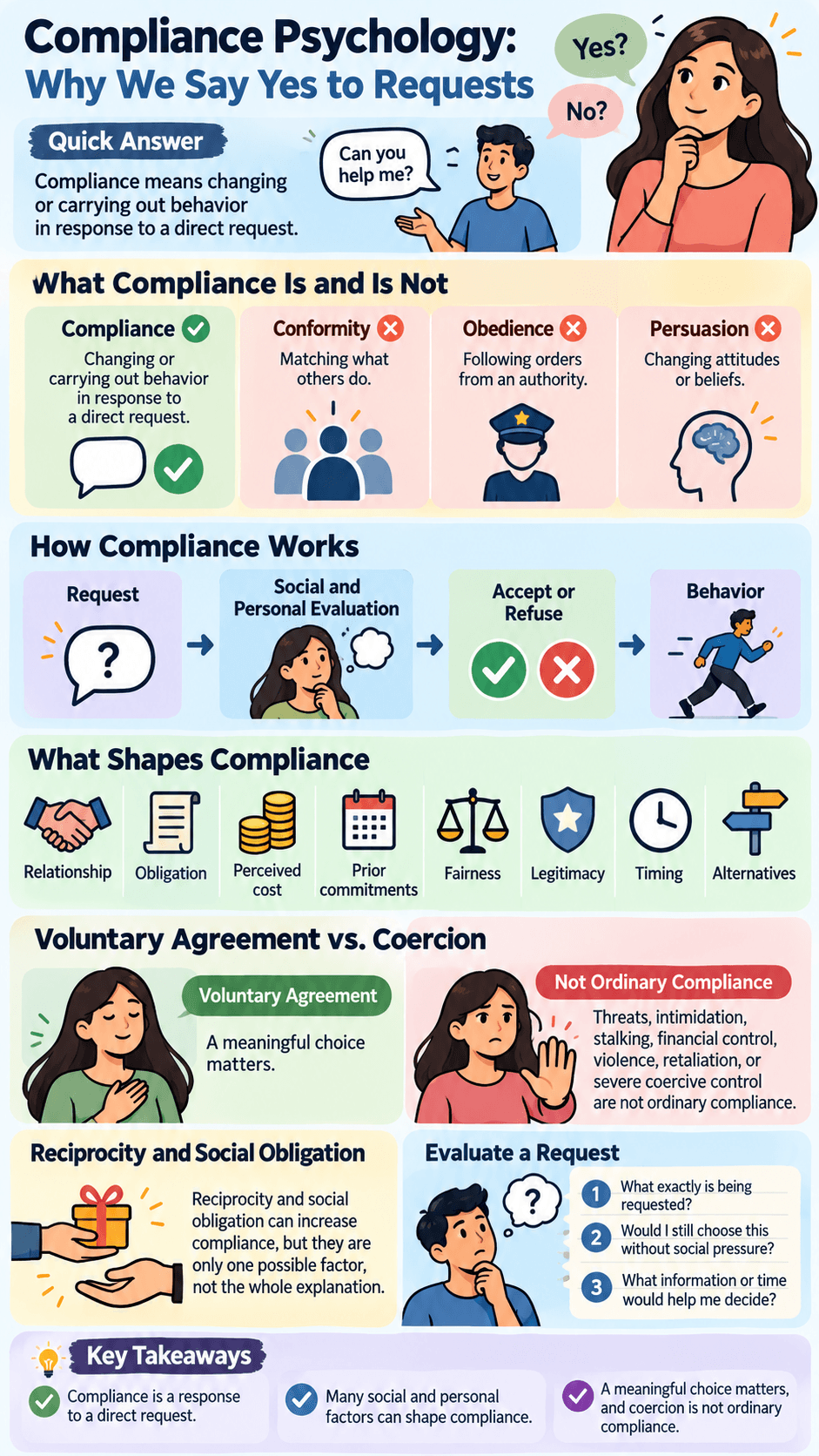
Compliance in psychology usually refers to changing or carrying out behavior in response to a direct request. A person may comply because the request seems reasonable, the relationship matters, social obligation is activated, the cost feels manageable, or prior commitments shape the decision. Compliance describes behavior, not necessarily private agreement. If meaningful choice is removed through threats, intimidation, or coercive control, ordinary request compliance is no longer the best frame.
Compliance Means Responding to a Request
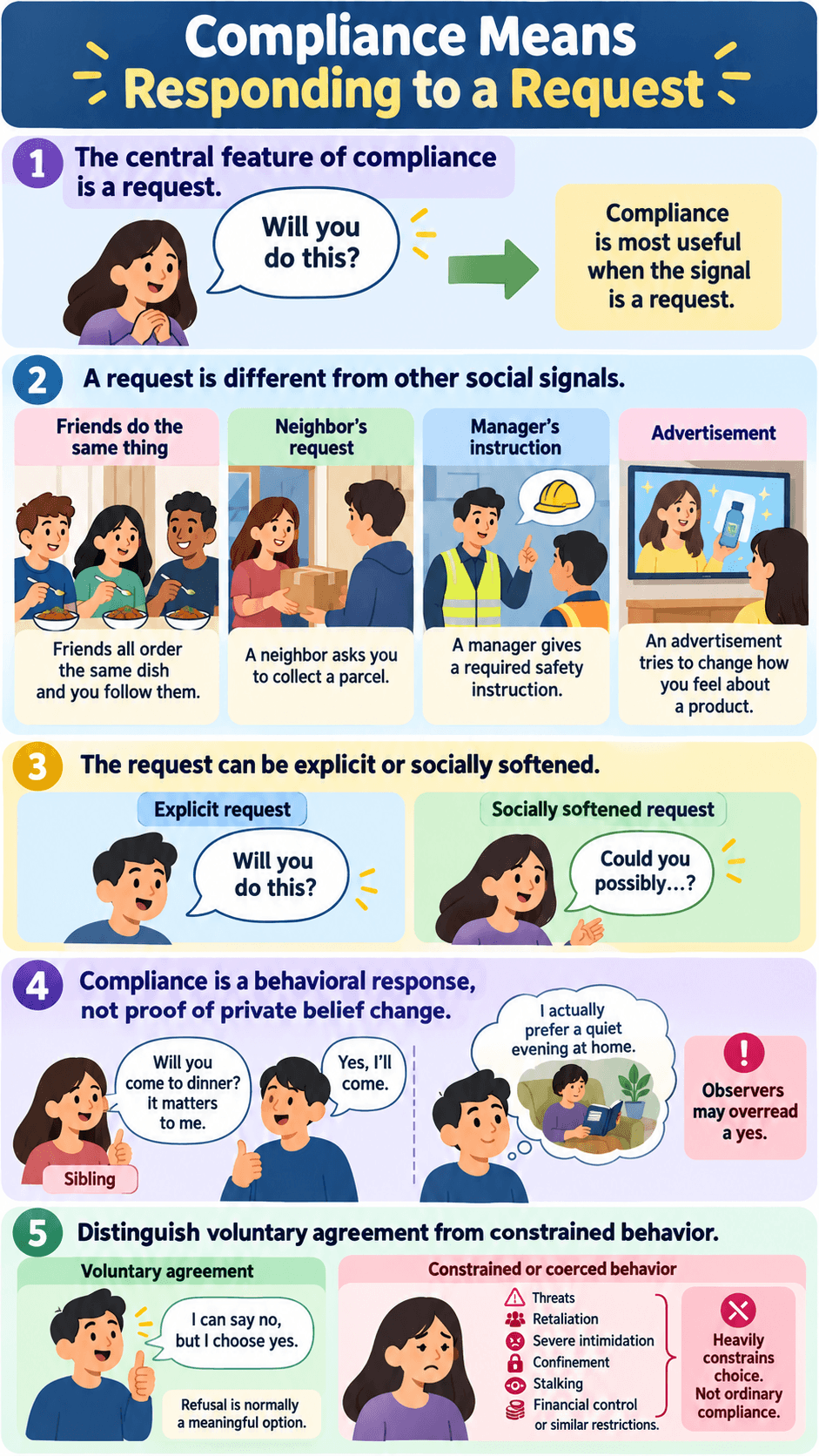
The central feature of compliance is a request. The APA Dictionary of Psychology entry on compliance provides the formal terminology, while broader social influence research distinguishes request-based compliance from other ways people respond to social pressure.
A request is different from a group norm or authority command
Imagine four situations. Your friends all order the same dish, and you follow them. Your neighbor asks you to collect a parcel. Your manager gives you a required safety instruction. An advertisement tries to change how you feel about a product. Those situations may all involve influence, but the social signal is different in each one.
Compliance is most useful when the signal is, “Will you do this?” The request can be explicit, such as asking for help moving furniture, or socially softened, such as asking whether you might have time to review a document. What makes it compliance is not how polite the wording sounds. It is that another person is asking for a behavioral response rather than merely representing a group norm or issuing a recognized directive.
Compliance is behavioral agreement, not proof of private belief change
If you agree to attend a dinner because it matters to your sibling, your behavior has changed in response to the request. That does not mean your private preference changed. You can still wish you had a quiet evening at home.
This distinction matters because observers often overread a yes. They may assume agreement proves enthusiasm, endorsement, or a changed attitude. In reality, people sometimes accept requests for practical or relational reasons. The behavior may be genuine and voluntary even when the person’s inner preference stays the same.
Voluntary agreement versus constrained or coerced behavior
A request normally leaves refusal as a meaningful option, even if saying no feels awkward. Once threats, retaliation, severe intimidation, confinement, stalking, financial control, or similar restrictions enter the picture, choice can become heavily constrained. At that point, describing the response as ordinary compliance risks hiding the power imbalance.
The distinction is not about whether the person looked calm or verbally said yes. It is about whether refusal was realistically available without serious consequences imposed by the other person.
Core Model: Request → Social and Personal Evaluation → Accept or Refuse → Behavior
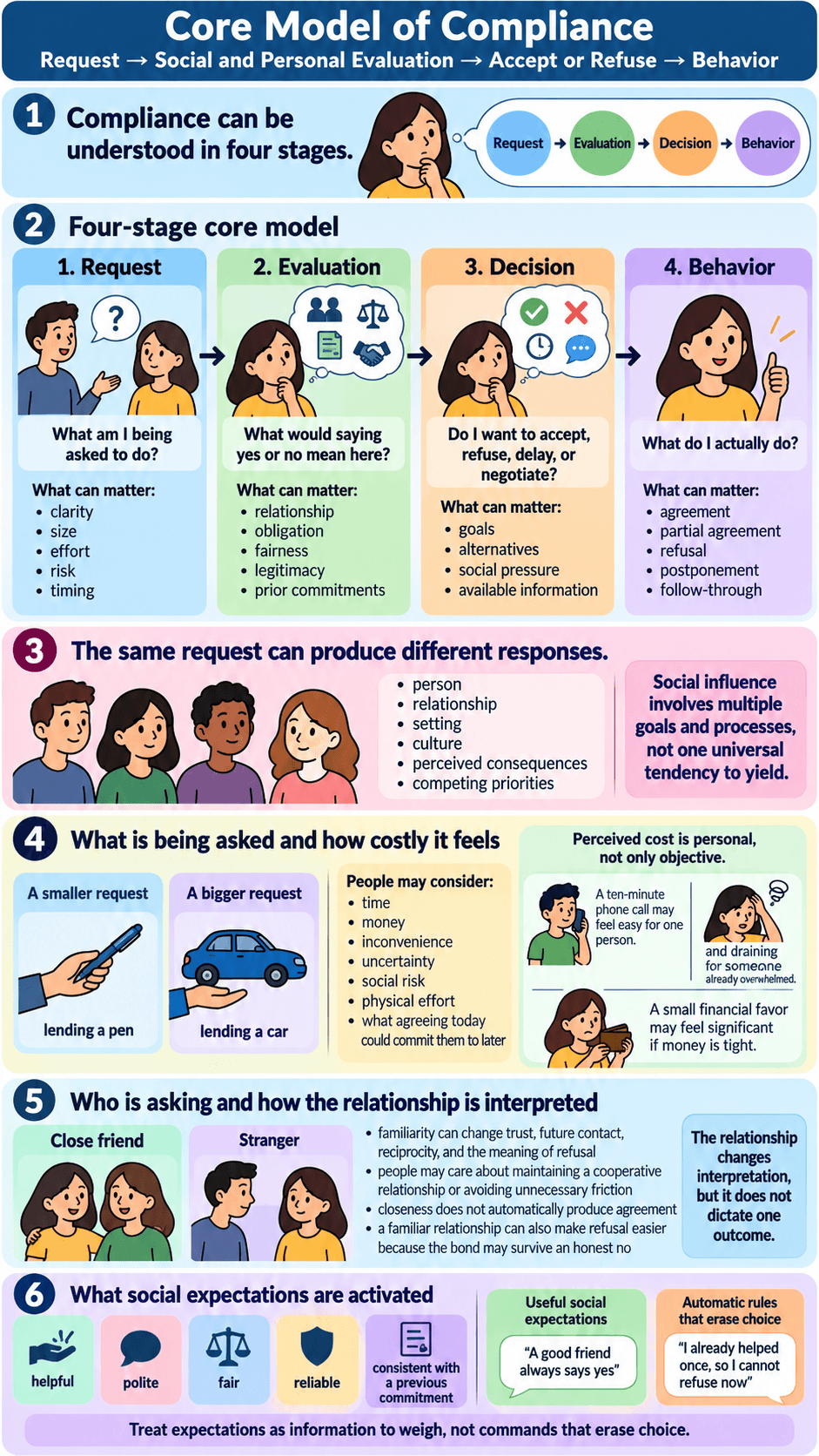
A practical way to understand compliance is to separate the moment into four stages. First, a request is made. Second, the person evaluates both the request and the social situation around it. Third, they decide whether to accept, refuse, delay, negotiate, or ask for more information. Finally, behavior follows.
| Stage | Question the person may be weighing | What can matter |
|---|---|---|
| Request | What am I being asked to do? | Clarity, size, effort, risk, timing |
| Evaluation | What would saying yes or no mean here? | Relationship, obligation, fairness, legitimacy, prior commitments |
| Decision | Do I want to accept, refuse, delay, or negotiate? | Goals, alternatives, social pressure, available information |
| Behavior | What do I actually do? | Agreement, partial agreement, refusal, postponement, follow-through |
This model avoids the idea that one hidden trigger “causes” compliance. The same request can produce different responses depending on the person, relationship, setting, culture, perceived consequences, and competing priorities. A major review in the Annual Review of Psychology likewise describes social influence as involving multiple goals and processes rather than one universal tendency to yield.
What is being asked and how costly it feels
Requests differ enormously. Lending a pen and lending a car are both favors, but they involve different costs. People may consider time, money, inconvenience, uncertainty, social risk, physical effort, and what agreeing today could commit them to later.
Perceived cost is personal, not only objective. A ten-minute phone call may feel easy for one person and draining for someone who is already overwhelmed. A small financial favor may feel significant if money is tight. Understanding compliance therefore requires attention to the person’s actual situation rather than assuming the request is “small” because it appears small from the outside.
Who is asking and how the relationship is interpreted
A request from a close friend is not evaluated in the same way as the same request from a stranger. Familiarity can change expectations about trust, future contact, reciprocity, and the meaning of refusal. People may also care about maintaining a cooperative relationship or avoiding unnecessary friction.
That does not mean closeness automatically produces agreement. A familiar relationship can also make refusal easier because the person expects the bond to survive an honest no. The relationship changes the interpretation of the request, but it does not dictate one outcome.
What social expectations are activated
Requests can activate everyday expectations such as being helpful, polite, fair, reliable, or consistent with a previous commitment. These expectations are often useful. Social life would be difficult if every request had to be evaluated as though it came from a complete stranger with no shared history.
Problems arise when an expectation is treated as an automatic rule. “A good friend always says yes” or “I already helped once, so I cannot refuse now” turns a social consideration into a demand. A more deliberate response treats expectations as information to weigh, not commands that erase choice.
Why a Request Can Become Easier or Harder to Accept

Compliance is shaped by the interaction between the request and the person receiving it. Research has examined many variables, but they should not be read as buttons that reliably produce a yes. Effects vary with context, interpretation, population, and procedure.
Politeness and social obligation
Politeness can make agreement feel easier because many people value smooth social interaction. Refusal may require an explanation, create momentary discomfort, or risk being interpreted as unhelpful. Sometimes the easiest short-term route is to agree.
But politeness does not cause compliance in a simple mechanical way. The same person who accepts one favor may refuse another when the cost is too high, the timing is poor, or the request feels unfair. Social obligation is one input among several.
Commitment and consistency at an overview level
People often prefer their later behavior to make sense alongside earlier choices. Classic request-compliance research explored how agreeing to an initial action could sometimes affect willingness to agree to a later one. The well-known 1966 study by Jonathan Freedman and Scott Fraser is indexed by PubMed as early request-compliance research.
The responsible takeaway is not that a first yes guarantees a second yes. It does not. The historical work helped establish questions about commitment, self-perception, and behavioral consistency, and later research has examined when such effects do and do not appear. For everyday decisions, prior agreement is something to notice, not a reason to ignore new information or changing circumstances.
Liking, familiarity, legitimacy, and perceived cost
We tend to evaluate requests partly through the person making them. Familiarity may reduce uncertainty. Liking may increase willingness to help. A source that seems legitimate in a particular context may make the request seem more reasonable. At the same time, a high cost can outweigh all of those factors.
These influences can also conflict. You may like the person but dislike the request. You may recognize someone’s expertise yet still decide that the favor falls outside their role. You may feel obligated but also know that agreeing would break an important commitment elsewhere. Compliance psychology is often about how competing considerations are integrated, not about finding one dominant motive.
Request size, timing, and context without turning them into tactics
The size of a request matters because larger demands usually require more justification, resources, or trust. Timing matters because people make decisions under different levels of fatigue, time pressure, and competing attention. Context matters because a request that seems ordinary in one relationship may feel inappropriate in another.
A useful modern review is the Oxford Handbook chapter on compliance, which describes compliance as behavior change in response to a direct request and reviews multiple mechanisms studied in the field. For a general reader, the important point is descriptive: requests are interpreted within a social setting. That is different from using the findings as a playbook for pressuring people.
Compliance vs Conformity vs Obedience vs Persuasion
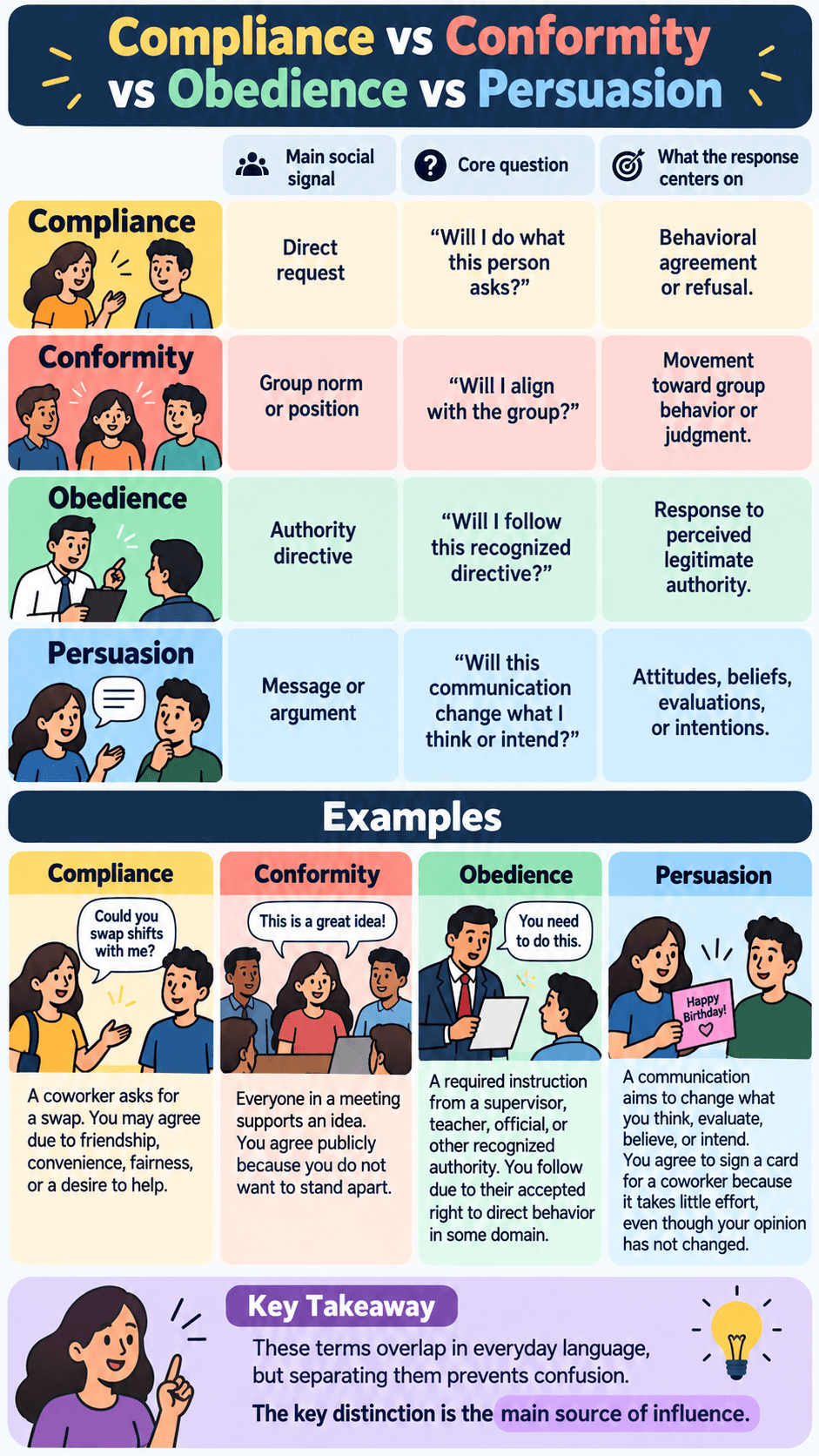
These terms overlap in everyday language, but separating them prevents a great deal of confusion.
| Process | Main social signal | Core question | What the response centers on |
|---|---|---|---|
| Compliance | Direct request | Will I do what this person asks? | Behavioral agreement or refusal |
| Conformity | Group norm or position | Will I align with the group? | Movement toward group behavior or judgment |
| Obedience | Authority directive | Will I follow this recognized directive? | Response to perceived legitimate authority |
| Persuasion | Message or argument | Will this communication change what I think or intend? | Attitudes, beliefs, evaluations, or intentions |
Compliance: response to a request
If a coworker asks, “Could you swap shifts with me?” and you agree, request compliance is the clearest frame. Your decision may reflect friendship, convenience, fairness, or a desire to help. None of those possibilities requires a group majority or a command.
Conformity: movement toward a group norm or position
Conformity centers on alignment with a group or perceived norm. If everyone in a meeting supports an idea and you publicly agree because you do not want to stand apart, that is conceptually different from one person asking you to complete a favor.
A request can occur inside a group, so real life is sometimes mixed. The distinction is about the main source of influence. Is the pressure coming from what the group appears to think or do, or from a specific ask directed at you?
Obedience: response to an authority directive
Obedience involves a directive connected to perceived legitimate authority. A required instruction from a supervisor, teacher, official, or other recognized authority is not merely a favor because the social relationship includes an accepted right to direct behavior in some domain.
This does not mean every instruction is valid or should be followed. It means the psychological structure differs from a peer asking for help.
Persuasion: communication aimed at attitudes, beliefs, or intentions
Persuasion focuses on changing how someone thinks, evaluates, believes, or intends to act through communication. Compliance can occur without that internal shift. You might agree to sign a card for a coworker because it takes little effort, even though your opinion of the coworker has not changed at all.
Why Saying Yes Does Not Necessarily Mean Believing
Visible behavior is tempting to treat as a window into private belief. In social situations, that inference is often too strong.
Behavioral agreement with private disagreement
Someone may agree to a request while privately thinking it is inconvenient, unnecessary, or poorly timed. They may judge the relationship benefit to be worth the cost. They may prefer to avoid a long discussion. They may see the request as reasonable even though it is not what they would choose on their own.
None of those explanations makes the agreement fake. It simply shows why behavior and belief should be measured separately.
Request acceptance because of convenience, relationship, or obligation
Consider a person who joins a neighborhood cleanup after being asked by someone they know. They may not have changed their beliefs about community volunteering. They may simply be free that morning, like the requester, and think helping once is a fair contribution.
Another person may accept because they received help from the neighbor last month and want to return the favor. A third may refuse because they already promised that time to family. The same request can produce different choices without any person being irrational.
Public behavior versus private acceptance
Psychology also uses the phrase “public compliance” in a different context, especially when discussing outward alignment under social pressure without corresponding private acceptance. That terminology can be confusing. Request compliance means agreeing to a request. Public compliance describes an outward social response that may not reflect internal belief.
Keeping those meanings separate prevents the mistaken conclusion that every outward yes represents a privately accepted view.
Reciprocity and Other Social Obligations: Bridge, Not a Second Theory
Why receiving a benefit can affect a later request
People often care about balanced exchange. If someone helped you recently, a later request from them may feel different from the same request made by a stranger. You may interpret agreement as fair return, relationship maintenance, or simple gratitude.
That feeling can be socially useful, but it should not erase the right to evaluate the new request on its own merits. A past favor does not automatically create unlimited debt.
Where reciprocity becomes the main question
If the central issue is why receiving a benefit creates pressure to return something, reciprocity is the more precise concept. Compliance remains focused on the request-response event. Reciprocity explains one possible social obligation that can enter the evaluation.
Why reciprocity is not the whole explanation for compliance
Many requests involve no prior favor at all. People may agree because they care about the relationship, believe the request is legitimate, see the cost as low, want to keep a commitment, or simply want to help. Treating reciprocity as the whole story would ignore the range of motives that make request decisions context-sensitive.
When a Request Stops Being Meaningfully Voluntary

Threats, retaliation, severe intimidation, confinement, or coercive control
There is an important boundary between social pressure and restricted choice. If refusing a request is met with threats, stalking, confinement, financial control, violence, or severe retaliation, the person’s apparent agreement may reflect danger management rather than ordinary voluntary compliance.
The National Domestic Violence Hotline’s explanation of power and control describes abuse as a pattern of behaviors used to gain or maintain power and control. That framework is relevant when a relationship contains fear or serious restrictions on choice.
Why coerced behavior should not be framed as ordinary compliance or persuasion
Calling coerced behavior “compliance” can make a harmful situation sound like a normal social decision. It can also shift attention onto why the targeted person said yes rather than onto the conditions that made refusal unsafe.
If fear, violence, stalking, confinement, or retaliation is present, communication tips and better refusal wording are not the priority. Safety and specialized support matter more than analyzing the request as though both people have equal freedom to negotiate.
How to Evaluate a Request More Deliberately
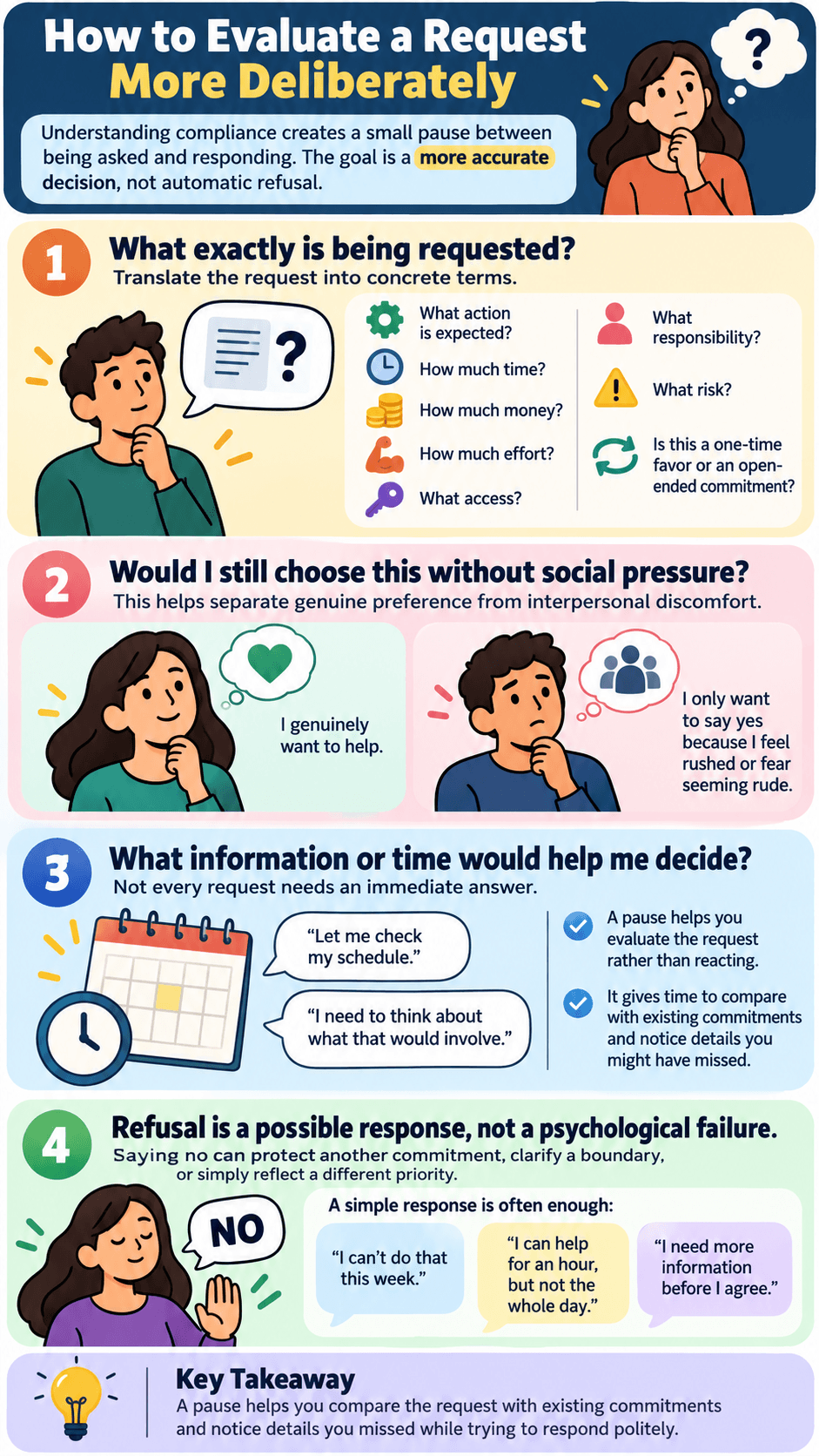
Understanding compliance is useful partly because it creates a small pause between being asked and responding. The goal is not automatic refusal. It is a more accurate decision.
What exactly is being requested?
Translate the request into concrete terms. What action is expected? How much time, money, effort, access, responsibility, or risk does it involve? Is this a one-time favor or an open-ended commitment?
Ambiguous requests are harder to evaluate because the social pressure arrives before the full cost is clear. Asking for specifics is a legitimate part of deciding.
Would I still choose this without social pressure?
This question separates preference from interpersonal discomfort. You may discover that you genuinely want to help but dislike feeling rushed. Or you may realize that the only reason you are leaning toward yes is fear of seeming rude.
Neither answer automatically determines what you should do. It simply identifies what is driving the decision.
What information or time would help me decide?
Not every request needs an immediate answer. “Let me check my schedule” or “I need to think about what that would involve” can create enough distance to evaluate the request rather than reacting to the social moment.
Time is especially useful when the request has consequences you cannot easily reverse. A pause can help you compare the request with existing commitments and notice details you missed while trying to respond politely.
Refusal is a possible response, not a psychological failure
Saying no does not mean you are uncooperative, selfish, or resistant to all social influence. Sometimes refusal protects another commitment, clarifies a boundary, or simply reflects a different priority.
A simple response is often enough: “I can’t do that this week,” “I can help for an hour, but not the whole day,” or “I need more information before I agree.” These are decision statements, not attempts to defeat the other person.
Everyday Examples Without Manipulation Framing
A favor between friends
A friend asks you to water their plants for five days. You like them, the task is easy, and they have helped you before. You say yes. What you may feel is mild obligation mixed with genuine willingness. What it may mean is that relationship value and low cost made the request acceptable. The next step is simply to clarify practical details so the favor stays manageable.
A request from a familiar colleague or family member
A colleague asks you to review a long presentation the evening before it is due. You want to be helpful, but you already have plans. You feel torn because refusal may seem unsupportive. What it may mean is that social obligation is competing with a real cost. A useful response is to negotiate the request: “I can’t review the whole deck tonight, but I can look at the first five slides tomorrow morning.”
A request that conflicts with a prior commitment
A relative asks you to attend an event on a day you promised to spend with someone else. You may feel guilt because both relationships matter. What it may mean is not that one person is more important, but that a new request has collided with an earlier commitment. The next step is to decide which obligation you want to honor and communicate that decision without inventing a psychological excuse.
FAQ
Is compliance the same as conformity?
No. Compliance is most specifically about responding to a direct request. Conformity concerns movement toward a group norm, group behavior, or group position. A real situation can contain both, but the concepts ask different questions about the source of influence.
Is compliance the same as obedience?
No. Obedience involves responding to a command or directive associated with perceived legitimate authority. Compliance usually involves a request that does not carry the same recognized right to direct. The difference is clearest when comparing a peer asking for help with an authority figure issuing a role-based instruction.
Can someone comply without agreeing internally?
Yes. A person may carry out a request because it is convenient, polite, relationally important, or less costly than refusing while privately holding the same opinion as before. Behavioral agreement should not automatically be treated as evidence of belief change.
Does politeness cause compliance?
Politeness can contribute to the social cost of refusing, but it is not a universal cause. People weigh politeness alongside the size of the request, their relationship with the requester, competing commitments, perceived fairness, and many other factors. The same person may accept one polite request and refuse another.
When is agreement better described as coercion rather than compliance?
When threats, violence, stalking, severe intimidation, confinement, financial control, or retaliation substantially restrict the person’s realistic ability to refuse, ordinary voluntary compliance is a poor description. In those situations, the conditions surrounding the apparent agreement matter more than the fact that the person outwardly said yes or went along.
Key Takeaways
- Compliance psychology focuses on behavioral response to a direct request, not simply any form of social influence.
- A yes can reflect politeness, relationship value, obligation, perceived legitimacy, manageable cost, or prior commitment without proving private belief change.
- Compliance differs from conformity, obedience, and persuasion because the central social signal is a request rather than a group norm, authority directive, or attitude-changing message.
- Request decisions are context-sensitive. The person, relationship, cost, timing, alternatives, and existing commitments can all change how the same request is evaluated.
- Past agreement or reciprocity can matter, but neither creates an automatic duty to keep saying yes.
- When threats, severe intimidation, retaliation, or coercive control meaningfully remove the option to refuse, the situation should not be reduced to ordinary request compliance.

Michael Reed is the Founder and Lead Writer at Psychology Exposed. He writes about human behavior, relationships, emotional patterns, self-awareness, and practical psychology topics using research-informed, easy-to-understand content.
Read More About Michael Reed: https://psychologyexposed.com/michael-reed/